Liturgy, Liturgy Notes, Liturgy Planner, Sunday Prep, Planning for Mass
Liturgy Notes, Liturgy Planner, Sunday Prep, Planning for Mass
July 19, 2026
⭐⭐⭐ The Weeds and the Wheat

⬅️ ➡️
The Church
Governments and Salvation of the World
Those Burdened by Adversity
Local Parish / Faith Community
SUNDAY PLANNING
RESOURCES
General Instruction of the Roman Missal
A Simple Guide to Liturgical Enviornment (DIocese of New Ulm PDF)
Common Questions on Liturgical Norms – by Father Edward McNamara, professor of liturgy at the Regina Apostolorum Pontifical Athenaeum
I want you to do two things.
First, create an 8.5×11 infographic using photorealistic images and large arial bold fonts summarizing and giving key points from the transcript. It is important that the infographic is able to show connections and how each part is related to whole. Extract only the major themes and highlights; do not print every word. Clean up the text to ensure grammatical precision, remove any redundancies or verbal fillers, and organize the information into brief thematic sections. Use large, photorealistic images and large, bold typography (like Arial or Open Sans) so it is easily readable. Ensure there are no cite markings anywhere on the infographic. [Insert Text Here]
Second, write a series of petitions for Prayers of the faithful be sure to have petitions for the church, the world, special needs, and the local assembly, also include an opening words of the presider, and. a closing prayer. All prayers should be based on the provided transcripts for each.

Video courtesy of Catholic Women Preach

THE WORD THIS WEEK infographics are created using using GOOGLE’S AI Gemini 2.5 Pro. You are free to use the above infographic in any non-profit ministry. Please give credit to TheWordThisWeek.net and Catholic Women Preach video series.
Jesus meets us where we are and guides us through the Holy Spirit on a journey toward God's kingdom, helping us to recognize and participate in its unfolding in our lives, even in the midst of challenges and uncertainty.
- 00:00 Jesus spoke to crowds in parables to meet people where they were, communicating divine knowledge of the kingdom through his human experiences.
- 01:06 Jesus meets us where we are, in the midst of an already and not yet realized kingdom of God that exists within and around us.
- 01:57 We must recognize God's kingdom unfolding in our lives with the help of the Holy Spirit, despite a tumultuous world that often makes God's presence feel distant.
- 02:51 The Holy Spirit guides us on a journey toward God's kingdom, helping us search our hearts and keeping our focus on the present and future reality of the kingdom.
- 03:18 Life is a grace-filled pilgrimage to the fullness of life in Christ, symbolized by the journey of the Camino de Santiago.
- 03:56 Calista Robledo reflects on a life-changing experience where she learned to surrender to God's plans, embracing the unexpected twists and surprises that came with a journey of self-discovery and spiritual growth.
- 04:45 Embracing resilience and hope helps us see that life's journey, with all its struggles and beauty, is a meaningful path to building God's kingdom through our everyday actions.
Kingdom of God as Journey
Q: How did Jesus use parables to communicate divine truth? A: Jesus communicated divine knowledge of the kingdom through human experiences from 1st century Palestine—sowing seeds, watching mustard trees grow, and baking bread—meeting people where they are through relatable stories.
Q: What does "already and not yet kingdom" mean in Christian theology? A: The kingdom of God exists within and around us, continuously unfolding in history through Jesus Christ and the church, while remaining not yet fully realized—making our present life a grace-filled pilgrimage toward fullness of life in Christ.
Practical Spirituality
Q: How do Christians actively participate in building God's kingdom? A: The kingdom of God is built brick by brick through everyday actions of embodying the light of Christ, with each small act inching us closer to God's reign of love, justice, and everlasting peace with the Holy Spirit's help.
Pilgrimage as Metaphor
Q: What spiritual lesson does the Camino de Santiago pilgrimage teach about faith? A: The Camino de Santiago serves as a metaphor for our collective journey toward God's kingdom, where gentle steadfastness grounded in resilience and hope is essential to completing the journey and accepting it as it unfolds.
Spiritual Resilience
Q: What enables believers to persevere in their spiritual journey? A: Opening hearts to the Spirit of resilience and hope allows believers to see that the journey, no matter how straining, is not and will never be in vain, sustaining them through the ongoing pilgrimage.
Holy Spirit's Role
Q: What is the Holy Spirit's function in the Christian journey toward the kingdom? A: The Holy Spirit provides guidance and help as believers are sent on a journey toward the kingdom Jesus proclaims, keeping hearts set on the already and not yetness while actively building God's kingdom on Earth.

Video courtesy of Ascension Press

THE WORD THIS WEEK infographics are created using using GOOGLE’S AI Gemini 2.5 Pro. You are free to use the above infographic in any non-profit ministry. Please give credit to TheWordThisWeek.net and Sundays with Ascension video series "Encountering the Word."
The Kingdom of God is a diverse and imperfect community where people at different stages of spiritual growth coexist, and rather than trying to judge or separate the "weeds" from the "wheat," we should trust in God's judgment and focus on nurturing and loving all people.
- 00:00 The Kingdom of God is diverse, comprising people at different stages of spiritual growth, and it's unrealistic to expect everyone to be the same or perfect.
- 01:00 The Kingdom of Heaven is like a field where an enemy secretly sows weeds among the wheat, and the owner advises against pulling out the weeds to avoid uprooting the good plants.
- 01:53 The master instructs his servants to let the weeds and wheat grow together until harvest time, when the weeds will be gathered and burned, and the wheat collected into his barn.
- 02:42 The Darnel plant, a noxious weed, resembles wheat in its early stages and can only be identified as harmful when fully mature.
- 03:13 We are called to plant and water the seeds of faith, while letting God cause the increase and judge who is wheat and who is weeds.
- 03:56 The Kingdom of God often begins with small, seemingly insignificant things that can grow into significant, nurturing sources of protection and care.
- 05:04 God calls us to nurture and love all people, even those who may seem insignificant or like weeds, trusting in His judgment rather than our own.
- 05:44 A small beginning, like a mustard seed, can grow into something extraordinary, becoming a source of great inspiration and blessing when nurtured by God.
Kingdom of God's Nature
Q: Why shouldn't we try to remove "weeds" (spiritually struggling people) from our communities? A: The Darnell plant, a noxious weed, looks identical to wheat in early stages and can only be identified when fully mature, so attempting early removal risks uprooting good wheat since only God knows the heart and will judge at the end of time.
Q: What does the mustard seed parable reveal about small beginnings in God's Kingdom? A: The smallest of all seeds grows into the greatest of shrubs and becomes a tree, demonstrating that seemingly insignificant things in the Kingdom can grow into great, nurturing plants that provide protection and shelter.
Spiritual Diversity and Judgment
Q: What does the weeds among wheat parable teach about spiritual diversity? A: The Kingdom of God is diverse with people at different spiritual growth stages, and God will judge and separate the weeds from the wheat at harvest time, not during the growing season.
Q: Who represents the "weeds" in the parable? A: The weeds represent those who are not truly following God, while the wheat represents genuine believers at various stages of spiritual maturity.
Practical Application
Q: What is our role regarding spiritual growth in our communities? A: We should love, nurture, and fertilize the wheat and mustard seeds in our parish, allowing God to judge and cause growth rather than attempting to remove those we perceive as weeds.
Kingdom Paradox
Q: What counterintuitive truth do these parables reveal about God's Kingdom? A: The Kingdom of God is not what it seems, containing diverse people at different spiritual stages where small, insignificant things can grow into significant, nurturing plants that provide protection.

Video courtesy of the Diocese of Colorado Springs

THE WORD THIS WEEK infographics are created using using GOOGLE’S AI Gemini 2.5 Pro. You are free to use the above infographic in any non-profit ministry. Please give credit to TheWordThisWeek.net and Diocese of Colorado Springs video series.
Jesus teaches through parables that God's way is one of allowing good and evil to coexist, and that through challenges and humility, God can bring about growth, transformation, and salvation.
- 00:00 Jesus teaches about Parables to help understand God's way, revealing God's power, love, mercy, and humility.
- 00:34 The Kingdom of Heaven is likened to a field where good seed and weeds coexist, with the master choosing to let them grow together to avoid damaging the good wheat.
- 00:51 God allows evil and suffering to exist alongside goodness, ultimately for our salvation and to strengthen us through challenges that foster growth.
- 01:30 Suffering can be a tool for growth, allowing God to bring new strengths and gifts, just like a mustard seed grows into a large plant from a small beginning.
- 01:57 God's power is expressed through humility, selflessness, and vulnerability, often starting small, as seen in the Incarnation of Jesus, which transforms our lives in a unique way.
- 02:30 God wants to interact with and transform us from within, just like yeast leavens dough, to help us grow and become someone we can't be on our own.
Bishop Golka's Reflection on the Sixteenth Sunday in Ordinary Time
Divine Purpose in Adversity
Q: Why does God allow evil to coexist with good in the world?
A: God permits weeds (evil) to exist among wheat (good) through providential care, transforming suffering into a tool for growth that strengthens us when we attribute meaning to challenges we wouldn't encounter otherwise.
Kingdom Growth Principles
Q: What does the mustard seed parable reveal about God's approach to power?
A: The mustard seed, being the smallest of all seeds yet growing into the largest plant, demonstrates God's pattern of allowing great things to start small, exemplified by the Incarnation where a tiny, vulnerable baby expressed God's power through humility, selflessness, and self-giving.
Transformative Divine Presence
Q: How does the yeast metaphor explain the Kingdom of Heaven's operation?
A: Yeast mixed with flour leavens the whole batch, symbolizing how the Kingdom of Heaven works by crawling into us and allowing God to transform us into someone we cannot be alone, enhancing our entire lives from within.
Spiritual Development Through Challenge
Q: What role does difficulty play in spiritual formation?
A: Suffering and difficulty provide opportunities to grow by enhancing and strengthening us, functioning as essential challenges without which we would lack the capacity for spiritual development.

Video courtesy of Dominican Friars (Chicago)

THE WORD THIS WEEK infographics are created using using GOOGLE’S AI Gemini 2.5 Pro. You are free to use the above infographic in any non-profit ministry. Please give credit to TheWordThisWeek.net and Dominican Friars, Province of St. Albert the Great.
Christians are encouraged to cultivate faith in action by practicing kindness, compassion, and forgiveness, and to avoid judging others, instead trusting in God's plan and abundance.
- 00:00 This Sunday's gospel reading continues to explore the theme of faith in action, using parables to caution against judging others and emphasizing the importance of living with God's love.
- 01:25 God's infinite wisdom teaches that those who are just must be kind, and through compassion, leads us to understand the lenient sense of justice, ultimately gifting us with great hope.
- 03:05 Reconciliation and forgiveness are key themes in the Sunday's scripture, encouraging humans to nurture their relationship with God through prayer, gratitude, and communication.
- 03:43 The Holy Spirit intercedes for believers with inexpressible groanings, allowing God to faithfully help them in times of weakness and vulnerability.
- 04:40 God cautions us to cultivate the gifts we've received, building on the abundance of the good soil of God's reign, which was reflected on through parables like that of the sower.
- 05:41 Jesus shares parables about the Kingdom of God, emphasizing patience, growth, and reconciliation through the stories of weeds and wheat, the mustard seed, and the leavened bread.
- 07:11 The parable of the wheat and the weeds reminds Christians to humbly practice their faith, avoiding judgmental attitudes towards others who may appear different, as they may be blessings in disguise.
- 08:45 Don't judge others as "thorns" or "weeds", but see them as part of God's abundant plan and cultivate kindness and compassion.
Judgment and Recognition of God's Presence
Q: Why shouldn't we quickly judge others as "weeds" in our communities? A: Fr. Brendan Curran warns that those we perceive as weeds—whether family, neighbors, or new immigrants—may actually be blessings and fertile in nurturing God's presence, making hasty judgment a dangerous spiritual practice.
Q: What does the parable teach about how Christians should conduct themselves? A: The parable cautions against acting like arrogant wheat that points fingers and judges others as weeds, reminding us to practice Christianity with humility rather than self-righteousness.
Divine Support and Growth
Q: How does God support us during weakness and vulnerability? A: The letter to the Romans promises that the spirit of God intercedes for us with inexpressible groanings, searching our hearts and knowing the spirit's intention as a powerful promise for those who stay faithful.
Q: What does the mustard seed parable reveal about spiritual growth? A: The mustard seed, one of the smallest seeds, when planted and cultivated grows strong roots and rises as a majestic shrub, exemplifying the process of growing into true holiness and helping others grow.
God's Justice and Compassion
Q: How does God's power relate to justice and kindness? A: The book of wisdom teaches that God, as the great caregiver of the Earth, shows might and source of justice with compassion, demonstrating that those who are just must also be kind.
Q: What does recognizing the abundant presence of God in others require? A: Fr. Brendan Curran challenges us to shift from considering people unworthy or as thorns to recognizing the abundant presence of God in all individuals, particularly those we're tempted to dismiss.
THE WORD THIS WEEK infographics are created using using GOOGLE’S AI Gemini 2.5 Pro. You are free to use the above infographic in any non-profit ministry. Please give credit to TheWordThisWeek.net and Dominican Friars, Province of St. Albert the Great.

Video courtesy of The Jesuit Post

THE WORD THIS WEEK infographics are created using using GOOGLE’S AI Gemini 2.5 Pro. You are free to use the above infographic in any non-profit ministry. Please give credit to TheWordThisWeek.net and THE JESUIT POST.
As followers of Christ, we should focus on nurturing the positive aspects of our lives and entrust our flaws and failures to God rather than trying to immediately correct them.
- 00:00 As followers of Christ, we should focus on nourishing the good in our lives and entrust our flaws and failures to God, rather than trying to pull them out immediately.
Are You a Weed or Wheat? | One-Minute Homily
Spiritual Discernment
Q: Why does Jesus advise against immediately removing weeds from our lives?
A: In the parable, weeds grow alongside wheat unnoticed until the wheat bears fruit, and the master harvester instructs to let them grow together until harvest because attempting to pull weeds risks tearing up the wheat in the process.
Focus and Trust
Q: What should we focus on instead of obsessing over our flaws?
A: Jesus encourages nourishing the good wheat and blessings in our lives while entrusting the weeds (flaws and failures) to him as the master harvester, rather than fixating on removing imperfections when we notice them.

Video courtesy of Priests for Life

THE WORD THIS WEEK infographics are created using using GOOGLE’S AI Gemini 2.5 Pro. You are free to use the above infographic in any non-profit ministry. Please give credit to TheWordThisWeek.net and PRIESTS FOR LIFE.
God gives his people time for repentance.
God gives time for repentance. This is a key theme of today’s readings, and it can be applied to the patience that the People of Life need to have as they build a Culture of Life with painstakingly slow but steady steps. Why, some might ask, does God not just stop all the abortions today? He certainly does not justify a single one of them, nor does he allow us to justify them. Moreover, he calls us to do the most we can to restore justice today.
Yet the weeds and wheat grow together; good and evil co-exist. This generous patience of the Lord by which he allows the sinner room to find repentance has led to many conversions. The website of the Silent No More Awareness Campaign, for example, contains numerous testimonies of those who speak out about their abortion and healing (www.SilentNoMore.com ). Also, many abortionists have converted and now speak out publicly about it (see www.AbortionTestimony.com. ).
As we try to elect and lobby public officials, it is particularly important to emphasize the theme of patience. Weeds and wheat grow together – but they do grow. As the bishops indicate in Living the Gospel of Life, we are called to use our votes to advance the culture of life. Yet no candidate has a magic wand to end the culture of death.
Divine Patience and Cultural Coexistence
Q: Why doesn't God immediately stop all abortions if they're unjust?
A: God allows weeds and wheat to grow together (good and evil coexisting) to give sinners time for repentance, though this doesn't justify abortion nor reduce our obligation to restore justice today through maximum effort.
Evidence of Conversion Impact
Q: What concrete evidence exists that patience in pro-life work leads to conversions?
A: The Silent No More Awareness Campaign website (www.SilentNoMore.com) contains numerous testimonies of post-abortive individuals now speaking publicly about abortion and healing, while many abortionists have publicly converted and now speak against abortion (documented at http://www.AbortionTestimony.com).
Political Action and Realistic Expectations
Q: How should pro-life advocates approach voting and political engagement?
A: Bishops' document "Living the Gospel of Life" calls for using votes to advance the culture of life, while recognizing no candidate has a magic wand to end the culture of death, requiring painstakingly slow but steady steps with patient persistence.

Video courtesy of Society of Our Lady of the Most Holy Trinity

THE WORD THIS WEEK infographics are created using using GOOGLE’S AI Gemini 2.5 Pro. You are free to use the above infographic in any non-profit ministry. Please give credit to TheWordThisWeek.net and Society of Our Lady video series "Liturgy Prep."
Christians must discern and distinguish between good and evil influences within themselves, recognizing that a life devoted to Christ brings true and lasting fulfillment, in contrast to worldly and sinful desires.
- 00:00 Jesus' parable reveals that even after planting good seeds, evil can still infiltrate and coexist with goodness, reflecting our own struggles with remaining sin.
- 00:50 This Sunday's reflection challenges us to discern the thoughts and movements of our heart, distinguishing those that lead us toward God and bring joy, peace, and love, from those that lead us away, fueled by envy, anger, and self-indulgence.
- 01:32 Saint Ignatius realized that a life of selfless devotion to Christ, unlike worldly ambitions, brings sustained passion and excitement, rooted in the intention of the heart.
Discernment of Interior Movements
Q: How does the Catechism describe the spiritual battle within every person?
A: The Catechism of the Catholic Church teaches that weeds of sin will always be mixed with the good wheat of the Gospel in everyone, requiring constant discernment of thoughts and movements of the heart that either lead toward or away from God.
Saint Ignatius's Method of Discernment
Q: What did Saint Ignatius discover about distinguishing true calling from false passion?
A: Saint Ignatius identified the difference between short-lived passion for being a great knight versus lasting excitement from living like the Saints by examining the intention of the heart, recognizing that the one who searches hearts knows the intention of the spirit.
Practical Criteria for Spiritual Discernment
Q: What specific indicators distinguish wheat from weeds in our thoughts?
A: Wheat thoughts produce joy, peace, love, patience, kindness, gentleness, faithfulness, self-control, and increase of faith, hope, and love, while weed thoughts leave envy, anger, impatience, sarcasm, self-indulgence, and infidelity.

Video courtesy of Eternal Word Television Network

THE WORD THIS WEEK infographics are created using using GOOGLE’S AI Gemini 2.5 Pro. You are free to use the above infographic in any non-profit ministry. Please give credit to TheWordThisWeek.net and EWTN video series "The Word on the Word."
The Holy Spirit assists and empowers individuals in prayer, especially during times of weakness, by interceding and helping them to express their thoughts and feelings more effectively.
- 00:00 The readings offer encouragement for those struggling with prayer, particularly highlighting how the Holy Spirit helps in times of weakness.
- 00:35 The Holy Spirit helps us pray more effectively, interceding for us with words that are too deep for us to express, and can make us more articulate in our prayers over time.
Prayer and the Holy Spirit
Q: How does the Holy Spirit help when we struggle to pray?
A: According to Romans 8:26, the Holy Spirit intercedes for us when we feel inadequate in prayer, helping us pray properly even when we mangle our words or don't know how to express ourselves, magnifying our prayers through sighs too deep for words.
Divine Intercession in Prayer
Q: What happens when I don't know how to pray properly?
A: The Holy Spirit intercedes for you with "sighs too deep for words" according to Romans 8:26, meaning the Spirit translates your inadequate prayers into articulate communication with God even if you never become well-spoken, essentially having your back in prayer weakness.
Liturgy Notes
create a 600x160px infographic showing relationship or connection between xxxxxxxxxxxxxxxx and what takes place at Mass, if an image of the altar is used have altar and priest facing the people vatican II. Do not use any of these words in the infographic.


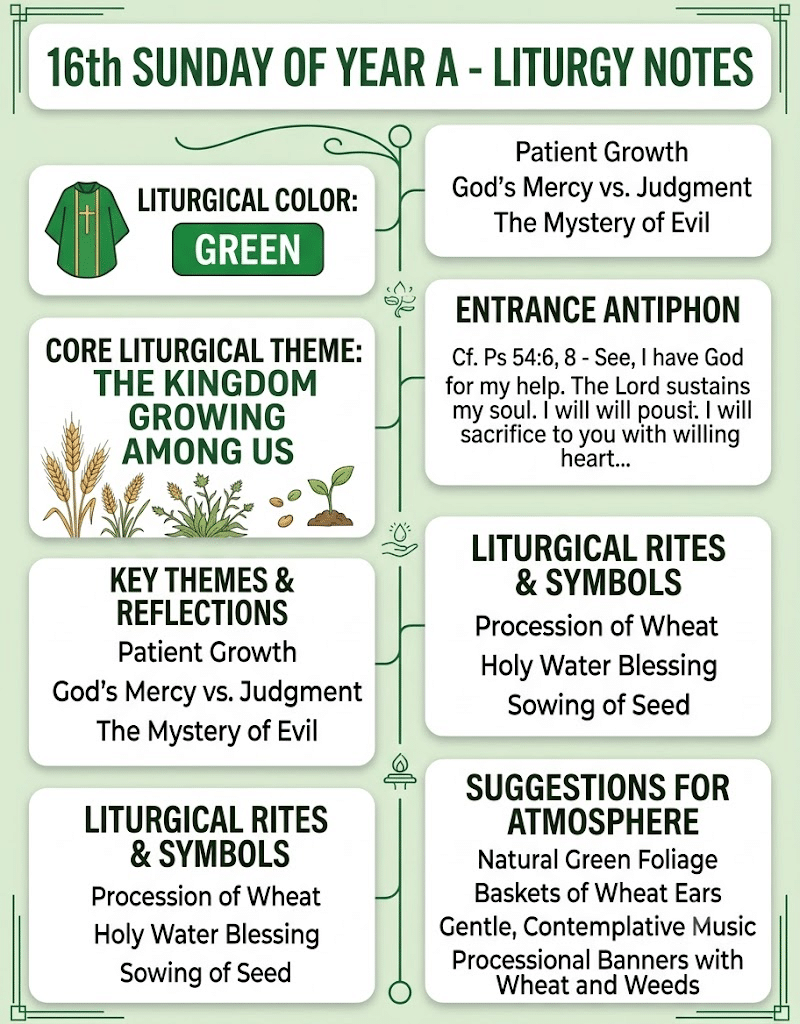
create a Liturgy notes for xxxxxxxxxx Year A 8.5x11 infographic in a one-column format with multiple 'card' sections, using large fonts that give the core liturgical theme include liturgical color, readings, themes and rites, entrance antiphon, suggestions for atmosphere, etc.

create an 8.5x11 infographic for xxxxxxxxxxxxx(A) wtih sweeping large photo realistic images . Do not present in a stacked layout, but rather offer a continues flowing unified whole theme showing connections and relationships takeaways from Fr. lawrence Mick's Liturgy Planning Notes.
16th Sunday of Year A
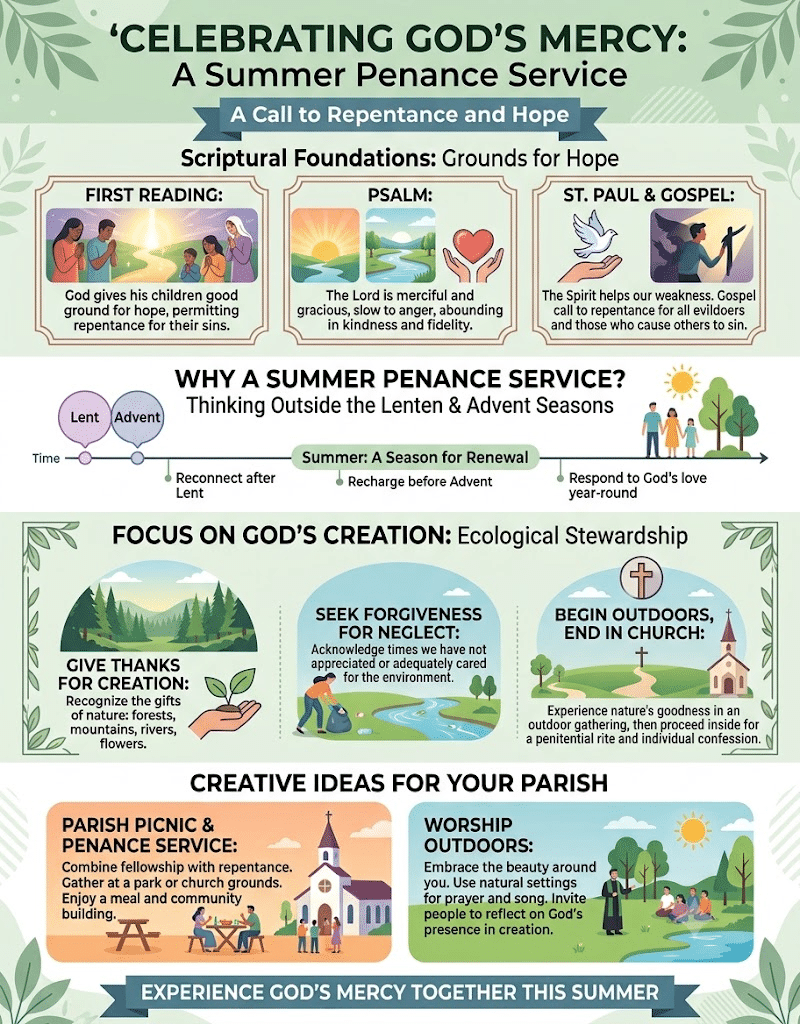
Summer Penance Service
The first reading ends by reminding us that God gave God’s children good ground for hope permitting repentance for their sins. The psalm proclaims God is “merciful and gracious, slow to anger, abounding in kindness and fidelity.” Paul speaks of the Spirit coming to the aid of our weakness, and the Gospel includes a call to repentance for “all who cause others to sin and all evildoers.”
This might be a good time to think about a summer penance service. It’s been months since Lent, and there are months ahead until Advent. Because those two seasons really occur rather close to each other, the bulk of the year can go by with no invitation to repentance and reconciliation. Can you find effective ways to invite people to gather to celebrate God’s mercy together outside of those two seasons?
You might also combine these two themes by focusing a penance service around repentance for our sins against God’s creation. In the midst of summer, many people spend time in nature, hiking, camping, biking or just relaxing outdoors. Could you invite people to gather to give thanks for all the gifts of creation and to seek forgiveness for the times we have not appreciated these gifts adequately or cared for them properly? You could even begin such a service outdoors, giving thanks as the assembly experiences the goodness of nature and then proceed into the church to offer prayers for forgiveness and the opportunity for confession.
It might also be possible to arrange a service that begins with a parish picnic. If that isn’t workable on the parish grounds, the parish could gather at a park and celebrate God’s mercy in the out-of-doors. Sometimes, we need to think outside the box (or outside the church walls) to entice people to gather for creative worship.
Full Series: Cycle A Resources
OCP MUSIC
Create an 8.5x11 inch vertical infographic with a clean, two-column layout. The theme should be Catholic Liturgy, using a palette of soft blues, sage greens, and a cream/parchment background with a subtle gold border. Use high-contrast, large, readable fonts.
1. Header Section:
Main Title: "Feast of the Holy Family" (Large, Bold, Blue)
Subtitle: "OCP Liturgy Podcast (2019)" (Smaller, Dark Blue)
2. Body Layout (6 Horizontal Rows):
Left Column: Contains a large, flat-style vector icon representing the part of the Mass.
Right Column: Contains the text for the specific Chant/Hymn and the book references.
Alternating Backgrounds: Alternate the background color of the rows between light blue and light green/white for readability.
3. Row Details:
Row 1 (Entrance Chant): Icon of a Church or Procession.
Row 2 (Responsorial Psalm): Icon of a Bible.
Row 3 (Gospel Acclamation): Icon of a Dove.
Row 4 (Presentation): Icon of Bread and Wine/Altar.
Row 5 (Communion): Icon of a Chalice/Host.
Row 6 (Sending Forth): Icon of Angels or Church. T

16th Sunday of Year A
Entrance
Table of Plenty (Dan Schutte)
Spirit & Song #233; Never Too Young #75; Breaking Bread #312
Verse 1 is so “in tune” with today’s Gospel parable: “O come and sit at my table where saints and sinners are friends…”
Response & Acclaim
Response & Acclaim


Lord, You Are Good and Forgiving (Tom Booth)
Spirit & Psalm 2026: p. 250
Tom Booth’s verbatim setting of Psalm 86 sings in praise of God’s mercy – the yeast that leavens the Kingdom.
2026 PLAYLIST (152 VIDEOS)

Alleluia: Mass of Renewal (Curtis Stephan)
Spirit & Psalm 2026: p. 252
This acclamation verse once again inspires us to listen to God’s word with the innocence and openness of a child.
2026 PLAYLIST (152 VIDEOS)
Presentation & Preparation
Presentation and Preparation

The House that Love Is Building (Sarah Hart)
Breaking Bread #319
“In the garden Love is tending there’s a great and boundless feast, where the seeds of hope are planted, and the yield is heaven’s peace.” This text from Verse 2 underscores the teaching of today’s readings.
Communion
Communion

You Stand Knocking (Tom Booth)
The prescribed antiphons often offer ideas for related songs that we can sing at the processions of the liturgy. Tom Booth’s “You Stand Knocking” follows up on the invitation of the Communion Antiphon: “You stand knocking at the door, offering all I’m hoping for.” You can find the sheet music at the link above.
Sending Forth
Sending Forth

Our God Is Good (Josh Blakesley and Cooper Ray)
Spirit & Song #227; Never Too Young #103
An energetic song that sends us forth from this Eucharist to proclaim that “His Kingdom lives on and on and on!”
THE COMMONS
Liturgy Blog is a weekly liturgy planning resource for musicians, liturgists, homilists, youth groups, faith sharing groups, and all who look to the liturgical readings for inspiration and nourishment. Join Ken Canedo as he breaks open the Scripture and suggests tracks from the Spirit & Song contemporary repertoire.
Design an 8.5x11-inch infographic offering practical, actionable delivery tips for lectors proclaiming the First Reading from Ezekiel 37:12-14 (NAB). Using the provided text below, organize the information into clear visual sections. Please generate highly specific suggestions regarding vocal pacing, where to pause, words to emphasize, and the overall tone required to convey the gravity of the text. Ensure the layout is clean, legible, and appropriate for a liturgical ministry guide.
you are a lector coach and your task is to instruct lectors. Create an 8.5x11 infographic showing how to best proclaim the following reading. Offer tips on pacing, pronunciation, clarity, etc. . Proclaim the text with authority and purpose, not just reading it, and maintain a prayerful, confident demeanor. Key techniques include using pauses, making eye contact, and dressing appropriately. high light key tips for lectors from following transcript
16th Sunday of Year A

Video courtesy of Lector with Lisa
Act as an expert lector coach and visual designer. Create a highly scannable, single-page 8.5x11 instructional "At-A-Glance Guide" for a church lector based on the following specific instructions.
Do not use citation markings, footnotes, or dense blocks of text. Prioritize quick scannability at the ambo using a clean Markdown table layout, bold headings, and horizontal rules.
Your output must include the following distinct sections:
1. MAIN HEADER: State the Sunday in Ordinary Time and which reading it is (First, Second, etc.).
2. THE WATCHWORD BOX: Highlight the overarching pacing theme, core concept vs. story reminder, and the required vocal emotional profile using a prominent Markdown blockquote.
3. DELIVERY BLUEPRINT TABLE: Create a 3-column Markdown table with these exact headers:
| Text Segment | Vocal Tone | Pacing & Ambo Actions |
Break the reading down line-by-line, matching the specific vocal shifts, mandatory pauses, eye contact cues, and word definitions based on my instructions.
4. THREE AMBO REMINDERS: Conclude with three sharp, numbered, actionable structural takeaways for the lector to keep in mind right before they step up to proclaim.
Here is the context and delivery strategy for the reading:
Delivery Blueprint & Pacing Control
Text Segment | Vocal Tone | Pacing & Ambo Actions |
"A reading from the Book of Wisdom." | Inviting | LONG PAUSE. Let the word "Wisdom" settle completely before continuing. |
"There is no God besides you who have the care of all," | Conversational | MAKE EYE CONTACT. Look directly at the assembly as you proclaim "care of all." |
"that you need show you have not unjustly condemned." | Steady | Full stop at the period. LONG PAUSE. |
"For your might is the source of justice;" | Admiring | Brief pause. Prepare for the balancing Hebrew parallel line. |
"your mastery over all things makes you lenient to all." | Tender | PAUSE. Let the radical idea of mastery creating leniency sit with them. |
"For you show your might when the perfection of your power is disbelieved;" | Stronger | Slightly firmer tone to reflect His historical power (like the Exodus). |
"and in those who know you, you rebuke temerity." | Direct | Temerity = shyness/timidity. God is telling us to step out in faith. |
"But though you are master of might, you judge with clemency," | Shift to Tender | Lower your volume slightly. Lean into the beauty of the word "clemency." |
"and with much lenience you govern us." | Grateful | Let your voice convey genuine gratitude. Pause before the conclusion. |
"For power whenever you will attends you." | Awestruck | Acknowledge God's absolute freedom and strength. |
"And you taught your people by these deeds" | Instructional | Slow down drastically here for the core pivot of the reading. |
"that those who are just... must be kind;" | MAXIMUM SLOW | LONG PAUSE AFTER "JUST." If you rush this phrase, the meaning is lost. |
"and you gave your children good ground for hope" | Hopeful | Bring a warm, reassuring tone to the word "hope." |
"that you would permit repentance for their sins." | Humble Sorrow | A quiet, deeply reflective finish. Think: "Create in me a clean heart." |
Wisdom 12:13, 16-19

Courtesy of Greg Warnusz
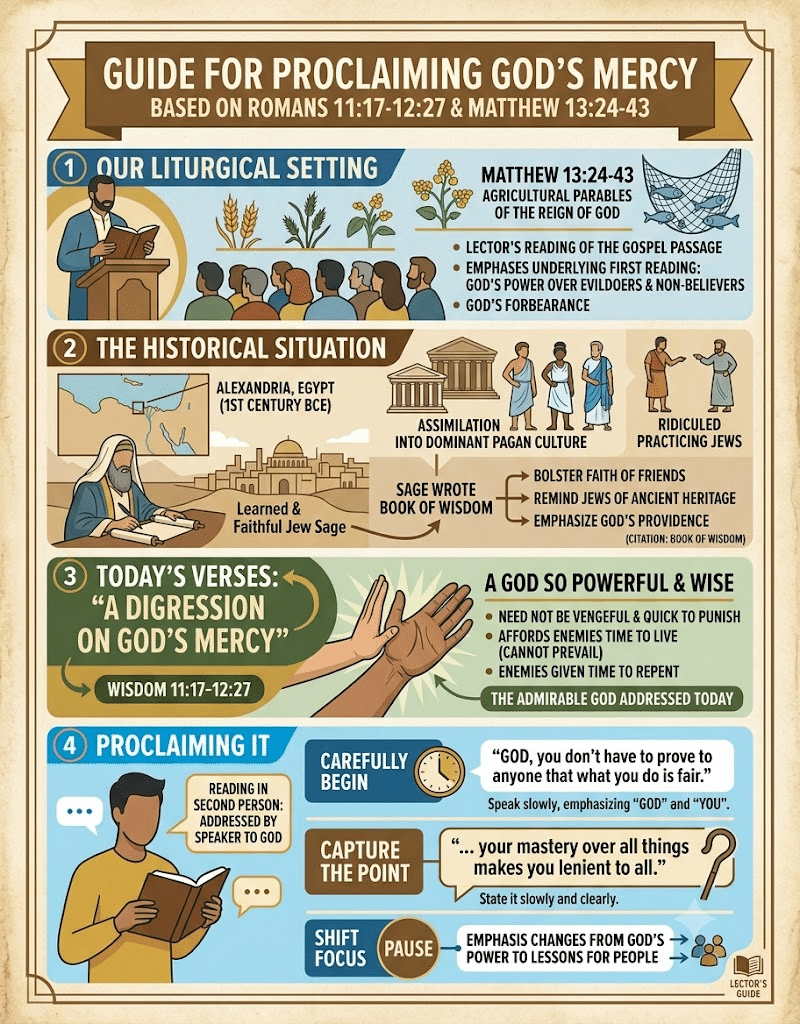
Our Liturgical Setting: As usual, a lector should start with a reading of the day's gospel passage, Matthew 13:24-43. It contains a few more of Jesus' agricultural parables about the reign of God. The emphases on God's power over evildoers and non-believers, and God's forbearance, underlie the choice of first reading.
The Historical Situation: About a century before the birth of Jesus, a learned and faithful Jew assessed the situation for Jews in the great cosmopolitan city Alexandria in Egypt. Many Jews there had "assimilated" into the dominant pagan culture. They and native pagans sometimes ridiculed practicing Jews, so our sage wrote a book of Wisdom, to bolster the faith of his friends. (The Church cites this book often in the Lectionary, so this introduction may be familiar to users of Lector's Notes.) One of the author's overall goals is to remind his fellow Jews of their ancient heritage, and to emphasize God's providence for these people throughout their history.
Today's verses come from a the section of the book, Wisdom, 11:17-12:27, called "A digression on God's mercy." And it really does digress. But one solid point it makes is that this God (and, it is implied, unlike all other gods) is so powerful and wise that he need not be vengeful and quick to punish. This God can afford to let his enemies live, for they can never prevail, and given time, might repent. That's the admirable God addressed in our passage today.
Proclaiming It: This reading is in the second person, addressed by the speaker to God. That's unusual among our readings. It will catch the congregation unawares, unless you begin your proclamation carefully. Speak the first sentence slowly, emphasizing the words "god" and "you" in the first line. The final clause of the first sentence means "God, you don't have to prove to anyone that what you do is fair."
Our second sentence ("... your mastery over all things makes you lenient to all.") captures most clearly the point of the whole passage (and the whole digression), so state it slowly and clearly. Pause before the final sentence, where the emphasis changes from the power of God to the lessons people should draw from dealing with such a God.
16th Sunday of Year A

Video courtesy of Lector with Lisa
Delivery Blueprint & Pacing Control
Text Segment | Vocal Tone | Pacing & Ambo Actions |
"A reading from the Letter of Saint Paul to the Romans." | Welcoming | LONG PAUSE. Let them settle into their seats and mentally prepare for Paul's teaching. |
"Brothers and sisters:" | Warm & Intimate | MAKE INTENTIONAL EYE CONTACT. Look directly at the people as you greet them. Do not look down at the text until you finish the phrase. |
"The Spirit comes to the aid of our weakness;" | Empathetic | DELIBERATE PAUSE. Let the word "weakness" land. Acknowledge the shared human reality of feeling spiritually tired. |
"for we do not know how to pray as we ought," | Vulnerable | LONG PAUSE. This is the critical moment for the congregation to internally agree with you: "Yes, I don't know how to do this right." |
"but the Spirit himself intercedes with inexpressible groanings." | Shift to Amazement | Let your voice fill with awe and relief. Speak "inexpressible groanings" with deep reverence for the mystery of silent prayer. |
"And the one who searches hearts" | Tender | Conversational speed. You are describing a God who knows us intimately. |
"knows what is the intention of the Spirit," | Assured | Steady pacing. Building the foundation of trust. |
"because he intercedes..." | Trusting | PAUSE. Create a distinct structural breath here. |
"...for the holy ones..." | Reassuring | PAUSE. Remind the listeners that they are the holy ones being prayed for. |
"...according to God’s will." | Grateful & Grounded | Bring the reading to a confident, peaceful finish. If we trust the Spirit, we are already resting in God's care. |
Romans 8:26-27

Courtesy of Greg Warnusz
The Theological Background: Like previous selections from Romans, chapter 8, this is about how helpless we are on our own, but how the Spirit of God nevertheless empowers us. Today the subject is prayer, which we can't muster by ourselves, but which the Spirit supplies in our hearts.
Proclaiming It: To prepare to read this, let yourself experience the lesson taught here. That is, ask the Spirit to fill your heart with gratitude.
In your actual proclamation, try to answer the question, "What's one important thing for which we need the help of God's Spirit?" The answer is "How to pray as we ought." Let your listeners hear the accent on "pray." And in the last sentence, show how the Spirit fulfills this need by emphasizing the synonym for "pray," "intercedes."
Extra! Each Sunday passage from Romans in context: Click here to see a table summarizing the readings from Romans from the 9th to the 24th Sundays of Ordinary Time, this year.

The 4th of July and the Catholic Mass
Catholic History Show (7:28)

Catholic Lectionary Readings
ORDINARY TIME
Date
Sunday
First
Reading
Responsorial
Second Reading
Alleluia / Gospel
Lect # Sunday or Feast
Gospel Passage Prescribed
vv. of Matthew OMITTED