Liturgy, Liturgy Notes, Liturgy Planner, Sunday Prep, Planning for Mass
Liturgy Notes, Liturgy Planner, Sunday Prep, Planning for Mass
July 5, 2026
⭐⭐⭐ Come to Me All who are Burdened

⬅️  ➡️
➡️





The Church
Governments and Salvation of the World
Those Burdened by Adversity
Local Parish / Faith Community
SUNDAY PLANNING

RESOURCES
General Instruction of the Roman Missal
A Simple Guide to Liturgical Enviornment (DIocese of New Ulm PDF)
Common Questions on Liturgical Norms – by Father Edward McNamara, professor of liturgy at the Regina Apostolorum Pontifical Athenaeum

Video courtesy of Catholic Women Preach
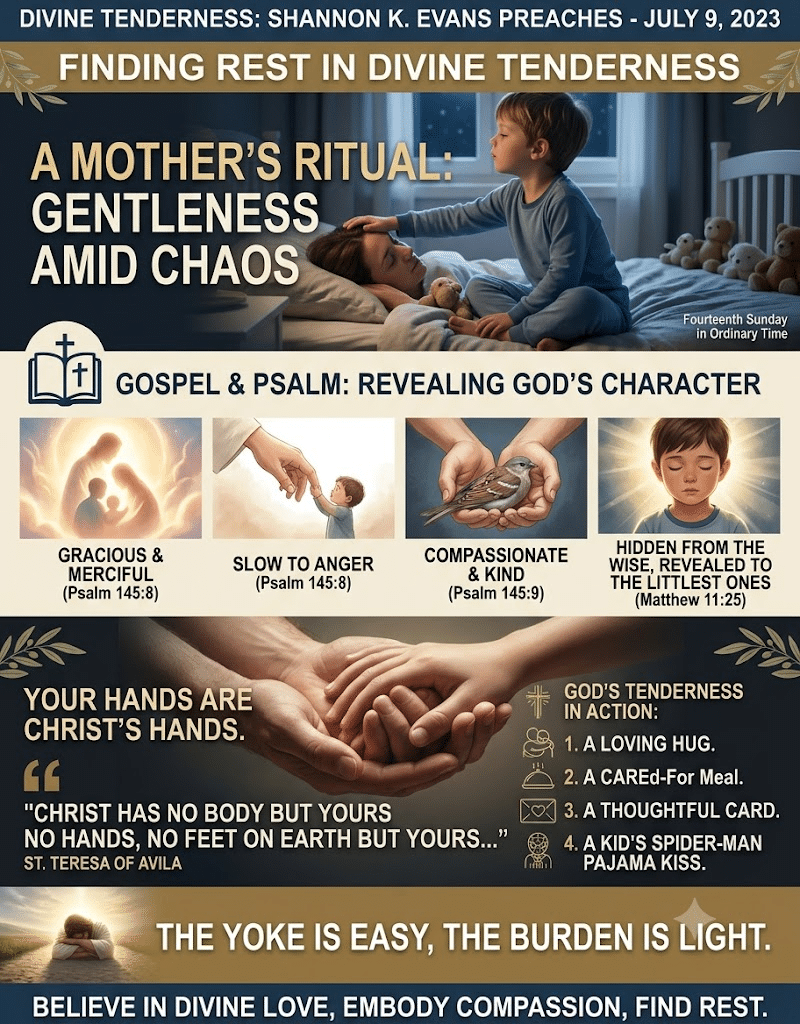
THE WORD THIS WEEK infographics are created using using GOOGLE’S AI Gemini 2.5 Pro. You are free to use the above infographic in any non-profit ministry. Please give credit to TheWordThisWeek.net and Catholic Women Preach video series.
God is a tender, benevolent, and compassionate being who offers mercy, humility, and rest for the soul, and that we, as His body, are called to transmit this compassion and tenderness to others through our everyday gestures.
- 00:00 A mother humorously describes her energetic and talkative five-year-old son, worrying he might become a televangelist one day due to his charismatic and non-stop nature.
- 00:58 A mother's exhausting day is instantly forgotten when her child shows affection before falling asleep, stroking her hair and kissing her cheek.
- 01:34 God is described as gracious, merciful, slow to anger, kind, good, and compassionate.
- 01:49 The Divine Creator is a tender and benevolent God who loves extravagantly, often revealing mysteries of faith to the humble and littlest ones rather than the wise.
- 02:28 God's mercy and tenderness offer rest for the soul, especially when life's burdens feel heaviest, whispering a gentle promise of meekness and humility.
- 03:08 The God described in today's readings is gracious, merciful, and compassionate, contradicting a harsh and judgmental image, and offering a lighter spiritual burden.
- 03:51 We are not just called to act as Christ's hands and feet, but to truly see and believe that we are his body, allowing his compassion and tenderness to transform us and be transmitted through the everyday gestures of others.
Experiencing God's Character Through Others
Q: How can we truly believe God's character beyond intellectual knowledge? A: The shift from knowing God is gracious, merciful, slow to anger, kind, and compassionate in our heads to believing it deeply enough to change us happens when we recognize God's tenderness working through others' actions toward us—their hugs, cooking, cards, coffee, and kisses become God's hands and feet serving us.
Q: What is the deeper meaning of Teresa of Avila's "Christ has no body but yours" quote? A: Teresa's statement "Christ has no body but yours, no hands, no feet on earth but yours" functions as instructions for how to see, not just how to be—meaning we must recognize that when others touch and serve us, it is God's tenderness doing so, helping us believe and offering the promised rest.
Finding Rest in Caregiving
Q: How does a mother experience God's promises during exhausting caregiving? A: After a long day of caregiving when the yoke feels difficult and burden heavy, a mother's soul is restored by her son's bedtime ritual of stroking her hair and kissing her cheek—these acts of kindness and gentleness embody God's promises that the burden is light and offer the rest promised in Scripture.
God's True Nature
Q: What does today's Psalm reveal about God's character versus common misconceptions? A: The readings combine to show God as gracious, merciful, slow to anger, abounding in kindness, and having compassion—rather than being harsh, judgmental, demanding perfection, or remaining aloof as often misperceived.
Reciprocal Divine Presence
Q: What is the reciprocal truth about being God's hands and feet? A: If we are the hands and feet of God to others, then the reciprocal truth is that when others touch and serve us, it is God's tenderness working through them—this bidirectional understanding transforms how we receive care and kindness.
Darkness as Sacred Space
Q: Where does God whisper promises to the weary caregiver? A: God whispers promises of rest and light burdens to the exhausted mother in the darkness around the twin-size bed during her son's bedtime ritual—the compassion and tenderness of her son's love becomes the vehicle for divine comfort.

Video courtesy of Ascension Press
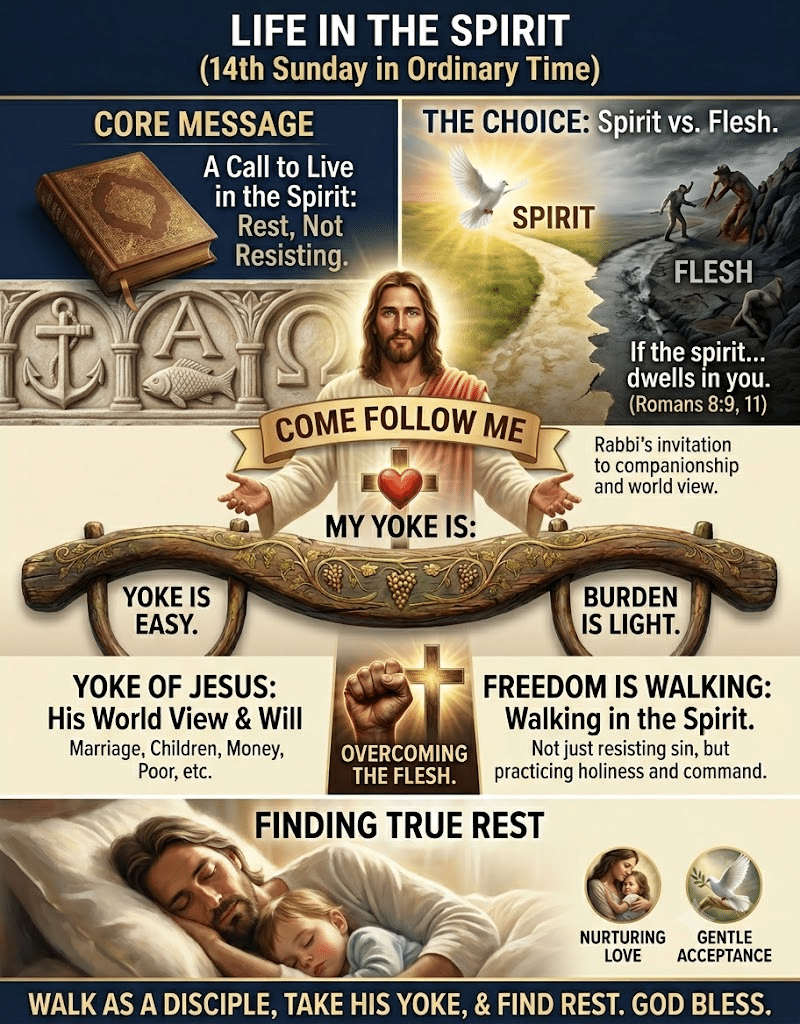
THE WORD THIS WEEK infographics are created using using GOOGLE’S AI Gemini 2.5 Pro. You are free to use the above infographic in any non-profit ministry. Please give credit to TheWordThisWeek.net and Sundays with Ascension video series "Encountering the Word."
Living life in the Spirit, as a Christian, means actively following Jesus and walking according to His will, rather than just identifying as a Christian or going through religious motions.
- 00:00 Living life in the Spirit means more than just being a Christian, attending church, and receiving the Eucharist.
- 00:38 As Christians, being consciously aware of whether we're living in the Spirit or the flesh on a daily basis is crucial, and St. Paul's words emphasize that those who have the Spirit of God dwelling in them are not bound by fleshly living.
- 01:17 Jesus gives a wonderful way to live in the spirit through the Gospel reading, which is to follow Him as He called His disciples in John chapter 6.
- 01:39 Jesus invites people to live in the Spirit by following Him, revealing divine truths to those who are humble, rather than the wise and understanding.
- 02:27 Jesus invites those who are weary and heavy laden to come to Him, take His yoke, and learn from Him, promising rest for their souls.
- 03:02 Living in the Spirit means walking under the yoke of Jesus, adopting His worldview and plan, and living according to His will.
- 03:53 Walking in Jesus' teachings, such as his views on marriage, children, money, and the poor, means walking in the Spirit.
- 04:18 To overcome the flesh and walk in holiness, one must not just resist sin, but actively walk in the Spirit by taking God's yoke and following His will.
Understanding Life in the Spirit
Q: What determines if you belong to Christ according to Romans 8:9-11? A: If the Spirit of God dwells in you, you belong to Christ, and that same Spirit will give life to your mortal body, making spiritual indwelling the defining marker of Christian identity.
Q: What does taking Jesus' yoke mean in Matthew 11:28-30? A: Taking Jesus' yoke means adopting his worldview, will, and way of life as a companion who follows him constantly to learn how to live in the Kingdom and Spirit, not just attending church services.
Practical Application of Spirit-Led Living
Q: How do you assess if you're walking under Jesus' yoke? A: Examine whether you've adopted Jesus' specific views on marriage, children, money, heaven, hell, judging others, and caring for the poor and widow across all life aspects.
Q: What's the correct approach to overcoming the flesh? A: Overcoming the flesh comes from walking in the Spirit, not merely resisting evil, because true freedom emerges from doing what Jesus commands rather than relying on willpower alone.
Beyond Religious Routine
Q: What does living in the Spirit require beyond religious practices? A: Living in the Spirit demands adopting Jesus' worldview and plan for all life aspects, transcending the routine of church attendance and Eucharist reception.
Q: What is Jesus' invitation in Matthew 11:28-30 calling us to become? A: Jesus invites us to become his companion through constant following and learning, making discipleship a comprehensive lifestyle transformation rather than periodic religious observance.

Video courtesy of the Diocese of Colorado Springs
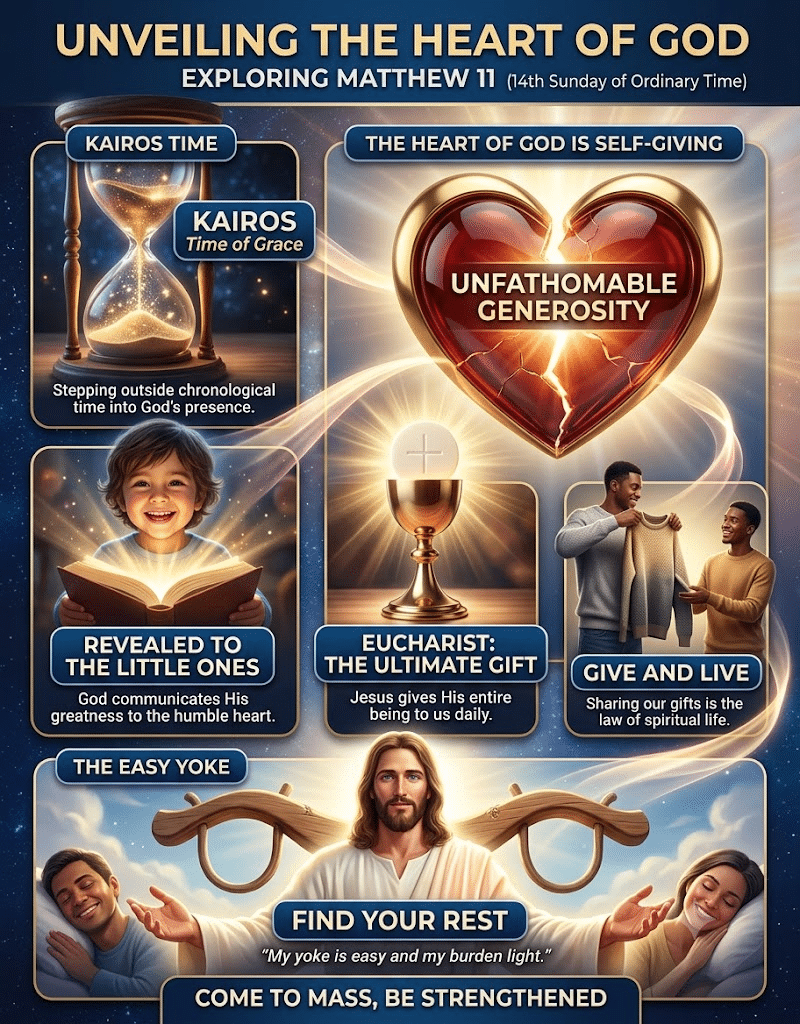
THE WORD THIS WEEK infographics are created using using GOOGLE’S AI Gemini 2.5 Pro. You are free to use the above infographic in any non-profit ministry. Please give credit to TheWordThisWeek.net and Diocese of Colorado Springs video series.
Through Jesus' relationship with God, we understand that God is a self-revealing and self-giving entity who sets an example for humans to follow, inviting us to a life of generosity, humility, and intimacy with Him.
- 00:00 Jesus' intimate conversation with God reveals the nature of their relationship and helps us understand our identity as children of God.
- 00:47 God is a revelatory God who constantly communicates with us, revealing Himself, and it's often we who hide from God, not the other way around.
- 01:18 Jesus, to whom the Father has given everything, emptied himself of his divine equality to give it all to us.
- 01:49 God is a self-giving, generous entity who sets an example for humans to follow by giving without expecting anything in return, and this is reflected in the Eucharist and our daily lives.
- 02:19 A young man's selfless act of giving away his sweater to a stranger inspires a desire to freely share God's gifts with others.
- 02:38 Jesus invites us to find rest and peace by coming to Him, taking His yoke, and learning from His meek and humble heart.
Divine Revelation and Generosity
Q: How does Jesus demonstrate God's self-giving nature through his earthly ministry? A: Jesus, having received all things (the entire universe) from the Father, spent his 33 years on Earth attempting to give it all away to humanity, emptying himself of divine status to embody self-giving generosity as the core attribute of God's character.
Q: What is the fundamental spiritual law governing life and death according to the teaching? A: The spiritual law operates on the principle that you give and you live, you hoard and you die, requiring believers to share their spiritual gifts as generous people created in God's image and likeness, mirroring how God gives.
Encountering God's Rest
Q: What does Jesus' invitation to take his yoke promise to those who accept it? A: Jesus' call to come to him, take his yoke, and learn from him who is meek and humble of heart offers rest for our souls, representing the Sabbath rest God created for humanity to be with Him as children in His family.
Q: What does the Greek word "Kairos" signify in Matthew 11's context? A: Kairos means a special grace time with God outside normal daily life, used when Matthew records "At that time, Jesus exclaimed," indicating a transformative encounter with God rather than ordinary chronological time.
Sacramental Presence
Q: How does Jesus continue his self-giving nature in present-day worship? A: Jesus continues giving his body and blood in the Eucharist every day, making the Mass central for believers to know God's attitude and heart, providing feeding and strengthening with whatever is needed.
Q: Why does God reveal himself to "little ones" rather than the "wise and learned"? A: God as a self-communicating, revelatory being intentionally hides from the wise and learned while revealing to the little ones as an act of gracious will, ensuring divine truth reaches those with humble, receptive hearts.

Video courtesy of Dominican Friars (Chicago)
THE WORD THIS WEEK infographics are created using using GOOGLE’S AI Gemini 2.5 Pro. You are free to use the above infographic in any non-profit ministry. Please give credit to TheWordThisWeek.net and Dominican Friars, Province of St. Albert the Great.
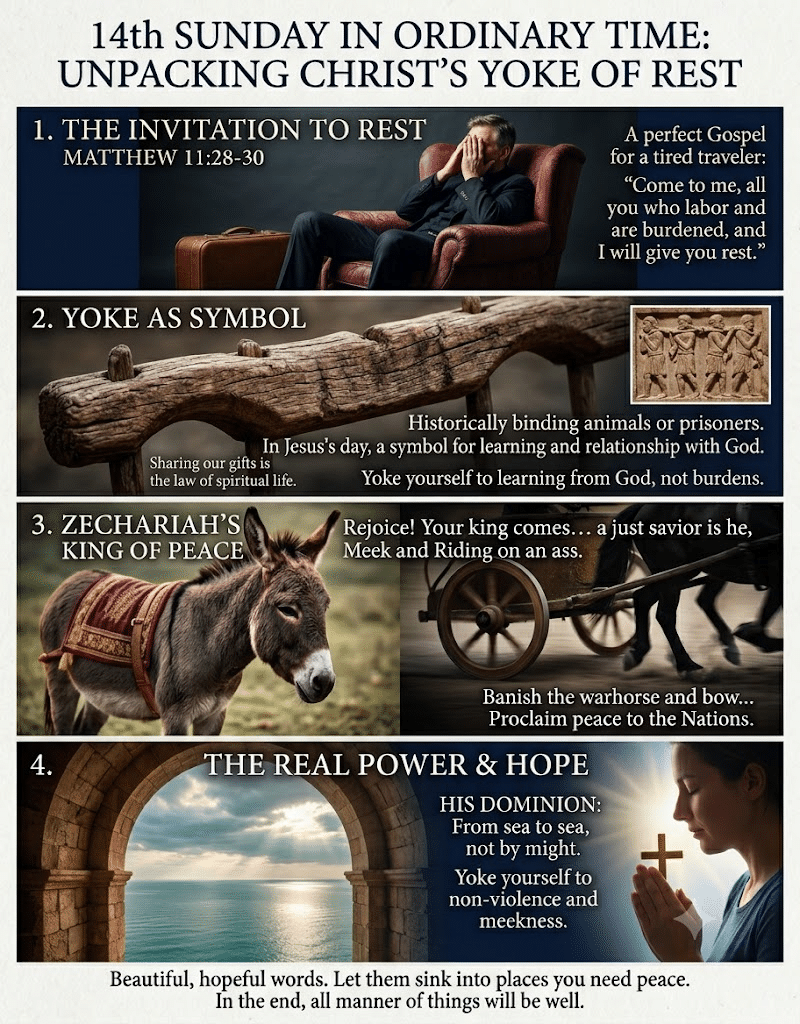
Jesus offers rest and salvation through a spiritual connection with God, characterized by meek and humble leadership, non-violence, and submission to His gentle nature.
- 00:00 Jesus invites those who are weary and burdened to come to him, promising rest and saying his yoke is easy and his burden is light.
- 00:58 Jesus uses the metaphor of a yoke to mean learning from God and bearing a similar burden, not physical labor, but rather a spiritual connection with God.
- 01:49 Jesus invites us to take his yoke and learn from him, which is not burdensome, and is tied to the cross he carries to his crucifixion.
- 02:52 The prophet Zechariah proclaims that a just savior, the king, will come to Jerusalem on a donkey, bringing joy and salvation.
- 03:19 Zechariah prophesies that a ruler on a donkey's foal will bring peace to nations, banish war instruments, and establish a dominion from sea to sea.
- 05:13 God's kingdom will be established through peaceful means, not military might, bringing an end to fear and domination.
- 06:03 God offers rest through meek and humble leadership, which brings true power through non-violence and submission to His gentle nature.
- 06:53 God's peace and hope can lead to rising above even death and difficulties, ultimately bringing about a better outcome where all will be well.
The Nature of Jesus' Invitation
Q: How does Jesus' yoke differ from the Pharisees' burden?
A: Jesus offers an easy yoke and light burden characterized by meekness and humility of heart, contrasting with the Pharisees who laid heavy burdens on people without providing rest for their souls.
Prophetic Foundation of Meekness
Q: What does Zechariah's prophecy reveal about the Messiah's method of rule?
A: Zechariah prophesies a just savior riding meekly on a donkey's foal (not a war horse) who will banish instruments of war and proclaim peace to the nations, ruling from sea to sea through peace rather than might.
The Paradox of Peace Through Weakness
Q: What is the consequence of yoking oneself to Jesus' non-violence?
A: Yoking oneself to Jesus' meekness, non-violence, and non-forceful leadership brings true rest for the soul even if it leads to death like Jesus', because this peace enables rising from real or pseudo deaths.
Wisdom Literature Connection
Q: How does Jesus' invitation connect to Jewish wisdom tradition?
A: Jesus' call to "take his yoke and learn from him" echoes the wisdom literature tradition of yoking oneself to God and learning what he teaches, establishing continuity with ancient Jewish spiritual practice.
Dual Symbolism of the Yoke
Q: What dual meaning does the yoke symbol carry in Jesus' teaching?
A: The yoke symbolizes both animals bound together to pull a plow or wheel and prisoners tied together, conveying the concept of being yoked to God as his people while learning from him.
Eschatological Hope
Q: What ultimate promise do the 14th Sunday readings offer?
A: The readings provide hopeful words that God will eventually bring peace and well-being, affirming that "all manner of things will be well in the end" even if it takes time, because God is God.
THE WORD THIS WEEK infographics are created using using GOOGLE’S AI Gemini 2.5 Pro. You are free to use the above infographic in any non-profit ministry. Please give credit to TheWordThisWeek.net and Dominican Friars, Province of St. Albert the Great.

Video courtesy of The Jesuit Post

THE WORD THIS WEEK infographics are created using using GOOGLE’S AI Gemini 2.5 Pro. You are free to use the above infographic in any non-profit ministry. Please give credit to TheWordThisWeek.net and THE JESUIT POST.
As adults, we need to find the courage to turn to Jesus for comfort and rest, recognizing that we cannot navigate life alone.
- Sometimes, I wish I were four again, and NOT forty. I’m Fr. Eric Immel, SJ, and this is my one-minute homily. In today’s Gospel, Jesus reminds us that children know a lot of things. Those of us a bit more advanced in our ages forget. Perhaps more than anything else, what kids know better than adults is how to ask for help. How to turn over their needs, wants, and burdens to someone else.
- When I was a little kid, I couldn’t do much on my own, and so I had to ask for what I needed: a snack or drink of water, a band-aid when I scraped my knee, a word of comfort after a bad dream, a hug when I was sad.
- As we grow up we take so much pride in caring for ourselves that we sometimes forget, no matter how old we are, we can’t do this alone. We need each other to survive.
- And when we remember this, perhaps we might find courage to go to Jesus, who promises to understand our burdens and give us comfort and rest.
Childlike Wisdom in Spiritual Life
Q: What spiritual practice do children naturally excel at that adults struggle with? A: Children instinctively know how to ask for help and turn over their needs, wants, and burdens to others, while adults often take pride in self-sufficiency despite still needing others to survive.
Approaching Jesus with Our Burdens
Q: What does Jesus promise when we bring our burdens to him? A: Jesus promises to understand our burdens and give us comfort and rest, requiring us to find the courage to go to him with the recognition that no matter how old we are, we cannot do everything alone.
Spiritual Practice
Q: How can I apply children's wisdom to my spiritual life? A: Turn over your needs, wants, and burdens to Jesus instead of relying solely on self-sufficiency, recognizing that we can't do everything alone and need others to survive.
Daily Action
Q: What specific step should I take when feeling overwhelmed? A: Ask for help like children naturally do, and go to Jesus who promises to understand your burdens and give you comfort and rest.

Video courtesy of Priests for Life

THE WORD THIS WEEK infographics are created using using GOOGLE’S AI Gemini 2.5 Pro. You are free to use the above infographic in any non-profit ministry. Please give credit to TheWordThisWeek.net and PRIESTS FOR LIFE.
Welcoming and valuing human life, as exemplified by Christ's acceptance of life, is essential and that rejecting another's life, such as through abortion, is contradictory to this acceptance.
- 00:00 The readings for the 13th Sunday of Year A emphasize the value of welcoming life, highlighting God's gift of life through the examples of Elisha, the woman of Shunam, and new life in Christ.
- 00:40 Christ's welcome to life must be extended to every human being, rejecting another's life would be a contradiction to accepting His welcome.
- 01:13 Embracing the Cross and self-giving, rather than self-assertion, is the path to finding oneself, and this is particularly relevant to the pro-life stance on abortion.
Welcoming Life as Response to Christ
Q: How does welcoming God's representatives connect to protecting unborn life? A: The readings link welcoming Elisha (resulting in the gift of a child to the Shunammite woman) and welcoming Christ (resulting in new life) to demonstrate that accepting Christ's welcome into the Father's life creates an obligation to extend welcome to every human being, making it contradictory to accept Christ while rejecting any human life including the unborn.
Self-Giving vs. Self-Assertion
Q: What does embracing the cross teach about the pro-choice position? A: Matthew 10:37-42 teaches that embracing the cross and self-giving directly opposes the self-centered "my rights, my life" assertion of pro-choice ideology, revealing that fulfillment comes through self-giving rather than self-assertion, even when that self-assertion costs an unborn child's life.
Parental Love as Christ's Love
Q: How do parents experience Christ's love through their children? A: Parents who give themselves to both born and unborn children directly experience the very love of Christ and discover their true fulfillment through self-giving rather than through asserting personal autonomy.
Living as Life-Givers
Q: How can I actively spread life rather than death in my daily choices? A: Recognize that the Spirit of the one who raised Jesus from the dead dwells in you, making you a life-giver with no neutral option – every action either spreads life or death in your culture, institutions, laws and policies, so consciously choose life-giving actions because you were made to be a life-giver and it is an easier yoke than spreading death.
Q: What does the Spirit reveal about my identity and purpose? A: The Son reveals the Father through the Spirit, teaching you the revelation of yourself as people of life, people of self-giving, people who can love like the Father loves, establishing His dominion of life over death not only in your body but throughout society.

Video courtesy of Society of Our Lady of the Most Holy Trinity
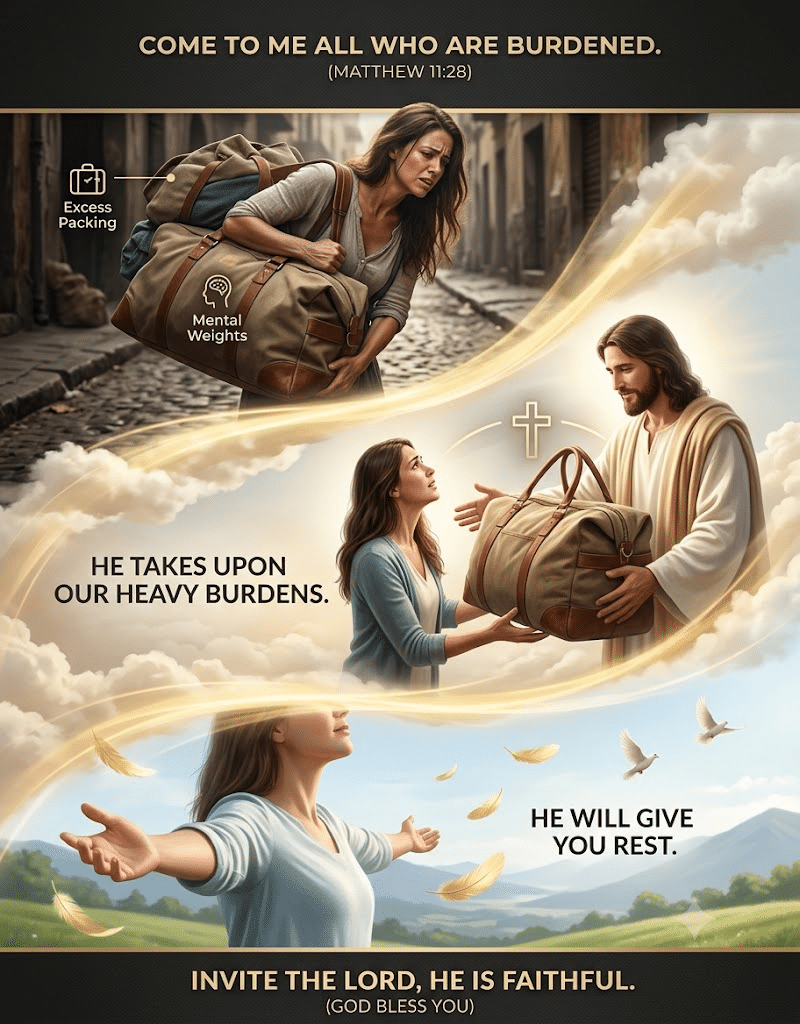
THE WORD THIS WEEK infographics are created using using GOOGLE’S AI Gemini 2.5 Pro. You are free to use the above infographic in any non-profit ministry. Please give credit to TheWordThisWeek.net and Society of Our Lady video series "Liturgy Prep."
Jesus offers relief to those who are weary and burdened by inviting them to come to him and take on their heavy burdens.
- 00:00 Jesus invites those who are weary and burdened to come to him and find rest, using the metaphor of carrying a heavy burden to illustrate the relief he offers.
- 01:08 The Lord takes upon our heavy burdens when we invite Him into those areas, and He will show up faithfully to ease our burdens.
Spiritual Relief Through Invitation
Q: How does inviting Jesus into burdened areas of life provide relief? A: Just as a gentleman carried a heavy bag for a mile during a one-week pilgrimage to Mexico City, Jesus takes upon our heavy burdens when we invite Him into the burdened areas of our lives, ultimately bearing them for us on the cross—He is faithful to His promise and will show up to provide rest and relief when we exercise faith and extend the invitation.
Surrendering Burdens to Christ
Q: What specific action should I take this week regarding my burdens? A: Identify the specific areas where you feel weighed down in your life, then actively invite the Lord into those struggles and surrender that heaviness to him, trusting in his faithfulness to his promise to take your burdens upon himself as he did on the cross.
Summary for: https://youtu.be/f-JiN_rh0ms by Noiz — Download YouTube Subtitles
Video courtesy of Eternal Word Television Network
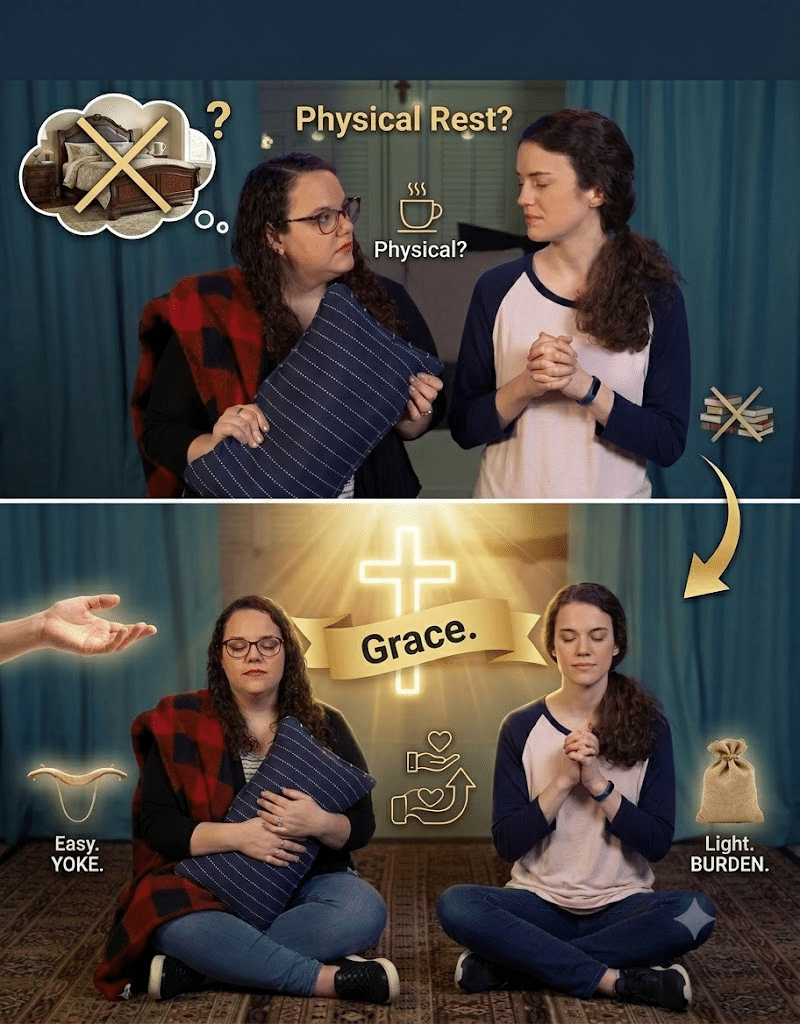
THE WORD THIS WEEK infographics are created using using GOOGLE’S AI Gemini 2.5 Pro. You are free to use the above infographic in any non-profit ministry. Please give credit to TheWordThisWeek.net and EWTN video series "The Word on the Word."
Jesus invites those who are overwhelmed to come to him and find rest, not physical rest, but spiritual rest and strength to endure life's hardships through His grace.
- 00:00 Resting in the Lord, not physical rest, is the focus of discussion on the Fourteenth Sunday in Ordinary Time, Year A, as Jesus faces rejection from the Pharisees.
- 00:24 Jesus invites those who feel overwhelmed to come to him and find rest, just like a child runs to their parents for comfort.
- 00:52 Being a follower of Christ doesn't mean hardships disappear, but that He gives us strength to endure and transforms our burdens with His grace.
Rest and Transformation in Christ
Q: What does Jesus promise to those who come to him with their burdens? A: Jesus invites the burdened to come for rest (Matthew 11:28), offering a comforting response similar to a child running to a parent when scared, though he won't remove all hardships but will provide strength to endure them.
Q: How does Jesus transform suffering rather than eliminate it? A: The cross you bear may not go away but will be transformed by his grace, meaning followers receive endurance capacity rather than burden removal, acknowledging that being a follower of Christ in today's world has never been easy.
Q: What is the practical invitation Jesus extends regarding personal struggles? A: Jesus invites believers to let him enter whatever burdens they carry, positioning himself as an active participant in their difficulties rather than a distant problem-solver who simply removes obstacles.
Responding to Life's Burdens
Q: How should I respond when facing difficult or scary situations? A: Come to Jesus with your burdens the same way a child runs to a parent when something scary happens, bringing your heavy loads directly to him for rest and strength.
Transforming Suffering Through Faith
Q: What should I expect when I bring my struggles to Jesus? A: Understand that the cross you bear may not go away, but it will be transformed by his grace, changing not necessarily the circumstance but your capacity to endure it.
Enduring as a Modern Christian
Q: How can I handle the challenges of being a Christian today? A: Trust that Jesus will give you the strength to endure and walk through anything you might encounter, even when being a follower of Christ in today's world isn't always easy.
Liturgy Notes




14th Sunday of Year A
Spirit and the Body
Our second reading today from Paul’s Letter to the Romans raises a significant issue for consideration. At the beginning of this passage Paul insists,
“You are not in the flesh; on the contrary, you are in the spirit, if only the Spirit of God dwells in you.”
Preachers would do well this weekend to explain what Paul really means, lest we continue to reinforce a negative view of the human body that is at odds with the Incarnation itself. God took on a human body, so the body is clearly not evil. Even Paul’s words in the passage indicate that: “The one who raised Christ from the dead will give life to your mortal bodies also, through his Spirit that dwells in you.” Our bodies are temples of the Lord.
Planners might give some thought this week to how well the parish liturgies involve our bodies. Do people know how to process with dignity and joy? Does the assembly stay standing until all have received Communion, expressing unity through their bodies? Do people genuflect and kneel with reverence when such postures are appropriate? Does the assembly bow at the proper time during the creed? Is any catechesis needed on the importance of worshiping with our bodies?
Full Series: Cycle A Resources

OCP MUSIC

14th Sunday of Year A
Entrance
Come, All You Thirsty (Kathleen Basi)
Breaking Bead #303
Kathleen Basi’s thoughtful song has an appealing melody that beckons us to come to the Lord who quenches our thirst and lifts us up from our weariness and fear.
Response & Acclaim
Response & Acclaim


I Will Praise Your Name for Ever, My King and My God (Ben Walther)
Spirit & Psalm 2026: p. 240
Ben Walther’s gentle verbatim setting of Psalm 145 is an apt response to the peace promised by the prophet Zephaniah in the First Reading.
2026 PLAYLIST (152 VIDEOS)


Alleluia: Mass of Renewal (Curtis Stephan)
Spirit & Psalm 2026: p. 242
The acclamation verse is a direct quote from the Gospel that we are about to hear and readies our hearts to be open to the teaching of Jesus.
2026 PLAYLIST (152 VIDEOS)
Presentation & Preparation
Presentation and Preparation

Christ the King Catholic Church: Special Guest ValLimar Jansen
I Will Rest in You (Frank and ValLimar Jansen)
Breaking Bread #452
Frank and ValLimar’s catchy and gently syncopated refrain invites us to respond to Jesus’ call to rest in him.
THE COMMONS / LITURGY BLOG

Communion
Communion

The Feast Meant for Everyone (Tom Booth and Sarah Hart)
Breaking Bread #366
A Communion song of love and inclusion, “The Feast Meant for Everyone” reminds us that all are called to the table of the Lord.
Sending Forth
Sending Forth

Forever (Chris Tomlin)
Never Too Young #90
Nourished by Jesus in this Eucharist, we are sent forth to joyfully sing in praise and thanksgiving. “Forever God is with us, forever!”
THE COMMONS / OCP.ORG
Liturgy Blog is a weekly liturgy planning resource for musicians, liturgists, homilists, youth groups, faith sharing groups, and all who look to the liturgical readings for inspiration and nourishment. Join Ken Canedo as he breaks open the Scripture and suggests tracks from the Spirit & Song contemporary repertoire.
14th Sunday of Year A

Video courtesy of Lector with Lisa
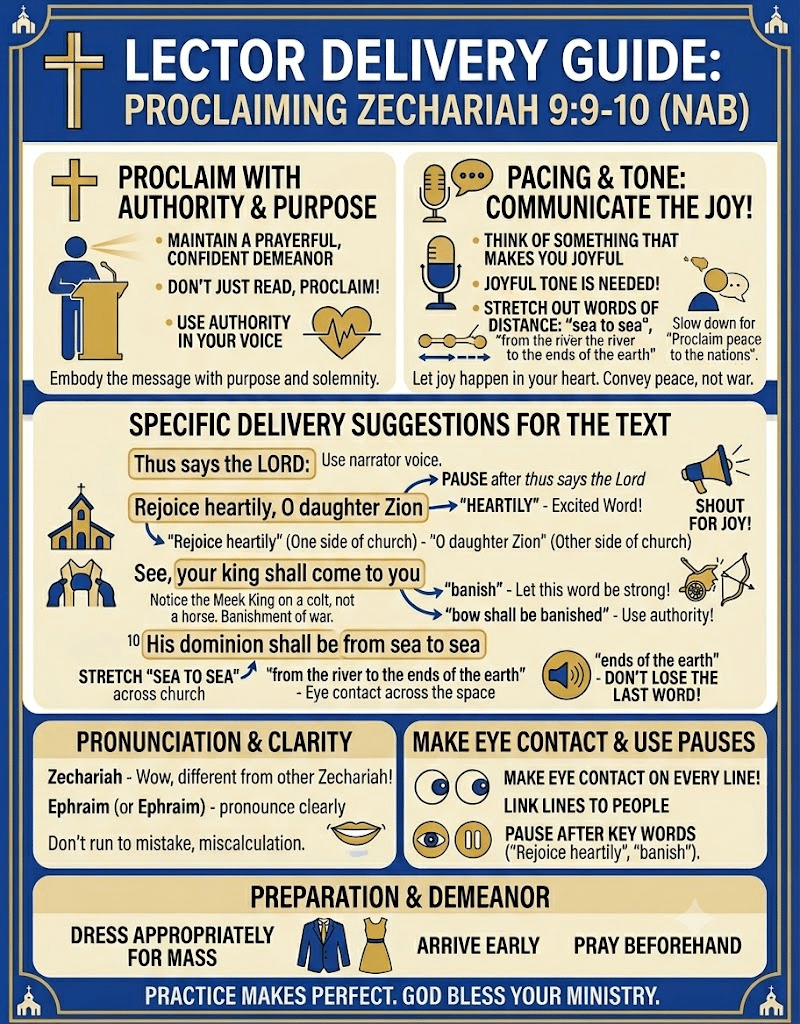
Zechariah 9:9-10

Courtesy of Greg Warnusz
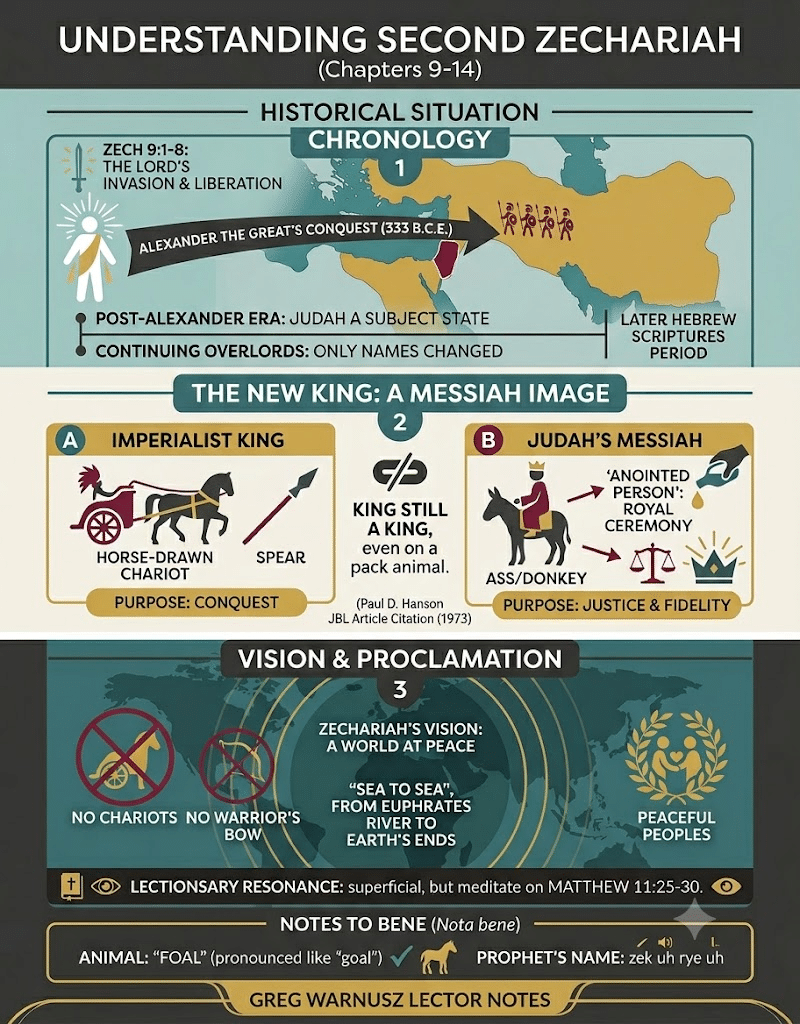
The Historical Situation: The book known as Zechariah comes from two different sources. Scholars call chapters 9-14 Second Zechariah. It's later than most of what we read from the Hebrew Scriptures, from the period after Alexander the Great conquered Judah in 333 B.C.E. By this time, Judah had been a subject state for a very long time. From generation to generation, only the names of its overlords had changed. The prophet begins (Zechariah 9:1-8) by announcing that the Lord will invade the lands of Judah's foes (some near and some far) and liberate Judah. Then, in the sentences we proclaim, he describes Judah's new king.
To understand this image of the Messiah, remember two things. Christianity did not yet exist and had not appropriated the title "Messiah." The word means "anointed person" and applied to Judah's kings because anointing (not coronation) was the kernel of the royal enthronement ceremony. Secondly, a king is still a king, even if he rides on an ass. Ancient Middle Eastern potentates who paraded in horse-drawn chariots were stating that the raison d'être of their kingships and their tribes was conquest. Judah had a different royal imagery. The purposes of its kings (and of the tribe itself) was not imperialism but justice and fidelity to a higher, invisible king. Thus Judah's Messiah, when receiving the accolades of his people, rides a low-slung pack animal. (In our time, contrast the May Day parades of missiles and tanks in the old Soviet Union with the inauguration of a President of the United States, when the latter still had the security and temperament to walk to the ceremony.)
(The Reverend Diedrich A. Nelson (DAN) cites a 1973 article from the Journal of Biblical Literature by Paul D. Hanson, explaining the meaning of the donkey imagery in Second Zechariah.
Proclaiming It: This passage is in the Lectionary today because its portrait of the Messiah superficially resonates with Jesus' portrait of his disciples in today's gospel, Matthew11:25-30. That's a remarkable, beautiful and moving passage, and you might try meditating on it as part of your preparation to proclaim the Zechariah. However, you'll be more faithful to the prophet's text if you steep yourself in his vision, which is more corporate. Zechariah sees not a lone humble subject, not even just a nation, but a world (sea to sea, from the [Euphrates] River to the ends of the earth) at peace, where there's no need for chariots or the warrior's bow.
Nota bene: The animal is the foal of a donkey or of an ass. That's not a misprint in your church's lectionary. It rhymes with "goal" and is not pronounced "fowl." I don't want to insult your intelligence; I only correct what I've heard. And just in case, the prophet's name is pronounced: zek uh rye uh.
14th Sunday of Year A

Video courtesy of Lector with Lisa

Romans 8:9, 11-13
Courtesy of Greg Warnusz
The Theological Background: You may remember this passage, perhaps even this commentary, from the Fifth Sunday of Lent earlier this year. Scholars have filled shelves with books about the meaning of "in the flesh" versus "in the spirit." In my opinion, the simplest and best explanation, and one consistent with the rest of Saint Paul's teaching, is that we're in the flesh to the extent that we try to save ourselves, earning salvation by our own works, by how well we keep rules, etc. That's proud and futile. Rather we're called to be in the spirit, to let the Spirit dwell in us, sanctifying us not by our works but by the undeserved grace of God, the only power capable of bringing life from death.
Proclaiming It: Reading this to a congregation is challenging, especially where the sentences are long. Try to break up the long sentences into sense lines, pausing briefly where that will help the listeners follow. Vary your tone of voice to bring out the contrasts between life and death, spirit and flesh, righteousness and sin.


Catholic Lectionary Readings
UNITED STATES (USCCB) — Monthly Calendar / Sunday’s Readings