Liturgy, Liturgy Notes, Liturgy Planner, Sunday Prep, Planning for Mass
Liturgy Notes, Liturgy Planner, Sunday Prep, Planning for Mass
June 28, 2026
⭐⭐⭐ Paradox of Discipleship









June 28, 2026
The Church
Governments and Salvation of the World
Those Burdened by Adversity
Local Parish / Faith Community
SUNDAY PLANNING
June 28, 2026





RESOURCES
General Instruction of the Roman Missal
A Simple Guide to Liturgical Enviornment (DIocese of New Ulm PDF)
Common Questions on Liturgical Norms – by Father Edward McNamara, professor of liturgy at the Regina Apostolorum Pontifical Athenaeum

Video courtesy of Catholic Women Preach

THE WORD THIS WEEK infographics are created using using GOOGLE’S AI Gemini 2.5 Pro. You are free to use the above infographic in any non-profit ministry. Please give credit to TheWordThisWeek.net and Catholic Women Preach video series.
Following Jesus and being a holy nation requires embracing costly grace, loving God beyond other allegiances, and prioritizing commitments to create a more inclusive and equitable community.
- 00:00 Being a holy nation requires loving God beyond any other allegiance, security, or purpose, and embracing a community of goodwill beyond rigid Christian nationalism.
- 01:25 Costly grace requires disciples to prioritize commitments and responsibilities beyond individual concerns, diverging from the comfort of familiar groups and embracing uncertainty and discomfort in following Jesus.
- 02:20 Generosity and hospitality towards a wise or spiritual person can lead to a profound blessing or reward, as exemplified by the story of the woman of influence in Shunem and her encounter with the prophet Elisha.
- 03:41 We must love God beyond national allegiances, receive prophets, and pursue common causes with neighbors, rejecting claims that differences hinder unity.
- 04:22 Challenge societal structures to eliminate patriarchal dominance and cultivate a spirituality focused on reconciliation, accountability, and equality, particularly for marginalized communities.
- 05:22 Pursuing spiritual grace through genuine relationships and ministry may come with significant costs, as reflected in the connection to Christ in both life and death through baptism.
- 05:57 Following Jesus and standing up for vulnerable groups like the environment, immigrants, and transgender children can lead to personal risk, unpopularity, and even suffering.
- 06:44 Christians should find trust and joy in God, celebrating their identities and resilience like the LGBTQ community, and strive to create an inclusive nation where all people can thrive.
Discipleship and Accountability
Q: What distinguishes costly discipleship from cheap grace according to Bonhoeffer's framework?
A: Dietrich Bonhoeffer's "The Cost of Discipleship" emphasizes that following Jesus requires accountability to broader commitments beyond individual concerns, even above family and worldly attachments, as Matthew's gospel demands loving God above all else.
Biblical Models of Hospitality and Generativity
Q: How does the Shunammite woman's hospitality model sustained spiritual relationship?
A: The woman of influence in Shunem welcomed prophet Elisha through dining together and offering a furnished room, creating sustained encounter that cherished his wisdom and was rewarded with a son, signifying generativity and God's favor.
Practical Framework for Holy Nation Building
Q: What concrete actions transform communities into a "holy nation" for all people?
A: Pursue common causes with diverse neighbors, challenge patriarchy in families, schools, workplaces, develop spirituality textured by reconciliation and accountability, address marginalized communities as equals, share resources and meals, befriend their ministers, avoiding flattening them into groups only ministered to.
LGBTQ Resilience and Pride Sunday
Q: What does Pride Sunday celebrate about LGBTQ community survival?
A: Pride Sunday celebrates the audacious tenacity of the LGBTQ community who, despite forces trying to kill, erase, convert, defang them, have sustained horrible losses yet survived as a people, showing up and celebrating despite hard times.
Cost of Christian Witness
Q: What ultimate price have some Christians paid for following Jesus?
A: Following Jesus may lead to suffering, exemplified by Christians like Renee Nicole Gooden who paid the ultimate price, yet the call remains to find trust and joy in God through it all, as Psalm 89 reminds believers to sing God's goodness forever.
Vision for Universal Thriving
Q: What is the theological vision for a holy nation approaching America's 250th anniversary?
A: The vision calls for all Christians to believe in God's glory with the same strength and for all people of goodwill to share in the project of becoming a nation where all — all, all, all — can thrive, addressing the contested concept of "holy nation" 2,000 years after 1 Peter first described earliest Christian communities of Asia Minor.

Video courtesy of Ascension Press

THE WORD THIS WEEK infographics are created using using GOOGLE’S AI Gemini 2.5 Pro. You are free to use the above infographic in any non-profit ministry. Please give credit to TheWordThisWeek.net and Sundays with Ascension video series "Encountering the Word."
Following Jesus requires a deep commitment to self-denial, prioritizing love for Him above all else, and participating in His sufferings, which ultimately leads to finding true life.
- 00:00 Following Jesus requires giving up one's life, picking up their cross, and prioritizing love for Him above all else.
- 02:02 To follow Christ, one must die to themselves, as Jesus teaches that those who find their own life will lose it, while those who lose their life for His sake will find it.
- 02:19 Following Christ requires a counter-cultural approach, living opposite to the world's ways.
- 02:29 Christianity is not just about receiving benefits from Jesus, but involves a deeper biblical understanding of following Him.
- 03:10 Jesus invites us to participate in his Messianic Mission, including interceding for each other, just as he intercedes between God and humanity.
- 03:40 As Christians, we participate in Christ's priestly, judicial, and redemptive roles by sharing in his sufferings, dying to ourselves, and carrying our own cross.
- 04:06 We must pick up our cross and participate in Christ's sufferings, filling up what is lacking in them, as St. Augustine and St. John Paul II have noted.
- 04:34 By uniting our personal sufferings and crosses with Christ's, we participate in God's redemptive suffering and find true life.
Overcoming Fear in Evangelization
Q: What does Jesus teach about fear when sharing the gospel?
A: Jesus commands in Matthew 10:26-33 to fear no one when proclaiming the gospel because nothing hidden will remain concealed, and instead to fear God who can destroy both soul and body in hell rather than those who can only harm the body.
Q: How did an evangelist overcome a threatening gang situation?
A: When surrounded by threatening street gangs, an evangelist proclaimed "Every piece will cry out, I love you," demonstrating that the power of love conquers fear, which resulted in the gang leader's repentance and entry into ministry.
Biblical Promises and Consequences
Q: What promise does Jesus make about acknowledging Him before others?
A: Matthew 10:32 promises that acknowledging Jesus before others brings His acknowledgment before the Father, while Matthew 10:33 warns that denying Him through silence or inauthentic living leads to His denial of us.
Q: What assurance does Jeremiah give about persecution?
A: Jeremiah 20:10-13 demonstrates that persecutors will not prevail over those who proclaim the truth of the Lord, even when facing persecution for sharing the gospel.
Practical Approach to Evangelization
Q: How does developing a relationship with Jesus help in evangelization?
A: Building a relationship with Jesus Christ overcomes fear of sharing the gospel because the excitement of revealing truth provides motivation that sustains even after many years of evangelization experience.
Q: What does Jesus say about our value and evangelization opportunities?
A: Matthew 10:31 affirms we are of more value than many sparrows, and Jesus promises to provide opportunities to tell others about Him as we walk in love and share the good news.
Summary for: https://youtu.be/dKzXYOAqGL4 by Noiz — YouTube Transcripter
Video courtesy of the Diocese of Colorado Springs
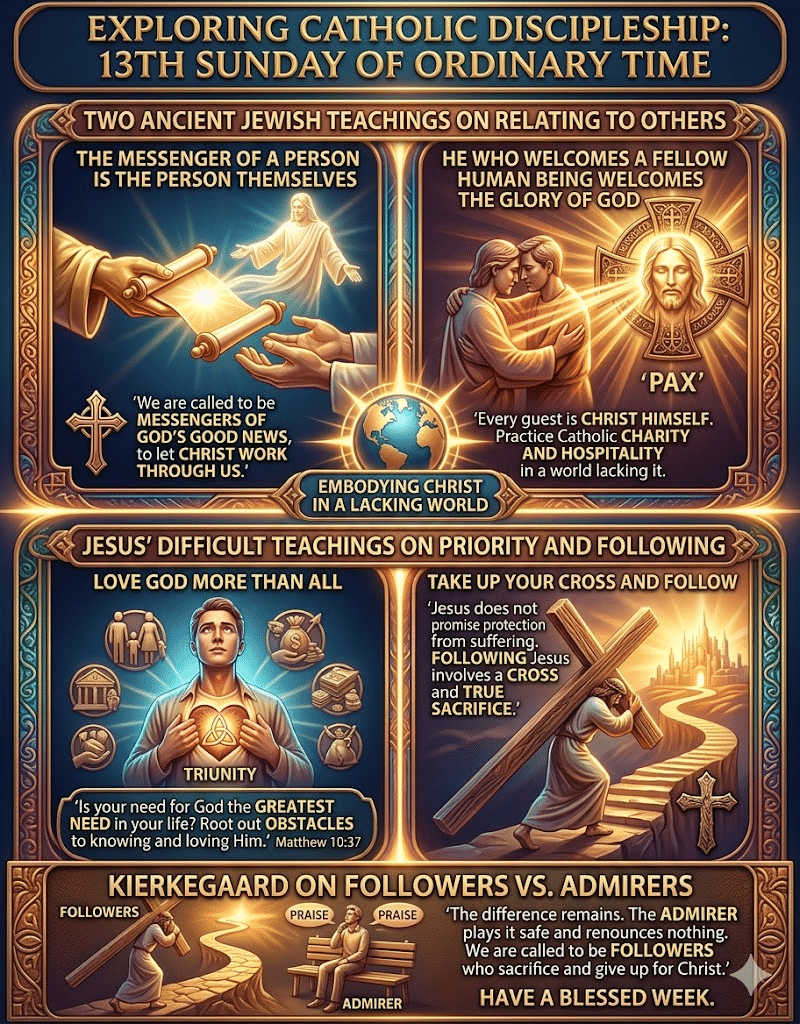
THE WORD THIS WEEK infographics are created using using GOOGLE’S AI Gemini 2.5 Pro. You are free to use the above infographic in any non-profit ministry. Please give credit to TheWordThisWeek.net and Diocese of Colorado Springs video series.
To be true followers of Jesus, one must be willing to make sacrifices and put their love and devotion to God above all else, while also treating others with charity and hospitality as a reflection of God's love.
- 00:00 Jesus teaches that as messengers of God's good news, we must receive others with charity, recognizing them as a reflection of God's light and glory.
- 01:10 In a culture lacking charity and hospitality, treat every guest as Christ himself, as reflected in Catholic tradition and emphasized in today's Gospel.
- 01:36 Jesus emphasizes that our love for God must supersede our love for anyone and anything else, not diminishing family life but highlighting our total dependence on God.
- 01:56 To live a life centered on God, one must identify and remove obstacles that hinder their ability to know, love, and serve Him, and ensure their actions reflect a deep dependence on Him.
- 02:29 Jesus doesn't promise protection from suffering, but instead requires followers to take up their cross, differentiating true followers from mere admirers who make no sacrifices.
- 02:52 Following Jesus requires sacrifice and suffering, involving giving up something for Christ.
Spiritual Identity and Mission
Q: How does receiving a messenger relate to spreading God's message?
A: Jesus teaches that receiving a messenger equals receiving the sender, calling believers to become messengers of God's good news and allow Christ to work through them to spread his message.
Q: What does the ancient Jewish saying reveal about hospitality?
A: The saying "When a guest comes, it is Christ who comes" directs believers to treat every guest as Christ himself, emphasizing charity and hospitality as essential practices in cultures lacking them.
Discipleship Requirements
Q: What is the primary requirement for following Jesus?
A: Jesus demands loving God more than anyone or anything else, making need for God the greatest need in life, and eliminating anything that obstructs knowing, loving, and serving God.
Q: How does Kierkegaard distinguish admirers from true followers?
A: Philosopher Søren Kierkegaard states "admirers never make true sacrifices", while genuine followers take up their cross and give up something for Christ, accepting that Jesus doesn't promise protection from suffering.
Encountering the Divine in Others
Q: What spiritual reality exists when welcoming another person?
A: Jesus teaches that welcoming a fellow human being equals welcoming the glory or light of God, creating an opportunity to encounter the light of God in them through charity.
Q: How does Catholic tradition approach hospitality?
A: Catholic tradition, rich in charity and hospitality, encourages treating every guest as Christ himself, emphasizing welcoming others as a core spiritual practice.

Video courtesy of Dominican Friars (Chicago)

THE WORD THIS WEEK infographics are created using using GOOGLE’S AI Gemini 2.5 Pro. You are free to use the above infographic in any non-profit ministry. Please give credit to TheWordThisWeek.net and Dominican Friars, Province of St. Albert the Great.
Christians are called to a life of devotion to God, prioritizing their love for Him above all else, including family, and embracing a spiritual growth that considers themselves dead to sin and alive to God.
- 00:00 The thirteenth Sunday of Ordinary Time readings bring hope and renewal as churches reopen, with St. Paul's letter to the Romans highlighting Jesus as the source of grace and life.
- 01:20 Through baptism, believers are united with Christ in his death and resurrection, and should consider themselves dead to sin and alive to God.
- 01:51 As Christians, we are called to be dead to sin and alive to God, embracing a life that desires spiritual growth, as exemplified by Elisha's ministry and his encounter with a woman of influence.
- 02:58 A woman seeks to create a space for a spiritual leader to rest, asking her husband to convert a room into a guest room for him.
- 03:22 Elisha receives hospitality from a devoted couple and shares a spiritual connection with them, allowing them to deepen their relationship with God.
- 03:52 Jesus teaches that love for family must not supersede love for Him, seeking to deepen understanding of true devotion.
- 05:08 Love God to the same degree you love your closest family members, and use that as the standard for your relationship with Him.
- 05:31 Jesus calls us to love Him with the same intensity we love our families, using natural loves to raise our love for Him.
Spiritual Identity and Transformation
Q: How does baptism fundamentally change our spiritual status according to St. Paul's letter to Romans? A: Baptism into Christ's death simultaneously raises believers to new life, requiring them to consider themselves dead to sin and alive for God, fundamentally shifting from physical to spiritual living.
The Nature of Divine Love
Q: What is Jesus' actual challenge regarding family love in Matthew 10? A: Jesus uses family love as the criteria for measuring love for God, not demanding comparative or competitive choice but calling believers to love Him with equal intensity to their deepest family bonds.
Q: What does Jesus mean by not being "obsessed" with family? A: The message isn't about giving up family but about not allowing family obsession to leave no room for God, maintaining family love while prioritizing love for God above all relationships.
Spiritual Hospitality and Connection
Q: How did the woman of notable means in Elisha's story demonstrate spiritual seeking? A: The woman of notable means invited prophet Elisha to dine regularly, pursuing spiritual connection with God through hospitality and sharing spiritual giftedness together rather than material exchange.
Divine Reciprocity
Q: What is God's invitation regarding the relationship between human and divine love? A: God invites believers to first acknowledge love for family, then recognize how much Jesus loves us and His desire for us to love Him in return with the same depth and commitment.
Spiritual Practice
Q: What meditation practice does the teaching suggest for deepening love of God? A: The challenge is to meditate on profound love for family and then hear God's call to love Him with equal intensity, consciously raising spiritual energies to match familial devotion.
THE WORD THIS WEEK infographics are created using using GOOGLE’S AI Gemini 2.5 Pro. You are free to use the above infographic in any non-profit ministry. Please give credit to TheWordThisWeek.net and Dominican Friars, Province of St. Albert the Great.

Video courtesy of The Jesuit Post
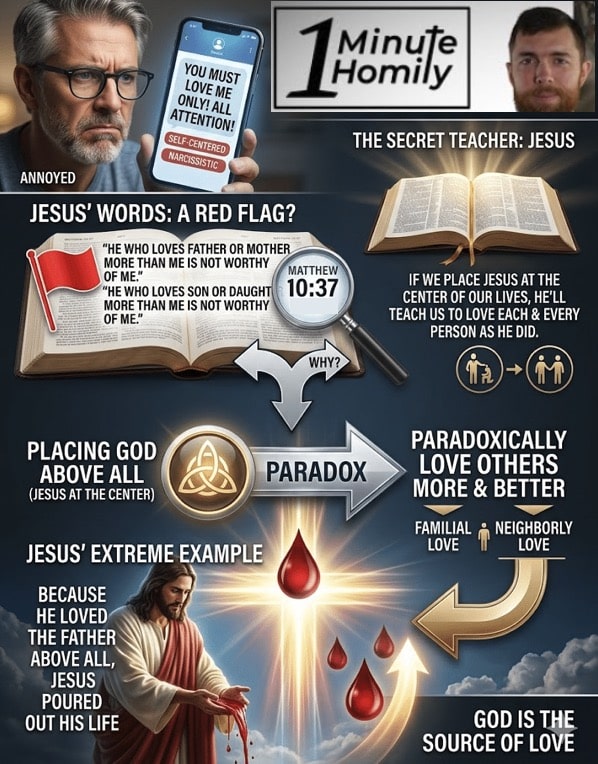
THE WORD THIS WEEK infographics are created using using GOOGLE’S AI Gemini 2.5 Pro. You are free to use the above infographic in any non-profit ministry. Please give credit to TheWordThisWeek.net and THE JESUIT POST.
Loving Jesus first enables us to love others more and better.
- 00:00 Loving Jesus first enables us to love others more and better, as He teaches us to pour out our lives for them, just as He did.
Paradox of Christ-Centered Love
Q: Why does loving Jesus first actually improve our love for others?
A: Jesus' seemingly self-centered Gospel commands paradoxically enhance our capacity to love others more and better when we love God above all, demonstrated through Jesus' own model of loving the Father above all while simultaneously pouring out his life for humanity in his death and resurrection.
Source of Transformative Love
Q: How does placing Jesus at the center enable better relationships?
A: Positioning Jesus at the center of our lives grants access to his teaching on loving each person as he did, because the Father is the source of Jesus' love, making divine love the foundation for human relationships rather than our limited human capacity.

Video courtesy of Priests for Life

THE WORD THIS WEEK infographics are created using using GOOGLE’S AI Gemini 2.5 Pro. You are free to use the above infographic in any non-profit ministry. Please give credit to TheWordThisWeek.net and PRIESTS FOR LIFE.
Welcoming and valuing human life, as exemplified by Christ's acceptance of life, is essential and that rejecting another's life, such as through abortion, is contradictory to this acceptance.
- 00:00 The readings for the 13th Sunday of Year A emphasize the value of welcoming life, highlighting God's gift of life through the examples of Elisha, the woman of Shunam, and new life in Christ.
- 00:40 Christ's welcome to life must be extended to every human being, rejecting another's life would be a contradiction to accepting His welcome.
- 01:13 Embracing the Cross and self-giving, rather than self-assertion, is the path to finding oneself, and this is particularly relevant to the pro-life stance on abortion.
Welcoming Life as Response to Christ
Q: How does welcoming God's representatives connect to protecting unborn life?
A: The readings link welcoming Elisha (resulting in the gift of a child to the Shunammite woman) and welcoming Christ (resulting in new life) to demonstrate that accepting Christ's welcome into the Father's life creates an obligation to extend welcome to every human being, making it contradictory to accept Christ while rejecting any human life including the unborn.
Self-Giving vs. Self-Assertion
Q: What does embracing the cross teach about the pro-choice position?
A: Matthew 10:37-42 teaches that embracing the cross and self-giving directly opposes the self-centered "my rights, my life" assertion of pro-choice ideology, revealing that fulfillment comes through self-giving rather than self-assertion, even when that self-assertion costs an unborn child's life.
Parental Love as Christ's Love
Q: How do parents experience Christ's love through their children?
A: Parents who give themselves to both born and unborn children directly experience the very love of Christ and discover their true fulfillment through self-giving rather than through asserting personal autonomy.

Video courtesy of Society of Our Lady of the Most Holy Trinity

THE WORD THIS WEEK infographics are created using using GOOGLE’S AI Gemini 2.5 Pro. You are free to use the above infographic in any non-profit ministry. Please give credit to TheWordThisWeek.net and Society of Our Lady video series "Liturgy Prep."
Through baptism, Christians are called to reflect Christ's presence in their daily interactions, becoming agents of joy, peace, and love who share the light of Christ with others.
- 00:00 Through baptism, Christians are called to radiate Christ's presence to others, becoming ambassadors and bearers of Christ, as Jesus dwells within them.
- 00:57 As a disciple, one must reflect on their relationships and encounters, ensuring they bring Jesus' joy, peace, and love to others, and share the light of Christ with everyone they meet.
Living as Christ's Presence
Q: What happens to us in baptism according to St. Paul?
A: In Romans 6:3-4, 8-11, St. Paul teaches that through baptism we are buried and rise with Christ to become a new creation in which Jesus dwells within us.
Our Mission as Disciples
Q: What three roles does Jesus call us to fulfill for others?
A: Jesus calls us to be ambassadors, bearers, and radiators of His life, joy, peace, and love, requiring us to share what we've received as His disciples.
Daily Practice
Q: How should we evaluate our daily interactions with others?
A: Reflect on daily encounters by asking if people are encountering Jesus in you, striving to bring the Light of Christ to everyone you meet as an invitation to live out our calling.

Video courtesy of Eternal Word Television Network

THE WORD THIS WEEK infographics are created using using GOOGLE’S AI Gemini 2.5 Pro. You are free to use the above infographic in any non-profit ministry. Please give credit to TheWordThisWeek.net and EWTN video series "The Word on the Word."
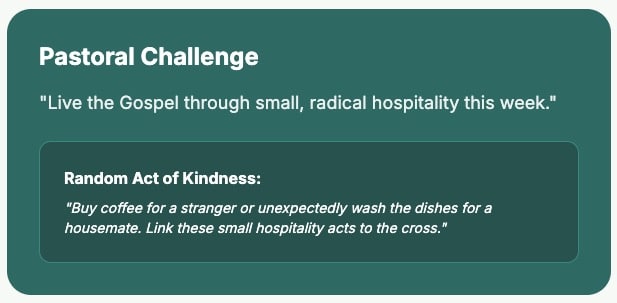
Performing a random act of kindness, inspired by the biblical story of a wealthy woman's kindness to the prophet Elisha, can have a positive impact on others and potentially be rewarded.
- 00:00 A wealthy woman's kindness to the prophet Elisha is rewarded with the promise of a son, whom she bears after Elisha declares she will conceive within a year.
- 00:47 The challenge is to do a random act of kindness for another person, such as buying coffee for a friend or cleaning up dishes after dinner.
Reciprocal Generosity in Faith
Q: How did the Shunammite woman's hospitality lead to a prophetic blessing?
A: The wealthy woman in 2 Kings 4 recognized Elisha as a "holy man of God" through his regular travels past her home, convinced her husband to build a spare bedroom for him, and received a prophecy that she would bear a son within a year despite being childless.
Q: What does Elisha's response reveal about handling overwhelming generosity?
A: Elisha felt overwhelmed by the woman's generosity and sought to reciprocate by asking his servant what she might need, discovering her childlessness and responding with the prophetic gift of a son as gratitude for her unsolicited hospitality.
Liturgy Notes

13th Sunday of Year A


13th Sunday of Year A
The Call to Hospitality

Today’s first reading and Gospel speak of hospitality toward those who serve God. The first reading tells the story of Elisha, who was welcomed by an influential woman in Shunem. She arranged a room for him to use and offered sustenance whenever he came to town. In response, the prophet promises that she and her husband would have a son.
In the Gospel, Jesus challenges us to follow him before every other relationship and concern. Then, he speaks of offering hospitality to apostles, prophets, righteous persons and disciples. Even giving a cup of cold water will prompt God’s favor, he says.
Hospitality is ultimately a matter of the heart. It’s not just providing food and shelter but opening our hearts and lives to others. If following Christ is first in our lives, then we will naturally welcome those who speak God’s word and share the good news.
In practice, of course, those who speak God’s word are not always welcome in our lives or even in our churches. God’s word is about love and blessing but it is also a word that calls us to change our lives by aligning with God’s love and share God’s blessings. Throughout history, prophets have been ignored or resisted and often abused and killed because God’s wisdom continually challenges the misuse of creation and the abuse of others.
Perhaps our second reading today can offer encouragement to both prophets and their hearers. Embracing God’s truth often means that something in our lives or our hearts must die. But that death leads to new life, a pattern we celebrate in baptism and recall in every celebration of the Eucharist. Following God’s ways is not easy but it always leads to fuller life.
The issue of prophecy also links to the celebration of Independence Day in the United States. Many Catholics still react negatively to any criticism of our country, calling it unpatriotic. The alliance of state and church during the Second World War still leads many to assume that the church should always support the country, regardless of its actions or policies.
That position makes the church’s mission of prophecy impossible. No country is perfect, and there is much in our country that is clearly contrary to Catholic teaching and Gospel values. To challenge those policies and situations is not unpatriotic but deeply patriotic. If we love our country, we should want it to improve and to align itself more fully with the word of God. The church must always make clear the difference between the kingdom of God and the kingdom of political power. Pray for your country, but do not make it an idol to worship.
Full Series: Cycle A Resources

OCP MUSIC

13th Sunday of Year A
Entrance
You Are Welcome Here (Chris Muglia)
Breaking Bread #302
The First Reading teaches us about the importance of hospitality and welcome. In the spirit of joy expressed in the Entrance Antiphon, consider Chris Muglia’s “You Are Welcome.”

Response & Acclaim
Response & Acclaim
Forever I Will Sing the Goodness of the Lord (Tom Booth)
Spirit & Psalm 2026: p. 234
Tom Booth’s verbatim setting of Psalm 89 responds to the joy of hospitality in the First Reading.
2026 PLAYLIST (152 VIDEOS)

Alleluia: Mass of St. Mary Magdalene (Sarah Hart)
Spirit & Psalm 2026: p. 236
The acclamation verse is a reassuring reminder of our call in light of the Gospel’s challenge of discipleship.
2026 PLAYLIST (152 VIDEOS)
Presentation & Preparation
Presentation and Preparation

This is a Matt Maher song with chords found in Spirit and Song.
Jesus, My Everything (Matt Maher)
Spirit & Song #321; Never Too Young #220
“Jesus, My Everything” is one of the gems from the Spirit & Song repertoire that is being discovered by today’s generation. Matt Maher’s heartfelt acknowledgment of our dependance on Christ encourages us to deepen our relationship with him.
THE COMMONS / LITURGY BLOG
Communion
Communion

Christ in Me Arise (Trevor Thomson)
Spirit & Song #278; Breaking Bread #512
The Dorian mode of Trevor’s melody gives “Christ in Me Arise” an appealing medieval feel. The verses are a call to Gospel discipleship. “Be now my footsteps, leading the way, taking me where I must go.”
THE COMMONS / LITURGY BLOG
Sending Forth
Sending Forth

YoTake Up Your Cross (Jaime Cortez)
Breaking Bread #711
Jaime’s tuneful anthem sends us from this Eucharist as disciples who bear the Cross of Christ.
THE COMMONS / OCP.ORG

Liturgy Blog is a weekly liturgy planning resource for musicians, liturgists, homilists, youth groups, faith sharing groups, and all who look to the liturgical readings for inspiration and nourishment. Join Ken Canedo as he breaks open the Scripture and suggests tracks from the Spirit & Song contemporary repertoire.
13th Sunday of Year A

Video courtesy of Lector with Lisa

2 Kgs 4:8-11, 14-16a

Courtesy of Greg Warnusz
Our Liturgical Setting: This reading prepares the congregation to hear the day's gospel, Matthew 10:37-42, which you should read first. Notice that the first half of these sayings of Jesus are about the behavior of his disciples; the second half are about the behavior of others towards the disciples. It's one of those sayings that prompted the selection of today's first reading.
The Historical Situation: The traveler who enjoys hospitality in this story is identified as "a holy man of God" in the story. In fact he is a prophet. (As Reginald Fuller points out, that's what the author meant by "holy man", one who is a bearer of God's word.1) Pronounce his name "e LISH uh" with a short e in the first syllable and a short i in the second. To the careful listener, this will distinguish him from his mentor, the more famous prophet Elijah ("ee LYE juh"), of whom you can read in 1 Kings, starting at chapter 17. This is the most innocent of a series of miracle stories in 2 Kings, chapter 4, that establish Elisha's authority as a man of God.
Proclaiming It: Now this reading is a simple story. When proclaimed to the congregation, it should sound like a story. The elements of the story are quite ordinary: a frequent traveler, a kind but childless couple, hospitality, promise and hope. Tell it like you'd tell the story of how you met your spouse, or how you'd tell a serious story to a child.
1- Preaching the Lectionary: The Word of God for the Church Today, Reginald H. Fuller. The Liturgical Press. 1984 (Revised Edition). pp. 139-141. See his treatment of all the day's readings at the link in the table below.

13th Sunday of Year A

Video courtesy of Lector with Lisa

Rom 6:3-4, 8-11
Courtesy of Greg Warnusz
The Theological Background: In prior chapters of Romans, Paul has established that God has given us Christ so that, by our relationship with Christ, we might enjoy God's favor. Now Paul is working out some of the implications of that. That Christ was raised from the dead means at least all of the following:
- Our earthly life in Christ is "a new life" even now, empowered already by the resurrection.
- We'll share in Christ's resurrection from the dead in the future.
- We're already as dead to sin (our old way of life) as Christ was dead before his resurrection.
- Baptism is our entrée into this new life.
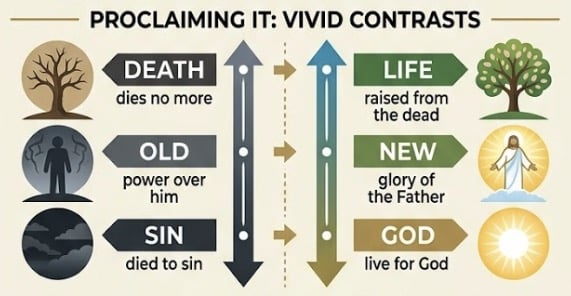
Proclaiming It: The letter to the Romans is full of vivid contrasts, and these paragraphs have that character in spades.
- death versus life (several times)
- old (implied) versus new
- sin versus God
Vary your pitch as you proclaim the contrasting elements. The congregation should hear the contrasts in your voice. If they're to grasp the contrasts intellectually, they need this help from you.

Catholic Lectionary Readings
UNITED STATES (USCCB) — Monthly Calendar / Sunday’s Readings