Homilies
Homilies
June 28, 2026
⭐⭐⭐ Earthquakes in Venezuela


13th Sunday of Year A
Miraculous Deliverance,
Unshaken Faith

Today’s readings speak of radical hospitality, a profound transition from death to life, and the heavy cross of total discipleship.
In light of the devastating earthquakes in Venezuela this past Wednesday, these readings for this Sunday are not abstract theology—they are being lived out in the dust, the concrete, and the agonizing silence of the rubble. For many, in a single, terrifying moment, everything that seemed permanent and secure—homes, roads, livelihoods—was reduced to debris. It is a painful reminder of the fragility of our earthly existence. But what has happened in Venezuela also forces us to confront the core of today’s message: when the earth literally shakes beneath our feet and everything visible crumbles, what remains? What is the foundation that cannot be shattered?
Preaching Guides in Immediate Aftermath of a Natural Disaster
- Theological Framework: The Catholic Apostolate Center provides excellent perspectives on finding God’s presence in loving, compassionate responses to disasters.
- Working Preacher from Luther Seminary: Read the Preaching after Natural Disaster Article for pastoral advice on how to frame messages during times of sudden chaos and community grief.
Lewis Center for Church Leadership: Explore the Preaching in the Wake of Mass Trauma Interview to learn how to address loss and handle narrative fracture in the pews.
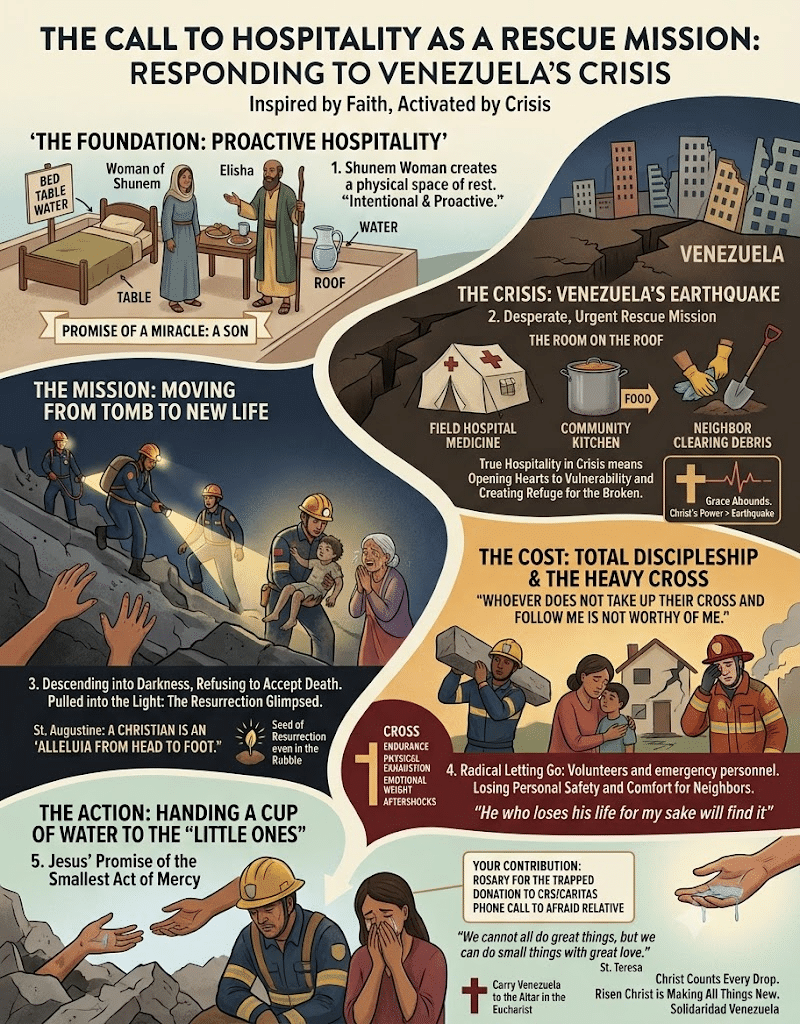
Hospitality as a Rescue Mission
Moving from the Tomb to New Life
The Heavy Cross of Total Discipleship
Handing a Cup of Water to the “Little Ones”
Carrying Venezuela to the Altar
Deacon Peter McCulloch
13th Sunday of Year A
✍️ A Benedictine Welcome
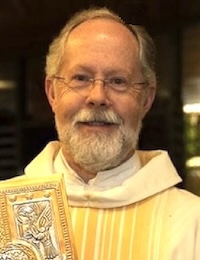
During the 5th-century collapse of the Roman Empire, St. Benedict established monasteries as havens of peace, famously welcoming people from all backgrounds—including a fearful Gothic monk whom he treated with gentle mercy instead of punishment. This radical hospitality was directly inspired by Holy Scripture. Throughout the Old and New Testaments, from Abraham to the prophet Elisha, welcoming others is central to faith. Jesus elevated this virtue by teaching that welcoming a stranger is equivalent to welcoming Christ Himself.
Deacon Peter’s homily contrasts xenophobia (hatred of the stranger) with philoxenia (love for the stranger), noting that the latter turns enemies into friends. This transformative power of love is mirrored in modern history by a simple, quiet gesture: a friend raising his hat to a humiliated, imprisoned Oscar Wilde. Ultimately, the text demonstrates that even the smallest act of kindness carries profound power to heal brokenness and change a life.

Fr. Tony’s Homilies
Welcoming Christ Through the Door
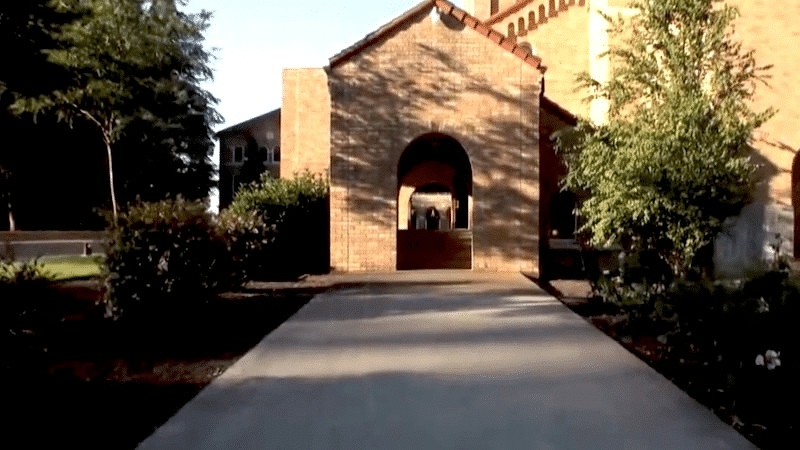
- Fr. Tony Kadavil, Fr. Tony’s Homilies – Anecdotes
- The Rule of Saint Benedict, Chapter 53 (“On the Reception of Guests”)
- Saint John Chrysostom, Homilies on the Gospel of Matthew (Homily 50)
- Catechism of the Catholic Church, paragraphs 1213-1216 (on Baptism) and 2447 (on works of mercy)
- Pope Benedict XVI, Deus Caritas Est (on charity as the heart of Christian life)
- Pope Francis, Evangelii Gaudium (encountering Christ in other)
- St. Augustine, Sermons – Mt 10
- The Navarre Bible Commentary on Matthew and Romans
- Scott Hahn, Catholic Bible Dictionary and Sunday reflections (St. Paul Center)
Bishop Robert Barron
13th Sunday of Year A
▶️ Be Attached to God Alone

In this profound 2026 homily for the 13th Sunday in Ordinary Time (Year A) on Matthew 10, the Bishop contrasts superficial religious sentimentality with the truly astonishing, disruptive nature of Jesus’s teaching. Building upon the prior week’s mandate to “fear nobody” by moving from bodily preoccupation to the soul’s depth, the Bishop centers this reflection on authentic detachment.
Crucially, authentic Christianity rejects puritanical dualism; creation is inherently good. The spiritual danger arises, as St. Augustine noted, when creatures are mistaken for the Creator, turning a worldly good into the summum bonum (the highest good). Jesus delivers a breath-taking challenge by demanding a love greater than that for mother, father, or child—the pinnacle of earthly goods. True spiritual conversion requires a radical alignment with the Shema, prioritizing the one true God above all else. Ultimately, major spiritual mischief follows when worldly attachments eclipse the Divine; true freedom is found only in absolute attachment to God alone.
Fr. Michael Chua
13th Sunday of Year A
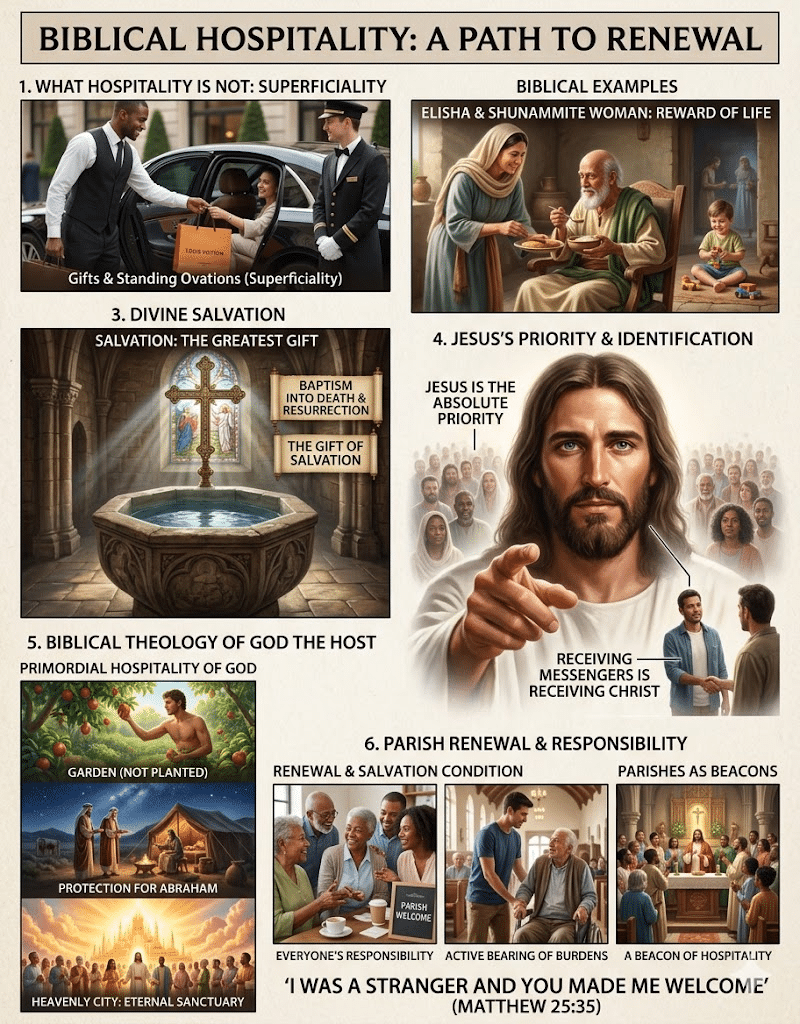
✍️ The Hospitality of God
While Catholic parishes are often criticized for lacking the warmth found in Protestant churches, biblical hospitality extends far deeper than mere superficial friendliness. In salvation history, hospitality is a theological reality prefiguring redemption. In the first reading, a Shunammite woman’s hospitality to Elisha yields the reward of life, mirroring the eternal life Christ promises. St. Paul highlights this in Romans, explaining that baptism into Christ’s death and resurrection grants the ultimate gift of divine hospitality: salvation.
The Gospel establishes Christ as our absolute priority, revealing that welcoming His disciples is equivalent to welcoming Him. Ultimately, scripture illustrates God as the world’s Host, countering human inhospitality through the Incarnation. Recapturing this biblical hospitality is essential for parish renewal. It is not an optional ministry but a universal responsibility and a condition for salvation, transforming parishes into community beacons that reflect God’s eternal sanctuary.
Dominican Blackfriars
13th Sunday of Year A
✍️ Perfect Love

In this reflection for the Thirteenth Sunday of Ordinary Time, Fr. Benedict Jonak, O.P., explores what makes us worthy followers of Christ. He argues that human merit alone is insufficient; rather, it is solely God’s mercy, grace, and Incarnation that elevate humanity, allowing us to relate to Him through friendship rather than fear.
Addressing the Gospel’s challenging words on family, Fr. Jonak explains that Christ does not condemn familial affection but instead establishes a proper “order of love.” Our bond with Jesus, forged in baptism, must take precedence. Loving God first does not diminish earthly relationships; instead, it purifies and deepens them. True love requires sacrifice, mirroring Christ’s ultimate sacrifice on the cross. Ultimately, believers are encouraged to shift their prayer lives from seeking favors to expressing profound longing for divine friendship, trusting that their daily crosses manifest God’s transformative power.

Fr. Austin Fleming

13th Sunday of Year A
✍️ Hospitality and Citizenship
This homily connects patriotism, Christian discipleship, and the call to hospitality. On Independence Day, the community will gather for Mass next weekend to pray for the nation’s leaders, wisdom, and the strength to defend vulnerable refugees. Centering on the Gospel, the speaker explains that loving Jesus above all else means recognizing and receiving Him in others, particularly the stranger. While the Gospel does not dictate specific immigration laws, it serves as the essential framework for Christians addressing complex societal issues.
The text highlights a dual citizenship—earthly and heavenly—echoing the second-century Letter to Diognetus, which describes early Christians as faithful citizens whose true homeland is heaven. Ultimately, Christ comes disguised as the refugee, the marginalized classmate, and the fractured family member. Fed by Christ’s sacrifice in the Eucharist, believers are challenged to transcend prejudices and welcome the stranger, thereby welcoming Christ Himself into their hearts and homeland.

Monsignor Peter Hahn
13th Sunday of Year A
▶️ Two Rules for True Happiness
Every human shares a universal desire for a full, happy life. However, Christ reveals a profound paradox: true happiness is not found by searching for it, but by losing oneself in selfless love and service. This spiritual truth is perfectly captured by two simple rules: see Christ in others, and be Christ for others.
To see Christ in others means recognizing every person as an infinitely loved child of God, treating them with reverence and hospitality, much like the Shunammite woman who welcomed the prophet Elisha. To be Christ for others requires living out our baptismal identity. This means ordering our loves properly by putting God first, taking up our cross, and rejecting the urge to judge or marginalize. By generously pouring ourselves out in imitation of Jesus, we reorient our lives toward the Divine, ultimately finding the unimaginable joy, peace, and lasting fulfillment meant for us in Christ.
Fr. Charles E. Irvin
13th Sunday of Year A
✍️ Putting God First

This homily emphasizes that our relationship with God must be the ultimate priority in our lives, drawing from foundational spiritual “firsts.” The author connects the first lesson of the Baltimore Catechism, the First Commandment, God’s covenant with Israel, and the baptism of Lydia—the first European convert—to demonstrate that what comes first is often most critical.
While modern life is consumed by “busy-ness” and a self-reliant attitude, the text challenges believers to evaluate where God truly fits into their daily routines. God frequently communicates through messengers and intermediaries, requiring openness and active attention from His people. Ultimately, eternal salvation depends on nurturing this bond on earth. The homily concludes with an invitation to utilize the slower pace of the summer season for quiet reflection, spiritual reading, and intentional focus on fulfilling our primary purpose: to know, love, and serve God.
Fr. Joe Jagodensky, SDS
NO HOMILY AVAILABLE


Fr. Langeh, CMF

13th Sunday of Year A
▶️ Hospitality

This homily for the 13th Sunday in Ordinary Time centers on the essential Christian virtue of hospitality, defined as the warm, friendly, and generous treatment of guests and strangers. Deeply rooted in both Old and New Testaments, scripture explicitly commands believers to love strangers as themselves, drawing historical parallels to the Israelites’ time in Egypt. Key scriptural examples highlight the profound blessings tied to welcoming others, including Abraham receiving messengers in Genesis and the prominent Shunamite woman opening her home to the prophet Elisha, which miraculously resulted in the birth of her biological son. Ultimately, the New Testament defines hospitality as the “love of strangers.” Jesus commands reciprocity during missionary journeys, explaining that welcoming His disciples means welcoming Christ Himself. By practicing this virtue daily, Christians recognize and nourish God’s presence in others, successfully transforming isolated strangers into embraced family members within the church community.

Msgr. Charles Pope
13th Sunday of Year A
✍️ Four Disciplines of Worthy Disciples
This reflection outlines four core principles of discipleship, centering on the Greek word for worthiness, axios, which means to ascribe proper weight or value to something. To be worthy of Jesus means prioritizing Him entirely.
- The Priority: A disciple’s love for Christ must eclipse all earthly relationships, including family, culture, and political allegiances.
- The Profundity: Worthiness is an internal disposition. We must tip the scales of our lives toward God, weighing His sacrifice heavier than worldly anxieties or fleeting successes.
- The Passion: Followers must embrace the cross. Just as people endure hardships for worldly gain, disciples must accept redemptive suffering, losing temporary life to find eternal reality.
- The Prize: God never overlooks obedience or acts of mercy. Embracing His truth yields transformative peace now and immense rewards hereafter.
Ultimately, worthiness requires taking God’s Word seriously and allowing His truth to direct our actions.

Father Kevin Rettig
13th Sunday of Year A
▶️ Legacy
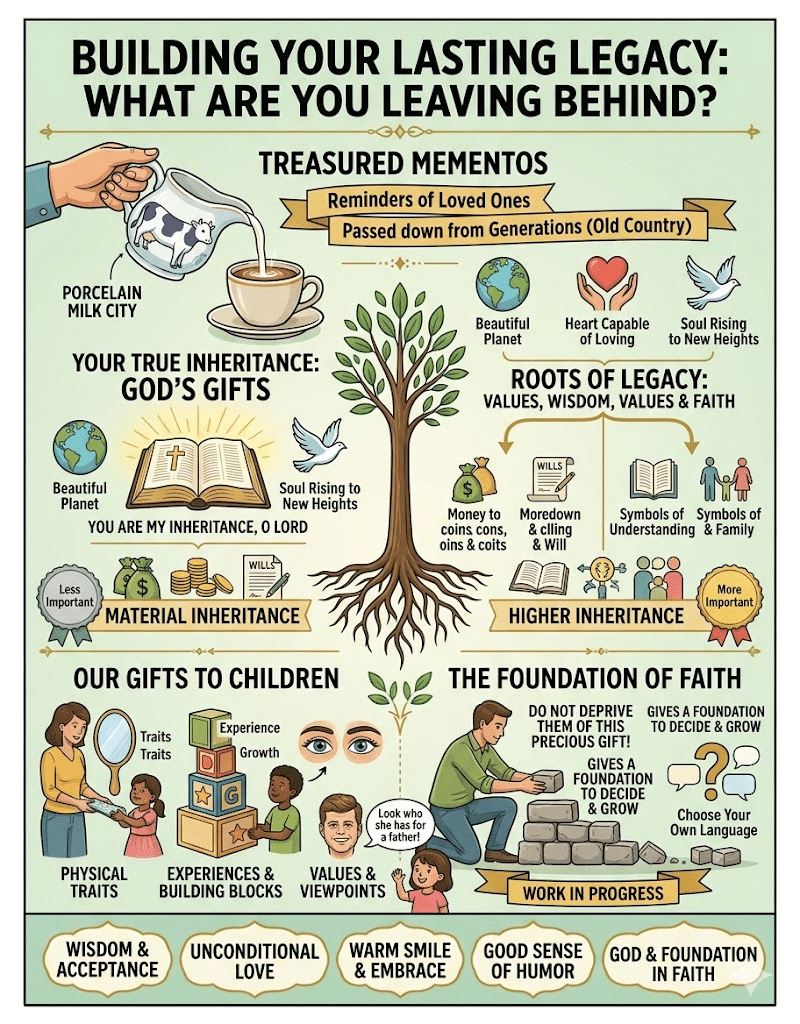
Father Kevin reflects on the profound nature of the legacies we pass on to future generations. Drawing from personal memories of a treasured heirloom from their grandparents, they note that while some inheritances are material, the most significant ones are intangible. God offers a unique inheritance to everyone, providing a beautiful world, the capacity to love, and distinct spiritual gifts. While families pass down physical traits, they more crucially transmit values, wisdom, and perspectives.
Father Kevin emphasizes that leaving a foundation of faith is paramount. Rejecting the idea of letting children choose a faith only when they grow up, the speaker equates it to withholding language. A spiritual foundation gives children a necessary starting point to grow, evolve, and build upon. Ultimately, the greatest legacies are not financial, but are rooted in wisdom, unconditional love, a sense of humor, and faith in God.
Fr. George Smiga
13th Sunday of Year A
✍️ Jesus Versus Family

Jesus delivers a challenging message: loving family more than Him makes one unworthy of Him. While family is a core value, this harsh statement historically comforted early Christians who faced intense familial rejection for joining a fringe religious movement. It affirmed that following Christ’s call held a higher value than pleasing their families.
Today, this message remains vital when Christ leads individuals toward paths that clash with the expectations of loved ones. Whether it is choosing a partner from a different background, embracing one’s true sexual orientation, or leaving a broken, unresolvable marriage after years of trying, the gospel reminds us that following God’s guidance must come first. Disappointing those we love is deeply painful, but prioritizing their approval over Christ’s direction ultimately compromises our faithfulness. True discipleship demands the courage to follow where He leads, even when it strains our closest bonds.

Additional Homilies
13th Sunday of Year A
Fr. Vincent Hawkswell | Archive
Lose Your Life, and You will Find IT
Fr. George Corrigan, OFM
Receiving: context
Receiving: choice of love
Receiving: reward
Msgr. Joseph Pellegrino (PDF) | Archive
Are You Not Aware?
Fr. Tommy Lane | Archive
Related: Homilies on carrying our cross
Fr. Michael Fallon, MSC | Archive