Commentary Intro to Mass Readings Sunday Readings
CommentaryIntro to Mass Readings Sunday Readings
June 28, 2026
⭐⭐⭐ Hearers of the Word—PDF | VIDEO



Our Sunday Readings *
Edrianne Ezell
Scripture Study for Catholics *
Vince Contreras
Hearers of the Word *
Fr. O’Mahony OSA
Friar Musings, OFM *
Fr. George Corrigan, OFM
Echoing God’s Word *
Fr. Clement Thibodeau


Fr. Francis Martin

Brant Pitre

Kevin Aldrich

13th Sunday of Year A
2 Kgs 4:8-11, 14-16a
XXXXXXXXXXXXXXXXXXXXXXX list ten questions divided into sections, with each section having a
title, based on the following that a preacher could ask an AI Catholic assistant for help with as the preacher prepares his homily. Do not use phrases such as “The text notes refer to” “The commentary suggests”. Instead use “xxxxxxx refers” and “xxxxxxx suggests” . Whenever possible though it is best to cite a specific verse or verses of the reading when writing the question. Do not place questions in quotation marks.
Create a verse by verse (NAB) commentary relating xxxxxxxxxxxxx TO CATHOLIC doctrine and practice. Give real life applications when appropriate
Verse 8 — "One day Elisha came to Shunem, where there was a woman of influence, who urged him to dine with her..."
The narrative opens with a woman described as wealthy or "of influence," who repeatedly presses Elisha to share a meal. The Hebrew suggests insistence—she does not offer once and retreat at a polite refusal; she perseveres.
Catholic connection: This is the virtue of hospitality (Latin hospitalitas), which Scripture elevates to a sacred duty. Hebrews 13:2 reminds us that some have entertained angels unawares, and the Catechism roots care for the stranger in the corporal works of mercy. Her social standing is significant: she uses her means not for self-aggrandizement but for service. This is authentic Christian stewardship—the recognition that wealth is given to be poured out.
Real-life application: Encourage parishioners with means—a comfortable home, financial security, a spare room—to see these not as private rewards but as instruments for hospitality: hosting a parish small group, sponsoring a refugee family, opening the table to the lonely. The woman models the affluent disciple who refuses to let comfort become insulation.
Verse 9 — "She said to her husband, 'I know that this is a holy man of God who visits us often.'"
Her hospitality flows from spiritual discernment. She perceives Elisha's holiness before she acts. Her generosity is not random benevolence but a response to recognized sanctity.
Catholic connection: This is the gift of discernment of spirits in seed form, and it points to the Catholic conviction that we are called to recognize the sacred in our midst—Christ in the Eucharist, in the priest who acts in persona Christi, and in the poor (Matthew 25:40). The sensus fidei, the instinct of faith given to the baptized, enables ordinary believers to perceive holiness and truth.
Real-life application: Invite the congregation to cultivate the habit of recognizing God's presence: honoring the priesthood, reverencing the Eucharist, and seeing Christ's face in the homeless person, the difficult relative, the immigrant. Discernment precedes generosity—we give well when we first see rightly.
Verse 10 — "Let us arrange a little room on the roof and furnish it for him with a bed, table, chair, and lamp, so that when he visits us he can stay there."
She proposes a permanent, dedicated space—and furnishes it with four specific items. Notice again her initiative: she conceives the plan and proposes it.
Catholic connection: This is prevenient generosity—giving before being asked, mirroring the prevenient grace God extends to us first. The four furnishings have long invited spiritual reading. We might see the bed as contemplative rest in God; the table as the Eucharistic table and the nourishment of the Word; the chair as the seat of teaching and attentive discipleship (recall Mary of Bethany at the Lord's feet, Luke 10:39); and the lamp as the light of faith (Psalm 119:105) and the lamp of witness that must not be hidden (Matthew 5:15).
The dedicated room also evokes the consecration of sacred space—the Catholic instinct to set apart places for God: the church building, the home oratory, the prayer corner.
Real-life application: Urge each household to "build the roof chamber"—a literal prayer space with a crucifix, Scripture, and a candle, and an interior space of daily prayer (Matthew 6:6). The four items can structure a self-examination: Does my life offer God rest (silence and Sabbath), a table (Mass and Scripture), a chair (docile listening and study), and a lamp (visible witness)?
Verse 11 — "One day Elisha came there, and he went to the upper room and lay down to rest."
God accepts the offering. Elisha enters and rests in the space she prepared. The gift is received and used.
Catholic connection: Here is the gentle truth that God deigns to dwell with us when we make room. The God who needs nothing nonetheless honors human hospitality by accepting it—as Christ accepted the hospitality of Martha and Mary, of Zacchaeus, of the home in which the Last Supper was held (the "upper room," tellingly). There is a Eucharistic and even a Marian resonance: when we prepare a worthy dwelling, the Lord comes to abide. "Behold, I stand at the door and knock" (Revelation 3:20).
Real-life application: Reassure your people that no act of preparation for God is wasted. When we make room—through Confession that cleanses the soul's chamber, through prayer that furnishes it—the Lord truly comes and rests there. The disposition of the soul in a state of grace becomes the "upper room" where Christ abides through the Eucharist.
Verse 14 — "Later Elisha asked, 'What can we do for her?' Gehazi answered, 'She has no son, and her husband is getting on in years.'"
Elisha seeks to reciprocate. Significantly, the woman has asked for nothing—earlier (v. 13) she declined any advocacy before the king. Her servant Gehazi names the unspoken ache: barrenness and an aging husband, a situation humanly closed.
Catholic connection: This is the gratuity of grace. God's blessing is not extracted by demand but flows from His initiative toward the one whose hands are empty and unasking. It echoes the divine pattern: "You did not choose me, but I chose you" (John 15:16). The asymmetry is striking—she gave bricks and meals; God prepares to give life. We cannot put God in our debt; His response always overflows our offering. This is grace, not commerce.
Real-life application: Console those who have "stopped asking"—the chronically ill, the long-infertile, those who have buried a hope to protect themselves from disappointment. God often acts precisely in the area we have sealed off as hopeless. Encourage practices of openness to grace: frequent reception of the sacraments, which dispose us to receive what we cannot manufacture.
Verse 15 — "He said, 'Call her.' When he had called her, she stood at the door."
She is summoned and comes, standing at the threshold—a posture of one who does not yet know what is coming, attentive but uncommitted.
Catholic connection: The threshold is a place of invitation and decision. God calls; we come, often without understanding. This is the structure of vocation—Samuel's "Speak, Lord" (1 Samuel 3), Mary's encounter with Gabriel. To stand at the door is to be available to God even before we grasp His plan.
Real-life application: Invite parishioners to make themselves available to God in prayer—to "stand at the door" daily, present and listening, even when nothing seems to be happening and no clear word has come.
Verse 16a — "Elisha said, 'This time next year you will be cradling a baby son.'"
The promise is concrete and astonishing—life where there was barrenness, joy where there was resignation.
Catholic connection: This is one of Scripture's great annunciation scenes, and it points unmistakably forward to the Annunciation of Luke 1. As with Sarah (Genesis 18) and the mother of Samson (Judges 13), God brings life from a closed womb—a sign of His sovereignty over life and a foreshadowing of the ultimate impossibility made possible: the Virgin who conceives, and beyond that, the dead who rise (which is exactly where this chapter goes when the boy later dies and is raised). The full verse 16 includes the woman's wary reply, "do not deceive your servant"—a hesitancy that grace honors rather than punishes, in contrast to Mary's unguarded fiat (Luke 1:38).
Catholic connection (deeper): This typology—Old Testament barren women fulfilled in Mary—is a cornerstone of the Church's reading of Scripture (the sensus plenior). Every divinely-given child in the Old Testament prepares us for the Child of Bethlehem.
Real-life application: Proclaim hope. The God who gives life is not bounded by the barrenness we have learned to accept. Yet preach this with pastoral honesty: God does not grant every specific request (recall St. Paul's thorn, 2 Corinthians 12:7-9). The promise is not that we always receive the exact gift we name, but that God's initiative is always toward life and always exceeds what we could negotiate for ourselves.
Algorithmically generated text
The story of the Shunammite woman in 2 Kings 4 offers a beautiful template for Christian discipleship, and her hospitality speaks across the centuries to how we make room for God. Let me draw out several dimensions of this for you.
The Text and Its Significance
In 2 Kings 4:8-10, the wealthy woman of Shunem perceives that Elisha is "a holy man of God" and resolves not merely to feed him as he passes, but to build him a permanent, dedicated space. She furnishes it deliberately—a bed, a table, a chair (or stool), and a lampstand. Each element is intentional, and each carries homiletic weight.
Models for Catholic Life
1. Hospitality as Recognition of the Sacred
The woman's first movement is perception—she recognizes holiness and responds. For modern Catholics, this models the call to recognize Christ in our midst: in the Eucharist, in the poor, in the stranger, in the priest who brings the sacraments. Her hospitality is not casual but flows from spiritual discernment. We are invited to ask: do we recognize the presence of the Holy in our ordinary days, and do we respond generously?
2. Building a "Roof Chamber"—The Interior Cell
The dedicated upper room is a powerful image of what the spiritual tradition calls the interior cell or the prayer closet of Matthew 6:6 ("go into your room and shut the door"). Just as she set apart physical space, every Catholic household and every soul benefits from a space consecrated to encounter with God—whether a literal prayer corner with a crucifix, icons, and Scripture, or the cultivated silence of the heart where God is welcomed.
3. The Four Furnishings as a Spiritual Pattern
The Church Fathers and later commentators delighted in allegorizing these four items. A homiletically fruitful reading:
- The bed signifies rest in God—the Sabbath rest, contemplative repose, and trust that allows us to "be still and know" (Psalm 46:10).
- The table signifies nourishment—pointing ultimately to the Eucharistic table, the bread of the Word, and the spiritual sustenance the soul requires.
- The chair signifies teaching and stability—the seat of authority, the place of learning at the Lord's feet, perseverance in the faith.
- The lamp signifies the light of faith and witness—Christ the Light, the lamp of God's Word "unto my feet" (Psalm 119:105), and our call to let our light shine before others.
A household or soul that has these four—rest, nourishment, instruction, and light—is well-prepared to host God.
4. Proactive, Not Reactive, Generosity
Crucially, the woman initiates. She does not wait to be asked; she proposes the project to her husband and carries it out. This models the proactive disposition of grace-filled stewardship. So many of us wait for a crisis to make room for God. She teaches us to prepare the space before it is needed—to cultivate prayer, the sacraments, and charity as ongoing habits rather than emergency measures.
5. Hospitality and the Reward of Fruitfulness
The narrative continues: her hospitality is met with the gift of a son, and later that son's restoration to life. The Catholic reading sees here that making room for God is never barren—it bears fruit, often unexpectedly and beyond our deserving. Generosity toward God opens us to His superabundant generosity in return, though we serve Him for His own sake and not for reward.
A Homiletic Thread
If you are developing this for preaching, a unifying image might be: "What furniture is in the room you have built for God?" You could invite the congregation to examine whether their lives offer the Lord a place of rest, a table of communion, a chair of attentive listening, and a lamp of faithful witness—or whether God is merely a passing guest rather than an honored, abiding resident.
Algorithmically generated text
The exchange in verses 14-16 is deceptively simple, but it opens onto one of the deepest truths of the spiritual life: grace consistently outruns, surprises, and even unsettles human expectation. Let me unfold this.
The Text and Its Tension
When Elisha asks what can be done for the woman, Gehazi observes that she has no son and her husband is old. Elisha summons her and declares she will embrace a son. Her response is telling: "No, my lord, O man of God, do not lie to your servant" (4:16). This is not faith—at least not yet. It is the wary self-protection of someone who has, presumably, long buried the hope of children and cannot bear to have the wound reopened by a promise that might fail.
Notice the structure of the gift: she never asked for it. Unlike Hannah, who begged for a son (1 Samuel 1), the Shunammite woman requests nothing. Earlier in the chapter, when Elisha offers to advocate for her with the king or the army commander, she demurs—she is content, dwelling secure among her own people (4:13). The gift God gives is precisely the one she did not request and dares not believe.
What This Reveals About Grace
1. Divine Initiative Precedes Human Desire
This is the Catholic doctrine of prevenient grace—grace that goes before. The Council of Trent and the entire Augustinian tradition insist that God does not respond merely to our initiative; He initiates. As St. Augustine prayed, God commands what He wills and gives what He commands. The woman's gift mirrors the structure of salvation itself: "You did not choose me, but I chose you" (John 15:16). We love because He first loved us (1 John 4:19). Her empty hands, not her petition, are what God fills.
2. God's Gifts Often Address the Wound We've Stopped Naming
Human expectation tends to operate within the bounds of the possible. She had made peace with barrenness—a deep, settled resignation. Divine initiative reaches past our managed disappointments to touch the very ache we've sealed off as hopeless. This is pastorally enormous: God is often most active precisely in the area of our lives we've labeled "closed for good." The barrenness here is not merely biological; it is symbolic of every human situation that seems beyond remedy.
3. Misgiving Does Not Disqualify the Recipient
Crucially, her doubt—"do not lie to your servant"—does not cancel the promise. The child is born regardless. This is profoundly consoling. Like Sarah laughing behind the tent (Genesis 18) or Zechariah struck silent (Luke 1), the Shunammite's hesitancy reveals that grace is not a reward for perfect faith. God's fidelity does not depend on the steadiness of our believing. He keeps His word to people who can barely hold the promise upright.
4. The Asymmetry of the Divine Economy
Here is the central insight for your question: in the economy of grace, the relationship between gift and merit is asymmetrical. The woman gave hospitality—a real but finite gift of bricks, furnishings, and meals. God responds with life itself, and later, resurrection. The human contribution and the divine response are not on the same scale. This is what makes it grace rather than commerce. We cannot put God in our debt; whatever we offer, His response overflows the ledger entirely. "The wages of sin is death, but the free gift of God is eternal life" (Romans 6:23)—note that one is wages, the other gift.
The Marian and Eucharistic Resonance
For a Catholic congregation, this passage finds its fulfillment in the Annunciation. Mary, too, receives an unrequested, humanly impossible promise of a son. But where the Shunammite says, in effect, "Do not deceive me," Mary says, "Let it be done to me according to your word" (Luke 1:38). The Shunammite shows us grace breaking through human reluctance; Mary shows us grace meeting its perfect, unguarded fiat. Preaching the two together can be powerful: the Old Testament woman is the honest portrait of where most of us stand, while Mary is the icon of where grace is leading us.
There is also a Eucharistic note: the woman who prepared a table for the man of God receives the gift of life at that table. The one who makes room is given more than she made room for. So it is with us at the altar.
A Pastoral and Homiletic Application
The danger in human expectation is that it becomes the ceiling of our hope. We pray within the limits of what we think God will do, and so we are perpetually surprised—and sometimes, like the Shunammite, unable to receive joy because we've armored ourselves against disappointment. The message to your congregation might be:
Do not let your past disappointments dictate the boundaries of God's future. The God who gives is not constrained by the barrenness you have learned to live with. He delights to give precisely what we have stopped daring to ask for.
One caution worth a gentle word from the pulpit: this passage must not be flattened into a prosperity promise—God does not grant every specific request, and many faithful people carry crosses of unanswered prayer (St. Paul's thorn, 2 Corinthians 12, is the necessary balance). The deeper truth is not that God gives us the particular thing we crave, but that His initiative is always toward life, and His response always exceeds what we could have negotiated for ourselves—even when that life comes in forms we did not expect.
Algorithmically generated text
The Shunammite woman's example only lands if your congregation can see themselves doing something this week. Abstract exhortations to "be more generous" tend to evaporate by the parking lot. Here are concrete, realistic examples organized by the kind of "room" people can build for God and neighbor.
The Principle First (Briefly)
Frame it simply: the woman didn't have extra time or a vacant guest wing—she made the room. Modern hospitality is less about square footage and more about margin: the deliberate carving out of time, attention, and resources we'd otherwise spend on ourselves.
Concrete Examples by Category
1. Building the "Roof Chamber" at Home (Space for God)
- Designate a literal prayer corner—a shelf with a crucifix, a candle, and the family Bible—so prayer has a physical home.
- Reclaim the car commute as a "mobile chapel": a decade of the Rosary or a podcast of the day's readings instead of the news.
- Keep a single chair where, ten minutes each morning before the phone comes on, you simply sit with the Lord.
2. The Table (Hospitality and Nourishment)
- Invite one lonely person—a widower from the parish, a college student far from home, an elderly neighbor—to Sunday dinner once a month.
- Double the recipe and bring the second portion to someone recovering from surgery or a new mother.
- Reinstate one screen-free family meal a week where grace is said slowly and each person is genuinely heard.
3. The Chair (Presence and Attentive Listening)
- Visit the homebound or a nursing home—not to fix anything, but simply to sit, as the chair invites sitting. Twenty minutes of presence is a gift.
- Be the parishioner who notices the newcomer in the pew and introduces yourself rather than rushing out.
- Offer to be a listening presence for a coworker going through divorce, grief, or job loss—the ministry of "being there."
4. The Lamp (Witness and Light)
- Pray a visible grace before meals in a restaurant—quietly, without spectacle, but unashamed.
- Volunteer for one parish ministry you've been avoiding: lector, catechist, St. Vincent de Paul, the pro-life committee, the funeral luncheon team.
- Mention your faith naturally when someone asks how you're getting through a hard time.
5. Generosity of Treasure (Practical Stewardship)
- Set up automatic giving so charity is the first line item of the budget rather than the leftover.
- Sponsor a struggling family's child for parish school tuition or a sacramental program fee.
- Donate not just what you no longer want, but something you'd actually miss.
The "One Thing" Technique
A homiletic device that works well with busy people: rather than offering this whole list and overwhelming them, name the menu briefly, then say:
"Don't try to do all of these. The Shunammite woman built one room. Choose one room to build this week—one person, one habit, one act—and build it well."
This respects their limits while still calling them upward. It also gives them something specific to confess they did or didn't do next Sunday, which creates accountability.
A Closing Image to Tie It Together
Consider ending where the text ends: her small room produced a child, and that child was raised from death. You might say that none of these small rooms we build seem like much—a meal, a phone call, ten minutes of prayer—but in God's economy, the small room is precisely where resurrection happens. We never know which small act of hospitality God will use to raise someone back to life.
Algorithmically generated text


Who has shown you hospitality lately? How have you shown your appreciation for their goodness?
The story of Elisha and the hospitable Shunammite woman showed that generosity shown comes back to bless the giver. This was not a dynamic principle of the spiritual world, like “karma,” but a simple reflection on human nature. The sincerely generous were more apt to freely receive, to share the good of others as they extended a helping hand.
The rich woman first gave meals to the wandering prophet, Elisha; then she prepared him a room to use when he was in the vicinity. In return, God blessed the elderly, barren woman with child, despite her misgivings. As the woman shared her wealth with God’s man in his need, so God would share his creative wealth with the woman in her need.
Elisha and his mentor, Elijah, roamed the area known in Jesus’ time as Galilee. They prophesied and worked mighty miracles, so their countrymen would return to the Lord. Jesus modeled himself after these two giants of faith. Like these prophets, Jesus wandered the countryside, preaching and healing. At the same time, he depended upon the hospitality and good will of the people he met. Like the Shunammite woman, their reward would be great! For God cannot be outdone!
Plan to show hospitality to a neighbor or acquaintance this week. Extend yourself in the name of Christ.
Create a simple, modern infographic illustrating [INSERT BIBLE PASSAGE OR TOPIC]. Use a [SPLIT-SCREEN / 3-PANEL] layout. The style should be clean, high-quality digital art or vector illustration.
Visuals:
Panel 1: Show [DESCRIBE SCENE 1 – e.g., a stormy sea].
Panel 2: Show [DESCRIBE SCENE 2 – e.g., Jesus calming the waves].
Text & Typography:
Font: Use EXTRA LARGE, BOLD, SANS-SERIF FONT (like Arial). Ensure high contrast so text is easily readable.
Header: Write “[INSERT MAIN TITLE]” at the top.
Captions: Include short, punchy text summaries in the panels: “[TEXT FOR PANEL 1]” and “[TEXT FOR PANEL 2]”.
Overall Vibe: Professional, educational, and uncluttered. Avoid small details; focus on big images and big text.

Non-profits have permission to use this infographic in their ministry.

13th Sunday of Year A
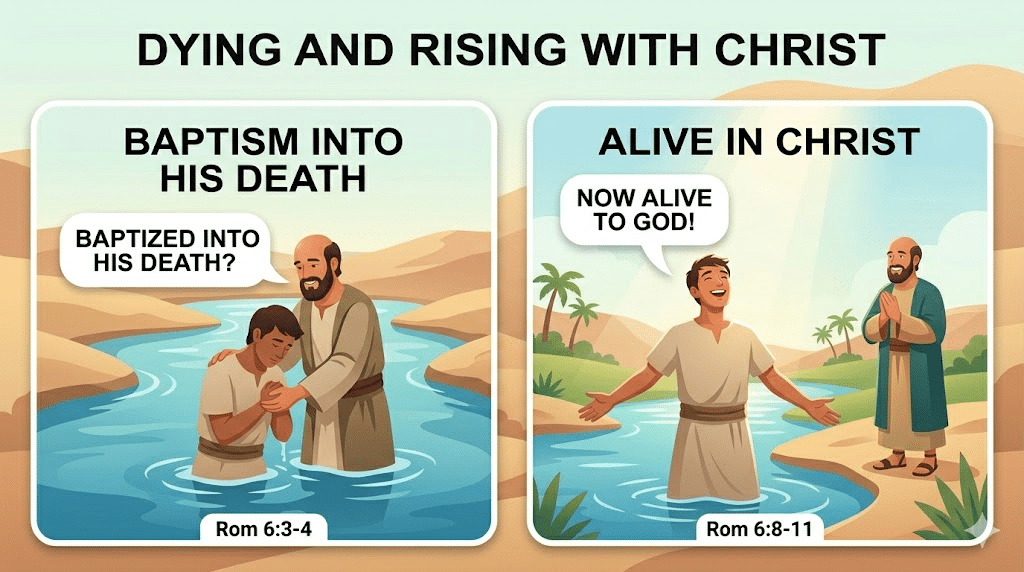
Rom 6:3-4, 8-11
XXXXXXXXXXXXXXXXXXXXXXX list ten questions divided into sections, with each section having a
title, based on the following that a preacher could ask an AI Catholic assistant for help with as the preacher prepares his homily. Do not use phrases such as “The text notes refer to” “The commentary suggests”. Instead use “xxxxxxx refers” and “xxxxxxx suggests” . Whenever possible though it is best to cite a specific verse or verses of the reading when writing the question. Do not place questions in quotation marks.
Verse 3 — "Are you unaware that we who were baptized into Christ Jesus were baptized into his death?"
Paul asks a rhetorical question that assumes the Romans should already know this—it is foundational catechesis. The key word is into (Greek eis): we are not baptized in memory of Christ's death but into it—really incorporated, plunged into the very event of Calvary.
Catholic connection: This is the bedrock of Catholic sacramental theology: the sacraments effect what they signify. Baptism does not merely symbolize union with Christ's death; it accomplishes it. The Catechism (§1227) teaches that the baptized are truly plunged into Christ's death so as to rise with him. This separates the Catholic understanding from any purely memorialist view—the water is the instrument of a real spiritual event, configuring us to Christ crucified.
Real-life application: Help parishioners recover the weight of their own baptism. It is not a sentimental ceremony from infancy but the most decisive event of their existence—the day they were joined to the death that saves the world. Encourage them to mark their baptismal anniversary as they would a birthday, and to bless themselves with holy water mindfully, recalling who they became.
Verse 4 — "We were indeed buried with him through baptism into death, so that... we too might live in newness of life."
Paul intensifies the imagery: not merely death but burial—synthaptō, "buried with." You do not bury a metaphor; you bury a body. And the purpose clause points forward: we are buried in order to rise to "newness of life," patterned on Christ's resurrection "by the glory of the Father."
Catholic connection: The early Church enacted this through full immersion—the font as both tomb and womb. The candidate went down under the water (buried) and rose gasping (reborn). The Catechism (§1214) notes the very word baptize means to "plunge" or "immerse," signifying burial into Christ's death from which we rise. "Newness of life" is sanctifying grace—not merely a fresh start by willpower but the infused life of God in the soul.
Real-life application: "Newness of life" must be visible. Invite parishioners to ask: where is the new life showing in concrete change—a forgiven grudge, a broken habit, a renewed marriage? Baptism is not finished business; it is a life to be lived out daily. The Easter renewal of baptismal promises is the annual recommitment to this newness.
Verse 8 — "If, then, we have died with Christ, we believe that we shall also live with him."
Paul moves from the past event to future hope, and grounds it in faith: "we believe." The dying with Christ (already accomplished in Baptism) is the guarantee of the living with him (yet to be fully realized).
Catholic connection: This is the structure of theological hope—the confident expectation of eternal life founded not on optimism but on union with the risen Christ. Our future resurrection is secured by our present incorporation into him. This is the "already and not yet" of Christian existence: we have already died and risen sacramentally, and we not yet fully live with him in glory. The Catechism (§1003) teaches that the baptized are already, in a real sense, raised with Christ and hidden with him in God.
Real-life application: Offer this to the grieving and the dying. Death for the baptized is not annihilation but the final fulfillment of a dying already begun at the font. Encourage parishioners to face mortality—their own and their loved ones'—with the firm hope that the One they died with will not abandon them in death.
Verse 9 — "We know that Christ, raised from the dead, dies no more; death no longer has power over him."
A triumphant declaration: Christ's resurrection is definitive. Unlike Lazarus, who rose only to die again, Christ rose to a life death can never reclaim. Death's dominion over him is permanently broken.
Catholic connection: This is the heart of the Paschal Mystery—Christ's victory over death is total and final. The risen Christ is the "firstfruits" (1 Cor 15:20), and his deathless life is the pledge of ours. This truth is proclaimed in every Mass, which makes present that one definitive sacrifice and resurrection. Death, the "last enemy" (1 Cor 15:26), has been disarmed at its root.
Real-life application: In a culture that fears death and hides from it, the Christian proclaims that death has lost its tyranny. Help parishioners live free from the paralyzing fear of death—not by denial, but by anchoring in Christ over whom death has no power. This frees us to spend our lives generously rather than clutching at self-preservation.
Verse 10 — "As to his death, he died to sin once and for all; as to his life, he lives for God."
Paul draws the contrast sharply: Christ's death was a once-for-all (ephapax) event with respect to sin, and his risen life is lived wholly "for God." Two orientations: a definitive break, and a total self-gift.
Catholic connection: The "once and for all" character of Christ's sacrifice is central—the Letter to the Hebrews develops it fully (Heb 9:28). This is why the Mass does not repeat Calvary but re-presents the one eternal sacrifice. Christ "lives for God" models the destiny of the redeemed: a life no longer curved in on itself but oriented entirely toward the Father. Grace reorients the whole person Godward.
Real-life application: Invite a personal examination: For what, or for whom, am I living? The risen Christ lives "for God"—the baptized are called to the same reorientation, away from the self as center and toward God and neighbor. Concretely: ordering one's day around prayer, offering one's work as a gift, choosing service over self-interest.
Verse 11 — "Consequently, you too must think of yourselves as being dead to sin and living for God in Christ Jesus."
Here is Paul's pastoral conclusion—and his only imperative in the passage: think of yourselves (logizesthe, "reckon," "consider") as dead to sin and alive to God. The indicative ("you have died and risen") gives rise to the imperative ("now live like it").
Catholic connection: This is the classic Catholic synthesis of grace and moral effort: "Become what you are." The moral life is not the cause of our union with God but its consequence and fruit. We do not strive in order to earn the new life; we strive because we have already received it. The struggle against sin remains real (Romans 7), which is why the Sacrament of Reconciliation continually applies baptismal grace to our daily failures—not as a loophole, but as the ongoing healing of the baptized.
Real-life application: Give parishioners the daily practice Paul commands: a deliberate reckoning. Each morning, claim the truth—"I am dead to sin and alive to God in Christ"—and let it govern the day's choices. When temptation comes, the response is not merely "I shouldn't" but "that is not who I am anymore." Identity drives behavior. And when we fall, Confession restores the newness without ever revoking the original gift.e; God responds by filling the barren places of our lives with life itself. The one who prepares a table for the Lord receives more than she ever set on it—a truth fulfilled every time we approach the altar.
Algorithmically generated text
An excellent and important question—this is one of the most pastorally vital passages in all of Paul, and getting its logic right protects against the perennial temptation to cheapen grace. Let's lay out Paul's argument and then offer some homiletic strategies for breaking it open.
Paul's Argument in Romans 6:1-2
The passage paraphrases closely: "What then shall we say? Shall we persist in sin that grace may abound? Of course not! How can we who died to sin yet live in it?"
Paul is anticipating an objection to what he just taught in 5:20—that "where sin increased, grace overflowed all the more." A clever interlocutor draws the wrong conclusion: if my sin draws out more grace, then sinning is practically a favor to God's glory! Paul's response is not a measured "let's be careful here" but an emphatic, almost scandalized rejection: mē genoito—"By no means!" / "God forbid!" / "Of course not!"
His refutation rests not on a new rule but on a change of identity and state of being: we have died to sin. You cannot simultaneously be dead to something and alive in it. The logic is ontological, not merely moral.
Breaking Down the "Black vs. White" Logic
Here is the key to preaching this well: Paul reasons from being, not from behavior. The reason a Christian cannot persist in sin is not "it's against the rules" but "it contradicts who you now are." Several strategies:
1. Name the False Logic Out Loud
Congregations rarely say it aloud, but many live by the misreading: "God's grace covers everything, so my habitual sin isn't a big deal—forgiveness is automatic." This is the ancient error of antinomianism (against the law) and what Dietrich Bonhoeffer later called "cheap grace"—grace as a commodity that excuses rather than transforms. Naming the temptation directly gives people permission to recognize it in themselves.
2. The Death Imagery Is the Hinge—Use Baptism
Paul's very next verses (6:3-4) ground the argument in Baptism: we were baptized into Christ's death and raised to "newness of life." For a Catholic congregation, this is golden. The "black vs. white" logic is the logic of death and resurrection—there is no halfway. A corpse does not negotiate with its old life. We have been buried with Christ; to return to sin is to crawl back into the tomb we were raised out of. The Catechism (§1213ff.) presents Baptism precisely as this radical break and new birth.
3. Use Concrete Analogies for the Severance
The abstract "died to sin" needs incarnating:
- A man who has divorced an abusive relationship does not keep visiting the abuser "now and then."
- An addict in recovery does not say, "Since the program forgives relapses, I'll keep one foot in the old life."
- A naturalized citizen who has sworn a new allegiance does not keep serving the former hostile regime.
In each case, the new identity makes the old behavior absurd, not merely forbidden.
4. Distinguish Grace as Power, Not Just Pardon
This is the heart of the Catholic correction to the cheap-grace error. In Catholic theology, grace is not merely God overlooking sin (a legal fiction) but God's life infused into the soul—sanctifying grace that actually transforms us (justification as real interior renewal, per the Council of Trent, contra a purely imputed righteousness). Grace doesn't give us a longer leash to sin; it gives us a new heart that no longer wants the leash. Preach grace as medicine and power, not as a permission slip.
5. The "Therefore" of Moral Life Flows From Identity
Help your people see Paul's whole structure: chapters 1-5 establish what God has done; chapter 6 onward says, in effect, "Now become what you are." The moral demand is not the cause of our standing with God but the consequence of it. We don't break from sin in order to earn grace; we break from sin because grace has already made us new. This is the Catholic synthesis of grace and works—works as the fruit and flowering of grace received, never as its purchase price.
A Homiletic Frame You Might Use
Consider building around a single controlling image: the empty tomb. Christ did not rise in order to walk back in. Then turn it on the congregation: "In Baptism, you were placed in that tomb with Him—and brought out. The question Paul puts to us is devastatingly simple: why would you move back into a grave?"
You can close by reframing the relationship between grace and effort so no one hears legalism: We do not climb out of sin to deserve grace; we have already been carried out. The Christian moral life is not the price of resurrection—it is what resurrection looks like when it's lived.
A Pastoral Caution
Two balances to hold so the homily doesn't wound:
Hold mercy and demand together. The same Paul who says "By no means!" also writes the hymn to grace. The goal is not fear but freedom—freedom from sin's dominion, not freedom to sin.saved the same way we fell—through a representative head.
Avoid rigorism. "Died to sin" describes our objective state in Christ and our trajectory, not a claim that we are now sinlessly perfect. The struggle continues (Romans 7), which is why the Sacrament of Reconciliation exists—not as a loophole, but as the ongoing application of baptismal grace to our daily failures. Make clear that falling is not the same as the settled persisting in sin Paul condemns.
Algorithmically generated text
A vital question, and one that strikes at a real weakness in much contemporary preaching and catechesis: Baptism is so often reduced to a charming ceremony with a baby in a white gown that its shocking, lethal language gets domesticated. Paul does not say we were reminded of Christ's death or symbolically associated with it—he says we were baptized into it. Let me unfold the theology and then offer ways to make its reality land.
The Text — Romans 6:3-4 (NABRE)
Close paraphrase: "Are you unaware that we who were baptized into Christ Jesus were baptized into his death? We were indeed buried with him through baptism into death, so that, just as Christ was raised from the dead by the glory of the Father, we too might live in newness of life."
Paul's grammar is forceful. The preposition into (Greek eis) denotes real incorporation, not mere reference. And the verb he uses next—buried with (synthaptō)—is the language of a corpse and a grave. You do not bury a metaphor.
The Catholic Foundation: Why It Is Real, Not Symbolic
This is the decisive Catholic point, and it distinguishes our sacramental theology from a purely memorialist view: the sacraments effect what they signify. Baptism does not merely picture dying and rising; it accomplishes it. The Catechism (§1227, §1265) teaches that in Baptism the Christian is truly "configured to Christ," made a new creation, with the old self really put to death and the life of grace really infused. The water is not a visual aid; it is the instrument of a genuine spiritual event.
The early Church understood this viscerally. St. Paul, and the Fathers after him, saw the baptismal font as both tomb and womb—we are drowned in it and born from it. St. Cyril of Jerusalem told the newly baptized that in the same moment they were dying and being born. The ancient practice of full immersion preached this with the body: the candidate disappeared beneath the water (buried) and rose up gasping (resurrected). The architecture itself often made fonts cruciform or tomb-shaped.
Communicating the Reality — Homiletic Strategies
1. Recover the Violence of the Language
Don't soften Paul's words—lean into them. Baptism is described in terms of death, burial, drowning, crucifixion of the old self (Rom 6:6). A congregation accustomed to thinking of Baptism as gentle and sweet needs to hear that it is, in its deepest meaning, an execution—the old self is put to death. This is jarring in a good way; it wakes people up to what actually happened to them.
2. Use the Immersion Image Even If You Baptize by Pouring
Paint the picture of the early Church's full immersion: going down under the water, out of sight, breath held—a real enactment of being buried; then breaking the surface into air and light. Whether your parish immerses or pours, the image teaches the theology. Help people feel the held breath and the rising gasp.
3. Make Clear the Dying Is Ongoing, Not Only Past
Here is the pastoral key. The death of Baptism happened once and is complete—but the living out of that death is a daily task. Paul will say elsewhere, "I die daily" (1 Cor 15:31), and "it is no longer I who live, but Christ lives in me" (Gal 2:20). The reality of the once-for-all baptismal death must be ratified every day in concrete acts of dying to self. This is where it stops being abstract.
4. Incarnate "Dying to Self" in Concrete Acts
"Dying to self" is hollow until it's specific. Give it flesh:
- Choosing to forgive the person you'd rather resent—that is the old self dying.
- Holding your tongue when you have the cutting remark ready.
- Getting up for the night feeding, the early shift, the sick parent—laying down your own preference.
- Surrendering the grudge, the addiction, the controlling need to be right.
Each of these is a small enactment of the tomb—a real, felt dying. Tell your people: every time you choose Christ over the demands of the ego, you are living out your baptism; the font is doing its work in you today.
5. Connect It to the Renewal of Baptismal Promises
Remind the congregation that every time they bless themselves with holy water entering the church, and especially when they renew their baptismal promises at Easter, they are not performing empty gestures—they are reaffirming a death they actually died and a life they actually received.
A Homiletic Frame You Might Use
Consider building around the paradox of the font as tomb and womb:
"We tend to think of the baptismal font as the gentlest thing in the church—a place for babies and white gowns and family photos. But Saint Paul would have us see it for what it really is: a grave. When you were baptized, something in you was meant to die. The water closed over the old self like the stone over the tomb. And here is the mystery—it was also a womb, because you rose out of it newly alive... But brothers and sisters, a person can be truly raised and still drag the grave-clothes around. The death we died in the font asks to be lived out every single day—in every choice to forgive, to serve, to surrender. The font did its work once. The question is whether we will let that death keep working in us."
A Caution to Keep It Balanced
Hold death and resurrection together. Paul never speaks of the dying without the rising. The tomb is for the sake of newness of life. End in resurrection, always, so the homily liberates rather than burdens.
Don't make it sound grim or life-denying. Dying to self is not self-hatred or the destruction of our true personhood. Grace perfects nature; what dies is the disordered self—the ego curved in on itself—so that the true self, made in God's image, can finally live. The aim is fullness of life (John 10:10), not annihilation. Make clear that we lose only what was killing us.
Algorithmically generated text
The winter-to-spring analogy is one of the most accessible and hope-giving frames available to a preacher, precisely because every parishioner has felt both seasons in their bones. Let me develop both the theological grounding and the practical homiletic weaving.
Why the Analogy Works Theologically
The death-to-life movement of grace maps onto the seasons with remarkable fidelity, and the Church herself has long thought this way:
- The liturgical calendar already preaches it. Lent falls in late winter and culminates in Easter as spring breaks—this is not accidental. The very word Lent derives from the Old English lencten, meaning "spring" / "the lengthening of days." The Church baked the analogy into her calendar: the season of penance is the season of thaw.
- Scripture is full of the imagery. "See, the winter is past... the flowers appear on the earth" (Song of Songs 2:11-12). Ezekiel's valley of dry bones coming to life (Ez 37). The grain of wheat that must fall and die to bear fruit (John 12:24). Christ's own resurrection in a garden, mistaken for the gardener (John 20:15)—new life breaking from a tomb amid growing things.
The Key Theological Points the Analogy Carries
This is what makes it more than a pretty picture—the analogy teaches genuine truths about grace:
1. Spring is not earned; it is received. No frozen branch strains itself into bud. The thaw comes from outside—from the sun's returning warmth. This perfectly carries the doctrine of grace: we do not manufacture our own renewal; God's grace, like the sun, comes to us and draws life out of us. For the parishioner stuck in habitual sin, this is liberating: you are not asked to generate spring by willpower; you are asked to turn toward the Sun.
2. Life was hidden, not destroyed, beneath the winter. This is the crucial pastoral note. Winter does not kill the tree; it makes it look dead while life waits dormant at the root. The soul mired in habitual sin often feels dead—but the baptismal life, the image of God, the capacity for grace, is dormant, not extinguished. Hope rests on this: God sees the living root beneath the frozen surface.
3. Spring is gradual, not instantaneous. Winter doesn't end in a day, and neither does the grip of habitual sin. This honors the lived reality of those who confess the same sins again and again. The thaw is real even when it's slow; a single warm afternoon doesn't end winter, but it is a true sign that the season is turning.
Weaving It Into the Homily — Practical Strategies
Open with the shared experience of winter. Don't start with doctrine—start with the feeling. The grey weeks when the cold seems permanent, when you can't quite remember what warmth felt like. Then name the spiritual parallel: the soul has its winters too—the long stretch in a habit of sin where grace feels distant, where you wonder if anything will ever grow again.
Validate the feeling of frozenness before offering the thaw. The parishioner stuck in habitual sin often carries shame and exhaustion—"I've confessed this a hundred times." Meet them there. Winter is genuinely hard; it is not a moral failure to have experienced a long one. This builds trust before you preach hope.
Locate the source of the thaw outside themselves. This is the hinge. Pivot from "try harder" (which is just demanding the branch bud itself) to "turn toward the Sun." Concretely, the "sun" is the means of grace: the Sacrament of Reconciliation, the Eucharist, prayer, Scripture. These are not chores to earn spring—they are standing in the sunlight. Reframe Confession especially not as a winter ritual of shame but as stepping into the warmth that does the work in us.
Use the gradualness to disarm discouragement. Tell them: spring does not arrive all at once, and neither will their freedom. There will be late frosts—relapses. But a frost in April does not mean winter has returned for good. The trajectory of the season has turned. This is the difference between Paul's "persisting in sin" and the penitent's struggle—the struggler is in spring, even amid setbacks.
Close in the garden of the Resurrection. Bring it to its Christian summit: our hope is not a vague natural optimism that "things get better." It is anchored in a specific event—Christ rising in a garden as the firstfruits. Easter is God's promise that the final word over every winter, even the winter of death itself, is spring.
A Sample Homiletic Movement
You might structure it as a single arc:
"We all know what it is to live through a long winter... [the felt experience]. And some of us know a winter of the soul—a sin we keep returning to, a coldness we can't seem to shake... [naming the struggle]. But here is the Gospel hidden in every spring: the frozen branch does not bud by trying harder. It buds because the sun comes back. And brothers and sisters, the Sun has come back. He rose in a garden... [the turn to grace]. Your task this Lent is not to manufacture your own spring. It is simply to step out of the shadow and into His light—in this confessional, at this altar... [the call to the means of grace]. And if a late frost comes, do not despair. One cold morning does not undo the spring. The season has turned. It turned at the empty tomb, and it is turning in you."
A Caution to Keep It Honest
Two balances so the image doesn't mislead:
Don't promise a particular timeline. Some winters of the soul are long, and dark nights can be God's purifying work, not merely the absence of grace (St. John of the Cross). Avoid suggesting that anyone who hasn't "felt spring" yet has done something wrong. to know exactly where to apply.
Don't imply the change is automatic or effortless. Spring in nature is passive, but our cooperation with grace is active—we must turn toward the Sun, frequent the sacraments, flee the near occasions of sin. Grace is gratuitous, but it is not coercive; the branch must not wrap itself in a tarp against the light. Make clear that "turning toward the Sun" includes real repentance and the firm purpose of amendment.
Algorithmically generated text
How does the change of seasons inspire you? How does your attitude adjust as winter becomes spring?
In these verses, Paul continued the “black vs. white” logic he used throughout Romans. This time he compared death and life to answer a question: if God acted and saved us even when we were sinners, why can’t we continue to live a sinful lifestyle? After all, we are now free from the Law! Why can’t we do as we please?
Paul answered this dilemma in death and life terms. When we were baptized, we died to self and committed ourselves to God. To do otherwise would be to break our baptismal promises. To act selfishly would be to turn away from our oath to God.
But, Paul saw a deeper connection. When we were baptized, Paul held, we gained a sacramental bond with the death of Christ. In a very real way, we died along with our Savior. Since the Risen Christ still carries the imprints of his crucifixion, he has death with him. It is as if Christ absorbed the power of death and transformed it into new life. As baptized Christians, we are one with the Risen Christ and one with death turned into life. We live death transformed because we are in Christ. In other words, when we were baptized, in a spiritual sense, we really did die. Our physical death in Christ also meant a death to previous immorality.
If we touch death in Christ, we are also one with his resurrected life. Now we can live a life united with God. Just as Christ is oriented towards the Father, we, too, should commit ourselves to the Father.
So, why can’t we do what we please? Because, in baptism, we change as Christ changed. Like winter that turns to spring, we change from the death of sin to a life forever with God. So, salvation does not mean libertine freedom from the Law. It means a freedom of commitment, freedom to align ourselves to someone greater.
Reflect on your baptism. Can you imagine what your life could have been before baptism? (Or, do you remember what your life was like before baptism?) How have you changed? How has your commitment to God grown?
Create a simple, modern infographic illustrating [INSERT BIBLE PASSAGE OR TOPIC]. Use a [SPLIT-SCREEN / 3-PANEL] layout. The style should be clean, high-quality digital art or vector illustration.
Visuals:
Panel 1: Show [DESCRIBE SCENE 1 – e.g., a stormy sea].
Panel 2: Show [DESCRIBE SCENE 2 – e.g., Jesus calming the waves].
Text & Typography:
Font: Use EXTRA LARGE, BOLD, SANS-SERIF FONT (like Arial). Ensure high contrast so text is easily readable.
Header: Write “[INSERT MAIN TITLE]” at the top.
Captions: Include short, punchy text summaries in the panels: “[TEXT FOR PANEL 1]” and “[TEXT FOR PANEL 2]”.
Overall Vibe: Professional, educational, and uncluttered. Avoid small details; focus on big images and big text.
Non-profits have permission to use this infographic in their ministry.


13th Sunday of Year A
Write an engaging description meant to get readers to read Larry Broding’s commentary which can be used to help preachers prepare their own homily. After a brief introduction give bulletin points of why this commentary matters for your homily. conclude with “Read Larry Broding’s full commentary to help your congregation…” Complete sentence. XXXXXXXXXXXXXXXXXXXXXXX
Matthew 10:37-42
XXXXXXXXXXXXXXXXXXXXXXX list ten questions divided into sections, with each section having a
title, based on the following that a preacher could ask an AI Catholic assistant for help with as the preacher prepares his homily. Do not use phrases such as “The text notes refer to” “The commentary suggests”. Instead use “xxxxxxx refers” and “xxxxxxx suggests” . Whenever possible though it is best to cite a specific verse or verses of the reading when writing the question. Do not place questions in quotation marks.
Verse 37 — "Whoever loves father or mother more than me is not worthy of me, and whoever loves son or daughter more than me is not worthy of me."
Jesus makes a startling claim to absolute priority—above even the most sacred and tender human bonds of family. The Lukan parallel (Lk 14:26) uses the even more jarring word "hate," a Semitic idiom for loving less by comparison. Jesus is not abolishing the Fourth Commandment; he is establishing the order of love.
Catholic connection: This teaches the proper hierarchy of charity (ordo caritatis). God must be loved above all things (the First Commandment and the Greatest Commandment, Mt 22:37-38). Far from undermining family love, rightly ordering our love toward God first purifies and perfects every other love. The Catechism (§2232) teaches that family bonds, though important, are not absolute—the disciple's first vocation is to follow Christ. Only the one who loves God supremely can love family rightly.
Real-life application: This speaks to anyone whose faith has cost them within their family—the convert whose relatives feel betrayed, the young person pursuing a religious vocation against parental wishes, the spouse who won't compromise moral conviction to keep peace. Reassure them: putting Christ first does not make you a worse son, daughter, or parent—it makes you a better one, because your love is now anchored in its true source.
Verse 38 — "...and whoever does not take up his cross and follow after me is not worthy of me."
This is the first mention of the cross in Matthew's Gospel—and it lands on the disciples before Jesus has even gone to Calvary. To his original hearers, the cross was an instrument of brutal Roman execution; "take up your cross" meant something like "carry the beam to your own death."
Catholic connection: This is the doctrine of redemptive suffering and the imitation of Christ (imitatio Christi). Discipleship is cruciform. The Catechism (§1506) and St. Paul (Col 1:24) teach that the Christian unites his sufferings to Christ's, filling up "what is lacking" not in their sufficiency but in their application to our lives and the Church. The cross is not merely endured but taken up—freely embraced as a share in Christ's saving work.
Real-life application: Help parishioners identify their actual cross—chronic illness, a difficult marriage faithfully kept, the demands of caring for an aging parent or special-needs child, faithful endurance of injustice. The call is not to seek out suffering, but to carry the cross already given, offering it in union with Christ rather than merely resenting it. "Offer it up" is not a pious cliché but a profound theology of redemptive love.
Verse 39 — "Whoever finds his life will lose it, and whoever loses his life for my sake will find it."
The great paradox of the Gospel, stated as a chiasm. The self-protective grasping at life ends in losing it; the self-emptying surrender of life "for my sake" is the path to truly finding it.
Catholic connection: This is the paschal pattern applied to the whole of life—the same dying-to-rise we find in Romans 6 and in the grain of wheat (Jn 12:24). It undergirds the Church's teaching that self-gift, not self-assertion, is the road to human fulfillment. Gaudium et Spes (§24) famously teaches that man "cannot fully find himself except through a sincere gift of himself." We are made in the image of a self-giving God, and so we become ourselves only by giving ourselves away.
Real-life application: This confronts the contemporary gospel of self-fulfillment, self-care-as-ultimate, and "looking out for number one." Concretely: the parent who pours out life for children, the spouse who serves rather than demands, the volunteer who spends themselves for strangers—these are not losing their lives but finding them. Invite parishioners to notice where clutching at self has left them empty, and where self-gift has surprised them with joy.
Verse 40 — "Whoever receives you receives me, and whoever receives me receives the one who sent me."
Jesus now turns from the cost borne by the missionaries to the welcome they will receive. He establishes a chain of identity: to welcome the apostle is to welcome Christ, and to welcome Christ is to welcome the Father.
Catholic connection: This is the principle of apostolic representation and the foundation of the Church's understanding of authority and the sacraments. The one sent acts in the name of the Sender; the priest acts in persona Christi. It also grounds our reverence for the Magisterium—"He who hears you hears me" (Lk 10:16). And it expresses the Trinitarian "sending" (missio): the Father sends the Son, the Son sends the apostles, and the Church continues that mission to this day.
Real-life application: Encourage genuine reverence and support for those who carry Christ's mission—priests, deacons, missionaries, catechists. To welcome, pray for, and assist them is to welcome Christ himself. And remind every baptized person that they too are sent—how others receive their witness is, in a real sense, how others receive Christ through them.
Verse 41 — "Whoever receives a prophet because he is a prophet will receive a prophet's reward, and whoever receives a righteous man because he is righteous will receive a righteous man's reward."
Jesus extends the principle: welcoming holy persons precisely because of their holiness draws the welcomer into a share of their reward. The motive matters—"because he is a prophet"—the welcome flows from recognition of and love for the holiness they represent.
Catholic connection: This beautifully grounds the communion of saints—we share in the spiritual goods of one another. By honoring and associating ourselves with the holy (the prophets, the saints, the righteous), we are drawn into their merits and their reward. This is the logic behind devotion to the saints, asking their intercession, and venerating their witness: we receive a share by receiving them. It also recalls the Shunammite woman, who welcomed Elisha as a holy man of God (2 Kings 4:9) and received a prophet's reward—a striking link if this is paired with that first reading.
Real-life application: Encourage parishioners to surround themselves with holiness—holy friendships, the company of the saints through reading their lives, devotion that draws them into the family of the righteous. Whom we welcome and admire shapes what we become. Supporting a holy work or person, even in small ways, makes us sharers in its fruit.
Verse 42 — "And whoever gives only a cup of cold water to one of these little ones to drink because he is a disciple—amen, I say to you, he will surely not lose his reward."
The discourse ends on the smallest possible gesture—a cup of cold water. Even the most trivial act of kindness, done because the recipient belongs to Christ, is seen and rewarded by God. The "little ones" are Christ's humble disciples; nothing offered to them is too small to matter.
Catholic connection: This is the dignity of small acts done in charity and the theology of merit—not that we earn salvation, but that God in his goodness crowns the works grace enables us to perform (cf. Mt 25:40, "whatever you did for one of these least... you did for me"). The Catechism (§2447) places the giving of water among the corporal works of mercy. The emphasis on a cup of cold water assures even the poorest disciple that they have something to give—generosity is measured by love, not by amount.
Real-life application: Liberate your people from thinking they must do something grand to please God. The text dignifies the smallest kindnesses: a kind word, a glass of water, a ride to Mass, a meal for a sick neighbor, a moment of attention to a lonely person—all done "because he is a disciple," for the love of Christ. Nothing offered in love is wasted or unseen. St. Thérèse's "little way" is built precisely on this verse's logic.
Algorithmically generated text
A pointed and timely question—because this is precisely where the abstract demand of Matthew 10:37 ("whoever loves... more than me is not worthy of me") meets the asphalt of Monday morning. The modern workplace is one of the chief arenas where putting Christ first costs something real, and your professionals need concrete, recognizable examples, not pious generalities. Here are some, organized by the kinds of pressure they actually face.
First, Frame the Principle Rightly
Before the examples, give your congregation the right frame so they don't hear "be a difficult, sanctimonious employee." Putting Christ first at work usually doesn't look like preaching at the coffee machine—it looks like integrity under pressure, excellence as a form of witness, and the quiet courage to say no when something is wrong. Often the witness is how they work, not just whether they talk about faith. Jesus in the "number one slot" most often shows itself in the moment of compromise, when no one would know if you bent.
Concrete Examples by Type of Pressure
1. The Pressure to Be Dishonest
- The accountant or analyst asked to "adjust" numbers, soften a disclosure, or bury an inconvenient figure—and who quietly refuses, even at cost to a bonus or a relationship with a superior.
- The salesperson pressured to overpromise what a product can do, who chooses truthful representation over the easy commission.
- The employee asked to cover for a boss's misconduct, who declines to lie even when "everyone does it."
The Christ-first move: losing the deal, the bonus, or the goodwill rather than losing integrity. This is "losing one's life to find it" (v. 39) in microcosm.
2. The Pressure to Stay Silent About Wrongdoing
- Witnessing harassment, discrimination, or the mistreatment of a vulnerable coworker, and choosing to speak up or report it rather than look away to protect oneself.
- Noticing a practice that exploits customers or cuts dangerous corners, and raising it despite the risk of being labeled "not a team player."
The Christ-first move: the cross of becoming inconvenient for the sake of justice (v. 38). This is costly and lonely—name that honestly.
3. The Pressure of the Crowd's Values
- The colleague who declines to join in tearing down an absent coworker, gossip, or office cruelty—and changes the tone of a room simply by not participating.
- The professional who won't laugh along at the crude joke or the mockery of someone's faith, family, or dignity.
- The person who maintains chastity and fidelity at the conference, the work trip, the after-hours culture where infidelity is winked at.
The Christ-first move: a witness given through what one refuses to do—often more eloquent than any sermon.
4. The Pressure of the Idol of Career
- The parent who declines the promotion that would mean never seeing their children, choosing the rightly-ordered love of family over advancement—an echo of getting the ordo caritatis right.
- The professional who guards Sunday Mass and the Sabbath rest against a culture of 24/7 availability, who logs off to be present to family and God.
- The person who refuses to let work become the source of their entire identity and worth, holding it instead as a vocation offered to God rather than an idol that consumes them.
The Christ-first move: refusing to let career occupy the number-one slot that belongs to God—and discovering, paradoxically, a freer and more human way to work.
5. The Pressure to Hide the Faith Entirely
- Keeping a small crucifix or holy image at one's desk, or simply not denying one's faith when it comes up naturally.
- Treating subordinates, the cleaning staff, and difficult clients with a consistent dignity that quietly puzzles people—and occasionally prompts the question, "Why are you different?"
- Being known as the person others come to when they're in crisis, because they've sensed something trustworthy.
The Christ-first move: the "cup of cold water" (v. 42)—witness through small, consistent acts of charity that make Christ visible without a word.
A Powerful Homiletic Technique: The Hidden Moment
The most effective workplace examples are the ones no one sees. Consider framing it this way for your congregation:
"Putting Jesus first at work rarely happens on a stage. It happens in a quiet moment when you could click 'send' on the misleading email and no one would ever know—and you delete it instead. It happens when you could pad the report, take the credit, stay silent about the wrong—and you don't. That hidden 'no' is where you decide who sits in the number-one slot of your life. God sees it. And Jesus promises that not even a cup of cold water given in his name will be forgotten."
The Reassurance and the Reward
Two things to add so the homily doesn't leave people merely braced for martyrdom:
- Name the real cost honestly. Sometimes integrity costs the promotion, the bonus, even the job. Don't promise that doing right always pays off worldly. Jesus didn't. The cross in verse 38 is real. But pair it immediately with verse 39's promise: what looks like losing your life is actually finding it.
- Point to the quiet fruit. Often the witness does bear visible fruit—the colleague who, years later, says "I never forgot that you treated me with respect," or "I started coming back to church because of how you carried yourself." Verses 40-42 promise that no faithful witness is wasted; the reward is sure even when invisible.
A Closing Image
You might end by collapsing the whole passage into the workplace: The cross you take up (v. 38) may be a Monday-morning decision no one applauds. The life you lose (v. 39) may be a bonus or a friendship at the office. But the cup of cold water you give in his name (v. 42)—the integrity, the kindness, the courageous no—will not lose its reward. Christ counts what the corporation never will.
Algorithmically generated text
An excellent instinct—Matthew 10:39 is a verse that demands self-examination, and interactive questions can turn a passive listening experience into a genuine moment of grace. A word of practical wisdom first, then the questions themselves.
A Note on Method
For most congregations, these should be rhetorical questions posed for silent reflection, not questions you expect people to answer aloud (which can make Catholics squirm). Pose a question, then pause—give two or three full seconds of silence so it can actually land. Silence is your most underused homiletic tool here. You might even name this explicitly: "I'm going to ask you some questions this morning, and I don't want answers out loud. I want you to answer them in the quiet of your own heart."
The art is to move from the general and safe toward the specific and uncomfortable, gently. Start where everyone can nod, then narrow until it touches a nerve.
The Questions, Arranged as a Progression
Opening — Naming the Universal Grasp
- What is the one thing in your life that, if God asked you to surrender it tomorrow, you would fight hardest to keep?
- If you're honest—what sits in the number-one slot of your life right now? Not what you'd say in church, but what your calendar and your bank statement and your worries actually reveal?
Deepening — Exposing the Forms of Self-Preservation
Frame these as the various "lives" we clutch at:
- Your reputation: Is there a truth you won't speak, a stand you won't take, because of what people might think of you?
- Your comfort: Where has the desire to keep my life easy quietly become the thing that runs my decisions?
- Your control: What am I gripping so tightly—a plan, a person, an outcome—that there's no room left in my hands to receive what God wants to give?
- Your grudges: Is there a resentment I'm protecting because, somehow, holding onto it feels like holding onto myself?
- Your security: Am I storing up so much against every possible future that I've stopped trusting God with any of it?
The Turn — Toward the Paradox
- Where in my life have I clutched at something to save it—and found it slipping away anyway? (the first half of v. 39)
- And where, surprisingly, have I given something away—my time, my pride, my plans—and discovered I was more alive, not less? (the second half)
- What would it look like, this week, to loosen my grip on just one thing—and place it in God's hands?
The Costly Particular — The Sharpest Questions
Save these for the climax; they touch the rawest places:
- Is there a relationship, a habit, or an ambition I already know, deep down, that Christ is asking me to lay down—and I keep negotiating, keep delaying?
- If I lost my health, my career, my reputation, my plans tomorrow—would there be anything of me left standing? Is Christ that foundation, or have I built my whole self on things that can be taken away?
- What am I so afraid of losing that the fear itself has become my master?
A Technique: The Single Held Question
Sometimes one well-placed question, returned to throughout the homily, is more powerful than a list. You might choose one—"What are you clutching?"—and let it echo as a refrain after each point, building intensity each time. The repetition does the examination work; by the fourth time they hear it, people are answering honestly.
A Closing Invitation Rather Than a Question
You might resolve the self-examination not with another question but with a gentle commission that gives them somewhere to put what surfaced:
"You've named something in the quiet just now—I can feel it in this room. Don't leave it here. Bring it to the altar in a few minutes. Whatever you've been clutching to save your life, lay it down on this altar, where Christ laid down his to find yours. And trust his promise: what you lose for his sake, you will not lose at all—you will finally find."
A Pastoral Caution
Two balances so the questions heal rather than wound:
Be mindful of the suffering present. Some in the pews have already lost—a spouse, a child, their health, their job. Frame "losing your life" carefully so the grieving don't hear that their involuntary losses are what Jesus demands. Distinguish the clutching at self Jesus warns against from the involuntary suffering he himself shares and redeems.
Don't leave them in the wound. Self-examination that only convicts and never consoles produces shame, not conversion. Always pair the searching question with the promise of v. 39's second half—losing for Christ's sake is finding. The point is liberation, not guilt.
Algorithmically generated text
A wonderful and concrete pastoral question—and one that gets at something many parishes quietly struggle with. Most parishes have friendliness; far fewer have hospitality in the theological sense Jesus describes in Matthew 10:40, where to welcome a person is to welcome Christ himself. Let me offer a framework for elevating it, moving from the theological foundation to practical structures.
First, Teach the "Why" Before the "How"
The transformation begins not with a new program but with a renewed vision. A parish that sees greeting as mere social nicety will produce nice greeters; a parish that believes it is literally welcoming Christ in the stranger (Mt 10:40; Mt 25:35, "I was a stranger and you welcomed me") will produce ministers. The foundational catechesis to instill:
- Every person who walks through the door may be Christ in disguise—the seeker, the grieving, the lapsed Catholic risking one more visit, the visitor deciding whether God wants them.
- Hospitality is evangelization. For many, the single experience of being warmly received—or coldly ignored—determines whether they ever return. The threshold of the church is where many vocations to deeper faith are won or lost.
- The Shunammite model (which we explored earlier): she didn't just greet Elisha—she built him a room. Hospitality at its fullest is proactive, costly, and structured, not merely reactive politeness.
Practical Steps to Elevate Hospitality into Ministry
1. Form a Dedicated Hospitality Ministry — and Form Them Spiritually
Don't just recruit greeters; form them. Hold a brief retreat or formation evening grounding the ministry in Scripture (Mt 10:40, Heb 13:2, the Shunammite). When greeters understand they are sacramentalizing Christ's welcome, their demeanor changes. The goal: every person is genuinely seen, not processed.
2. Train for the Specific Moments That Matter Most
- The newcomer: equip greeters to notice unfamiliar faces, introduce themselves by name, help them find seating, and—crucially—follow up. A simple "It was good to have you; I hope we see you again" matters enormously.
- The vulnerable: the visibly grieving, the person with a disability, the family with a crying child (the family that feels welcomed rather than glared at will return; the one that feels judged will not), the obviously poor or homeless person.
- The hesitant returner: the lapsed Catholic testing the waters often arrives anxious. A non-judgmental warmth can be the deciding grace.
3. Build "Rooms" — Structures of Real Welcome
Move beyond the handshake to tangible structures:
- A staffed welcome table with a friendly face, parish information, and a small gift for newcomers.
- A newcomer's coffee or dinner hosted regularly by the pastor and parishioners.
- A connection card and a genuine follow-up (a call or note that week)—this is the parish "building the roof chamber."
- Name tags for ministers, and a culture where regulars are encouraged to sit next to visitors rather than leaving the social safety of their usual pew.
4. Address the "Frozen Chosen" Problem Directly
Many parishes are warm internally but invisible walls keep visitors out—established parishioners cluster with friends after Mass while strangers stand alone. Preach and teach a gentle challenge: the three minutes after Mass belong to the stranger, not to your friends you'll see anyway. Encourage the simple discipline of seeking out one unfamiliar face each Sunday.
5. Extend Hospitality Beyond the Door
True hospitality follows people home:
- A meal ministry for the sick, bereaved, and new parents.
- A ministry to the homebound who can no longer come—bringing the parish's welcome (and the Eucharist) to them.
- Intentional integration so newcomers are quickly invited into a small group, ministry, or friendship—because people stay where they are known, not merely greeted.
6. Make the Liturgy Itself Hospitable
Welcome culminates at the altar. Clear worship aids, an unhurried sign of peace offered with genuine eye contact, an usher who helps rather than hovers, a homily that assumes some present may be seekers or returning after years away—these embody Christ's welcome in the parish's central act.
A Caution to Keep It Authentic
Two balances so the effort bears fruit:
- Welcome without smothering. Some visitors want anonymity at first; aggressive friendliness can overwhelm. Train ministers to read people—warm and available, never pushy. The art is to be welcoming and respectful of where someone is.
- Don't outsource it to a committee. A hospitality ministry is the engine, but the goal is a hospitable culture—every parishioner owning the welcome. If only the official greeters are warm, the project has failed.
A Homiletic Frame to Launch It
If you want to preach this to galvanize the parish, consider:
"When a stranger walks through our doors on Sunday, Jesus says something staggering: that person is me. 'Whoever receives you receives me.' Which means the way we treat the newcomer in the back pew is the way we treat Christ himself. We are good people here—but are we a welcoming people? When someone new stands alone in our gathering space after Mass, do we see an interruption to our conversation... or do we see the Lord, waiting to be welcomed home?"
Then issue a single, concrete challenge—"This week, find one face you don't recognize, and welcome them as you would welcome Christ"—so the homily produces action, not just sentiment.
Algorithmically generated text
The priority of faith demanded radical consequences for early Christians.
Since extended, closely-knit families formed the basis of ancient society, a choice for Christ could mean a rejection of the family’s faith and values. And, ultimately, excommunication by the family. Outside of one’s extended family, a person could easily slide into homelessness.
Jesus reminded his followers that the Christian life involved such risks (a cross to carry in Mt 10:38). And one could not compromise these risks away. A believer could not placate his or her family if the cost threatened faith. No, faith could involve an extreme choice. Either the relationship with family took priority (“…finding life in this world”) or the relationship with Jesus took the number one slot. [Mt 10:39]
What obstacles get in the way of a Christian commitment? How can you overcome such obstacles?
Video courtesy of Larry Broding.
What happened if the follower suffered the worst from his or her declaration for Christ? Fellow Christians would create a new extended family. Here, Christ stressed hospitality. Whoever welcomed the Christian, welcomed Christ and his Father. [10:40] Whoever welcomed those who lived the consequences of radical choice (the traveling missionary and the “good” person who lived God’s will), received the same gift of grace God gave to those in ministry. [10:41] Even in the smallest kindness, God rewarded the minister and the host equally. [10:42] Jesus, then, took a popular virtue and turned it into a ministry on par with the missionary.
Faith demands great risks. But it gives great rewards. One could lose his or her family, but the person gains so much more in return.
How can I extend hospitality to other Christians, especially those in need?
Create a simple, modern infographic illustrating [INSERT BIBLE PASSAGE OR TOPIC]. Use a [SPLIT-SCREEN / 3-PANEL] layout. The style should be clean, high-quality digital art or vector illustration.
Visuals:
Panel 1: Show [DESCRIBE SCENE 1 – e.g., a stormy sea].
Panel 2: Show [DESCRIBE SCENE 2 – e.g., Jesus calming the waves].
Text & Typography:
Font: Use EXTRA LARGE, BOLD, SANS-SERIF FONT (like Arial). Ensure high contrast so text is easily readable.
Header: Write “[INSERT MAIN TITLE]” at the top.
Captions: Include short, punchy text summaries in the panels: “[TEXT FOR PANEL 1]” and “[TEXT FOR PANEL 2]”.
Overall Vibe: Professional, educational, and uncluttered. Avoid small details; focus on big images and big text.

Non-profits have permission to use this infographic in their ministry.