Commentary Intro to Mass Readings Sunday Readings
CommentaryIntro to Mass Readings Sunday Readings
October 11, 2026
⭐⭐⭐ Fr. George Corrigan, OFM—PDF

⬅️  ➡️
➡️
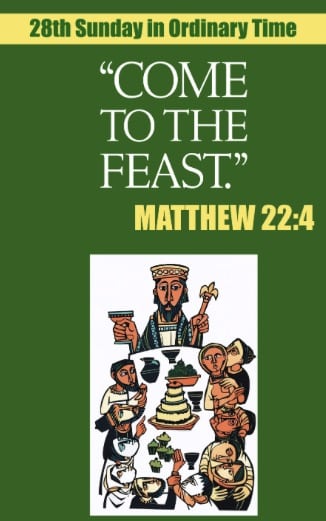
October 11, 2026
Our Sunday Readings
Edrianne Ezell
Catholic Scripture Study
Vince Contreras
Hearers of the Word
Fr. O’Mahony OSA
Friar Musings, OFM
Fr. George Corrigan, OFM
Echoing God’s Word
Fr. Clement Thibodeau


“A Walk in The Word” series is based on the Sunday Mass readings and led by International Catholic evangelist and bible teacher, Hector Molina.

Ten minute video excerpts from the “The Mass Readings Explained” subscription series based resource from Catholic Productions.

Francis Martin (1930 – 2017) was an American Catholic priest of the Archdiocese of Washington, and a professor of Sacred Scripture. His teaching appointments included the Dominican House of Studies, the John Paul II Institute, the Catholic University of America, and Sacred Heart Major Seminary.

Kevin Aldrich
Kevin Aldrich’s “Doctrinal Homily Outlines” is a lectionary-based aid for homilists. A career Catholic K-12 educator in Catholic schools., he has written the teacher guides for nine of the Didache series high school religion texts. He has a Master’s Degree in Theology with an emphasis on Sacred Scripture from Holy Apostles College and Seminary.

Fr. Geoffrey Plant
28th Sunday of Year A

Isaiah 25:6-10a
Create a verse by verse (NAB) commentary relating xxxxxxxxxxxxx TO CATHOLIC doctrine and practice. Give real life applications when appropriate
give me three thought provoking questions followed up with detailed answer reflection based on xxxxxxxxxxxx
Isaiah 25:6
"On this mountain the LORD of hosts will provide for all peoples a feast of rich food and choice wines, juicy, rich food and pure, choice wines."
- Catholic Doctrine: This verse establishes the Messianic Banquet on Mount Zion, finding its sacramental prefiguration in the Holy Eucharist and its ultimate fulfillment in the Heavenly Liturgy (Catechism of the Catholic Church [CCC] 1335, 1344). Christ draws directly upon this imagery in His parables of the kingdom (e.g., Matthew 22:1–14) and at the Last Supper. The universality—“for all peoples”—points to the Catholic (universal) nature of the Church, which gathers every tribe, tongue, and nation into one Communion.
- Liturgical & Sacramental Practice: Every Holy Sacrifice of the Mass is a real participation in this banquet. The altar is Mount Calvary and Mount Zion united, where Christ feeds His people not merely with earthly food, but with His own Body, Blood, Soul, and Divinity under the appearances of bread and choice wine.
- Real-Life Application: Approach Sunday Mass not as an administrative obligation or passive routine, but as an invitation from the Host of Heaven. Prepare for the banquet through regular reception of the Sacrament of Penance, fast prayerfully before Mass, and extend this hospitality by sharing food with the isolated or poor in your community.
Isaiah 25:7
"On this mountain he will destroy the veil that veils all peoples, the web that is woven over all nations."
- Catholic Doctrine: The "veil" and "web" signify the darkness of spiritual ignorance, sin, and the blindness that separated humanity from God following the Fall. In Catholic theology, this veil is destroyed by Christ’s Paschal Mystery. At the moment of His death on Mount Calvary, the veil of the Temple was torn in two (Matthew 27:51), opening access to the Holy of Holies. It also reflects the removal of blindness through Divine Revelation and the illumination of Baptism (photismos), which dispels spiritual blindness (CCC 1216).
- Liturgical & Sacramental Practice: In the Rite of Christian Initiation of Adults (RCIA / OCIA) and infant Baptism, the passing from darkness into Christ’s light is dramatized through the presentation of the white garment and baptismal candle.
- Real-Life Application: Cultivate intellectual and spiritual clarity by allowing Christ to lift modern cultural "veils"—such as consumerism, relativism, or digital distraction. Ground daily life in Scripture, study Catholic doctrine through the Catechism, and make an evening examination of conscience to unmask subtle vices or self-deceptions.
Isaiah 25:8
"He will destroy death forever. The Lord GOD will wipe away the tears from all faces; the reproach of his people he will remove from the whole earth; for the LORD has spoken."
- Catholic Doctrine: This is one of the most profound Old Testament prophecies of the Resurrection of the Body and Eternal Life (CCC 989, 1008). Saint Paul explicitly quotes this passage in 1 Corinthians 15:54: "Death is swallowed up in victory." Christ conquered death ontologically on Easter Sunday, and at the Parousia, bodily death will be annihilated completely. The wiping away of tears and removal of reproach anticipate the Eschatological Restoration and the Beatific Vision, echoed in Revelation 21:4.
- Liturgical & Sacramental Practice: This text forms a staple of the Catholic Order of Christian Funerals. In the funeral liturgy, the Church does not grieve as those who have no hope (1 Thessalonians 4:13); the paschal candle stands lit by the casket, and incense rises to honor a body baptized for resurrection. The Sacrament of the Anointing of the Sick also imparts grace to face sickness and death united to Christ's Passion.
- Real-Life Application: In times of bereavement, severe illness, or chronic suffering, unite your personal grief to the Cross. Offer consoling presence to someone grieving through the spiritual work of mercy (Comforting the Afflicted), rather than offering hollow platitudes; remind them that sorrow does not have the final word in Christ.
Isaiah 25:9
"On that day it will be said: 'Indeed, this is our God; we looked to him, and he saved us! This is the LORD to whom we looked; let us rejoice and be glad that he has saved us!'"
- Catholic Doctrine: This verse encapsulates the theological virtue of Hope (spes), defined as the desire for the kingdom of heaven and eternal life as our happiness, placing our trust in Christ's promises (CCC 1817). The joy proclaimed is not self-reliance, but the fruit of patient endurance and perseverance in grace until the end.
- Liturgical & Sacramental Practice: This text is proclaimed during Advent in the Roman Lectionary. Advent trains the Church in the art of holy longing, directing our gaze not only to Christ's first coming in humility at Bethlehem, but toward His second coming in glory. It also mirrors the Sanctus and the doxological acclamations of the Eucharistic Prayer where the Church rejoices in salvation already begun.
- Real-Life Application: When prayers seem unanswered or when navigating periods of interior spiritual dryness, resist cynical resignation. Cultivate daily patience in traffic, difficult family dynamics, or workplace tension as small exercises in "waiting on the Lord," trusting that God's providence unfolds in His time.
Isaiah 25:10a
"For the hand of the LORD will rest on this mountain..."
- Catholic Doctrine: In biblical language, the "hand of the LORD" signifies divine power, active favor, and permanent protection. Prophetically, this resting hand designates the indefectibility and holiness of the Church, built upon the rock of the apostles and guarded by the Holy Spirit (Matthew 16:18). It underscores the reality of the Incarnation and the Communion of Saints, where God permanently tabernacles among His people.
- Liturgical & Sacramental Practice: The imposition of hands (epiclesis) throughout Catholic sacramental life—calling down the Holy Spirit over the bread and wine at Mass, over the confirmand at Confirmation, over the penitent in Absolution, and over ordinands in Holy Orders—acts as an explicit continuation of the Lord's hand resting in blessing and consecration upon His holy sanctuary.
- Real-Life Application: Find security in God's continuous presence rather than shifting worldly assurances. Make a weekly habit of spending time in silent Adoration before the Blessed Sacrament, placing your life, fears, and family deliberately under the resting, protective hand of Christ.
Algorithmically generated text
give me three thought provoking questions followed up with detailed answer reflection based on xxxxxxxxxxxx. Keep questions and answers appropriate for Sunday congregation giving real life application.
Isaiah 25:6 envisions the summit of God's holy mountain as a banquet of "rich food and choice wines" spread out not just for the chosen few, but for all nations. In Catholic theology, this prophecy finds its sacramental, present-day reality in every Holy Sacrifice of the Mass. Yet a deep spiritual tension often arises: if the King of the Universe has prepared the richest table possible—offering not merely earthly delicacies, but His own Body, Blood, Soul, and Divinity—why does our interior experience of the liturgy so often feel pedestrian, routine, or dry?
The difference lies between physical reception and spiritual disposition. To sit at a banquet requires appetite, presence, and reverence for the Host. When approaching the altar out of mere social expectation or hurried routine, the soul remains undernourished despite the abundance offered. Saint Thomas Aquinas noted that while the sacrament always contains grace in itself (ex opere operato), its fruitfulness in the recipient depends directly on their interior openness (ex opere operantis).
Cultivating this banquet mentality demands deliberate preparation: arriving early to recollected silence, observing the Eucharistic fast with interior intention, and reconciling through Confession when burdened by sin. In daily life, this asks whether we allow Christ’s lavish generosity at the altar to transform our own tables into places of authentic hospitality, charity, and communion with those who are spiritually or physically hungry.
Algorithmically generated text
Isaiah 25:7 promises that the Lord will tear away the "veil that veils all peoples, the web that is woven over all nations." In salvation history, this veil points directly to the blindness of sin, the shadow of death, and the separation of humanity from God—symbolized by the temple veil that tore from top to bottom when Christ died on Calvary.
While Christ has objectively destroyed that barrier, human beings possess a persistent tendency to weave new veils of their own making. These modern veils are often subtle: cynicism disguised as realism, endless digital distraction that dulls contemplative awareness, or ideological rigidities that reduce complex people into political or social caricatures. When a veil covers the heart, God's active providence is perceived as absence, and the dignity of neighbor is reduced to utility or nuisance.
Allowing God to destroy this web requires the vulnerability of daily self-examination. In Catholic spirituality, this is the gift of illumination—asking the Holy Spirit to expose where pride, resentment, or unspoken fears cloud spiritual vision. It demands the intellectual courage to challenge our prejudices through Church teaching and prayer, letting the radiant light of Christ reveal reality as it truly is: a world bathed in redemption, inhabited by immortal souls meant for eternal life.
Algorithmically generated text
The Isaiah 25:8–9 offers one of the most poignant vistas in Sacred Scripture: God personally wiping tears from every face, annihilating death forever, and eliciting the cry, "Indeed, this is our God; we looked to him, and he saved us!" This passage captures the essence of Christian hope (spes)—an active, patient confidence in God’s ultimate victory that refuses to be collapsed into instant gratification or despair.
Contemporary culture is built around immediacy, comfort, and the avoidance of sorrow. When tragedy strikes, bereavement occurs, or prayers remain seemingly unanswered over months or years, the instinct is often either bitter despair or hasty escapism. Christian hope does not deny pain or stifle grief; rather, it anchors the heart in the certainty that suffering and death are not the final chapters of the human story. The Catholic funeral liturgy proclaims this boldly: life is changed, not ended.
Living in the light of Isaiah's promise means embracing the virtue of patience in ordinary trials. When we experience loss, chronic illness, or unanswered longings, we are challenged to unite our tears to the Cross, trusting that no tear is forgotten by God. Instead of demanding that heaven be realized entirely in the here-and-now, the soul learns the mature art of holy waiting—confidently anticipating the dawn when the resting hand of the Lord will make all things new.
Algorithmically generated text
Create a simple, modern infographic illustrating [INSERT BIBLE PASSAGE OR TOPIC]. Use a [SPLIT-SCREEN / 3-PANEL] layout. The style should be clean, high-quality digital art or vector illustration.
Visuals:
Panel 1: Show [DESCRIBE SCENE 1 – e.g., a stormy sea].
Panel 2: Show [DESCRIBE SCENE 2 – e.g., Jesus calming the waves].
Text & Typography:
Font: Use EXTRA LARGE, BOLD, SANS-SERIF FONT (like Arial). Ensure high contrast so text is easily readable.
Header: Write “[INSERT MAIN TITLE]” at the top.
Captions: Include short, punchy text summaries in the panels: “[TEXT FOR PANEL 1]” and “[TEXT FOR PANEL 2]”.
Overall Vibe: Professional, educational, and uncluttered. Avoid small details; focus on big images and big text.


Write an engaging description meant to get readers to read Larry Broding’s commentary which can be used to help preachers prepare their own homily. After a brief introduction give bulletin points of why this commentary matters for your homily.
In the Midst of Danger, Hope

When crisis looms and the congregation gathers carrying personal grief, anxiety, or weariness, abstract theology falls flat. Larry Broding’s reflection on Isaiah 25:6–10a, “In the Midst of Danger, Hope,” bridges the ancient world of prophetic urgency with the lived struggles of modern believers. Broding roots Isaiah’s banquet of rich wine, marrow, and swallowed-up death directly into the brutal historical reality of an advancing Assyrian army—reminding preachers that biblical hope was never born in calm waters, but forged under imminent threat. For any pastor or deacon striving to preach authentic restoration rather than cheap optimism, this commentary is an indispensable homiletic compass.
- Roots Prophetic Joy in Real Geopolitical Crisis: Broding firmly situates Isaiah’s opulent imagery of choice wines and succulent marrow within the catastrophic geopolitical siege of Judah. By showing how the prophet delivered this banquet vision while the brutal Assyrian army stood poised at the gates, the commentary equips you to preach a resilient hope that confronts real dread head-on rather than escaping into naive escapism.
- Transforms Abstract Poetry into Visceral Deliverance: Unpacks the heavy metaphors of the suffocating “veil” and the shroud of death, turning literary imagery into tangible comfort for parishioners facing real grief, diagnosis, or anxiety.
- Bridges the Eschatological Feast to the Eucharistic Table: Broding establishes a seamless theological trajectory running from Isaiah’s mountain banquet to the altar of the Sunday assembly. He provides a clear homiletic transition that bridges the ultimate end-times victory of God with the real-time reception of Christ’s Body and Blood, allowing the parishioner to taste eschatological healing right in the midst of weekly struggle.
- Reframes Death as a Conquered Tyrant: The commentary emphasizes the sheer force of Yahweh “swallowing up death forever” and tenderly wiping away every tear. Broding provides the biblical lineage of death as a destructive monster, empowering preachers to present salvation not merely as a set of rules kept, but as God’s fierce, active rescue operation for an imperiled humanity.
- Equips Preachers with Conversational Pastoral Inquiries: By challenging believers to identify exactly where divine intervention has already met them in their most “down-and-out” valleys, the commentary gives you ready-made launching points to craft a compelling application and homiletic close.

Commentary by Dr. Brant Pitre | Catholic Productions

Commentary by Fr. Francis Martin | The Word Proclaimed
clean up grammar and spelling, divide into sections with titles for the following transcript xxxxxxxxxxxx
Verbal fillers, stumbles, and repetitions have been removed while keeping the original phrasing, theological precision, and cadence intact.
Biblical Imagery: The Sacred Meal and Hospitality
Now we are going to look at part two, which covers the first reading and the responsorial psalm. The primary theme of this liturgy is the invitation to a banquet—to a sacred meal. It is helpful to hold in mind the rich tapestry of images that the New Testament employs, drawing extensively from the Old Testament. We find an abundance of such imagery here, much like the way St. John develops the theological motif of living water.
In Sacred Scripture, meals serve as profound expressions of hospitality, rejoicing, and communion:
- The Hospitality of Abraham: The Lord appeared to Abraham by the terebinths of Mamre. Abraham ran to Sarah, saying, "Quick, prepare three measures of fine flour, knead it, and make rolls." This encounter with the three heavenly visitors forms the foundation of the famous icon of the Holy Trinity by Andrei Rublev.
- The Road to Emmaus: The two disciples on the road to Emmaus believed they were merely showing hospitality to an unknown traveler. As evening fell, they urged Him, "Stay with us, for it is nearly evening and the day is almost over." When He sat at table with them, He took bread, said the blessing, broke it, and gave it to them. In that moment, their eyes were opened: they realized that their guest was the Lord Himself, feeding them.
- The Prodigal Son: In our Lord's parable, the reconciliation between the merciful father and the returning son culminates in a great celebratory feast.
In the biblical tradition, sacred meals do not create a covenant; rather, they seal and confirm one. We see this, for instance, in Genesis 31:53–54, where Jacob and Laban swear an oath by "the God of Abraham and the God of Nahor," offering a sacrifice on the mountain and eating bread together to ratify their peace.
Meals in the Divine Presence and the Prefiguring of the Liturgy
Throughout salvation history, meals celebrate and manifest the relationship between God and His people:
- The Anointing of Saul: In 1 Samuel 9, Samuel brought Saul and his servant into the banquet hall and placed them at the head of about thirty guests. Samuel instructed the cook to bring out the choice portion set aside beforehand and set it before Saul, marking the sacred prelude to his anointing as king.
- The Bread of the Presence: Leviticus 24 commands that twelve loaves of the Bread of the Presence be set out regularly before the Lord every Sabbath day as a perpetual covenant, reserved for Aaron and his sons to eat in a holy place.
- The Theophany on Mount Sinai: In Exodus 24:9–11, Moses ascended with Aaron, Nadab, Abihu, and the seventy elders of Israel. They beheld the God of Israel, and under His feet was something like a pavement of sapphire stone, clear as the sky itself. Yet the Lord did not stretch out His hand against these chosen men: they beheld God, and they ate and drank.
This Sinai banquet foreshadows the Holy Sacrifice of the Mass: we gaze upon God, we hear His voice proclaimed, and we eat and drink the sacred reality of His Body and Blood.
Scripture also presents meals celebrated directly in the presence of the Lord:
- Wisdom’s Feast: In Proverbs 9, Divine Wisdom builds her house, dresses her meat, mingles her wine, and cries aloud to the simple: "Come, eat of my food, and drink of the wine I have mixed!"
- The Ministry of Jesus: Our Lord constantly shared fellowship at table: the Wedding Feast at Cana, the home of Mary, Martha, and Lazarus, and the house of Simon the Pharisee, where the penitent woman washed His feet with tears and dried them with her hair. He dined with publicans and entered the house of Zacchaeus.
In ancient Semitic culture—as was still true when I lived in the region decades ago—to dine in a person’s home meant pledging solidarity and entering into communion under their roof. Sharing a table was never a casual transaction.
This trajectory finds its earthly culmination in the Upper Room at the Last Supper: every Mass is the fulfillment of that Paschal meal. It also points forward to the eschatological banquet described in Luke 12:37:
"Blessed are those servants whom the master finds vigilant on his arrival. Amen, I say to you, he will gird himself, have them recline at table, and proceed to wait on them."
Finally, this communion is extended individually to the soul in Revelation 3:20:
"Behold, I stand at the door and knock. If anyone hears my voice and opens the door, then I will enter his house and dine with him, and he with me."
Isaiah’s Eschatological Vision on Mount Zion
Grounded in this biblical foundation, we turn to the first reading from the Apocalypse of Isaiah—chapter 25:6–10:
"On this mountain the Lord of hosts will provide for all peoples a feast of rich food and choice wines, juicy, rich food and pure, choice wines."
The mountain is Mount Zion, the site of the Temple, elevated here into a universal, eschatological reality where the Lord of Sabaoth invites all nations.
The prophet continues:
"On this mountain he will destroy the veil that veils all peoples, the web that is woven over all nations; he will destroy death forever."
The Lord promises to remove the spiritual blindness that keeps the nations from recognizing the one true God, and He will swallow up death itself. That ultimate victory remains pending until the general resurrection at the Second Coming, when the heavenly Jerusalem descends in glory. Yet its initial fulfillment has already begun in the Incarnation, Passion, and Resurrection of Jesus Christ, and it is offered to us sacramentally in the Holy Eucharist.
Isaiah adds:
"The Lord God will wipe away the tears from every face; the reproach of his people he will remove from the whole earth, for the Lord has spoken. On that day it will be said: 'Behold our God, to whom we looked to save us! This is the Lord for whom we looked; let us rejoice and be glad that he has saved us!' For the hand of the Lord will rest on this mountain."
This mountain represents the eternal, heavenly Mount Zion. Earlier, in Isaiah 24:23, the prophet foretold: "The moon will blush and the sun grow pale, for the Lord of hosts will reign on Mount Zion and in Jerusalem, glorious in the sight of his elders." Scripture balances this vision of glory with a warning of divine judgment against unrepentant rebellion, underscoring the solemn gravity of the Lord's invitation.
The Shepherd’s Table: Psalm 23
When arranging this liturgy around the themes of divine nourishment, shelter, and the heavenly banquet, the Church selects Psalm 23 as the responsorial psalm:
"The Lord is my shepherd; there is nothing I shall want. In verdant pastures he gives me repose; beside restful waters he leads me; he refreshes my soul."
Here, the believer is guided by the Good Shepherd, trusting Him entirely for nourishment and direction:
"He guides me in right paths for his name's sake. Even though I walk in the dark valley, I fear no evil; for you are at my side with your rod and your staff that give me courage."
The shepherd's staff and rod represent instruments of protection used to fend off predators, prefiguring the wood of the Cross by which Christ defends and delivers His flock.
Then, the pastoral imagery shifts directly into a banquet:
"You spread the table before me in the sight of my foes; you anoint my head with oil; my cup overflows."
Once again, the central motif is the prepared table and the sacred meal. The psalmist concludes:
"Only goodness and kindness follow me all the days of my life; and I shall dwell in the house of the Lord for years to come."
In the Hebrew text, the phrase for "goodness and kindness" incorporates tov (טוֹב)—the same word God used at creation to declare that His work was good and beautiful. Furthermore, where our translation reads "for years to come," the original idiom is lə’ōrek yāmîm (לְאֹרֶךְ יָמִים)—literally, "for the length of days," pointing to eternity.
At this ultimate heavenly banquet, our primary nourishment is Jesus Christ Himself. We will dwell in direct, beatific communion with the Most Holy Trinity, sustained forever by the very divine life of God. That eternal reality is the true fulfillment toward which all sacred meals and the Holy Eucharist point.
Click chevron banner to read transcript
organized into thematic sections.
28th Sunday of Year A

Phil 4:12-14, 19-20
Create a verse by verse (NAB) commentary relating xxxxxxxxxxxxx TO CATHOLIC doctrine and practice. Give real life applications when appropriate
give me three thought provoking questions followed up with detailed answer reflection based on xxxxxxxxxxxx
Philippians 4:12
"I know indeed how to live in humble circumstances; I know also how to handle abundance. In every circumstance and in all things I have learned the secret of being well fed and of going hungry, of living in abundance and of being in need."
- Catholic Doctrine: St. Paul articulates the virtue of evangelical detachment and temperance (Catechism of the Catholic Church [CCC] 1809, 2544–2547). Catholic theology teaches that created goods are intrinsically good because they come from God, but they are means rather than final ends. Paul has "learned the secret" (memuēmai, an initiation term borrowed from mystery religions but repurposed for Christ): true freedom consists in Holy Indifference—what St. Ignatius of Loyola calls indiferencia in the Spiritual Exercises. This is not stoic apathy or fatalism, but an interior freedom that refuses to allow material poverty to cause despair or material wealth to become an idol.
- Ascetical & Monastic Practice: This dynamic underpins the Catholic tradition of the evangelical counsels (specifically the vow of poverty) observed in consecrated life, as well as the universal penitential discipline required of all faithful. The Church prescribes alternating seasons: the feasts (living in abundance) and the fasts of Lent and Fridays (going hungry and living in need). Both liturgical states train the soul to praise God in feast and fast alike.
- Real-Life Application: Practice holy moderation in both financial comfort and hardship. When life is comfortable and provisions are plentiful, guard against complacency through deliberate almsgiving, regular tithing, and avoiding lifestyle inflation. When navigating periods of financial stress, job insecurity, or forced frugality, resist bitter comparison; offer the anxiety as a sacrifice united to Christ’s poverty, viewing the season as a school for spiritual reliance rather than a metric of personal failure.
Philippians 4:13
"I have the strength for everything through him who empowers me."
- Catholic Doctrine: This verse is a cornerstone of the doctrine of Grace and Justification (CCC 1996, 2008). Far from being a modern "manifestation" mantra or a promise of athletic/material success, Paul writes this while chained in a Roman prison facing possible execution. Catholic dogma teaches that sanctifying and actual grace are necessary to perform any supernatural good (Council of Trent, Session VI). Without Christ, we can do nothing (John 15:5); with His empowering grace (en tō endynamounti me), the soul receives the divine potency to endure trial, fulfill moral duty, resist mortal sin, and achieve heroic virtue.
- Sacramental Practice: The ordinary channels of this supernatural strengthening are the Sacraments, particularly the Eucharist and Confirmation. In Confirmation, the soul receives the special strength of the Holy Spirit to act as a bold witness of Christ and endure the spiritual combat (CCC 1285). In the Holy Eucharist, Christ Himself becomes our viaticum—the interior food and medicine of immortality that sustains the soul through trials, sickness, and death.
- Real-Life Application: Reframe moments of overwhelming exhaustion, severe temptation, or vocational burnout. When patience runs out with difficult family members, or when persistent sins feel insurmountable, abandon self-reliant willpower. Make a conscious, split-second aspiration of surrender: "Lord Jesus, empower me in this moment, for I cannot do it on my own." Approach the Sacrament of Reconciliation with confidence, knowing absolution does not just pardon past sin—it infuses restoring grace to fight future battles.
Philippians 4:14
"Still, it was kind of you to share in my distress."
- Catholic Doctrine: Paul immediately safeguards against individualistic self-sufficiency by praising the Philippians' solidarity. In Catholic ecclesiology, this demonstrates the Mystical Body of Christ and the Communion of Saints in its earthly, active reality (CCC 953, 1939–1942). The phrase "to share" (synkoinōnēsantes) denotes true communion, mutual fellowship, and co-bearing of burdens. No Christian is called to endure suffering in proud isolation; Christ allows us to experience need so that others may exercise charity, uniting the giver and receiver in merit.
- Moral & Social Practice: This verse manifests the Corporal and Spiritual Works of Mercy, specifically visiting the imprisoned, comforting the afflicted, and providing for ministers of the Gospel. It forms the biblical bedrock for Catholic Social Teaching’s principle of Solidarity, which requires that members of society actively share both material aid and spiritual fraternal support across barriers and distances.
- Real-Life Application: Cultivate practical interdependence. When you witness someone in your parish, family, or neighborhood enduring emotional, physical, or financial distress, don't stop at saying "I'll pray for you"—take concrete, practical action through a meal, financial assistance, or a steady personal visit. Conversely, cultivate the humility to let others help you when you are the one in distress; allowing a brother or sister in Christ to assist you gives them the opportunity to fulfill Christ’s command of love.
Philippians 4:19
"My God will fully supply whatever you need, in accord with his glorious riches in Christ Jesus."
- Catholic Doctrine: This verse is a profound proclamation of Divine Providence (Catechism of the Catholic Church [CCC] 302–305) and the gratuitous nature of Grace (CCC 1996). Paul does not write generic optimism; having just received the material support of the Philippian community (which he terms a "fragrant aroma, an acceptable sacrifice, pleasing to God" in v. 18), he assures them that God will not be outdone in generosity. Crucially, the text promises that God supplies what we need (chreian), not every passing earthly desire. His supply is measured not by finite worldly standards, but "in accord with his glorious riches"—the infinite treasury of divine life made available through the Incarnation, Passion, and Resurrection of Christ Jesus.
- Sacramental & Liturgical Practice: The ultimate fulfillment of this promise is found in the Holy Eucharist, where Christ gives not merely a created gift, but Himself—the source of all glorious riches. In Catholic tradition, this verse also resonates with the daily petition of the Lord’s Prayer: "Give us this day our daily bread" (CCC 2830, 2837), which encompasses both temporal sustenance and the supersubstantial Bread of Life.
- Real-Life Application: Combat the spiritual paralysis of financial anxiety or future uncertainty. Ground your household budget in intentional stewardship: give to your parish and the poor first, rather than offering God only what remains after personal luxuries. When facing an unexpected expense, a difficult diagnosis, or a season of vulnerability, pray the Litany of Trust or make an explicit act of abandonment to Divine Providence: "Lord, I trust that You know what my family truly needs today, and You will not abandon us."
Philippians 4:20
"To our God and Father, glory forever and ever. Amen."
- Catholic Doctrine: Paul naturally crowns his theological and pastoral reflections with a doxology—a formal praise of God's uncreated glory (CCC 2639–2643). In Catholic theology, the final end of man, of creation, and of the entire economy of salvation is the glory of the Father through the Son in the Holy Spirit (ad majorem Dei gloriam). The use of the solemn "Amen" (so be it / it is true) affirms humanity’s assent and ratifies God’s eternal covenant (CCC 1061–1065).
- Liturgical Practice: Doxology is the rhythmic heartbeat of Catholic worship. Every Catholic liturgical prayer culminates in this movement:
- The Minor Doxology (Gloria Patri), prayed repeatedly throughout the Rosary and the Liturgy of the Hours: "Glory be to the Father, and to the Son, and to the Holy Spirit..."
- The Major Doxology (Gloria in Excelsis Deo) sung on Sundays and solemnities.
- The Eucharistic Doxology at the summit of every Mass, when the priest elevates the consecrated Host and Chalice: "Through him, and with him, and in him, O God, almighty Father, in the unity of the Holy Spirit, all glory and honor is yours, for ever and ever," to which the congregation responds with the Great Amen—the most vital affirmation of the entire liturgy.
- Real-Life Application: Shift your prayer life from being merely transactional (a list of petitions) to transformational through spontaneous praise. When God answers a prayer or provides a breakthrough, do not simply move on to the next problem; pause, bow your head, and pray a deliberate Gloria Patri in thanksgiving. Moreover, sanctify daily tasks—whether mundane office work, preparing a meal, or enduring routine physical aches—by mentally dedicating them to God: "For Your glory, Father, forever and ever. Amen."
Algorithmically generated text
give me three thought provoking questions followed up with detailed answer reflection based on xxxxxxxxxxxx. Keep questions and answers appropriate for Sunday congregation giving real life application.
When life is comfortable and our plans succeed, praising God comes naturally; yet when unexpected medical diagnoses, financial pressure, or family heartaches arrive, anxiety often takes over. Are we allowing our circumstances to dictate our peace, or have we discovered the deeper secret of interior contentment in Christ? St. Paul writes that he has "learned the secret" of facing both abundance and need. Notice the word learned. True spiritual contentment is not an automatic switch flipped at Baptism; it is a habit developed through practice and trial. In good times, abundance tempts us toward self-sufficiency—we secretly begin to believe our security comes from our savings account, good health, or social standing. In hard times, scarcity tempts us toward resentment and despair.
Paul’s secret is holy detachment: recognizing that every blessing is a gift from God to be stewarded with gratitude, and every loss is an occasion to rely more completely on His grace.
Take a conscious inventory of what currently anchors your mood and security. If you are in a season of abundance—a stable job, good health, a peaceful home—guard against spiritual laziness by setting aside deliberate time for daily prayer and increasing your sacrificial giving to those in need. If you are navigating a season of scarcity or loss, resist the urge to measure God’s love by your bank account or health charts. Begin each morning by naming three small, concrete blessings, offering your worries directly to God in the words: "Lord, whether full or hungry today, let me belong entirely to You."
Algorithmically generated text
Philippians 4:13—"I have the strength for everything through him who empowers me"—is often quoted like a slogan for winning athletic games, securing business promotions, or achieving personal dreams. But what kind of strength did Christ actually give Paul while sitting in a dark Roman prison cell? When ripped from its context, this verse is easily reduced to a baptism of personal ambition. Yet Paul did not write these words from a winner's podium; he wrote them while chained to a Roman soldier, facing the real possibility of execution. The Greek term for "empowers" implies an infusing of interior vigor. Paul is not claiming he can accomplish any worldly feat he dreams up. Rather, he is declaring that he can endure any trial, fulfill every moral duty, and bear any cross without losing his faith or charity, because Christ supplies the interior grace.
In Catholic theology, this points directly to the power of actual grace and the sacraments. When life demands patience that exhausts our human limits—caring for an aging parent with dementia, showing mercy to someone who wounded us, or remaining faithful to Church teachings when the culture pushes back—our natural willpower runs dry. Christ does not promise to remove every cross; He promises to enter into the cross with us and provide the supernatural endurance to carry it with dignity and peace.
Identify the single heaviest cross or demanding duty currently on your shoulders—a strained marriage, chronic pain, a difficult work environment, or a persistent struggle with sin. Stop relying purely on white-knuckle self-discipline. Instead, bring that exact burden to the Sacraments. Make a sincere confession to clear away guilt, approach the Eucharist specifically asking Jesus for the grace of endurance, and throughout the day use this short breath-prayer when patience begins to fray: "Jesus, I cannot do this with my own strength; empower me through Yours."
Algorithmically generated text
When someone asks how we are doing in the church vestibule or at coffee hour, the reflexive answer is almost always, "Everything is fine." If Christ gives us the strength for everything, why did Paul place so much value on the Philippians stepping in to "share in his distress"? Immediately after declaring his strength in Christ, Paul writes: "Still, it was kind of you to share in my distress." Paul was fiercely devoted to Christ, but he was never an island. He did not let spiritual fortitude become an excuse for proud self-reliance. He received the Philippians' financial and emotional support with heartfelt gratitude because he understood a fundamental reality of the Church: we are the Mystical Body of Christ, and God often chooses to deliver His comfort through the hands and feet of our brothers and sisters.
Modern culture prizes fierce independence, and within Christian communities, many people secretly suffer in silence out of fear of looking weak, needy, or unfaithful. But keeping pain hidden robs the parish family of its calling. When we hide our struggles, we deprive others of the opportunity to exercise Christian charity and fulfill Christ’s command to carry one another's burdens (Galatians 6:2).
This truth works in two directions. First, cultivate the humility to ask for and accept help. If you are drowning under medical bills, grieving a loss, or battling loneliness, take a step of vulnerability: reach out to your priest, a ministry leader, or a trusted parish friend and say, "I am having a hard time right now, and I could use some help or prayer." Second, keep your eyes open for those sitting quietly in the back pews. Don’t settle for polite pleasantries; follow up on a neighbor who looks tired or absent, drop off a warm meal, write a handwritten note of encouragement, or offer concrete assistance before they even have to ask.
Algorithmically generated text
Create a simple, modern infographic illustrating [INSERT BIBLE PASSAGE OR TOPIC]. Use a [SPLIT-SCREEN / 3-PANEL] layout. The style should be clean, high-quality digital art or vector illustration.
Visuals:
Panel 1: Show [DESCRIBE SCENE 1 – e.g., a stormy sea].
Panel 2: Show [DESCRIBE SCENE 2 – e.g., Jesus calming the waves].
Text & Typography:
Font: Use EXTRA LARGE, BOLD, SANS-SERIF FONT (like Arial). Ensure high contrast so text is easily readable.
Header: Write “[INSERT MAIN TITLE]” at the top.
Captions: Include short, punchy text summaries in the panels: “[TEXT FOR PANEL 1]” and “[TEXT FOR PANEL 2]”.
Overall Vibe: Professional, educational, and uncluttered. Avoid small details; focus on big images and big text.
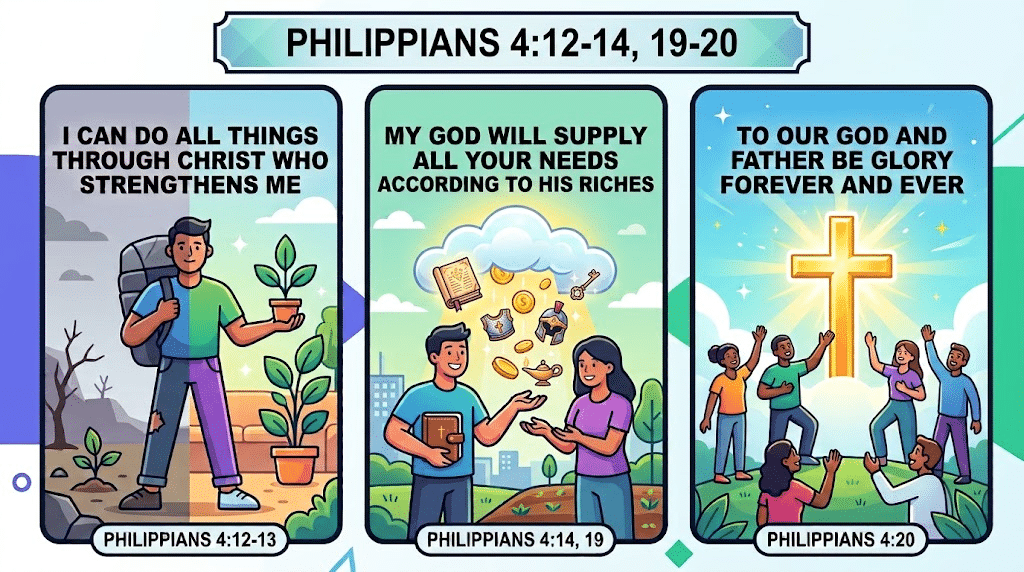
Write an engaging description meant to get readers to read Larry Broding’s commentary which can be used to help preachers prepare their own homily. After a brief introduction give bulletin points of why this commentary matters for your homily.
The Secret of Living
In a culture that ties happiness to comfort and security, Saint Paul’s voice from prison cuts through with startling clarity. Larry Broding’s commentary on Philippians 4:12–14, 19–20 reframes Paul’s endurance—finding strength in the One who empowers him—not as a shallow slogan, but as a gritty testimony forged through scarcity and plenty. For preachers aiming beyond superficial positive thinking to address real-world anxieties with genuine spiritual contentment, Broding’s analysis offers an invaluable foundation for a transformative homily.
- Reclaims One of Scripture’s Most Misquoted Verses: Unpacks Philippians 4:13 within its authentic context of survival, hardship, and missionary endurance, helping steer us away from prosperity-gospel clichés and toward genuine spiritual resilience.
- Reframes Christian Happiness as Grounded in Vocation: Connects Paul’s inner serenity directly to his divine calling rather than his material conditions, giving preachers a compelling angle to challenge modern consumerism and emotional burnout.
- Highlights the Power of Communal Partnership: Emphasizes that even an empowered apostle relied on the practical generosity of the Philippian community, offering a natural bridge to preach on stewardship, mutual support, and solidarity in times of affliction.

Excerpt from a commentary by Dr. Brant Pitre | Catholic Productions

Commentary by Fr. Francis Martin | The Word Proclaimed
clean up grammar and spelling, divide into sections with titles for the following transcript xxxxxxxxxxxx
Verbal fillers, stumbles, and repetitions have been removed while keeping the original phrasing, theological precision, and cadence intact.
Paul’s Holy Indifference: Contentment in All Circumstances
Now we turn to the second reading which, as you know, follows its own rhythm. Sometimes it blends easily with the first reading and the Gospel, and sometimes it does not. We are reading from the final chapter of the Letter to the Philippians—chapter 4. St. Paul is essentially telling the Philippians that he is content whatever happens. He is thanking them for sending him financial support, but he adds: "I can get along on nothing if I have to."
He begins:
"I know how to live in humble circumstances; I also know how to live with abundance."
That is death to self, isn't it? It is easy to say, "Wonderful! I have steak tonight," or, "How miserable, I only have a hamburger." But to Paul, they are both gifts from God. One cannot simply say, "God loves me deeply because I had steak three times this week." All one can conclude is that God provided steak three times—perhaps even to keep you from craving it!
Paul continues:
"In every circumstance and in all things I have learned the secret of being well-fed and of going hungry, of living in abundance and of being in need. I can do all things in him who strengthens me. Still, it was kind of you to share in my distress."
Here at the close of his epistle, Paul expresses his gratitude. He is glad for their provision and is not dismissing his need, yet he maintains that when provision is present, he is grateful, and when it is absent, he remains at peace. That is the Christian ideal. If one is only content when suffering, one holds a distorted view of God; if one is only content with steak and fine drink, one holds an equally distorted view. Life has its rhythms, and Paul embraces whatever God ordains.
The Lectionary Omission and the Philippian Partnership
Our lectionary text moves directly from this reflection to: "My God will fully supply whatever you need..." It skips verses 15 through 18. Lectionary editors often make these omissions for brevity—to assist with parish scheduling and clear the parking lot before the next liturgy arrives—though sometimes the omitted portions provide vital context.
The omitted section reads:
"You Philippians indeed know that at the beginning of the Gospel, when I left Macedonia, not a single church shared with me in an account of giving and receiving except you alone. For even when I was at Thessalonica, you sent me something for my needs, not only once but more than once. It is not that I am eager for the gift; rather, I am eager for the profit that accrues to your account."
Recall from the Acts of the Apostles that Paul saw a vision of a Macedonian pleading, "Come over to Macedonia and help us." A Macedonian was unmistakable in appearance, even in a dream. Through that call, the Gospel entered Europe for the first time in Paul’s apostolic ministry. He arrived in Philippi, and it became one of his most beloved communities.
Even though they had their share of difficulties—such as the dispute between Euodia and Syntyche, two prominent women leaders whom Paul urged the community pastor to reconcile because of their great service to the Gospel—the Philippians remained uniquely generous.
Paul employs commercial terminology here: "an account of giving and receiving," and "the profit that accrues to your account." He tells them that their generosity is a sound spiritual investment because God will repay them abundantly. He rejoices not merely for his own relief, but for the heavenly reward accumulating to their benefit.
He then writes: "I have received full payment"—using the Greek term apechō ($\alpha\pi\acute{\epsilon}\chi\omega$), the formal receipt acknowledging that payment in full has been delivered. He continues: "I am very well supplied because of what I received from you through Epaphroditus."
He calls their gift "a fragrant aroma, an acceptable sacrifice, pleasing to God," drawing directly on Old Testament sacrificial language.
Christian Charity as a Pleasing Sacrifice
One can fall into a false mysticism that claims utter indifference to material goods; yet that pretense quickly fades when hunger arrives. Conversely, others manipulate sacred causes for personal gain. True Christian giving is neither. It is a sacrifice offered in the name of Christ. We no longer offer animal sacrifices, but we offer ourselves, our comfort, and our financial resources for the aid of our brothers and sisters.
This brings to mind 1 John 3:16–18:
"This is how we know what love is: Jesus Christ laid down his life for us. And we ought to lay down our lives for our brothers and sisters. If anyone has material possessions and sees a brother or sister in need but has no pity on them, how can the love of God be in that person? Dear children, let us not love with words or speech but with actions and in truth."
Genuine charity is not demonstrated through rhetoric, nor by publicizing one’s good deeds after the fact. Let the Lord acknowledge it before the angels in Heaven; our role is to give quietly and move on. St. John insists that we love en ergō ($\grave{\epsilon}\nu$ $\grave{\epsilon}\rho\gamma\omega$—in deed) and en alētheia ($\grave{\epsilon}\nu$ $\grave{\alpha}\lambda\eta\theta\epsilon\acute{\iota}\alpha$—in truth). In our interconnected world, human suffering and poverty are readily visible; true love demands that we act.
I recall living with a religious community that subsisted on alms. A couple of modest means once sent three dollars and eighty-six cents with a note explaining that they had diligently turned off unneeded lights in their home, and they were joyful to send the money saved on their electric bill to care for the poor. It is often those with the least who possess the deepest sensitivity toward the needy.
Similarly, in a mission parish I served in the Canadian bush, the men labored through exhausting winter logging—demanding work that left them freezing, soaked from the waist down in snow, and ravenously hungry. Most of them smoked. For Lent, these working men chose to give up tobacco, calculated the money saved, and during the Good Friday Veneration of the Cross, placed those savings into the collection baskets beside the crucifix. That quiet, hidden self-denial is precisely the spirit of sacrifice of which St. Paul writes.
Giving in Truth and Apostolic Prudence
In Johannine thought, truth signifies the revelation of the Father. When we give with warmth, freedom, and discretion, our actions reflect the Father's own nature. As Matthew 5:16 teaches:
"Let your light shine before others, that they may see your good deeds and glorify your father in heaven."
God sustains the entire cosmos at every second, yet He does so with absolute discretion—the dawn rises without fanfare or blaring trumpets announcing His daily providence. Christian charity ought to mirror that same humble generosity, rather than making a display over modest contributions.
The liturgical reading concludes with Paul’s assurance:
"My God will fully supply whatever you need in accord with his glorious riches in Christ Jesus. To our God and Father, glory forever and ever. Amen."
St. Paul was not a professional fundraiser; he was an Apostle whose entire life was consumed by the proclamation of the Gospel. If he needed boat fare to reach his next mission, he accepted it with gratitude so the work could advance.
Yet, for all his mystical contemplation, Paul was grounded in practical wisdom. When he gathered a collection for the impoverished church in Jerusalem, he refused to administer the funds alone. He appointed trustworthy brethren to accompany the offering, ensuring complete financial transparency and preventing any accusation of impropriety. Though he was a great mystic, he never surrendered his common sense.
Click chevron banner to read transcript
organized into thematic sections.
28th Sunday of Year A

Matthew 22:1-14
Create a verse by verse (NAB) commentary relating xxxxxxxxxxxxx TO CATHOLIC doctrine and practice. Give real life applications when appropriate
Matthew 22:1–2
"Jesus again in reply spoke to them in parables, saying, 'The kingdom of heaven may be likened to a king who gave a wedding feast for his son.'"
- Catholic Doctrine: The "King" is God the Father, the "Son" is Jesus Christ, and the "wedding feast" is the Incarnation and redemption of humanity—the nuptial union between Christ the Bridegroom and His Church, the Bride (Catechism of the Catholic Church [CCC] 796, 1602). This marriage covenant reaches its earthly sacrament in the Mass and its eternal fulfillment at the "marriage supper of the Lamb" (Revelation 19:9).
- Liturgical Practice: At every Mass, before Holy Communion, the priest elevates the Host and chalice, echoing the Angel of the Apocalypse: "Behold the Lamb of God... Blessed are those called to the supper of the Lamb." The Mass is not a generic community meal; it is the literal entrance into this royal wedding banquet.
- Real-Life Application: Recognize the grandeur of your baptismal calling. Approach Sunday Mass with the dignity befitting royal guests invited to celebrate the union of divinity with humanity, rather than treating church attendance as an administrative chore or a weekly social routine.
Matthew 22:3
"He dispatched his servants to summon the invited guests to the feast, but they refused to come."
- Catholic Doctrine: In salvation history, the "servants" represent the Old Testament prophets sent to the original covenant people of Israel. The refusal highlights the grave mystery of human free will (CCC 1730–1732). God’s grace is universally offered and efficacious, but He never coerces love; human beings possess the tragic ability to resist divine invitations (resistenza alla grazia).
- Sacramental Practice: The Church continuously echoes this summons through her Evangelization and preaching. In every Sunday homily and catechetical instruction, the modern successors to the servants call the baptized to deeper conversion and sacramental fidelity.
- Real-Life Application: Examine the subtle excuses used to refuse God's summons in daily life—prioritizing sleep over Sunday Mass, ignoring the promptings of the Holy Spirit to pray, or putting off Confession month after month. Refusal rarely begins with overt rebellion; it often begins with quiet apathy.
Matthew 22:4
"A second time he sent other servants, saying, 'Tell those invited: "Behold, I have prepared my banquet, my calves and fattened cattle are killed, and everything is ready; come to the feast."'"
- Catholic Doctrine: This represents the persistence and long-suffering mercy of God (patientia Dei). The "second sending" points to the Apostles and early disciples preaching after the Resurrection and Pentecost. The slaughtered cattle evoke the true sacrificial victim: Christ, the true Paschal Lamb, who offers His Flesh for the life of the world (John 6:51; CCC 1362–1367).
- Liturgical Practice: The altar at Mass is both a table of sacrificial offering and a banquet of communion. The sacrifice and the meal are inseparable realities in Catholic Eucharistic theology: Christ has already been slain, the altar is prepared, and the Church repeats at every Mass: "Come to the feast."
- Real-Life Application: Marvel at God's inexhaustible patience. When you have fallen or drifted from the practice of faith, remember that God does not cancel His banquet; He sends second, third, and fourth invitations through friends, conscience, and liturgical seasons like Lent and Advent. Respond immediately rather than presuming on future time.
Matthew 22:5–6
"Some ignored the invitation and went away, one to his farm, another to his business. The rest laid hold of his servants, mistreated them, and killed them."
- Catholic Doctrine: Jesus diagnoses two primary spiritual pathologies:
- Worldliness and Temporal Distraction (v. 5): Legitimate earthly goods (farming, commerce) become idols when elevated above the Kingdom of God (CCC 2544).
- Active Malice and Persecution (v. 6): The rejection of truth culminating in martyrdom, seen from the Old Testament prophets to the Apostles, the early Christian martyrs, and modern witnesses for the faith (CCC 2473).
- Moral & Ascetical Practice: The Church emphasizes the virtue of detachment (paupertas spiritu). Worldly pursuits, professional ambition, and financial upkeep are duties of one's state in life, but they must remain subordinate to eternal salvation.
- Real-Life Application: Audit where your core attention lies. Does a weekend side-hustle, sports league, or house chore systematically push out Mass, family prayer, and acts of charity? Work and business are meant to serve life and glorify God, not crowd Him out.
Matthew 22:7
"The king was enraged and sent his troops, destroyed those murderers, and burned their city."
- Catholic Doctrine: This verse historically anticipates the destruction of Jerusalem in 70 AD by Roman legions, an event viewed in early Christian theology as a historical judgment on the rejection of the Messiah. Doctrinally, it reminds the faithful of Divine Justice and the reality of final judgment (CCC 1038–1041). While God is infinite mercy, persistent and impenitent rejection of that mercy inevitably invites judgment.
- Liturgical Practice: The Church keeps this eschatological reality before the faithful in the Dies Irae of the traditional requiem and in the solemn readings at the close of the liturgical year (the final weeks of Ordinary Time), reminding us that history moves toward a definitive divine accounting.
- Real-Life Application: Foster the theological gift of the Holy Fear of the Lord (reverence and awe), which guards against the widespread modern heresy of presumption—the idea that God's mercy renders repentance, obedience, and moral integrity irrelevant.
Matthew 22:8–10
"Then he said to his servants, 'The feast is ready, but those who were invited were not worthy to come. Go out, therefore, into the main roads and invite to the feast whomever you find.' The servants went out into the streets and gathered all they found, bad and good alike, and the hall was filled with guests."
- Catholic Doctrine: This marks the opening of the Kingdom to the Gentiles and establishes the Universality (Catholicity) of the Church (CCC 830–831). The Church on earth (ecclesia militans) is a corpus permixtum—a mixed body containing "bad and good alike"—echoing the parable of the wheat and the weeds (Matthew 13:24–30). The Church is not a club for the morally elite, but a field hospital and refuge for sinners summoned to redemption.
- Missiological Practice: This is the mandate for Catholic missionary work, street evangelization, and parish hospitality. It justifies the Church's historic openness to all social classes, cultures, races, and backgrounds.
- Real-Life Application: Avoid parish cliquishness or spiritual elitism. Welcome the newcomer, the struggling single parent, or the person who looks out of place in your church pews. In your own spiritual life, never think, "I'm too broken to go to church." The invitation is open to the imperfect, provided they are willing to step inside the banquet hall.
Matthew 22:11–12
"But when the king came in to meet the guests, he saw a man there not dressed in a wedding garment. The king said to him, 'My friend, how is it that you came in here without a wedding garment?' But he was reduced to silence."
- Catholic Doctrine: In ancient Near Eastern customs, a wealthy host or king often provided clean garments for wedding attendees. Patristic tradition (St. Augustine, St. Gregory the Great) interprets the "wedding garment" as Sanctifying Grace and Charity (agape / caritas) expressed through good works (CCC 1822, 1999). It is not enough to enter the Church outwardly (external membership); one must be clothed in the interior life of grace.
- Sacramental Practice: At Baptism, the newly baptized is clothed in a white garment while the priest prays: "Receive this white garment, and bring it unstained to the judgment seat of our Lord Jesus Christ, so that you may have eternal life." If that garment is soiled by mortal sin, it is washed clean in the Sacrament of Reconciliation before one dares to receive the Eucharist (1 Corinthians 11:27–29; CCC 1385, 1446).
- Real-Life Application: Never presume that mere outward association with the Catholic Church saves you. Examine your conscience before approaching the altar for Holy Communion. If you carry unconfessed grave sin, go to Confession first; put the baptismal garment back on before sitting at the Eucharistic feast. The man's silence in the parable shows that on judgment day, excuses for neglecting grace will vanish.
Matthew 22:13
"Then the king said to his attendants, 'Bind his hands and feet, and cast him into the darkness outside, where there will be wailing and grinding of teeth.'"
- Catholic Doctrine: This is an explicit teaching from Christ on the dogma of Hell (gehenna)—eternal separation from God and communion with the damned (CCC 1033–1037). The loss of mobility ("bind his hands and feet") signifies the total end of the time for repentance and merit after death. The "darkness outside" (tenebrae exteriores) is the loss of the Beatific Vision, while "wailing and grinding of teeth" expresses the agony of despair and eternal remorse.
- Pastoral Practice: The Church consistently warns her children of eternal loss, not to incite dread, but out of pastoral charity. Prayers like the Fatima Prayer recited between decades of the Rosary ("Lead all souls to Heaven, especially those most in need of Thy mercy") arise directly from this reality.
- Real-Life Application: Pray daily for the grace of final perseverance—dying in the state of grace. Regularly intercede for souls at the point of death through the Divine Mercy Chaplet or prayers to St. Joseph, the patron of a holy death.
Matthew 22:14
"Many are invited, but few are chosen."
- Catholic Doctrine: This solemn aphorism summarizes the relationship between Universal Salvific Will and Predestination / Election (CCC 600, 1037). God sincerely invites all humanity to salvation ("God desires all men to be saved and to come to the knowledge of the truth," 1 Timothy 2:4). However, the "chosen" (eklektoi) are those who not only receive the initial call, but respond in active faith, remain clothed in charity, and persevere in grace until the end.
- Ascetical Practice: Catholic spirituality encourages the balance between theological hope and holy vigilance: "Work out your salvation with fear and trembling" (Philippians 2:12), backed by complete confidence in God’s unfailing mercy and sacraments.
- Real-Life Application: Let this warning banish presumption without sinking into despair. Cultivate consistency in your daily spiritual life: morning offering, daily prayer, regular confession, worthy reception of the Eucharist, and selfless acts of mercy. Election is not a private badge of pride, but a daily call to walk worthily of the vocation you have received.
Algorithmically generated text
give me three thought provoking questions followed up with detailed answer reflection based on xxxxxxxxxxxx. Keep questions and answers appropriate for Sunday congregation giving real life application.
Matthew 22:1–14 actively refutes the "exclusive country club" model of parish life; rather than barring the marginalized, the parable explicitly commands their inclusion. Interpreting the ejection of the man without a wedding garment as an exclusion of the poor or homeless misreads both the narrative structure of Jesus’s parable and ancient near-Eastern banquet customs.
- The Original Elites Disqualified Themselves: The initial invitees—the wealthy landowners, merchants, and political elites—are the ones who snubbed the king's invitation and abused his messengers (Matt 22:3–5). Jesus delivers this parable to the chief priests and Pharisees to show that social pedigree, inherited status, and religious entitlement do not guarantee a seat at God's table.
- The Universal Dragnet in the Thoroughfares: In verse 9, the king commands his servants: "Go out, therefore, into the main roads and invite to the feast whomever you find." The servants gather everyone—explicitly noted as "bad and good alike" (v. 10)—filling the hall from the city streets. This directly parallels Luke 14:21, which specifies bringing in "the poor, the crippled, the blind, and the lame." The entire point of the king’s decree is that the banquet hall is not an exclusive salon for the privileged; it is an open hall for those pulled from the margins.
- The Provision of the Garment: In ancient royal banquets, a monarch inviting common street travelers did not expect destitute guests to own royal court attire. Culturally, high-status hosts often provided suitable festive robes (enduma) at the door to level the playing field and preserve the celebration’s dignity. The man’s offense was not his poverty or homelessness; it was his deliberate refusal to receive and wear the robe made available to him. When asked how he came in without one, "he was reduced to silence" (v. 12)—he had no excuse of deprivation.
- The Theological Meaning of the Robe: The early Church Fathers (including Augustine, Chrysostom, and Gregory the Great) consistently interpret the wedding garment not as material wealth, but as baptismal grace, charity, and inner conversion. Salvation is freely given to all—rich and poor alike—but coming to the King requires letting oneself be transformed. The garment represents "putting on Christ" (Gal 3:27) and living out the works of mercy.
Turning a church into an exclusive country club that screens out the poor mimics the arrogance of the original invited guests who thought the feast existed on their terms. The King invites the destitute and broken into the hall unconditionally, requiring only that every soul—regardless of worldly means—accepts the interior transformation symbolized by the robe.
Algorithmically generated text
The man expelled into the dark had already made it through the palace doors and was sitting at the table. If being inside the banquet hall represents being a baptized, practicing Catholic, what is the "wedding garment" we might still be refusing to wear?
It is tempting to read this parable and assume we are safe simply because we are sitting in a pew on Sunday morning. But Jesus offers a sobering warning: physical presence in the hall is not enough. In ancient tradition, the host provided a clean garment for the wedding guests so that everyone—rich or poor—could honor the bridegroom fittingly.
In Catholic tradition, the early Church Fathers recognized this robe as the garment of baptismal sanctifying grace, adorned with authentic charity and good works. The man was speechless because he had no excuse; the garment was readily available, yet he insisted on attending the royal banquet strictly on his own terms, clinging to his old, stained clothes.
It is easy to claim external Catholic identity while harboring unrepented grave sins, feeding secret grudges, or refusing to let the Gospel transform how we treat our spouses, coworkers, or enemies. Walking into the royal feast without repentance is an insult to the Host.
Never treat Holy Communion as a thoughtless, automatic routine. Saint Paul warns that whoever eats and drinks without discerning the Body eats and drinks judgment upon himself (1 Corinthians 11:29). If your spiritual garment has been stained by grave sin, bitterness, or negligence, do not try to conceal it or justify it. Take full advantage of the Sacrament of Reconciliation, where Christ gladly washes that robe clean in His mercy, clothing you anew in the garments of grace before you step forward to receive His Body and Blood.
Algorithmically generated text
Preaching Matthew 22:1–14 to address church attire requires connecting the physical "wedding garment" to the biblical call for reverence, intentionality, and respect for sacred space without falling into superficial legalism.
In the ancient near-Eastern context of a royal banquet, guests were expected to honor the host by arriving properly prepared—traditionally, either wearing celebratory festive attire or accepting a clean garment provided by the king. To attend in careless, everyday rags or inappropriate wear was an overt gesture of disrespect, apathy, or defiance against the king's honor.
Here are the primary homiletic pathways to connect this passage to modern church dress and modesty:
- Reclaiming Baptismal Dignity: The white garment received at Baptism symbolizes putting on Christ (Galatians 3:27). The homily can challenge the congregation to consider whether their weekly church attire honors that identity, calling both men and women to dress in a manner that reflects their elevated dignity as children of God entering a heavenly banquet.
- Outward Attire as an Echo of Inward Disposition: In Patristic tradition (such as Gregory the Great and Augustine), the wedding garment represents charity, baptismal purity, and a heart conformed to Christ. A preacher can bridge interior grace to exterior presentation: our physical bearing and clothing are liturgical acts that reflect our interior posture before God. Arriving at the Holy Sacrifice of the Mass casually, provocatively, or carelessly signals a lack of interior awareness of whose presence we are entering.
- The Distinction Between Poverty and Immodesty: The guest in Matthew 22 was not cast out for lacking wealth, brand-name clothing, or social pedigree; the king explicitly invited the street-dwellers and the poor. Modesty in church is never about expensive finery—it is about avoiding vanity, distraction, and self-promotion. Dressing immodestly draws attention to oneself rather than the altar, turning the sanctuary into a venue for personal display rather than worship.
- Respect for the Sacred Space and the Community: Christian modesty is fundamentally an act of charity toward one’s neighbors and reverence toward God. Just as a guest at a state dinner or a formal wedding adjusts their appearance out of respect for the bride and groom, attending church calls for attire that acknowledges the solemnity of the Eucharistic banquet. Immodesty disregards the sanctity of the sacred space and introduces unnecessary visual stumbling blocks into an environment meant for prayer.
Algorithmically generated text
Create a simple, modern infographic illustrating [INSERT BIBLE PASSAGE OR TOPIC]. Use a [SPLIT-SCREEN / 3-PANEL] layout. The style should be clean, high-quality digital art or vector illustration.
Visuals:
Panel 1: Show [DESCRIBE SCENE 1 – e.g., a stormy sea].
Panel 2: Show [DESCRIBE SCENE 2 – e.g., Jesus calming the waves].
Text & Typography:
Font: Use EXTRA LARGE, BOLD, SANS-SERIF FONT (like Arial). Ensure high contrast so text is easily readable.
Header: Write “[INSERT MAIN TITLE]” at the top.
Captions: Include short, punchy text summaries in the panels: “[TEXT FOR PANEL 1]” and “[TEXT FOR PANEL 2]”.
Overall Vibe: Professional, educational, and uncluttered. Avoid small details; focus on big images and big text.
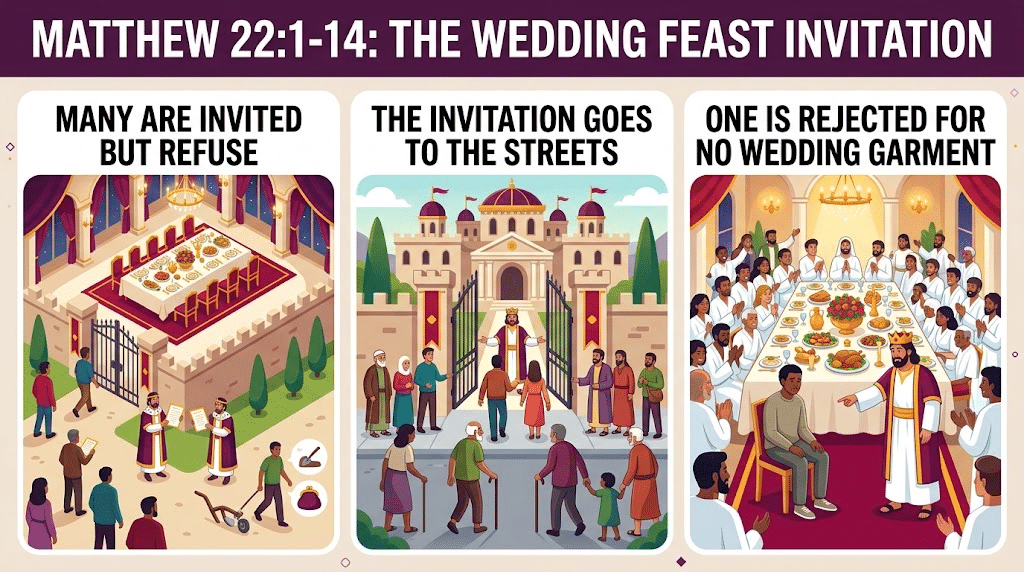
Write an engaging description meant to get readers to read Larry Broding’s commentary which can be used to help preachers prepare their own homily. After a brief introduction give bulletin points of why this commentary matters for your homily.
Equal Dignity for All
Too often reduced to a tidy Sunday school allegory, the Parable of the Wedding Feast (Matt 22:1–14) carries a raw shock value that familiarity has dulled. Setting the text against the ruthless class divisions of the Roman Empire and Jerusalem’s purity codes, Larry Broding reveals a king whose scandalous banquet shatters sacred hierarchies. For preachers seeking to move beyond tired tropes and proclaim the radical, upside-down Kingdom of God, this commentary delivers the historical sharpness and theological depth your homily needs.
- Restores the Original Shock Value: Moves beyond standard allegorical readings to show how ancient listeners would have reeled at a king perceived as weak, elite nobles defying royal authority, and beggars occupying seats reserved for the aristocratic five percent.
- Dismantles “Sacred Geography”: Highlights the provocative setting of Jesus preaching in the Temple courts, demonstrating how this parable challenged the assumption that spiritual proximity to God was determined by institutional status, pedigree, or ritual hierarchy.
- Reframes the Wedding Garment with Baptismal Clarity: Connects the jarring expulsion of the improperly dressed guest (22:11–14) to the Christian neophyte’s white baptismal robe, giving you a compelling image to preach that radical grace requires an authentic, visible conversion of life.


Commentary by Fr. Francis Martin | The Word Proclaimed
clean up grammar and spelling, divide into sections with titles for the following transcript xxxxxxxxxxxx
Verbal fillers, stumbles, and repetitions have been removed while keeping the original phrasing, theological precision, and cadence intact.
The Context: The Parable of the Wedding Feast
Now, all the readings and reflections we have been doing up to this point are to help us understand the Gospel where our Lord uses this image of a great banquet. This text—Matthew 22:1–14—builds on all the imagery read for you at the beginning: the heavenly imagery and the fellowship between friends.
Our Lord invokes this, saying, in effect, "Like a king—like my Father who invites all of you to a banquet—accept the invitation if you are wise."
The text notes that Jesus spoke "in reply." Scripture uses the phrase "in reply" not necessarily in response to a direct question, but to resume the conversation. He addressed the chief priests and the elders of the people in parables. Now you understand the audience: these are the leaders He is deeply concerned about, the ones destined to reject the invitation. They are the very ones who ought to recognize the wedding feast—the eschatological banquet prophesied in Isaiah 25:6. It is already present in their minds; the moment He mentions a banquet, they understand His meaning.
The Invitation and the Rejection
"The Kingdom of Heaven may be likened to a king who gave a wedding feast for his son." Who is the Son? Jesus. What is the wedding feast? Heaven. Is there a foretaste of Heaven on Earth? Yes—the Holy Eucharist. Yet people claim they are too busy to attend.
He dispatched his servants to summon the invited guests to the feast. This same parable appears in other Gospels, though Matthew recounts it in his own distinct manner. The king dispatched his servants to call those who had been invited, but they refused to come. Literally, they did not wish to attend; they simply did not feel like coming.
A second time, he sent other servants. Consider who these servants represent. Recall the Parable of the Wicked Tenants: servant after servant was sent, and the tenants killed them all until the landowner said, "They will respect my son"—and yet they did not. These servants represent the prophets.
The king said, "Tell those invited: Behold, I have prepared my banquet. My calves and fattened cattle are killed, and everything is ready; come to the feast."
Ordinarily, in custom, a formal first announcement was delivered: "I will host a banquet for my son's wedding in about two months." The guests would express interest and agree to attend. When the preparation neared completion—two or three days prior—the host would dispatch the secondary summons. In this case, upon the first summons, they declined; nevertheless, the king extended another opportunity.
The Worldly Excuses and the Fall of the City
Who would refuse such an invitation? Imagine knowing a truly magnificent cook. It brings to mind my visits to Alabama, where I spent time with my friend, Archbishop Joseph Raya, among local Melkite Greek Catholic families. Those families prepared extraordinary feasts. The Lebanese tradition often saw success in trade and enterprise, and while many households had assistance, when it came time for the feast, the mother of the home prepared the meal herself—directing several helpers, yet crafting the dishes with her own hands before welcoming her guests. We would gather on Sundays, visiting while the meal was readied. These reflections evoke vivid memories of both that fellowship and my time in the Holy Land.
Here, the king announces: "I have prepared my banquet. My calves and fattened cattle are killed. Everything is ready; come to the feast."
Yet some ignored the summons entirely and departed—one to his farm, another to his business. In Luke's account, the excuses are vivid: purchasing a team of oxen that must be examined, or inspecting newly acquired land. The remainder seized the king’s servants, mistreated them, and killed them. These servants of the king are the prophets.
The king was enraged. He dispatched his troops, destroyed those murderers, and burned their city. Historically, this prefigures the destruction of Jerusalem. To this day, the original Temple mount is occupied by an Islamic shrine rather than the Temple. When our Lord spoke these words in the early 30s AD, that city and its Temple had approximately forty years remaining before their destruction, culminating in widespread crucifixion and devastation. That impending ruin is precisely why Christ wept over Jerusalem.
The Call of the Gentiles and the Mixed Church
The king then commanded: "Go out into the main streets and invite to the feast whomever you find."
Who does this represent? That represents us: the Gentiles. We were the wanderers brought in from outside, historically distant from knowledge of the one true God during the millennia in which Israel was prepared. Our ancestors—in the British Isles or wherever they dwelt—did not know the God of Abraham.
The servants went out into the streets and gathered all they found, bad and good alike. This imagery mirrors the Parable of the Wheat and the Tares, or the net gathering every variety of fish into the vessel: some good, some bad. The Lord indicates that within His Church on Earth, the righteous and the unrighteous coexist, but a final separation will occur when the wicked are eliminated. We must ensure our fidelity rather than compromise our faith.
People often prioritize self-interest. Like those in the parable, many refuse to come because they are preoccupied. God Himself invites us to a sacred banquet where His Body and Blood serve as our spiritual nourishment, conforming us to eternal life. Yet someone may say, "I have a round of golf," or "My son has a soccer tournament." Rather than asserting Christian priorities—requesting that youth leagues schedule events for the afternoon—morning sporting events have become routine, serving as a subtle distraction that pulls families away from the Sunday Eucharistic Liturgy.
The Wedding Garment: Reverence and Gratitude
When the king entered to inspect the guests, he noticed a man who was not wearing a wedding garment. The king addressed him: "My friend, how is it that you came in here without a wedding garment?" But the man was silent.
This passage presents an interpretive challenge. What would have made that guest properly prepared? It was fundamentally a posture of interior gratitude, which explains his silence.
One observes a noticeable decline in outward and inward reverence for our Lord’s majesty. At every Eucharistic liturgy, countless angels surround the altar in worship, taking up no physical space within the parish church. The Lord of Glory is truly present—not another Jesus, but the same Christ who reigns in Heaven, veiled under the forms of Bread and Wine. The heavenly host stands in awe of His condescension in feeding us, a gathered people from every nation. Yet this guest lacked all gratitude; he was internally unprepared, leaving him without a defense.
Consider the wedding garment as an outward sign of reverence. How many individuals honor God by dressing with dignity for Mass? It remains a worthy practice when a father, mother, and children dress with deliberate care—not out of vanity or display, but out of filial reverence for the King of Glory who summons them to His table. The physical dispositions of the body instruct and support the dispositions of the soul. I recall my own father sitting attentively each Sunday morning before Mass, reviewing the texts with his English-Latin missal, already dressed with care. That quiet witness offered an enduring lesson on the dignity of the sacred liturgy.
Few Are Chosen
The king instructed his attendants: "Bind his hands and feet, and cast him into the darkness outside, where there will be wailing and grinding of teeth."
"Many are invited, but few are chosen." Many received the invitation; most ignored it or persecuted the messengers, and one attempted to enter without gratitude or repentance. While the call is universal, the chosen are those who receive the Kingdom in truth and participate worthily.
A moment will arrive when earthly liturgies cease, yielding entirely to the eternal liturgy of Heaven. To attain that end is everything. It is said that one should never aim merely for Purgatory, for if one falls short, the alternative is perilous; aim instead for Heaven, and should purification be required, mercy provides Purgatory.
Ultimately, this Gospel illustrates how many within Israel, influenced by their religious leaders, rejected the Messiah, breaking our Lord's heart. They were His kin according to the flesh, guided through centuries of preparation for His Incarnation, His ministry, His miracles, and His Paschal mystery.
As Saint Augustine observed in commenting on 1 John 3:16: if one is not yet ready to lay down one's life, begin by parting with modest resources; take a concrete step toward love. In like manner, responding to God's invitation begins with approaching the Holy Sacrifice of the Mass with a grateful and prepared heart. When the gates of eternity open, one must not linger over worldly distractions, for the doors will eventually close. Amen.
Click chevron banner to read transcript
organized into thematic sections.

Doctrinal Homily Outlines
Central idea: The Desirability of Salvation
Doctrine: Heaven, Hell, and Purgatory
Application: The Spiritual Works of Mercy
Sunday Prep Videos
28th Sunday of Year A