Papal Homilies, Pope Francis, Pope Benedict, Pope John Paul II, Pope Leo
September 27, 2026
⭐⭐⭐ Pope Leo XIV



Holy See
- The Bible
- Catechism of the Catholic Church
- Codes of Canon Law
- Ecumenical Councils
- Official Acts of the Holy See
- Social Doctrine of the Church
- Abuse of Minors, the Church’s Response
- Press Office
- Vatican News – Radio Vaticana
- L’Osservatore Romano
- Vatican Websites
- Vatican City State
- Basilicas and Papal Chapels – Virtual Tours
- Liturgical Celebrations
- Tickets for Papal Audiences and Celebrations
26th Sunday of Year A


Personal Responsibility
FROM THE ARCHIVES (1999)
The consciousness of one’s personal responsibility is the prevailing theme in today’s liturgy. To the exiles who accuse God of injustice for treating the “just” who do wrong differently from the “wicked” who act justly, God says, “Is it not your ways that are not just?” The upright dies because of the wrong that he himself has done, and the wicked will live to abandon wickedness. Both are responsible for their deeds. True personal responsibility, as Jesus teaches us in the Gospel, becomes manifest not so much in what we say, but in what we do. Saint Paul presents Jesus Christ to the Philippians as an example of responsibility and consistency. Christ’s “yes” is a concrete “yes,” incarnated in his works to bring about redemption (second reading).
P. Antonio Izqeuirdo, L.C., Copyright © Dicastery for the Clergy
Doctrinal Messages
The responsibility to which the liturgical texts refer is not aimed at the tasks and obligations of human coexistence
Rather, its object is man’s relationship with God. In such a relationship, a responsible person is one who converts and believes. In this sense, the exiles of Babylon do not behave in a responsible way. Instead of converting to God, they complain and blame him for his unjust behavor (first reading). The chiefs of the priests and the elderly (the political and religious authorities of Israel) did not behave in a responsible way either. John showed them the way to salvation but they did not believe him nor did they convert. The tax collectors and prostitutes, however, responded to John’s preaching with repentance and faith, although they had a past of wickedness and sin. The past does not matter in the eyes of God; what matters to him is the present and responsible “yes” to him in one’s everyday life.
Responsibility is measured according to the deeds of the present
Through the prophet Ezekiel, God does not allow us to doubt that, “When a righteous man turns away from his righteousness and commits iniquity, he shall die for it” (Ezk 18: 26). Jesus illustrates this with the parable of the two sons. The first son, who represents the high priests and the elders, has a history of impeccable conduct, but now that God calls him to conversion again and to faith to find salvation, he says “yes” with his words but “no” with his deeds. His past responsibility is of no help, for it has vanished, and now his behavior is irresponsible. The second son, who represents the tax collectors and prostitutes, lived his relationship with God in an irresponsible way in the past. However, although so far he has said “no” with his words, with his deeds of conversion he has started to say “yes” to God’s call. His past irresponsibility has been cleansed and purified by his present responsibility. The second reading goes beyond the inconsistency between past and present, between the “yes” and the “no” by showing us Jesus Christ as an example of total consistency and responsibility before God, his Father. Jesus Christ’s past does not differ from his present attitude, nor is the “yes” of his words any different from the “yes” of his deeds. For this reason, Saint Paul urges us to, “Make your own the mind of Christ Jesus.” He did not play with “yes” and “no”; rather his life was a “yes” exclusively. He did not play freely between the past and the present, but each day he drew nourishment, strength and support for his activities from the will of the Father.
Pastoral Suggestions
The inner life of a parish
A parish is made up of genuine Christians who have lived and continue to live in an attitude of permanent faith and conversion. That is wonderful, and may there be many! Possibly there are also “old” Christians, who are Christian by tradition and inheritance, rather than by their own personal belief. They say “yes” during the liturgy and “no” to certain requirements of Christian morality. Or vice versa, some say “yes” to certain moral values and “no” to the Faith. How many “old” Christians of this type are there in our parish? There are those who have been cold from a religious point of view, who have belonged to another religion, have even been secularists and atheists, but who have then converted and now seek to be fervent Christians. Are there many that belong to this group? And most likely, there are those who have said and continue to say “no” to faith and inner conversion with their words and deeds. I have given you a basic, but rather realistic description of a parish. What can I do as a parish priest, parish vicar, religious man or woman, in such a situation? Do everything that the Holy Spirit inspires you to do, let others do what the same Spirit is asking of them, and always keep your hopes very high.
The need for witnesses
As humans, we learn things, even the most noble and spiritual, through our senses. We learn to be responsible by seeing others behave in a responsible way. The example of others helps and encourages us to continue being responsible. Paul VI said that the Church needs witnesses more than preachers. Here is a lovely task for us to perform in our pastoral duties or office! We must desire and work to become witnesses. We must become actively involved in the formation of active witnesses, to create among Christians the consciousness that being Christian and being a witness are the same thing. There is a lot of good to be done in a parish, in a community, in a diocese with a group of witnesses. Being the witnesses of Christ is a wonderful way to carry out the new evangelization.
SOURCE: YEAR A DICASTERY NOTES (1999)
P. Antonio Izqeuirdo, L.C., Copyright © Dicastery for the Clergy, The header image is an AI-generated visual concept illustrating the central themes, scripture quotes, and visual motifs from this week’s Mass readings.

26th Sunday of Year A
The Parable of Two Sons
27 September 2020 | Saint Peter’s Square
Authentic Obedience and the Parable of the Two Sons
With his preaching on the Kingdom of God, Jesus opposes a religiosity that does not involve human life, that does not question the conscience and its responsibility in the face of good and evil. He demonstrates this with the parable of the two sons, offered to us in the Gospel of Matthew (cf. 21:28–32). To the father’s invitation to go and work in the vineyard, the first son impulsively responds, “No, I’m not going,” but then he repents and goes. Instead, the second son, who immediately replies, “Yes, sir,” does not actually do so; he does not go.
Obedience does not consist in merely saying “yes” or “no,” but in taking action, cultivating the vineyard, bringing about the Kingdom of God, and doing good. With this simple example, Jesus moves beyond a religion understood only as an external and habitual practice that does not affect people’s lives and attitudes—a superficial religiosity that is merely ritualistic.
The Façade of Religiosity and the Priority of Grace
The exponents of this façade of religiosity, of which Jesus disapproves, were the chief priests and the elders of the people (Mt 21:23), who, according to the Lord’s admonition, will be preceded in the Kingdom of God by tax collectors and prostitutes (cf. v. 31). Jesus tells them that the tax collectors and prostitutes go into the Kingdom of God before them.
This affirmation must not lead us to think that those who do not follow God’s commandments or morality do well, reasoning, “In any case, those who go to church are worse than us.” No, this is not Jesus’ teaching. Jesus does not point to publicans and prostitutes as models of life, but as privileged by grace. Conversion is always a grace—a grace that God offers to anyone who opens up and turns to him. Listening to his preaching, these people repented and changed their lives. Let us think of Saint Matthew, for example, who was a publican and considered a traitor to his people.
God’s Patience and the Daily Choice of Faith
In the Gospel, the one who makes the best impression is the first brother, not because he said “no” to his father, but because after his “no,” he converted to “yes”; he repented. God is patient with each of us: he does not tire, and he does not desist after our “no.” He leaves us free even to distance ourselves from him and make mistakes. God’s patience is wonderful: the Lord always waits for us, standing beside us to help while respecting our freedom. He awaits our “yes” to welcome us anew into his fatherly arms and fill us with his boundless mercy.
Faith in God asks us to renew every day the choice of good over evil, truth over falsehood, and love for our neighbor over selfishness. Those who convert to this choice after experiencing sin will find the first places in the Kingdom of heaven, where there is greater joy over a single sinner who repents than over ninety-nine righteous people who need no repentance (cf. Lk 15:7).
Conversion as Spiritual Battle and Concrete Commitment
Conversion—changing the heart—is a process that purifies us from moral encrustations. At times, it is a painful process, because there is no path of holiness without sacrifice and spiritual battle: battling for good, battling not to fall into temptation, and doing our part so that we may live in the peace and joy of the Beatitudes.
The Gospel calls into question our way of living the Christian life, which is not made up of vague dreams and pious aspirations, but of concrete commitments to align ourselves with God’s will and love our brothers and sisters. Yet, even the smallest concrete commitment cannot be made without grace. Conversion is a grace we must always ask for.

September 27, 2020
26th Sunday of Year A
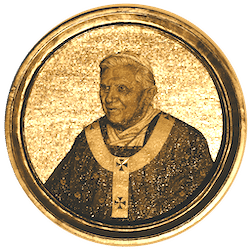
On the Anniversary of the Death of Pope John Paul I
21 September 2008 | Courtyard of the Papal Summer Residence, Castel Gandolfo
Biblical Foundations: Conversion, Humility, and Christ’s Kenosis
Today the liturgy presents the Gospel parable of the two sons sent by their father to work in his vineyard. One of them immediately agrees to go but then does not; the other refuses at first, but later repents and complies with his father’s wishes. With this parable, Jesus reaffirms his predilection for sinners who convert and teaches that humility is necessary to accept the gift of salvation.
Saint Paul, in his Letter to the Philippians, likewise urges this same humility: “Do nothing from selfishness or conceit,” he writes, “but in humility count others better than yourselves” (cf. Phil 2:3). These are the very sentiments of Christ, who, emptying himself of divine glory out of love for humanity, took on human flesh and humbled himself even unto death on a Cross (cf. Phil 2:5–8). The Greek verb ekenôsen means literally that he “emptied himself,” casting a clear light on the deep humility and infinite love of Jesus, the Servant par excellence.
Pope John Paul I and the Episcopal Motto Humilitas
Reflecting on these biblical texts brings to mind Pope John Paul I, the 30th anniversary of whose death is commemorated today. He chose the same episcopal motto as Saint Charles Borromeo: Humilitas. This single word summarizes the essence of the Christian life and points to the indispensable virtue required of those called to the service of authority in the Church.
At one of the four General Audiences during his brief pontificate, he noted in his characteristically familiar tone: “I will just recommend one virtue so dear to the Lord. He said, ‘Learn from me who am meek and humble of heart.’… Even if you have done great things, say: ‘We are useless servants.'” He then observed: “On the contrary the tendency in all of us, is rather the opposite: to show off” (General Audience, September 6, 1978). Humility stands as his enduring spiritual testament.
The Pastoral Legacy and Catechetical Simplicity of Albino Luciani
Through this profound humility, it took only thirty-three days for Pope Luciani to win hearts across the world. In his addresses, he drew continually upon the concrete experiences of daily life, family memories, and popular wisdom. This accessible simplicity served as the vehicle for rich and solid doctrine, enhanced by his remarkable memory, wide learning, and references to both Christian and secular authors.
He proved to be an incomparable catechist, walking in the footsteps of Saint Pius X—his fellow countryman from the Veneto and his predecessor upon the chairs of Saint Mark and Saint Peter. “We must feel small before God,” he insisted at that same audience, adding: “I am not ashamed to feel like a child before his mother; one believes in one’s mother; I believe in the Lord, in what he has revealed to me.”
These words testify to the authenticity of his faith. In thanksgiving to God for granting him to the Church and the world, his example remains a call to cultivate that genuine humility which reaches out to everyone, especially the lowly and the distant, through the intercession of Mary Most Holy, the humble Handmaid of the Lord.

26th Sunday of Year A
The Lord’s Vineyard
Tuesday, 16 December 1997 | STUDENTS OF THE ROMAN STATE UNIVERSITIES
The Cosmic Vineyard and the Mystery of the Incarnation
The Word of God refers to the Lord’s vineyard, an evocative allegory that occurs frequently in the Gospels and serves as the central theme of this passage. Following the Gospel texts, the vineyard represents the whole created cosmos, which, through Christ’s coming, becomes God’s property in a special way. Through Christ’s redemption, both creation and humanity belong to God in an entirely renewed manner.
In this sense, Christmas marks the holy day when both the visible and the inanimate assume a profound and unexpected significance. As the Evangelist John reminds us, “God so loved the world that he gave his only Son, that whoever believes in him should not perish but have eternal life” (Jn 3:16). These words capture the deep meaning of the vineyard image to which Jesus repeatedly points. Through the mystery of the Incarnation of the Word, humanity and the entire cosmos discover with joy that they are the Lord’s vineyard—the direct object of God’s saving love.
The Call to the Vineyard: Concrete Action over Words
“Go and work in my vineyard!” (cf. Mt 21:28), the father commands his two sons in the Gospel parable. He expects an answer, yet he is never satisfied with mere words; he requires actual commitment. The two sons respond in fundamentally different ways: the first professes willingness but does nothing, while the second initially refuses his father’s invitation, yet reconsiders and fulfills what was asked of him.
The Evangelist Matthew presents here a typology of human responses to God throughout history. The Gospel invitation to labor in the Lord’s vineyard echoes in the heart and life of every person, summoning each to dedicate themselves actively to the divine vineyard and engage in the mission of salvation. In this parable, each of us can recognize the reality of our own personal experience.
Academic Life, Human Progress, and Moral Temptations
The university community represents a particularly fertile ground for cultivating the talents the Lord entrusts to each person for the common good. Through disciplined study and rigorous research, those who develop these gifts are equipped to lead initiatives that advance the authentic progress of society.
Yet, as the Second Vatican Council cautions in Gaudium et spes (n. 37), the advantages of human progress carry grave temptations. When the hierarchy of values becomes disordered, good and evil intermingle, and individuals or groups focus solely on self-interest rather than the common good. Consequently, earthly achievements alone have not forged true brotherhood; instead, unchecked power poses severe risks to humanity itself.
Cultural Renewal, True Wisdom, and the Light of Faith
Authentic human progress is realized only when individuals, guided by the Holy Spirit, commit to directing temporal affairs toward the Kingdom of God (cf. Gaudium et spes, n. 72). By fostering an encounter with the Son of the living God, the Spirit purges intellectual presumption, guiding the human heart toward true wisdom—a gift that must always be sought and received with humility.
Young scholars and students are called to listen to the Spirit of the Lord, unleashing generous cultural energies to serve the broader mission of faith in society. Knowledge grounded in faith possesses genuine cultural dignity. Rather than diminishing inquiry, faith illuminates intellectual pursuits and makes them fully human. As the Second Vatican Council teaches, it is only in the mystery of the Word made flesh that the mystery of the human person truly becomes clear: Christ, the new Adam, in revealing the mystery of the Father and his love, fully reveals man to himself and discloses his supreme calling (cf. ibid., n. 22). us. Amen.

Matthew 21:28-32
Search Engine created by Jeff Pinyan
26th Sunday of Year A
Ezekiel 18:25-28
Search Engine created by Jeff Pinyan
26th Sunday of Year A
Philippians 2:1-11
Search Engine created by Jeff Pinyan
26th Sunday of Year A
 Highlight text or double-click a paragraph anywhere on the site to ADD TO NOTES. You can also click ASK AI to copy your selection to the clipboard with a command prompt, ready for you to paste manually into the chat above.