Fr. Tony’s Homily, Homily Starters
Fr. Tony’s Homily, Homily Starters
September 27, 2026

⬅️  ➡️
➡️


RELATED
PAGES


“Never”
26th Sunday of Year A

STATE FARM COMMERCIAL (0:29)
Summary: A young man repeatedly declares major life events that he will “never” do: he will never get married, never move to the suburbs, never have a child, and never buy a minivan. With each declaration, the scene cuts forward in time showing him happily doing the exact opposite.
Like Father, Like Son
26th Sunday of Year A

Summary: A father confronts his teenage son after finding a box of drugs in his bedroom, demanding to know where he learned to use them. The distraught son yells, “You, alright? I learned it by watching you!” leaving the father speechless in guilt.
The Brothers Karamazov
26th Sunday of Year A

The three Karamazov brothers were abandoned by their father Fyodor (Lee J. Cobb) after their mother died. They reassemble now to do battle with their father and claim what is rightfully theirs. Their conflicts reflect those of Everyman, which occur not only in his soul, but also in his relationship to God.
Sigmund Freud considered Dostoevsky’s The Brothers Karamazov one of the three greatest works in world literature. In Freud’s interpretation, the three Karamazov brothers symbolize the nature of man.
- The eldest son, Dmitri (Yul Brenner), is a wild wastrel. He represents man dominated by sensuality.
- The next son, Ivan (Richard Basehart), is a teacher, writer and atheist. He symbolizes the intellectual dimension of man.
- The young son, Alyosha (William Shatner), was a novice at a monastery. He stands for the spiritual nature of man.
Cal Ripken, Jr.
26th Sunday of Year A

Baseball fans are familiar with the accomplishments of baseball great Cal Ripken, Jr. Ripken entered the sports history books when he played a record 2,632 consecutive baseball games. That’s a major feat; most players miss a game here or there because of injuries or a need to rest their bodies. Ripken didn’t get injured less than any other player, and he doesn’t need less rest. But Ripken earned national respect because he played on in spite of injuries or exhaustion. As he says, “I want to be remembered as an iron man, a player who went out there and put it on the line every day. I want people to say, “They couldn’t keep him out of the lineup.’” (Selling Power, June 2000, p. 96).
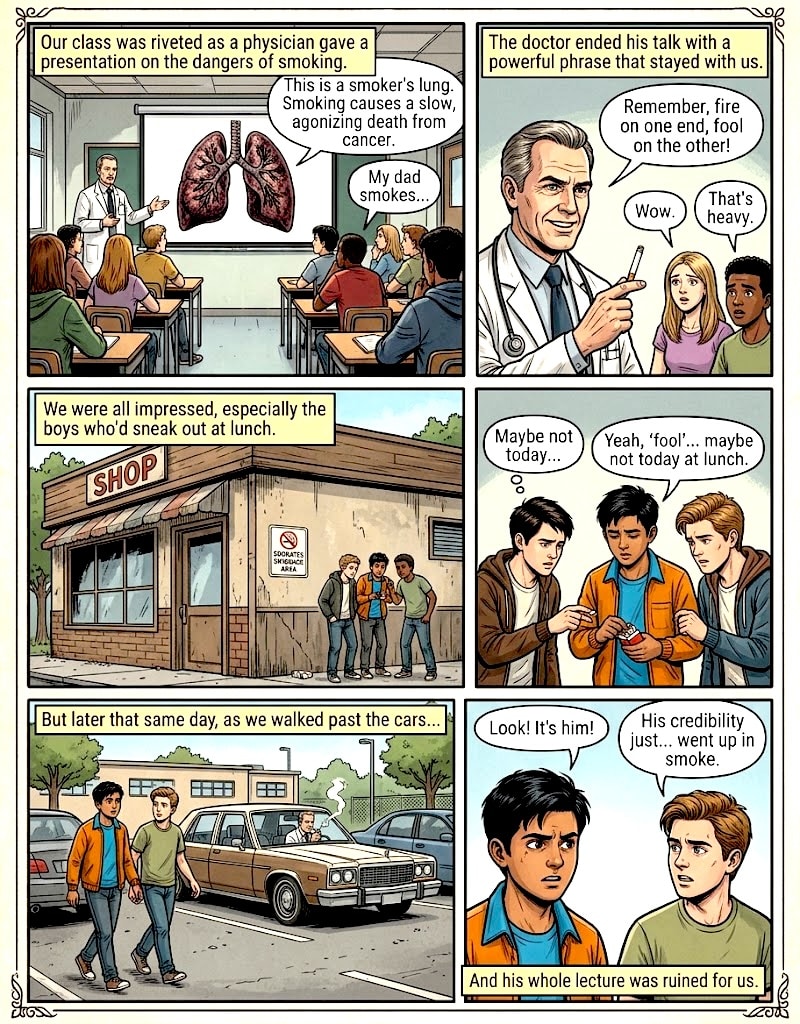
“Fire on One End,
Fool on the Other”
26th Sunday of Year A
Eternal reward or
Punishment?
26th Sunday of Year A
The clipart is from the archive of Father Richard Lonsdale © 2000. It may be freely reproduced in any non-profit publication.
Our final decision for or against God — our choosing to obey Him gracefully by doing His will or our choosing to go against His will! Gifted with free will, we are the ones who choose our eternal destiny.
Ezekiel 18:25-28
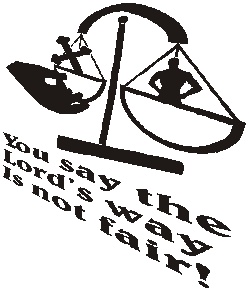
In the first reading, Ezekiel’s message from the Lord God to Israel answers the objections of those who think it is not fair that God should give such weight to one’s final decision because a person who, after a very long virtuous life, finally chooses sin will be punished, while another, who finally chooses virtue after a life of loose morals, will be rewarded.
In chapter 18, the Lord God, through His prophet, Ezekiel, challenges two old beliefs common among His people: that children inherit the guilt of their ancestors and are punished for it, and that God is more strict than merciful. Here, the Lord God declares His option for personal responsibility, which means one is to be rewarded or punished according to one’s individual actions, not for someone else’s.
In today’s passage, Ezekiel answers the objection raised by the Jewish slaves in Babylon, “Our ancestors sinned, but we are punished, and so God is not fair!” God’s message is that His mercy overrules strict justice, and He doesn’t hold our past against us. Hence, if God is “not fair,” it is to our advantage, because He doesn’t hold the past against us and always gives us another chance. In the same chapter of Ezekiel, God returns this “not fair” accusation, asking the House of Israel if their ways are “fair” when they turn from God’s love to serve false gods and their own false sense of what life is.
We often think that it is not fair for God to reward or punish one based only on one’s final option for God or against God, without considering one’s lifetime indulgence in vices or lifetime practice of virtues. The prophecy’s response is that God always gives people a chance to change and to accept the consequences of that change. The Lord further explains that that it is possible for a wicked person to renounce his sins, begin respecting God’s law, and live an upright life. Such a person will not die but live, and God will not remember any of his crimes against him. Likewise, it is possible for a good person to turn away from uprightness and to forfeit the favor of God and neighbor. Such a person’s past good deeds will be “forgotten from then on,” and he shall die for his sins, — unless, of course, he repents and turns back to God.
The Good News is that God is always ready to forgive; we need only show willingness to accept God’s forgiveness through our forgiveness of each other. Can one who “denies one’s Faith” ever come back into the Church? Yes. This issue confronted Pope Cornelius in the 3rd Century, and he called a Synod of Bishops to proclaim that an apostate who, after the persecution ends, truly repents, changing his mind and his way of life, can be readmitted to the Church community after receiving the Sacrament of Reconciliation and doing penance.
Philippians 2:1-11

The second reading, taken from Paul’s Letter to the Philippians, also affirms the truth that the final choice for God, made by perfect obedience to Him, will be rewarded. Paul emphasizes the fact that, because of Christ’s obedience to God’s will, emptying himself, taking human form and humbling himself by accepting death on a cross, that God the Father exalted Christ, bestowed on him the Name above every other name, and made Jesus the recipient of universal adoration.
Here, citing Jesus as the supreme model of obedience to the Father’s will, St. Paul also affirms the truth that those who make the final choice for God will be rewarded. Using lines from a hymn of early Christian belief which existed long before Paul penned his letter to the Philippians, the Apostle reminds his community of their obligation to look to others’ interests rather than their own (Phil 2:1-11).
As the hymn states, they need only take Jesus as their model for such behavior, because Jesus obeyed his Father completely, emptying himself, taking human form and humbling himself by accepting death on a cross. Paul emphasizes the fact that it is because of Christ’s loving obedience to the Father’s will that God the Father exalted Christ, bestowed on him the Name above every other name, and made Jesus the recipient of universal adoration.
The message is that if we are united with Christ in his faithful obedience to God, we will also share his glory. Paul adds that such faithfulness and obedience to God demand that “we do nothing out of selfishness or vainglory.” Instead, we should “humbly regard others as more important” than ourselves, “each looking out not for his own interests, but also for those of others.”
The hymn exemplifies the “mind” of Christ that we must “put on” when we face each other, which means that we will find unending joy and consolation only when we die to ourselves.
Matthew 21:28-32

In today’s Gospel parable, a man with two sons tells both to go out to work in the vineyard. The first son says he won’t go, but later regrets it and works. The second son says he will go but does not. In each case, it is the final decision that is more important. Jesus says, that repentant tax-collectors and prostitutes, represented by the first son who initially refused to go, will make their way into the Kingdom of God before the chief priests and the elders, represented by the second son in the parable.
The context: Jesus has now entered Jerusalem, the scene of all the Passion events he has predicted. When he reaches the Temple – the most religiously sensitive area for all of Judaism – Jesus becomes furious and drives out the merchants and moneychangers (Mt 21:12). It is not surprising, then, that the “chief priests and elders” should show great concern and great caution about Jesus’ presence in the Temple. That is why Jesus addressed this parable to those (v. 23) who approached him while he taught in the Temple and asked for his credentials: “By what authority are you doing these things, and who gave you this authority?” The parable of the two sons serves Jesus as a master strategy for defending his honor and presenting a counterchallenge to his adversaries. The purpose of this parable was to give a wake-up call to the chief priests and elders. The parable hints that their position as leaders of the Chosen People and their observance of Mosaic Law give them no guarantee that they will possess the Kingdom of God. Rather, because of their pride and their refusal to obey God’s call to repentance, they will exclude themselves from that Kingdom, while the tax-collectors and sinners, whom they despise, repenting of their sins and obeying Him, will be welcomed by Him into the Kingdom.
The parable and its meaning: Barclay calls this parable “The Better of Two Bad Sons.” Jesus presents us with a vineyard owner who has two sons. Both sons are asked by their father to go and work in his vineyard. The first son, when asked, says, “No.” He later changes his mind and goes. The second says “Yes, sir,” but does not go. Jesus then asks his listeners which of the two did the father’s will. They answer, “The first”, and their correct answer strengthens Jesus’ case against them. The message of the story is crystal clear. There are two very common classes of people in this world. First, there are those like the parable’s first-asked son, whose practice is far better than their profession. Second, there are the people like the second-asked son, whose profession is much better than their practice. While the first class should be preferred to the second, neither is anything like perfect, because the really good man is the man in whom profession and practice meet and match. The ideal son in this parable would be one who accepted the father’s orders with grace and respect and who unquestioningly and fully carried them out as Jesus obeyed his Father’s orders. The only sign of belonging to the kingdom is faithfulness to the will of God.
This parable underlines the necessity of our responding with a continual “yes” to the saving act of God. Further, this parable teaches us that promises can never take the place of performance, and fine words are never a substitute for fine deeds. In other words, the parable clearly teaches that the Christian Way is followed in performance, not in promise alone, and that the mark of a Christian is obedience, graciously, promptly, and courteously given. That is, we are not supposed to say “yes” to God on Sundays and “no” to God on weekdays. God does not want polite but hypocritical words, for that isn’t obedience at all. “Merciful and quick to forgive,” God tolerates willful, even blasphemous disobedience, provided repentance follows. God remains faithful, always ready to receive repentant sinners. He never abandons us even when we abandon Him. The parable teaches us that there are indeed two conditions for entering the Kingdom of God. One of these is giving up sinful ways. The second condition is believing the words of Jesus, and then acting accordingly. In both cases, or conditions, the emphasis is on the response of the listener to the word of God.
The twofold application of the parable: (1) This parable, found only in Matthew, outlines two responses to God’s call. The first son says, “I will not,” but changes his mind and does what is needed. The second son says, “I go, sir,” but does not go. Verses 31-32 make it clear that the repentant tax collectors and prostitutes are seen in the first son, and the second son signifies the self-righteous among the chief priests and elders. When John the Baptist called people to repent, tax collectors and prostitutes repented and were baptized. It was easy for them to repent, because their sins were obvious, even to themselves. The religious leaders, however, were not able, or ready, to admit their need for repentance, and therefore they rejected John and his call. So also, they rejected Jesus. We are reminded of Jesus’ words earlier in this Gospel, “Not everyone who says to me, ‘Lord, Lord,’ will enter the Kingdom of Heaven, but only the one who does the will of my Father in Heaven” (7:21). The life-saving difference between the two sons was the fact that one had the good sense to remember the love of his father, to turn from evil and decide to do what was right.(2) Today, the first son, the faithful son, has still another face — a repentant alcoholic, a small band of worshipers in a storefront, a Church that reaches out to the needy in its community, a Pastor who calls parishioners to true repentance, a Church member who decides to tithe, a young person who decides to remain abstinent until marriage — all people who, however reluctantly or painfully, obey Christ. The second son is now the person in the pew who refuses Christ entry into his or her heart and life — a Christian who refuses to obey Christ in the sensitive areas of sex, money, and power; a Preacher whose sermon is designed to please people rather than to please God; a Church that ignores issues of justice and mercy; a Sunday School that neglects to teach children the great Biblical stories — in short, all people who appear to be faithful but, down deep, are not.
Life Messages
26th Sunday of Year A
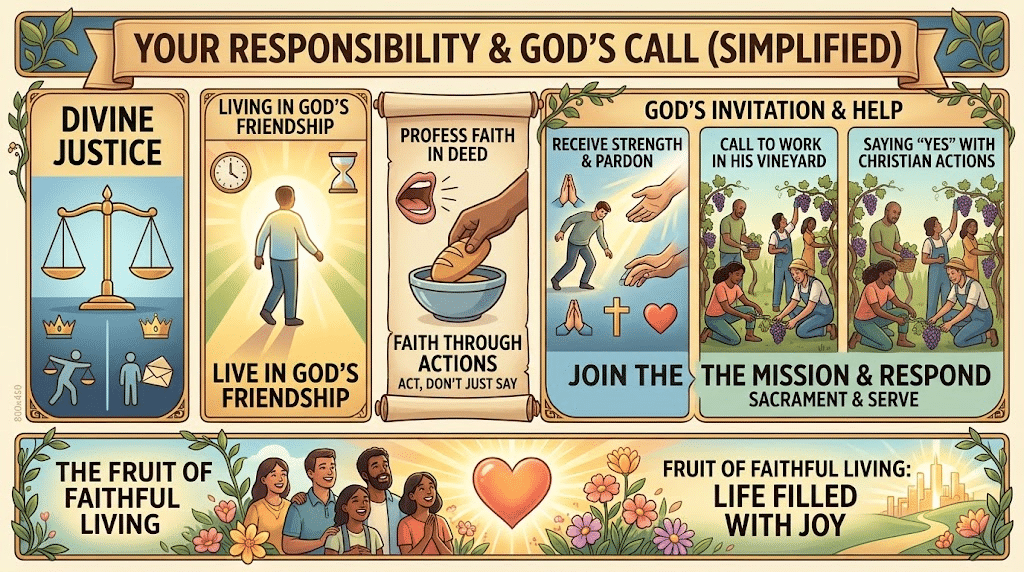
We each need to lead a responsible Christian life, saying “yes” to God

Each one of us is responsible to God for every one of our actions, and the just God will punish or reward each of us according to our actions. As we do not know at what moment death will take us, our only guarantee of dying in God’s friendship is to live in that friendship always, saying “Yes” to God in our deeds. We should become men and women who profess our Faith in word and deed, remembering that, “Not all those who say to me, ‘Lord, Lord,’ will enter the Kingdom of Heaven, but those who do the will of my Father Who is in Heaven” (Mt 7:21). God is ever with us to strengthen us, to pardon us, and to lift us up again when, through human weakness, we stumble on the road. God is calling us right now, inviting us to work in His vineyard, inviting us to say “Yes” to Him with our words and actions. Let us accept God’s invitation by purifying our hearts in the Sacrament of Reconciliation; by resolving to act upon our promises each morning before we get out of bed; and by declaring interiorly that people will be able to identify us as followers of Christ, not by empty words or pious gestures but simply by our Christian actions. In this way, we shall live a life filled with the joy that doing the will of the Father brings.
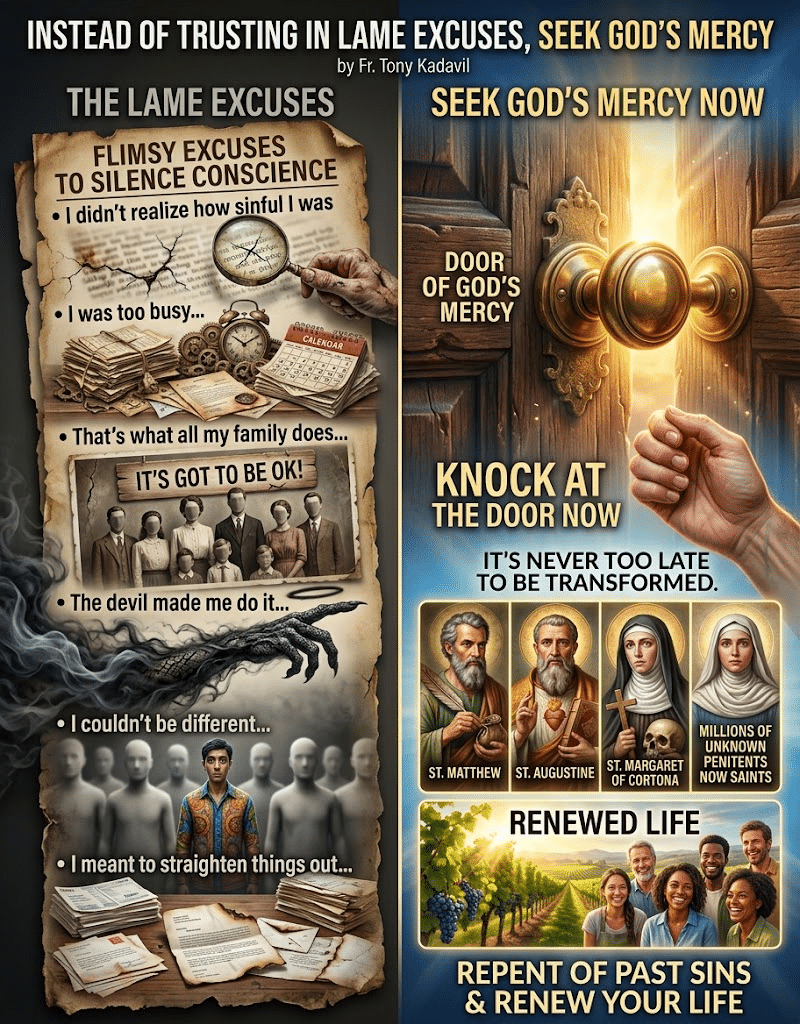
Instead of trusting in lame excuses, we need to seek God’s mercy
We often use flimsy excuses to silence our conscience. They run like this: “I didn’t realize how sinful I was”; “I was just too busy with work, family, and a decent social life to have time for Sunday Mass”; “That’s what all my family does – it’s got to be OK!” ; “The devil made me do it – it wasn’t my fault!”; ””I couldn’t be different from everyone else—I’d look stupid!”; “I meant to straighten things out – I just didn’t get to it.” These are not valid excuses at the judgment seat of God. Hence, if we have been disobedient to God in our past life, we need to knock at the door of God’s mercy now. We need to remember that what God in his mercy did for the tax-collectors and harlots in the parable, the Matthews, the Augustines, the Margarets of Cortona, and the millions of unknown penitents who are now Saints in Heaven, He can, and will, do for us, if we repent of our past sins and renew our lives as the first-asked son in the parable did. It is never too late for us to be transformed.