Liturgy, Liturgy Notes, Liturgy Planner, Sunday Prep, Planning for Mass
Liturgy Notes, Liturgy Planner, Sunday Prep, Planning for Mass
September 27, 2026
Sept 6 | Today | Sept 13 | Sept 20 | Sept 27

⬅️  ➡️
➡️






PETITIONS
September 27, 2026
The Church
Governments and Salvation of the World
Those Burdened by Adversity
Local Parish / Faith Community
THE WORD
IN SONGS
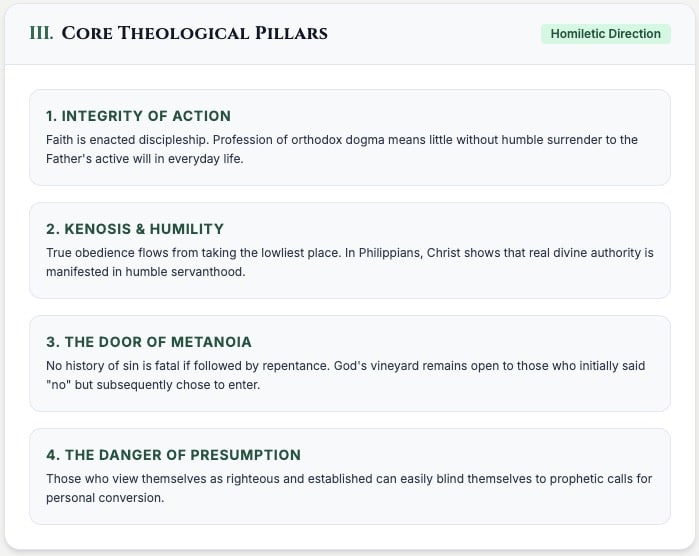
THIS WEEK


ONE WORD
MANY CHARISMS
Sunday Lectionary Perspectives Across Religious Traditions


26th Sunday of Year A
September 27, 2026




THE WORD THIS WEEK
He said "I will go,"
Yet his feet never moved out;
Promises ring false.
September 27, 2026


Papal Homilies






Featured Blog Posts
September 27, 2026



Fr. George Corrigan, OFM
Conflict in Jerusalem
Jesus' Authority Challenged
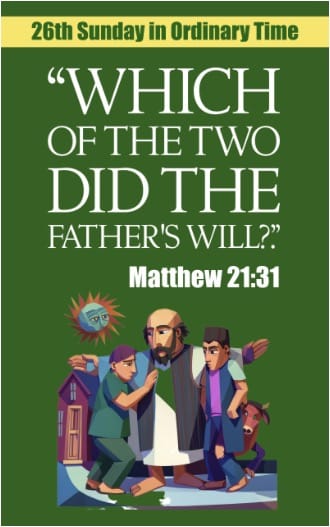
The Parable of the Two Sons
Which of the two did his father’s will?
The answer… or at least an answer
What Next?
…and nothing more
Msgr. Joseph Pellegrino (PDF) | Archive
Just Do It, Jelly Belly Kelly (2026)
The Name Above All names (2023)
The Eternal Offering (2020)
Scoreboard (2017)
Empty Means Full (2014)
Fr. Michael Fallon, MSC | Archive
26th Sunday in Ordinary Time (PDF)

Liturgy Notes

Courtesy of The Sunday Mass—2023 Cycle A
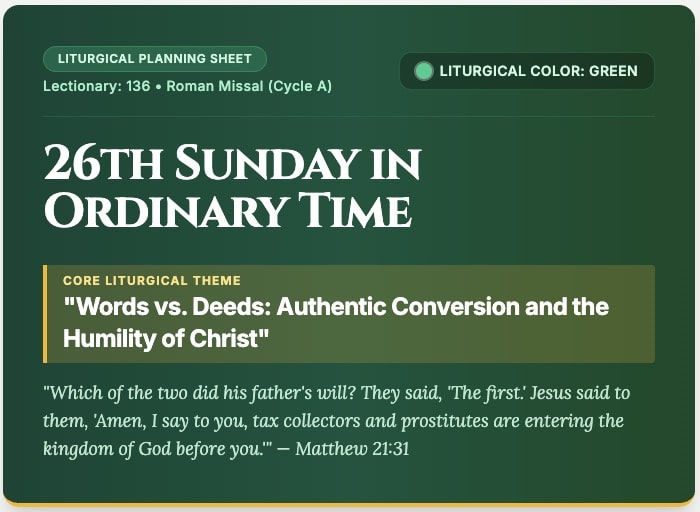

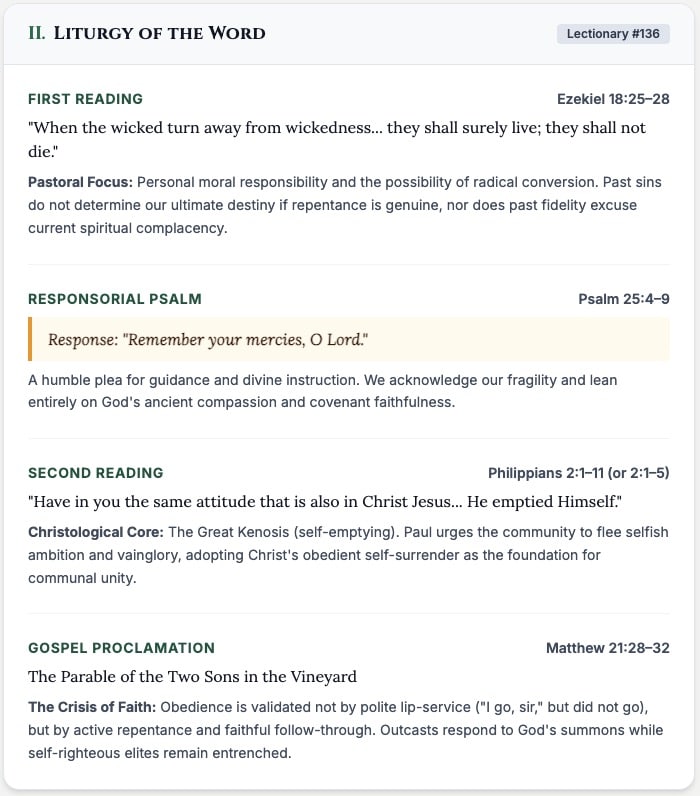

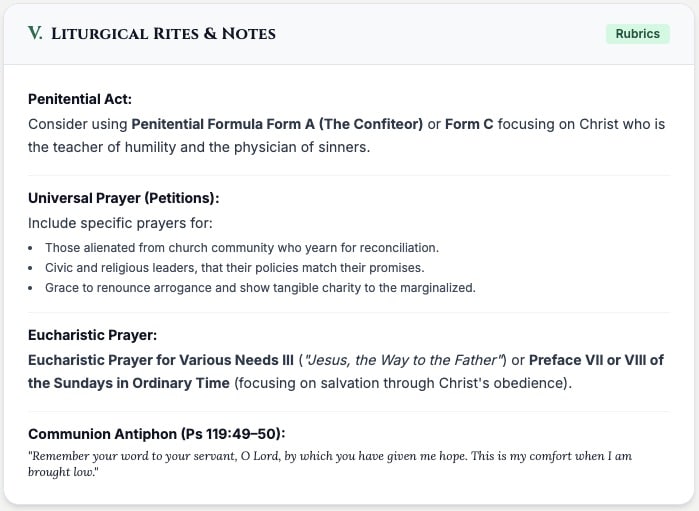
26th Sunday of Year A
Church Conflicts
Are there ever any conflicts in your parish? Silly question, isn’t it? A humorous adage says, “Two Jews; three opinions.” That applies to any gathering of humans, not just Jews. Conflict seems endemic to human interaction, at least at times.
This is not a new problem in the church, as today’s readings make clear. The prophet, Wisdom says, is rejected and attacked “because he is obnoxious to us; he sets himself against our doings, reproaches us for transgressions of the law and charges us with violations of our training.”
Conflict can even occur among those who seek to lead the parish’s worship life. Why is this? In today’s epistle, James says, “Where jealousy and selfish ambition exist, there is disorder and every foul practice.” Can jealousy and selfish ambition creep into our ministries? Think of a lector who gets angry when he or she is not scheduled for a big celebration like Christmas or Easter Vigil. Or of a planner whose ideas are not embraced by the larger group. Or of conflicts between planners and presiders. There are multiple situations that are open to jealousy or personal ambition or hurt feelings that can lead to open conflict among parish ministers.

Full Series: Cycle A Resources
Entrance Song

Response & Acclaim
Response & Acclaim




Presentation & Preparation
Presentation and Preparation
Communion
Communion

Sending Forth
Sending Forth

Everlasting God (Brenton Brown and Ken Riley)
SPIRIT & SONG | THE COMMONS
Liturgy Blog is a weekly liturgy planning resource for musicians, liturgists, homilists, youth groups, faith sharing groups, and all who look to the liturgical readings for inspiration and nourishment. Join Ken Canedo as he breaks open the Scripture and suggests tracks from the Spirit & Song contemporary repertoire.
Ezekiel 18:25-28

2023 video courtesy of Lector with Lisa

26th Sunday in Ordinary Time — First Reading
Proclamation Coaching Guide | Ezekiel 18:25–28
The Watchword Box
OVERARCHING PACING THEME: Prophetic confronting transitioning into warm mercy.
CONCEPT VS. STORY: This is not narrative storytelling; it is a sharp, logical disputation that resolves into an invitation of life. Treat the logic with objective clarity so the contrast lands cleanly.
VOCAL EMOTIONAL PROFILE: Start with a firm, parental, "hands-down" firmness ("Oh no, hold on right here!"). Shift into steady, objective legal logic in the middle, and finish with a warm, relieved, reassuring smile.
Delivery Blueprint Table
Text Segment | Vocal Tone | Pacing & Ambo Actions |
A reading from the Book of the Prophet Ezekiel. | Reverent, measured, clear. | Establish ambo footing. Pause 3 full seconds. Sweep eyes across the assembly before speaking. |
Thus says the LORD: / "You say, 'The LORD’s way is not fair!'" | Prophetic, assertive, confronting. No tender softness here—this is "hands down" authoritative. | Deliver with the directness of an exasperated parent intervening ("Oh no, hold on right here"). Direct eye contact. |
"Hear now, house of Israel: / Is it my way that is unfair, / or rather, are not your ways unfair?" | Firm rhetorical challenge; pointed and piercing. | Slow the tempo on each question. Direct eye contact on the questions; let the inversion of "my way" vs. "your ways" land across the room. |
"When someone virtuous turns away from virtue / to commit iniquity, and dies, / it is because of the iniquity he committed that he must die." | Objective, balanced, matter-of-fact; legal precision. | Definition: Iniquity = gross injustice or deliberate sin. Drop the emotional heat; deliver this with straightforward logical clarity. Keep gaze steady between page and people. |
"But if he turns from the wickedness he has committed / and does what is right and just, / he shall preserve his life;" | Transitioning; warmer, hopeful, rising inflection. | [MANDATORY LONG PAUSE] Semicolon pause. Hold silence to signal that the thought is restarting with even greater emphasis. |
"since he has turned away from all the sins that he has committed, / he shall surely live, / he shall not die." | Warm, liberating, deeply reassuring. | Deliver with a genuine smile. Let relief and grace displace the opening harshness. Bring voice to a full, settled cadence. |
[Silence] | Internal quiet. | Look down at the Lectionary. Take a deliberate breath. Do not rush. |
"The Word of the Lord." | Simple, dignified proclamation. | DO NOT LIFT THE BOOK. Keep hands resting lightly at the ambo. Speak outward, then lift eyes to receive the assembly’s response: "Thanks be to God." |

- Own the Opening "Parental" ShockDo not shy away from the prophetic bite at the start. Unlike Isaiah’s tender "my thoughts are not your thoughts," Ezekiel opens with an assertive confrontation ("Oh no, hold on here"). Deliver the opening complaint and rhetorical rebuttal with unapologetic strength before pivoting to the final smile.
- Ground the Proclamation (Leave the Book on the Ambo)Once the final lines are proclaimed, the Word is already out in the room. Never physically lift the Lectionary when announcing "The Word of the Lord." Let the text remain resting on the ambo while your posture conveys reverence and quiet authority.
- Remain Put as the Visual Model of PonderingYou are not finished when the reading concludes. Stay completely still at the ambo regardless of how you feel the delivery went. Keep your eyes gently lowered to the sacred page, prayerfully pondering the Word until the music for the Responsorial Psalm begins. Your visible reverence teaches the assembly how to receive and digest the Word.
Ezekiel 18:25-28
Greg Warnusz


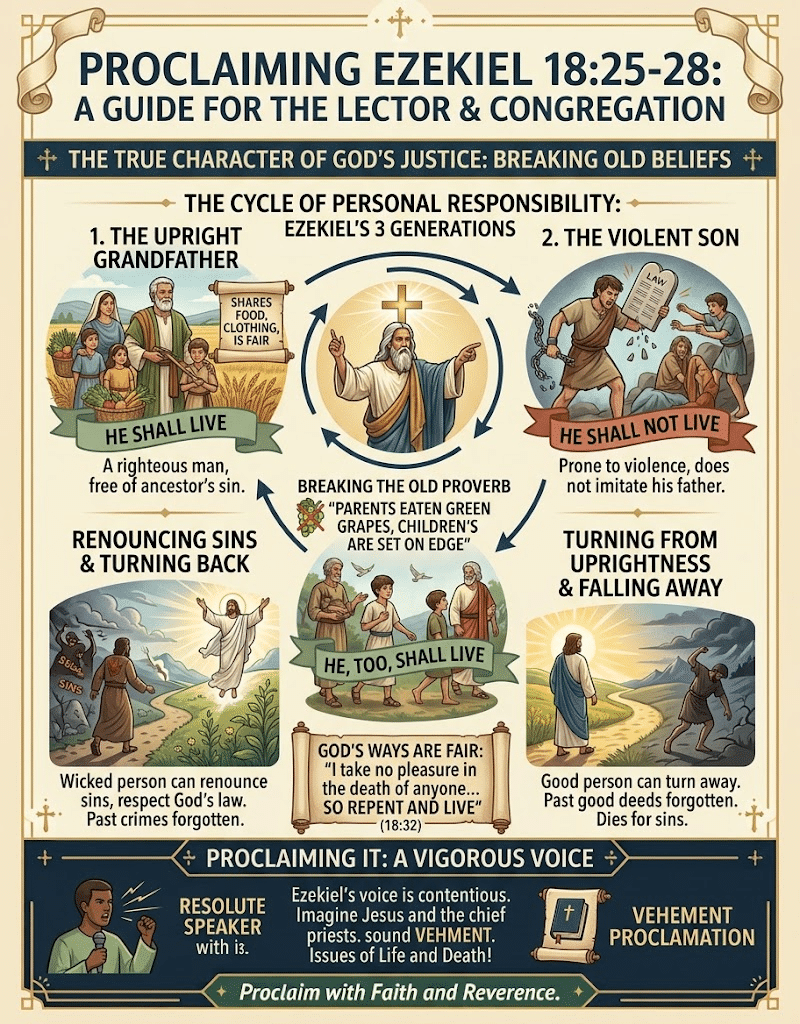
The Theological Situation: In chapter 18, Ezekiel challenges two old beliefs common among his people:
- That children inherit the guilt of their ancestors,
- and that God is more strict than merciful.
The chapter begins with prophet announcing that God wants the people to stop repeating (and believing) an old proverb, "Parents have eaten green grapes, and their children's teeth are set on edge." He goes on to describe God's response to three generations of a certain family. A certain man is good; he does not worship idols, commit adultery, or charge interest on loans. He shares food and clothing with the poor. He is fair in his judgments of others. Such a man is upright in God's eyes, and he shall live. Now this man has a son "prone to violence and bloodshed," who chooses to do everything wrong. He is not upright, and by God's judgment, shall not live. And there is a grandson who, "in spite of seeing all his father has committed, does not imitate him." He acts more like his grandfather than like his father. So he does not inherit his father's disfavor with God, but rather is upright; he, too, shall live.
Not content just to upset the people's old belief about inherited guilt, Ezekiel attacks their convictions about "once a sinner, always a sinner." He asserts that it is possible for a wicked person to renounce his sins, begin respecting God's law, and live uprightly. Such a one will not die but live, says the Lord through Ezekiel. None of his crimes will be remembered against him. At least not by God, for the implication is that the people rather enjoyed remembering the sins of others, and condemning them over and over. Why else would Ezekiel need to make this prophecy?
Likewise it is possible for a good person to turn away from uprightness and to forfeit the favor of God and neighbor. Such a person's past good deeds will be "forgotten from then on." He shall die for his sins.
Now it's these two challenges to old beliefs, these assertions that children are not to bear their parents' guilt and that both the upright and especially the wicked can reverse their ways and reverse their standing in God's eyes, that precede the verses of today's selection. These are the new prophetic revelations that make the people say "God's ways are unfair." Ezekiel's response is unsympathetic and uncompromising. "This is the way God is, people, despite what you used to think. It's your own sins, not your fathers', that have got you into trouble. Repent, take responsibility. It's possible. You can live. No excuses! 'I take no pleasure in the death of anyone -- declares the Lord Yahweh -- so repent and live' (18:32)"
Proclaiming It: Ezekiel is very contentious here. He deserves a vigorous proclamation. A good way to deliver this in your Sunday congregation would be to imagine you are Jesus in that heated discussion with the chief priests and elders. Their arrogance is getting to you, so you reach in your pocket, pull out your copy of Ezekiel, open it and say,
Don't be afraid to sound vehement. Ezekiel wasn't; he was talking (and you'll be reading) about issues of life and death.
Philippians 2:1-11

2023 video courtesy of Lector with Lisa
26th Sunday in Ordinary Time — Second Reading
Proclamation Coaching Guide | Philippians 2:1–11
The Watchword Box
OVERARCHING PACING THEME: Slower, deliberate conditional buildup accelerating into victorious, energetic exaltation.
CONCEPT VS. STORY: This is not narrative storytelling; it is a foundational, two-part theological movement. Part one is a balanced conditional appeal ("If... then...") requiring equal weight on every premise, flowing into counter-cultural instruction. Part two is the great Christological hymn moving from extreme descent to soaring triumph.
VOCAL EMOTIONAL PROFILE: Begin with warm, earnest, communal pleading. Transition into instructional, gentle firmness when commanding self-forgetful humility. Drop into solemn, reverent awe at the descent of the cross, then burst into brisk, energetic celebration for Christ's universal exaltation.
Delivery Blueprint Table
Text Segment | Vocal Tone | Pacing & Ambo Actions |
A reading from the Letter of Saint Paul to the Philippians. | Clear, dignified, steady. | Anchor ambo footing. Pause 3 full seconds. Survey the entire assembly before beginning. |
Brothers and sisters: | Direct, personal, pastoral warmth. | Make direct eye contact with someone in the assembly. Establish a human, familial connection. |
If there is any encouragement in Christ, | Earnest, measured appeal; premise 1 of 4. | Give equal weight to each condition. Do not gesture with hands. Slight pause at the comma. |
any solace in love, | Compassionate, gentle; premise 2 of 4. | Definition: Solace = comforting relief in sorrow. Equal weight. Brief pause. |
any participation in the Spirit, | Communal, inviting; premise 3 of 4. | [MANDATORY LONG PAUSE] Hold silence to let the trinity of spiritual gifts settle before the final emotional beat. |
any compassion and mercy, | Tender, heartfelt; premise 4 of 4. | Complete the conditional sequence. Keep vocal pitch suspended for the resolution. |
complete my joy by being of the same mind, / with the same love, / united in heart, / thinking one thing. | Urgent, pleading, unifying affection. | Here lands the "Then": "If you experience this grace, live it!" Enunciate the four marks of unity deliberately without rushing. |
Do nothing out of selfishness or out of vainglory; | Clear, corrective warning. | Definition: Vainglory = empty pride or boasting. Direct gaze out to the assembly. |
rather, humbly regard others as more important than yourselves, | Gentle, earnest, instructional firmness. | Direct, intentional eye contact. This cuts against human nature; deliver it gently rather than scoldingly, letting the challenge register. |
each looking out not for his own interests, / but also for those of others. | Thoughtful, pastoral counsel. | Deliberate pause. Give the congregation space to digest this counter-cultural mandate before shifting to the hymn. |
Have in you the same attitude / that is also in Christ Jesus, | Solemn, elevated introduction to the hymn. | Slow down your cadence noticeably. Transition from Paul's instruction to the divine exemplar. |
Who, though he was in the form of God, / did not regard equality with God something to be grasped. | Reverent, contemplative, careful. | Definition: Grasped = greedily clutched or exploited (the contrast to Adam's grasping). Take your time with "grasped." |
Rather, he emptied himself, / taking the form of a slave, / coming in human likeness; | Deeply humbled, lowering pitch, quiet gravity. | [MANDATORY SEMICOLON PAUSE] Treat this semicolon almost like a full period. Reset breath and voice before the next descent. |
and found human in appearance, / he humbled himself, / becoming obedient to the point of death, / even death on a cross. | Profound solemnity, stark and heavy. | Drop tempo to its slowest point. Feel the weight of ultimate obedience and execution. Let the silence hang after "cross." |
Because of this, God greatly exalted him / and bestowed on him the name that is above every name, | Dynamic shift: Brisk, rising, triumphant excitement. | Speed up tempo and elevate energy. Pivot sharply from the grave into divine victory and joy. |
that at the name of Jesus every knee should bend, / of those in heaven and on earth and under the earth, | Powerful, sweeping, expansive. | Maintain the brisk, rhythmic pace. Project outward across the whole church building. |
and every tongue confess that / Jesus Christ is Lord, / to the glory of God the Father. | Climactic, ringing declaration. | Full vocal projection and ringing clarity. Do NOT add "Amen" at the end. Bring cadence to a resolved, regal finish. |
[Silence] | Quiet presence. | Look down at the Lectionary. Breathe deliberately. Do not rush to dismiss. |
"The Word of the Lord." | Grounded, noble proclamation. | Keep hands resting on the ambo. Proclaim outward, then look up to receive the response: "Thanks be to God." |

- Balance the "If" List and Deliver the "Grasped" ContrastGive equal weight and distinct rhythmic spacing to each of the four opening conditional gifts (encouragement, solace, participation, compassion). When you reach the hymn, linger deliberately on the word "grasped." Slowing down there highlights the crucial theological contrast between Adam grasping for divine status and Christ willingly surrendering it.
- Master the Gear Shift (Descent vs. Exaltation)Treat this reading as two opposing musical movements. Allow your voice to slow down and descend into quiet, solemn reverence as Christ empties Himself to the point of "death on a cross." Then immediately shift gears at "Because of this": pick up the tempo, elevate your energy, and proclaim the universal bending of knees with joyful, brisk momentum.
- Keep the Ending Clean and Free of AdditionsConclude the hymn text cleanly with "to the glory of God the Father" without instinctively inserting an "Amen." Take a deliberate breath in the sacred silence, announce "The Word of the Lord" with quiet dignity from the ambo, and let the assembly's response conclude the proclamation.
Philippians 2:1-11
Greg Warnusz

The lector should prepare for this by savoring this text slowly and reverently. Notice the cycle:
- Jesus, though divine, did not cling to his divine prerogatives
- but emptied himself,
- even to the point of dying on a cross.
- God then raised him,
- giving him the most exalted of titles,
- so that all creation is destined to honor him.
Proclaiming It: The English translation available to us doesn't seem poetic or worthy of singing. Until the right poet/musician comes along who can render the passage more beautifully, it's up to you speak it faithfully, with the solemnity that its venerable status calls for.
