Fr. Tony’s Homily, Homily Starters
Fr. Tony’s Homily, Homily Starters
September 13, 2026



RELATED
PAGES
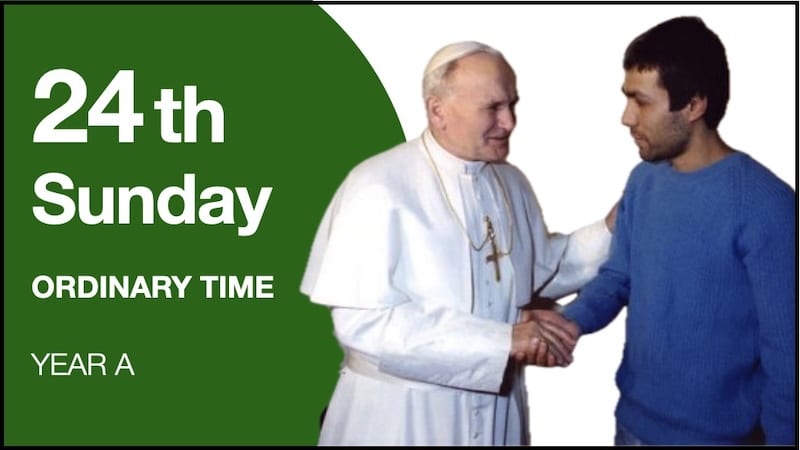






1972 Vietnam Bombing Attack
24th Sunday of Year A

“…forgive your brother from your heart.”—Mt 18:35
No Justice without Forgiveness
24th Sunday of Year A

“Should you not also have had compassion on your fellow servant, just as I had pity on you?”—Mt 18:33
Amish Forgiveness
24th Sunday of Year A

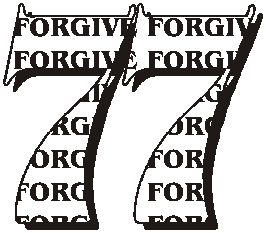
“Lord, if my brother sins against me, how often must I forgive? As many as seven times?” Jesus answered, “I say to you, not seven times but seventy-seven times. “—Mt 18:21-22
Christmas 1914
24th Sunday of Year A

“Remember your last days, set enmity aside… and overlook faults.”—Sir 28:6-7
Gandhi (1982)
24th Sunday of Year A

“Wrath and anger, these also are abominations, yet a sinner will hold on to them.”—Sir 27:30

Forgiveness
24th Sunday of Year A
The clipart is from the archive of Father Richard Lonsdale © 2000. It may be freely reproduced in any non-profit publication.
Our readings for this Twenty-Fourth Sunday concern forgiving and being reconciled with those who wound us. All three readings today remind us of the path to forgiveness, mercy, and reconciliation and challenge us to walk this path with Jesus, the only Way to Life.
The Gospel specifically emphasizes two ideas. The first idea, found in Jesus’ reply to Peter’s question, is that the disciples of Jesus must forgive one another always (“seventy times seven times” = without limit). The second idea, found in the parable, is the communal dimension of forgiveness.
Sirach 27:30—28:7

In the first reading, Sirach reminds his listeners that if they don’t heal and forgive and show mercy, they can’t expect to receive mercy from God in return. It is unwise to nurse grudges and wise to forgive because our life span is very short and our eternal destiny is decided by how we forgive, how we work for reconciliation with those who wound us, and how we render humble and loving service to them.
In today’s Psalm, (Ps 103), the Psalmist sings, “The Lord is gracious and merciful, slow to anger and of great kindness.”
First Reading (Sir 27:30–28:7) explained. The Book of Sirach was written around 180 B.C. by a wise Jew, Jesus Ben Sira, or Sirach. By this time in Israel’s history, the great theological battles about monotheism have ended, the kings have come and gone, and the Exile is a distant memory. The prophets have been silent for a long time, and many Jews are living in cities where pagans are in the majority. In these circumstances, the writer teaches the Jews how to live a good life, what moral and spiritual choices one should make, how awful wrath and anger are, and how, in spite of this, the sinner “hugs them tight.” Release them and let them go, he says.
“The vengeful will suffer Yahweh’s vengeance; for He remembers their sins in detail. Forgive your neighbor’s injustice; then when you pray, your own sins will be forgiven.”
Sirach reminds his listeners that if they don’t lay aside anger, forgive, and show mercy to an offender they can’t expect to receive much forgiveness and mercy when they face God. This teacher of wisdom tells us how to avoid Divine retribution. God treats us the way we treat each other.
Today’s passage says, in various ways, that it’s unwise to nurse grudges and wise to forgive. It concludes by reminding us of our own death:
“Remember your last days, and set enmity aside; remember death and decay, and cease from sin! Think of the commandments, hate not your neighbor; remember the Most High’s covenant, and overlook faults.”
This reading prepares us for today’s Gospel passage, the familiar parable of the unforgiving steward, in Mt 18:21-35.
Romans 14:7-9
In the second reading, Paul reminds us that we have to forgive others because we belong to Christ who, by his own example in forgiving those who killed Him, taught us how we must forgive in our turn. Since we humans are related to each other as brothers and sisters of Jesus, we are in the family of God, so hatred and bitterness toward anyone should have no place in our hearts.
Second Reading (Rom 14:7-9) explained: The context of this passage is a discussion of relations between the strong and the weak members of the Church. This discussion was occasioned by tensions in Rome between the Gentile Christians who were liberal in their attitude toward the Law and the Jewish Christians who were scrupulous about legal observances. They were the strong and the weak, respectively. Paul urges mutual tolerance. The strong, in particular, should respect the scruples of the weak.
The fundamental principle here is that no Christian exists by himself or herself, but only in relation to the Lord, the risen and exalted Kyrios, that is, Christ, and therefore in relation to other Church members, who are equally related to the Kyrios — all of us adopted brothers and sisters to Jesus, and so brothers and sisters to each other.
Paul reminds us that we live and die for Jesus Christ who, from his cross pardoned his crucifiers, among whom we must include ourselves, for Jesus died for the sin of all mankind. In this way, Jesus teaches us by stunning example to forgive those who wound us. Then too, since we humans are related as adopted brothers and sisters of Jesus, we are members of God’s family in whose hearts hatred and bitterness should have no place.
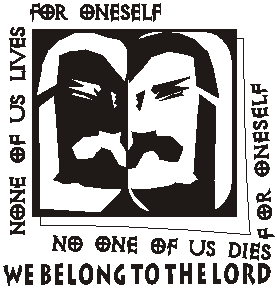
“No one of us lives for oneself,” the Apostle writes, “and no one dies for oneself. For if we live, we live for the Lord; and if we die, we die for the Lord; so then, whether we live or die, we are the Lord’s.”
Matthew 18:21-35
In today’s Gospel, through the parable of the two debtors, Jesus teaches us that there should be no limit to our forgiveness and no conditions attached to our reconciliation. We represent the greater debtor in the parable because we commit sins every day and, hence, we need God’s forgiveness every day. But we must forgive in order to be forgiven. Jesus explains, after teaching us the prayer Our Father, “For if you forgive men their trespasses, your Heavenly Father also will forgive you. “
“Seventy times seven times!”: Jesus’ parable of the ‘unforgiving servant’ is found only in the Gospel of Matthew, where it is intended to be a moral exhortation for the Church on the need for forgiveness. Peter asked Jesus how often he ought to forgive his brother, and then answered his own question by suggesting that he should forgive seven times. It was the Rabbinic teaching that a man must forgive his brother three times. The Biblical proof for this was taken from the first and second chapters of Amos where we find a series of condemnations on the various nations for three transgressions (Am.1:3, 6, 9; Am.1:11, 13; Am.2:1, 4, 6). From this it was deduced that God’s forgiveness extends to three offenses, and that He visits the sinner with punishment at the fourth. Also, seven was a holy number to Jewish people, symbolizing perfection, fullness, abundance, rest, and completion. Peter expected to be warmly commended. But Jesus’ answer was that the Christian must forgive “seventy times seven times.” In other words, there is no reckonable limit to forgiveness.
The lessons taught by the parable:
(1) We must forgive in order to be forgiven. Jesus explains this after teaching the prayer, Our Father, saying, “For if you forgive men their trespasses, your Heavenly Father also will forgive you; but if you do not forgive men their trespasses, neither will your Father forgive your trespasses”(Mt 6:14-15). James offers this warning in different words: “For judgment is without mercy to the one who has shown no mercy” (Jas 2:13). This means that Divine and human forgiveness go hand in hand.
(2) We represent the greater debtor in the parable. We commit sins every day and, hence, need God’s forgiveness every day. In the parable, the first servant (a top official of the king), owed his master 10,000 talents, an incredible debt. 10,000 is the highest number used in reckoning, and the talent is the largest currency unit in the whole of the Near East. The modern equivalent would be about ten million dollars! Surely Christ is exaggerating here because, according to Roman tax records of the time, all Israel’s taxes for one year amounted to about $800,000. We are told that this was an amount equivalent to 15 years of wages to a laborer in that day. The first servant would have taken 15 years to pay off the debt while the other only, three months of work. What Jesus means is that this man was hopelessly indebted. The accumulated sum of all our sins makes us greater debtors before God than the first debtor in the story. But God is ready to forgive us unconditionally. The sum total of all the offenses which our brothers and sisters commit against us is equivalent to the small debt of the second debtor in the parable, namely 100 denarii, one denarius being “the normal daily wage for a laborer” (NAB note). 100 denarii could have been carried in a pocket, and it was one five-hundred thousandth of the debt which the first servant owed. Our own merciless behavior towards our fellow human beings is both shocking and sad; it resembles that of the forgiven first servant who turned toward his fellow servant in the same household and refused to forgive a much smaller debt. The moral of Jesus’ story is that members of the community must treat one another as God has treated each of us. Here is a Divine call to throw away the calculator when it comes to forgiveness. We must choose the more honorable path and forgive one another “from the heart.” Jesus’ instruction echoes Lv 19:17: “You shall not hate your brother in your heart . . . you shall love your neighbor as yourself.” We have been forgiven a debt which is beyond all paying – the debt of the sin of all mankind which brought about the death of God’s own Son – and, if that is so, we must forgive others as God has forgiven us. Having experienced forgiveness at the hands of God and God’s people, we are then called, and given grace, to forgive those who wound us in our turn and so make it possible for others to experience God’s Mercy through us. If we refuse that grace and cling to our anger, we have Jesus’ promise, “… if you do not forgive men their trespasses, neither will your Father forgive your trespasses.”
(3) Peter’s question resonates within us: “How often should I forgive?” Jesus’ answer comes in the form of an idiom, “seventy times seven times,” which means that, at all times and in all places, we are to embody God’s forgiving grace. Forgiveness involves more than absolution of guilt. It involves reconciliation – the mending of our past, now-fractured, relationships and the healing of our mutual brokenness. It involves intentional work to heal and be reconciled with another. God awakens in us the wholeness that invites us to share in His holiness. Healing, reconciliation, and forgiveness, acting together, sketch a way of life embodying an ever-deepening friendship with God and with one another.
(4) Forgiveness does not mean condoning evil: Neither in God nor in the Christian community, do forgiveness and reconciliation mean the indefinite tolerance of evil and unjust behavior. The king was perfectly ready to forgive the senior official. But how could reconciliation take place when the official later behaved in such an abominable way to a brother? We can be ready to forgive the sinner indefinitely, but we must fight against sin without counting the cost. God and the Church can forgive the repentant sinner, but they cannot condone unrepented behavior that is a source of real evil and suffering. God cannot be reconciled with the sinner who chooses to stay in sin, nor can the Christian community fully incorporate a member who refuses reconciliation and the healing of the behaviors that offend against truth and love. With God in the Sacrament of Reconciliation, forgiveness is easily available to the individual Christian, but along with the Sacrament of Reconciliation, we must seek a mutual healing of wounds and a real change of mind and evil behavior.
(5) Catechism on forgiveness: The gates of forgiveness are always open to anyone who turns away from sin (CCC #982). Everyone must be tireless in forgiving each other both the petty and the serious; the charity of Christ demands it (CCC #2227). It is our own heart that binds us to heaven or hell, just as the “merciless servant” discovers in today’s Gospel (CCC #2843).
6) Scripture warnings of our need to experience and show mercy:
1) Matt 6:14 For if you forgive men when they sin against you, your heavenly Father will also forgive you. But if you do not forgive men their sins, your Father will not forgive your sins
2) Matt 5:7 Blessed are the merciful, for they will be shown mercy.
- Matt 7:2 For in the same way you judge others, you will be judged, and with the measure you use, it will be measured to you.
- Luke 6:37 Do not condemn, and you will not be condemned. Forgive, and you will be forgiven.
- Matt 18:35 This is how my heavenly Father will treat each of you unless you forgive your brother from your heart.
- James 2:13 For judgment without mercy will be shown to anyone who has not been merciful. But mercy triumphs over judgment!
- Sirach 27:30 The vengeful will suffer the Lord’s vengeance, for He remembers their sin in detail. Forgive your neighbor’s injustice; then when you pray, your own sins will be forgiven. Can anyone nourish anger against another and expect healing from the Lord? Can anyone refuse mercy to another like himself and then seek pardon for his own sins? Remember your last days — set enmity aside. Remember death and cease from sin. Think of the Commandments, hate not your neighbor, remember the Most High’s covenant, and overlook faults.
Life Messages
24th Sunday of Year A
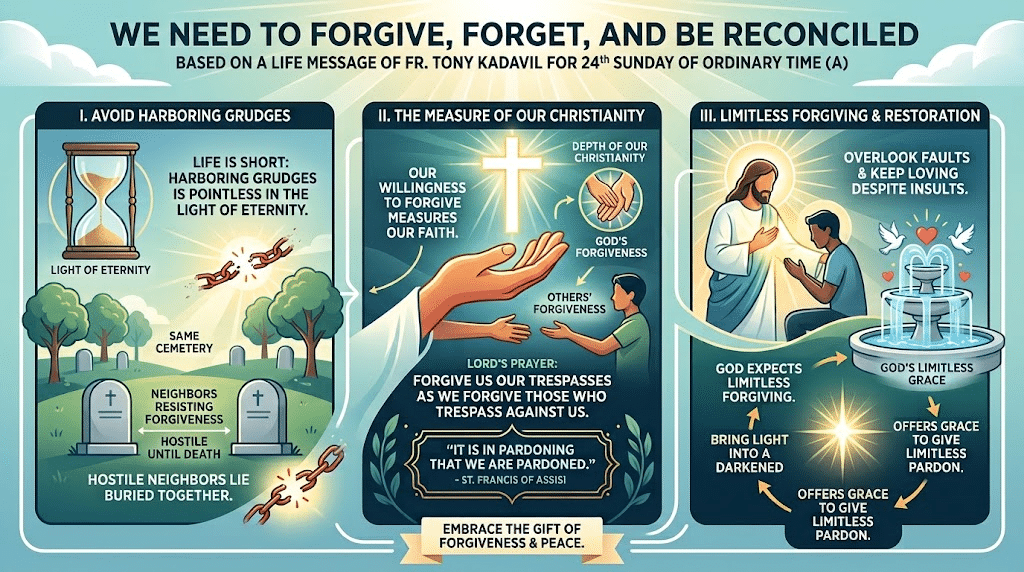
We need to forgive, forget,
and be reconciled

In the light of eternity and the shortness of our span of life, harboring old grudges is pointless. Neighbors who remained hostile and unforgiving till their death are buried a short distance from one another in the same cemetery.
Our ability and willingness to forgive are the measure of the depth of our Christianity. The forgiveness that we offer others is the indispensable condition which makes it possible for us to receive God’s forgiveness and to pray meaningfully: “Forgive us our trespasses as we forgive those who trespass against us.”
Let us remember St. Francis of Assisi’s prayer: “It is in pardoning that we are pardoned.” Our failure to offer pardon means that we have forgotten God’s goodness or have not fully appreciated the unconditional forgiveness we have received from Him. What God expects from us, and offers us grace to give, is limitless forgiving with the ability and willingness to overlook faults and to keep on loving even in the face of insults.
“Should you not have had pity
on your fellow servant, as
I had pity on you?”
Incidents of simple human frailties challenge each of us on a personal level. We need to find healing for painful family relationships. We need to find forgiveness for/from an employer and for/from a friend who has deserted us. We need to find forgiveness for the teacher who may have judged us wrongly.
We need to find courage to stop, to be silent, and to pray for grace when we find ourselves in conflict with the one we most trusted, so that we may answer with compassion — not counter-attack nor recriminate, but seek the reasons for what we experience as a betrayal, that we may resolve the issue, be reconciled, and forgive one another without conditions.

We need to think more of the
advantage of forgiving
Let us forgive the person who has wronged us before the hatred eats away at our ability to forgive. It will not be easy, but God is there to help us. We can do this by offering that individual to God, not sitting in judgment on him or her, but by simply saying, “Help so-and-so and me to mend our relationship.” Whatever the hurt, pain, disappointment, fear or anger that we may be feeling, we need to say, “God, I give this over to You. I can’t take care of it, but I know that You can. What would You have me to do?” And then listen.
This isn’t merely being passive – or passing the buck to God. In fact it’s just the opposite. This kind of prayer and this kind of listening has to give birth to action, but it’s action that realistically acknowledges God’s Lordship, and trusts that, through God’s power, we can do all things, even the impossible . . . like forgiving.
Alexander Pope once said, “To err is human, to forgive, Divine.” Believe it – because God alone is the Divine! When we withhold forgiveness, we remain the victim. When we offer forgiveness, we are doing it also for our own well-being. Forgiveness allows us to move beyond the pain, the resentment, and the anger. We always have a choice: to forgive or not to forgive. When we forgive we make the choice that heals.