Papal Homilies, Pope Francis, Pope Benedict, Pope John Paul II, Pope Leo
September 13, 2026
⭐⭐⭐ Pope Leo XIV

⬅️  ➡️
➡️

Holy See
- The Bible
- Catechism of the Catholic Church
- Codes of Canon Law
- Ecumenical Councils
- Official Acts of the Holy See
- Social Doctrine of the Church
- Abuse of Minors, the Church’s Response
- Press Office
- Vatican News – Radio Vaticana
- L’Osservatore Romano
- Vatican Websites
- Vatican City State
- Basilicas and Papal Chapels – Virtual Tours
- Liturgical Celebrations
- Tickets for Papal Audiences and Celebrations
24th Sunday of Year A


Theme of the Readings
FROM THE ARCHIVES (1999)
The word “forgiveness” occurs frequently in the texts of this Sunday. First and foremost is the forgiveness granted by God. “And out of pity for him the lord of that servant released him and forgave him the debt” (Mt 18:27). Fraternal forgiveness is a necessary condition that precedes divine forgiveness. “Forgive your neighbor the wrong he has done, and then your sins will be pardoned when you pray” (Sir 28:2). Thirdly, there is boundless forgiveness. “Lord, how often must I forgive my brother if he wrongs me? As often as seven times? Jesus answered, Not seven, I tell you, but seventy-seven times”(Mt 18: 21-22). Finally, the reason for forgiveness is nothing other than our belonging to the same Lord. For none of us lives for himself …while we are alive, we are living for the Lord” (cf. Rom 14: 7-8).
P. Antonio Izqeuirdo, L.C., Copyright © Dicastery for the Clergy
Doctrinal Messages
We are all debtors before God
With the parable of forgiveness, Jesus teaches us in a brilliant but discrete way that we are all debtors before God. Such debt exceeds our possibilities of payment, and it is therefore impossible for us to re-establish justice. There is only room for forgiveness and pardon. This is what God does. God gives us an example of forgiveness in the figure of the servant’s master. Jesus Christ follows the same path. “Father, forgive them; they do not know what they are doing” (Lk 23: 34). The huge debt that man has towards God is sin, in other words, falling short of God’s plan. In this situation, God could have exercised divine justice, causing man to eternally live separated God. Instead, God acts out of mercy and forgiveness. “And out of pity for him the lord of that servant released him and forgave him the debt.”
Forgiveness asks for forgiveness
Pardoned by God and reconciled with him, man must follow the divine footsteps of forgiveness, and forgive and be reconciled with his neighbor. At some point, we all offend others and are offended by them. Forgiving those who offend us and being forgiven by those whom we have offended is the attitude that God expects of us and for which he gives us his grace. It must be a generous pardon, with no limits of any kind, “seventy-seven times.” It must be a forgiveness that stems from the forgiveness received by God. “Should not you have had mercy on your fellow servant, as I had mercy on you?” (Mt 18: 33). Furthermore, it is a forgiveness that God has established as a condition for his pardoning us. “Forgive your neighbor the wrong he has done, and then your sins will be pardoned when you pray” (Sir 28: 2). It must be a forgiveness motivated by the fact that the Christian does not belong to himself, but to the Lord. Therefore, what he does, he does for the Lord. We must thus show him respect, although he may think and act differently from us. If at any time we feel offended, we must be able to pardon him with all of our heart (Rom 14: 5-9). Finally, it is a forgiveness that must remain alive and sincere over time, removing from one’s heart and deeds any form of animosity, vengeance, and resentment. “Does a man harbor anger against another, and yet seek for healing from the Lord?” (Sir 28: 3).
Pastoral Suggestions
The Church, house of forgiveness
The Church is the house in which God lives and offers us his forgiveness. Since we do not only offend God but the Church as well, the Church too is the house in which he grants us his forgiveness. The Christian is reconciled with God and with the Church, especially through the sacrament of Reconciliation. I often wonder why Christians have a certain fear when receiving this sacrament. They even tend to have a certain “aversion” to it. Has the feeling of guilt perhaps diminished in the conscience of Christians? Is it perhaps because the sacrament is not perceived as a personal encounter with God, the Father of forgiveness and mercy? Are we as priests responsible for it, as perhaps in our sacramental ministry we do not reflect the loving attitude of the Father? As confessors, these are questions that we must not sweep away under the carpet. We must find answers so that the sacrament of forgiveness finds its place in Christian consciousness, and the Church may be the house of generous forgiveness for all.
The forms of this difficult forgiveness
Judging by the news in the papers and on television, forgiveness is indeed very difficult for the human heart. People show anger. They demand justice. They seek vengeance, but very seldom do we see someone who can forgive sincerely. The gesture of the Pope forgiving the man who shot him, Alì Agka, is not frequently reproduced on the television screen. I am sure that there are very many Christians who forgive and know how to forgive, but since they do not appear on television, it is as if they did not exist. In any event, there is no doubt that true forgiveness is difficult, and it requires a higher strength from God.
Remaining silent before an impulse
Perhaps, it would thus be useful to speak of the different forms of forgiveness, which manifest forgiveness to a different degree: remaining silent before an impulse of anger, addressing in a friendly way those who have offended us in some way, respecting those who have insulted us without returning the insult, forgiving sincerely even though the intervention of justice is requested, shaking hands with or even embracing those who approach us and ask for our forgiveness, struggling to avoid falling prey to the desire for revenge, stepping forward to greet the person with whom we have had an argument, praying for those who have behaved in a contemptible way towards us or that have sworn a
SOURCE: YEAR A DICASTERY NOTES (1999)
P. Antonio Izqeuirdo, L.C., Copyright © Dicastery for the Clergy, The header image is an AI-generated visual concept illustrating the central themes, scripture quotes, and visual motifs from this week’s Mass readings.

24th Sunday of Year A
The Merciful King
13 September 2020 | Saint Peter’s Square
The Parable of the Merciful King and the Two Debts
In the parable from today’s Gospel reading—that of the merciful King (cf. Mt 18:21–35)—we find this plea twice: “Have patience with me, and I will pay you everything” (vv. 26, 29).
The first time, it is pronounced by the servant who owes his master ten thousand talents, an enormous sum. Today, it would amount to millions and millions of euros. The second time, it is repeated by another servant of the same master. He too is in debt—not toward his master, but toward the servant who was forgiven that enormous sum. His debt is very small, roughly a week’s wages.
Compassion versus Pitilessness
The heart of the parable is the indulgence the master shows toward the servant with the greater debt. The evangelist underlines that, “moved with compassion, the master let him go and forgave him the loan” (v. 27). We should never forget this quality of Jesus: He always acts with compassion. It was an enormous debt, and therefore a huge remission.
Immediately afterward, however, that servant shows himself to be pitiless toward his companion, who owed him only a modest amount. He refuses to listen, acts with hostility, and has him thrown into prison until the debt is paid (cf. v. 30). Hearing of this, the master becomes indignant, calls the wicked servant back, and condemns him (cf. vv. 32–34): “I forgave you a great deal, and you are not capable of forgiving so little?”
Divine Mercy and Human Justice
In this parable, we encounter two contrasting attitudes: God’s attitude, represented by the king who forgives abundantly because God always forgives, and man’s attitude. In the divine attitude, justice is pervaded by mercy, whereas the human attitude is limited strictly to justice.
Jesus exhorts us to open ourselves courageously to the strength of forgiveness, because not everything in life can be resolved by justice alone. There is a profound need for merciful love. This truth forms the basis of the Lord’s answer to Peter’s question preceding the parable: “Lord, how often shall my brother sin against me, and I forgive him?” (v. 21). Jesus replies, “I do not say to you seven times, but seventy-seven times” (v. 22). In the symbolic language of Scripture, this means we are called to forgive always.
Forgiveness as a Way of Life
How much suffering, how many wounds, and how many wars could be avoided if forgiveness and mercy were the style of our life! This applies deeply to families. How many broken families do not know how to forgive one another, and how many siblings harbor deep resentment within? It is vital to bring merciful love into all human relationships: between spouses, between parents and children, within our parish communities, in the Church, and throughout society and politics.
Remembering the End of Life
While celebrating Mass this morning, I paused, deeply touched by a phrase in the first reading from the Book of Sirach: “Remember the end of your life, and cease from enmity” (Sir 28:6).
Think of the end! Consider that one day you will lie in a coffin; will you carry hatred there? Think of your mortality, and let go of hatred and resentment. Reflect on that touching phrase: “Remember the end of your life, and cease from enmity.”
Overcoming Persistent Resentment
Forgiving is not easy. In moments of calm, we might say: “This person has wronged me, but I have wronged others too. It is better to forgive so that I may be forgiven.” Yet resentment often returns like a bothersome fly in summer. Forgiveness is not a single, isolated act; it is a continuous commitment against returning resentment and hatred. Let us reflect on our end and cease from hating.
The Condition of the Lord’s Prayer
Today’s parable illuminates the profound meaning of the petition we recite in the Lord’s Prayer: “And forgive us our debts, as we also have forgiven our debtors” (Mt 6:12).
These words contain a decisive truth: we cannot seek God’s forgiveness for ourselves if we refuse to grant forgiveness to our neighbor. It is a fundamental condition. Remember your end, rest in God’s forgiveness, and cast out hatred. Reject resentment, and commit to forgiving and loving so that you may also receive forgiveness and love.

September 13, 2020
MORE HOMILIES
Jesus Introduces the Teaching of Today’s Parable into the Our Father
17 September 2017 | Saint Peter’s Square
It’s Not Easy to Forgive
17 March 2020 | Holy Mass Casa Santa Marta (Domus Sanctae Marthae)
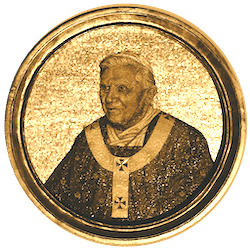
24th Sunday of Year A
Love Your Neighbor As Yourself
4 September 2011 | Courtyard of the Papal Summer Residence, Castel Gandolfo
The Prediction of the Passion and Peter’s Resistance
In today’s Gospel, Jesus explains to his disciples that he must “go to Jerusalem and suffer many things from the elders and chief priests and scribes, and be killed, and on the third day be raised” (Mt 16:21).
Everything seems to have been turned upside down in the disciples’ hearts. How could “the Christ, the Son of the living God” (v. 16) suffer unto death? The Apostle Peter rebels; he refuses to accept this route and rebukes the Teacher, saying: “God forbid, Lord! This shall never happen to you” (v. 22).
God’s Plan versus Human Expectations
The divergence between the Father’s loving plan—which went so far as the gift of the Only-Begotten Son on the Cross to save humanity—and the disciples’ expectations, wishes, and projects stands out clearly.
Today too, this contrast is repeated: when the fulfillment of one’s life is geared solely toward social success and physical or financial well-being, one no longer reasons according to God, but according to men (v. 23). Thinking as the world thinks sets God aside, refusing his plan of love and attempting to prevent his wise will.
For this reason, Jesus directs harsh words to Peter: “Get behind me, Satan! You are a hindrance to me” (ibid.). The Lord teaches that “the way of discipleship [is] the way to follow him [walk behind him], the Crucified. In all three Gospels he also interprets this ‘following’ on the way of the Cross” as “the indispensable way for man to ‘lose his life’, without which it is impossible for him to find himself” (Jesus of Nazareth, English edition, New York, p. 287).
The Call to Take Up the Cross
Just as he invited the disciples, Jesus addresses an invitation to each of us: “If any man would come after me, let him deny himself and take up his cross and follow me” (Mt 16:24).
A Christian follows the Lord by lovingly accepting their own cross—which in the world’s eyes appears as defeat and loss of life (cf. vv. 25–26)—knowing it is not carried alone, but alongside Jesus in his journey of self-giving.
The Redemptive Obedience and Glory of the Cross
The Servant of God Paul VI wrote: “In a mysterious way, Christ himself accepts death… on the Cross, in order to eradicate from man’s heart the sins of self-sufficiency and to manifest to the Father a complete filial obedience” (Apostolic Exhortation Gaudete in Domino, 9 May 1975). By willingly accepting death, Jesus carries the cross of all human beings, becoming the source of salvation for all humanity.
St. Cyril of Jerusalem commented: “The glory of the Cross led those who were blind through ignorance into light, loosed all who were held fast by sin and brought redemption to the whole world of mankind” (Catechesis Illuminandorum XIII, 1: De Christo crucifixo et sepulto: PG 33, 772 B).
Note: The header image is an AI-generated visual concept illustrating one of the central themes, scripture quotes, from the pope’s homily.

24th Sunday of Year A
Proclaiming Christ and the Paths of Ecclesial Renewal
8 August 1999 | Angelus
In the Gospel passage presented to us in today’s liturgy, we once again listen to Jesus’ words to his terrified and fearful disciples: “Take heart, it is I; have no fear” (Mt 14:27). The Evangelist notes that encouraged by the Lord’s presence, “those in the boat worshiped him, saying, ‘Truly you are the Son of God'” (ibid, 14:33). The Church makes her own this profession of faith in the Son of God, and renews it constantly as she spreads the Good News which he came to bring the people of all times and places.
The Legacy and Witness of Paul VI
The Servant of God Paul VI, my venerable Predecessor, was also a tireless proclaimer and bold witness of Christ’s Gospel. On 6 August, 35 years ago now, he promulgated his first Encyclical entitled Ecclesiam suam. Fourteen years later, also on the Feast of the Transfiguration and precisely here in Castel Gandolfo, he was called to contemplate the Lord’s face forever in the blessed homeland.
Three Paths for the Church’s Mission
In Ecclesiam suam, this great Pontiff indicated the paths of an inspired ecclesial journey towards the third millennium:
- The Spiritual Path: Refers to the awareness the Church must have of herself to conform to the vocation entrusted to her by the Redeemer.
- The Moral Path: Concerns the authentic ascetic, practical, and canonical renewal she needs to carry out her mission in the world.
- The Way of the Apostolate: For the ecclesial community, the method of dialogue is becoming the way in which to work to bring the Lord’s comforting message of salvation everywhere.
Guided by Faith Toward the New Millennium
How is it possible not to thank God for the gift of this prophetic teaching which has guided the journey of the Christian people in the past 35 years? With the Second Vatican Council, wisely led by Paul VI, the Church more closely examined her inmost nature and universal mission. With the constant support of the Holy Spirit, her faith has remained steadfast in these last decades of the century, marked by many lights, but also by numerous shadows, and she is now preparing confidently to cross the threshold of the next millennium.

Matthew 18:21-35
Search Engine created by Jeff Pinyan
24th Sunday of Year A
Sirach 27:30—28:7
Search Engine created by Jeff Pinyan
24th Sunday of Year A
Romans 14:7-9
Search Engine created by Jeff Pinyan
24th Sunday of Year A