Commentary Intro to Mass Readings Sunday Readings
CommentaryIntro to Mass Readings Sunday Readings
May 10, 2026



PDF AIDS



6th Sunday of Easter (A)
Acts 8:5-8, 14-17
Fr. Tim Peters, S.T.D explores the scriptural context and theological significance of the first reading according to the following thematic outline.
INSIGHTS FOR HOMILY
PREPARATION

Steps of Evangelization
The task of crafting a homily that resonates deeply while remaining doctrinally sound can be a daunting journey. Larry Broding’s commentary offers a bridge between the historical witness of the early Church and the practical needs of a modern congregation. By dissecting the nuances of Philip’s mission in Samaria, Broding reveals how the movement from “Spirit-led” to “Spirit-filled” remains the blueprint for effective evangelization today.
Why this commentary matters for your homily:
- Linguistic Nuance: Broding clarifies often-misunderstood passages, such as the distinction in Acts 8:7 where the “cries” originate from the departing spirits rather than the afflicted, allowing for a more precise depiction of spiritual deliverance.
- Theological Precision: The commentary identifies the “Taheb” or the Restorer, bridging the gap between Samaritan messianic expectations and the fulfillment found in Christ.
- The Blueprint of Metanoia: It breaks down the evangelization process into Peter’s three essential steps: the turning of the heart-mind, the necessity of baptism, and the ultimate reception of the Holy Spirit.
- Practical Encouragement: Broding emphasizes that effective preaching is not a solo act of rhetoric but a cooperation with the Spirit, encouraging preachers to rely on their God-given charisms to support their words.
- Thematic Unity: By connecting Philip’s actions to the broader narrative of Acts, the commentary helps you show your congregation how the gifts of the Spirit lead directly to a Spirit-filled community.
Read Larry Broding’s full commentary to help your congregation encounter the Restorer and live as a Spirit-led people.
AI THOUGHT STARTERS
To strengthen key sections of your homily, here are questions you might ask the AI assistant (simply copy and paste a question into chat bot in the lower right corner of the page):
Biblical and Cultural Context
- How did the Samaritan expectation of the Taheb, or the Restorer, differ from the Jewish expectation of the Messiah as referenced in Acts 8:5?
- In what ways does the concept of the Taheb as one who restores help my congregation understand the specific mission of Jesus to marginalized groups?
- Acts 8:7 refers to unclean spirits crying out in a loud voice; how can I explain to my listeners that these screams represented the demons leaving rather than the suffering of the possessed person?
Theological Depth and Doctrine
- Acts 2:38 suggests a three-step process of evangelization; how can I structure my homily to clearly define the relationship between metanoia, baptism, and the reception of the Spirit?
- Since Acts 8:16 indicates the Samaritans had been baptized but had not yet received the Holy Spirit, how should I explain the distinction between these two sacramental moments?
- How does the phrase turn your heart-mind away from sin in Acts 2:38 provide a deeper definition of repentance for a modern audience?
Practical Evangelization and Charisms
- Acts 8:6 suggests that the crowds paid attention to Philip because of the signs they saw; how can I encourage my parishioners to recognize the “signs” of the Spirit in their own lives?
- If effective evangelization requires cooperation with the Spirit as shown in Philip’s journey, what specific prayers can I suggest to my congregation to help them become more Spirit-led?
- How does the transition from being Spirit-led to Spirit-filled in the mission to Samaria serve as a model for our parish’s outreach efforts?
Spiritual Application
- How can I use the idea of the Spirit falling upon an audience of even one person to encourage those who feel their personal witness is insignificant?


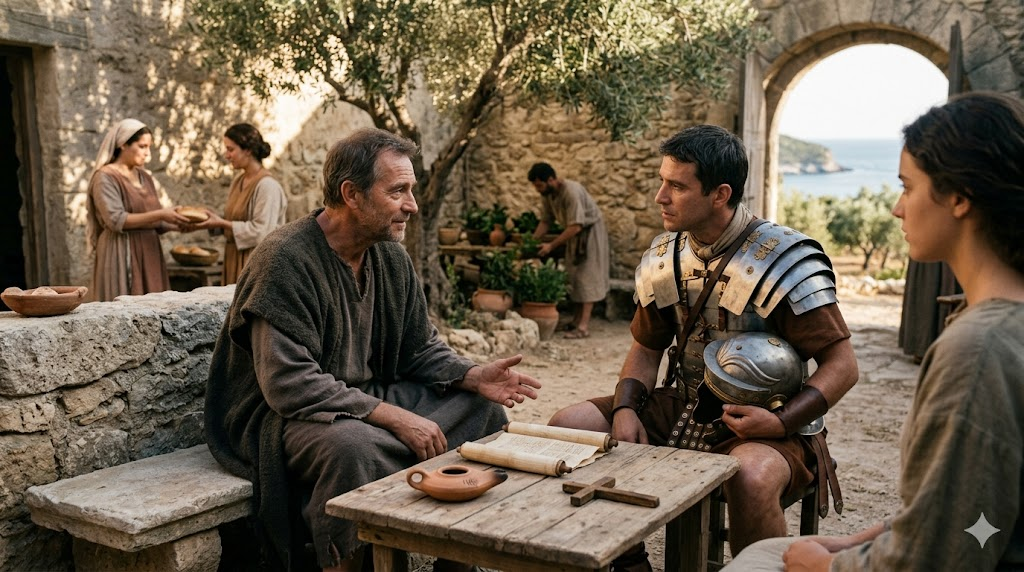
6th Sunday of Easter (A)
1 Peter 3:15-18
Fr. Tim Peters, S.T.D explores the scriptural context and theological significance of the second reading according to the following thematic outline.
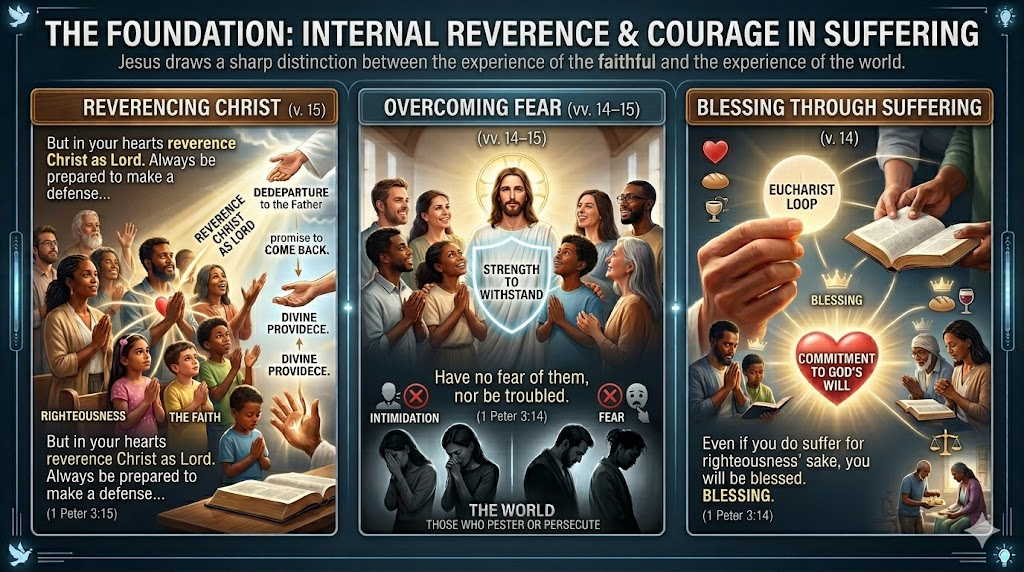
1. Internal Reverence and Courage in Suffering
The foundation of a Christian's response to persecution is the internal state of the heart. By setting Christ apart as Lord, the believer finds the strength to withstand intimidation and fear.
- Reverencing Christ: The command is to "reverence Christ as Lord" specifically within the context of suffering for righteousness or the faith (1 Peter 3:15).
- Overcoming Fear: Establishing Christ’s lordship in the heart removes the fear of those who pester or persecute the believer (1 Peter 3:14–15).
- Blessing through Suffering: Peter emphasizes that even if one suffers for what is right, they are considered blessed (1 Peter 3:14).
2. The Mandate for Intellectual and Spiritual Defense
Believers are called to be prepared to articulate the reason for their faith. This "defense" is a response to the visible hope that others see in the midst of trials.
- Constant Preparedness: Christians must "always be prepared to make a defense" to anyone who asks for an account (1 Peter 3:15).
- The Hope Within: The focus of the defense is the "hope that is in you," which serves as a testimony to others (1 Peter 3:15).
- The Role of Study: To fulfill this, believers are encouraged to study Scripture and the faith daily so they can provide meaningful answers to questions.
3. The Manner of Defense: Gentleness and Authenticity
The effectiveness of one’s testimony is tied to the manner in which it is delivered. A defense of the faith must be characterized by humility rather than pride or aggression.
- Gentleness and Reverence: The defense must be conducted with a spirit of gentleness, avoiding the pride and lack of knowledge often seen in social media debates (1 Peter 3:15).
- Clear Conscience: By maintaining good behavior in Christ, those who revile or abuse the believer may be put to shame by the believer's integrity (1 Peter 3:16).
- Authentic Response: The goal is an "authentic" giving of oneself to the Lord, responding to pestering with a "cool" head and a humble mind.
4. Christ as the Archetype of Righteous Suffering
Peter grounds the call to suffer for doing right in the historical and theological reality of Christ’s own passion.
- Suffering for Right: It is better to suffer for doing right, if it is God’s will, than for doing wrong (1 Peter 3:17).
- The Final Sacrifice: Christ died for sins "once for all, the righteous for the unrighteous," establishing the pattern of selfless suffering (1 Peter 3:18).
- The Outcome of Christ's Work: Though put to death in the flesh, He was "made alive in the spirit," ultimately bringing us to God (1 Peter 3:18).
INSIGHTS FOR HOMILY
PREPARATION
No Good Deed Goes Unpunished
Preachers often face the difficult task of encouraging a flock that feels weary from the world’s scrutiny. Larry Broding’s commentary dives into the heart of this struggle, offering a balanced perspective on how to maintain Christian integrity when “no good deed goes unpunished.” By connecting the trials of modern saints like Mother Teresa and Pope John Paul II to the apostolic exhortations of 1 Peter, Broding provides the homiletic tools to transform the experience of criticism into a profound witness for Christ.
Why this commentary matters for your homily:
- Pastoral Realism: 1 Peter 3:14b suggests a posture of calm and fearlessness; Broding provides relatable examples of how even the greatest saints faced detractors, helping your congregation feel less alone in their own struggles.
- Theological Perspective on Suffering: The commentary explains how suffering for the sake of good allows the believer to walk in the footsteps of Christ, who suffered for sinners to lead us to God.
- Practical Character Building: 1 Peter 3:15 suggests a dual approach to opposition; Broding emphasizes the necessity of being intellectually prepared for critique while remaining “gentle and reverent” in response.
- Ethical Integrity: Broding explores how maintaining a clear conscience in the face of oppression eventually turns the shame back upon the critic, offering a powerful lesson on the strength of Christian character.
- Evangelistic Opportunity: The commentary reveals that even when a good deed is “punished,” the way a Christian handles that criticism can actually become the very bridge that shows others the way to Christ.
Read Larry Broding’s full commentary to help your congregation find the courage to do good, even when the world offers only criticism in return.
AI THOUGHT STARTERS
To strengthen key sections of your homily, here are questions you might ask the AI assistant (simply copy and paste a question into chat bot in the lower right corner of the page):
Context and Cultural Reality
- 1 Peter 3:14b refers to a specific command to not tremble in fear; how can I explain the historical oppression the early community faced to help my congregation relate to modern social pressures?
- “No good deed goes unpunished” is a cynical but real experience for believers; what examples from the life of Mother Teresa or Pope John Paul II best illustrate this struggle for a homily?
- How does the phrase “do not be troubled” in 1 Peter 3:14b provide a practical spiritual strategy for someone facing public scrutiny for their faith today?
Character and Response
- 1 Peter 3:15 suggests a dual approach to criticism; how can I help my parishioners develop an “answer” for their faith that is simultaneously intellectually sound and spiritually gentle?
- If answering with reverence leads to a clear conscience, what specific steps of “metanoia” can I preach to help people move away from defensive or angry responses?
- How can I use the example of saints who had detractors to show that being criticized is often an indication of living a Spirit-led life?
Theology of Suffering and Witness
- 1 Peter 3:17 refers to it being better to suffer for doing good than for doing evil; how can I frame this to my congregation as an invitation to walk in the footsteps of Christ?
- Christ suffered for sinners to lead us to God; how can I connect this sacrificial act to the daily sacrifices a parent or worker makes for others?
- In what ways does 1 Peter 3:16 suggest that our “good conduct in Christ” is the most effective way to cause critics to feel shame for their false accusations?
Spiritual Application
- If the goal of suffering for good is to show others the way to Christ, what specific questions can I ask my audience to help them evaluate how they have been strengthened by the criticism of others?


Courtesy of Larry Broding
6th Sunday of Easter (A)
John 14:15-21
Fr. Tim Peters, S.T.D explores the scriptural context and theological significance of the Gosple reading according to the following thematic outline.
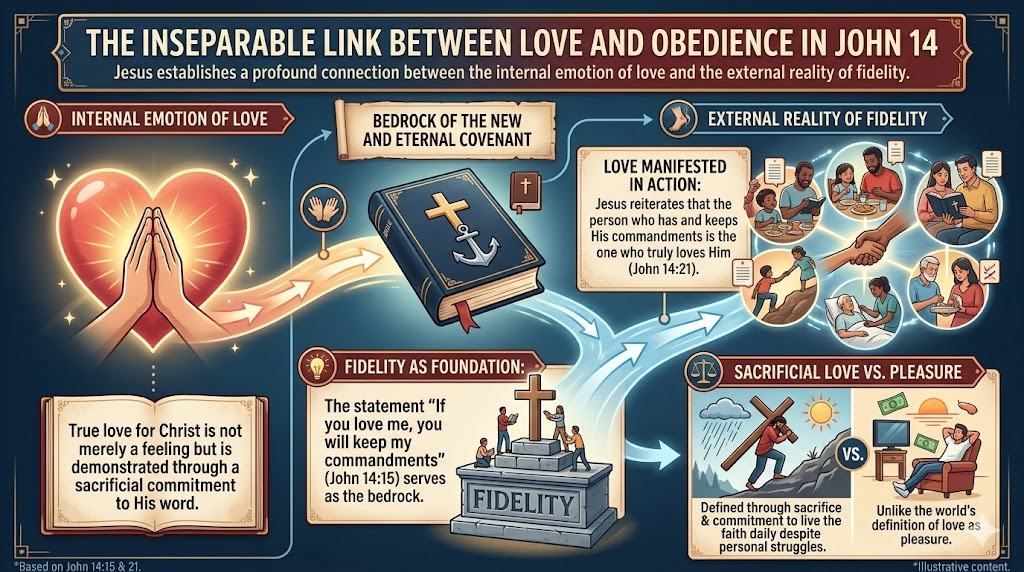
1. The Inseparable Link Between Love and Obedience
Jesus establishes a profound connection between the internal emotion of love and the external reality of fidelity. True love for Christ is not merely a feeling but is demonstrated through a sacrificial commitment to His word.
- Fidelity as Foundation: The statement "If you love me, you will keep my commandments" (John 14:15) serves as the bedrock of the new and eternal covenant.
- Love Manifested in Action: Jesus reiterates that the person who has and keeps His commandments is the one who truly loves Him (John 14:21).
- Sacrificial Love vs. Pleasure: Unlike the world's definition of love as pleasure, Christ defines love through sacrifice and the commitment to live the faith daily despite personal struggles.
2. The Gift of the Counselor and Spirit of Truth
As Jesus prepares for His departure to the Father, He promises a new kind of divine presence. This "Another Counselor" ensures that the church is never alone and is continually guided by truth.
- The Paraclete: Jesus promises to pray to the Father to give "another Counselor" to be with the church forever (John 14:16).
- Spirit of Truth: This title emphasizes the Spirit’s role in guiding the church in all truth—a truth the world cannot receive because it neither sees nor knows Him (John 14:17).
- An Abiding Presence: The promise is that the Spirit dwells with the disciples and will be in them, moving beyond a mere external presence (John 14:17).

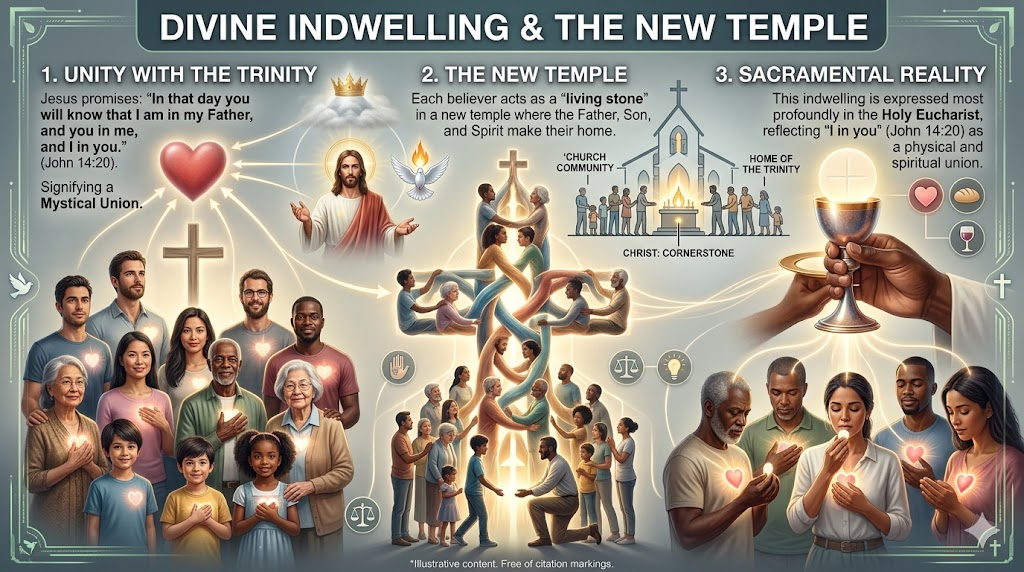
3. Divine Indwelling and Temple Theology
The transcript highlights a "temple theology" where the presence of God shifts from a physical building to a spiritual indwelling within the believer and the community.
- Unity with the Trinity: Jesus promises that "In that day you will know that I am in my Father, and you in me, and I in you" (John 14:20), signifying a mystical union.
- The New Temple: Each believer acts as a "living stone" in a new temple where the Father, Son, and Spirit make their home.
- Sacramental Reality: This indwelling is expressed most profoundly in the Holy Eucharist, reflecting the reality that "I in you" (John 14:20) becomes a physical and spiritual union.
4. The Contrast Between the Church and the World
Jesus draws a sharp distinction between the experience of the faithful and the experience of "the world." While He departs from the world's sight, He remains visible and present to His disciples.
- Not as Orphans: Jesus promises, "I will not leave you desolate" or as orphans, promising to come back to them (John 14:18).
- Vision of the Risen Christ: Jesus notes that while the world will see Him no more, the disciples will see Him because He lives (John 14:19).
- Manifestation through Love: Christ promises to love and "manifest" Himself specifically to those who love Him and keep His word (John 14:21), a revelation not shared with the world.

INSIGHTS FOR HOMILY
PREPARATION
The Command to Love
The bridge between hearing the Word and living it out is often the most challenging part of the Christian life to navigate from the pulpit. Larry Broding’s commentary on John 14 offers a profound look at this “if…then” relationship, showing how love for Christ is inextricably linked to action through the power of the Holy Spirit. By exploring the Greek nuances of the “Paraclete” and the rabbi-disciple dynamic, Broding provides preachers with a rich theological framework to explain how the Spirit transforms a community from mere observers into the living presence of God.
Why this commentary matters for your homily:
- Relational Paradigm: Broding explains how the relationship between the Father and the Son serves as the ultimate blueprint for the Christian community, turning the abstract concept of “love” into a concrete “if…then” command as shown in John 14:15.
- The Rabbi-Disciple Dynamic: The commentary provides historical context on how a rabbi’s teaching was vindicated by his example, helping you illustrate to your congregation that our actions are what ultimately validate the truth of the Gospel.
- Linguistic Depth of the Paraclete: John 14:16 refers to the Spirit as the “Helper”; Broding clarifies the Greek Parakletos, moving beyond a narrow legal definition to present the Spirit as the “one called alongside” to empower our daily witness.
- Presence and Eternity: John 14:17 refers to the Spirit being “in you”; the commentary explores the uncertainty of the original tense to show that the Spirit’s presence is both a current reality and an eternal promise that assists the believer into the next age.
- The Spirit of Truth: Broding connects the “Spirit of Truth” to God’s inner dynamic power, helping you teach that the Spirit is not just a messenger about God, but is God himself acting within the believer.
- Contrast with the World: The commentary offers a sharp contrast between the “worldly” focus on narcissism and the Spirit-led focus on Christ, providing a powerful rhetorical edge for homilies addressing modern anxieties and ambitions.
Read Larry Broding’s full commentary to help your congregation move beyond lip service to love and experience the indwelling power of the Spirit of Truth.
AI THOUGHT STARTERS
To strengthen key sections of your homily, here are questions you might ask the AI assistant (simply copy and paste a question into chat bot in the lower right corner of the page):
The Rabbi-Disciple Relationship
- John 14:15 refers to an if/then statement regarding love and commands; how can I explain the ancient rabbi-disciple dynamic to show that our actions are what vindicate the truth of Jesus’ teaching?
- Since the rabbi expected disciples to follow his example rather than just learn facts, what specific examples of Jesus’ lifestyle should I highlight to help my congregation keep his commands?
- Deuteronomy 5:5 refers to the Decalogue as the words of God; how does this historical connection between word and command help my audience understand that Jesus’ words are not just advice but a moral roadmap?
The Identity and Role of the Paraclete
- John 14:16 refers to the Spirit as the Paraclete, or one called alongside; how can I use the broader meaning of Helper to describe the Spirit’s role in a parishioner’s daily struggles?
- The Spirit is both the messenger of truth and God himself; how can I explain the phrase wherever God acts, God is to help my congregation understand the Real Presence of the Spirit?
- John 14:17 refers to the Spirit of Truth; how does the definition of truth as the only means to reveal God change the way we approach modern “relative” truths?
Living in the Spirit vs. the World
- John 14:17 suggests that the world cannot see the Spirit because it is tied to ambitions and anxieties; how can I help my listeners identify the “worldly” narcissism that prevents them from knowing true love?
- Since the Spirit is the power that assists the believer from the moment of faith into the afterlife, how can I describe the transition from being a worldly person to a Spirit-oriented person?
- John 14:17b refers to the Spirit living in the follower; how can I use this to encourage those who feel empty or incapable of loving difficult people in their lives?
Spiritual Application
- How can I contrast the world’s lip service to love with the indwelling of Christ’s very risen life to challenge my congregation to a deeper commitment?