Papal Homilies
May 3, 2026



NOTABLE QUOTES
Pope Francis
“Jesus is the way, and therefore there is no other way. To follow Jesus is to follow the way of the Truth and the Life. Philip says: ‘Lord, show us the Father.’ And Jesus says: ‘I have been with you so long and you still do not know me?’ To see Jesus is to see the Father.”
— Morning Mass at Santa Marta, May 14, 2013
“Jesus says: ‘I am the way.’ It is the way of humility, the way of the Incarnation. If you do not arrive at the Father through the humanity of Jesus, you will not arrive… The Holy Spirit then reminds us of what Jesus said, and teaches us to enter into the mystery of the Son.”
— Santa Marta Reflection on John 14
Pope Benedict XVI
“You are a chosen race, a royal priesthood, a holy nation… These words of the Apostle Peter do not simply remind us of the dignity which is ours by God’s grace; they also challenge us to an ever greater fidelity to the glorious inheritance which we have received in Christ.”
— Homily at Yankee Stadium, April 20, 2008 (Reflecting on 1 Peter 2)
“Christ is the way that leads to the Father, the truth which gives meaning to human existence, and the source of that life which is eternal joy… Let us take the Lord at his word! Let us renew our faith in him and put all our hope in his promises!”
— Regina Caeli, May 22, 2011
St. John Paul II
“The Apostles chose seven men ‘filled with the Spirit and wisdom.’ This reminds us that the Church’s mission has always looked out for the temporal well-being of individuals… for you cannot preach the Gospel to a hungry stomach.”
— Reflection on the Diaconate in Acts 6
“In the Father’s house there are many dwellings. This is the great hope of the Christian: that our life does not end in the void, but in the heart of God. Jesus went to prepare a place for us, so that where he is, we also may be.”
— Homily on the Last Supper Discourse

5th Sunday of Easter (A)

Theme of the Readings
FROM THE ARCHIVES (2005)
“My Father’s house,” “a spiritual house,” “a full meeting of disciples” are all expressions in this Sunday’s liturgy that belong to the same semantic field: a building, both as an edifice and a meeting or dwelling place. “There are many rooms in my Father’s house … I am going now to prepare a place for you,” Jesus says in the Gospel according to St. John. St. Peter reminds the Christians that they too are “the holy priesthood that offers the spiritual sacrifices which Jesus Christ has made acceptable to God … living stones making a spiritual house” (second reading). In the first reading, the Apostles, confronting a problem in the community, gather the disciples, possibly in the Upper Room, and ask them to select seven deacons to serve the widows of the Hellenist Christians.
Doctrinal Messages
The Father’s house is in heaven. In the meantime, the risen Jesus Christ has prepared a room for us there. As the Catechism teaches: “By his death and resurrection Jesus Christ has ‘opened’ heaven to us” (CCC, n. 1026). From heaven he invites us to follow in his footsteps (“I am the way, and the truth, and the life”), because no one can go to the Father’s house except by following Christ. The image of the house, to describe heaven to us, speaks to us of heaven as a family, intimacy, love. Heaven is the definitive and eternal encounter with God, our Father, with Jesus Christ, our Redeemer, with our Sanctifier, the Holy Spirit. It is likewise the encounter with all our brothers and sisters, who have been redeemed by Christ’s blood, in an indescribable embrace of brotherhood and communion. Heaven is the homeland of immortal love, of the love that has overcome hatred and injustice, of the love that unites one and all in an ineffable sharing of the very life of God-Love. Heaven is our true homeland, for here on earth “we have no permanent dwelling place.”
Here on earth, the Father’s house is the Church. A house that is built with living stones, a house that is never completed because with each generation it is renewed and restored, a house whose doors are open to all who wish to enter, a house where we all feel we are God’s family. The Catechism (n. 756) tells us that in the Scriptures this house has many names: “‘the house of God’ (1 Tim 3:15) in which his family dwells; ‘the household of God in the Spirit’ (Eph 2:19-22), ‘the dwelling-place of God among men’ (Rev 21:3) and, especially, ‘the holy temple’ (1 Pet 2:5)”. The Church is a family and therefore all its members must be very close to each other. The parents must have a vocation to serve the children, and the children, to serve their parents. Thus all together, each according to his own capacity and tasks, must seek the family’s good and happiness.
This family of God is not exempt from problems. The first reading, from the Acts of the Apostles, addresses one of the problems the family of God had to face in the early years of its life in Jerusalem. But problems can be resolved when there is goodwill and collaboration on the part of all and a common effort to seek the most appropriate way to find a solution. This is what happened in the community of Jerusalem and peace and harmony returned among the members of the family. Today this must also be the way we face the difficulties and problems of the Church, as the family of God.
Pastoral Suggestions
The “political” view of the Church as “power and subjection” is not a proper concept of the Church. Nor should it be seen as “sociological,” providing social service in the style of the international organizations for charitable and voluntary work. Even less should it be described as “individualistic” in that some suppose the Church to be a sort of “hotel” or “condominium,” where each individual person lives in order to meet his own spiritual needs, without entering into any relationship with the others. “Power” does exist in the Church, but it is the power of a loving father. “Subjection” also exists, but it is the loving submission of a child. The Church does great good to the needy, but because these needy are brothers and sisters, children of the same Father. In the Church the individual does not melt into anonymity or into the mass. Since it is a family, all know and love one another personally. The Church is at the same time community and communion, the union of all the members to constitute one, single family.
This concept of the Church can encounter difficulties in our faithful, in the groups with whom we do pastoral work. It can happen in our parish that some belong to the family but have moved away from it and no longer live in the same house. At times, some criticize the father of the family: the Pope, the Bishop, the parish priest, albeit without malice, but weakening the unity of God’s family. Others perhaps do not pay much attention to the rules in force in God’s house, thereby creating inconsistencies and breaches between the family members. It can also happen that there are tensions, resentment, misunderstandings, or bad dealings among the children of the same family of God. A lot has yet to be done to make the Church truly be God’s family. What can I do in my parish, in the environment in which I exercise my ministry?
SOURCE: YEAR A DICASTERY NOTES (2004-05)
Message of Pope Francis
AT A GLANCE
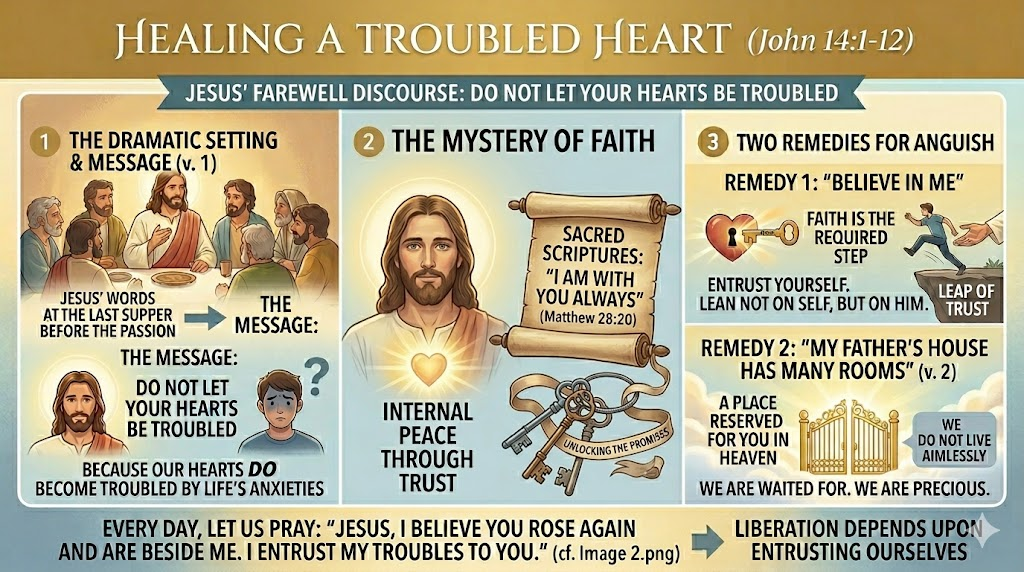
- A Call to Peace: Jesus’ opening words to his disciples before his Passion, “Do not let your hearts be troubled,” offer comfort not only to them, but to us in our own life’s struggles.
- The Remedy of Faith: He offers two remedies for a troubled heart. The first is to “Believe in me,” which means to entrust ourselves to Him completely, leaning not on our own strength but on His help, especially in moments of anxiety.
- A Prepared Place: The second remedy is the assurance of a place in Heaven, prepared for each of us by Jesus. This comforting truth reminds us that we are precious to God and that our lives have a destination – Paradise.
- Jesus, the Way: When asked how to reach this prepared place, Jesus’ answer is definitive: “I am the Way.” To follow Him is to have a living relationship with Him, to imitate his love, and to walk his path of humility and service.
QUESTIONS FOR REFLECTION
- When you experience anxiety or anguish, do you feel alone or unable to cope? How can you practice “leaning on Jesus” in those moments?
- Do you truly believe that God loves you and has prepared a place specifically for you in Heaven? How does this belief shape your perspective on life?
- In your daily life, which “way” do you tend to follow? The way of worldliness and self-affirmation, or Jesus’ way of humble love, prayer, and service?
- How can you deepen your “living relationship” with Jesus and truly make him the protagonist of your life?
ACTIONABLE
TAKEAWAY
Commit to making Jesus the “protagonist” of your life by asking him these three simple questions each day:
- “Jesus, what do you think of the choice I made?” Before making a decision, big or small, take a moment to lift it up to Jesus and ask for his guidance.
- “Jesus, what would you do in this situation?” When faced with challenges or difficult interactions, try to discern the loving and compassionate approach that Jesus would take.
- “Jesus, how would you act with these people?” Strive to see others through Jesus’ eyes and treat them with the same kindness, respect, and mercy that he would.
5th Sunday of Easter (A)
Finding Peace in Christ
10 May 2020 – Library of the Apostolic Palace
In today’s Gospel passage (cf. Jn 14:1-12), we hear the beginning of Jesus’ so-called “Farewell discourse”. They are the words he addresses to the disciples at the end of the Last Supper, just before facing the Passion. In such a dramatic moment Jesus began by saying, “Do not let your hearts be troubled” (v. 1). He says it to us too, in life’s troubles. But how can we ensure that our hearts are not troubled? Because the heart does become troubled.
The First Remedy: Entrustment to Christ
The Lord indicates two remedies for being troubled. The first is: “Believe in me” (v. 1). It would seem to be rather theoretical, abstract advice. Instead, Jesus wants to tell us something precise. He knows that, in life, the worst anxiety, anguish, arises from the sensation of not being able to cope, of feeling alone and without points of reference when faced with events. We cannot overcome this anguish alone, when one difficulty is added to another.
We need Jesus’ help, and this is why Jesus asks us to have faith in him, that is, to lean not on ourselves but on him. Because liberation from being troubled depends upon entrusting ourselves. Entrusting ourselves to Jesus, taking the “leap.” And this is liberation from feeling troubled. Jesus is risen and lives precisely to be always by our side. We can thus say to him, “Jesus, I believe that you rose again and are beside me. I believe that you listen to me. I bring to you what upsets me, my troubles; I have faith in you and I entrust myself to you.”
The Second Remedy: Our Eternal Destination
There is then a second remedy for being troubled, which Jesus expresses with these words: “My Father’s house has many rooms… I am going there to prepare a place for you” (v. 2). This is what Jesus did for us: he reserved a place in Heaven for us. He took our humanity upon himself to carry it beyond death, to a new place, to Heaven, so that we might also be where he is. It is the certainty that comforts us: there is a place reserved for each of us.
There is a place for me too. Each of us can say: there is a place for me. We do not live aimlessly and without destination. We are awaited. We are precious. God is in love with us; we are his children. And he has prepared for us the most worthy and beautiful place: Paradise. Let us not forget this: the dwelling place that awaits us is Paradise.
The Hope of Paradise
We are in transit here. We are made for Heaven, for eternal life, to live forever. Forever: it is something we cannot even imagine now. But it is even more beautiful to think that this forever will be entirely in joy, in full communion with God and with others, without any more tears, without resentment, without division or turmoil.
Following the True Way
But how can we reach heaven? What is the way? Here is Jesus’ decisive phrase. He says to us today: “I am the Way” (v. 6). Jesus is the way to go up to Heaven: to have a living relationship with him, to imitate him in love, to follow in his footsteps.
And I, a Christian, you, a Christian, every one of us Christians, can ask ourselves: “Which way do I follow?” There are ways that do not lead to Heaven: the ways of worldliness, the ways of self-affirmation, the ways of selfish power. And there is Jesus’ way, the way of humble love, of prayer, of meekness, of trust, of service to others. It is not the way of my self-centeredness. It is the way of Jesus, who is the protagonist of my life. It is to go forth every day, asking him: “Jesus, what do you think of the choice I made? What would you do in this situation, with these people?”

Message of Pope Benedict XVI
AT A GLANCE
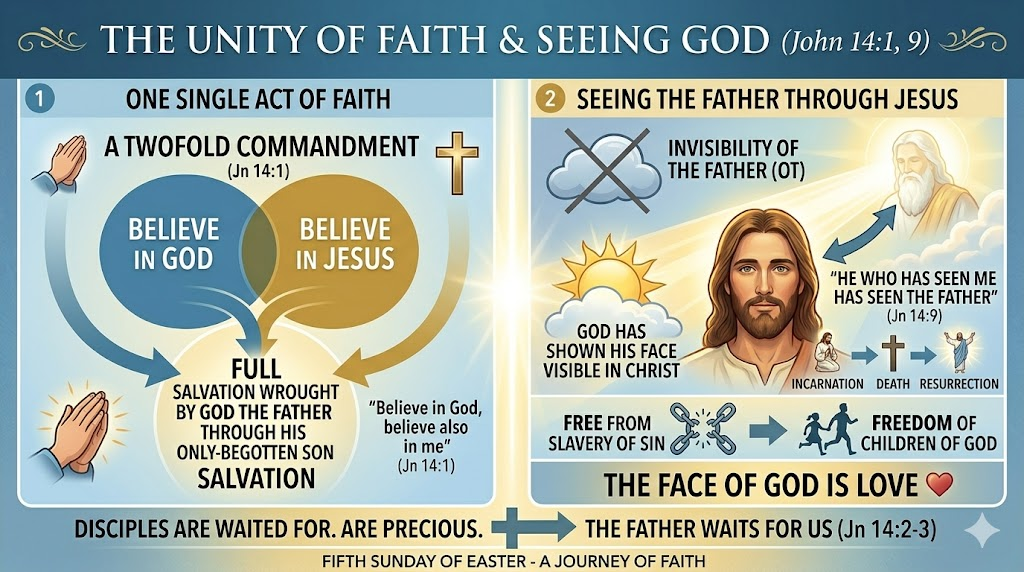
- The Unity of Faith: Belief in God and belief in Jesus are not two separate actions but a single act of faith. To adhere to Christ is to adhere to the salvation wrought by the Father.
- The Visible Face of God: The New Testament ends the invisibility of the Father. Through the Incarnation, Jesus reveals that God’s face is Love; to see the Son is to truly see the Father.
- The Sacred Humanity: Remaining united to the “most sacred humanity” of Jesus is our greatest blessing. It is through this union—and not through our own strength—that we are empowered to continue His work in history.
- The Gentle Mystery: God acts with profound gentleness, building His history through simple daily actions and knocking softly at the door of the human heart rather than overwhelming it with force. our “narrow agendas” to immerse ourselves in the will of God.
- The Need for Pastors: Even in a technological world, the human heart requires physical shepherds to proclaim the Word and provide the Sacraments.
QUESTIONS FOR REFLECTION
- Jesus says, “He who has seen me has seen the Father.” When you picture God the Father, do you see the same mercy, love, and sacrifice found in Jesus, or do you still view the Father as distant or invisible?
- St. Teresa of Avila warns against withdrawing from the “sacred humanity” of Christ. In your prayer life, do you treat Jesus as a real, living person, or has He become an abstract theological concept?
- If God “knocks gently” at the door of your heart, what are the “noises” or distractions in your daily life that might be preventing you from hearing Him?
- St. Bonaventure invites us to see God in “all creatures.” How would your perspective change today if you looked for the face of Christ in every person you encountered?
ACTIONABLE
TAKEAWAY
Practice the “Way of Truth and Life” through these three practical steps:
- The Daily Following: Identify one “simple action” that makes up your routine (washing dishes, answering emails, commuting). Dedicate that specific task to Christ, performing it with the same love and “gentleness of God” mentioned in the homily.
- Open the Spiritual Ear: Set aside five minutes of intentional silence today. Instead of speaking to God, simply “dispose your heart” and listen, acknowledging that He often reveals Himself slowly and quietly.
- Visible Love: Since God has made His love visible in Christ, make that love visible to someone else. Act as a “living sign” of the Father’s face by performing one hidden act of service for someone who cannot pay you back.
5th Sunday of Easter (A)
The Way, the Truth,
and the Life
22 May 2011 | Saint Peter’s Square

The Gospel of this Sunday, the Fifth of Easter, proposes a twofold commandment of faith: to believe in God and to believe in Jesus. In fact, the Lord said to his disciples: “Believe in God, believe also in me” (Jn 14:1). They are not two separate acts but one single act of faith, full adherence to salvation wrought by God the Father through his Only-begotten Son. The New Testament puts an end to the Father’s invisibility. God has shown his face, as Jesus’ answer to the Apostle Philip confirms: “He who has seen me has seen the Father” (Jn 14:9). With his Incarnation, death and Resurrection, the Son of God has freed us from the slavery of sin to give us the freedom of the children of God and he has shown us the face of God, which is love: God can be seen, he is visible in Christ.
Union with the Sacred Humanity
St. Teresa of Avila wrote: “the last thing we should do is to withdraw from our greatest good and blessing, which is the most sacred humanity of Our Lord Jesus Christ” (cf. The Interior Castle, 6, ch. 7). Therefore, only by believing in Christ, by remaining united to him, may the disciples, among whom we too are, continue their permanent action in history: “Truly, truly, I say to you,” says the Lord, “he who believes in me will also do the works that I do” (Jn 14:12).
The Gentle Mystery of Daily Following
Faith in Jesus entails following him daily, in the simple actions that make up our day. “It is part of the mystery of God that he acts so gently, that he only gradually builds up his history within the great history of mankind; that he becomes man and so can be overlooked by his contemporaries and by the decisive forces within history; that he suffers and dies and that, having risen again, he chooses to come to mankind only through the faith of the disciples to whom he reveals himself; that he continues to knock gently at the doors of our hearts and slowly opens our eyes if we open our doors to him” (Jesus of Nazareth II, 2011, p. 276).
Jesus as the Way to the Father
St. Augustine says that “it was necessary for Jesus to say: ‘I am the way, the truth, and the life’ (Jn 14:6) because once the way was known, the end remained to be known” (cf. In Evangelium Iohannis Tractatus, 69, 2: CCL 36, 500), and the end is the Father. For Christians, for each one of us, hence, the way to the Father is to allow ourselves to be guided by Jesus, by his word of truth, and to receive the gift of his life.
Let us make St. Bonaventure’s invitation our own: “Open, therefore, your eyes, lend your spiritual ear, open your lips and dispose your heart, so that you will be able to see, hear, praise, love, venerate, glorify, honour your God in all creatures” (Itinerarium mentis in Deum, i, 15).
The Mission of the Church
Dear friends, the commitment to proclaim Jesus Christ, “the way, the truth, and the life” (Jn 14:6), is the main task of the Church. Let us invoke the Virgin Mary that she may always assist the Pastors and those in the different ministries to proclaim the Good News of salvation, that the Word of God may be spread and the number of disciples multiplied (cf. Acts 6:7).

ROME REPORTS (3:18) – God serves as a guiding Shepherd to people across the world, throughout history, and across various cultures.
Message of Pope Saint John Paul II
AT A GLANCE
- The Way to the Father: Jesus is the “Way, the Truth, and the Life.” Holiness is not a human achievement but the process of allowing Christ to live within us (Gal 2:20).
- Conformed to the Passion: Padre Pio’s life was a “constant act of faith.” Through his stigmata and mystical sufferings, he became a living image of the suffering and risen Christ, proving that “Calvary is the hill of the saints.”
- The School of Love: True love is learned at the foot of the Cross. Suffering, when embraced with obedience, becomes a crucible of purification and a means of salvation.
- Charity as an “Ordinary Miracle”: Faith must be active in charity. Padre Pio’s legacy includes both the spiritual (Prayer Groups) and the temporal (House for the Relief of Suffering), treating the sick with a “truly human” medicine.
QUESTIONS FOR REFLECTION
- Trust in Turmoil: When your heart is “troubled,” do you try to solve the problem through your own strength, or do you “abandon yourself to the heart of Jesus like a child in the arms of his mother”?
- The Path of Obedience: Padre Pio faced misunderstandings and trials with strict obedience. How do you respond when your good intentions are misunderstood or when you are asked to be patient in a “storm”?
- Living Stones: St. Peter describes us as “living stones” built into a spiritual house. What specific role are you playing in building up your local church community right now?
- The Goal of Holiness: If holiness is “Christ living in us,” what parts of your “self” are currently standing in the way of Him acting through you?
ACTIONABLE
TAKEAWAY
Commit to these three “Pio-inspired” steps to internalize the Gospel message:
- The Prayer of Abandonment: Each morning this week, pray for the grace of total trust. Use Padre Pio’s advice: “Jesus, I abandon myself fully to your Divine Heart. I trust you like a child trusts their mother.”
- Practice “Human” Kindness: Padre Pio insisted that medicine be “truly human.” In your workplace or home, choose one person who is “suffering” (physically, emotionally, or through loneliness) and offer them “warm concern and sincere attention” rather than just a quick fix.
- The Crucible Check: The next time you face a minor trial or misunderstanding, instead of defending yourself immediately, offer it to God as a “crucible of purification” and ask, “Lord, how can this help me become more like You?”
5th Sunday of Easter (A)
Do Not Let Your Hearts Be Troubled
2 May 1999 | BEATIFICATION OF PADRE PIO
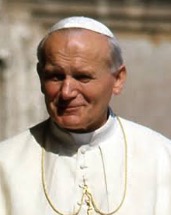
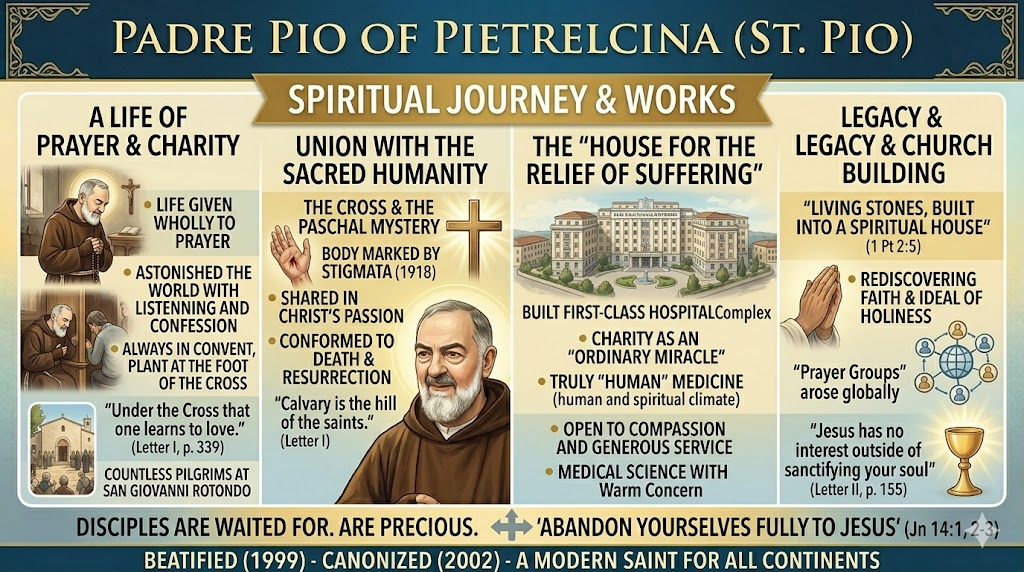
“Sing a new song to the Lord!”. The summons of the entrance antiphon captures well the joy of so many of the faithful who have long awaited the beatification of Padre Pio of Pietrelcina. By his life given wholly to prayer and to listening to his brothers and sisters, this humble Capuchin friar astonished the world.
Countless people came to meet him in the friary of San Giovanni Rotondo and, since his death, the flow of pilgrims has not ceased. When I was a student here in Rome, I myself had the chance to meet him personally, and I thank God for allowing me today to enter Padre Pio’s name in the book of the blessed. Guided by the texts of this Fifth Sunday of Easter, which provides the context for the beatification, let us this morning trace the main features of his spiritual experience.
Christ as the Way to the Father’s House
“Do not let your hearts be troubled. Believe in God and believe also in me” (Jn 14:1). In the Gospel just proclaimed, we heard these words of Jesus to his disciples who were in need of encouragement. In fact, his allusion to his imminent departure had thrown them into turmoil. They were afraid of being abandoned, of being alone, and the Lord consoled them with a very specific promise: “I am going to prepare a place for you”, and then, “I will come again and will take you to myself, that where I am you may be also” (Jn 14:2-3).
Through Thomas, the Apostles reply to this reassurance: “Lord, we do not know where you are going; how can we know the way?” (Jn 14:5). The remark is apt, and Jesus does not avoid the question which it implies. The answer he gives will remain for ever a light shining for generations still to come: “I am the way and the truth and the life; no one comes to the Father but by me” (Jn 14:6).
The “place” that Jesus goes to prepare is in “the house of the Father”; there the disciple will be able to be with the Master for all eternity and share in his joy. Yet there is only one path that leads there: Christ, to whom the disciple must be conformed more and more. Holiness consists precisely in this: that it is no longer the Christian who lives, but Christ himself who lives in him (cf. Gal 2:20). An exhilarating goal, accompanied by a promise which is no less consoling: “Whoever believes in me will also do the works that I do, and greater works than I will they do, because I am going to the Father” (Jn 14:12).
Conformed to the Suffering and Risen Christ
We hear these words of Christ and think of the humble friar of Gargano. How clearly were they fulfilled in Bl. Pio of Pietrelcina! “Do not let your hearts be troubled. Believe …”. What was the life of this humble son of St Francis if not a constant act of faith, strengthened by the hope of heaven, where he could be with Christ? “I am going to prepare a place for you … that where I am you may be also”. What other purpose was there for the demanding ascetical practices which Padre Pio undertook from his early youth, if not gradually to identify himself with the Divine Master, so that he could be “where he was”?
Those who went to San Giovanni Rotondo to attend his Mass, to seek his counsel or to confess to him, saw in him a living image of Christ suffering and risen. The face of Padre Pio reflected the light of the Resurrection. His body, marked by the “stigmata”, showed forth the intimate bond between death and resurrection which characterizes the paschal mystery. Bl. Pio of Pietrelcina shared in the Passion with a special intensity: the unique gifts which were given to him, and the interior and mystical sufferings which accompanied them, allowed him constantly to participate in the Lord’s agonies, never wavering in his sense that “Calvary is the hill of the saints”.
No less painful, and perhaps even more distressing from a human point of view, were the trials which he had to endure as a result, it might be said, of his incomparable charisms. It happens at times in the history of holiness that, by God’s special permission, the one chosen is misunderstood. In that case, obedience becomes for him a crucible of purification, a path of gradual assimilation to Christ, a strengthening of true holiness. In this regard, Bl. Pio wrote to one of his superiors: “I strive only to obey you, the good God having made known to me the one thing most acceptable to him and the one way for me to hope for salvation and to sing of victory” (Letter I, p. 807). When the “storm” broke upon him, he took as his rule of life the exhortation of the First Letter of Peter, that we have just heard: Come to Christ, a living stone (cf. 1 Pt 2:4). He himself thus became a “living stone” for the building of that spiritual house which is the Church. For this we today give thanks to the Lord.
A Legacy of Charity and the Relief of Suffering
Let me conclude with the words of the Gospel of this Mass: “Do not let your hearts be troubled. Have faith in God”. There is a reference to this exhortation of Christ in the advice which the new blessed never tired of giving to the faithful: “Abandon yourselves fully to the divine heart of Jesus, like a child in the arms of his mother”. May these words of encouragement fill our hearts too and become a source of peace, serenity and joy. Why should we fear, if Christ for us is the Way, and the Truth and the Life? Why should we not trust in God who is the Father, our Father?
“You too are living stones, built into a spiritual house” (1 Pt 2:5). How fitting are these words if we apply them to the extraordinary ecclesial experience which grew up around the new blessed! So many people, meeting him directly or indirectly, rediscovered their faith; inspired by his example, “prayer groups” sprang up in every corner of the world. To all who flocked to him he held up the ideal of holiness, repeating to them: “It seems that Jesus has no interest outside of sanctifying your soul” (Letter II, p. 155). If God’s Providence willed that he should be active without ever leaving his convent, as though he were “planted” at the foot of the Cross, this is not without significance. One day the Divine Master had to console him, at a moment of particular trial, by telling him that “it is under the Cross that one learns to love” (Letter I, p. 339). The Cross of Christ is truly the outstanding school of love; indeed, the very “well-spring” of love. Purified by suffering, the love of this faithful disciple drew hearts to Christ and to his demanding Gospel of salvation.
At the same time, his charity was poured out like balm on the weaknesses and the sufferings of his brothers and sisters. Padre Pio thus united zeal for souls with a concern for human suffering, working to build at San Giovanni Rotondo a hospital complex which he called the “House for the Relief of Suffering”. He wanted it to be a first-class hospital, but above all he was concerned that the medicine practised there would be truly “human”, treating patients with warm concern and sincere attention. He was quite aware that people who are ill and suffering need not only competent therapeutic care but also, and more importantly, a human and spiritual climate to help them rediscover themselves in an encounter with the love of God and with the kindness of their brothers and sisters. With the “House for the Relief of Suffering”, he wished to show that God’s “ordinary miracles” take place in and through our charity. We need to be open to compassion and to the generous service of our brothers and sisters, using every resource of medical science and technology at our disposal.
The echo stirred by this beatification in Italy and throughout the world shows that the fame of Padre Pio, a son of Italy and of Francis of Assisi, has gone forth to embrace all the continents. And I gladly greet those who have gathered here — in the first place the Italian authorities who have chosen to be present: the President of the Republic, the President of the Senate, the Prime Minister, who leads the official delegation, and the many other ministers and distinguished guests. Italy is represented most worthily! But also the many faithful from other nations have gathered here to pay homage to Padre Pio. My affectionate greeting goes to all who have come from near and far, with a special thought for the Capuchin Fathers. To everyone I offer heartfelt thanks.

CATHOLIC AND PROUD (5:10) – Explore the profound spiritual connection between Pope Saint John Paul II and Saint Pio of Pietrelcina in this enlightening video. From their initial meeting in 1947, where a young Father Karol Wojtyła sought the counsel of the revered Capuchin friar, to the miraculous healing of Dr. Wanda Półtawska in 1962 through Padre Pio’s intercession, their relationship exemplifies the mysterious workings of divine providence. Delve into their enduring bond, culminating in Pope John Paul II’s role in the beatification and canonization of Padre Pio, and discover how their encounters continue to inspire the faithful worldwide.