Commentary Intro to Mass Readings Sunday Readings
CommentaryIntro to Mass Readings Sunday Readings
May 3, 2026


PDF AIDS



5th Sunday of Easter (A)
ACTS 6:1-7
Biblical exegesis from Fr. Tim Peters, S.T.D for this Sunday’s first reading.
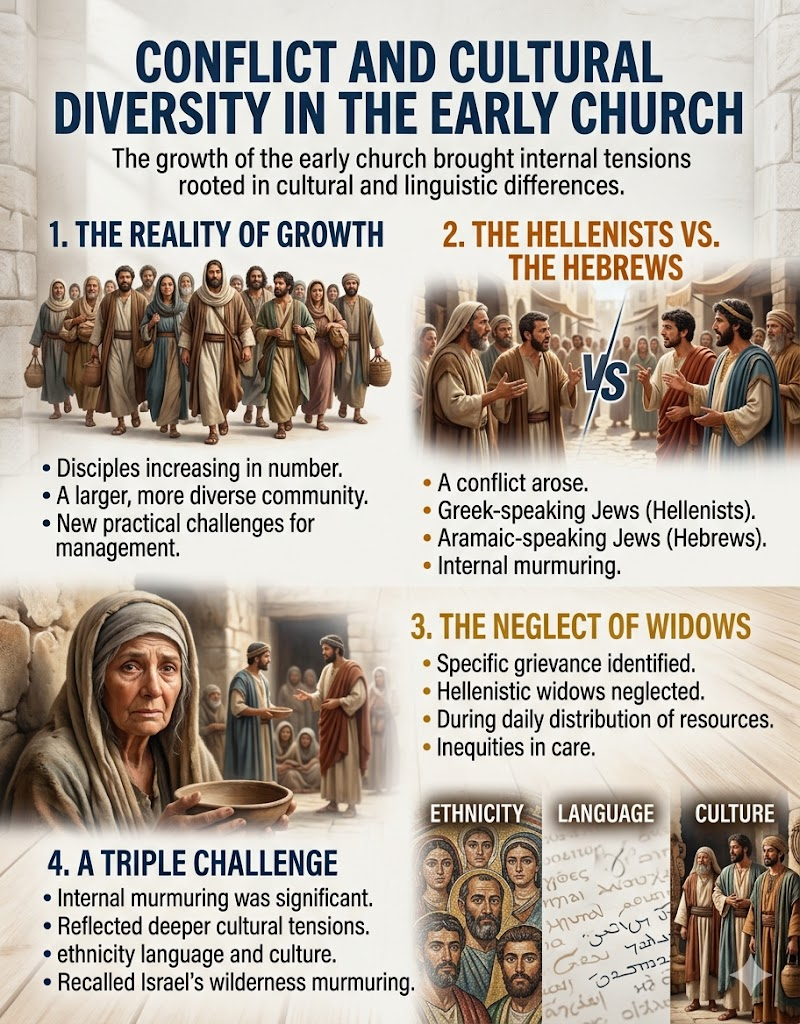
Conflict and Cultural Diversity in the Early Church
The growth of the early church brought internal tensions rooted in cultural and linguistic differences. This section highlights how the community addressed these inequities.
- The Reality of Growth: As the disciples increased in number, the church faced the practical challenge of managing a larger, more diverse community.
- The Hellenists vs. the Hebrews: A conflict arose where the Hellenists (Greek-speaking Jews) murmured against the Hebrews (Aramaic-speaking Jews).
- The Neglect of Widows: The specific grievance involved the neglect of Hellenistic widows during the daily distribution of food and resources.
- A Triple Challenge: This internal murmuring reflected deeper tensions involving ethnicity, language, and culture, reminding the church of the "murmuring" of the Israelites in the desert.
Non-profits have permission to use this infographic in their ministry.
Apostolic Priorities: Prayer and the Word
The Apostles recognized that the health of the church depended on maintaining a clear distinction between administrative service and spiritual leadership.
- The Summoning of the Disciples: The Twelve Apostles called the body of disciples together to address the community's needs without compromising their primary mission.
- Defining the Apostolic Mandate: They declared that it was not right for them to give up preaching the Word of God to "serve tables."
- Devotion to the Essentials: The Apostles committed themselves to two primary pillars of leadership: prayer and the ministry of the Word.
- The Necessity of Delegation: By delegating the daily distribution to others, the Apostles ensured the Gospel would continue to be proclaimed productively.

Non-profits have permission to use this infographic in their ministry.
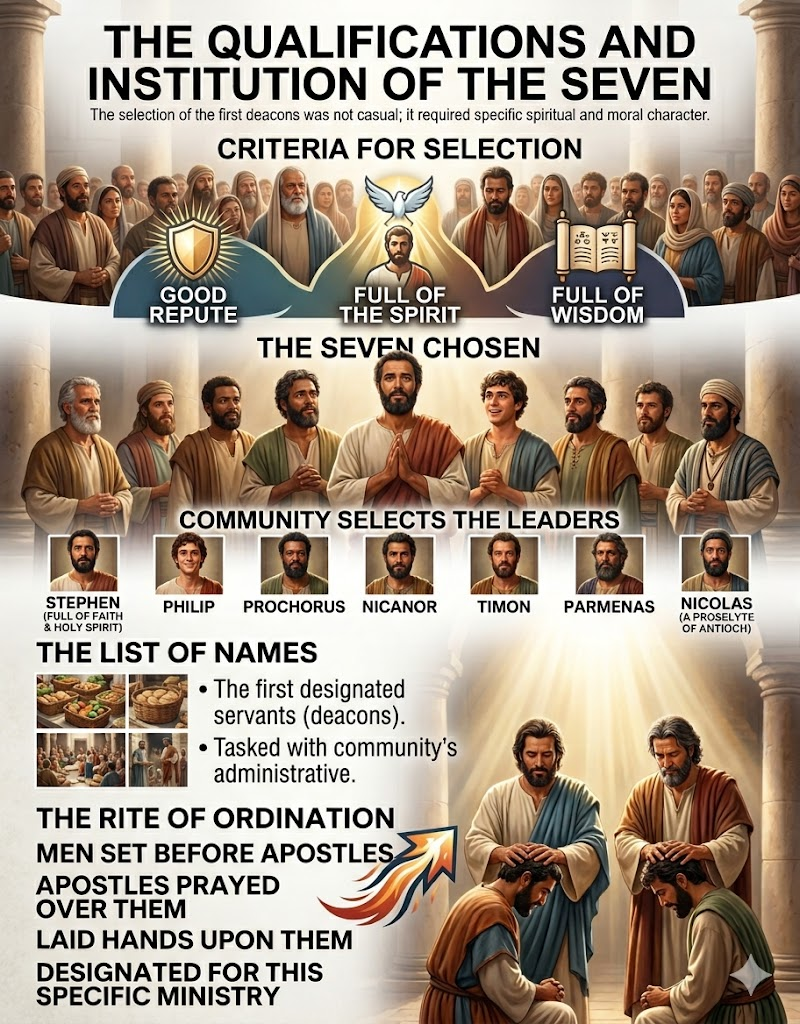
The Qualifications and Institution of the Seven
Fr. Tim Peters notes that the first deacons was not a casual appointment; it required men of specific spiritual and moral character.
- Criteria for Selection: The Apostles required seven men who were of good repute, full of the Spirit, and full of wisdom.
- The Seven Chosen: The community selected Stephen (a man full of faith and the Holy Spirit), Philip, Prochorus, Nicanor, Timon, Parmenas, and Nicolas (a proselyte of Antioch).
- The List of Names: The names represent the first designated servants (deacons) tasked with supporting the community's administrative and charitable needs.
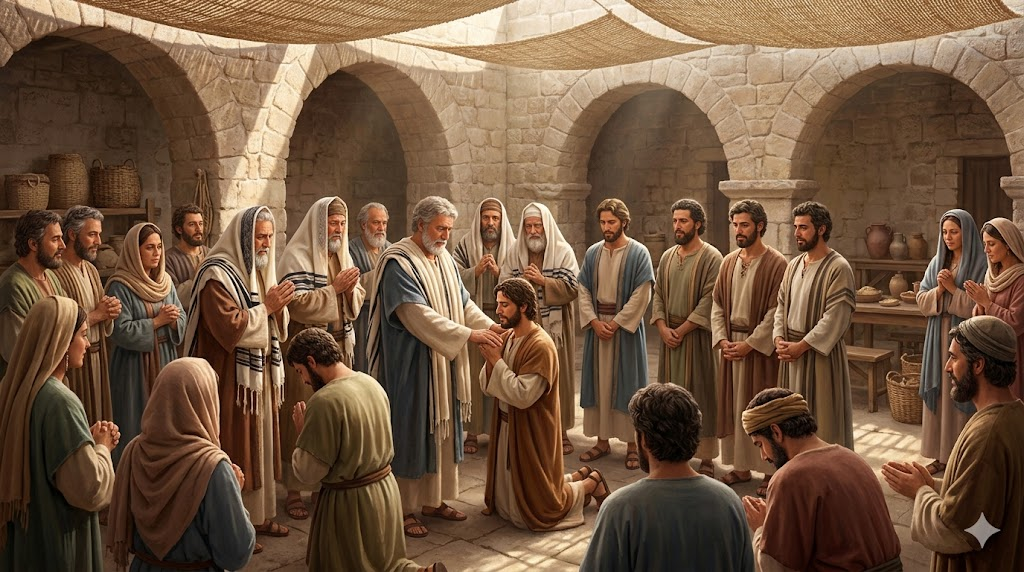
- The Rite of Ordination: These men were set before the Apostles, who prayed over them and laid hands upon them, designating them for this specific ministry.
Non-profits have permission to use this infographic in their ministry.
The Multiplication of the Word and the Obedience of Faith
The restoration of order and the appointment of the seven led to an immediate and profound expansion of the church's influence.
- Growth in Jerusalem: Following the selection of the deacons, the Word of God increased, and the number of disciples in Jerusalem multiplied greatly.
- The Conversion of the Priests: A "great many of the priests" became obedient to the faith, signaling that many from the Levitical priesthood were converting and believing in Jesus.
- The Concept of Obedience: Being "obedient to the faith" (a concept also found in Paul’s Letter to the Romans) signifies the act of receiving baptism and making a full commitment to follow Christ.
- Impact of the Diaconate: The service of the deacons, though administrative in character, facilitated a public witness that allowed even the deacons themselves to perform great wonders and signs.

Non-profits have permission to use this infographic in their ministry.
INSIGHTS FOR HOMILY
PREPARATION
Acts 6:1-7

The Birth of the Diaconate
The early Church faced a crisis of growth that threatened to overshadow its mission of prayer and preaching. From this tension, the diaconate was born—a ministry rooted in the humble “service of the table.” Larry Broding’s commentary on Acts 6:1-7 provides preachers with a rich historical and spiritual roadmap to explore the essential nature of service within the Body of Christ. By examining the transition from material distribution to liturgical ministry, Broding offers a compelling vision of how “waiting tables” became a sacred act of faith.
Why this commentary matters for your homily:
- Clarifies the Roots of the Diaconate: Unpack the Greek origins of diakonia and diakoneo to help your congregation understand that the office of deacon began as a practical solution to ensure no one was left behind.
- Balances Word and Service: Broding highlights the necessary distinction between the Apostles’ ministry of prayer and the deacons’ ministry of charity, providing a framework for discussing diverse charisms within the parish.
- Examines the Character of Leadership: Focus on the essential attributes of “good reputation, Spirit, and wisdom,” allowing you to preach on what it means to be a person of public integrity and spiritual depth.
- Connects the Poor to the Altar: Gain insights into how the historical distribution to widows evolved into a liturgical role, emphasizing the deacon’s place as a bridge between the community’s needs and the Lord’s Table.
- Inspires Lay Service: Use this commentary to challenge all baptized Christians to reflect on their own call to service, using the deacon as the visible sign of the “spirit of giving” that should animate every believer.
Read Larry Broding’s full commentary to help your congregation appreciate the vital role of service and the diverse gifts that build up the Church.
AI THOUGHT STARTERS
To strengthen key sections of your homily, here are questions you might ask the AI assistant (simply copy and paste a question into chat bot in the lower right corner of the page):
Cultural Conflict and Social Responsibility
- How can I use the fact that Acts 6:1 refers to a dispute between Greek and Hebrew followers to address modern cultural or linguistic cliques within our own parish?
- Acts 6:1 suggests that shared faith did not prevent cultural division; what strategies can I offer to help our community overcome parochial attitudes toward those with different backgrounds?
- Since Acts 6:1 refers to the neglect of widows whose families had depleted their savings on pilgrimages, how might we identify the modern equivalents of these destitute and homeless individuals in our city today?
The Ministry of Service and the Table
- Acts 6:1-2 suggests a linguistic connection between distribution and service at the table; how can I deepen the congregation’s understanding of the link between the Eucharistic meal and our obligation to feed the poor?
- Because Acts 6:2 refers to the Apostles refusing to abandon the word of God to serve tables, how can I explain the healthy balance between spiritual leadership and the necessary work of social charity?
- Acts 6:1-7 suggests that serving tables originated from gathering offerings before the Eucharist; how can I encourage the laity to see their weekly donations as a direct continuation of this early Christian tradition?
The Diaconate and Spiritual Gifts
- Acts 6:3 refers to the requirement for a good reputation and being full of the Spirit; how can I use these criteria to help the parish recognize and affirm the specific charisms of our own deacons?
- Since Acts 6:3 suggests that Nicolaus was a convert from Antioch, what does the inclusion of a former pagan-culture outsider tell us about the early Church’s commitment to diversity in leadership?
- Acts 6:1-7 refers to the distinct gifts of the servants compared to the Apostles; how can I encourage parishioners to value their own unique service even if they are not called to the ministry of prayer and preaching?
- How does the fact that Acts 6:1-7 suggests the deacon represents the community’s spirit of giving help me explain why the deacon has a specific liturgical role at the Lord’s Table?
5th Sunday of Easter (A)
1 Peter 2:4-9
Biblical exegesis from Fr. Tim Peters, S.T.D for this Sunday’s second reading.
Christ as the Living Stone and Cornerstone
The passage centers on the identity of Jesus Christ as the foundation of the faith, using Old Testament imagery to describe his relationship with God and the world.
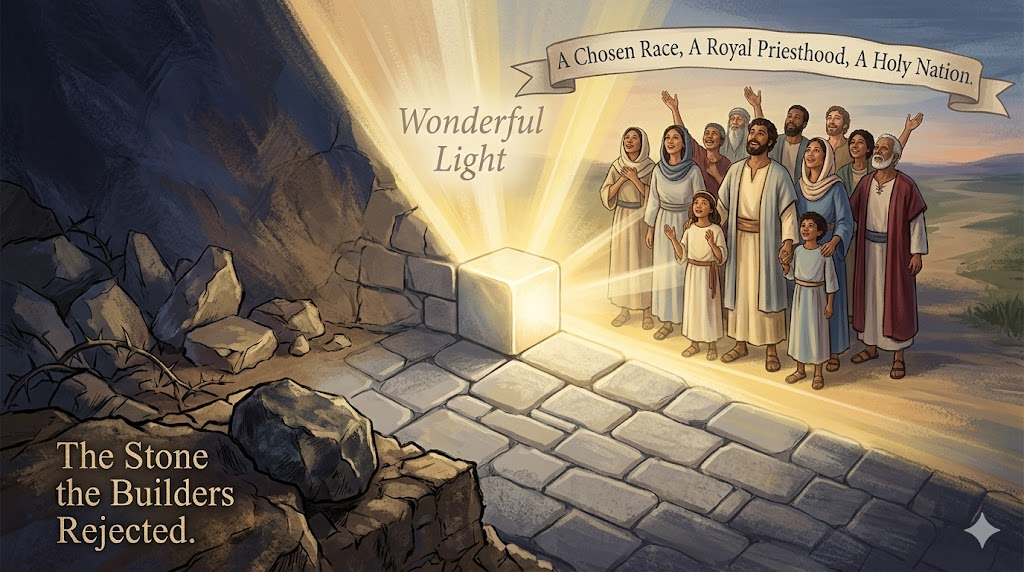
- The Paradox of Choice: Christ is described as a "living stone," rejected by humanity but chosen and precious in the sight of God.
- Biblical Foundation: This concept draws from Isaiah 28:16, where God lays a "cornerstone" in Zion, and Psalm 118:22, regarding the stone the builders rejected.
- The Stumbling Block: For those who do not believe, Christ becomes a stone that makes men stumble and a rock that makes them fall because they disobey the Word.
- The Head of the Corner: Despite worldly rejection, he has become the head of the corner, the essential piece that holds the spiritual structure together.

Non-profits have permission to use this infographic in their ministry.
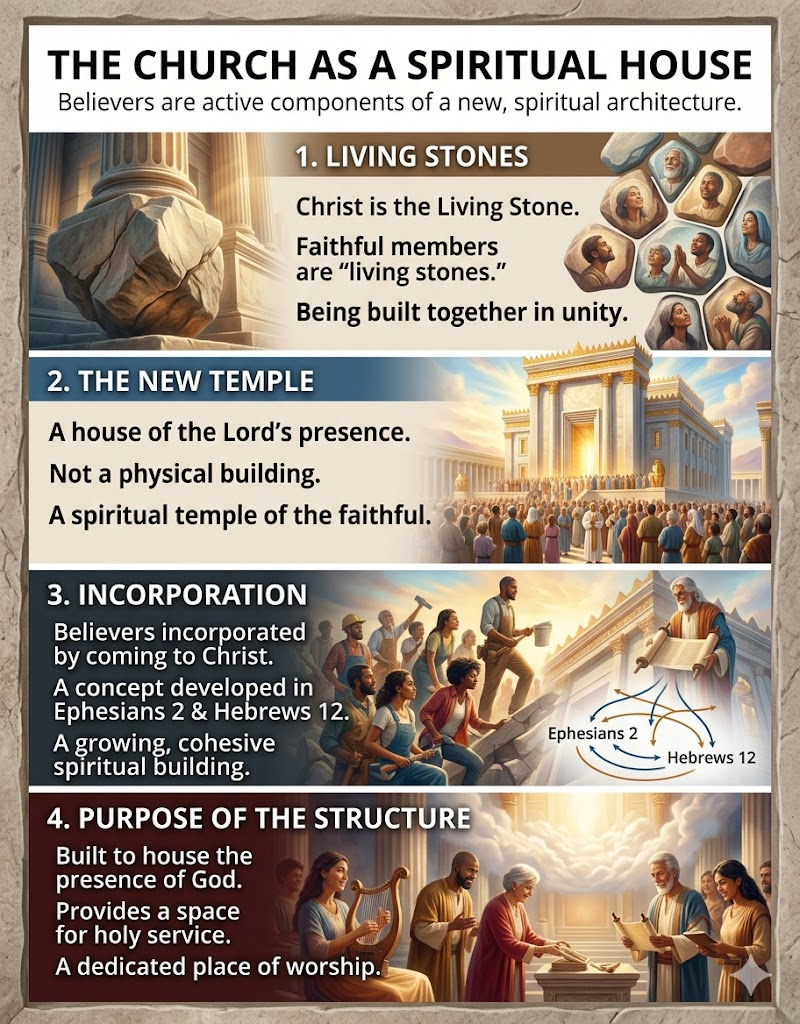
The Church as a Spiritual House
Believers are not merely passive followers but are active components of a new, spiritual architecture.
- Living Stones: Just as Christ is the Living Stone, the members of the church are "living stones" being built into a spiritual house.
- The New Temple: This house is a reference to the Temple of the Lord, but it is no longer a physical building; it is a spiritual temple comprised of the faithful.
- Incorporation: By coming to Christ, believers are incorporated into this temple, a concept further developed in Ephesians 2 and Hebrews 12.
- Purpose of the Structure: The spiritual house exists to house the presence of God and provide a space for holy service.
Non-profits have permission to use this infographic in their ministry.
The Royal Priesthood and Spiritual Sacrifices
The text defines the identity of the baptized community, emphasizing their collective role in the mediation between God and humanity.
- Priesthood of the Baptized: All who are baptized are part of a "holy priesthood" and a "royal priesthood." This is distinct from the ministerial priesthood (bishops and priests) but involves every member of the church.
- Spiritual Sacrifices: The role of this priesthood is to offer "spiritual sacrifices" acceptable to God through Jesus Christ.
- Life as Sacrifice: This involves offering one's body and life as a sacrifice, denying earthly privileges to serve Christ—a theme also found in Romans 12.
- Mediation: In Christ, the great expectation of a priestly people originally mentioned in Exodus 19 is finally realized.

Non-profits have permission to use this infographic in their ministry.
The Identity of the New Exodus People
Peter uses the language of the Exodus to describe the new status of Christians, marking a transition from a state of wandering to a state of belonging.
- Covenant Titles: The church is given four specific titles: Chosen Race, Royal Priesthood, Holy Nation, and God's Own People.
- Fulfillment of Promises: These titles fulfill the promises of Exodus 4 (Israel as God's firstborn) and Exodus 19 (a kingdom of priests).
- From Darkness to Light: The fundamental mission of this people is to declare the wonderful deeds of Him who "called you out of darkness into his marvelous light."
- The Transformation of Mercy: Drawing from Hosea, Peter notes that those who were once "no people" are now "God's people," having moved from a lack of mercy to the reception of God's full mercy.

Non-profits have permission to use this infographic in their ministry.
INSIGHTS FOR HOMILY
PREPARATION
1 Peter 2:4-9
Living Stones
In a world that prizes “likability” and social cohesion above almost all else, the call to be a Christian can feel like a profound paradox. We all want to fit in, yet the Gospel often calls us to stand out—sometimes to the point of scandal. Larry Broding’s commentary dives into the heart of 1 Peter to explore what it truly means to be “living stones” in God’s spiritual architecture. For the preacher, this commentary provides a bridge between the modern desire for community and the ancient, radical call to be a people set apart for God’s own purpose.
Why this commentary matters for your homily:
- Addresses the “Likability” Trap: Broding contrasts the modern business world’s obsession with social skills against the biblical mandate to be a “scandal” to the world, helping you address the tension your congregation feels every day.
- Masterful Metaphorical Analysis: Gain deep insights into the imagery of the “Cornerstone” and the “Spiritual Edifice,” allowing you to paint a vivid picture of how individual believers function as essential parts of a greater whole.
- Clarifies the Purpose of Community: Move beyond the idea of the Church as a mere social club; this commentary refocuses the homily on the “Royal Priesthood” and our collective mission to praise and evangelize.
- Navigates Social Rejection: Find the words to encourage those who feel marginalized for their faith, framing “not fitting in” as a sign of being built into God’s own Temple.
- Action-Oriented Evangelism: This resource helps you pivot from theological theory to practical application, showing how “fitting in” where we can is actually a strategic means to invite others into the Kingdom.
Read Larry Broding’s full commentary to help your congregation understand their unique place as living stones in the house of the Lord.
AI THOUGHT STARTERS
To strengthen key sections of your homily, here are questions you might ask the AI assistant (simply copy and paste a question into chat bot in the lower right corner of the page):
Scriptural Foundation and Ancient Nuance
- How does the literal translation of 1 Peter 2:6, which refers to being surrounded in Scripture, help me explain the early Church’s view of the Word of God as a protective or encompassing boundary?
- Since 1 Peter 2:6 suggests an emphatic double negative regarding being certainly not shamed, what are some powerful ways to communicate the absolute security of faith to those feeling marginalized by society?
- 1 Peter 2:6 refers to a stone that has been tested in its quote of Isaiah 28:16; how can I apply the concept of a tested foundation to the modern struggles of my parishioners?
- How can I use the fact that 1 Peter 2:7a refers to Psalm 118:22 to encourage those who feel like a rejected stone to find their identity as part of God’s cornerstone?
- 1 Peter 2:9 suggests a direct echo of Exodus 19:3-6; how can I help the congregation understand their identity as a royal priesthood in the context of their baptismal call?
Community and the Scandal of Faith
- 1 Peter 2:4-9 refers to the Church as a spiritual edifice built on Christ; how can I contrast this biblical investment in community with the modern altar of rugged individualism?
- How can I explain that 1 Peter 2:7b suggests Christ is a stumbling stone to help parishioners navigate the misunderstanding or disdain they may face from outsiders?
- 1 Peter 2:4-9 refers to believers as living stones; what practical advice can I give to help people find their specific place in the building of the local parish community?
Mission and the Purpose of Likability
- While 1 Peter 2:4-9 suggests that fitting in and being liked is a pleasant thought, how can I challenge the congregation to see social success primarily as a means to evangelize?
- Since 1 Peter 2:9 refers to us being a people of God’s own possession so we can praise him, how can I encourage the laity to use their influence in family and society to invite others into that same praise?
5th Sunday of Easter (A)
John 14:1-12
Biblical exegesis from Fr. Tim Peters, S.T.D for this Sunday’s first reading.
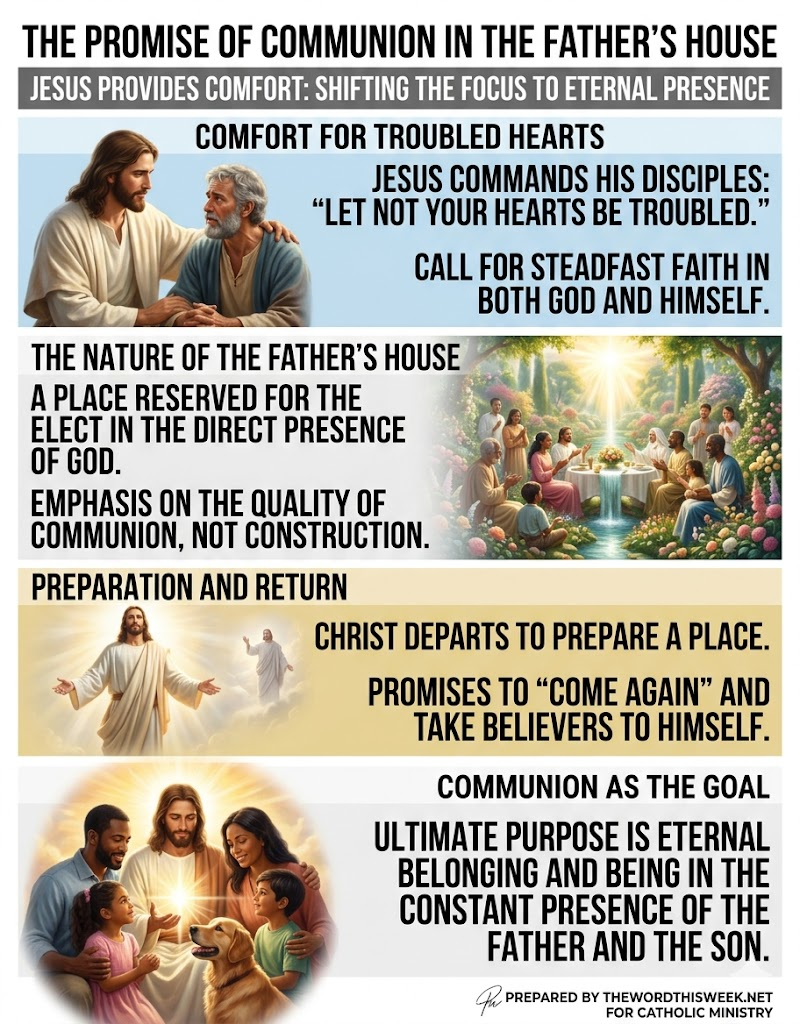
The Promise of Communion in the Father’s House
esus provides comfort to his disciples in the face of uncertainty, shifting the focus from physical dwellings to eternal presence.
- Comfort for Troubled Hearts: Following the prediction of Peter's denial, Jesus commands his disciples, "Let not your hearts be troubled." He calls for a steadfast faith in both God and himself.
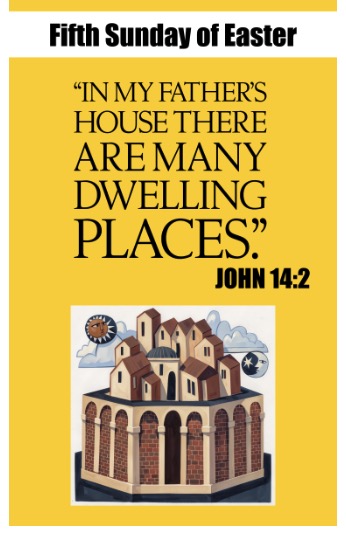
- The Nature of the Father's House: While often translated as "mansions," the emphasis of the "many rooms" is on the quality of communion rather than construction. It signifies a place reserved for the elect in the direct presence of God.
- Preparation and Return: Christ departs to prepare a place for believers, promising to "come again" and take them to himself.
- Communion as the Goal: The ultimate purpose of this preparation is eternal belonging and being in the constant presence of the Father and the Son.
Non-profits have permission to use this infographic in their ministry.
Jesus as the Way, the Truth, and the Life
This section explores the sixth "I am" statement, establishing Christ as the unique and necessary mediator between humanity and the Father.
- Thomas’s Inquiry: In response to Thomas’s confusion about the destination, Jesus identifies himself as the "Way, the Truth, and the Life."
- Old Testament Foundations: * Exodus Connection: The "Way" recalls Exodus 23, where the Lord promised an angel to guard the people on their way to a prepared place.
- Isaiah’s Vision: It also fulfills the "way of holiness" and the "way of peace" prophesied by Isaiah for the redeemed.
- Exclusive Mediation: Jesus declares that "no one comes to the Father but by me," establishing that he is the fulfillment of the Law and the only means to know, love, and serve the Father.
- The Journey Home: Unlike the Exodus leading to a physical Promised Land, Jesus leads his disciples directly to the Father.

Non-profits have permission to use this infographic in their ministry.
The Mutual Indwelling and Revelation of the Father
Jesus clarifies the profound unity between himself and the Father, answering Philip's request for a direct manifestation of God.
- The Request of Philip: Philip’s plea, "Show us the Father," reveals a lack of understanding that the unseen Father is already visible in the Son.
- He Who Has Seen Me: Jesus explains that to see him is to see the Father. He is the definitive revelation of the Father’s love, mercy, and character.
- Mutual Indwelling: Jesus describes a relationship of total unity: "I am in the Father and the Father in me."
- Divine Authority: The words Jesus speaks and the works he performs are not on his own authority but are the Father dwelling in him and doing his work.

Non-profits have permission to use this infographic in their ministry.
The Empowerment of the Church for Greater Works
Jesus prepares the disciples for his departure by explaining how his return to the Father will empower their future mission.
- The Significance of the Ascension: Jesus' return to the Father is a "mission complete" moment that transforms history, allowing him to intercede at the Father's right hand.
- Greater Works Defined: The "greater works" promised to believers do not refer to works of greater power than Christ's, but to the scope of evangelization.
- The Work of Evangelization: Through the coming of the Holy Spirit at Pentecost, the church is empowered to bring the Gospel to the entire world, reaching all nations.
- In My Name: These works are made possible because the church can now ask for all things in Jesus' name, ensuring the Father is glorified in the Son through the church’s witness.

Non-profits have permission to use this infographic in their ministry.
INSIGHTS FOR HOMILY
PREPARATION
John 14:1-12
Do We Really Know Jesus?
Unlock the profound depths of the Gospel of John and transform your preaching from the routine to the transcendent with the insights of Larry Broding. We often suffer from a “familiarity that breeds dullness,” where the most revolutionary claims of Christ become mere background noise in our spiritual lives. Broding’s commentary cuts through the fog of the everyday, reintroducing us to a Jesus who doesn’t just give directions, but who is the destination.
By exploring the radical implications of the Last Discourse, this commentary provides the theological muscle and pastoral heart needed to craft a homily that resonates with a modern, anxious world.
Why this commentary matters for your homily:
- Confronts Spiritual Apathy: Broding addresses the “blindness of familiarity,” helping you challenge your congregation to see Jesus not as a historical figure, but as the living “I AM” who shakes our comfortable foundations.
- Decodes Complex Metaphors: Gain a clearer understanding of the “many rooms” in the Father’s house, moving beyond literal architecture to the beautiful reality of an extended family relationship with God.
- Theological Precision on the “Way”: Navigate the famous but often misunderstood “Way, Truth, and Life” declaration with a focus on Jesus as the faithful bridge to the Father.
- Connects Suffering to Glory: Find the language to explain how the “way” of the cross is the only path to true life, offering a grounded hope to those in your pews facing their own trials.
- Exposes the “Only” Reality: Use Broding’s insight into the divinity of Christ to remind your listeners that any existence away from God is a false reality, centering their identity firmly in Christ’s presence.
Read Larry Broding’s full commentary to help your congregation rediscover the startling reality of God acting and dwelling among us.
AI THOUGHT STARTERS
To strengthen key sections of your homily, here are questions you might ask the AI assistant (simply copy and paste a question into chat bot in the lower right corner of the page):
Faith as the Remedy for Anxiety
- John 14:1 refers to the direct connection between trust and the reduction of worry; how can I explain to the congregation that the end game of this trust is the preparation of the Kingdom for them?
- Since John 14:1 suggests the verbs for believe can be translated as either a statement of fact or a command, how can I illustrate the shift from a familiar faith in God to a radical new commitment to believe in Jesus?
- John 14:1 refers to this discourse occurring immediately after the prophecy of Peter’s apostasy; what does this timing suggest about the depth of Christ’s mercy for those who feel their hearts are currently troubled?
The Father’s House and Divine Relationship
- John 14:2 suggests that the many rooms refer to an extended family relationship rather than physical space; how can I best describe the Father’s house as an invitation for all people to become God’s children?
- Because John 14:3 refers to Jesus going to prepare a place through the cross, how can I frame the road of suffering as the necessary path to the gift of new, eternal life?
- John 14:4a-c suggests that Jesus returns to us as a companion through his Spirit; what are some practical examples of how his risen life becomes our risen life in the midst of daily trials?
Jesus as the Way, Truth, and Life
- John 14:6 refers to Jesus as the way, the truth, and the life; how can I explain the role of truth as a bridge that makes the way faithful and the life truly meaningful?
- Since John 14:6 suggests that I AM echoes the divine name in Exodus, how can I emphasize that Jesus is the only true reality that matters in a world full of false choices?
- John 14:6 refers to Jesus as the only means to the Father; how can I preach this in a way that highlights his divinity as the very presence of God on earth?
- How does the fact that John 14:1-12 suggests wherever God acts, God is help me encourage the laity to recognize Jesus acting in their own lives right now?