Homilies
Homilies
April 26, 2026
⭐⭐⭐ Cut to the Heart – Bishop Robert Barron


4th Sunday of Easter (A)
Jesus the Gate


SDS


CMF








PAPAL HOMILIES




RECOMMENDED
The Augustinian Province of St. Thomas of Villanova maintains a dedicated “Homilies” page with reflections grounded in the Confessions and the Rule of St. Augustine.
✍️ Augustinian Province – Weekly Homilies
📺 Fr. Paul Galetto
📺 Fr. Tom McCarthy
✍️ Fr. Kieran J. O’Mahony
Core Charism: Interiority (searching for God within), community life (“one mind and one heart on the way to God”), and the restless heart that finds repose only in God.
4th Sunday of Easter (A)
Focus Reading: John 10:9-10 (The Door to the Heart)
Key Phrase: “The Restless Heart Finds the Gate”
This Sunday’s Hook: The Shepherd as the end of our interior searching.
The Approach with Application: This perspective focuses on the interiority and the “restless heart.” Christ is the “Door” through which we enter to find our true selves. The application focuses on community (Cor Unum) and the movement from the “external” world of distractions to the “internal” world where the Teacher/Shepherd dwells.
Draft Opening: “St. Augustine famously cried out, ‘Late have I loved you, Beauty so ancient and so new!’ He spent years searching outside for what was actually within. Today, Jesus says, ‘I am the gate.’ He is not just an entrance to a place, but the entrance to the truth of who we are. Our hearts are restless, wandering through many doors, until they finally pass through the One who calls us by name.”
RECOMMENDED
Many Benedictine Abbeys publish the Abbot’s homilies online. Quarr Abbey and Saint Meinrad Archabbey are excellent sources for traditional Benedictine “Lectio” style preaching.
✍️ Saint Meinrad Archabbey Reflections
✍️ Monastery of Christ in the Desert
✍️ Mepkin Abbey

Core Charism: Ora et Labora (Prayer and Work), Stability, Hospitality, Lectio Divina, Listening with the “ear of the heart.”
4th Sunday of Easter (A)
Focus Reading: John 10:1-5 (Hearing and Listening)
Key Phrase: “Listen with the Ear of Your Heart”
This Sunday’s Hook: The stability of the sheepfold and the discipline of listening.
The Approach with Application: Rooted in the Rule of Saint Benedict, this approach emphasizes Stabilitas and Obedience (from the Latin ob-audire, to listen deeply). The application is about creating a “monastery of the heart” where one stays still long enough to actually know the Shepherd’s cadence.
Draft Opening: “The very first word of Saint Benedict’s Rule is ‘Listen.’ In today’s Gospel, the sheep follow because they know the voice. They have spent time in the silence of the fold. We live in a culture of constant flight, but the Shepherd calls us to stability—to stay in the fold of his presence until his voice becomes more familiar to us than our own heartbeat.”

LECTIO DIVINA
APRIL 2026 (PDF)
RECOMMENDED
The Carmelites offer a unique “Lectio Divina” style reflection for each Sunday through their international headquarters.
✍️ OCarm.org – Lectio Divina for Sundays
📺 Fr. Greg

Core Charism: Contemplation, The Desert, Prayer as Friendship, The Dark Night, Elijah, St. Teresa of Avila.
4th Sunday of Easter (A)
Focus Reading: 1 Peter 2:21-25 (Following in Silence)
Key Phrase: “The Dark Night of the Shepherd”
This Sunday’s Hook: Following the Shepherd through the valley of the shadow into union with God.
The Approach with Application: Carmelite spirituality (Teresa of Avila, John of the Cross) emphasizes the contemplative journey. The “insults” and “suffering” mentioned in 1 Peter are seen as the “purgative way.” The application is about the “ascent” of the soul—following the Shepherd even when we cannot see him, trusting the “silent music” of his presence during the dark nights of life.
Draft Opening: “To follow the Shepherd often means walking through a mist where the path is hidden and the senses are dry. Peter speaks of Christ suffering for us, leaving an example. In the silence of Carmel, we learn that the Shepherd is most present when he is most silent. Today we ask: do we have the courage to follow him not just into the green pastures, but into the quiet, transformative darkness where only faith can lead?”
RECOMMENDED
The Dominicans have one of the most robust preaching websites called “Torch.” It features a new homily every week from a different friar.
✍️ English Dominican Friars – Torch

Core Charism: Veritas (Truth), Preaching, Study, Combatting Error with Clarity, Contemplation passed on to others.
4th Sunday of Easter (A)
Focus Reading: Acts 2:14a, 36-41 (Peter’s Kerygma)
Key Phrase: “Veritas: The Truth that Pierces the Heart”
This Sunday’s Hook: The power of the Word to move the intellect and the will simultaneously.
The Approach with Application: Dominicans focus on Praedicare (to preach). The focus is on the doctrinal clarity of Peter’s proclamation: “God has made him both Lord and Christ.” The application is intellectual conversion leading to moral action. It asks the congregation: “What must we do?”—demanding a response to the Truth that has been revealed.
Draft Opening: “When Peter spoke on that first Pentecost, the scripture says the people were ‘cut to the heart.’ This was not a mere emotional sting; it was the sharp edge of Truth—Veritas. Today, we explore not just a nice story about sheep, but the objective reality of the Resurrection that demands a radical reorganization of our entire understanding of the world.”
RECOMMENDED
St. Anthony Messenger and the various provinces often provide “Franciscan Spirit” reflections that focus on the Gospel of the day.
✍️ Franciscan Media – Sunday Homily Helps
📺 Fr. Paul Galetto
📺 Fr. Tom McCarthy
✍️ Fr. Kieran J. O’Mahony

Core Charism: Poverty, Minority (being “lesser”), Fraternity, and finding God in the grit of humanity and creation.
4th Sunday of Easter (A)
Draft Opening: “Saint Francis used to say that the sheep followed the Lord because they recognized his humble love. Today, in a world screaming for our attention, the Shepherd doesn’t shout over the noise. He whispers our names from the muddy paths of our daily lives, inviting us not to a palace, but to a pasture where every living creature is our brother and sister.”
Focus Reading: John 10:1-10 (The Good Shepherd)
Key Phrase: “The Shepherd’s Footprints in the Dust”
This Sunday’s Hook: The intimacy of a voice that doesn’t command from a throne, but calls from the middle of the flock.
The Approach with Application: Franciscans emphasize the poverty and humility of Christ. The application focuses on “fraternitas”—recognizing the Shepherd’s voice in the marginalized and the natural world. It challenges the listener to abandon “thief-like” egoism to find “life to the full” in simple, radical service.
RECOMMENDED
The Jesuits typically provide reflections through America Magazine or their provincial websites. Their “The Word” column is the gold standard for Ignatian preaching.

Core Charism: Ad Maiorem Dei Gloriam (For the Greater Glory of God), Discernment of Spirits, Finding God in All Things, Imaginative Contemplation.
4th Sunday of Easter (A)
Focus Reading: John 10:1-10 (Discernment of Spirits)
Key Phrase: “Discerning the Voice of the True Shepherd”
This Sunday’s Hook: How do we distinguish the “voice” of the Shepherd from the “noise” of the stranger in our interior life?
The Approach with Application: Drawing from the Spiritual Exercises, the focus is on “Discernment of Spirits.” The application provides a practical framework: the Shepherd’s voice brings a sense of deep peace (consolation), while the stranger’s voice (the enemy of human nature) brings agitation and anxiety. The goal is Magis—choosing the path that leads to greater service of God.
Draft Opening: “Imagine you are standing at the gate of a crowded sheepfold. Multiple voices are calling out at once. This is the interior landscape of our souls. Ignatius of Loyola invites us today to examine the ‘quality’ of these voices. Does the voice calling you lead toward hope and labor for others, or does it steal your peace and leave you in desolation?”
March/April 2026
RECOMMENDED
The Redemptorists of the Baltimore and Denver Provinces often provide weekly reflections, particularly through their “Missionaries of Hope” video series or Lenten booklets.
✍️ The Redemptorists (Baltimore Province) News & Reflections

Core Charism: Preaching “Plentiful Redemption” (Copiosa Redemptio), especially to the abandoned and sinners; Moral Theology (St. Alphonsus Liguori).
4th Sunday of Easter (A)
Focus Reading: 1 Peter 2:20b-25 (The Wounded Healer)
Key Phrase: “Copiosa Apud Eum Redemptio” (With Him is Plentiful Redemption)
This Sunday’s Hook: The comfort of a Shepherd who carries the scars of the sheep.
The Approach with Application: Following St. Alphonsus Liguori, this perspective is deeply pastoral and focuses on the “plentiful redemption” available to the most abandoned. The application emphasizes that “by his wounds you have been healed.” It offers a message of profound mercy for those who feel they have strayed too far to be brought back.
Draft Opening: “Many of us feel like the stray sheep—bruised by our own choices or the harshness of the world. But Peter reminds us today that we have returned to a Shepherd who was himself wounded. He does not stand at the gate with a ledger of our sins; he stands with open arms and scarred hands, offering a redemption that is more than enough for every one of us.”
4th Sunday of Easter (A)
Bishop Robert Barron
Agents of Divine Mercy

Friends, all during the Easter season, we read from the Acts of the Apostles, and this Sunday, we hear part of Peter’s oration on Pentecost morning. His bold proclamation is, in a way, the mother of all sermons; it is the essence of authentic Christian preaching. Peter, filled with the excitement of the Gospel, names the problem of sin, declares Jesus as Lord and Christ, and cuts his listeners to the heart. Then there comes naturally a question in response: “What are we to do?”

4th Sunday of Easter (A)
Featured Homily
The Voice of the Good Shepherd in the Modern World

Jesus, the Good Shepherd, speaks to us in many unexpected ways today, but the noise of modern life can make His voice difficult to discern. To help guide the faithful, the Church observes World Day of Prayer for Vocations, praying for dedicated priests and religious who can help us understand the Scriptures and recognize Christ’s call. Ultimately, the Mass remains the most profound place to encounter Jesus. Through the proclaimed Word, communal prayer, and especially the Eucharist, He unites Himself with us. We are called to remain deeply connected to this holy communion and His flock, the Church.

4th Sunday of Easter (A)
Fr. Michael Chua
2026 HOMILIES | ARCHIVE: 2023 | 2020 | 2017 | 2014 | 2011
The Voice of the Shepherd

Fr. Michael Chua addresses the tension between preaching “itching ears” theology and the “uncomfortable truth” of the Gospel. He identifies three essential yet unpopular themes for Good Shepherd Sunday: the reality of sin, which makes salvation meaningful; the necessity of the Cross, which transforms suffering into redemptive grace; and the existence of objective truth in defiance of relativism. He concludes that true sheep are not mindless, but spiritually mature—discerning the Shepherd’s voice from counterfeits. Ultimately, both clergy and laity must submit to Christ’s authority to experience “life to the full” and find true spiritual safety.

EVALUATION
THEOLOGICAL ACCURACY & BIBLICAL FIDELITY
- Textual Accuracy: The homilist masterfully weaves together 2 Timothy (“itching ears”), 1 Peter (suffering patiently), and John 10 (the Good Shepherd). The distinction drawn between the Synoptic portrayal of sheep (lost and needing to be found) and John’s portrayal (mature, discerning the shepherd’s voice) is a brilliant piece of biblical scholarship.
- Doctrinal Soundness: This homily is fiercely orthodox. It aggressively defends the necessity of salvation by highlighting the reality of sin, accurately describes the Catholic understanding of redemptive suffering, and takes a firm stance against moral relativism. The critique of modern Catholic funerals—reminding the congregation that we pray for the dead, not to them—is a sharp, highly accurate point of sacramental theology.
- Exegesis: The preacher expertly uses the Good Shepherd metaphor not just as a comforting image, but as a framework for the prophetic duty of the priesthood (to lead and feed with truth) and the duty of the laity (to listen and discern).
THEMATIC ORGANIZATION & STRUCTURE
- Central Theme: The thesis is clear and uncompromising: the duty of the true shepherd is to preach the hard, unpopular, objective truths (sin, suffering) rather than pandering to the culture.
- Structural Clarity: The architecture of this homily is flawless. It opens with the central tension (truth vs. popularity), clearly enumerates its three main points (First: Sin, Second: Suffering, Third: Objective Truth), and concludes by turning the focus from the shepherd back to the sheep.
- Transitions: The transitions are explicit and highly effective. The listener never has to guess where the preacher is going or how the current point connects to the overarching theme.
DELIVERY & PACING
- Grammar and Polish: The prose is exceptionally literate and sophisticated. The vocabulary is elevated (“euphemistic,” “pejoratively,” “sine qua non”), which gives the homily a commanding, authoritative tone.
- Pacing and Flow: Because it reads like a well-crafted theological essay, it is slightly dense. A preacher would need to deliver this with deliberate pacing and strategic pauses to ensure the congregation could digest the heavier concepts.
PRACTICAL APPLICATION & RELEVANCE
- Congregational Context: It is highly relevant to the modern cultural moment. By directly addressing the “gospel of prosperity,” the “heresy of relativism,” and modern “cancel culture,” the preacher proves that the Gospel is perfectly equipped to confront contemporary issues.
- Actionable Takeaway: The application is a mental and spiritual shift rather than a physical task. The congregation is challenged to stop demanding “feel-good” sermons, to embrace their own suffering as redemptive, and to mature in their ability to discern truth from cultural counterfeits.
- Empathy: This homily opts for “tough love” over gentle empathy. By critiquing modern psychological crutches, the “poor me” victim mentality, and narcissism, the preacher takes a bold, prophetic stance. While this is structurally necessary for the theme, it inherently sacrifices some of the warm, pastoral bedside manner seen in other homilies.
ENGAGEMENT & PASTORAL CONNECTION
- Hook and Introduction: The opening is fantastic. By pulling back the curtain on the anxiety a priest feels when preparing a homily (Do I tell them what they want to hear or the truth?), the preacher immediately secures the congregation’s attention and trust through vulnerability.
- Pacing and Energy: The energy is assertive, intellectual, and challenging. It does not coddle the listener; it challenges them to rise to a higher standard of faith.
- Storytelling: The homily lacks narrative storytelling or personal anecdotes, relying instead on cultural critique and theological exposition. While the intellectual arguments are engaging, the lack of a human story makes it slightly less emotionally resonant.
HOMILY HELPER
GO DEEPER
PROMPTS TO KEEP YOU WRITING
Copy/paste one of these command prompts into the Catholic Assistant (bottom right corner). This tool can help you brainstorm and provide you with further ideas to keep you writing.
_
- The Modern Crisis explores the tension between delivering a palatable message and the "uncomfortable truth" of Scripture in a culture of compromise. Direct the AI to write a reflection on the preacher's struggle.
- The Sinful Condition argues that ignoring personal culpability makes the concept of salvation entirely meaningless and the Resurrection a hollow victory. Direct the AI to emphasize the necessity of acknowledging sin.
- The Counterfeit Voice examines the warning in 2 Timothy regarding teachers who pander to "itching ears" rather than providing sound, transformative doctrine. Direct the AI to focus on discerning false shepherds.
- The Redemptive Cross rejects the "gospel of prosperity" by framing suffering as a priceless opportunity to participate in Christ’s own redemptive mission. Direct the AI to write about the inevitability of the Cross.
- The Truth Absolute challenges the modern heresy of relativism by presenting the Good Shepherd as the only source of objective, saving truth. Direct the AI to focus on the danger of relativism.
- The Mature Flock redefines the image of "sheep" from mindless followers to discerning believers who can distinguish the Shepherd’s cadence from a stranger's. Direct the AI to focus on spiritual maturity.
- The Funeral Reality critiques the "ritual of canonization" in modern funerals, reminding the faithful that we must pray for the deceased rather than to them. Direct the AI to write on the theology of death.
- The Shepherd's Arsenal lists sin, suffering, and objective truth as the "nutritious sustenance" required to prevent the congregation from experiencing theological indigestion. Direct the AI to focus on these three themes.
- The Freedom of Authority explores the paradoxical idea that true human freedom is only found through total submission to the authority of the Good Shepherd. Direct the AI to write on the beauty of obedience.
- The Shared Journey highlights that priests and bishops remain sheep within the fold of Christ, needing the same mercy and guidance as the laity. Direct the AI to focus on clerical humility.
4th Sunday of Easter (A)
Dominican Blackfriars
2026 HOMILIES | ARCHIVE: 2023 | 2020 | 2017 | 2014 | 2011 | 2008 | 2005 | 2002
Feeding His Flock

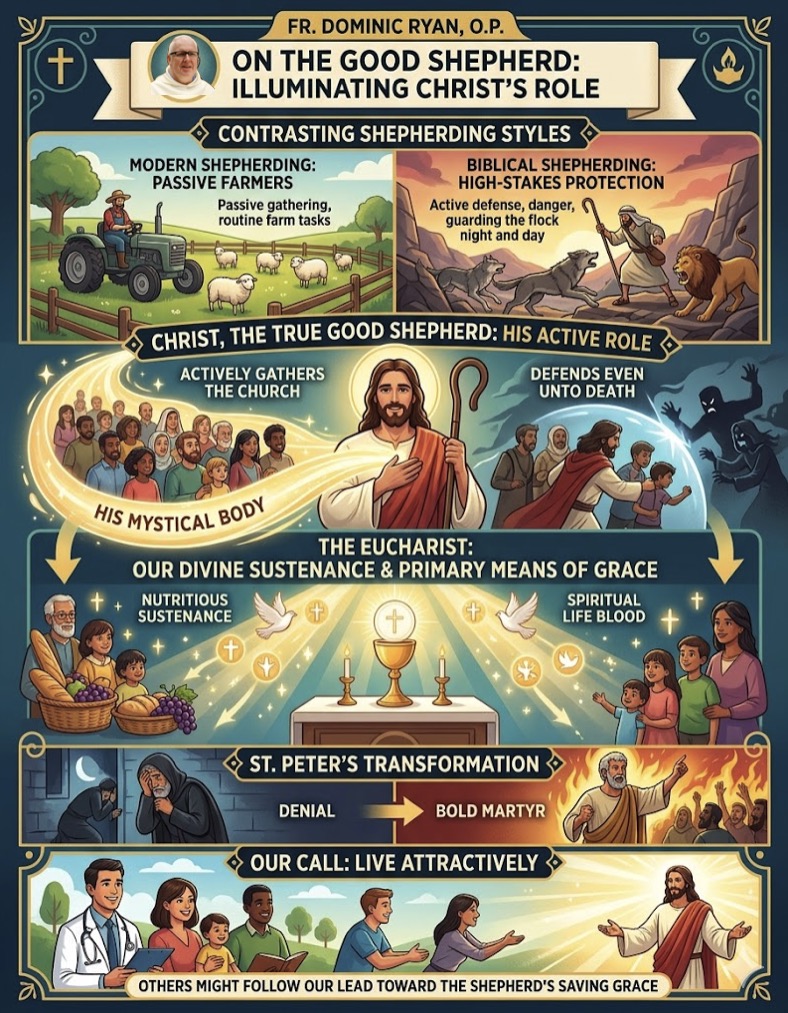
Fr. Dominic Ryan, O.P., contrasts modern shepherding with the high-stakes protection required in biblical Israel to illuminate Christ’s role as the Good Shepherd. Unlike passive farmers, Christ actively gathers the Church into His mystical body, defending it even unto death. To ensure His flock continues to receive the benefits of His sacrifice, Christ instituted the Eucharist as the primary means of grace and “nutritious sustenance.” This divine support transformed a fearful St. Peter into a bold martyr and calls us today to live attractively so that others might follow our lead toward the Shepherd’s saving grace.
EVALUATION
THEOLOGICAL ACCURACY & BIBLICAL FIDELITY
- Textual Accuracy: The homilist does an excellent job of historically contextualizing the Gospel of John. Explaining the realities of first-century shepherding in Israel (the common pen, the gatekeeper, the constant physical danger) prevents the modern listener from domesticating the text into a soft, pastoral cliché. The references to Peter’s transformation in Acts 2 are also perfectly accurate.
- Doctrinal Soundness: The theological depth is superb, particularly the Dominican precision regarding the Eucharist. Stating that Christ instituted the Eucharist “so that the sacrifice of the cross would be made present and its benefits be shared” is a flawless articulation of Catholic Eucharistic doctrine. The preacher also accurately references the Church as the “mystical body” and correctly notes that “Only Christ can justify.”
- Exegesis: The exegesis bridges the historical reality of the shepherd with the sacramental reality of the Church seamlessly.
THEMATIC ORGANIZATION & STRUCTURE
- Central Theme: The thesis is clear and well-developed: Christ is the Good Shepherd who gives His life to protect us, feeds us with the Eucharist for the journey, and calls us to lead others into the flock.
- Structural Clarity: The homily follows a highly logical, almost scholastic structure. It moves from historical context (the shepherd), to Christological fulfillment (Jesus as the ultimate shepherd), to sacramental theology (the Eucharist), to a scriptural witness (St. Peter), and ends with a practical application.
- Transitions: The transitions are exceptionally smooth. For example, moving from the danger the flock faces to how Christ prepares the flock for those dangers via the Last Supper is a brilliant thematic pivot.
DELIVERY & PACING
- Grammar and Polish: As a published text, the grammar is impeccable. The phrasing is clear, measured, and educational.
- Pacing and Flow: The pacing is steady and instructional. It lacks the highly emotive, rhythmic repetition or rhetorical fireworks of a more extemporaneous sermon, reading more like a rich, thoughtful theological reflection.
PRACTICAL APPLICATION & RELEVANCE
The practical application is solid, but it is confined entirely to the concluding paragraphs rather than being woven throughout the text.
- Congregational Context: Bridging the gap between the modern understanding of shepherding (dogs, safe fields) and the biblical reality (wolves, life-or-death protection) is highly relevant, as it corrects a common modern misunderstanding of the text.
- Actionable Takeaway: The final application is highly practical and memorable: “Sheep follow other sheep.” Giving the congregation the directive to simply live out their faith well so that others will want to follow them into the flock is an excellent, accessible form of everyday evangelization.
- Empathy: The homily acknowledges that “difficulties have to be faced” but approaches the human condition more from a perspective of theological instruction than emotional commiseration.
ENGAGEMENT & PASTORAL CONNECTION
While intellectually stimulating for a reader who is already invested, it may struggle to capture the attention of a general congregation if spoken aloud.
- Hook and Introduction: The opening is a bit academic and dry (“Today’s gospel focuses on sheep and shepherds. The idea is…”). It informs rather than emotionally hooks the listener.
- Pacing and Energy: The energy is calm, pastoral, and instructive. It does not attempt to elicit strong emotional swings but rather seeks to enlighten the mind and encourage the will.
- Storytelling: While there are no personal anecdotes or modern parables, the homilist effectively uses the historical transformation of St. Peter—from a coward hiding from a serving girl on Good Friday to a bold, martyred witness in Rome—as an inspiring narrative arc to prove the power of the Eucharist.
HOMILY HELPER
4th Sunday of Easter (A)
Fr. Austin Fleming
2026 HOMILIES | ARCHIVE: 2023 | 2020 | 2017 | 2014 | 2011 | 2008
I am the Gate for the Sheep
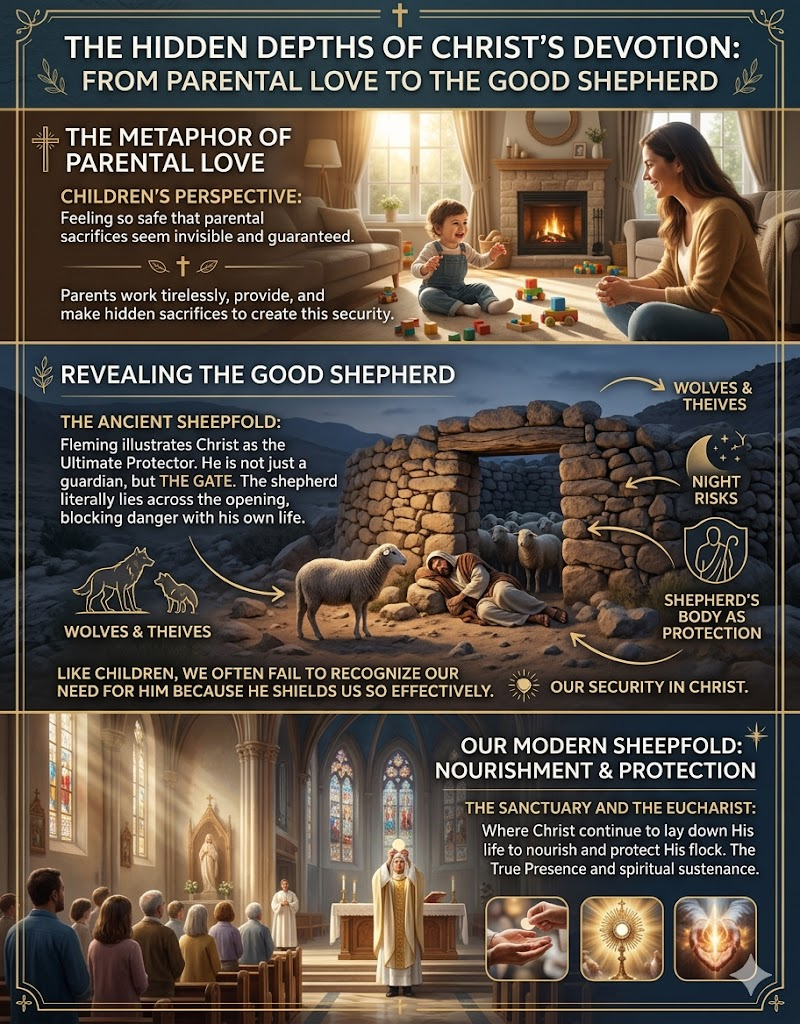
Fr. Austin Fleming utilizes the metaphor of parental love to reveal the hidden depth of Christ’s devotion. Just as children often take their parents’ sacrifices for granted because they feel so safe, we often fail to recognize our need for the Good Shepherd because He shields us so effectively. By explaining the ancient sheepfold where the shepherd physically lies across the opening as a human “gate,” Fleming illustrates Jesus as our ultimate protector. He concludes that the sanctuary and the Eucharist are our modern sheepfolds, where Christ continues to lay down His life to nourish and protect His flock.
EVALUATION
THEOLOGICAL ACCURACY & BIBLICAL FIDELITY
- Textual Accuracy: The homilist provides a historically brilliant and accurate explanation of a first-century Middle Eastern sheepfold. Explaining that the pen had no physical wooden gate, but rather an opening that the shepherd literally slept across, perfectly unlocks the meaning behind Jesus’ confusing statement in John 10: “I am the gate for the sheep.”
- Doctrinal Soundness: The theology of the Cross and the Eucharist are seamlessly integrated. The homily correctly connects the shepherd laying down his life at the gate to Christ laying down His life on the cross, and then brings that reality into the present moment at the “sacrifice of this table.”
- Exegesis: The exegesis is highly effective. By explaining the historical context of the sheepfold, the preacher draws the true, intended meaning out of the text rather than imposing a modern interpretation onto it.
THEMATIC ORGANIZATION & STRUCTURE
- Central Theme: The thesis is clear and beautifully maintained: just as good parents self-sacrificially protect their children (even when the children don’t realize they are in danger), the Good Shepherd protects us.
- Structural Clarity: The homily has a flawless, symmetrical architecture. It moves from human experience (taking parents for granted) $\rightarrow$ to the biblical text (the sheepfold) $\rightarrow$ to spiritual application (taking God for granted) $\rightarrow$ to the Eucharistic conclusion.
- Transitions: The transitions are highly organic. The pivot from taking parental protection for granted because “I never knew that harm might come to me” directly into taking the Lord’s protection for granted for the exact same reason is a profound and smooth connection.
DELIVERY & PACING
- Grammar and Polish: The transcript is formatted almost like blank verse poetry. The short, deliberate line breaks suggest a preacher who knows how to use pausing, pacing, and silence to great effect.
- Pacing and Flow: The pacing is gentle, intimate, and reflective. It avoids being overly academic and instead speaks directly to the heart with simple, elegant vocabulary.
PRACTICAL APPLICATION & RELEVANCE
- Congregational Context: The opening is universally relatable. Almost everyone has an experience with parental love (or the lack thereof), making the foundational metaphor instantly accessible to the congregation.
- Actionable Takeaway: While it does not give a specific “to-do” list, it offers a crucial spiritual warning. It asks the congregation to stop being naive about spiritual danger (“evil, like a thief, waits to rob me… of what innocence I have left”) and to actively recognize their daily need for the Shepherd’s protection.
- Empathy: The homilist demonstrates profound pastoral sensitivity. By explicitly acknowledging that “sadly, some children aren’t loved as well as others,” the preacher ensures that those with traumatic childhoods are not alienated by the parental metaphor. Furthermore, the preacher’s willingness to admit his own spiritual blindness makes the message highly empathetic.
ENGAGEMENT & PASTORAL CONNECTION
- Hook and Introduction: Opening with a vulnerable, personal confession about taking his parents for granted immediately disarms the listener. It establishes the preacher not as an aloof authority figure, but as a fellow human being navigating the same spiritual realizations.
- Pacing and Energy: The energy is warm, comforting, and fatherly. It feels less like a formal oration and more like a fireside chat that gently leads the listener to the altar.
- Storytelling: The preacher uses two excellent “stories.” The first is his own retrospective narrative about his parents. The second is the vivid, historical description of the shepherd sleeping across the opening of the stone wall. Both effectively capture the imagination.
HOMILY HELPER
GO DEEPER
PROMPTS TO KEEP YOU WRITING
Copy/paste one of these command prompts into the Catholic Assistant (bottom right corner). This tool can help you brainstorm and provide you with further ideas to develop your homily.
_
- The Parental Parallel uses the selfless, often invisible sacrifices of mothers and fathers to mirror the "no-strings-attached" love Jesus has for every person. Direct the AI to write on the theme of sacrificial love.
- The Safety Paradox explores how being well-protected can lead a soul to forget its desperate need for a savior and a protector. Direct the AI to focus on overcoming spiritual complacency.
- The Human Threshold describes the ancient shepherd lying across the sheepfold opening to illustrate how Jesus literally becomes the gate to keep the flock safe. Direct the AI to explain the mechanics of the sheepfold.
- The Thievery of Virtue warns that modern "wolves" seek to rob us of our remaining innocence, honesty, and purity under the cover of spiritual darkness. Direct the AI to focus on the dangers of moral erosion.
- The Sanctuary Fold compares the sacred space of the church to a protective enclosure where the Shepherd's voice is heard through the proclamation of the Word. Direct the AI to write on the church as a haven.
- The Eucharistic Pasture identifies the Altar as the place where the Shepherd continues to lay down his life to provide "life to the full" for the flock. Direct the AI to emphasize the nourishment of the Eucharist.
- The Faltering Void acknowledges that while human parental love is a beautiful sign, it can fail, whereas the love of Christ is perfectly steadfast and eternal. Direct the AI to focus on Christ’s unfailing devotion.
- The Invisible Shield reflects on how many harms we never encountered simply because a loving protector stood in the gap before we even sensed the danger. Direct the AI to write about the hidden protection of God.
- The Center of the Fold shifts the focus from the shepherd at the door to the Shepherd on the Cross at the center of the sanctuary. Direct the AI to focus on the Crucifixion as our safety.
- The Vulnerability of Ignorance argues that the less aware we are of our need for God’s love, the more susceptible we become to the world's harms. Direct the AI to emphasize the importance of spiritual awareness.
4th Sunday of Easter (A)
Monsignor Peter Hahn

Our Dependence on Jesus, the Shepherd

Msgr. Peter Hahn explores the humility required to accept the metaphor of being “sheep,” acknowledging our fundamental weakness and total dependence on God. On this World Day of Prayer for Vocations, he connects the voice of the Good Shepherd to the ministry of priests and religious who mirror Christ’s truth. Msgr. Hahn emphasizes the transformative power of the Eucharist, citing St. Augustine’s insight: unlike natural food, the Eucharist assimilates us into Christ. By receiving the Good Shepherd, we don’t just consume Him; we become part of His Mystical Body to experience life abundantly.

EVALUATION
THEOLOGICAL ACCURACY & BIBLICAL FIDELITY
- Textual Accuracy: The homilist does an excellent job of navigating multiple readings for the day, accurately referencing Psalm 23, Acts 2 (Peter’s call to repentance), 1 Peter 2 (straying sheep), and John 10 (Jesus as the gate/shepherd).
- Doctrinal Soundness: The theological depth is superb, particularly in the second half. The description of religious life correctly identifies the “evangelical counsels of poverty, chastity, and obedience.” Furthermore, the Eucharistic theology is flawlessly orthodox, utilizing standard Church terminology (“body and blood, soul and divinity”).
- Exegesis: The inclusion of St. Augustine’s observation that normal food is assimilated into our bodies, but in the Eucharist we are assimilated into Christ’s body, is a brilliant, classical piece of patristic exegesis that elevates the homily significantly.
THEMATIC ORGANIZATION & STRUCTURE
- Central Theme: The overarching theme is the Good Shepherd, but the homily struggles slightly with trying to cover too many sub-themes (the nature of sheep, Psalm 23, World Day of Prayer for Vocations, the first and second readings, a recent First Communion Mass, and Eucharistic theology).
- Structural Clarity: Because it touches on so many different topics, it reads a bit like a laundry list. It moves from one point to the next without a strong central spine holding it all together.
- Transitions: The transitions are somewhat abrupt. Moving from the second reading straight into “earlier today our parish celebrated our first holy communion” is a hard pivot, even though the preacher eventually connects it back to the Eucharist.
DELIVERY & PACING
- Grammar and Polish: The transcript reveals a very conversational, extemporaneous delivery. There are several run-on sentences and slight verbal stumbles (“partly might be because”, “bone and blur blood and tissue”).
- Pacing and Flow: The pacing is steady but lacks the polished, rhythmic rhetorical build-up seen in fully scripted sermons. It flows more like a warm, pastoral catechesis.
PRACTICAL APPLICATION & RELEVANCE
- Hook and Introduction: The opening is very functional (“As we said at the introduction for mass today…”). It sounds more like a bulletin announcement than an emotional or intellectual hook.
- Pacing and Energy: Once past the introduction, the energy is warm, fatherly, and joyful, particularly when the preacher talks about the children receiving their First Communion.
- Storytelling: The homily effectively uses the cultural slogan “You are what you eat” as a modern mini-parable to explain St. Augustine’s ancient Eucharistic theology, which is an excellent way to engage a modern listener’s mind.
ENGAGEMENT & PASTORAL CONNECTION
- Hook and Introduction: The opening is incredibly strong because of its vulnerability. A priest admitting that preaching can sometimes be difficult—and that listening can be difficult too—instantly disarms the congregation and builds a warm, human rapport.
- Pacing and Energy: The energy matches the content perfectly. It begins with the “indescribable ease and joy” of Easter, shifts into a solemn acknowledgment of life’s tragedies, and ends on a note of deep reverence and peace.
- Storytelling: Rather than relying on an external anecdote, the preacher effectively uses the Emmaus narrative as the primary story, successfully inviting the listener to see themselves as the unnamed disciples on the road.
HOMILY HELPER
GO DEEPER
PROMPTS TO KEEP YOU WRITING
Copy/paste one of these command prompts into the Catholic Assistant (bottom right corner). This tool can help you brainstorm and provide you with further ideas to develop your homily.
_
- The Flattery Gap addresses the discomfort of being compared to sheep, emphasizing that spiritual growth begins with the "grace to be honest" about our fundamental human weakness. Direct the AI to write on the necessity of spiritual dependence.
- The Vocational Mirror explores how the lives of priests and religious are meant to echo the Shepherd’s voice, offering the world a compelling witness of selfless service. Direct the AI to focus on the theology of religious vocations.
- The Eleven Words provides a deep meditation on the opening of Psalm 23, explaining how connection to the Shepherd leaves the soul with "nothing left to want." Direct the AI to reflect on the sufficiency of Christ.
- The Augustinian Paradox contrasts natural digestion with Eucharistic assimilation, where we do not change the Bread into ourselves, but are changed by it into Christ. Direct the AI to emphasize the transformative power of the Eucharist.
- The Second Grade Teacher uses the "joy and excitement" of First Communicants to challenge long-time parishioners to renew their awe for the presence of the Risen Lord. Direct the AI to write about recovering Eucharistic wonder.
- The Guardian's Path reflects on the First Reading's call to repentance and baptism as the essential steps to returning to the "guardian of our souls." Direct the AI to focus on the theme of returning to the fold.
- The Abundant Life connects the Shepherd’s role as the "Gate" to the ultimate purpose of his mission: providing a life that is "more abundant" than anything the world offers. Direct the AI to focus on the promise of John 10:10.
- The Evangelical Witness highlights how the counsels of poverty, chastity, and obedience provide a "compelling voice" that guides the Church toward the heart of the Good Shepherd. Direct the AI to write on the evangelical counsels.
- The Mystical House describes the Church not as a building, but as the "mystical body" and "dwelling place" where the flock finds eternal safety and kindness. Direct the AI to focus on the nature of the Church.
- The Pure Encounter emphasizes that the Eucharist is the "most important thing in our life" because it is a physical encounter with the Risen Shepherd. Direct the AI to write on the Eucharist as a glimpse of heaven.
4th Sunday of Easter (A)
Fr. Charles E. Irvin
The Voice of Our Good Shepherd

Fr. Irvin reconstructs the ancient Palestinian sheepfold—a stone circle where the shepherd’s own body served as the literal “gate”—to demonstrate Christ’s visceral protection. He shifts from historical imagery to the interior life, challenging the listener to discern the Shepherd’s voice amidst the “seductive whispers” of the world and the ego. Fr. Irvin emphasizes that God speaks through remorse, beauty, and quiet reflection. He concludes that the spiritual life is not just about understanding the Gospel, but about the vulnerable act of letting the Shepherd find us and carry us home.

EVALUATION
THEOLOGICAL ACCURACY & BIBLICAL FIDELITY
- Textual Accuracy: The historical contextualization of the 1st-century sheepfold (the circular stone pen, the shepherd sleeping as the literal “gate”) is highly accurate and does a great job of explaining the imagery. The explanation of sheep recognizing their specific shepherd’s voice is also historically spot-on.
- Doctrinal Soundness: The homily presents a very orthodox and beautifully articulated theology of grace and conscience. Defining conscience as “to know with” and framing remorse not as condemnation, but as God’s voice inspiring us to do better, is excellent pastoral theology.
- Exegesis: The preacher draws the meaning out of the text well, properly linking the historical reality of the shepherd to the spiritual reality of Christ’s protection and guidance.
THEMATIC ORGANIZATION & STRUCTURE
- Central Theme: The thesis is clear and practical: We are surrounded by competing voices, so how do we practically discern and listen to the voice of the Good Shepherd?
- Structural Clarity: The homily has a very logical flow. It starts with historical context, moves to the biblical text, identifies the modern problem (competing voices), provides a list of solutions (how God speaks), and concludes with an encouragement to let God find us.
- Transitions: The transitions are mostly smooth, with one major exception. The pivot in the middle—”Now let me repeat the teaching Jesus was giving… [proceeds to quote a massive paragraph of John 10]”—brings the structural momentum to a grinding halt. Since the Gospel is read immediately before the homily, re-reading such a massive block of text verbatim is usually unnecessary and disrupts the flow.
DELIVERY & PACING
- Grammar and Polish: The language is clear, accessible, and conversational. It avoids overly dense academic jargon in favor of direct, easily understandable questions.
- Pacing and Flow: Outside of the large block quote mentioned above, the pacing of the second half is excellent. The rapid-fire listing of the ways God speaks (good experiences, remorse, prayer, creation, good people) creates a compelling, rhythmic rhetorical build-up.
PRACTICAL APPLICATION & RELEVANCE
- Congregational Context: The preacher accurately diagnoses a very modern spiritual condition: the tendency to listen only to our “own inner voice” or the “seductive whispers of the world.”
- Actionable Takeaway: This is the homily’s greatest strength. It is incredibly practical. Many people ask, “How do I actually hear God’s voice?” and this preacher gives them a tangible, five-point checklist (gratitude for good things, listening to remorse, silent prayer, the beauty of nature, the example of good people).
- Empathy: The homilist demonstrates strong empathy by directly confronting the congregation’s potential fear of God (“Do you really believe that God is angry with you, that He wants to inflict punishing pain…”). Reassuring the listener that God simply wants to free them from guilt is highly comforting and pastoral.
ENGAGEMENT & PASTORAL CONNECTION
- Hook and Introduction: Explaining the ancient mechanics of shepherding is a classic and effective hook for this specific Gospel. It bridges the gap between the agrarian biblical world and the modern congregation.
- Pacing and Energy: The energy is highly instructional, warm, and fatherly. It challenges the listener without ever sounding scolding or harsh.
- Storytelling: The homily does not rely on a specific external story or anecdote. Instead, it invites the listeners to reflect on their own internal stories—their moments of awe in nature, their experiences of guilt, and the good people in their lives.
HOMILY HELPER
GO DEEPER
PROMPTS TO KEEP YOU WRITING
Copy/paste one of these command prompts into the Catholic Assistant (bottom right corner). This tool can help you brainstorm and provide you with further ideas to develop your homily.
_
- The Threshold Bedroll vividly describes the shepherd sleeping across the sheepfold opening to show how predatory animals must pass through him to reach the flock. Direct the AI to write on Christ as the physical protector.
- The Voice Recognition explains how ancient sheep were sorted not by visual marks or dyes, but solely by the unique frequency of their shepherd’s call. Direct the AI to focus on the intimacy of the Shepherd’s voice.
- The Seductive Whispers identifies the competing voices of the world, the ego, and fleeting desires that attempt to drown out the Holy Spirit’s guidance. Direct the AI to focus on the necessity of discernment.
- The Remorseful Call redefines "conscience" as "knowing with" God, suggesting that feelings of regret are actually the Shepherd’s voice calling us to higher things. Direct the AI to focus on the grace of penance.
- The Verdant Lead illustrates the shepherd walking ahead of the flock to ensure the path to the pasture is safe and the food is good. Direct the AI to emphasize Christ’s proactive leadership.
- The Awe of Creation explores how the beauty and majesty of nature serve as a non-verbal medium through which the Shepherd communicates His glory to us. Direct the AI to focus on God speaking through nature.
- The Disposition Filter argues that our basic belief about God—whether He is angry or loving—determines what we are actually able to hear from Him. Direct the AI to focus on our internal image of God.
- The Shouldered Stray presents the image of a God who does not wait for us to find our own way back but actively hunts for us. Direct the AI to focus on the Shepherd’s search for the lost.
- The Silent Imagination teaches that the Holy Spirit inspires our inner thoughts and dispositions when we provide the necessary space of quiet attentiveness. Direct the AI to focus on the power of silent prayer.
- The Act of Letting shifts the focus from our effort to find God to the humble surrender of allowing God to find and carry us. Direct the AI to emphasize the passivity of being found.
4th Sunday of Easter (A)
Fr. Joe Jagodensky, SDS
Jesus, “The Good Shepherd”

Fr. Joe Jagodensky, SDS, explores the unique intimacy of the title “Shepherd,” noting its gentleness compared to more authoritative titles. He moves from the “tender image” of Jesus carrying a lamb to the startling reality of a Shepherd who knows us “inside out”—a level of intimacy that can feel both comforting and exposing. Fr. Joe identifies the family home and parenting as the primary laboratory for this shepherding love. He concludes with the Eucharistic mystery where the Shepherd becomes the Lamb, uniting Creator and created to transform how we treat one another within the community.

EVALUATION
THEOLOGICAL ACCURACY & BIBLICAL FIDELITY
- Textual Accuracy: The homily accurately references the Good Shepherd discourse (John 10) regarding the Shepherd knowing His sheep intimately. It also correctly references the titles of Jesus and the liturgical exclamation, “Behold the Lamb of God.”
- Doctrinal Soundness: The theology is fundamentally orthodox (mentioning the Incarnation, the Eucharist, and the Holy Spirit), but it is presented very loosely. The preacher’s admission that he doesn’t want God knowing him completely (“If I’m placing a border around my heavenly shepherd, that’s just me”) is a relatable human sentiment, but theologically, it flirts with resisting the omniscience and intimacy of God.
- Exegesis: The homily is more of a topical reflection on the idea of a shepherd rather than a strict exegesis of a specific biblical text. It touches on several profound concepts (the Shepherd becoming the Lamb) but does not dive deeply into the scriptural mechanics of them.
THEMATIC ORGANIZATION & STRUCTURE
- Central Theme: The theme wanders a bit. It moves from the gentleness of the Shepherd title, to the fear of being known completely, to the vocation of human parenting, and finally to the Eucharistic reality of the Shepherd becoming the Lamb.
- Structural Clarity: Because it covers so many different angles in a very short amount of time, it reads more like a stream-of-consciousness reflection than a carefully architected sermon.
- Transitions: The transitions are quite abrupt. For example, the jump from human parenting directly into “Did you know that the shepherd can become a sheep, a lamb?” is jarring and lacks a smooth theological or narrative bridge.
DELIVERY & PACING
- Grammar and Polish: The tone is highly conversational, colloquial, and folksy. There are a few syntactical clunks in the transcript (e.g., “placed back on the shelve,” “what been divinely united”), indicating a very relaxed, extemporaneous delivery style.
- Pacing and Flow: The sentences are short and punchy. It flows like a casual fireside chat rather than a formal oration. While it lacks rhetorical elevation, its brevity keeps it from dragging.
PRACTICAL APPLICATION & RELEVANCE
- Congregational Context: Connecting the ancient agrarian metaphor of shepherding to the modern reality of parenting (“All of human emotions can be exercised in the family home… Now that’s shepherding the flock”) is a highly relevant, brilliant pastoral move. Almost everyone can relate to the chaotic, loving reality of family life.
- Actionable Takeaway: The application is simple and practical: we are called to shepherd each other in trying times, and we must do so with gentleness, realizing that “hitting a sheep or using caustic words” does not change behavior.
- Empathy: The preacher is highly vulnerable. Admitting that the idea of God knowing him “inside out” is actually a bit intimidating is a deeply honest, empathetic acknowledgment of the human fear of total vulnerability.
ENGAGEMENT & PASTORAL CONNECTION
- Hook and Introduction: The opening is a classic, self-deprecating icebreaker: “We all know about being a shepherd and tending sheep, so I should just stop right here.” It instantly disarms the congregation and establishes a warm, friendly rapport.
- Pacing and Energy: The energy is lighthearted, approachable, and comforting. It doesn’t attempt to carry a heavy emotional or intellectual load, making it very easy to listen to.
- Storytelling: Rather than telling a single long story, the preacher uses quick, relatable modern references (couples married 60 years, Disney movies on DVD) to keep the congregation engaged. The closing rhetorical joke (“what’s the plural of sheep?”) is a charming, folksy way to end the reflection.
HOMILY HELPER
GO DEEPER
PROMPTS TO KEEP YOU WRITING
Copy/paste one of these command prompts into the Catholic Assistant (bottom right corner). This tool can help you brainstorm and provide you with further ideas to develop your homily.
_
- The Tender Title contrasts the authoritative sound of "Messiah" with the gentle, enduring appeal of the "Shepherd" that touches even the hearts of skeptics. Direct the AI to write on the gentleness of Christ's titles.
- The Intimate Resume explores the daunting reality that the Good Shepherd knows each member of the flock "inside out," beyond what even the closest spouses know. Direct the AI to focus on the mystery of being fully known by God.
- The Domestic Shepherd identifies the family home and the "all-in-one-hour" emotions of parenting as the most profound human imitation of Jesus’ care for His flock. Direct the AI to focus on the vocation of parenting.
- The Disney Distinction warns against treating the Incarnation as a "cute" fictional story rather than the radical, physical union between the Creator and the created. Direct the AI to emphasize the reality of the Incarnation.
- The Shepherd-Lamb Paradox reflects on the liturgical moment when the One who guards the sheep becomes the "Lamb of God" sacrificed for their life. Direct the AI to focus on the Eucharistic reversal.
- The Caustic Word argues that harsh language and "hitting" the sheep only serve to break the divine unity that the Holy Spirit has bundled together. Direct the AI to write on the importance of pastoral kindness.
- The Vertical and Horizontal describes how the Shepherd mediates through our prayers to God while simultaneously working through our daily interactions with family and friends. Direct the AI to focus on the dual nature of grace.
- The Bordered Heart admits the human tendency to put "borders" around God’s love because His total knowledge of our struggles can feel overwhelming. Direct the AI to write on surrendering to God’s complete gaze.
- The Neck-Carried Lamb utilizes the iconic image of Jesus carrying a sheep to symbolize the grace and support provided to us by the Holy Spirit. Direct the AI to focus on the theme of being carried by God.
- The Plurality of One uses the fact that "sheep" is both singular and plural to illustrate the communal identity of the Body of Christ. Direct the AI to focus on the unity of the Church.
4th Sunday of Easter (A)
Deacon Greg Kandra

Are We Listening?

Deacon Greg Kandra uses the powerful narrative of Fr. Dayan Machado—who moved from an atheist childhood in Cuba to a Florida cathedral—to illustrate that the Shepherd’s voice often reaches us in the most unlikely places. Kandra argues that the “domestic church” of the home is the primary seedbed for vocations, whether through a television screen or a casual dining room conversation. On this Vocation Sunday, he challenges the faithful not only to listen for God’s call in their own lives but to dare to ask others the pivotal question: “Have you ever thought about religious life?”

EVALUATION
THEOLOGICAL ACCURACY & BIBLICAL FIDELITY
- Textual Accuracy: The homily accurately references the core message of Good Shepherd Sunday (John 10): recognizing and listening to the voice of the Shepherd.
- Doctrinal Soundness: The theology of vocation and the “domestic church” (the family) is superb. The preacher correctly identifies parents as the “first teachers” of the faith, which is a direct reflection of the Catechism and the Rite of Baptism. The anecdote about Pope St. Pius X beautifully elevates the Sacrament of Matrimony as the foundational bedrock from which Holy Orders springs.
- Exegesis: Rather than a strict, verse-by-verse exegesis of the ancient sheepfold, the homily uses the Gospel text as a thematic springboard. It focuses entirely on the application of the text (hearing God’s voice today) rather than the historical mechanics of the text.
THEMATIC ORGANIZATION & STRUCTURE
- Central Theme: The thesis is clear and emotionally resonant: Vocations are born from hearing the voice of the Shepherd, and that voice is usually first heard and nurtured within the family home.
- Structural Clarity: The homily boasts a flawless narrative architecture. It opens with an intriguing hook, tells a compelling biographical story, pivots to the liturgical occasion (Vocation Sunday), challenges the congregation to act, reinforces the theme with a short historical anecdote (Pius X), and concludes with a callback to the opening premise.
- Transitions: The transitions are seamless. Moving from Dayan’s parents writing him a letter of blessing to the general role of parents in fostering vocations is a natural, highly effective pivot.
DELIVERY & PACING
- Grammar and Polish: The prose is exceptionally polished, rhythmic, and poetic. The use of repetition (“From you, they will learn… From you, they will learn…”) is a classic, highly effective rhetorical device.
- Pacing and Flow: The script is clearly written for the ear, not just the eye. The short paragraphs and deliberate line breaks indicate a preacher who masters the use of pausing, pacing, and dramatic timing.
PRACTICAL APPLICATION & RELEVANCE
- Congregational Context: This is highly relevant for Vocation Sunday. Furthermore, the preacher’s vulnerability in sharing a brief personal detail (“He called me when I was in my 40’s”) shatters the misconception that vocations are only for teenagers, making the message relevant to older members of the congregation as well.
- Actionable Takeaway: The application is incredibly specific and practical. Rather than asking the congregation to simply “pray for vocations” in the abstract, the preacher challenges them to ask a specific question out loud: “Dare to ask the question: have you ever thought about religious life?”
- Empathy: The homily exhibits a deep understanding of family dynamics. It acknowledges that vocations are born in the messy, ordinary realities of life—”in the kitchen,” “in the car on the way to soccer practice”—rather than just in the pews.
ENGAGEMENT & PASTORAL CONNECTION
- Hook and Introduction: The hook is cinematic and instantly engaging: “Face down on the floor of a cathedral in Florida…” It creates immediate visual intrigue and suspense, forcing the listener to pay attention to find out how he got there.
- Pacing and Energy: The energy is captivating. It moves from an inspiring biographical narrative into a direct, challenging, and warmly pastoral exhortation.
- Storytelling: This is a masterclass in homiletic storytelling. The story of Dayan Machado—watching Mass through an open window in communist Cuba, his father’s surprising support, the secret baptism—is emotional, vivid, and perfectly tied to the theological theme. The secondary story of Pius X kissing his mother’s wedding band provides a brilliant, poignant emotional reinforcement.
HOMILY HELPER
GO DEEPER
PROMPTS TO KEEP YOU WRITING
Copy/paste one of these command prompts into the Catholic Assistant (bottom right corner). This tool can help you brainstorm and provide you with further ideas to develop your homily.
_
- The Atheist's Spark explores the unexpected origins of faith in the life of Fr. Dayan Machado, who first heard the Shepherd’s voice through a television screen in communist Cuba. Direct the AI to write on the theme of unlikely vocations.
- The Open Window illustrates the courage required to "watch Mass through a window" and eventually step into the fold of the Church despite cultural or familial restrictions. Direct the AI to focus on the bravery of conversion.
- The Kitchen Vocation argues that the most profound spiritual calls often begin in the ordinary setting of the home, around dining tables or during drives to soccer practice. Direct the AI to focus on the domestic church.
- The Paternal Support reflects on the father who, despite being raised in an atheist state, told his son "do not be afraid" when he discovered his secret faith. Direct the AI to write on parental encouragement.
- The Prostrating Leap describes the physical and spiritual surrender of lying face down during ordination as the ultimate response to hearing the Shepherd’s voice. Direct the AI to focus on total surrender to God.
- The Intergenerational Ring uses the story of Pope St. Pius X and his mother to show that the vocation of the child is rooted in the faithfulness of the parent. Direct the AI to write on the hidden influence of parents.
- The Late Calendar highlights Deacon Kandra’s own call in his 40s to remind the faithful that God’s timing for a vocation does not always follow human expectations. Direct the AI to focus on adult vocations.
- The Casual Question challenges the congregation to become the "voice" of the Shepherd by simply asking others if they have ever considered the priesthood or religious life. Direct the AI to write on the power of inviting others.
- The Electric Charge describes the visceral, life-changing moment of recognizing the truth of the Gospel for the first time, regardless of one's background. Direct the AI to focus on the moment of spiritual awakening.
- The Listening Response connects the Gospel of Good Shepherd Sunday to the practical necessity of creating a space where the "whisper" of God can actually be heard. Direct the AI to focus on active listening in prayer.
4th Sunday of Easter (A)
Fr. Langeh, CMF

Recognising the Shepherd’s Voice
Fr. Jude Langeh emphasizes the distinction between Jesus as “The” Good Shepherd—the singular source of salvation—rather than just one of many options. Drawing on John 10, he presents Christ as both the Shepherd and the Sheepfold Gate, whose ultimate sacrifice provides “life to the full.” Fr. Langeh incorporates Pope Francis’s teaching on the “art of listening” to argue that vocations fail when we merely hear noise rather than opening our hearts to a genuine spiritual encounter. He concludes with a sobering call to pray for “bad shepherds” and to support the rigorous nurturing of authentic laborers for the harvest.
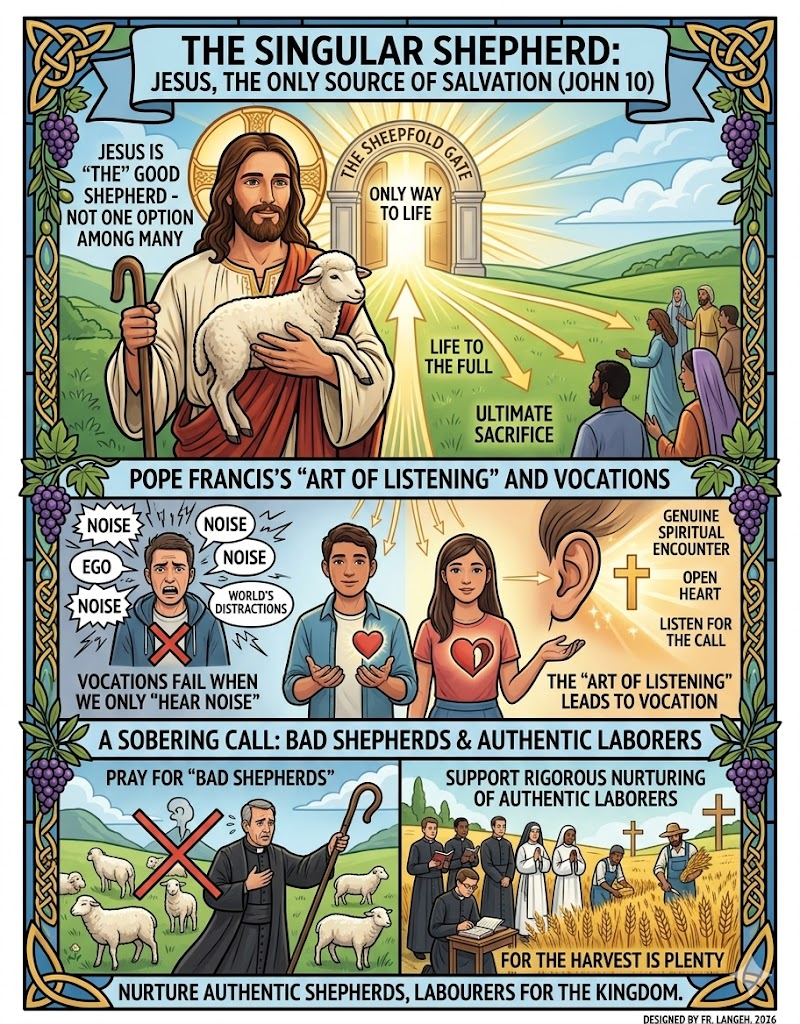
EVALUATION
THEOLOGICAL ACCURACY & BIBLICAL FIDELITY
- Textual Accuracy: The text accurately cites John 10, Matthew 9, and Luke 10, correctly distinguishing between the thief who comes to “steal and kill and destroy” and the Good Shepherd who brings abundant life.
- Doctrinal Soundness: The theology of vocation is orthodox and well-stated. The inclusion of Pope Francis’s Evangelii Gaudium adds excellent Magisterial weight to the concept of “listening.”
- Exegesis: The author makes a solid, foundational exegetical point right away: Jesus is not just a good shepherd, but the Good Shepherd, and also the Gate. This dual-image is handled accurately.
THEMATIC ORGANIZATION & STRUCTURE
- Central Theme: The thesis is clear and consistent: We must actively practice listening to recognize the Good Shepherd’s voice among the noise, which is the foundation of all vocations.
- Structural Clarity: The structure is logical. It introduces the liturgical occasion (Vocations Sunday), explains the biblical text (John 10), diagnoses the modern problem (too much noise), offers a solution (the Pope Francis quote on the “art of listening”), and concludes with a call to pray for vocations and current shepherds.
- Transitions: The transitions are functional, though moving from the long block quote directly into “Vocation is all about recognising…” feels a bit like a textbook rather than a flowing narrative.
DELIVERY & PACING
- Grammar and Polish: As a written digital post, the grammar is perfectly fine. However, as a spoken homily, the hashtags render it clunky. Furthermore, reading a 75-word block quote from a papal encyclical aloud is notoriously difficult; it requires a highly skilled orator to keep the congregation’s attention from drifting during dense, written theological prose.
- Pacing and Flow: The pacing reads like an informational article or a parish bulletin column. It lacks the natural rhetorical rhythms, pauses, and cadences of spoken preaching.
PRACTICAL APPLICATION & RELEVANCE
- Congregational Context: The diagnosis of the modern world—”We hear thousands of voices, lots of talk, yelling and loud music”—is highly relatable and relevant to a congregation constantly distracted by smartphones and media.
- Actionable Takeaway: The primary takeaway is an internal one: practicing the “art of listening” with an open heart. The secondary takeaway is a specific, actionable prayer: to pray not only for new vocations but specifically for “bad shepherds” who have failed to follow Christ’s example.
- Empathy: Acknowledging that there are “bad shepherds” who cannot lead others is a surprisingly blunt but highly empathetic move. It validates the frustration or hurt that many modern Catholics feel regarding Church leadership failures.
ENGAGEMENT & PASTORAL CONNECTION
- Hook and Introduction: The opening is purely informational: “The Church celebrates the fourth Sunday of Easter as The Good Shepherd Sunday.” It reads like an encyclopedia entry and does nothing to grab the listener’s emotional or intellectual curiosity.
- Pacing and Energy: The energy is academic and instructive. It informs the mind but does not make a strong appeal to the heart until the very last paragraph.
- Storytelling: The text completely lacks narrative storytelling, metaphors (outside of the biblical sheep), or personal anecdotes. It relies entirely on scriptural summary and magisterial quotes to carry the message.
HOMILY HELPER
GO DEEPER
PROMPTS TO KEEP YOU WRITING
Copy/paste one of these command prompts into the Catholic Assistant (bottom right corner). This tool can help you brainstorm and provide you with further ideas to develop your homily.
_
- The Definite Shepherd explores the theological significance of Jesus being "The" Good Shepherd rather than just one among many, establishing him as the singular gate to salvation. Direct the AI to focus on Christ's unique authority.
- The Harvest Mandate emphasizes the public fulfillment of the Lord’s instruction to pray for laborers, framing Vocation Sunday as a direct response to a divine command. Direct the AI to write on the necessity of vocational prayer.
- The Thief's Contrast vividly compares the Shepherd who gives life with the thief who comes only to "steal, kill, and destroy" in the modern world. Direct the AI to focus on the choice between life and destruction.
- The Art of Listening utilizes Pope Francis’s teaching to distinguish between the noise of thousands of voices and the "openness of heart" required for a genuine spiritual encounter. Direct the AI to focus on deep spiritual listening.
- The Missionary Pulse reflects on the call "ad gentes," exploring how recognizing the Shepherd’s voice necessarily leads the believer toward a life of outward mission. Direct the AI to focus on the missionary vocation.
- The Premature Drift analyzes why many vocations end early, pointing to the failure to "take pains" to recognize and remain tuned to the Shepherd’s cadence. Direct the AI to write on the challenges of spiritual perseverance.
- The Sheepfold Gate examines the paradox of Jesus being both the guardian who leads the sheep and the door through which they must pass for safety. Direct the AI to focus on the dual imagery in John 10.
- The Bad Shepherd addresses the sobering reality of those who fail to follow Christ’s example, calling the faithful to pray for the purification of the Church’s leadership. Direct the AI to focus on the need for authentic shepherds.
- The Rigorous Nurture describes the Church’s role in training the "called" so they may become true shepherds who mirror the self-sacrifice of Christ. Direct the AI to write on the formation of priests and religious.
- The Bystander’s Exit challenges the congregation to move beyond being simple observers of the faith to becoming active responders to the love God has sown in their lives. Direct the AI to focus on the transition to active discipleship.
4th Sunday of Easter (A)
Deacon Peter McCulloch
2026 HOMILIES | ARCHIVE: 2023 | 2020
Sheepdogs and Angels
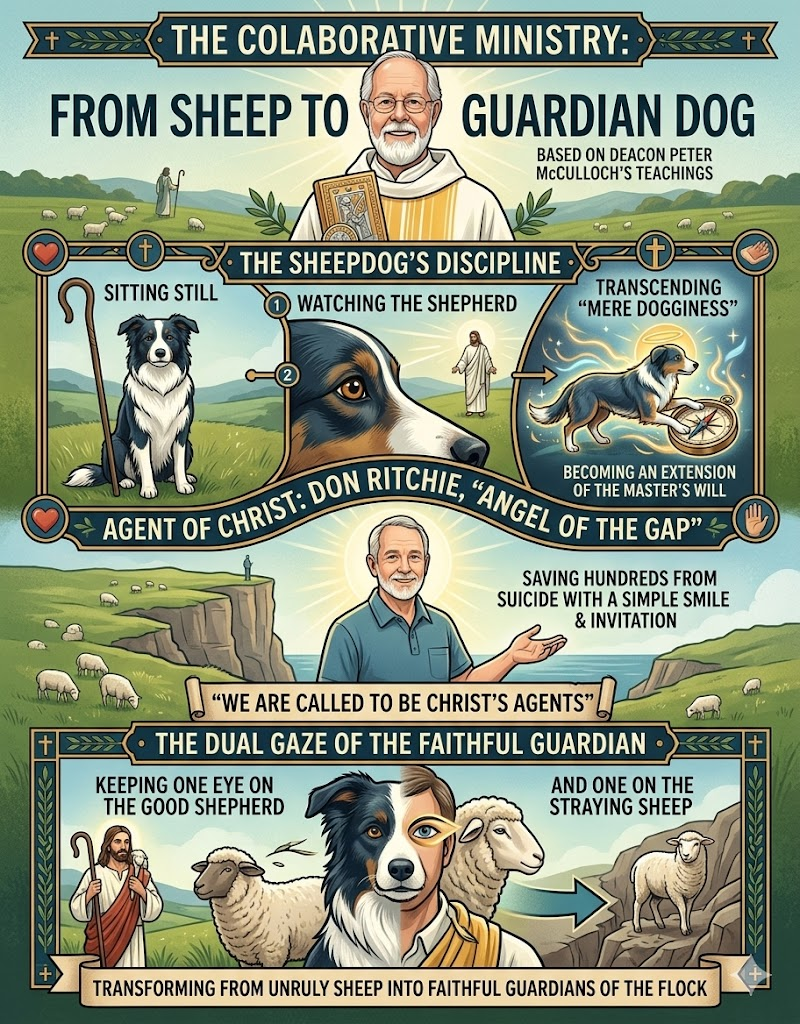
Deacon Peter McCulloch uses the imagery of sheepdog trials to explore the collaborative nature of ministry. He highlights the “sheepdog’s” discipline: sitting still, watching the shepherd, and transcending “mere dogginess” to become an extension of the master’s will. Through the story of Don Ritchie, the “Angel of the Gap,” who saved hundreds from suicide with a simple smile and an invitation, McCulloch illustrates that we are called to be Christ’s agents. By keeping one eye on the Good Shepherd and one on the straying sheep, we transform from unruly sheep into faithful guardians of the flock.
EVALUATION
THEOLOGICAL ACCURACY & BIBLICAL FIDELITY
- Textual Accuracy: The homilist handles the biblical context very well, accurately referencing Ezekiel 34 regarding the failure of the Old Testament kings to act as proper shepherds.
- Doctrinal Soundness: The theology of discipleship and apostolic succession is beautifully explained through the metaphor of the sheepdog. The idea that Jesus’ disciples became His “sheepdogs” and subsequently His “shepherds” aligns perfectly with the Great Commission and the Catholic understanding of mission.
- Exegesis: The linguistic note that Caleb translates to “dog” (Hebrew: kelev) and represents faithfulness is a fantastic, historically accurate exegetical detail that adds wonderful color to the Old Testament references.
THEMATIC ORGANIZATION & STRUCTURE
- Central Theme: The thesis is highly focused and creative: Christians are called to be the Good Shepherd’s “sheepdogs”—obediently waiting for His signal and gently rescuing His lost sheep.
- Structural Clarity: The homily has a flawless narrative architecture. It opens with a secular hook (sheepdog trials), moves into biblical history (Moses, Paul, Caleb), deepens the metaphor with a spiritual giant (Evelyn Underhill), applies it to a modern hero (Don Ritchie), and concludes with a direct challenge to the congregation.
- Transitions: The transitions are seamless and brilliant. Moving from Underhill’s observation of sheepdogs to Jesus’ disciples, and then leaping to the story of Don Ritchie, provides a masterclass in connecting ancient metaphor to modern reality.
DELIVERY & PACING
- Grammar and Polish: The prose is exceptionally well-crafted. It features a wonderful variety of sentence lengths, which provides excellent pacing for oral delivery.
- Pacing and Flow: The flow is smooth and conversational. The preacher asks engaging rhetorical questions (“Have you ever seen a sheepdog trial?”, “Why do shepherds need sheepdogs?”) that naturally break up the text and keep the listener actively involved.
PRACTICAL APPLICATION & RELEVANCE
- Congregational Context: This is highly relevant to the modern world. By redefining the Christian vocation as being a “sheepdog”—someone whose only interest is obeying the Master and helping the flock—it removes the pressure of having to be the “Savior” and simply asks the congregation to be faithful helpers.
- Actionable Takeaway: The spiritual takeaway provided by the Evelyn Underhill section is profound: to spend time “just sitting still, watching the shepherd,” waiting for a sign before acting. It is a beautiful, practical lesson in contemplative prayer.
- Empathy: Bringing in the story of Don Ritchie and the tragedy of suicide at The Gap demonstrates incredible pastoral empathy. It confronts a dark, painful reality of the modern world but frames it entirely within the context of radical gentleness, hope, and life-saving intervention.
ENGAGEMENT & PASTORAL CONNECTION
- Hook and Introduction: Opening with the 1860s New Zealand sheepdog trials is a highly unique and fascinating hook. It immediately captures the imagination in a way that standard biblical summaries usually do not.
- Pacing and Energy: The energy starts out educational and lighthearted (wagging tails, transcending “mere dogginess”) but masterfully shifts into a deeply moving, emotionally heavyweight climax with the story of the “Angel of the Gap.”
- Storytelling: The storytelling is top-tier. The inclusion of Evelyn Underhill provides intellectual and spiritual depth, while the story of Don Ritchie—coaxing terrified people away from a literal cliff edge with a smile and a cup of tea—is an absolute emotional powerhouse that will command the absolute silence and attention of any room.
HOMILY HELPER
GO DEEPER
PROMPTS TO KEEP YOU WRITING
Copy/paste one of these command prompts into the Catholic Assistant (bottom right corner). This tool can help you brainstorm and provide you with further ideas to develop your homily.
_
- The Trial Maze describes the extraordinary coordination between a shepherd and his dog to navigate a flock through obstacles, mirroring our need to work with Christ. Direct the AI to write on the theme of divine-human cooperation.
- The Sitting Still highlights the sheepdog’s discipline of watching the shepherd’s every move and waiting for a signal before moving an inch. Direct the AI to focus on the importance of contemplative waiting.
- The Mere Dogginess explores Evelyn Underhill’s observation that a faithful agent transcends their natural instincts to become a perfect extension of the master’s will. Direct the AI to write on the transformation of the self through grace.
- The Angel of the Gap tells the story of Don Ritchie, who saved hundreds of lives simply by standing at the edge and offering a smile and a kind word. Direct the AI to focus on the power of small, persistent acts of mercy.
- The Wagging Tail reflects on the source of joy found in working for a plan that is not our own and which we may not fully understand. Direct the AI to write on finding happiness in obedience.
- The Old Testament Failure contrasts the ancient rulers who "killed and stole" from the flock with God’s promise to personally shepherd His people. Direct the AI to focus on the reliability of the Good Shepherd.
- The Faithful Caleb explores the Hebrew meaning of the name "Caleb" to illustrate how being a "sheepdog" for God is rooted in simple, unwavering faithfulness. Direct the AI to focus on the virtue of fidelity.
- The Gentle Approach examines how Don Ritchie shifted from physical restraint to a gentle invitation, showing that the Shepherd’s voice is most effective when it is kind. Direct the AI to write on the effectiveness of gentleness in ministry.
- The Two-Eyed Vigil challenges the believer to keep "one eye on the Shepherd and one eye on the sheep" to ensure we are always balanced between prayer and action. Direct the AI to focus on the balance of the active and contemplative life.
- The Successful Failure acknowledges that even "angels" like Don Ritchie weren't always successful, yet their fulfillment came from the lives they did touch. Direct the AI to write on persevering in mission despite setbacks.
4th Sunday of Easter (A)
Msgr. Charles Pope
Are You Smarter than a Sheep?

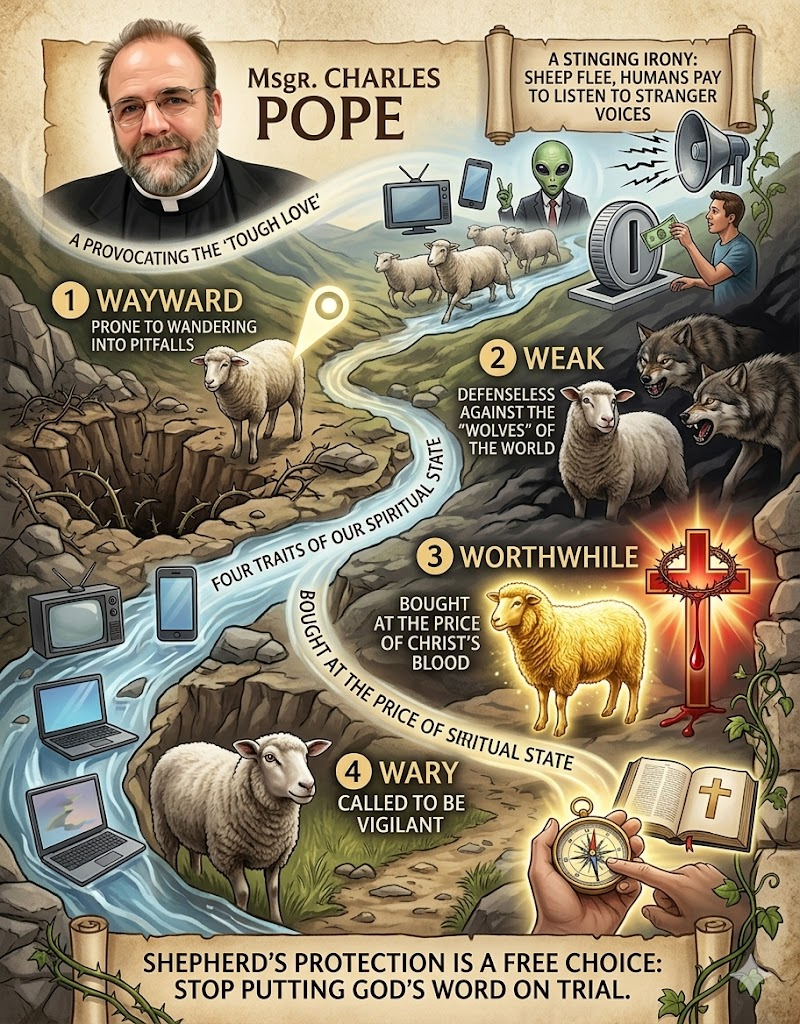
Msgr. Charles Pope uses a provocative, “tough love” approach to the sheep metaphor, categorizing our spiritual state into four traits: we are Wayward (prone to wandering into pitfalls) and Weak (defenseless against the “wolves” of the world), yet we are Worthwhile (bought at the price of Christ’s blood) and called to be Wary. He highlights a stinging irony: while actual sheep instinctively flee a stranger’s voice, humans often pay for the privilege of listening to “stranger” voices through media. He concludes that the Shepherd’s protection is a free choice that requires us to stop putting God’s Word on trial.
EVALUATION
THEOLOGICAL ACCURACY & BIBLICAL FIDELITY
- Textual Accuracy: The homilist handles the scriptural texts exceptionally well, grounding the message in John 10 but expertly weaving in supporting scriptures like Isaiah 53:6 (straying sheep), 1 Peter 1 (purchased with precious blood), and 2 Timothy 4 (itching ears).
- Doctrinal Soundness: The theology of grace and human nature is highly orthodox. The preacher rightly emphasizes that without the grace of the Good Shepherd and the protective walls of the Church and Commandments, human willpower alone is completely insufficient against the “world, the flesh, and the devil.”
- Exegesis: The preacher draws out the biblical reality of sheep (their waywardness, their value, their hearing) and applies it directly to the human condition in a way that respects the original intent of the Johannine text.
THEMATIC ORGANIZATION & STRUCTURE
- Central Theme: The thesis is clear and brilliantly maintained: We share the negative traits of sheep (wayward, weak) but must strive to emulate their positive traits (worthwhile, wary).
- Structural Clarity: This is the homily’s absolute greatest strength. The use of an alliterative outline (Wayward, Weak, Worthwhile, Wary) is a classic, highly effective homiletic tool. It guarantees that the congregation will actually be able to remember the points when they leave the church.
- Transitions: The transitions are flawless. The pivot in the middle (“YET…”) perfectly shifts the tone from a diagnostic critique of human weakness into an uplifting reminder of human value and spiritual vigilance.
DELIVERY & PACING
- Grammar and Polish: The prose is punchy, colloquial, and highly energetic. Phrases like “we would be toast!” or “How dumb is that!” indicate a preacher with a dynamic, bold, and highly conversational delivery style.
- Pacing and Flow: The pacing is excellent. The short, crisp paragraphs keep the momentum moving rapidly forward, preventing the listener’s mind from wandering.
PRACTICAL APPLICATION & RELEVANCE
- Congregational Context: The homilist directly addresses the modern crisis of competing voices and media consumption. Calling out the time and money spent on television, radio, and the internet grounds the ancient text in the 21st-century living room.
- Actionable Takeaway: The application is challenging and direct: stop feasting on the enemy’s voice through secular media, and start actively fleeing from voices contrary to Christ.
- Empathy: This homily utilizes “tough love” rather than gentle commiseration. While it lacks the soft, comforting bedside manner of some other preachers, its bluntness (“Choosing any other place is just dumb”) is driven by a clear pastoral desire to protect the flock from actual spiritual harm.
ENGAGEMENT & PASTORAL CONNECTION
- Hook and Introduction: The hook is fantastic. “Get a little indignant with me here!” immediately grabs the congregation’s attention by playfully challenging their ego. Comparing humans to majestic eagles versus lowly sheep is a great rhetorical setup.
- Pacing and Energy: The energy is high, prophetic, and commanding. It demands attention and challenges the listener to self-reflect.
- Storytelling: While there isn’t a long-form narrative story, the preacher paints vivid, miniature word pictures (mules kicking, skunks spraying, sheep falling into crevasses) that keep the brain visually engaged.
HOMILY HELPER
GO DEEPER
PROMPTS TO KEEP YOU WRITING
Copy/paste one of these command prompts into the Catholic Assistant (bottom right corner). This tool can help you brainstorm and provide you with further ideas to develop your homily.
_
- The Wayward Wanderer explores the tendency of sheep to get lost without realizing it, comparing this to the "foolish errors" and pitfalls Catholics face when they stray from Mass. Direct the AI to focus on the danger of spiritual isolation.
- The Weakness Illusion deconstructs our reliance on "star power" and political strength, arguing that without Christ’s grace, we are completely defenseless against the world, the flesh, and the devil. Direct the AI to emphasize our total dependence on God.
- The Worthy Price reflects on the objective value of the human soul, evidenced by Christ paying for our redemption not with gold, but with His precious blood. Direct the AI to focus on the theology of the Atonement.
- The Instinctual Fleeing contrasts the natural wariness of sheep toward strangers with the human tendency to draw closer to voices that contradict the Gospel. Direct the AI to focus on the necessity of spiritual wariness.
- The Television Wolf challenges the modern household to evaluate how much time is spent listening to "the enemy’s voice" through media versus listening to the Word of God. Direct the AI to write on the influence of secular media.
- The Trial Reversal argues that we often put God’s Word on trial to suit our preferences instead of putting the world on trial for its lies and errors. Direct the AI to focus on the authority of Scripture.
- The Commandment Fence portrays God’s laws not as restrictions, but as protective walls that ensure the flock has "green and safe pastures." Direct the AI to focus on the protective nature of moral law.
- The Indignant Sheep addresses the blow to human pride when being compared to a lowly animal, showing how humility is the first step toward salvation. Direct the AI to focus on the virtue of humility.
- The Double Life warns that the Lord’s protection is only effective for those who do not "open the door of their heart to Satan" through compromise. Direct the AI to write on the importance of spiritual integrity.
- The Itching Ear warns against seeking counselors who simply tell us what we want to hear rather than the difficult truths necessary for our protection. Direct the AI to focus on the danger of seeking false validation.
4th Sunday of Easter (A)
Father Kevin Rettig
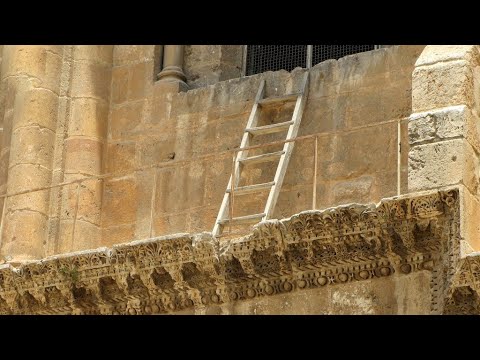
2026 HOMILIES | ARCHIVE: 2023 | 2020
The Ladder in Church

Fr. Kevin Rettig uses the “Immovable Ladder” of the Church of the Holy Sepulchre—leaning against a window for 300 years due to denominational infighting—as a searing indictment of religious pride and territorialism. He contrasts the “holy brawls” of competing Christian factions with the universal heart of the Good Shepherd. Fr. Rettig argues that God’s flock is not an exclusive club defined by boundaries, but a “beautiful family” encompassing all humanity. He calls for the symbolic burial of the “hateful old ladder” to embrace a grace that is greater than our petty jealousies.
EVALUATION
THEOLOGICAL ACCURACY & BIBLICAL FIDELITY
- Textual Accuracy: The historical background regarding the Church of the Holy Sepulchre—the six squabbling denominations, the Muslim families holding the keys, the “Immovable Ladder,” and the Status Quo—is factually accurate and brilliantly utilized.
- Doctrinal Soundness: This is where the homily struggles from an orthodox perspective. The preacher embraces strict Universalism (the belief that all humans are automatically saved and part of the flock regardless of faith). While the Catholic Church teaches profound respect for other religions (e.g., Nostra Aetate), blurring the lines to imply that all religions are equal paths and that the specific “flock” of Christ includes everyone indiscriminately pushes against standard Magisterial teaching.
- Exegesis: The exegesis of John 10 is highly problematic. The preacher takes Jesus’ specific words to His disciples (“My sheep hear my voice… I give them eternal life”) and applies them as a blanket statement to “Muslim, Hindu… every sort of human being.” This imposes a modern, universalist philosophy onto the biblical text rather than drawing the actual meaning out of it.
THEMATIC ORGANIZATION & STRUCTURE
- Central Theme: The thesis is clear, powerful, and unwavering: religious tribalism and sectarian arrogance contradict the gentle, unifying message of the Good Shepherd.
- Structural Clarity: The architecture is masterful. The homilist uses the “Immovable Ladder” as the structural spine of the message. It begins as a literal, historical object, transitions into a metaphor for human stubbornness, and concludes as a spiritual barrier that the congregation is challenged to tear down.
- Transitions: The transitions are flawless. Moving from the absurdity of monks brawling with candlesticks to the broader, tragic reality of religious wars sets up the contrast with Christ the Good Shepherd perfectly.
DELIVERY & PACING
- Grammar and Polish: The prose is exceptionally well-crafted, cinematic, and dramatic. The preacher uses excellent rhetorical devices, such as the rhythmic repetition near the end (“Any people. All people. Every person…”).
- Pacing and Flow: The pacing is fantastic. The homilist knows exactly how to balance humor and absurdity (“You can’t make this stuff up”) with profound, prophetic seriousness (“the bloodiest wars have arisen when people of religion…”).
PRACTICAL APPLICATION & RELEVANCE
- Congregational Context: The critique of religious hypocrisy, tribalism, and the “self-righteous religious fanatic” is highly relevant in a polarized modern world.
- Actionable Takeaway: The takeaway is more of a philosophical and spiritual mindset shift than a concrete action. Telling the congregation to “take down that silly hateful old ladder” is a beautiful poetic conclusion, but it leaves the listener without a specific, tangible action to perform in their local community that week.
- Empathy: The homily exhibits a massive, sweeping empathy for all of humanity. The image of the Shepherd who “smashes all boundaries” to reach the fallen is deeply comforting and pastorally warm.
ENGAGEMENT & PASTORAL CONNECTION
- Hook and Introduction: This is a masterclass in homiletic hooking. The story of the Church of the Holy Sepulchre is bizarre, fascinating, and slightly scandalous. By opening with the mystery of a wooden ladder that hasn’t been moved in 300 years, the preacher guarantees the absolute attention of everyone in the room.
- Pacing and Energy: The energy is captivating. It feels like a high-quality historical documentary that slowly morphs into a passionate, prophetic sermon.
- Storytelling: The storytelling is top-tier. The vivid details—the 4:30 a.m. ritual with the ancient cast-iron key, the monks swinging metal crucifixes at each other, Pope Paul VI’s sad decree—paint an unforgettable picture that perfectly supports the ultimate message.
HOMILY HELPER
GO DEEPER
PROMPTS TO KEEP YOU WRITING
Copy/paste one of these command prompts into the Catholic Assistant (bottom right corner). This tool can help you brainstorm and provide you with further ideas to develop your homily.
_
- The Immovable Ladder tells the story of a wooden ladder left on a church ledge for three centuries as a shaming monument to human pride and denominational stubbornness. Direct the AI to write on the tragedy of religious division.
- The Muslim Keyholders explores the irony of a Sultan entrusting the keys of Christ’s tomb to neutral Muslim families because Christians could not stop fighting over them. Direct the AI to focus on the need for humility in faith.
- The Holy Brawls describes the absurdity of "men of God" using metal crucifixes as weapons, illustrating how far we have strayed from the command to love one another. Direct the AI to focus on the poison of self-righteousness.
- The Prophetic Reminder reflects on Pope Paul VI’s decision to leave the ladder in place until Christians learn to embrace one another in genuine harmony and love. Direct the AI to write on the long journey toward Christian unity.
- The Universal Flock challenges the arrogant claim of exclusive rights to God, asserting that every human being is a beloved member of the Shepherd’s enormous and diverse family. Direct the AI to focus on the universality of God’s love.
- The Foot-Washing Shepherd mirrors the actions of the "Shepherd of Rome" who smashes boundaries by washing the feet of people from every faith and walk of life. Direct the AI to emphasize the inclusive nature of Christ's service.
- The Seductive Gatekeeper argues that our "petty jealousies" and "turf wars" are the very things that prevent us from hearing the gentle, long-forgotten message of the Shepherd. Direct the AI to focus on removing the obstacles to hearing God's voice.
- The Image of God asserts that there is no person on earth who does not bear the divine image, making every person a potential sheep in the Good Shepherd’s hand. Direct the AI to focus on the dignity of the human person.
- The Unsnatchable Soul offers the comfort that the Father is greater than our chaos and that no human arrogance can take a single soul out of the Shepherd’s hand. Direct the AI to focus on the security found in God’s grace.
- The Burial of the Ladder calls for a final end to the "silly, hateful" divisions that define the religious landscape, inviting all to live as one beautiful family. Direct the AI to write a call to action for communal reconciliation.
4th Sunday of Easter (A)
Fr. George Smiga
Going In and Out

Fr. George Smiga explores the essential rhythm of the Christian life through the Shepherd’s dual actions: leading the sheep “in” and leading them “out.” Going “in” represents the movement toward the safety and comfort of Christ’s presence during life’s dangerous nights of sickness or turmoil. Going “out” is the movement toward service, kingdom-building, and addressing injustice. Fr. Smiga warns that without the “in,” we face burnout and exhaustion; without the “out,” our faith becomes selfishly preoccupied. True discipleship requires a balanced surrender to this continuous, life-giving cycle.
EVALUATION
THEOLOGICAL ACCURACY & BIBLICAL FIDELITY
- Textual Accuracy: The homilist zeroes in on a very specific, easily overlooked phrase from John 10:9: “will come in and go out and find pasture.” Using this exact biblical phrasing as the entire foundation of the message is a superb use of the text.
- Doctrinal Soundness: The homily perfectly articulates the classic Catholic balance between the contemplative life (prayer, receiving grace) and the active life (charity, justice, service).
- Exegesis: The exegesis is brilliant in its simplicity. By defining “going in” as receiving God’s comforting protection and “going out” as being sent on mission, the preacher extracts a profound spiritual theology directly from the agrarian mechanics of the sheepfold.
THEMATIC ORGANIZATION & STRUCTURE
- Central Theme: The thesis is crystal clear and perfectly balanced: a healthy spiritual life requires both the comfort of Christ’s protection (in) and the challenge of Christ’s mission (out).
- Structural Clarity: The architecture is flawless. It follows a perfect dialectic structure: Thesis (Going In), Antithesis (Going Out), and Synthesis (How the two rely on each other to prevent selfishness and exhaustion).
- Transitions: The transitions are highly logical and explicit. The pivot from the danger of selfishness straight into the danger of exhaustion creates a beautifully balanced, symmetrical argument.
DELIVERY & PACING
- Grammar and Polish: The prose is crisp, concise, and highly polished. It avoids bloated theological jargon, relying instead on short, punchy, declarative sentences (“He comforts us and challenges us. He gives us security, and he calls us to serve.”)
- Pacing and Flow: The repeated contrast of “in” and “out” creates a natural, rhythmic cadence that would sound incredibly engaging and poetic when spoken aloud.
PRACTICAL APPLICATION & RELEVANCE
- Congregational Context: This homily perfectly addresses the two most common spiritual pitfalls in a modern congregation: treating religion strictly as a personal, cozy security blanket, or acting as an exhausted social justice warrior/overworked parent who never stops to pray.
- Actionable Takeaway: The application is a brilliant self-diagnostic tool for the listener. The preacher gives them the exact remedy for their spiritual state: If you are feeling selfish, you need to be led “out.” If you are feeling exhausted, you need to be led “in.”
- Empathy: Acknowledging the reality of burnout—giving and giving “to our family, to our friends, to our community until there is nothing left”—demonstrates profound pastoral empathy for the overworked members of the congregation.
ENGAGEMENT & PASTORAL CONNECTION
- Hook and Introduction: The introduction is functional and gets straight to the point (“Christ is our good shepherd. But what does a shepherd do?”). However, it lacks an emotional, narrative, or intellectual “hook” to immediately grab the listener’s imagination.
- Pacing and Energy: The energy is steady, calm, and deeply pastoral. It is a comforting message that gently challenges the listener.
- Storytelling: The homily does not utilize any external storytelling, anecdotes, or modern parables. While the metaphor itself is very strong, the lack of a human narrative keeps the engagement score from reaching the exemplary tier.
HOMILY HELPER
GO DEEPER
PROMPTS TO KEEP YOU WRITING
Copy/paste one of these command prompts into the Catholic Assistant (bottom right corner). This tool can help you brainstorm and provide you with further ideas to develop your homily.
_
- The Rhythmic Shepherd explores the dual necessity of being led "in" for protection and "out" for service to maintain a healthy and balanced relationship with Christ. Direct the AI to focus on the balance of the spiritual life.
- The Dangerous Night reflects on the sheepfold as a place of comfort and security during life’s "wolves," such as physical sickness, financial hardship, or family turmoil. Direct the AI to focus on Christ as a protector.
- The Selfish Sheepfold warns against a faith that only seeks comfort, showing how a relationship with God can become self-centered without the Shepherd leading us out to serve. Direct the AI to focus on the call to mission.
- The Exhausted Laborer addresses the spiritual fatigue that comes from giving to others without returning to the fold to be replenished by the Shepherd’s love. Direct the AI to emphasize the importance of prayerful withdrawal.
- The Kingdom Builder describes the "outward" movement of following Christ into the world to attack injustice, oppose oppression, and care for those in need. Direct the AI to write on the social dimension of the Gospel.
- The Interrelated Dynamic argues that our service to others suffers when we don't embrace God’s comfort, and our comfort becomes stale without the challenge of service. Direct the AI to focus on the synergy of rest and work.
- The Family Pasture highlights how the Shepherd leads us out to be the "best mothers, fathers, sons, and daughters" as our primary way of building the kingdom. Direct the AI to focus on holiness in everyday life.
- The Drinking of Love emphasizes the necessity of taking time to be thankful and to "embrace the presence" of the Shepherd to find the energy to serve again. Direct the AI to write on the necessity of gratitude.
- The Gate of Discernment explores how the Shepherd’s voice guides us to know exactly when it is time to rest and when it is time to act for the sake of the world. Direct the AI to focus on discerning God's timing.
- The Universal Threshold describes Christ as the constant presence who watches us through the night so that we can boldly face the day's challenges. Direct the AI to focus on the security of the Good Shepherd.
4th Sunday of Easter (A)