Children, Catholic Home School, Children’s Liturgy of the Word, Catholic Home School
Children, Catholic Home School, Children’s Liturgy of the Word, Catholic Home School
April 26, 2026
⭐⭐⭐ Do the Right Thing: Trust Jesus


4th Sunday of Easter (A)






LITURGY OF
THE WORD




↩️ ↪️ Catholic Women Preach

THE WORD THIS WEEK infographics are created using using GOOGLE’S AI Gemini 2.5 Pro. You are free to use the above infographic in any non-profit ministry. Please give credit to TheWordThisWeek.net and Mary Jo Cole which contributed content.
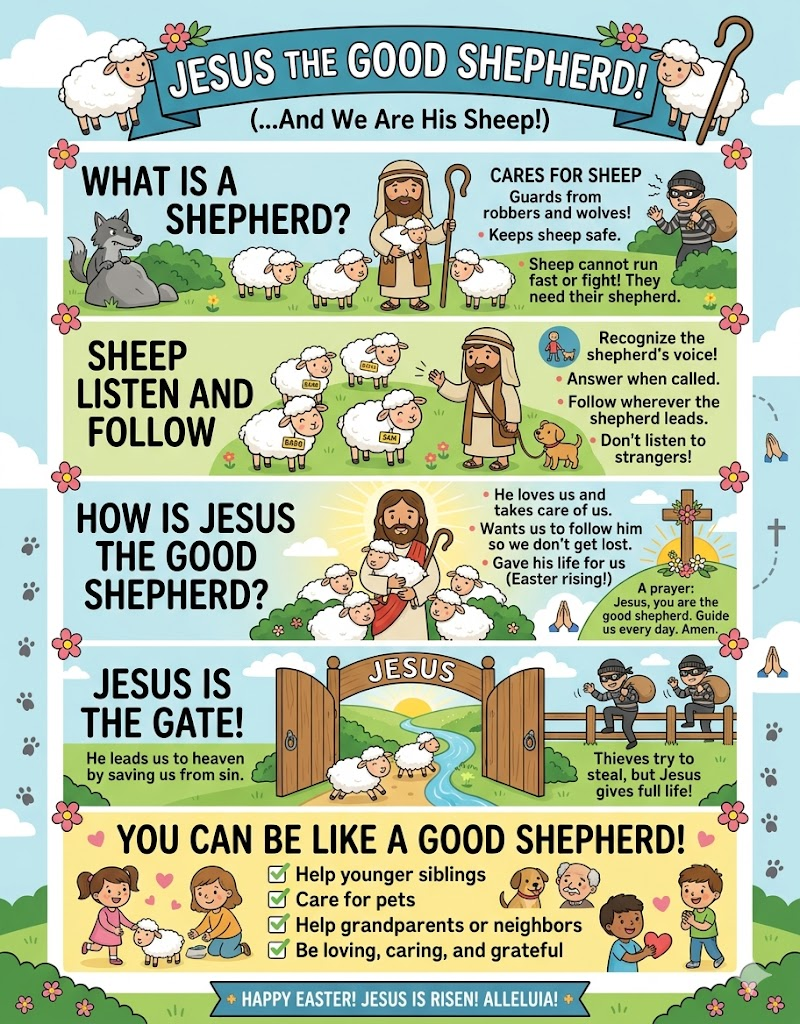
Jesus as the Good Shepherd
Q: What does Jesus as the “gate” for sheep mean? A: Jesus refers to Himself as the gate for the sheep, meaning He came to lead us to heaven by saving us from our sins, serving as the entry point to eternal life.
Q: How did Jesus demonstrate being the Good Shepherd? A: Jesus, our Good Shepherd, gave His life for us on the cross and rose from the dead, which we celebrate on Easter, showing the ultimate sacrifice a shepherd makes for his flock.
Historical Context of Shepherding
Q: What were the responsibilities of shepherds in Jesus’ time? A: Shepherds lived outside year-round, guarded sheep from robbers and wolves, and risked their lives to keep them safe, making it a dangerous and demanding occupation.
Sheep-Shepherd Relationship
Q: How do sheep demonstrate trust in their shepherd? A: Sheep are loyal to their shepherd, recognizing their voice and following them, completely trusting the shepherd to take good care of them and keep them safe.
Practical Application
Q: How can we follow Jesus’ example as the Good Shepherd this week? A: Be a good shepherd by being loving, caring, and grateful; help take care of family, pets, or neighbors, following Jesus’ example of sacrificial care.
Core Message
Q: Why does Jesus want us to follow Him as our shepherd? A: Jesus, called the Good Shepherd, takes care of us like a shepherd cares for sheep, wanting us to follow Him to avoid losing our way in life.
↩️ ↪️ Jeff Cavins


THE WORD THIS WEEK infographics are created using using GOOGLE’S AI Gemini 2.5 Pro. You are free to use the above infographic in any non-profit ministry. Please give credit to TheWordThisWeek.net and Heidi Witte – Kid’s Liturgy.
Salvation and Forgiveness
Q: What does Jesus as “the gate for the sheep” mean for believers? A: In John 10:7-10, Jesus declares himself the gate through which believers must enter to be saved, find pasture, and receive abundant life, contrasting with thieves who come to steal, kill, and destroy.
Q: What did Peter tell the Jerusalem crowd about receiving forgiveness? A: In Acts 2:36-41, Apostle Peter instructed those who put Jesus to death to turn back to God and be baptized in Jesus’ name for forgiveness and to receive the Holy Spirit, with this promise extending to everyone everywhere who believes.
The Shepherd’s Relationship with His Sheep
Q: How does the Good Shepherd interact with his sheep? A: Jesus the Good Shepherd knows his sheep by name, calls them out individually, walks in front to lead them, and they follow because they recognize his voice while rejecting strangers whose voices they don’t know.
Q: What protection does Jesus provide as the Good Shepherd? A: Jesus’ love and protection accompany believers daily, even through the darkest valleys, as he stays right beside them guiding along the right paths, eliminating the need for fear.
Following Jesus’ Teachings
Q: How should believers respond to teachings that contradict Jesus? A: Believers must listen to Jesus’ voice and teachings like sheep listen to their shepherd, rejecting anything heard that contradicts Jesus’ words and remembering to follow his way of love and kindness.
Q: What is the ultimate destination Jesus leads believers toward? A: Jesus the Good Shepherd leads believers to everlasting life, with the goal of being united with him and each other forever in heaven by hearing his voice and following him.

↩️ ↪️ Bishop James Golka
THE WORD THIS WEEK infographics are created using using GOOGLE’S AI Gemini 2.5 Pro. You are free to use the above infographic in any non-profit ministry. Please give credit to TheWordThisWeek.net and Uganda Catholic Television which contributed content.
Understanding Jesus as the Good Shepherd
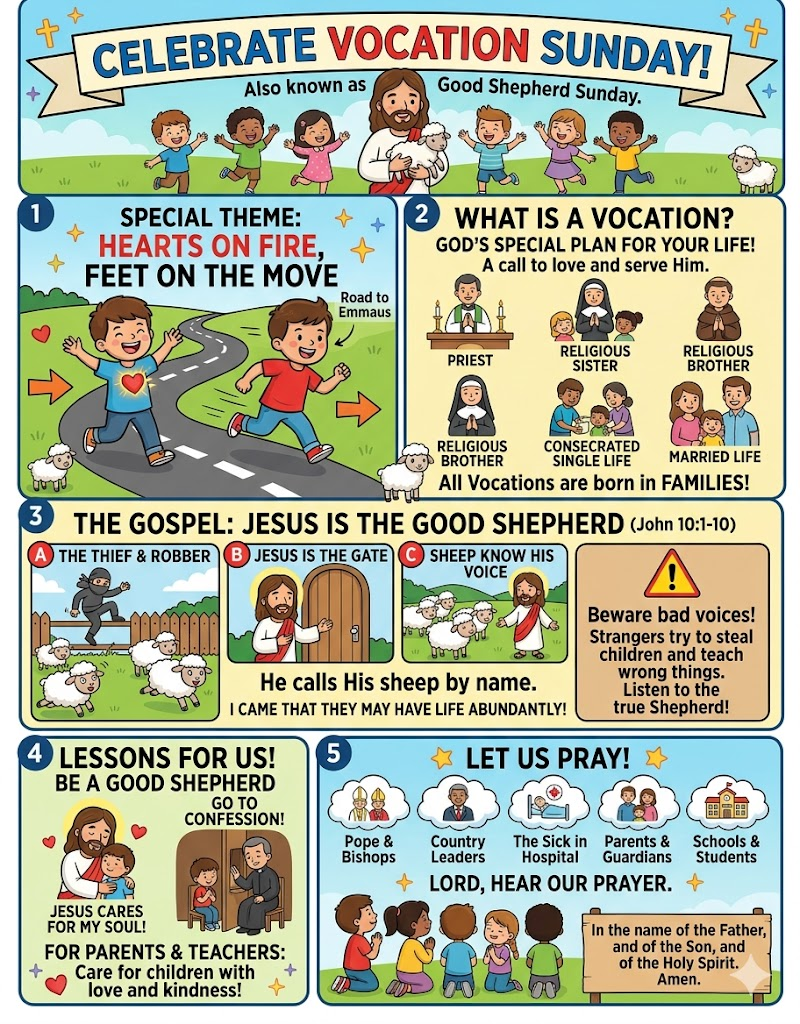
Q: What dual identity does Jesus claim in John 10:1-10? A: Jesus identifies himself as both the Good Shepherd who knows his sheep by name and leads them to pasture, and the door of the sheep through which salvation comes, contrasting himself with thieves and robbers who come to steal, kill, and destroy.
Q: What is the ultimate promise Jesus makes to his followers? A: Jesus promises to give his sheep abundant life (John 10:10), providing not just existence but fullness of life, while protecting them from those who seek to steal, kill, and destroy.
Vocations and Prayer
Q: What is the purpose of Vocations Sunday (Good Shepherd Sunday)? A: Vocations Sunday calls the Catholic Church to pray for all vocations including priests, religious sisters, brothers, and single life, asking for those already serving to live their vocations well and happily while serving God.
Q: Who specifically should receive prayers on Good Shepherd Sunday? A: The Church prays for bishops, priests, religious, and catechists to be showered with the Holy Spirit in their mission, working toward the day when the world has one flock and one Shepherd.
Practical Applications
Q: How does the Good Shepherd model apply to parents and educators? A: The Good Shepherd calls parents, teachers, and childcare providers to be empathetic in caring for children, helping them feel God’s love and protection while being mindful of their safety, hearts, and souls.
Q: What sacramental opportunity does the Good Shepherd provide for renewal? A: Jesus offers the Sacrament of Penance where he, through the priest, forgives sins and helps believers start a new life, demonstrating his ongoing care for our safety, hearts, and souls.
↩️ ↪️ Know Before You Go


THE WORD THIS WEEK infographics are created using using GOOGLE’S AI Gemini 2.5 Pro. You are free to use the above infographic in any non-profit ministry. Please give credit to TheWordThisWeek.net and Edmonton Catholic Schools Division.
Little Liturgies: April 30 2023 — 4th Sunday of Easter
Discerning Jesus’ Voice
Q: How can we recognize Jesus’ voice among other voices in our lives?
A: Jesus’ voice is unique and consistent, always involving love through invitations to love others, be loved by God, act justly, be kind, forgive, and show mercy, serving as the gate to enter the communion of love.
The Gate Metaphor
Q: What does Jesus mean by calling himself “the gate for the sheep” in John 10:1-10?
A: Jesus as the gate (John 10:7) means whoever enters by him will be saved, come in and go out, and find pasture (v. 9), contrasting with the thief who comes to steal, kill and destroy while Jesus offers life abundantly (v. 10).
Practical Love in Daily Life
Q: How does the call of love manifest in everyday situations?
A: The call of love speaks daily in small ways like greeting parents, teachers, and friends with words of love, helping us let go of things that take us away from our call of love.
The Path of Transformation
Q: What results from following the path of love despite its difficulty?
A: Following the path of compassion, gentleness, and care brings transformation, with love being the gift we keep in the communion of love, remaining in heaven.
Jesus’ Priority Groups
Q: Who does Jesus show special concern for according to this Gospel reading?
A: Jesus has special concern for the poor, widow, orphan, lost, and broken, who should be gathered into communities of care and compassion reflecting his love.
Prayer Focus
Q: What should we pray for regarding Jesus’ call of love?
A: Pray in thanksgiving for Jesus’ voice and for those who have not yet heard the call of Jesus’ love, that they may be surrounded by people who imitate Jesus and welcome others into the communion of love.
↩️ ↪️ 1-Minute Homily

THE WORD THIS WEEK infographics are created using using GOOGLE’S AI Gemini 2.5 Pro. You are free to use the above infographic in any non-profit ministry.
Developing a Prayer Practice with Jesus
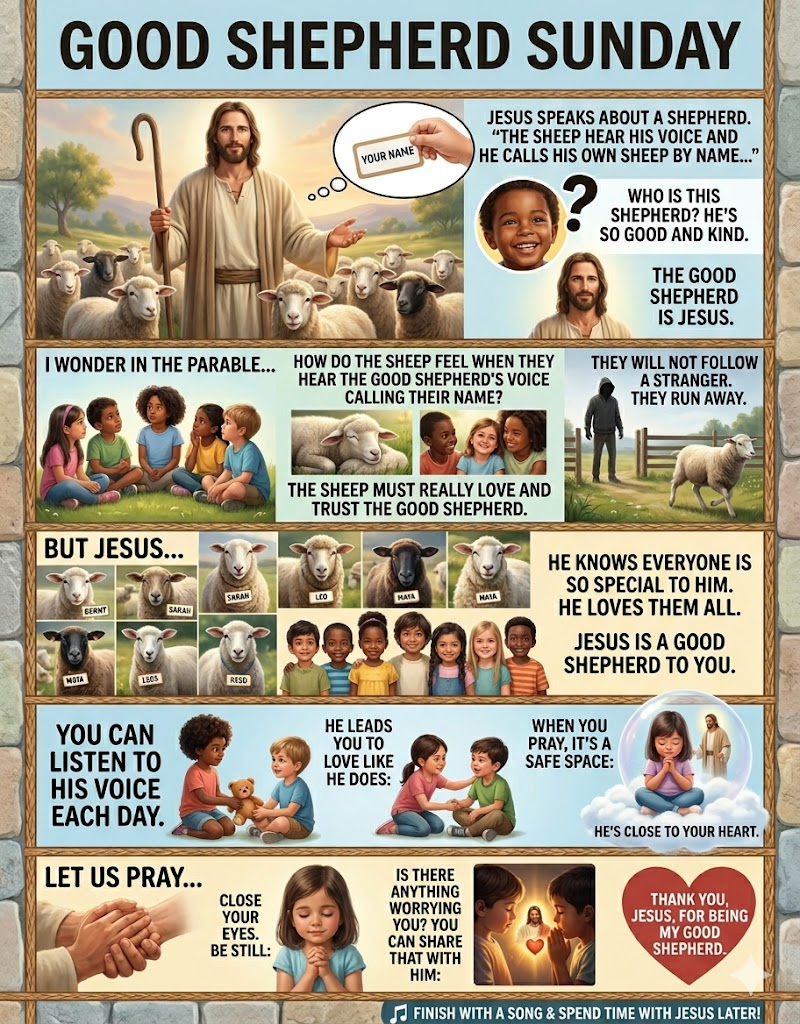
Q: How do I start a daily prayer conversation with the Good Shepherd?
A: Find a quiet moment each day to talk to Jesus about what made you happy or sad, then listen for his voice in your heart as he is present day and night to help and guide you.
Q: What should I share with Jesus during prayer?
A: Share your thoughts, worries, and joys with the Good Shepherd, including anything worrying you today, as he provides a safe space where you feel loved and guided.
Q: How do I recognize Jesus speaking to me in prayer?
A: Listen for the gentle voice of the Good Shepherd in your heart, as he doesn’t always speak loudly but communicates through the quiet of your heart when you listen.
Following the Good Shepherd’s Guidance
Q: How does the Good Shepherd lead me in daily decisions?
A: The Good Shepherd leads you to do the right thing and love like he does, and when you listen to his voice in your heart, you can feel safe, loved, and guided in your choices.
Q: What does the parable teach about following Jesus versus strangers?
A: The sheep follow the Good Shepherd because they know his voice and he calls them by name, but they will not follow a stranger and flee from him because they do not recognize the voice of strangers.
Q: What makes Jesus’s relationship with me personal?
A: Jesus the Good Shepherd knows each sheep by name, loves them personally, and always loves you, demonstrating that he knows your specific identity and cares for you individually.

Children’s Message (4-26-26) – Annie’s Prayer…about praying!
↩️ ↪️ Priests for Life

Children’s Message (4-30-23) – Will YOU ‘glow in the dark?’
First Communion

THE WORD THIS WEEK infographics are created using using GOOGLE’S AI Gemini 2.5 Pro. You are free to use the above infographic in any non-profit ministry.
Understanding the Real Presence
Q: What happens during First Communion? A: Blessed bread becomes Christ’s body and blessed wine becomes his blood, which we consume to be transformed to love and serve the world, even though the change isn’t visible to our eyes.
Q: What does “real presence” mean in First Communion? A: Receiving Jesus in First Communion is called the real presence, where we may not feel different but are meant to be transformed and “glow in the dark” by loving the world as we take Jesus into our hearts.
Practical Application
Q: How can we better appreciate Jesus’s real presence in First Communion? A: Learn to be really present to each other in daily life—the more we practice this presence with others, the more we will recognize we are taking Jesus into our hearts when we receive him.

4th Sunday of Easter (A)


Jesus, as the good shepherd, exemplifies selfless love and protection for his followers, in stark contrast to those who prioritize their own interests.
- Jesus is depicted as the good shepherd in the Gospel of John, emphasizing his love and sacrifice for his followers, contrasting with hired hands who lack genuine care.
- Jesus, the good shepherd, selflessly protects and loves us, unlike those who abandon us for their own interests.
Check for Understanding (PDFs)
Our Sunday Visitor

THE WORD THIS WEEK infographics are created using using GOOGLE’S AI Gemini 3 Pro. You are free to use the above infographic in any non profit ministry. Please give credit to TheWordThisWeek.NET and Our Sunday Visitor.
4th Sunday of Easter (A)


MINISTRY-TO-CHILDREN: This Bible Object Lesson will teach kids that Jesus is the Good Shepherd and how we can trust Him. It’s based on John 10:1-10 where Jesus says, “I am the Good Shepherd.” Download the teachers notes, watch our Children’s Message example, and gather your supplies.

4th Sunday of Easter (A)
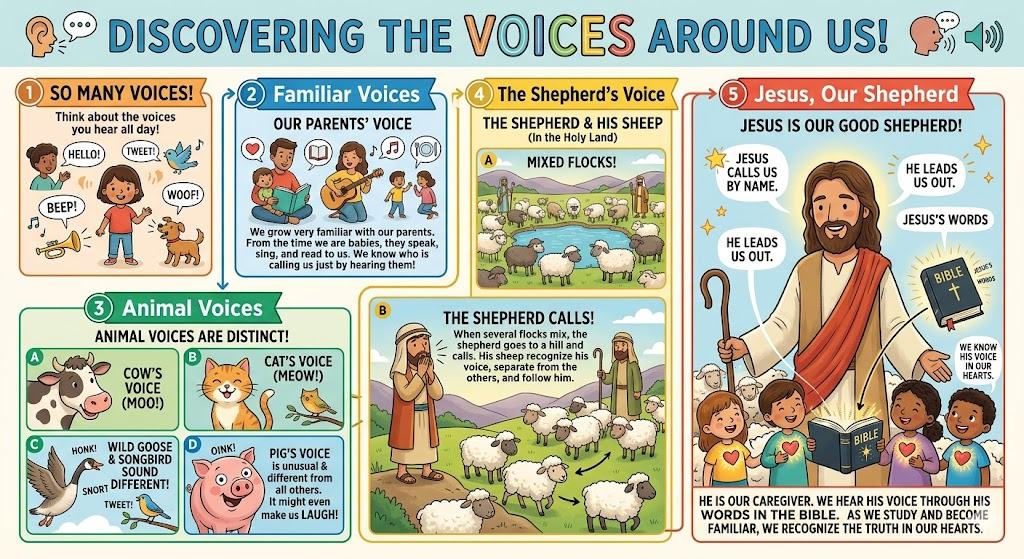
Image added by TWTW; not part of original source material
Recognize the Voice
There are many types of voices in the world. Think about the voices you hear as you go about your day. We become very familiar with our parents’ voices. From the time we are babies our parents speak to us, sing to us, and read to us. We can tell who is calling us to come in for dinner just by listening to the voice.
Animals have distinct voices. A cow’s voice sounds different from a cat’s voice. The voice of a wild goose is unlike that of a songbird. A pig’s voice is very unusual; it is different from any other animal’s voice and may even make us laugh.
In the Holy Land shepherds, caregivers of sheep, bring their flocks to a place where the animals can drink water. Several flocks of sheep mix together. When it is time to leave the area the shepherd goes to a hill and calls his sheep. They recognize his voice, separate out from the other flocks, and follow him.

Image added by TWTW; not part of original source material
More than Enough
Today let’s talk about a word that may be new to you. The word is abundance. Abundance means you have a great quantity of something – you have more than enough – more than you need. Here are some examples:
Think about all the choices of food you find in a grocery store. There are more items on the shelves than we would ever need. Just looking at all the cereals that are available makes us realize we have an abundance of food in our grocery stores.
We can also see abundance in nature. In parts of the world where it snows, millions of snowflakes float down from the sky until snow piles up in drifts. A snow storm is made up of an abundance of snowflakes.
Think of the stars. When we look at the sky on a clear, moonless night we can see about three thousand stars. If we use a telescope we can see approximately one hundred thousand stars. No one knows for sure how many stars there are, but some astronomers say there are two hundred billion stars in the Milky Way alone. That’s abundance!
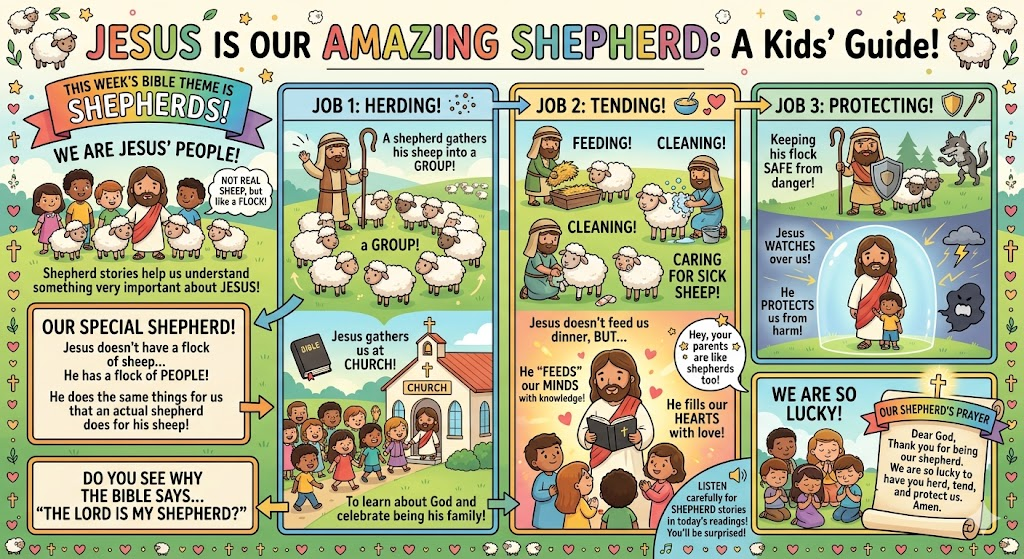
Image added by TWTW; not part of original source material
The Jobs of a Shepherd
This week’s Bible readings have a special theme. They talk about what it means to be a shepherd.
Do you know anything about shepherding that you could share? What types of work does a shepherd do? (Solicit children’s comments.)
Wow, you sure know a lot about shepherding – which is kind of funny, because we don’t see too many shepherds around these days, do we? They were very common when Jesus was alive though, and the Bible is full of shepherd stories – not to teach us about the real work of shepherds back then, but to help us understand something very important about Jesus.
Jesus is a special kind of shepherd. He doesn’t have a flock of sheep – he has a flock of people – and we’re them. We are Jesus’ sheep!
That’s kind of a funny thought, isn’t it? We aren’t really sheep of course, but the Bible helps us to understand that Jesus does the same things for us, that an actual shepherd does for his sheep.
You see, shepherds have three important jobs: herding, tending and protecting.
When we say that shepherds “herd,” we mean that one of their jobs is to gather their sheep into groups. Where do we gather together because of Jesus? That’s right! We come to church to learn about God and to celebrate being a part of his family. So that’s one way, isn’t it?
SOURCE: Sermon Writer – © 1997 – 2026 Richard Niell
4th Sunday of Easter (A)


DOWNLOAD PDF (High Resolution)

DOWNLOAD PDF (High Resolution)
THE WORD THIS WEEK infographics are created using using GOOGLE’S AI Gemini 3 Pro Nano Banana and images from Unsplash. You are free to use the above infographic in any non-profit ministry. Please give credit to TheWordThisWeek.net and the Word-Sunday.
4th Sunday of Easter (A)
Entrance Song
Teaching Children About the Catholic Faith
Q: What age group and settings work best for the first song about Psalm 23?
A: The song targets children ages 3-8 and fits three specific contexts: bedtime routines, worship time at home, and Sunday school classes, using kid-friendly lyrics and gentle animated visuals of Jesus as the Shepherd to reinforce the biblical message.
Core Message and Themes
Q: What three key spiritual concepts does the first song teach children about Jesus?
A: The lyrics emphasize trust in Jesus as the Good Shepherd, love and obedience to Him by following wherever He goes, and comfort in His presence specifically when shadows grow long and night feels near, making abstract faith concepts concrete for young minds.

ST. JOSEPH’S CORNER (2:37) —See left sidebar for Questions
Response & Acclaim

Response & Acclaim

Communion
4th Sunday of Easter (A)
Understanding Jesus as the Good Shepherd
Q: How does Jesus demonstrate individual care for each person?
A: Jesus calls each sheep by name, knows their home, feelings, and needs, and cares for them individually, demonstrating his deep love and concern for each person rather than treating them as a collective group.
Q: How does God view each person according to Church teaching?
A: Each person is weak and unique in God’s eyes, requiring us to always follow Jesus’ voice to avoid distractions from other voices, as he wants the best for each of us.