Commentary Intro to Mass Readings Sunday Readings
CommentaryIntro to Mass Readings Sunday Readings
April 26, 2026


4th Sunday of Easter (A)

PDF AIDS
Scripture Study for Catholics *

Hector Molina
Matt Zemanek
PARISH BIBLE STUDY (St. Timothy Catholic Church, Laguna Niguel, CA)


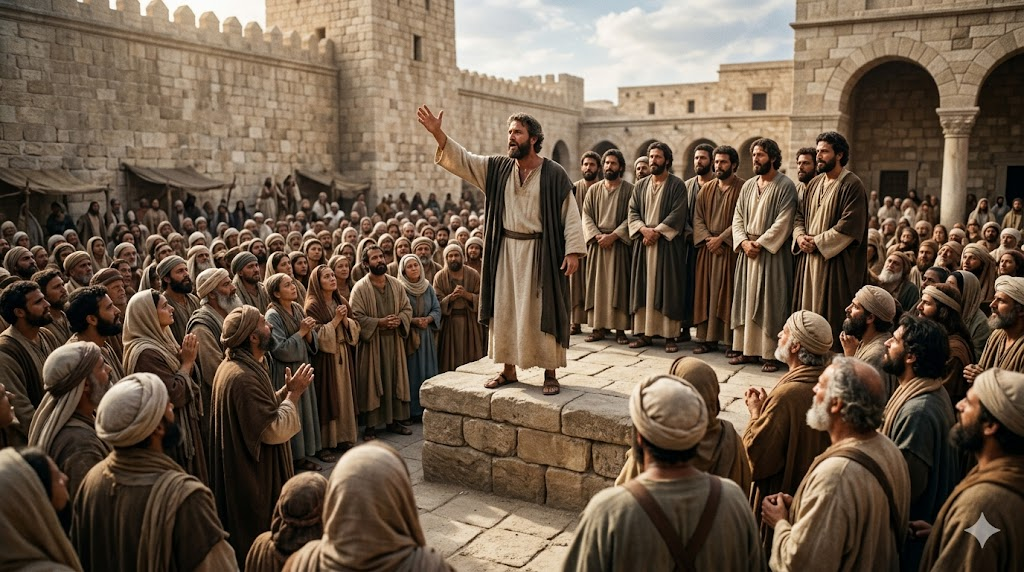
Acts 2:14a, 36-41
KEY CONCEPTS
The following sections reflect the core theological reflections shared by Fr. Tim Peters in his videos on the text of this Sunday’s first reading.
The Recognition of Culpability and Sin
Peter’s address forces the audience to confront their personal role in the crucifixion of Jesus, leading to a deep emotional and spiritual realization.
- Proclaiming the Truth: Peter boldly identifies Jesus as both "Lord and Christ".
- Direct Confrontation: He explicitly states, "this Jesus whom you crucified".
- The Emotional Response: The audience was "cut to the heart" as the Holy Spirit worked behind the scenes to draw them to conversion.
- Authentic Acknowledgment: Just as that generation did, believers today are encouraged to "look in the mirror" and acknowledge their own guilt while remaining grateful for mercy.
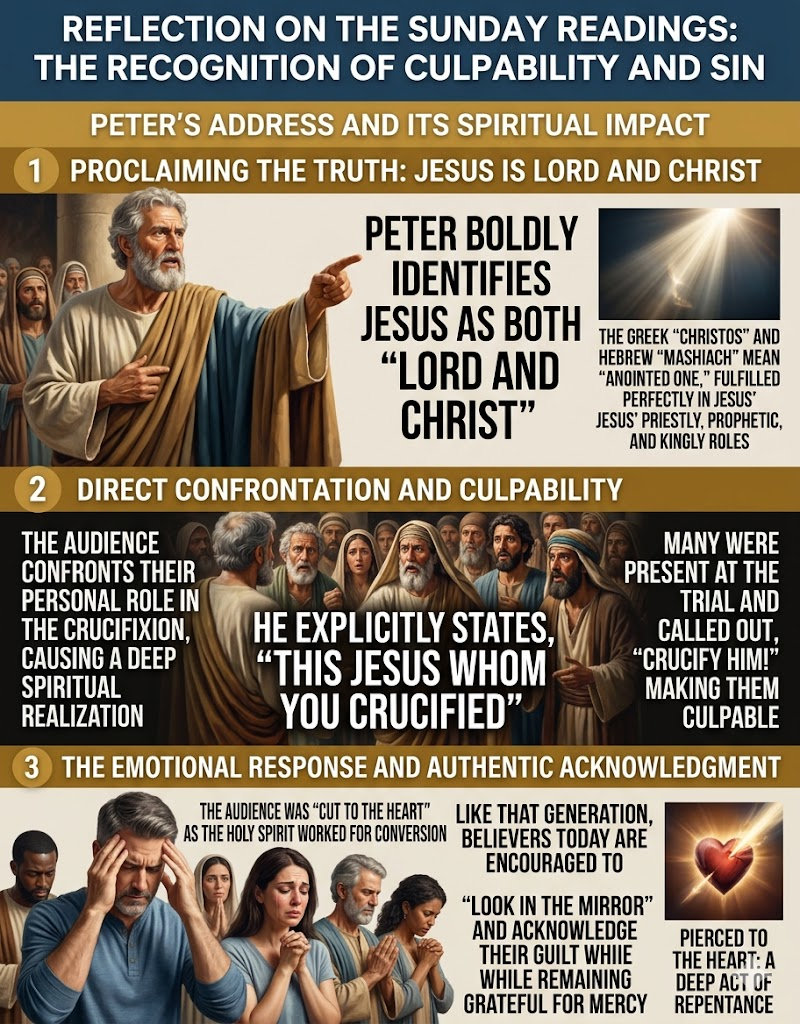
Non-profits have permission to use this infographic in their ministry.
The Call to Repentance and Action
Once the crowd recognizes their situation, they seek a way forward, leading to Peter’s specific instructions for restoration.
- The Critical Question: The people ask the apostles, "Brethren, what shall we do?".
- Twofold Testimony: The Gospel is attested to through two primary means:
- Miracles: The mighty works and signs performed in their midst.
- The First Step: Peter declares that "Repentance is always the first step".
- Turning Away from the World: He exhorts them to "Save yourselves from this crooked generation," acknowledging that the world cannot provide for their deepest needs.
- A Lifelong Commitment: Repentance involves a daily decision to "die to ourselves and faithfully follow Christ".

Non-profits have permission to use this infographic in their ministry.
The Sacrament of Baptism
Fr. Tim Peters emphasizes baptism as the essential response to the Gospel and the means through which believers enter into a new covenant.
- Necessity of the Rite: Peter commands them to be "baptized, every one of you in the name of Jesus Christ for the forgiveness of your sins".
- A New Identity: Through baptism, individuals receive a new identity as "sons and daughters of the living God".
- Comparison to Sinai: While the Sinai Covenant resulted in 3,000 deaths, the New Covenant at Pentecost resulted in 3,000 souls being "added that day" through baptism.
- Living the Mystery: Every time a believer blesses themselves with holy water, they are asking for help to "live out fully our baptism".
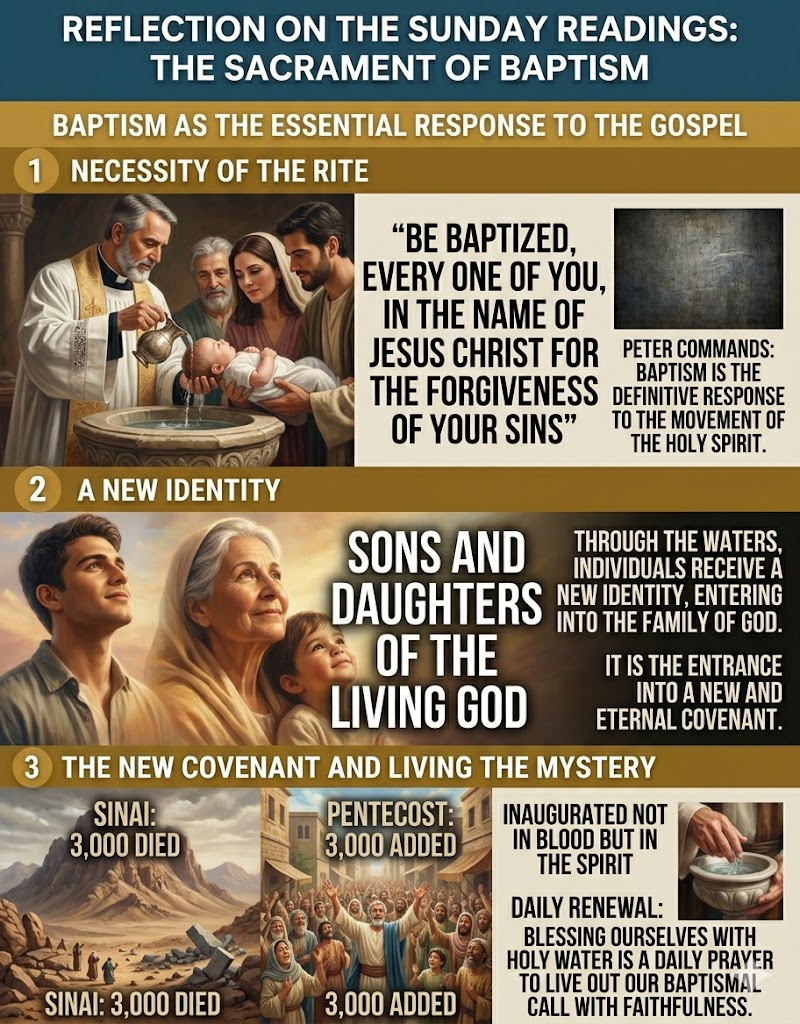
Non-profits have permission to use this infographic in their ministry.
The Gift and Promise of the Holy Spirit
The final concept focuses on the internal transformation and empowerment provided by the Spirit to those who believe.
- The Promised Gift: Peter identifies the Holy Spirit as a "gift and promise" for the believers and their children.
- Universal Scope: The promise extends to "all that are far off, everyone whom the Lord our God calls".
- Abundant Action: The "pouring out" of the Spirit conveys a sense of abundance intended to guide and help believers die to selfish desires.
- Prophetic Fulfillment: This outpouring fulfills the prophecy of Joel, signaling the arrival of the "last days".

Non-profits have permission to use this infographic in their ministry.
INSIGHTS FOR HOMILY
PREPARATION
Acts 2:14a, 36-41

The Challenge of
Salvation
The first proclamation of the Good News on Pentecost wasn’t just a speech; it was a cosmic shift in perspective. As Peter stood before the crowds, he laid out a radical roadmap for salvation that transformed the tragedy of the crucifixion into the triumphant starting point of the “end times.” For those tasked with breaking open the Word this Sunday, Larry Broding’s commentary offers a profound deep dive into the mechanics of Peter’s message, helping you bridge the gap between an ancient Judean crowd and a modern congregation seeking spiritual renewal.
Why this commentary matters for your homily:
- A Three-Part Proclamation: Gain clarity on Peter’s structured approach, from explaining the sign of “tongues” to the apologetic exposition of the Messiah’s death and resurrection.
- The Weight of Universal Responsibility: Explore the provocative idea that guilt and salvation transcend personal borders, challenging your listeners to see the Good News as a universal necessity.
- The Anatomy of Metanoia: Broding breaks down the three essential steps for joining the community of the saved—radical change of heart (metanoia), public baptism, and the active anticipation of the Holy Spirit.
- A Shift in Outlook: Move your congregation from a “moment of despair” regarding the cross to seeing it as the spark of the Spirit’s ongoing empowerment in the world today.
- The Promise of the Diaspora: Understand how the gift of the Spirit extends through generations and geographies, ensuring every member of your flock feels included in God’s ancient promise.
Read Larry Broding’s full commentary to help your congregation see the world through Peter’s eyes and recognize how today is an active part of God’s unfolding end-times promise.
AI THOUGHT STARTERS
To strengthen key sections of your homily, here are questions you might ask the AI assistant (simply copy and paste a question into chat bot in the lower right corner of the page):
The Proclamation of the Messiah and Judgment
- Acts 2:14, 36-41 refers to the three-part structure of Peter’s proclamation on Pentecost; how can I explain to the congregation how Peter uses Joel 2:28-32 to signal that we are living in the end times?
- Since Acts 2:14, 36-41 suggests that God alone is the one who makes the final judgment, how can I encourage parishioners to focus on their own response to Jesus rather than judging the guilt of others?
- In light of Acts 2:36, which refers to the proclamation of Jesus as both Lord and Messiah, what are some effective ways to describe the transition from the despair of the crucifixion to the hope of the resurrection?
Universal Responsibility and the Choice for Salvation
- Acts 2:14, 36-41 suggests that the guilt of Christ’s death is a universal offense; how can I preach about personal responsibility and the need for salvation without causing the audience to feel hopeless?
- Because Acts 2:37 refers to the people being cut to the heart, what modern examples of a stirring conscience can I use to illustrate the first step toward metanoia?
- Acts 2:38 refers to a radical departure from the way of the world; what practical lifestyle changes should I challenge my community to make as a sign of their commitment to the Good News?
Baptism and the Promise of the Spirit
- Acts 2:38 suggests that baptism in the name of Jesus is the public manifestation of an internal change; how can I help parents and godparents at upcoming baptisms see this as a removal from a perverted generation?
- Since Acts 2:39 refers to the promise being made to those present, their families, and those far off, how can I emphasize the inclusive nature of the Holy Spirit’s gift to the righteous Gentiles and the Diaspora?
- Acts 2:14, 36-41 suggests that the gift of the Holy Spirit is an anticipation of the end times; how can I explain the active empowerment of Pentecost as a reality that continues in the Church today?
- How does the worldview found in Acts 2:14, 36-41, which refers to the cross as the starting point of the end times, inspire a renewal of faith in a world that often feels like it is in a state of despair?

1 Peter 2:20b-25
KEY CONCEPTS
The following sections reflect the core theological reflections shared by Fr. Tim Peters in his videos on the text of this Sunday’s second reading.
The Call to Patient Endurance of Injustice
Peter highlights a specific type of suffering that carries spiritual weight: enduring pain when one has done nothing to deserve it.
- Distinguishing Suffering: It is one thing to be punished for a wrong you committed, but another to suffer while doing right.
- Divine Approval: Taking unmerited punishment patiently is what finds "God’s approval".
- The Christian Vocation: Peter explains that believers are specifically "called" to this type of endurance.

Non-profits have permission to use this infographic in their ministry.
Christ as the Perfect Archetype of Suffering
Fr. Tim Peters emphasizes that Jesus did not just save us, but left a physical and moral "map" for how to handle mistreatment.
- The Sinless Example: Christ "committed no sin" and had "no guile... on his lips," making his suffering the ultimate injustice.
- Non-Retaliation: When reviled, He did not revile in return; when He suffered, He did not threaten his tormentors.
- Trust in Ultimate Justice: Rather than seeking revenge, He "trusted to him who judges justly," knowing the Father would clear all injustices on the last day.

Non-profits have permission to use this infographic in their ministry.
The Redemptive Power of the Cross
Focusing on the substitutionary nature of Christ's passion, Fr. Tim Peters explains the purpose behind the physical wounds of Jesus.
- Bearing Our Sins: He bore our sins "in his body on the tree" (the cross) so that we might die to sin.
- Healing through Wounds: Quoting Isaiah 53, the text notes that "by his wounds, you have been healed".
- Sacrificial Manifestation: The life of faith is meant to be a manifestation of "sacrificial love," where we serve Christ through joyful sacrifice.
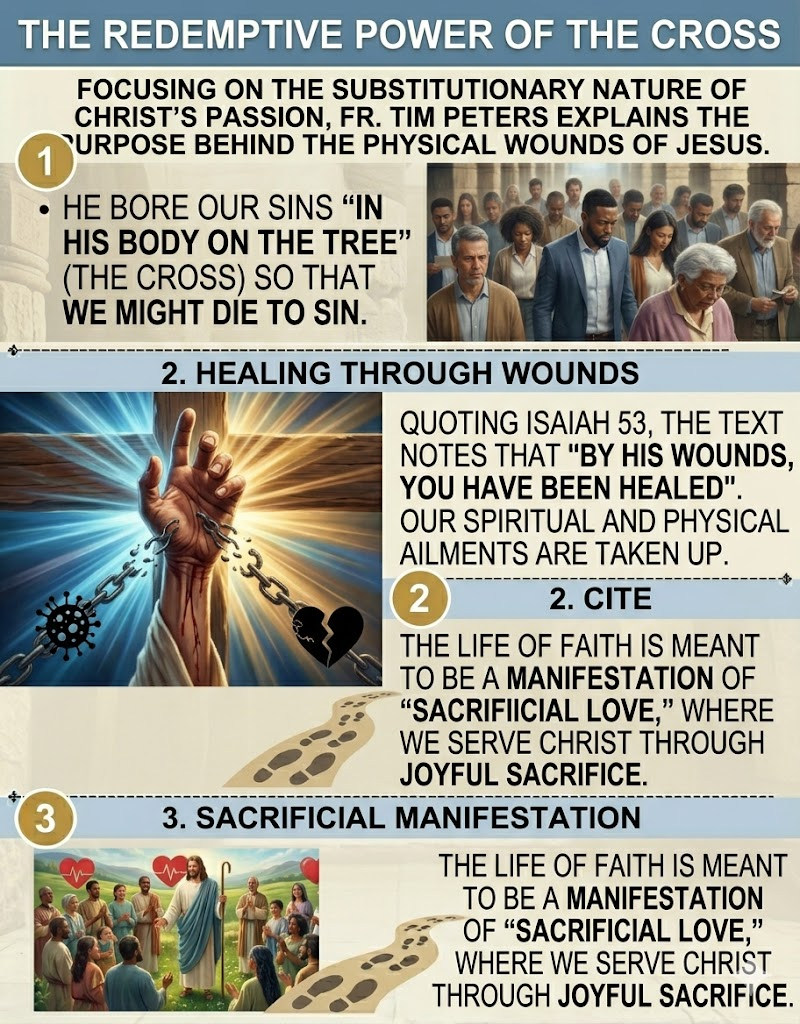
Non-profits have permission to use this infographic in their ministry.
The Return to the True Shepherd
The passage concludes by describing the transition from a state of wandering to a state of being protected and guided.
- The State of Straying: Peter describes the human condition prior to Christ as "straying like sheep".
- The Shepherd and Guardian: Through His suffering, believers have "now returned to the shepherd and guardian of your souls".
- Biblical Connection: This concept echoes the very end of the longest Psalm (Psalm 119:176) and reinforces the "Good Shepherd" theme of the Sunday readings.
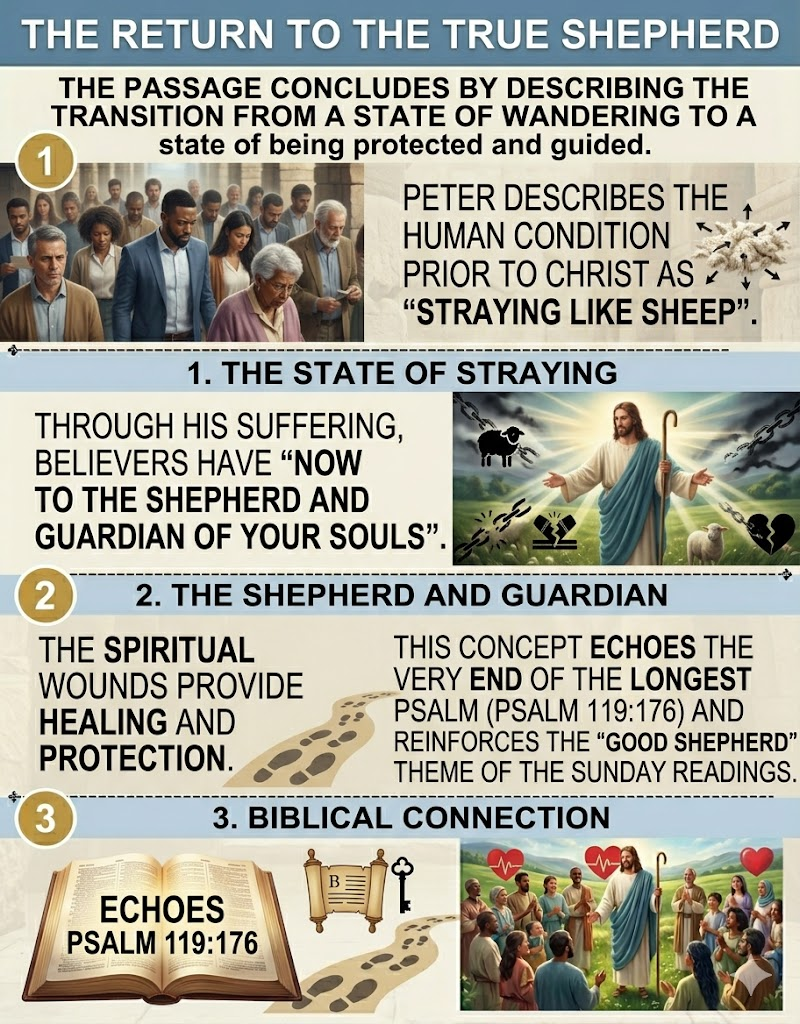
Non-profits have permission to use this infographic in their ministry.
INSIGHTS FOR HOMILY
PREPARATION
1 Peter 2:20b-25
Follow in the
Footsteps of Jesus
While the core tenets of the faith are simple enough for a child to recite, the reality of living them out—especially when faced with suffering—is where the “way gets tough.” Larry Broding’s commentary provides a powerful framework for preachers to address the gritty reality of the Christian lifestyle, moving beyond abstract doctrine into the transformative power of breaking the cycle of sin. It offers the theological depth needed to help a congregation understand how Christ’s endurance of evil wasn’t just a historical event, but a blueprint for their own daily victories.
Why this commentary matters for your homily:
- Breaking the Cycle of Sin: Gain insights into how to preach on Christ’s unique response to suffering as the definitive break in the cycle of abuse, lies, and oppression.
- From Doctrine to Lifestyle: Explore ways to translate the simple “Christ died for us” into a practical guide for parishioners facing their own “tough life” situations.
- The Power of Non-Retaliation: Access a deeper understanding of 1 Peter’s call to avoid deceit and threats, providing your audience with a counter-cultural model for handling conflict.
- Walking in His Footsteps: Develop the theme of “suffering to prevail,” helping your congregation see their challenges not as signs of defeat, but as opportunities to follow the Shepherd’s path.
- Strengthening the Faithful: Find inspiration to craft a message that doesn’t just acknowledge pain but offers the strength of Christ’s victory as a source of endurance.
Read Larry Broding’s full commentary to help your congregation break the cycle of evil and find the strength to remain faithful even when the path is difficult.
AI THOUGHT STARTERS
To strengthen key sections of your homily, here are questions you might ask the AI assistant (simply copy and paste a question into chat bot in the lower right corner of the page):
Breaking the Cycle of Sin and Violence
- 1 Peter 2:20b-25 refers to the temptation to react to suffering out of weakness; how can I help my congregation identify the ways they might be reinforcing a cycle of evil through retaliation or deceit?
- Since 1 Peter 2:23 refers to Christ not returning insult for insult or threatening his oppressors, what specific pastoral advice can I give to those who find themselves in the midst of the abused becoming the abuser?
- 1 Peter 2:20b-25 suggests that Christ broke the cycle of sin by bearing the full force of evil without deceit; how can I preach this as a practical model for ending conflict in modern family or work life?
The Meaning and Grace of Patient Endurance
- 1 Peter 2:20 refers to the future tense of endurance; how can I explain that this implies a divine possibility for the faithful to remain steadfast even when life gets tough?
- Because 1 Peter 2:20b-25 suggests that we are called to follow in the footsteps of Christ, how can I help the laity distinguish between suffering that is simply a result of poor choices and suffering that is for the sake of the good?
- Since 1 Peter 2:21 refers to Christ leaving us an example, what are some contemporary illustrations of people who have suffered for the good of others without losing their integrity?
Healing and Victory Through the Servant
- 1 Peter 2:22 refers to Isaiah 53:9b to show Christ was without sin or deceit; how does this connection to the Suffering Servant help us understand the unique way Christ frees us from our own sinful tendencies?
- 1 Peter 2:24 refers to us being healed by his wounds; how can I best communicate that this healing is not just for our future in heaven, but for our present ability to live for righteousness?
- Since 1 Peter 2:25 suggests we were once like straying sheep, how can I describe the comfort of returning to the Shepherd and Guardian of our souls when we are faced with the pressures of the world?
- How can I use 1 Peter 2:20b-25 to inspire a renewal of faith by showing that when we walk in the footsteps of Jesus, we prevail over evil simply because he has already claimed the victory?
John 10:1-10
KEY CONCEPTS
The following sections reflect the core theological reflections shared by Fr. Tim Peters in his videos on the text of this Sunday’s Gospel.
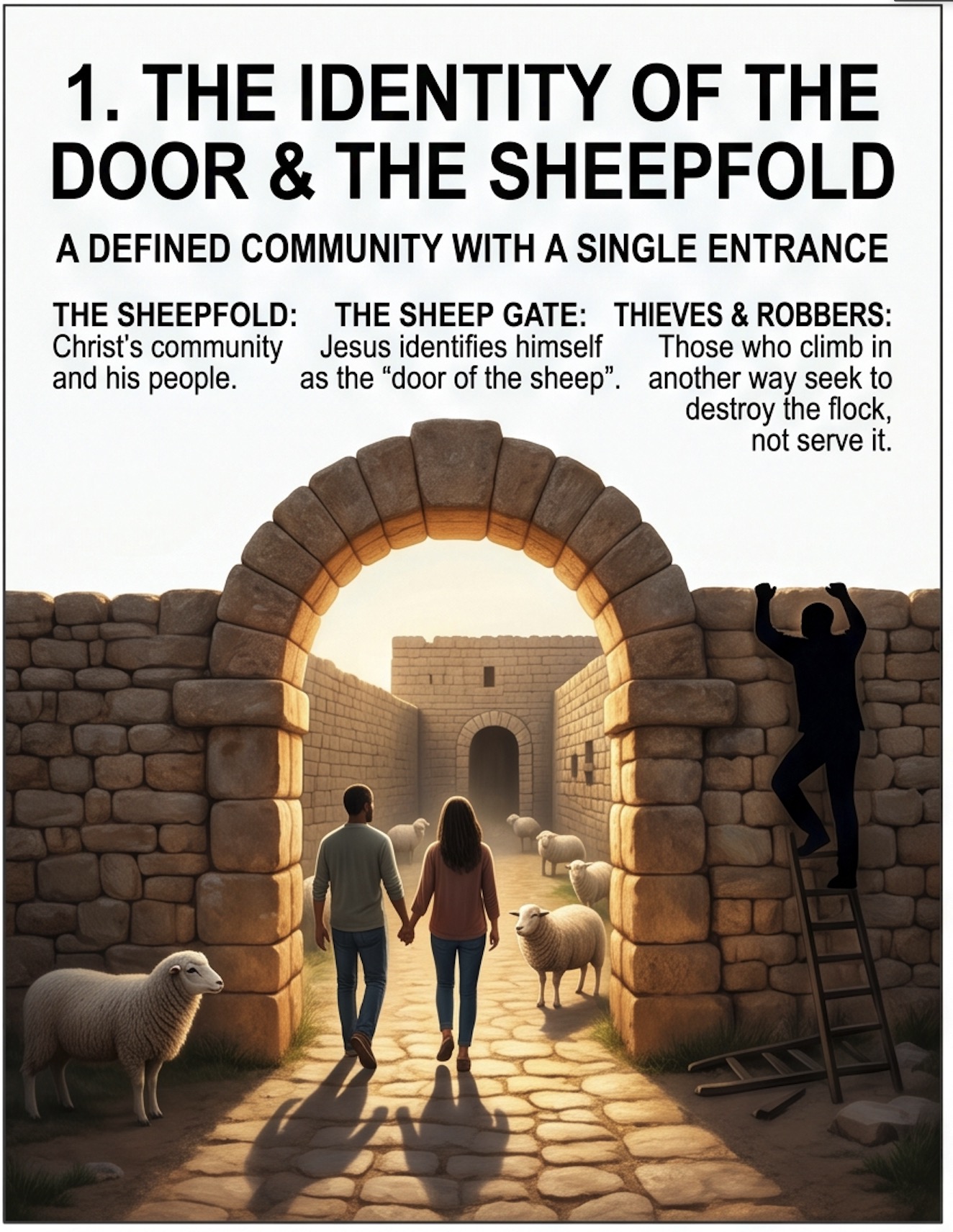
The Identity of the Door and the Sheepfold
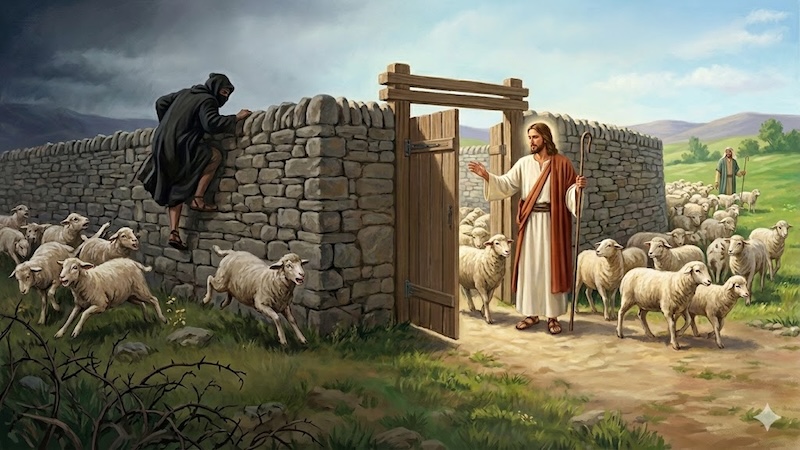
Jesus uses the imagery of a sheepfold to define the boundaries of His community and the specific way to enter it.
- The Sheepfold as Church: The sheepfold represents Christ’s community and His people.
- The Single Entrance: Jesus identifies Himself as "the door of the sheep," emphasizing that there is only one way to enter the community of God.
- The Counterfeit Entrance: Those who climb in by another way are identified as "thieves and robbers" who seek to destroy the flock rather than serve it.
Non-profits have permission to use this infographic in their ministry.
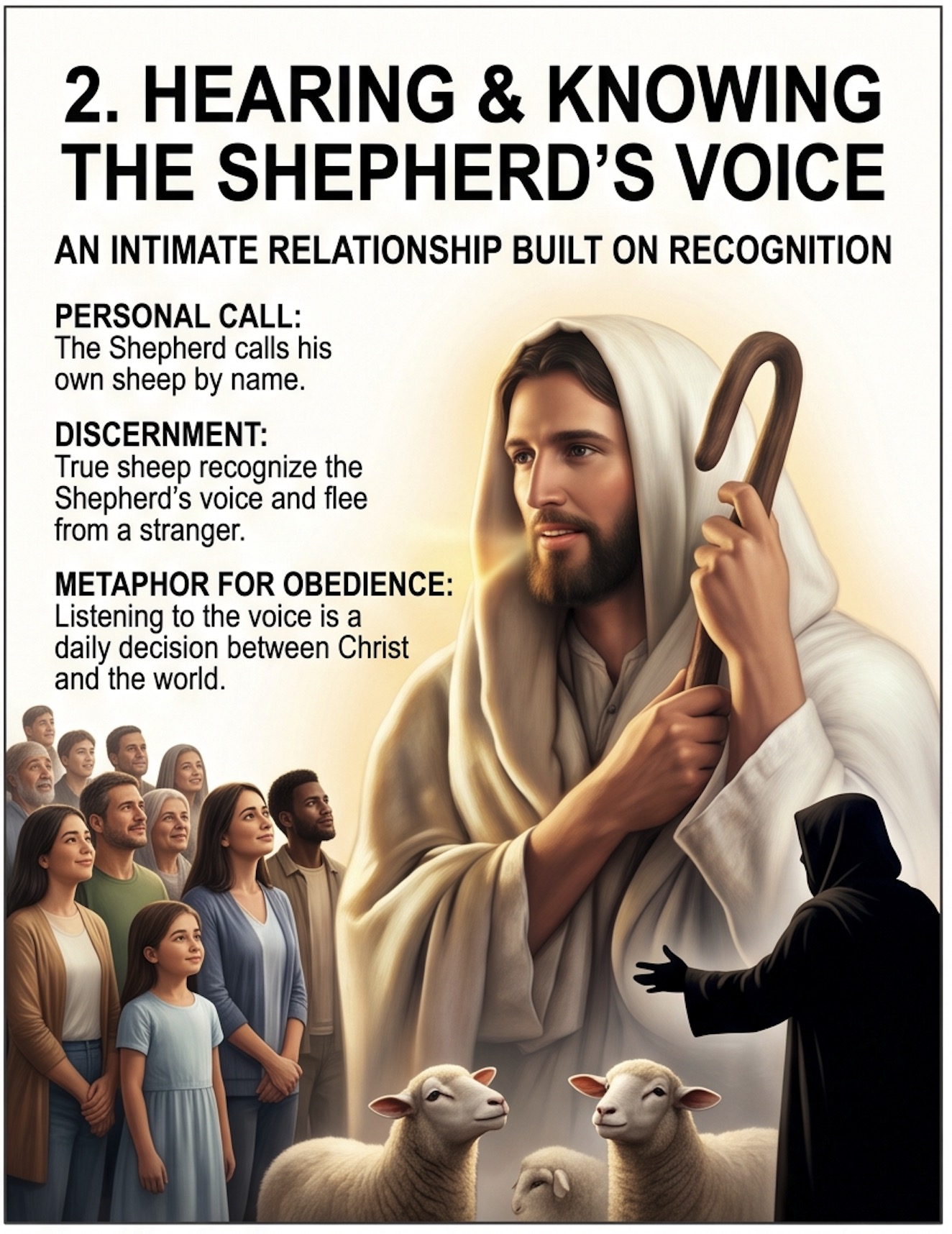
Hearing and Knowing the Shepherd's Voice
A central theme is the intimate, reciprocal relationship between the Shepherd and the sheep, rooted in recognition and obedience.
- The Personal Call: The Shepherd calls His own sheep specifically by name.
- Discernment of Voices: The true sheep recognize the Shepherd’s voice and will flee from a stranger because they do not know a stranger's voice.
- Metaphor for Obedience: Listening to the voice is a metaphor for being obedient to the Lord; it requires making a distinction between the voice of Christ and the voices of the world.
Non-profits have permission to use this infographic in their ministry.
Protection and the Role of the True Shepherd
Fr. Tim Peters connects Jesus' actions to the Old Testament expectations of God as the true guardian of Israel.
- The Guardian at the Gate: At a practical level, shepherds would sleep at the gate of a structure, essentially laying down their lives to protect the entrance.
- Fulfillment of Prophecy: Jesus fulfills the promise in Ezekiel 34, where God declared He would personally search for and shepherd His scattered sheep.
- Blessing in "Coming and Going": By entering through Christ, the flock is protected in all activities, recalling the blessings of Deuteronomy 28.

Non-profits have permission to use this infographic in their ministry.
The Promise of Abundant Life
The ultimate purpose of Jesus' coming is contrasted with the destructive intent of "the thief."
- The Thief's Intent: The thief comes only to "steal, and kill, and destroy".
- Abundance Beyond Materialism: Abundant life does not mean material wealth; it refers to being in total communion with the Lord.
- Choosing Life: This promise recalls Deuteronomy 30, urging the people to "choose life" by choosing to do God's will.

Non-profits have permission to use this infographic in their ministry.
INSIGHTS FOR HOMILY
PREPARATION
John 10:1-10
The Shepherd and
Sheep Gate
To preach on the “Good Shepherd” is to touch one of the most beloved images in the Christian heart, yet the historical reality behind John’s Gospel is far more provocative than a simple pastoral scene. Larry Broding’s commentary uncovers the hidden political and religious tensions of first-century Palestine, revealing how Jesus used the imagery of shepherds, thieves, and robbers to launch a direct polemic against the leadership of his day. By reading this commentary, preachers can move beyond the “Sunday School” version of this parable and offer their congregation a gritty, life-changing choice between the rigid “fence” of the Law and the intimate, life-giving voice of the True Shepherd.
Why this commentary matters for your homily:
- The Shadow of the Hasmoneans: Discover the fascinating historical theory connecting the “thief and robber” to the corrupt Maccabean kings, providing a powerful analogy for leaders who use messianic language for personal power.
- The Urban Sheepfold: Gain a clearer architectural understanding of the stone-walled courtyards of Jerusalem, helping you paint a more accurate and vivid picture of the “gatekeeper” and the communal protection of the flock.
- Thieves vs. Terrorists: Unpack the specific Greek nuances between a “thief” (one who uses stealth) and a “robber” (one who uses intimidation), and how these traits applied to the Pharisees’ leadership style.
- The “Fence” of the Law: Contrast the Pharisees’ approach of “legislating fidelity” with Jesus’ approach of “relational trust,” providing a clear theological distinction for your parishioners who feel burdened by “rules” rather than inspired by faith.
- A Scandalous Metaphor: Explore why a “shepherd” was actually a shocking and morally questionable choice of a title in Jesus’ time, adding a layer of radical humility and counter-cultural depth to your message.
- Universal Hope for Outcasts: Learn how Jesus’ “Good Shepherd” message broke the parochial boundaries of the time to offer a universal path to God for the sinner, the slave, and the Gentile alike.
Read Larry Broding’s full commentary to help your congregation distinguish between the voices that seek to intimidate them and the one True Voice that calls them each by name.
AI THOUGHT STARTERS
To strengthen key sections of your homily, here are questions you might ask the AI assistant (simply copy and paste a question into chat bot in the lower right corner of the page):
Historical Imagery and the False Messiahs
- John 10:1 refers to both a thief and a robber; how can I use the historical background of the Hasmonean robber-marauders to explain to the congregation why the Pharisees’ quest for power was so dangerous to the people’s faith?
- Since John 10:1-10 suggests a comparison between the Hasmonean kings and the Pharisees, how can I illustrate the difference between leaders who seek to be served and the Messiah who comes to serve?
- John 10:1 refers to the thief approaching by stealth and the robber by intimidation; how might these two images represent the different ways that sin or false ideologies “sneak” into or “bully” our modern lives?
The Shepherd and the Gatekeeper
- John 10:3a refers to the gatekeeper who recognizes the shepherd; in a homily, how can I present the Holy Spirit or the Church as the gatekeeper who helps us discern the true voice of Christ?
- Since John 10:3b suggests that the shepherd calls his own sheep by name, what are some moving ways to remind the parishioners that God’s love is personal and individual rather than a generic, distant care?
- John 10:4 refers to the shepherd walking in front of the flock; how can I encourage the faithful to trust in Christ’s leadership even when he leads them into “pastures” that seem unfamiliar or challenging?
Legalism vs. Relationship
- John 10:1-10 suggests that the Pharisees led through strict legislation while Jesus leads through relationship; how can I explain the difference between a “duty-based” faith and a “trust-based” life in Christ?
- Because John 10:1-10 refers to the Law being a burden to the outcasts, how can I present Jesus as the sheep gate through whom even the most marginalized find hope and a “true life” with meaning?
- Since John 10:6 suggests the Pharisees did not understand the image of the shepherd due to its low social status, how can I challenge the congregation to look for God’s truth in the humble and unexpected places they might normally overlook?
- How does the fact that John 10:10 refers to Jesus coming so that we might have life more abundantly help me invite the parish to move beyond a “survivalist” faith into a joyful mission of universal hope?