Homilies
Homilies
April 19, 2026
3rd Sunday of Easter (A)


Road to Emmaus


SDS


CMF












RECOMMENDED
The Augustinian Province of St. Thomas of Villanova maintains a dedicated “Homilies” page with reflections grounded in the Confessions and the Rule of St. Augustine.
✍️ Augustinian Province – Weekly Homilies
📺 Fr. Paul Galetto
📺 Fr. Tom McCarthy
✍️ Fr. Kieran J. O’Mahony

Core Charism: Interiority (searching for God within), community life (“one mind and one heart on the way to God”), and the restless heart that finds repose only in God.
3rd Sunday of Easter (A)
Focus Reading: Luke 24:13–35 (The Restless Heart) Augustinians emphasize the search for God within the community and the “interior teacher.”
Key Phrase: “Our hearts are restless until they rest in You.”
The Hook: Our eyes are often prevented from seeing because our hearts are looking for the wrong things.
The Approach: Focus on the concept of the Christus Totus (The Whole Christ). Jesus teaches from within (the burning heart) and from without (the community/Scripture). Application: Ask yourself, “What am I actually searching for?” and redirect that restlessness toward the Word of God.
Opening: “Restlessness is the hallmark of the human heart. These two disciples were walking seven miles away from the source of their joy, yet their hearts were burning within them the whole time. They were restless because the ‘Interior Teacher’ was already speaking to them. We often travel far and wide looking for God, only to realize He was the one walking in our shoes the entire journey.”
RECOMMENDED
Many Benedictine Abbeys publish the Abbot’s homilies online. Quarr Abbey and Saint Meinrad Archabbey are excellent sources for traditional Benedictine “Lectio” style preaching.
✍️ Saint Meinrad Archabbey Reflections
✍️ Monastery of Christ in the Desert
✍️ Mepkin Abbey

Core Charism: Ora et Labora (Prayer and Work), Stability, Hospitality, Lectio Divina, Listening with the “ear of the heart.”
3rd Sunday of Easter (A)
Focus Reading: Luke 24:13–35 (Hospitality and Recognition) Benedictines prioritize Stability, Prayer (Ora), and Work (Labora) within a community.
Key Phrase: “Receive all guests as Christ himself.”
The Hook: “Stay with us, for it is nearly evening.” The transformative power of monastic hospitality.
The Approach: Highlight the “School of the Lord’s Service.” The disciples recognized Jesus through the ritual action of the breaking of the bread—a liturgical act. Application: Create a “sacred rhythm” in your home where the evening meal is treated with the same reverence as a prayer.
Opening: “In the Rule of St. Benedict, we are told to ‘Listen with the ear of the heart.’ On the road to Emmaus, the disciples were listening with their ears, but their hearts were still closed by grief. It was only when the stranger became a guest, and the guest became the host at the table, that the stability of God’s presence was revealed. We meet that same presence here, in the silence of the sanctuary and the breaking of the bread.”

LECTIO DIVINA
APRIL 2026 (PDF)
RECOMMENDED
The Carmelites offer a unique “Lectio Divina” style reflection for each Sunday through their international headquarters.
✍️ OCarm.org – Lectio Divina for Sundays
📺 Fr. Greg

Core Charism: Contemplation, The Desert, Prayer as Friendship, The Dark Night, Elijah, St. Teresa of Avila.
3rd Sunday of Easter (A)
Focus Reading: Luke 24:13–35 (The Veiled Presence) Carmelites focus on the “Interior Castle,” contemplative prayer, and the “Dark Night.”
Key Phrase: “In the evening of life, we will be judged on love alone.”
The Hook: Jesus becomes invisible the moment he is recognized. Why does he disappear when we finally “see” him?
The Approach: Focus on the transition from physical sight to “faith-sight.” The journey to Emmaus is a metaphor for the contemplative life—moving from outward signs to an inward, silent union. Application: Spend 10 minutes in absolute silence today, allowing the “Teacher” to speak to your heart without words.
Opening: “There is a profound mystery in the ‘disappearing’ Jesus. The moment the disciples recognize Him in the bread, He vanishes from their sight. Why? Because the Risen Lord is teaching them—and us—to move from the visible to the invisible. He is calling us into the ‘Interior Castle’ of the soul, where He no longer needs to stand in front of us because He lives within us.”
RECOMMENDED
The Dominicans have one of the most robust preaching websites called “Torch.” It features a new homily every week from a different friar.
✍️ English Dominican Friars – Torch

Core Charism: Veritas (Truth), Preaching, Study, Combatting Error with Clarity, Contemplation passed on to others.
3rd Sunday of Easter (A)
Focus Reading: Acts 2:14, 22–33 (Peter’s Proclamation) The Order of Preachers focuses on Veritas (Truth) and the clear, doctrinal explanation of the faith.
Key Phrase: “To contemplate and to give to others the fruits of contemplation.”
The Hook: Peter, once fearful and silent, now stands with theological clarity to explain the “why” behind the Resurrection.
The Approach: Focus on the fulfillment of prophecy (David and the Psalms). The homily should move from the “Word” to “Wisdom,” explaining how the Resurrection is the logical and divine conclusion of God’s plan. Application: Study the Catechism or Scripture this week to be able to “give a reason for your hope.”
Opening: “The Church is born from the mouth of a witness. Today, we see Peter standing up—not as the man who denied Christ, but as the man who has synthesized the Truth. He connects the dots from King David’s ancient songs to the empty tomb. Today’s liturgy demands we ask ourselves: Is our faith merely a feeling, or is it a conviction rooted in the ‘reason’ of the Word made flesh?”
RECOMMENDED
St. Anthony Messenger and the various provinces often provide “Franciscan Spirit” reflections that focus on the Gospel of the day.
✍️ Franciscan Media – Sunday Homily Helps
📺 Fr. Paul Galetto
📺 Fr. Tom McCarthy
✍️ Fr. Kieran J. O’Mahony

Core Charism: Poverty, Minority (being “lesser”), Fraternity, and finding God in the grit of humanity and creation.
3rd Sunday of Easter (A)
Focus Reading: Luke 24:13–35 (The Road to Emmaus) The Franciscans emphasize the “Incarnational” presence of God in the humble and the everyday.
Key Phrase: “The Lord meets us in the ordinary dust of our journey.”
The Hook: Jesus doesn’t wait for us at the finish line; he walks the dusty, discouraged roads of our lives as a fellow traveler.
The Approach: Focus on the “Brotherhood” of Christ. Just as St. Francis found God in the leper and the poor, we find the Risen Lord in the breaking of bread and simple hospitality. Application: Look for “neighbor” moments this week where a simple shared meal or conversation can become a sacred encounter.
Opening: “Peace and good to you all. Have you ever noticed that Jesus is a terrible hiker? On the road to Emmaus, He doesn’t lead the way or set the pace; He just wanders up beside two losers—two men who feel like they’ve lost everything—and asks to walk in their dust. He doesn’t come in the clouds today; He comes in the middle of a long walk and a simple, shared meal.”
RECOMMENDED
The Jesuits typically provide reflections through America Magazine or their provincial websites. Their “The Word” column is the gold standard for Ignatian preaching.

Core Charism: Ad Maiorem Dei Gloriam (For the Greater Glory of God), Discernment of Spirits, Finding God in All Things, Imaginative Contemplation.
3rd Sunday of Easter (A)
Focus Reading: Luke 24:13–35 (The Road to Emmaus) Ignatian spirituality centers on “Finding God in All Things” and the “Discernment of Spirits.”
Key Phrase: “Discern the fire within.”
The Hook: Why were their hearts burning before they recognized him? Understanding the interior movements of the soul.
The Approach: Use the “Composition of Place.” Invite the congregation to imagine themselves on that seven-mile walk. Analyze the shift from desolation (looking downcast) to consolation (hearts burning). Application: Practice a daily “Examen” to look back at where your heart “burned” with God’s presence today.
Opening: “Let’s look closely at the ‘holy frustration’ of the two disciples. They had the facts, but they lacked the fire. St. Ignatius tells us that God deals with us directly; notice how Jesus doesn’t just give a lecture, He asks a question: ‘What are you discussing as you walk along?’ He begins with their experience, their desolation, and their confusion, because that is exactly where the Spirit begins the work of discernment.”
March/April 2026
RECOMMENDED
The Redemptorists of the Baltimore and Denver Provinces often provide weekly reflections, particularly through their “Missionaries of Hope” video series or Lenten booklets.
✍️ The Redemptorists (Baltimore Province) News & Reflections

Core Charism: Preaching “Plentiful Redemption” (Copiosa Redemptio), especially to the abandoned and sinners; Moral Theology (St. Alphonsus Liguori).
3rd Sunday of Easter (A)
Focus Reading: 1 Peter 1:17–21 (Ransomed by the Blood of the Lamb) Founded by St. Alphonsus Liguori, Redemptorists focus on “Copious Redemption” for the most abandoned.
Key Phrase: “With Him, there is plentiful redemption.”
The Hook: You were not bought with perishable things like silver or gold, but with the precious blood of Christ.
The Approach: Focus on the infinite value of a human soul. No matter how far the Emmaus disciples walked away, the “Redeemer” followed them to win them back. Application: Reflect on a “lost” area of your life and trust in the overwhelming mercy of God to buy you back.
Opening: “If you have ever felt like you were walking away from hope—if you’ve ever felt like you were heading toward your own personal ‘Emmaus’ because staying in Jerusalem was too painful—then today’s Gospel is for you. St. Peter reminds us that we weren’t bought with silver or gold, but with Blood. You are so valuable to God that He will chase you down a lonely highway just to tell you that you are redeemed.”
3rd Sunday of Easter (A)
Bishop Robert Barron

Agents of Divine Mercy

Friends, we come to this Third Sunday of Easter, and our Gospel is Luke’s account of the disciples on the road to Emmaus. This masterpiece is a summation of the spiritual life, and it starts with two disciples of Jesus walking the wrong way.
Reflecting on Recent Headlines
Deacon Greg Kandra
Let’s Not Fool Ourselves

APRIL 13, 2026—Deacon Greg Kandra reflects on the jarring conflict between the presidency and papacy, occurring specifically at the end of Divine Mercy Sunday. He argues this hostility is a deliberate attack on the Easter spirit of reconciliation and peace. Kandra views this not as a political disagreement, but as a spiritual one instigated by Satan to breed hatred against the Pope and thwart Christian unity. Critiquing social media’s role in fueling this division, Kandra urges the faithful to resist online vitriol. Instead, they should practice prayerful defiance, embracing Padre Pio’s advice to “pray, hope, and don’t worry” while actively promoting peace.

HOMILY HELPER
GO DEEPER
AI PROMPTS TO HELP YOU GO DEEPER INTO THIS TOPIC
Copy/paste one of these command prompts into the Catholic Assistant (bottom right corner). This tool can help you brainstorm and provide you with further ideas to keep you writing.
_
- Write a reflective piece contrasting the spiritual peace of Divine Mercy Sunday with sudden political discord involving the Pope and a President. AI, emphasize the theological significance of Easter unity.
- Draft an essay discussing how social media fuels bitter divisions and thwarts the Christian pursuit of harmony, especially following Easter celebrations. AI, focus your rewriting on promoting a digital detox.
- Expand on the concept that spiritual forces of darkness actively sow hostility and discord to undermine global church growth and papal authority. AI, write focusing on this unseen spiritual battle.
- Compose a thoughtful reflection using the advice of Padre Pio as an antidote to modern political toxicity and public anger. AI, write highlighting prayerful defiance against modern cynical cultural division.
- Analyze the tragic irony of a bitter public clash erupting immediately after churches preached reconciliation, mercy, and peace. AI, rewrite this narrative to emphasize the disruption of Easter grace today.
- Develop a thematic exploration contrasting the Pope and his constant dedication to peace with aggressive efforts to diminish papal authority. AI, write emphasizing the triumph of enduring Christian global unity.
- Outline a practical guide for believers to actively promote peace in their homes and relationships during the fifty days following Easter. AI, ensure you emphasize turning away from digital hatred.
- Examine the deliberate attempts to sabotage the joyful momentum of church growth through coordinated political hostility and social outrage. AI, focus your response on strategies for maintaining unshakeable spiritual joy.
- Write a cultural critique analyzing how keyboards and emojis disguise destructive hostility, distracting believers from genuine life and gratitude. AI, emphasize the necessity of abandoning shallow online daily political arguments.
- Discuss the stark contrast between Christ praying for unity and contemporary aggressive efforts to fuel outrage toward papal leadership. AI, explicitly write about reclaiming peace through deliberate and defiant silence.
3rd Sunday of Easter (A)
Featured Homily
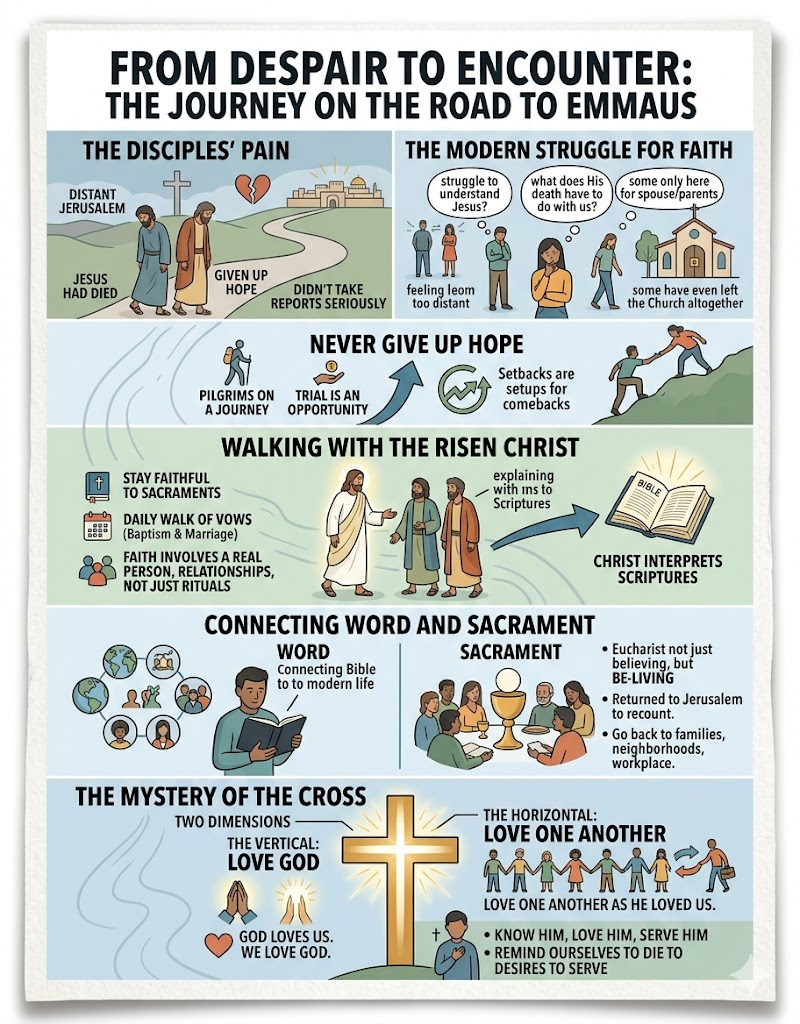
From Despair to Encounter

The homily frames the Emmaus account as a roadmap for “making the connections” between historical facts and a living relationship with Christ. It identifies the despondency of the disciples with modern struggles of faith—particularly among adult children who have left the Church or those who attend Mass out of obligation without “getting it.” The homily posits that Christianity is not a set of programs but a relationship with a Real Person. By linking the “vertical” love of God with the “horizontal” love of neighbor, the homily argues that the Eucharist must be transformed from something we believe into something we are “be-living.”
3rd Sunday of Easter (A)
Fr. Michael Chua
2026 HOMILIES | ARCHIVE: 2023 | 2020 | 2017 | 2014 | 2011
The Road which Leads to the Eucharist

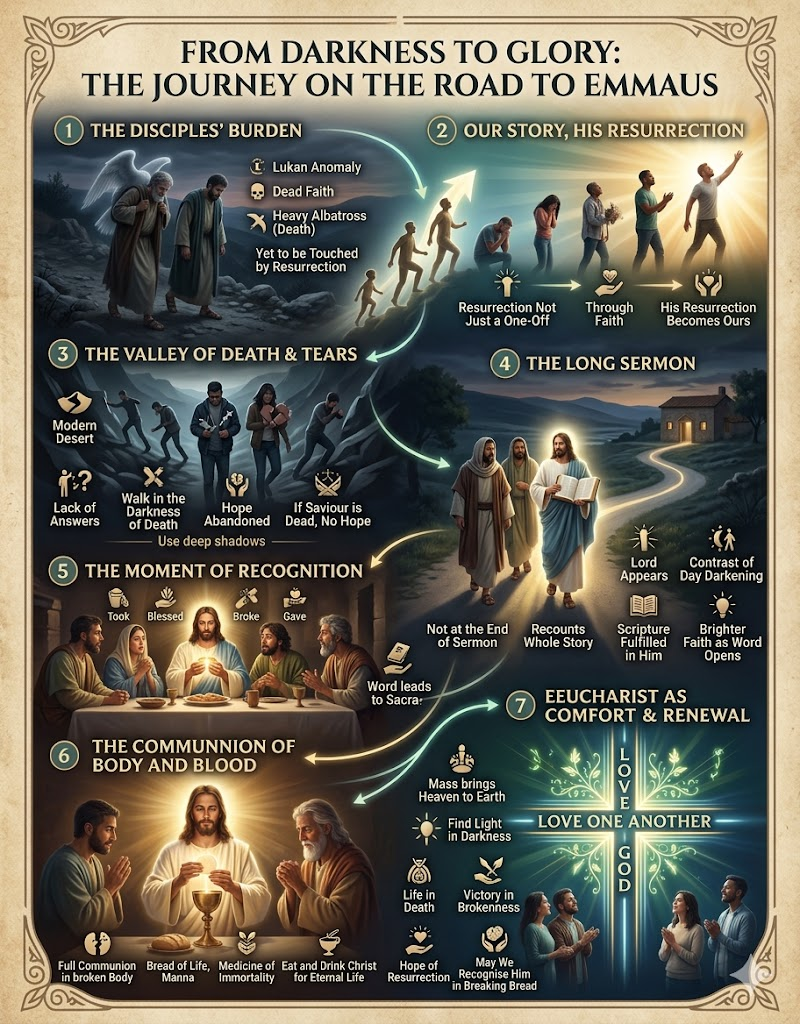
Fr. Michael Chua explores the journey of the disciples on the road to Emmaus, framing it as a movement from the “valley of death and tears” toward the light of the Resurrection. He posits that Christ’s Resurrection is not a distant historical miracle but a reality made accessible through faith and the Eucharist. While the exposition of Scripture begins to illuminate the disciples’ hearts, full recognition only occurs in the Breaking of the Bread. Ultimately, the homily emphasizes that the Word must lead to the Sacrament, where the Risen Lord offers the “medicine of immortality” to a despairing world.
EVALUATION
THEOLOGICAL ACCURACY & BIBLICAL FIDELITY
- Textual Accuracy: The scriptural context is perfectly framed. The reference to Cycle A usually featuring Matthew and John is a sharp liturgical observation. The location of Emmaus and the chronological placement of the story on Easter evening are handled accurately.
- Doctrinal Soundness: The homily demonstrates robust, orthodox theology. The transition from the Liturgy of the Word to the Liturgy of the Eucharist is beautifully articulated. Referring to the Eucharist as the “medicine of immortality” (an ancient patristic concept from Ignatius of Antioch) and explicitly defending the Real Presence (“heaven and earth meet together in the very Body and Blood”) shows deep theological precision.
- Exegesis: The preacher expertly draws out the Lukan contrast between the darkening of the physical day and the brightening of the disciples’ spiritual faith. This is authentic exegesis that illuminates the text rather than manipulating it.
THEMATIC ORGANIZATION & STRUCTURE
- Central Theme: The thesis is clear and unwavering: encountering the Risen Christ moves us from despair to hope, a journey that begins in the Word but is only fully realized in the Sacrament of the Eucharist.
- Structural Clarity: The homily is beautifully organized into logical, thematic sections. It moves seamlessly from an introduction of the biblical text to the human condition of despair, then to the scriptural exposition on the road, climaxing at the Eucharistic table, and concluding with a practical application regarding Mass attendance.
- Transitions: The transitions are highly effective. Moving from the disciples’ “walk in the desert” to the congregation’s shared experience of the “valley of death and tears” bridges the ancient and modern worlds smoothly.
DELIVERY & PACING
- Grammar and Polish: The text exhibits excellent grammatical precision. The sentence structures are varied and elevated without being overly academic. Phrases like “heavy spectre of death” and “epitome of all the contradictions” provide a polished, rhythmic cadence that would sound highly articulate when spoken.
- Pacing and Flow: The script reads cleanly, free of awkward phrasing or conversational stumbles that might translate to verbal fillers. There is a natural crescendo from the quiet despair of the opening to the triumphant theological claims at the end.
PRACTICAL APPLICATION & RELEVANCE
- Congregational Context: The homilist shows a deep empathy for the human condition, validating the very real pain, contradictions, and “unimaginable darkness” that people face. It does not offer cheap optimism, but rather a profound, sacramental hope.
- Actionable Takeaway: The conclusion brings the lofty theology down to a highly practical reality: the necessity of attending Sunday Mass. It re-frames skipping Mass not merely as a broken rule, but as a tragic denial of the “only food that can bring them to heaven.”
ENGAGEMENT & PASTORAL CONNECTION
- Hook and Introduction: The opening lines regarding the lectionary cycles (Cycle A vs. Luke) are intellectually interesting but might be a bit “inside baseball” for the average listener, potentially delaying the emotional hook. However, the preacher quickly recovers engagement by painting a vivid picture of the disciples weighed down by the albatross of death.
- Pacing and Energy: The energy appropriately builds toward the climax of the breaking of the bread. There is also a well-placed moment of levity regarding the length of the sermon (“perhaps the solution is not found in making the homily shorter, but longer!”), which helps reset the congregation’s attention before delivering the core Eucharistic message.
HOMILY HELPER
GO DEEPER
PROMPTS TO KEEP YOU WRITING
Copy/paste one of these command prompts into the Catholic Assistant (bottom right corner). This tool can help you brainstorm and provide you with further ideas to keep you writing.
_
- Walking Through Despair establishes the scene of two travelers burdened by grief and a sense of abandonment. Use vivid imagery of the valley of shadows. Direct the AI to write a reflection on finding hope.
- The Liturgy's Foundation focuses on the transition from the Liturgy of the Word to the Liturgy of the Eucharist. Contrast the spoken word with the physical bread. Direct the AI to emphasize sacramental presence.
- Burning Hearts and Minds explores the intellectual and emotional transformation that occurs when Christ explains the scriptures. Highlight the fulfillment of prophecy. Direct the AI to focus on the power of biblical teaching.
- The Medicine of Immortality treats the Eucharist as a necessary remedy for the spiritual and physical decay of the world. Connect the bread of life to eternal survival. Direct the AI to emphasize healing.
- A Journey of Recognition follows the narrative arc from blindness to sight during a simple shared meal. Detail the specific moment the bread is broken. Direct the AI to write about spiritual epiphany.
- The Tragedy of Disconnection addresses those who have wandered away from the communal life of the Church and the altar. Use a tone of pastoral concern and urgency. Direct the AI to focus on invitation.
- Heaven Meets Earth describes the Mass as a thin place where the celestial and the mundane intersect through the Body of Christ. Focus on the cosmic significance of worship. Direct the AI to emphasize transcendence.
- Scripture’s Golden Thread demonstrates how the entire Bible points toward the suffering and glory of the Messiah. Portray Christ as the master storyteller. Direct the AI to write about biblical fulfillment.
- The Emmaus Path Today modernizes the journey of the two disciples, placing contemporary struggles on that ancient dusty road. Use relatable modern anxieties. Direct the AI to focus on Christ’s accompaniment.
- The Risen Lord’s Presence asserts that the Resurrection is a present reality rather than a past historical event. Focus on the "now" of the faith. Direct the AI to emphasize current transformation.
3rd Sunday of Easter (A)
Dominican Blackfriars
2026 HOMILIES | ARCHIVE: 2023 | 2020 | 2017 | 2014 | 2011 | 2008 | 2005 | 2002
Leaving Jerusalem

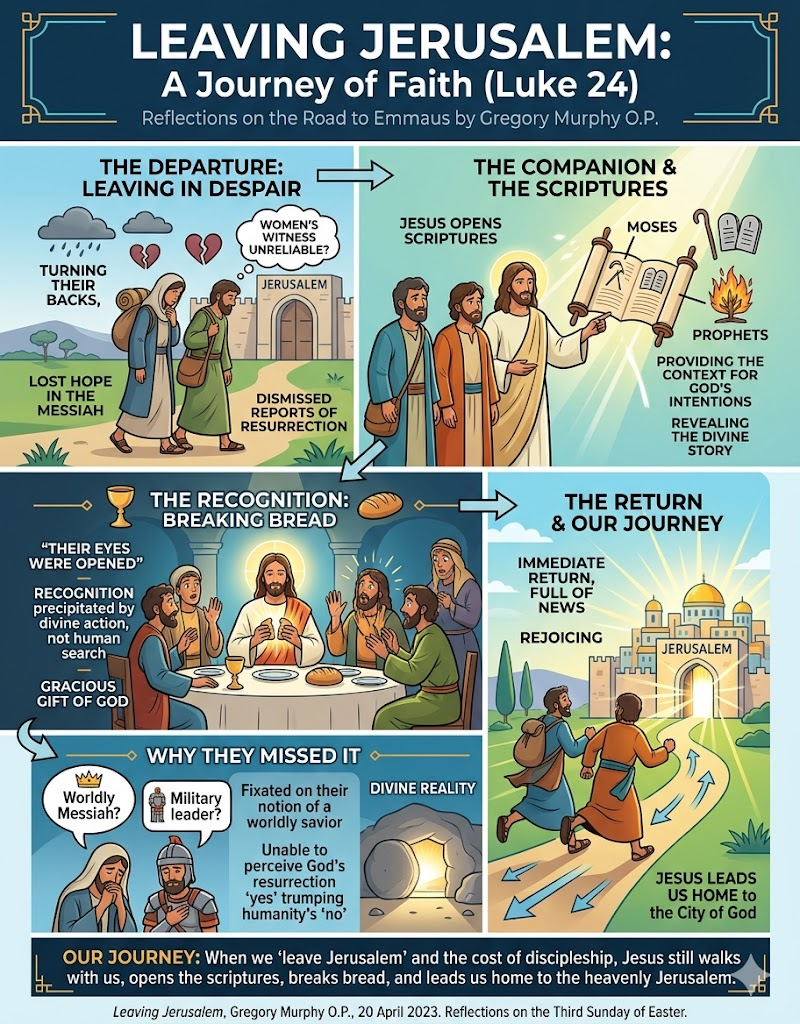
Fr. Gregory Murphy, OP, examines the journey of Cleopas and his companion as an act of desertion—turning their backs on Jerusalem in despondency. Despite hearing reports of the Resurrection, the disciples remain trapped in worldly skepticism and “enlightenment” doubt, unable to reconcile a crucified Messiah with their political expectations. Murphy argues that recognition is a divine gift, not a human achievement; it requires the Risen Christ to provide the interpretive key to Scripture. Ultimately, the encounter in the breaking of bread reverses their flight, transforming their retreat into a joyful return to the community of faith.
EVALUATION
THEOLOGICAL ACCURACY & BIBLICAL FIDELITY
This reflection shines in its academic rigor and theological depth, handling the Lukan text with precision.
- Textual Accuracy: The author correctly frames the cultural context of the time (e.g., women not being accepted as reliable witnesses) and accurately tracks the narrative arc of Luke’s Gospel.
- Doctrinal Soundness: The theology is highly orthodox and insightful. The observation that Luke uses the passive voice (“their eyes were opened”) to emphasize that revelation is a divine gift rather than a human achievement is an excellent, doctrinally rich point.
- Exegesis: The homilist does a fantastic job of exploring the “paradoxical relationship” between the risen Jesus and the Jewish scriptures, demonstrating how the Old Testament is required to understand Christ, and Christ is required to understand the Old Testament.
THEMATIC ORGANIZATION & STRUCTURE
The text follows a logical, traditional expository structure, though it leans heavily into academic formatting.
- Central Theme: The thesis is clear: the resurrection provides the necessary context to understand both the scriptures and the demands of discipleship.
- Structural Clarity: The reflection moves methodically from the historical narrative (Paragraph 1) to theological analysis (Paragraph 2), to sacramental theology (Paragraph 3), and finally to a pastoral application (Paragraphs 4 and 5).
- Transitions: The transitions are competent, though somewhat abrupt between paragraph three (the Eucharist) and paragraph four (Jesus’ prayer in Gethsemane). It requires the reader to work a bit to connect the “erstwhile disciples’ mistake” back to the preceding thoughts on revelation.
DELIVERY & PACING
Evaluated as a piece of written prose, the mechanics are highly polished, but it lacks the dynamic rhythm of a spoken address.
- Grammar and Polish: The sentences are grammatically flawless and demonstrate a high level of vocabulary (“ignominious,” “erstwhile,” “nascent”).
- Pacing and Flow: Because it reads like a theological essay, the sentences are dense. Phrases like “an understanding of the scriptures is critical to recognising who Jesus is and to grasping the import of what he has done” are structurally sound but lack the punchy, conversational rhythm that keeps a live audience engaged.
- Tone: The tone is reverent, academic, and serious. It acts more as a teaching document than a persuasive, pastoral exhortation.
PRACTICAL APPLICATION & RELEVANCE
The practical application is solid, but it is confined entirely to the concluding paragraphs rather than being woven throughout the text.
- Congregational Context: The homilist makes a good connection between the disciples leaving Jerusalem and modern believers “refusing the cost of discipleship” or struggling with “our turbulent times.”
- Actionable Takeaway: The takeaway is somewhat abstract. It encourages the reader to realize that Jesus walks with them and will lead them to the “heavenly Jerusalem,” but it lacks specific, grounded actions for the congregation to take into their upcoming week.
- Empathy: The writer asks an empathetic question (“How often do we find that the demands of the Lord… are too much for us?”), effectively bridging the gap between the historical failure of Cleopas and the modern failures of the reader.
ENGAGEMENT & PASTORAL CONNECTION
While intellectually stimulating for a reader who is already invested, it may struggle to capture the attention of a general congregation if spoken aloud.
- Hook and Introduction: The opening sentence is a straightforward, factual summary of Luke’s Gospel. It provides necessary context but does not serve as a compelling “hook” to immediately grab the listener’s emotional attention.
- Storytelling: The homilist relies entirely on the biblical narrative itself. There are no modern anecdotes, metaphors, or external stories used to illuminate the central theme for a contemporary audience.
- Pacing and Energy: The energy remains highly consistent and level throughout. It does not build to a particularly urgent or emotional crescendo, closing instead on a comforting, traditional note.
HOMILY HELPER
3rd Sunday of Easter (A)
Fr. Austin Fleming

2026 HOMILIES | ARCHIVE: 2023 | 2020 | 2017 | 2014 | 2011 | 2008
The Light of Christ
Fr. Austin utilizes the imagery of the Paschal candle and a small votive light to illustrate the constant, intimate presence of the Risen Christ. He argues that while a massive candle is a helpful liturgical reminder, the reality of Christ’s light is more like a steady, quiet glow that accompanies us through mundane rituals—showering, driving, and even unkind thoughts. By interpreting the road to Emmaus as “anywhere and everywhere,” Fr. Austin suggests that our daily commutes and routines are the true sites of divine encounter, culminating in the “breaking of the bread” where our eyes are finally opened to the One who has been talking to us all day long.

EVALUATION
THEOLOGICAL ACCURACY & BIBLICAL FIDELITY
- Textual Accuracy: The homilist accurately handles the Emmaus narrative (Luke 24). The passing note that historians and archaeologists are uncertain about the exact location of ancient Emmaus is a great, factually accurate detail that enhances the point rather than distracting from it.
- Doctrinal Soundness: The theology of the “Light of Christ” is deeply rooted in Easter/Paschal theology. The transition at the end to recognizing Jesus “in the breaking of the bread” reinforces solid sacramental theology regarding the Real Presence of Christ in the Eucharist.
- Exegesis: The preacher takes the specific historical road to Emmaus and allegorizes it into the modern believer’s daily journey. While this is more of a pastoral application than strict historical-critical exegesis, it is a well-established and faithful way to preach this specific text.
THEMATIC ORGANIZATION & STRUCTURE
- Central Theme: The core thesis is highly focused and easy to identify: the Risen Christ is a constant, intimately present light in the mundane moments of our everyday lives, even when we do not recognize Him.
- Structural Clarity: The homily follows a clear, three-part movement: 1) The visual object lesson of the candles; 2) The litany of everyday situations where Christ is present; 3) The scriptural anchor of the Emmaus story, culminating at the altar.
- Transitions: The transition from the “everyday life” litany into the Emmaus story (“look at the two disciples in the gospel today…”) is slightly abrupt but functions well enough to tie the modern experience of “not seeing Jesus” to the biblical narrative.
DELIVERY & PACING
- Grammar and Polish: Because this is a raw, extemporaneous transcript, it lacks grammatical precision. There are several run-on sentences and repetitive structures (“whatever you do today whatever you choose not to do”).
- Pacing and Flow: There are noticeable conversational stumbles and verbal fillers (“uh”, “you know”) that interrupt the flow. The phrasing “Jesus never shuts up never” is certainly punchy and memorable, but it borders on being overly casual and could temporarily pull some listeners out of the spiritual reverence of the message.
- Vocal Clarity (Implied): The extensive use of repetition (repeating “The Light of Christ” at the start of multiple sentences) creates a litany-like rhythm that likely sounded very poetic and comforting when spoken, even if it looks repetitive on paper.
PRACTICAL APPLICATION & RELEVANCE
- Congregational Context: This is the homily’s strongest attribute. Naming specific local routes (Route 126, Route 27) and mapping the spiritual journey onto a morning commute, showering, and brushing teeth brings lofty theological concepts directly into the congregation’s actual reality.
- Actionable Takeaway: It reframes the congregation’s entire week. The takeaway is a call to spiritual mindfulness—to actively look for the light of Christ in ordinary interactions and to return to the Eucharist to practice “recognizing” Him.
- Empathy: The homilist demonstrates beautiful pastoral care. Acknowledging that the listener might have unkind thoughts, experience grief, or shed tears—and placing Christ directly in those specific, messy moments—shows deep empathy for the human condition.
ENGAGEMENT & PASTORAL CONNECTION
- Hook and Introduction: Starting with a reference to the massive Paschal candle and contrasting it with a small, intimate votive candle is a fantastic visual hook. It immediately scales down a giant church concept into something personal.
- Pacing and Energy: The energy is warm, comforting, and conversational. It builds nicely from the quiet intimacy of a “night light” to the communal gathering of the church.
- Storytelling: Instead of telling a standalone anecdote, the preacher makes the congregation’s own daily routine the “story.” This is a highly effective way to keep the listeners personally invested in the message.
HOMILY HELPER
GO DEEPER
PROMPTS TO KEEP YOU WRITING
Copy/paste one of these command prompts into the Catholic Assistant (bottom right corner). This tool can help you brainstorm and provide you with further ideas to develop your homily.
_
- Rhetorical Strategy: Relatable Personification
- Notice how the preacher describes Jesus as "never shutting up" and "jumping into the car." Use this conversational, slightly humorous personification to make Jesus feel like a persistent, loving companion rather than a distant historical figure. It breaks down the formal "stained-glass" barrier and invites a more intimate relationship.
- Liturgical Strategy: Visual Aid Contrast
- If possible, use a physical votive candle as a prop during the homily to contrast with the large Paschal candle. This visual shift from the "extraordinary" (Easter Season) to the "ordinary" (daily life) reinforces the theology of the Incarnation—that God dwells in the small and the manageable.
- Pastoral Strategy: Compassion in the Shadows
- Address those for whom the "clouds are thick." Validate that walking by faith is hard when the light isn't visible. Offer the image of Christ as a "night light" keeping vigil; this provides a sense of security for those suffering from anxiety or grief, focusing on Christ’s active protection while we are "asleep" or unaware.
- Mystagogical Strategy: Recognizing the Incessant Voice
- Help the faithful understand that the "word of Truth" is being spoken to them "all day long," not just during the Sunday readings. Explain that we come to Mass not to start the conversation with Jesus, but to finally recognize the voice that has been speaking to us since we woke up.
- The Vigilant Nightlight portrays the Risen Lord as a silent guardian keeping watch while the world sleeps. Direct the AI to emphasize safety and peace.
- The Unstoppable Light asserts that no darkness, including the darkness of death or wasted time, can extinguish Christ’s glow. Direct the AI to focus on divine persistence.
3rd Sunday of Easter (A)
Monsignor Peter Hahn

Tragedies and Trials of Contemporary Life

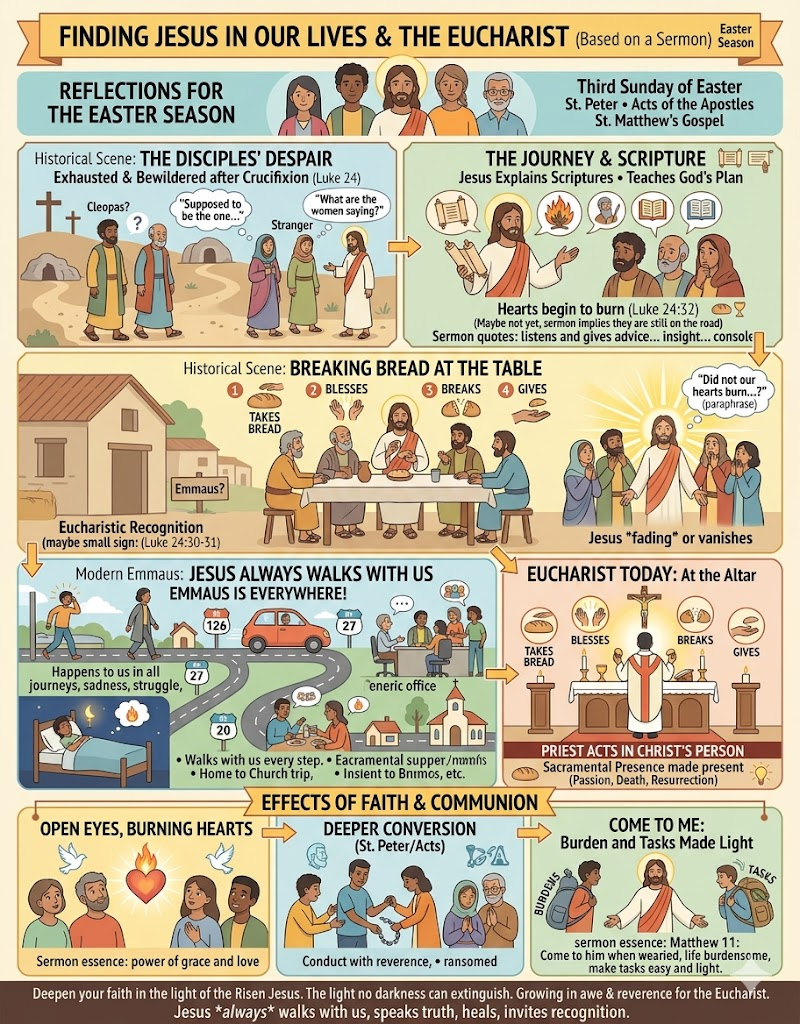
Msgr. Peter Hahn reflects on the Emmaus narrative as a continuous reality for the modern believer, rather than a mere historical event. He identifies the exhaustion and bewilderment of the disciples with the “tragedies and trials” of contemporary life. Msgr. Hahn emphasizes that through the ministry of the priest, the same Christ who walked the road to Emmaus acts at the altar—taking, blessing, breaking, and giving. This sacramental encounter is intended to spark a “burning heart” and a “deeper conversion,” empowering the faithful to carry their own crosses united to Christ’s perfect sacrifice.
EVALUATION
THEOLOGICAL ACCURACY & BIBLICAL FIDELITY
- Textual Accuracy: The homilist accurately recounts the Emmaus story and impressively weaves in multiple other scriptural references, including the Acts of the Apostles, the First Letter of Peter, and Jesus’s words in Matthew 11 (“come to me whenever we are wearied”).
- Doctrinal Soundness: The theological explanation of the Mass is superb. The preacher explicitly links the actions at Emmaus to the specific parts of the liturgy (the epiclesis, the fraction rite) and accurately describes the Eucharist as the “one perfect Sacrifice of his passion death and resurrection that is sacramentally made present for us.”
- Exegesis: The preacher draws a beautiful, accurate parallel between the discouraged disciples on the road and the modern Christian carrying their crosses, showing how Christ meets both exactly where they are.
THEMATIC ORGANIZATION & STRUCTURE
- Central Theme: The core message is clear and comforting: Jesus walks with us in our burdens and reveals Himself in the Eucharist to give us rest and strength.
- Structural Clarity: The homily has a very solid architecture. It opens with a personal reflection, moves into the biblical narrative, applies it to the congregation’s struggles, grounds that application in the Eucharist, and concludes with a call to conversion and rest.
- Transitions: The transitions are mostly smooth. However, the section between 04:52 and 05:40 rapid-fires through references from Acts, Peter, and Matthew. While theologically rich, packing three distinct scriptural pivots into a single minute slightly crowds the structural flow.
DELIVERY & PACING
- Grammar and Polish: The extemporaneous nature of the delivery results in several run-on sentences and slightly tangled phrasing (e.g., “The one walking along with them on the way was the one whom they loved and who may followed and whom they saw crucified again”). There are also likely some transcription errors here (e.g., “Christ rose the den” instead of “from the dead”), but the spoken syntax is generally quite loose.
- Pacing and Flow: The pacing is gentle and reflective. The preacher brings things full circle nicely at the end, referencing the opening (“I hope today the listening was as easy as was the preaching”), which provides a satisfying rhetorical closure.
PRACTICAL APPLICATION & RELEVANCE
- Congregational Context: The homilist speaks directly to the reality of human suffering. Acknowledging that people often walk through life “disheartened and downcast” carrying heavy crosses makes the message highly relevant to a congregation that may be silently struggling.
- Actionable Takeaway: The takeaway is more of an internal spiritual disposition than an external action plan. The call is to allow the Eucharist and the reality of the Resurrection to prompt a “deeper conversion in our love for him and for one another.”
- Empathy: The empathy here is profound. The priest explicitly links the cross of Christ to “all the crosses that you and I will carry,” offering a deeply compassionate view of the congregation’s daily trials.
ENGAGEMENT & PASTORAL CONNECTION
- Hook and Introduction: The opening is incredibly strong because of its vulnerability. A priest admitting that preaching can sometimes be difficult—and that listening can be difficult too—instantly disarms the congregation and builds a warm, human rapport.
- Pacing and Energy: The energy matches the content perfectly. It begins with the “indescribable ease and joy” of Easter, shifts into a solemn acknowledgment of life’s tragedies, and ends on a note of deep reverence and peace.
- Storytelling: Rather than relying on an external anecdote, the preacher effectively uses the Emmaus narrative as the primary story, successfully inviting the listener to see themselves as the unnamed disciples on the road.
HOMILY HELPER
GO DEEPER
PROMPTS TO KEEP YOU WRITING
Copy/paste one of these command prompts into the Catholic Assistant (bottom right corner). This tool can help you brainstorm and provide you with further ideas to develop your homily.
_
- The Disheartened Journey describes the exhaustion and bewilderment of the disciples following the trauma of the crucifixion. Direct the AI to emphasize the human feeling of being demoralized.
- The Stranger’s Wisdom follows an unknown traveler as he listens to the disciples’ grief and offers unexpected insight into their situation. Direct the AI to focus on the power of listening.
- Eyes Opened at the Altar connects the moment the bread is broken at Emmaus to the Fraction Rite in the modern Mass. Direct the AI to focus on sacramental recognition.
- The Ransomed Conduct explores the call to live differently after being redeemed by the precious blood of Christ. Direct the AI to focus on moral conversion.
- Rest for the Weary utilizes the promise from Matthew 11 to describe the Eucharist as a place of refreshment for the burdened. Direct the AI to emphasize spiritual rest.
- United in the Cross depicts Christ gathering up the various crosses carried by the faithful and uniting them to his own. Direct the AI to focus on redemptive suffering.
- The Vanishing Presence reflects on the moment Jesus disappears after being recognized, leaving the disciples with "burning hearts" to share the news. Direct the AI to focus on internal transformation.
- An Incessant Presence argues that the walk to Emmaus is a template for every tragedy and trial faced by the modern Church. Direct the AI to emphasize constant accompaniment.
- The Priest’s Privilege reflects on the fundamental ministry of preaching the Gospel and the joy of sharing the Easter message. Direct the AI to focus on the beauty of ministry.
- Awe and Reverence encourages the faithful to approach the Holy Eucharist with a renewed sense of wonder at Christ’s self-gift. Direct the AI to emphasize liturgical devotion.
3rd Sunday of Easter (A)
Fr. Charles E. Irvin
Recognition of Christ Occurs in Brokenness

Fr. Irvin presents the Emmaus account as a lesson in divine revelation, suggesting that Jesus intentionally remained hidden to first illuminate the disciples’ minds through Scripture. He defends the Catholic Church’s deep scriptural roots, highlighting the thematic unity between the Old and New Testaments in the Mass. Fr. Irvin’s central thesis is that recognition of Christ occurs in “brokenness”—just as the disciples recognized Him in the broken bread, modern believers must find Him in the “tsunami” of contemporary economic and social fears, and specifically within the suffering of the marginalized and broken-hearted.

EVALUATION
THEOLOGICAL ACCURACY & BIBLICAL FIDELITY
- Textual Accuracy: The homilist accurately references the Emmaus narrative and expertly ties it to Matthew 25 (the judgment of the nations). The inclusion of St. Augustine and the Church Fathers’ perspective on Christ’s deliberate concealment is a strong, historically grounded addition.
- Doctrinal Soundness: The defense of the Catholic Liturgy of the Word is factually and doctrinally accurate, highlighting the intrinsic connection between the Old Testament, the Epistles, and the Gospel within the Mass.
- Exegesis: The preacher makes a fascinating and theologically rich pivot near the end. While the “breaking of the bread” in Luke 24 is primarily Eucharistic, the homilist expands this exegesis to mean recognizing Christ in “human brokenness.” This is a creative, pastorally sound interpretation that aligns beautifully with broader biblical teachings, even if it stretches the strict literal context of the Emmaus text.
THEMATIC ORGANIZATION & STRUCTURE
- Central Theme: The core message attempts to bridge recognizing Jesus in Scripture/Eucharist with recognizing Him in the suffering of others. However, the sheer number of sub-themes slightly muddles the primary focus.
- Structural Clarity: The homily wanders significantly in the middle. It begins as a scriptural commentary, shifts into an apologetic defense of Catholic Bible reading, and then pivots into a socio-economic commentary before landing on human suffering.
- Transitions: The structural flow is interrupted by explicit detours. The phrase “As an aside I want to point out here…” literally announces a break in the homily’s architecture. The jump from this liturgical defense into the “tsunami-like changes” and the “mortgage mess” feels abrupt and disjointed.
DELIVERY & PACING
- Grammar and Polish: Unlike a highly extemporaneous speech, this text reads like a well-prepared, scripted essay. The sentence structures are formal, complete, and grammatically precise (e.g., “Moreover Jesus, they believed, wanted the disciples to see and understand…”).
- Pacing and Flow: The pacing is generally steady, though the dense listing of societal issues (globalization, mortgages, energy costs, illegal immigration, racism) creates a heavy, rapid-fire section that might verbally overwhelm the listener before they can process the underlying point about fear.
PRACTICAL APPLICATION & RELEVANCE
- Congregational Context: The preacher attempts to connect the ancient disciples’ trauma with modern fears. However, referencing the “mortgage mess,” “value of the dollar plummeting,” and specific hot-button socio-political issues (“illegal immigrations”) anchors the homily to a very specific, somewhat dated temporal context. Depending on the congregation, this could come across as overly political or strictly focused on economic anxieties rather than universal spiritual realities.
- Actionable Takeaway: The conclusion is highly actionable and beautifully stated. Asking the congregation to actively look for Jesus in the brokenhearted, the sick, and the grieving provides a clear, practical spiritual directive for the week.
- Empathy: The homilist shows strong empathy for the fears and anxieties of the modern world, culminating in a compassionate call to alleviate the suffering of others.
ENGAGEMENT & PASTORAL CONNECTION
- Hook and Introduction: The opening is quite academic and standard (“Last Sunday’s Gospel… Today’s Gospel…”). It informs the listener but does not immediately capture their emotional or intellectual curiosity.
- Pacing and Energy: The energy dips during the apologetic defense of the Mass, as it feels more instructional than pastoral. However, the energy rises beautifully in the final third when the preacher moves into the stirring, prophetic call of Matthew 25.
- Storytelling: The homily lacks a central narrative or story. Instead of illustrating “human brokenness” with a specific, relatable anecdote, it relies on a broad, abstract list of global and societal problems, which is generally less engaging than a focused narrative.
HOMILY HELPER
GO DEEPER
PROMPTS TO KEEP YOU WRITING
Copy/paste one of these command prompts into the Catholic Assistant (bottom right corner). This tool can help you brainstorm and provide you with further ideas to develop your homily.
_
- The Intentional Veil explores St. Augustine's idea that Jesus hid His identity to prioritize the teaching of the Scriptures. Direct the AI to focus on divine pedagogy.
- A Scriptural Nourishment defends the Catholic Mass as a deeply biblical liturgy where the Old and New Testaments meet. Direct the AI to focus on liturgical apologetics.
- Burning Hearts on the Road captures the moment of intellectual and emotional awakening as the prophets are revealed in Christ's light. Direct the AI to emphasize internal illumination.
- The Tsunami of Fear addresses modern economic and social anxieties, from mortgage crises to globalization, through the lens of faith. Direct the AI to focus on contemporary relevance.
- Recognizing Human Brokenness identifies the presence of the Risen Lord specifically within those who are suffering, grieving, or marginalized. Direct the AI to focus on social compassion.
- The Liturgy's Two Tables explains the essential relationship between the Liturgy of the Word and the Liturgy of the Eucharist. Direct the AI to emphasize spiritual feeding.
- Seeing Without Recognizing analyzes the psychological and spiritual barriers that prevent us from seeing God in our neighbors. Direct the AI to focus on spiritual inattentiveness.
- The Judgment of Presence connects the Emmaus recognition to the criteria of Matthew 25—finding Christ in the hungry and naked. Direct the AI to focus on active charity.
- Nailing Him Still reflects on how modern sin and the rejection of the suffering continue the "ongoing" Passion of Christ. Direct the AI to emphasize the mystical Body.
- The Road Through Darkness offers the "Promise of Easter" as the only antidote to the deluge of fears in the new millennium. Direct the AI to focus on resurrection hope.
3rd Sunday of Easter (A)
Fr. Joe Jagodensky, SDS
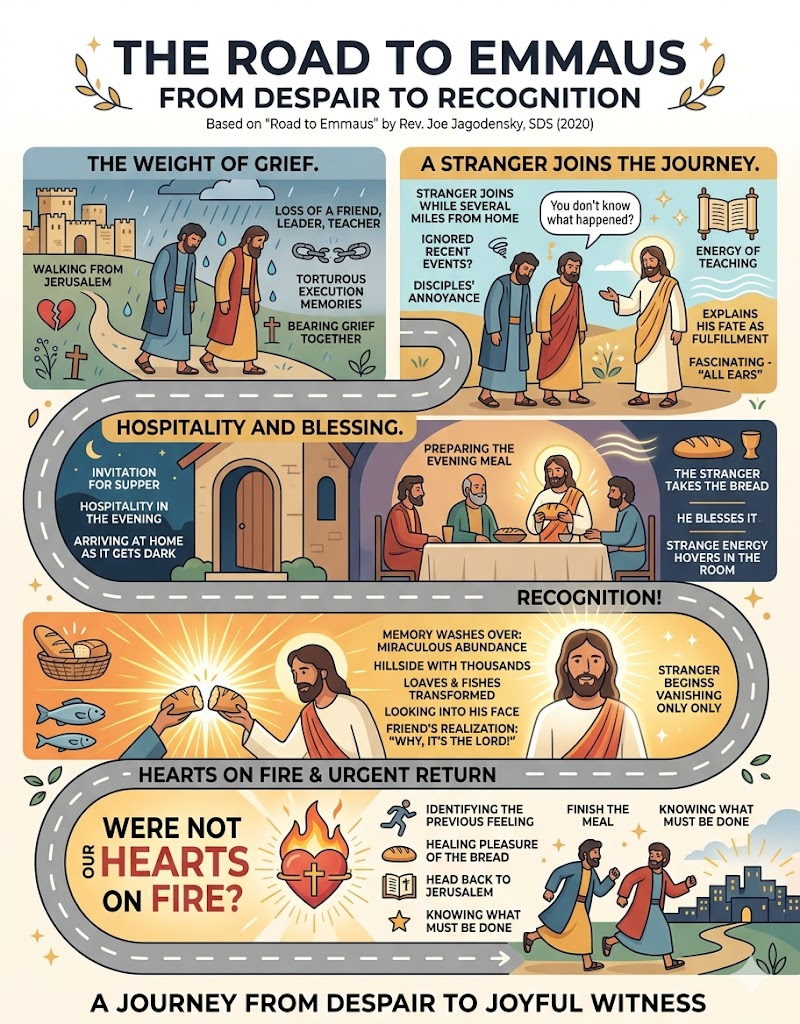
Road to Emmaus

Rev. Joe Jagodensky, SDS, utilizes an Ignatian imaginative approach to the Emmaus narrative, inviting the listener to step into the physical and emotional labor of grief. He portrays the walk not just as a journey of miles, but as a “hard work” of processing trauma, branded by memories of blood and shame. The stranger’s entrance shifts the atmosphere from despondency to fascination, but it is the physical act of blessing bread—recalling the miraculous abundance on the hillside—that triggers an explosive realization. This internal “lightning” compels the disciples to immediately reverse their journey, moving from isolation back to community.
EVALUATION
THEOLOGICAL ACCURACY & BIBLICAL FIDELITY
- Textual Accuracy: The narrative faithfully tracks the entire sequence of the Luke 24 Emmaus account, from the grief of the walk to the exposition of Scripture, the breaking of the bread, the sudden vanishing, and the immediate return to Jerusalem.
- Doctrinal Soundness: It beautifully captures the theology of recognition. The homilist connects the blessing of the bread at Emmaus to a previous miracle (the feeding of the multitudes), which accurately reflects how the disciples would have recognized Jesus’s specific, physical mannerisms of blessing and breaking bread.
- Exegesis: Rather than an academic exegesis, this is a narrative exegesis. The preacher draws the meaning out of the text by exploring the psychological and emotional reality of the disciples, which is a highly effective, ancient method of scriptural interpretation.
THEMATIC ORGANIZATION & STRUCTURE
- Central Theme: The core theme is the transformative journey from profound grief and trauma to the electrifying realization of the Resurrection.
- Structural Clarity: The homily possesses a flawless narrative arc. It moves chronologically: trauma/grief $\rightarrow$ companionship on the road $\rightarrow$ scriptural illumination $\rightarrow$ the Eucharistic revelation $\rightarrow$ missionary action.
- Transitions: Because it operates as a story, the transitions are organic and seamless. The movement from the dusty road into the intimate setting of the house is paced perfectly.
DELIVERY & PACING
- Grammar and Polish: The prose is exceptionally polished and poetic. It uses vivid, sensory vocabulary (“gasping for air,” “long, rainy afternoon,” “waves of that energy, like lightning sparking”) that would make for a captivating oral delivery.
- Pacing and Flow: The pacing is masterful. The use of rhetorical questions in the middle of the narrative (“Where have you heard this sort of blessing before? What do you see?”) acts as built-in dramatic pauses, giving the listener time to mentally picture the scene before the preacher continues.
PRACTICAL APPLICATION & RELEVANCE
- Congregational Context: This homily relies on universal human emotions—specifically the heavy, exhausting “work of grief”—to connect with the listener. Anyone who has lost a loved one can immediately relate to the exhaustion and the need to “cry for a while.”
- Actionable Takeaway: Unlike a traditional homily, this does not end with a moral directive or a specific “to-do” list for the modern world. Its application is strictly internal and experiential. It asks the listener to experience the joy of the Resurrection internally, which is a powerful spiritual exercise, though slightly less “practical” in a conventional sense.
- Empathy: The description of grief, trauma, and intrusive memories (“you close your eyes and see blood”) demonstrates a profound psychological empathy.
ENGAGEMENT & PASTORAL CONNECTION
- Hook and Introduction: The immediate use of the second-person point of view (“It’s a long walk home from Jerusalem, but you’re glad for the exertion”) is an incredibly strong hook. It forces the congregation out of the role of passive listeners and turns them into active participants in the story.
- Pacing and Energy: The energy builds perfectly from a slow, heavy, sorrowful slog into an electric, fast-paced conclusion (“you look at each other and know what you must do”).
- Storytelling: This is storytelling at its finest. By putting the listener inside the shoes of Cleopas or his companion, the homilist ensures that the congregation is hanging on every word.
HOMILY HELPER
GO DEEPER
PROMPTS TO KEEP YOU WRITING
Copy/paste one of these command prompts into the Catholic Assistant (bottom right corner). This tool can help you brainstorm and provide you with further ideas to develop your homily.
_
- The Branded Memory focuses on the traumatic sights and sounds of the crucifixion that haunt the disciples on their walk home. Direct the AI to focus on processing grief.
- The Hard Work of Walking depicts the physical exertion of a long journey through a rainy afternoon as a metaphor for spiritual struggle. Direct the AI to emphasize physical and emotional labor.
- All Ears for the Truth explores the fascination of the two friends as a stranger explains the fulfillment of ancient prophecies. Direct the AI to focus on intellectual awakening.
- The Miraculous Echo connects the blessing of the bread in the Emmaus house to the multiplication of the loaves and fishes. Direct the AI to focus on the power of memory.
- Lightning in the Room describes the supernatural energy and warmth that remains in the house after Jesus vanishes. Direct the AI to emphasize the "lightning" of the Resurrection.
- The Healing Pleasure reflects on the restorative power of eating bread blessed by the hands of Christ. Direct the AI to focus on the healing nature of the Eucharist.
- A Shared Conviction explores the bond between the two friends as they encourage one another through their darkest hour. Direct the AI to focus on companionship in faith.
- Heading Back to the City portrays the urgent, late-night journey back to Jerusalem to reunite with the other followers. Direct the AI to focus on the mission to share the news.
- The Face of the Lord asks the reader to imagine the specific expression and look in Jesus' eyes at the moment of recognition. Direct the AI to focus on the visual encounter.
- Identified by Fire reflects on the delayed realization that their hearts were already burning before their eyes were even opened. Direct the AI to focus on the "burning heart" phenomenon.
3rd Sunday of Easter (A)
Deacon Greg Kandra

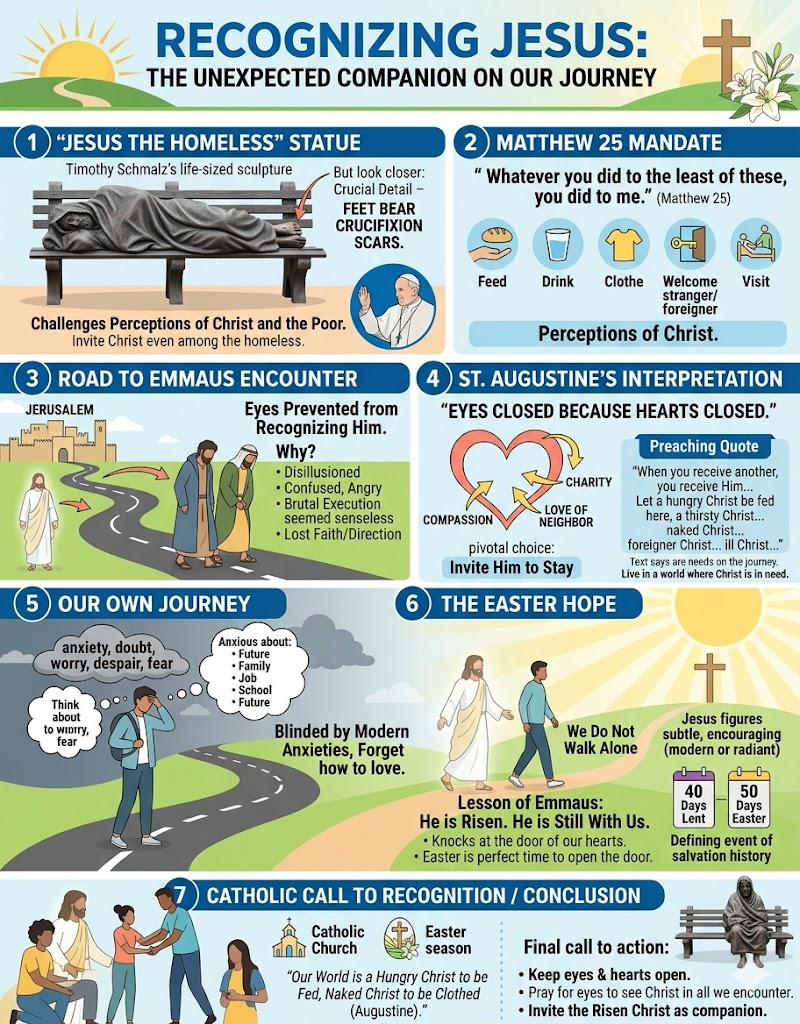
We Do Not Walk Alone
Deacon Greg Kandra opens with the provocative image of the “Homeless Jesus” statue—a figure easily mistaken for a vagrant until one notices the stigmata on the feet. He links this modern “unrecognizability” to the disciples on the road to Emmaus, suggesting that their blindness was not merely physical but a result of closed hearts. Drawing on St. Augustine, Kandra argues that the turning point of the story is the act of hospitality; it is only when the disciples welcome the “stranger” that they encounter the Savior. Ultimately, the homily challenges the faithful to recognize Christ in the marginalized and to sustain the Easter spirit long after the “plastic grass” of the holiday has been discarded.
EVALUATION
THEOLOGICAL ACCURACY & BIBLICAL FIDELITY
- Textual Accuracy: The homilist accurately and seamlessly weaves together the Emmaus narrative (Luke 24) with the Judgment of the Nations (Matthew 25).
- Doctrinal Soundness: The theology of the Incarnation and the Resurrection is spot-on. The preacher highlights how Christ comes to us in the mundane and the marginalized (as a baby, a stranger, bread, and the poor).
- Exegesis: The inclusion of St. Augustine’s commentary is a masterstroke of exegesis. Pointing out that the disciples’ “eyes were closed because their hearts were closed”—and that the pivotal moment of revelation required an act of charitable hospitality—provides a profound, historically grounded interpretation of the text.
THEMATIC ORGANIZATION & STRUCTURE
- Central Theme: The thesis is crystal clear: Will we recognize the Risen Christ, especially when He appears to us in unexpected or distressing disguises?
- Structural Clarity: The homily utilizes a flawless “bookend” structure. It opens with the modern news story of the homeless Jesus statue, transitions into the biblical story of Emmaus, applies the lesson to the congregation’s daily anxieties, and then perfectly circles back to the homeless Jesus statue to close the message.
- Transitions: The transitions are incredibly smooth. Moving from the woman in North Carolina failing to recognize a statue of Jesus to the disciples failing to recognize the actual Jesus is a brilliant, effortless pivot.
DELIVERY & PACING
- Grammar and Polish: The script is exceptionally well-written for oral delivery. The use of short, punchy sentences and standalone paragraphs creates a natural, dramatic pacing.
- Pacing and Flow: The pacing of the introduction is phenomenal. The preacher deliberately drops breadcrumbs (“It turned out to be a false alarm,” “It was a statue,” “The feet bear the scars”) to build suspense before delivering the theological payload. This shows a high level of homiletic craftsmanship.
PRACTICAL APPLICATION & RELEVANCE
- Congregational Context: The preacher brilliantly grounds the lofty theology of the Easter season into the mundane reality of the modern household, warning the congregation not to throw away the Easter joy along with the “wilted flowers and the stale chocolate and plastic grass.”
- Actionable Takeaway: The application is highly practical. It challenges the congregation not merely to feel good about the Resurrection, but to actively practice the hospitality of Emmaus by serving the poor, the naked, and the hungry in their own communities.
- Empathy: Acknowledging the “anxieties, angers, and fears” regarding school, jobs, and the future shows a solid understanding of the daily burdens the congregation carries into the pews.
ENGAGEMENT & PASTORAL CONNECTION
- Hook and Introduction: This is a masterful hook. Opening with a highly visual, modern news story featuring a “plot twist” immediately grabs the congregation’s attention and perfectly tees up the entire theological premise of the homily.
- Pacing and Energy: The energy starts with narrative intrigue, moves into quiet reflection on the scriptures, rises to a challenging call-to-action regarding Easter joy, and ends on a solemn, unified prayer.
- Storytelling: The use of the Timothy Schmalz statue as the primary narrative device is incredibly effective. It serves as a modern-day parable that perfectly mirrors the Emmaus road experience.
HOMILY HELPER
GO DEEPER
PROMPTS TO KEEP YOU WRITING
Copy/paste one of these command prompts into the Catholic Assistant (bottom right corner). This tool can help you brainstorm and provide you with further ideas to develop your homily.
_
- The Statue on the Bench describes a false alarm where a homeless man is revealed to be a sculpture of the crucified Christ. Direct the AI to focus on challenging perceptions.
- The Bare Scarred Feet zooms in on the only visible parts of a man under a blanket, revealing the marks of the Resurrection. Direct the AI to emphasize hidden identity.
- Closed Hearts and Eyes explores St. Augustine’s theory that the disciples couldn't see Jesus because they had forgotten how to love. Direct the AI to focus on spiritual blindness.
- Stay With Us reflects on the critical moment of hospitality that changes the trajectory of the Emmaus journey. Direct the AI to focus on the power of an invitation.
- A Hungry Christ to Feed applies the mandate of Matthew 25 to the "needs that arise on the journey" of life. Direct the AI to emphasize the corporal works of mercy.
- The Empty Easter Basket confronts the temptation to treat the Resurrection as a finished holiday once the chocolate and flowers are gone. Direct the AI to focus on liturgical persistence.
- A Startling Presence follows the theme of Jesus appearing in "unexpected ways"—from the manger to the park bench. Direct the AI to focus on the element of surprise.
- Walking Through Anxiety addresses the modern worries about jobs, school, and family that prevent us from seeing our Companion. Direct the AI to focus on pastoral reassurance.
- The Pope’s Blessing depicts the "Homeless Jesus" statue at the Vatican and its global impact on how the Church sees the poor. Direct the AI to focus on social impact.
- Companion on the Road prays for the grace to have eyes to see Christ in everyone we encounter, for as long as the journey lasts. Direct the AI to focus on lifelong discipleship.
3rd Sunday of Easter (A)
Fr. Langeh, CMF

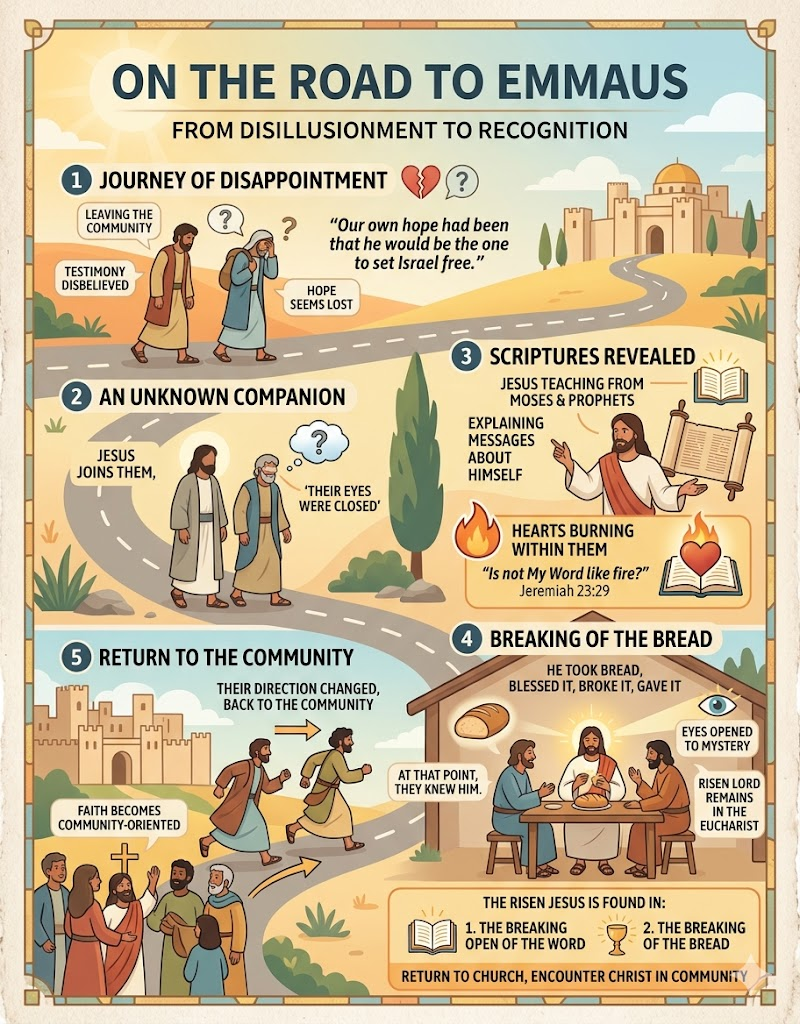
On the Road to Emmaus
Fr. Langeh presents the Emmaus account as a story of “interrupted journeys” and the restoration of lost hope. He highlights the initial “breaking news” of the Resurrection which, ironically, led the disciples to flee the community in disbelief. By identifying the Risen Christ with the fire of Jeremiah’s prophecy, Fr. Langeh argues that the Word prepares the heart for the eventual recognition in the Eucharist. The homily’s climax is the reversal of direction: the encounter with Christ transforms a private retreat into a community-oriented mission, forcing a return to the Church.
EVALUATION
THEOLOGICAL ACCURACY & BIBLICAL FIDELITY
- Textual Accuracy: The homilist handles the Emmaus narrative with high accuracy, tracking the disciples’ transition from fleeing Jerusalem to returning. The cross-reference to Jeremiah 23:29 (“Is not My Word like fire?”) is a fantastic, scripturally sound addition that enriches the Lukan text.
- Doctrinal Soundness: The theology is highly orthodox, particularly in its conclusion. The preacher correctly identifies the dual pillars of Catholic liturgy—the Liturgy of the Word and the Liturgy of the Eucharist—as the permanent ways the Church encounters the Risen Christ.
- Exegesis: The preacher offers excellent insight by noting that Jesus’ sudden disappearance “was not a disappointment, but another sign that the risen Lord would remain forever… in the breaking of bread.” This is a sophisticated and highly accurate theological reading of the text.
THEMATIC ORGANIZATION & STRUCTURE
- Central Theme: The thesis is clear and consistent: the journey to Emmaus is a journey from isolation and despair back to community and Eucharistic communion.
- Structural Clarity: The homily follows the natural chronological structure of the biblical story. It moves systematically through the disciples’ despair, the opening of the Word, the breaking of the bread, and the return to the community.
- Transitions: The transitions are logical, moving smoothly from the biblical exposition in the first four paragraphs to the contemporary application in the final paragraph.
DELIVERY & PACING
- Grammar and Polish: There are a few minor grammatical stumbles (e.g., “situation of disbelieve” instead of “disbelief”). More significantly, the phrasing feels a bit academic and dry. Sentences like “To portray this, Jesus taught and ate with them” read more like a biblical commentary or an essay than a spoken oration.
- Pacing and Flow: The pacing is steady, but it lacks rhetorical build-up. It is informative but does not employ the poetic or rhythmic devices that make a spoken homily memorable.
PRACTICAL APPLICATION & RELEVANCE
- Congregational Context: The homilist addresses a very real contemporary issue: Catholics walking away from the Church due to “confusion and disappointments.” Likening this modern exodus to the disciples fleeing Jerusalem is a highly relevant comparison.
- Actionable Takeaway: The call to action is clear and direct: “Let us return to the Church.” It gives the congregation a specific communal and sacramental directive.
- Empathy: The homilist acknowledges that “we too may have our states of confusion and disappointments,” but this is stated rather briefly. The homily doesn’t dwell on the emotional reality of those disappointments as deeply as some of the previous texts did.
ENGAGEMENT & PASTORAL CONNECTION
- Hook and Introduction: The opening hook (“It made what we will describe today as breaking news”) is a bit of a cliché and doesn’t do much to draw the listener in emotionally. The introduction mostly functions as a standard summary of the Gospel reading.
- Pacing and Energy: The energy is mostly analytical. Because the first four paragraphs are dedicated strictly to summarizing and explaining the biblical text, it takes a long time for the homily to finally connect with the listener’s actual life in the fifth paragraph.
- Storytelling: The homily does not use external storytelling, anecdotes, or metaphors, relying entirely on summarizing the biblical narrative. While the biblical narrative is strong, summarizing it without adding narrative color can sometimes struggle to hold a modern congregation’s attention.
HOMILY HELPER
GO DEEPER
PROMPTS TO KEEP YOU WRITING
Copy/paste one of these command prompts into the Catholic Assistant (bottom right corner). This tool can help you brainstorm and provide you with further ideas to develop your homily.
_
- The Breaking News explores the initial reaction of the disciples to the "alleged" resurrection as a confusing and unbelievable headline. Direct the AI to focus on skeptical uncertainty.
- The Jeremiah Fire compares the explanation of the Scriptures to the fire mentioned in the prophets that consumes and transforms. Direct the AI to focus on spiritual combustion.
- The Holy U-Turn depicts the moment the disciples' journey to Emmaus is interrupted and they choose to head back to Jerusalem. Direct the AI to focus on changing direction.
- Forever in the Bread reflects on how Jesus’ disappearance was actually a sign of His new, permanent presence in the Eucharist. Direct the AI to focus on sacramental mystery.
- Continuity of the Lord argues that the Risen Christ is the exact same Jesus who taught in Galilee, despite His transformed glory. Direct the AI to emphasize identity and continuity.
- The Lost Creedence analyzes why the disciples didn't believe the testimony of the women at the tomb and chose to flee. Direct the AI to focus on the struggle for faith.
- A Community Oriented Faith explores the necessity of returning to the group of believers after encountering Christ individually. Direct the AI to emphasize communal life.
- Breaking Down the Word follows Jesus as He meticulously interprets every scriptural passage that referred to His suffering and glory. Direct the AI to focus on biblical teaching.
- The Mystery of Presence captures the moment the disciples' eyes are finally opened to see the Risen Lord in their midst. Direct the AI to focus on the moment of comprehension.
- The Unfinished Destination ponders the idea that the disciples never actually arrived at Emmaus because Christ became their true home. Direct the AI to focus on spiritual redirection.
3rd Sunday of Easter (A)
Deacon Peter McCulloch
2026 HOMILIES | ARCHIVE: 2023 | 2020
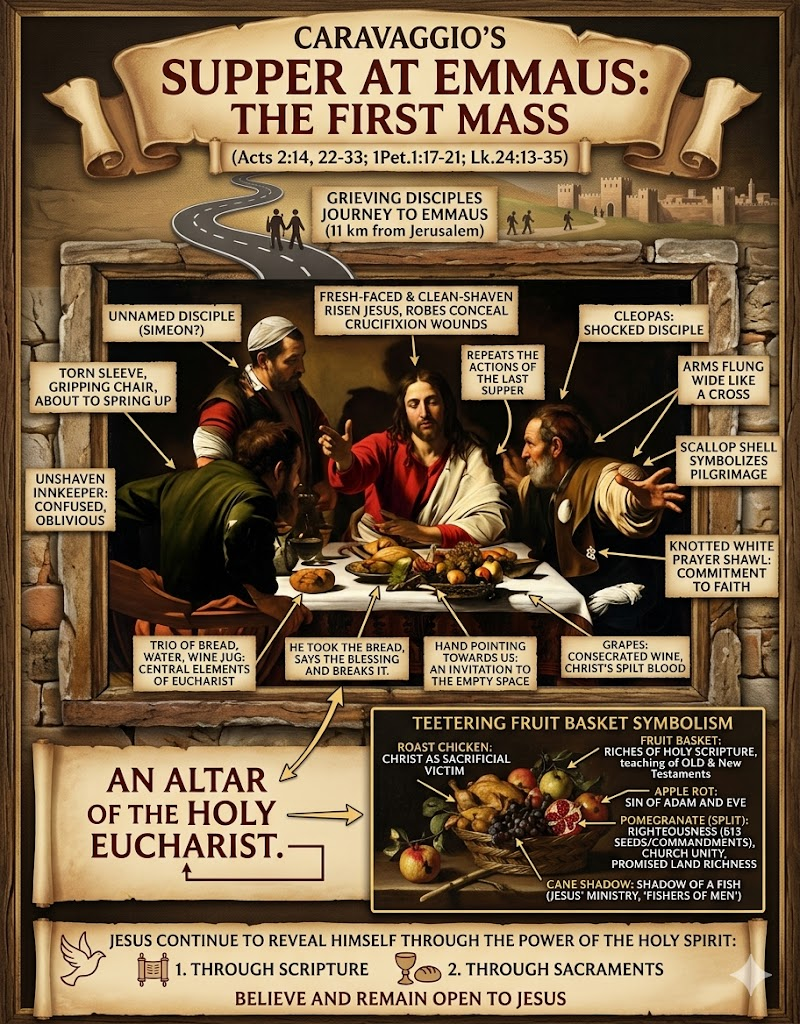
Caravaggio’s Supper at Emmaus
Deacon Peter McCulloch uses Caravaggio’s 1601 masterpiece, The Supper at Emmaus, as a visual lens to explore the mystery of the Resurrection. He interprets the painting not merely as a historical depiction, but as a representation of the first Mass. Through the symbolic “still life” on the table—the precarious fruit basket, the rotting apple of original sin, and the righteous pomegranate—McCulloch illustrates how Christ’s presence upends earthly expectations. Ultimately, the homily posits that just as Jesus revealed himself to the astonished disciples through Scripture and the Eucharist, he continues to invite us to the “empty space” at his table today.
EVALUATION
THEOLOGICAL ACCURACY & BIBLICAL FIDELITY
- Textual Accuracy: The homilist handles the Luke 24 text accurately. The identification of Cleopas is biblical, and the suggestion that the unnamed disciple might be his son Simeon (who later became the second bishop of Jerusalem) is a well-founded historical tradition.
- Doctrinal Soundness: The sacramental theology is robust and perfectly aligned with Church teaching. Equating the table at Emmaus to an altar and identifying the bread, water, and wine as the “three central elements of the Holy Eucharist” reinforces the doctrine of the Real Presence.
- Exegesis: Using Caravaggio’s artistic choices (the rotting apple representing the Fall, the pomegranate representing the Church, the beardless Jesus) as a lens to interpret the scriptural reality of the Resurrection is a brilliant and highly effective form of exegesis.
THEMATIC ORGANIZATION & STRUCTURE
- Central Theme: The thesis is clear: just as Jesus revealed Himself to the disciples at Emmaus, He continues to reveal Himself to us today through Scripture and the Eucharist.
- Structural Clarity: The organization is flawless. After a brief scriptural introduction, the homily systematically guides the listener’s “eye” around the painting: first to Jesus, then the innkeeper, the disciples on the right and left, down to the table’s symbolic elements, and finally zooming out to the overarching theological message.
- Transitions: The transitions are smooth and natural, moving geographically across the canvas (“On the right…”, “To the left…”, “On the table…”).
DELIVERY & PACING
- Grammar and Polish: The prose is polished, descriptive, and educational. It reads like a captivating museum audio guide seamlessly blended with a pastoral sermon.
- Pacing and Flow: The pacing is excellent. By constantly asking the listener to “notice” specific details (the shadow of the fish, the torn sleeve, the knot in the shawl), the preacher ensures active, continuous listening.
- Caveat: The entire delivery relies on the assumption that the congregation is looking at a projected image of the painting or a printed handout. If they cannot see the painting, the delivery will completely fail. Assuming they can, it is highly engaging.
PRACTICAL APPLICATION & RELEVANCE
- Congregational Context: The homilist makes a wonderful connection between the ancient disciples’ struggle to believe and the modern congregation’s identical struggle. Pointing out that even the people who personally knew Jesus had a hard time understanding the Resurrection offers great comfort to modern believers who wrestle with doubt.
- Actionable Takeaway: The application is more contemplative than action-oriented. The primary call is to accept Christ’s invitation to sit at the “empty space in front” of the table and remain open to His revelation in the sacraments.
- Empathy: Acknowledging the disciples’ depression and confusion, and equating it to our modern struggles with faith, demonstrates strong pastoral empathy.
ENGAGEMENT & PASTORAL CONNECTION
- Hook and Introduction: Using a world-famous masterpiece as the focal point is an incredible hook. Humans are highly visual creatures, and decoding a painting feels like solving a mystery, which instantly captivates an audience.
- Pacing and Energy: The energy is meditative and revelatory. Every time the preacher reveals a new hidden symbol (like the cane casting the shadow of a fish), it provides a satisfying “aha!” moment for the listener.
- Storytelling: The storytelling here is visual. The homilist brings the static figures to life (Cleopas flinging his arms, Simeon gripping his chair), turning a 400-year-old painting into a dynamic, unfolding narrative.
HOMILY HELPER
GO DEEPER
PROMPTS TO KEEP YOU WRITING
Copy/paste one of these command prompts into the Catholic Assistant (bottom right corner). This tool can help you brainstorm and provide you with further ideas to develop your homily.
_
- The Caravaggio Canvas recreates the dramatic moment Jesus blesses the bread, capturing the shock and raw emotion of the disciples. Direct the AI to focus on artistic realism.
- The Empty Space explores Christ’s reaching hand as a direct invitation for the viewer to sit at the table of the Eucharist. Direct the AI to focus on personal invitation.
- Teetering Expectations uses the image of a falling fruit basket to show how the Resurrection disrupts our earthly security and plans. Direct the AI to focus on spiritual upheaval.
- Shadow of the Fish analyzes the subtle lighting in a room where a simple cane casts the sign of the fish and the call to ministry. Direct the AI to focus on hidden symbolism.
- Pilgrims on the Way depicts Cleopas with his scallop shell and torn sleeve, representing the weary journey of every believer. Direct the AI to focus on the theme of pilgrimage.
- The First Mass reimagines the supper at Emmaus as the inaugural celebration of the Eucharist following the Resurrection. Direct the AI to emphasize liturgical continuity.
- Righteousness in a Pomegranate explores the Jewish symbolism of the fruit as the fulfillment of the Torah and the unity of the Church. Direct the AI to focus on biblical richness.
- A Fresh-Faced Savior reflects on the transformed appearance of the Risen Christ, whose robes hide the wounds of His execution. Direct the AI to focus on the mystery of the Resurrection.
- The Innkeeper’s Silence ponders the perspective of the bystander who witnesses the miracle without understanding its divine significance. Direct the AI to focus on spiritual awareness.
- The Knot of Commitment uses the prayer shawl on Cleopas' lap to symbolize an absolute and binding commitment to the faith of the apostles. Direct the AI to focus on radical discipleship.
3rd Sunday of Easter (A)
Msgr. Charles Pope

Mass on the Move

Msgr. Charles Pope presents the Road to Emmaus not merely as a story, but as the structural blueprint for the Holy Sacrifice of the Mass. He identifies the two disciples as “broken men” walking in the wrong direction—physically West, away from the rising sun/Son. Msgr. Pope argues that the Lord uses the framework of the Liturgy to reorient them, moving from a Gathering and Penitential Rite on the road to a Liturgy of the Word that sets hearts on fire, and finally to a Liturgy of the Eucharist. The homily concludes that the “vanishing” of Jesus is an invitation to see Him through the eyes of faith in the Sacraments, commissioning the faithful to run back to their “Jerusalem” with joy.
EVALUATION
THEOLOGICAL ACCURACY & BIBLICAL FIDELITY
- Textual Accuracy: The homilist handles the Emmaus narrative with high precision. The observation that the disciples are walking West (into the setting sun/darkness) and away from Jerusalem (the site of the Resurrection/the East) is a brilliant, factually accurate geographical and theological detail.
- Doctrinal Soundness: The liturgical theology is exceptionally orthodox. Mapping the Emmaus story directly onto the structure of the Mass (Liturgy of the Word leading into the Liturgy of the Eucharist) is a classic, foundational piece of Catholic sacramental theology.
- Exegesis: Identifying the unnamed disciple (Cleopas’ companion) as the listener (“the other is you”) is a highly effective, time-honored exegetical tradition that invites the congregation directly into the text.
THEMATIC ORGANIZATION & STRUCTURE
- Central Theme: The thesis is crystal clear and never wavers: the Emmaus journey is the blueprint for the Mass, designed to move us from darkness and discouragement into the light of the Resurrection.
- Structural Clarity: This is the homily’s absolute strongest point. The explicit, step-by-step parallel structure (Stage One: Gathering Rite, Stage Two: Penitential Rite, etc.) makes the message incredibly easy to follow, digest, and remember.
- Transitions: The transitions are flawless because they are built directly into the chronological flow of both the biblical narrative and the weekly liturgy. The repeated pivot (“So, too, for us at Mass…”) serves as an excellent rhetorical anchor.
DELIVERY & PACING
- Grammar and Polish: The prose is highly polished, articulate, and instructional. It avoids the dry, clinical tone of an academic lecture by using active, encouraging language (“Help is on the way!”, “Taste and see!”).
- Pacing and Flow: The pacing is rhythmic and predictable in a good way. The repeated structure builds a comforting cadence, culminating in the high-energy dismissal at the end.
PRACTICAL APPLICATION & RELEVANCE
- Congregational Context: This homily is universally relevant to anyone sitting in the pews. By explaining what they are currently doing (attending Mass) through the lens of why they are doing it, it reinvigorates a weekly routine that can easily become stale.
- Actionable Takeaway: The takeaway is highly practical: to view the Sunday Mass not as an obligation, but as a healing journey, and to take the Ite Missa Est (the dismissal) as a literal commission to share the joy of the Gospel.
- Empathy: The preacher demonstrates excellent pastoral empathy in the “Penitential Rite” section, acknowledging that the congregation often enters the church “looking downcast and carrying many burdens and sins.”
ENGAGEMENT & PASTORAL CONNECTION
- Hook and Introduction: The opening paints a vivid, relatable picture of two depressed, exhausted men walking in the wrong direction. Asking the four rapid-fire rhetorical questions (“How will the Lord give them vision? How will He reorient them…?”) creates a strong sense of anticipation for the listener.
- Pacing and Energy: The energy tracks perfectly with the structure of the Mass itself. It begins heavy and sorrowful, gradually builds warmth (“hearts burning”) during the Liturgy of the Word, peaks at the Eucharistic revelation, and ends with an urgent, joyful push out the doors.
- Storytelling: The homilist uses the biblical text as the primary story but skillfully overlays the congregation’s weekly experience on top of it, creating a “living story” that the listeners are actively participating in at that exact moment.
HOMILY HELPER
GO DEEPER
PROMPTS TO KEEP YOU WRITING
Copy/paste one of these command prompts into the Catholic Assistant (bottom right corner). This tool can help you brainstorm and provide you with further ideas to develop your homily.
_
- Walking the Wrong Way portrays the disciples heading West toward the sunset, symbolically retreating from the light of the Resurrection. Direct the AI to focus on spiritual reorientation.
- The Anonymous Companion explores the idea that every believer is the unnamed second disciple walking alongside Cleopas on the road. Direct the AI to focus on personal identification with Scripture.
- A Gentle Rebuke depicts the Penitential Rite as a conversation where Jesus asks, "Where are you going with your life?" Direct the AI to focus on healing and recovery of sight.
- Hearts on Fire follows the Liturgy of the Word as Christ "breaks open" the Scriptures, transforming despondency into burning hope. Direct the AI to emphasize the power of the homily.
- Stay with Us, Lord reimagines the intercessory prayers as a plea for Christ to remain with us through the growing shadows of life. Direct the AI to focus on the light that never fades.
- The Consecration Moment captures the exact second the disciples’ eyes are opened through the taking, blessing, and breaking of bread. Direct the AI to focus on the Eucharistic encounter.
- Eyes of Faith reflects on why Jesus "vanishes" immediately after recognition, shifting His presence from the physical to the sacramental. Direct the AI to focus on the mystery of the altar.
- Taste and See explores the sensory experience of the Mass as the fulfillment of Psalm 34’s promise of radiant joy. Direct the AI to focus on the goodness of the Lord.
- The Jerusalem Run depicts the enthusiastic seven-mile journey back to the city to share the news of the Risen Christ. Direct the AI to emphasize missionary zeal.
- Gloom to Glory traces the entire emotional arc of the Mass, from the downcast gathering to the delighted dismissal. Direct the AI to focus on spiritual transformation.
3rd Sunday of Easter (A)
Father Kevin Rettig

2026 HOMILIES | ARCHIVE: 2023 | 2020
Hot Cross Buns

Fr. Kevin Rettig uses the simple nursery rhyme and culinary tradition of the “Hot Cross Bun” to explore how spiritual realities are recognized through physical signs. He notes that while the bun’s spices represent Christ’s burial, it is the visible cross that identifies it. Drawing a parallel to the post-Resurrection appearances, Rettig suggests that just as the disciples recognized Jesus in his wounds or the breaking of bread, we recognize Him today in the “sweet and bitter morsels of life.” Ultimately, Christ is made visible through our hospitality, our shared bread, and our commitment to healing a wounded world.
EVALUATION
THEOLOGICAL ACCURACY & BIBLICAL FIDELITY
- Textual Accuracy: The homilist references the famous “burning hearts” line from Luke 24, but misses a crucial contextual element. The actual text reads, “Were not our hearts burning within us while he spoke to us on the way and opened the scriptures to us?” The homily completely drops the scriptural connection and reinterprets the “burning heart” solely as a feeling of romantic/emotional love.
- Doctrinal Soundness: The theological conclusion that “God is Love” (1 John 4:8) and the reference to the Catholic devotion of the Sacred Heart are doctrinally sound. However, equating the divine, revelatory presence of Christ strictly with the emotional feeling of human romance flattens the theology.
- Exegesis: The exegesis here is very weak. Rather than drawing the meaning out of the text (eisegesis), the preacher imposes a modern, secular understanding of “being in love” onto the biblical narrative. The disciples’ hearts were burning because the truth of salvation history was being revealed to them, not because they were experiencing a romantic-style emotional high.
THEMATIC ORGANIZATION & STRUCTURE
- Central Theme: The central theme is identifiable—love is a powerful force, and since God is love, recognizing love means recognizing God.
- Structural Clarity: The homily suffers structurally because it relies on a string of largely disconnected anecdotes. It jumps from a 1926 silent film set, to a European confirmation class, to Harry Truman in 1955, and then tries to tie them all back to Emmaus.
- Transitions: The transitions are abrupt. The jump from Bess Truman burning letters (“She said I am [thinking of history]”) directly into “The disciples did not recognize Jesus” is jarring and lacks a clear logical bridge.
DELIVERY & PACING
- Grammar and Polish: The transcript reveals a very casual, conversational delivery. There are several run-on thoughts and informal filler phrases (“well think back,” “course”).
- Pacing and Flow: The heavy reliance on rapid-fire historical anecdotes keeps the pacing fast, but the lack of a cohesive narrative thread makes the flow feel scattered.
PRACTICAL APPLICATION & RELEVANCE
- Congregational Context: The homily does a good job of trying to connect an abstract biblical concept to a universal human experience (falling in love, seeking consolation).
- Actionable Takeaway: The takeaway is somewhat abstract and sentimental: “let us open our eyes and recognize love.” It lacks a concrete spiritual or practical directive for the congregation to apply to their daily lives.
- Empathy: The strongest part of this section is the homilist’s final observation: “the more I see that life is not black and white life is far more often black and blue.” This is a fantastic, highly empathetic pastoral phrase that acknowledges the reality of human suffering.
ENGAGEMENT & PASTORAL CONNECTION
- Hook and Introduction: Asking the congregation to remember what it felt like to be in love is a strong, universally engaging hook. It instantly grabs human interest.
- Pacing and Energy: The homilist is clearly a natural storyteller with a warm, engaging energy.
- Storytelling: The anecdotes themselves (John Gilbert, the Heidelberg Catechism, Harry Truman) are charming and well-told. The issue isn’t the quality of the storytelling, but rather that the stories distract from the Gospel text rather than illuminating it.
HOMILY HELPER
GO DEEPER
PROMPTS TO KEEP YOU WRITING
Copy/paste one of these command prompts into the Catholic Assistant (bottom right corner). This tool can help you brainstorm and provide you with further ideas to develop your homily.
_
- The Vendor’s Cry explores the history of the hot cross bun nursery rhyme as a physical reminder of Holy Week traditions. Direct the AI to focus on cultural and religious heritage.
- Spices of the Burial connects the ingredients of a sweet bun to the aromatic spices used to prepare Jesus’ body for the tomb. Direct the AI to focus on sensory symbolism.
- A Recognizable Sign reflects on how the cross on the bun serves as a visible path to understanding spiritual realities. Direct the AI to emphasize the importance of symbols.
- Not Just a Smiley Face contrasts the "knot cross bun" with the original, arguing that the cross is a more poignant reminder of Christ's love. Direct the AI to focus on depth over sentimentality.
- Recognition Through Wounds follows the story of Thomas, who identified the Risen Lord specifically through His physical scars. Direct the AI to focus on the theology of the stigmata.
- Breaking Bread and Barriers explores how the Emmaus encounter calls us to dismantle social boundaries through hospitality. Direct the AI to emphasize social justice and communion.
- Sweet and Bitter Morsels treats the varied experiences of life—joy and grief—as places where Jesus can be found. Direct the AI to focus on finding God in all things.
- The Crucified Healer portrays Christ as the one who heals the world through His own brokenness and suffering. Direct the AI to focus on the "wounded healer" archetype.
- Quiet Prayer and Restless Struggle balances the internal life of faith with the external work for a better world. Direct the AI to focus on the tension between contemplation and action.
- Fresh from the Oven uses the metaphor of a fresh bun to describe the immediate, living presence of the Risen Jesus in the current moment. Direct the AI to focus on the "now" of faith.
3rd Sunday of Easter (A)
Fr. George Smiga
Recognizing Jesus

Fr. George Smiga addresses the “shattered dreams” of the Emmaus disciples, identifying their failure to recognize Jesus as a byproduct of being “controlled by fear” and hyper-focused on loss. Writing during the height of the coronavirus pandemic, Smiga parallels the disciples’ flight from Jerusalem with our modern loss of routine, security, and income. He argues that the spiritual challenge of a crisis is to look past what is absent to see what is present. By recognizing the Risen Christ in the work of scientists, governors, and the comfort of our own homes, we move from the darkness of isolation into the light of gratitude.
EVALUATION
THEOLOGICAL ACCURACY & BIBLICAL FIDELITY
- Textual Accuracy: The homilist accurately summarizes the beginning of the Emmaus narrative—the grief, the journey away from Jerusalem, and the failure to recognize Jesus.
- Exegesis: The preacher attributes the disciples’ blindness entirely to psychological factors: they were “caught up in their pain,” “controlled by their fear,” and “focused on what they had lost.” While this is a highly effective pastoral interpretation, it bypasses the actual text of Luke, which states their eyes were divinely “kept from recognizing him” until the breaking of the bread.
- Doctrinal Soundness: The theology of the Resurrection is present (“the Lord of life”). However, the homily completely omits the climax of the Emmaus story: the Liturgy of the Word and the Eucharist. Note: In April 2020 when this homily was delivered, public Masses were suspended almost everywhere. The preacher likely omitted the Eucharistic climax intentionally, as preaching about the “breaking of the bread” to a congregation watching on a screen who were forbidden from receiving Communion might have caused more pain than comfort. This pastoral pivot lowers the strict theological score but elevates the pastoral score.
THEMATIC ORGANIZATION & STRUCTURE
- Central Theme: The thesis is clear, singular, and perfectly maintained: We must look past our immediate losses and recognize the presence and blessings of Christ in our current crisis.
- Structural Clarity: The homily is beautifully and logically structured. It moves from the biblical narrative (Paragraph 1-2) directly into the modern parallel of pandemic loss (Paragraph 3), pivots to the blessings we still have (Paragraph 4), and concludes with a practical call to prayer (Paragraph 5).
- Transitions: The transitions are flawless. The bridge sentence, “We are those disciples on a journey as we continue to face the threat of the coronavirus,” perfectly connects the ancient text to the immediate reality of the listeners.
DELIVERY & PACING
- Grammar and Polish: The prose is exceptionally well-crafted for spoken delivery. It relies heavily on anaphora (the repetition of words at the beginning of successive clauses) to build rhetorical rhythm and emotional resonance.
- Pacing and Flow: The pacing is masterful. The rhythmic repetition of our shared grief (“We have lost our routine. We have lost our security. We have lost our touch…”) is perfectly balanced in the following paragraph by the rhythmic repetition of shared gratitude (“He blesses us by giving us… He blesses us with…”). This creates a highly comforting, poetic cadence.
PRACTICAL APPLICATION & RELEVANCE
- Congregational Context: It is impossible for a homily to be more relevant to its specific time and place. It names the exact, visceral reality of the congregation in April 2020.
- Empathy: The preacher demonstrates profound pastoral empathy. Acknowledging the loss of “routine,” “touch,” “income,” and “patience” validates the exact, specific traumas the congregation was experiencing in isolation.
- Actionable Takeaway: The takeaway is highly practical and immediately actionable. Rather than a vague call to “be holy,” the preacher gives the congregation a specific psychological and spiritual tool for surviving the lockdown: “Each day when we pray, we should begin not by focusing on what is absent… We should begin with thankfulness.”
ENGAGEMENT & PASTORAL CONNECTION
- Hook and Introduction: The introduction begins as a standard biblical summary, which is a bit slow. However, the preacher quickly accelerates into the emotional core of the text (“their dreams are shattered,” “they stagger as much as they walk”).
- Pacing and Energy: The energy is somber, grounding, and ultimately uplifting. It meets a traumatized congregation exactly where they are—in their grief—and gently lifts their gaze toward hope.
- Storytelling: Rather than telling an external anecdote, the preacher makes the congregation’s shared, real-time lockdown experience the central narrative of the homily.
HOMILY HELPER
GO DEEPER
PROMPTS TO KEEP YOU WRITING
Copy/paste one of these command prompts into the Catholic Assistant (bottom right corner). This tool can help you brainstorm and provide you with further ideas to develop your homily.
_
- The Staggering Path describes the disciples as they walk away from Jerusalem, literally and figuratively retreating from a life that has fallen apart. Direct the AI to focus on the weight of shattered dreams.
- Blinded by Absence explores how the focus on what we have lost prevents us from seeing the Risen Christ standing directly in front of us. Direct the AI to focus on the psychology of fear.
- Grace in the Laboratory portrays the work of scientists and healthcare professionals as a direct manifestation of Christ’s blessing during a global crisis. Direct the AI to focus on seeing God in science.
- The Sanctuary of Home reflects on the blessing of familiar surroundings as a place to wait out the storms of the world in the company of Jesus. Direct the AI to focus on domestic peace.
- A Litany of Gratitude follows Fr. Smiga’s advice to begin every prayer with thankfulness for what is present rather than fear of what is missing. Direct the AI to focus on the discipline of thankfulness.
- The Lord of Life asserts that Christ’s love is stronger than any virus or worldly threat, even when He seems to be "lying in the tomb." Direct the AI to emphasize resilient hope.
- Connected in Isolation explores the use of modern communication and relationships to ground and support us during times of distance. Direct the AI to focus on the theme of community.
- Control vs. Sight analyzes how being "controlled by fear" shuts down our spiritual senses, making us deaf to the voice of the Lord. Direct the AI to focus on spiritual awareness.
- Walking Through the Darkness reimagines the journey to Emmaus as a modern-day navigation through the shadows of a global pandemic. Direct the AI to focus on Christ’s accompaniment.
- The Shift of Focus provides a narrative beat-by-beat guide on how to move from a state of being "downcast" to a state of being aware of the Risen Lord. Direct the AI to emphasize spiritual transformation.
3rd Sunday of Easter (A)