Commentary Intro to Mass Readings for Sunday
CommentaryIntro to Mass Readings for Sunday
April 19, 2026
3rd Sunday of Easter (A)



PDF AIDS
Scripture Study for Catholics *

Hector Molina
Matt Zemanek
PARISH BIBLE STUDY (St. Timothy Catholic Church, Laguna Niguel, CA)


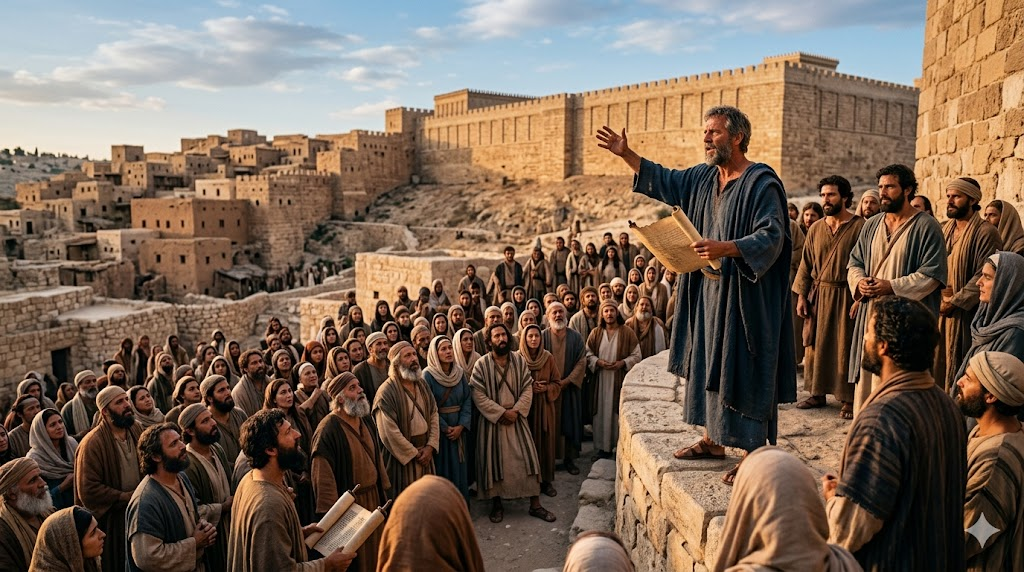
Acts 2:14, 22-28
KEY CONCEPTS
The following sections reflect the core theological reflections shared by Fr. Tim Peters in his videos on the text of this Sunday’s first reading.
Peter’s Proclamation and the Ministry of the Apostles
Scripture: "Then Peter stood up with the Eleven, raised his voice, and proclaimed..."
- The Unified Church: The image of Peter standing with the eleven disciples is a vital picture of the early Church. It depicts the Church preaching the Gospel with Peter leading the way—having received the keys and the authority to guide—while supported by the collective witness of the Apostles.
- The Context of the Third Hour: Peter addresses the crowd at the "third hour" (9:00 a.m.). This coincides with the Tamid offering in the Temple, where an unblemished lamb was offered to start the day. It also marks the moment Jesus was nailed to the Cross, preparing the way for the outpouring of the Spirit.

Non-profits have permission to use this infographic in their ministry.
Jesus of Nazareth: Commended by God
Scripture: "Jesus the Nazarene was a man commended to you by God with mighty deeds, wonders, and signs... delivered up by the set plan and foreknowledge of God..."
- The Handing Over: Christ was "delivered up" twice—first by Judas to his own people, and then to the lawless hands of the Romans. Peter emphasizes that while this was God's plan, there was real personal culpability for those who saw these miracles yet chose crucifixion.
- Twofold Testimony: The Gospel is attested to through two primary means:
- Miracles: The mighty works and signs performed in their midst.
- Prophecy: The fulfillment of God's definitive, pre-decided plan.

Non-profits have permission to use this infographic in their ministry.
The Victory Over Death
Scripture: "But God raised him up, releasing him from the throes of death, because it was impossible for him to be held by it."
- Divine Necessity: Death could not hold Christ because of His divine nature and the fulfillment of the Father's plan.
- Personal Application: Recognizing Christ's victory requires us to face our own guilt and need for forgiveness. Once we see the greatness of our sins alongside the abundance of His mercy, we can respond with truly grateful hearts and extend that same mercy to others.

Non-profits have permission to use this infographic in their ministry.
The Exaltation and
the Promise
Scripture: "Exalted at the right hand of God, he received the promise of the Holy Spirit from the Father and poured him forth, as you see and hear."
- The Fullest Meaning: The resurrection of Jesus is the absolute fulfillment of David’s prophecy in Psalm 16. Christ is the "seed" on the throne who was not abandoned to the netherworld.
- Gift and Promise: The Holy Spirit is consistently referred to as both a "promise" and a "gift." By being exalted to the right hand of the Father, Jesus pours out the Spirit to transform the world and inaugurate a new era of salvation history.
- The Last Days: This outpouring signifies that we are now living in the "last days." It challenges us to be open to the Spirit’s guidance, dying to ourselves daily so that Christ can fill us.

Non-profits have permission to use this infographic in their ministry.
3rd Sunday of Easter (A)
INSIGHTS FOR HOMILY
PREPARATION

Proclamation of the Good News
Equip your preaching with the historical depth and narrative power of Larry Broding’s commentary on Acts 2:22-33. By framing Peter’s Pentecost speech not just as a sermon, but as a revolutionary “turning on its head” of popular messianic expectations, Broding helps homilists bridge the gap between ancient prophecy and the lived experience of the Holy Spirit. His insights into the “chiasm” of salvation history—moving from God’s plan to human action and back to divine triumph—provide a robust structure for any message centered on the Resurrection.
Why this commentary matters for your homily:
- Structural Integrity: Broding identifies the three-part movement of Acts 2:22-24, centering the homily on Jesus as the object of God’s appointment, human rejection, and divine vindication.
- Cultural Nuance: The commentary clarifies the literal meaning of “Hades” and the “presence of the face,” allowing you to explain the afterlife and divine blessing without the baggage of modern misconceptions.
- Theological Reversal: It explores how Luke reinterprets the “End Times,” replacing the popular view of a vengeful political kingdom with a universal outpouring of the Spirit that transcends bloodlines and status.
- Scriptural Synthesis: Broding expertly demonstrates how Peter uses Psalm 16 to prove the Resurrection, interpreting David’s words as a “first-person projection” that points directly to the glorified Christ.
- Missional Urgency: The commentary connects the events of Pentecost to our current reality, challenging the congregation to recognize their own spiritual gifts as the catalyst for proclaiming the Good News today.
Read Larry Broding’s full commentary to help your congregation place their faith and hope in the God who raises the dead.
GO DEEPER
CATHOLIC AI PROMPTS FOR HOMILY PREPARATION
To assist in crafting a homily that is both theologically rigorous and pastorally sensitive, a preacher might ask an AI assistant the following questions (simply copy and paste a question into chat bot in the lower right corner of the page):
- The Chiasm of Salvation: “In Acts 2:22-24, Broding describes a movement from God’s appointment to human activity and back to God’s raising. How can I structure my homily to mirror this movement, showing how God’s sovereignty encompasses even the most painful human actions?”
- Linguistic Distinction (Hades vs. Hell): “How can I explain the literal meaning of ‘Hades’ in verse 2:27 to my congregation to clarify that the Creed’s ‘descended into hell’ refers to the state of the dead rather than eternal damnation?”
- Biblical Imagery: “The commentary mentions ‘the presence of your face’ in 2:28 as a sign of divine blessing. Can you find other instances in the Psalms or Pentateuch where God’s ‘face’ is used this way to help me illustrate the joy of the Resurrection?”
- The Nature of the Outpouring: “Regarding verse 2:33, Broding discusses whether Jesus poured out the Holy Spirit or the ‘event’ of Pentecost itself. How can I preach on the Holy Spirit as both an internal gift and a visible, communal event in the Church today?”
- Reversing Expectations: “Broding notes that Luke turns the popular notion of the Messiah’s ‘triumphant entry’ on its head by pointing to the Cross. How can I use this to challenge my congregation’s expectations of what ‘success’ looks like in a life of faith?”
- Universal vs. Tribal Salvation: “The commentary contrasts ‘bloodline’ with ‘faith’ in the context of salvation. What are some modern ‘bloodlines’ or exclusive identities that might be preventing people in our community from fully embracing the universal call of the Spirit?”
- The Mechanics of Proclamation: “Peter uses a four-step rhetorical process (attention, thesis, Scripture, defense). Can you help me apply this four-step method to draft a modern ‘mini-proclamation’ for a parishioner to share their faith at work or home?”
- David as a ‘First-Person Projection’: “Can you help me expand on the idea of David speaking in the ‘shoes’ of Christ in Psalm 16? How does this help us understand the way we should read the Psalms in light of the Resurrection during our daily prayer?”
- The Witness of the Twelve: “Broding highlights the importance of ‘personal witness’ in 2:32. How can I encourage my congregation to see themselves as the contemporary ‘Twelve,’ providing the living proof of the Risen Christ to a skeptical world?”
- Living in the ‘End Times’: “If we are living in the ‘end times’ as described in the commentary, what specific ‘gifts of the Spirit’ (beyond tongues) should I highlight to help my parishioners recognize that the power of Pentecost is still active in their everyday lives?”

1 Peter 1:17-21
KEY CONCEPTS
The following sections reflect the core theological reflections shared by Fr. Tim Peters in his videos on the text of this Sunday’s second reading.
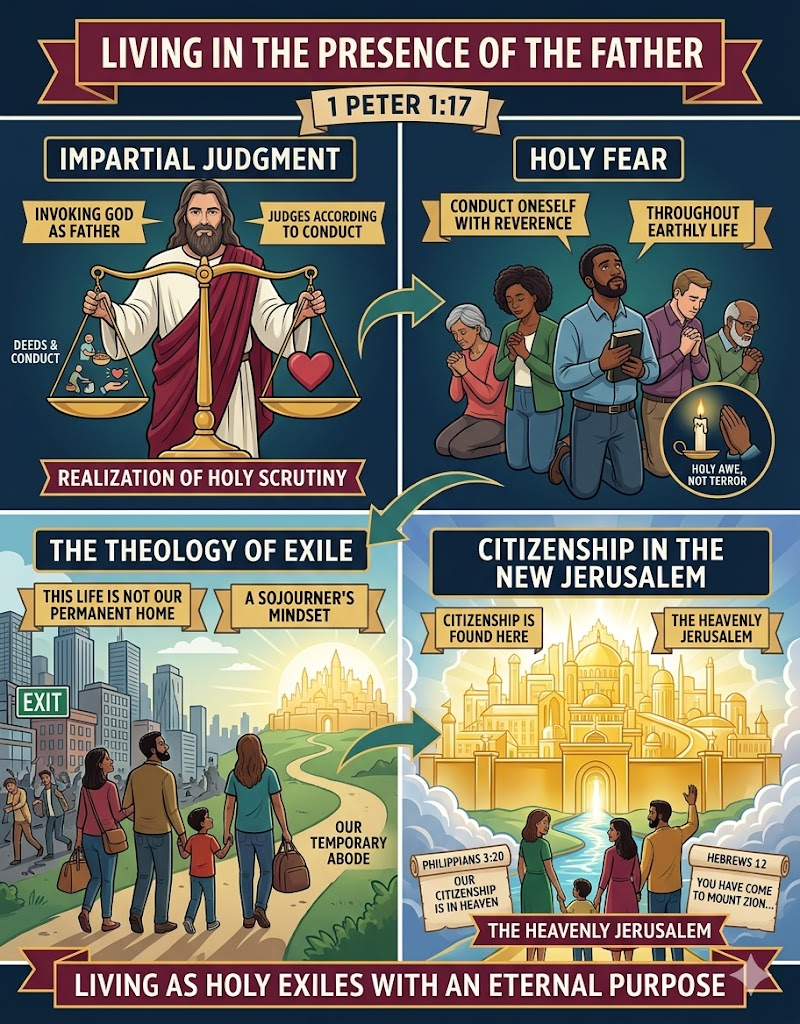
Living in the Presence of the Father (v. 17)
- Impartial Judgment: Invoking God as Father requires a realization that He judges according to deeds and conduct.
- Holy Fear: A call to conduct oneself with reverence throughout the duration of earthly life.
- The Theology of Exile: * This life is not our permanent home.
- Citizenship is found in the New Jerusalem (referencing Philippians 3:20 and Hebrews 12).
Non-profits have permission to use this infographic in their ministry.
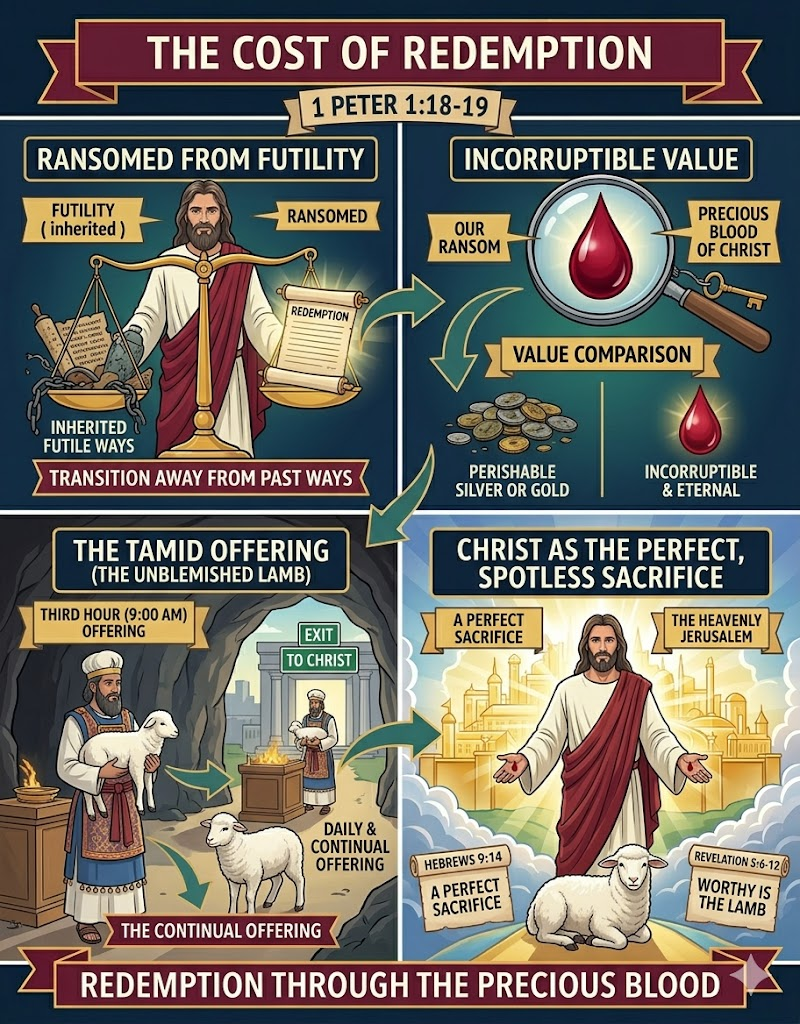
The Cost of Redemption (v. 18–19)
- Ransomed from Futility: The transition away from "futile ways" inherited from previous generations.
- Incorruptible Value: Redemption was not bought with perishable silver or gold, but with the "precious blood of Christ."
- The Lamb Without Blemish: * Direct connection to the Tamid offering (the unblemished lamb of the third and ninth hours).
- Christ as the perfect, spotless sacrifice.
Non-profits have permission to use this infographic in their ministry.
The Manifestation of Christ (v. 20–21)
- Divine Foreknowledge: Christ was destined before the foundation of the world.
- Salvation History Timeline: * His manifestation marks the "end of times" or the "last days."
- The pouring out of the Spirit and the coming of Christ represent a cataclysmic change in the world's spiritual landscape.
- Resulting Faith and Hope: * God raised Him from the dead and gave Him glory.
- The specific purpose of the Resurrection is so that our faith and hope are anchored in God.

Non-profits have permission to use this infographic in their ministry.
Practical Application: A New Identity
- Non-Conformity: The demand to not be conformed to "this generation" or the "crooked world."
- Obedience to Truth: Purifying the soul through obedience to lead to a sincere, earnest love for the brethren.

Non-profits have permission to use this infographic in their ministry.
3rd Sunday of Easter (A)
INSIGHTS FOR HOMILY
PREPARATION
If You Pray…
Deepen your congregation’s encounter with 1 Peter through the insightful scholarship of Larry Broding. Far from a dry academic exercise, Broding’s commentary bridge the gap between the complex rhetorical structures of the ancient Greek world and the lived reality of a modern faith community. By untangling the “hooked clauses” of the Petrine epistles and exploring the cultural weight of “saving face,” Broding provides preachers with the linguistic and theological tools necessary to transform a difficult text into a life-changing message of hope and holy fear.
Why this commentary matters for your homily:
- Rhetorical Clarity: Broding deconstructs the long, complex sentences of 1 Peter 1:17-21, identifying the “hooked clauses” to help you isolate the core kerygma: that we are ransomed by the precious blood of Christ.
- Cultural Contextualization: By explaining the literal meaning of “not receiving face,” the commentary allows you to preach on God’s impartial judgment with a fresh perspective on dignity, influence, and status.
- Theological Depth: The commentary moves beyond rote definitions of faith, highlighting that our belief is directional—directed toward the Father specifically through the person of Jesus Christ.
- Practical Application: Broding challenges the “phoning in” of prayer, providing a powerful metaphor for homilists to address the habit of rote devotion versus the transformative power of “holy fear.”
- Eschatological Vision: It offers a compelling framework for viewing prayer not as a chore, but as a practice for life in the Kingdom, allowing you to invite your listeners into a life that foreshadows eternal glory.
Read Larry Broding’s full commentary to help your congregation live as if their lives were a living prayer.
GO DEEPER
CATHOLIC AI PROMPTS FOR HOMILY PREPARATION
To assist in crafting a homily that is both theologically rigorous and pastorally sensitive, a preacher might ask an AI assistant the following questions (simply copy and paste a question into chat bot in the lower right corner of the page):
- Cultural Linguistics: “Broding mentions that ‘without regard for one’s status’ literally means ‘not receiving face.’ How can I explain this ancient court concept to a modern audience to show that God’s judgment is based on truth rather than social influence or reputation?”
- Modern Analogies: “The commentary compares ‘presenting face’ to modern concepts like ‘face time’ or ‘saving face.’ Can you help me develop a contemporary story or analogy about a person trying to ‘gain face’ with the world while neglecting their standing before God?”
- The Direction of Faith: “Regarding verse 1:21, Broding emphasizes that faith has a ‘direction’ through Jesus to God. How can I use this to explain the necessity of the Incarnation—that we don’t just believe in a distant ‘higher power,’ but in a God made accessible through Christ?”
- Defining Holy Fear: “The commentary describes ‘holy fear’ as an awareness of God’s presence as our Creator. How can I differentiate ‘holy fear’ from ‘servile terror’ or ‘scrupulosity’ for my congregation?”
- Combating Rote Prayer: “Broding uses a powerful metaphor about an actor ‘phoning in’ a performance to describe rote prayer. Can you provide three practical tips I can share in my homily to help parishioners move from ‘phoning it in’ to a genuine ‘mindset’ of prayer?”
- The Theology of Ransoming: “The text mentions being ransomed from ‘useless behavior’ inherited from parents. How can I preach on this sensitively, focusing on breaking generational cycles of sin through the ‘precious blood of Christ’?”
- Living Prayer: “Broding suggests we should live as if our lives were ‘living prayer.’ What are some concrete examples of everyday actions—like work, parenting, or community service—that can be reframed as an act of prayer?”
- Eschatological Practice: “The commentary states that prayer is ‘practice for life in the Kingdom.’ How can I help my congregation view our Sunday liturgy as a ‘rehearsal’ for the eternal glory we will experience in heaven?”
- The Transience of Wealth: “The text contrasts the blood of Christ with ‘silver or gold that tarnishes.’ Can you help me find a modern cultural obsession with ‘wealth’ or ‘security’ that I can use to highlight the eternal value of Christ’s sacrifice?”
- Application Questions: “The commentary concludes with the question, ‘How is your prayer like your life?’ Can you help me refine this into a series of three ‘examination of conscience’ questions that would be effective for a closing homily appeal?”
Luke 24:13-35
KEY CONCEPTS
The following sections reflect the core theological reflections shared by Fr. Tim Peters in his videos on the text of this Sunday’s Gospel.
The Journey and Spiritual Direction (vv. 13–17)
Walking Away from Jerusalem:
- Jerusalem as the center of the Paschal mystery.
- Walking away signifies defeat, loss of hope, and confusion regarding the Resurrection.
The Sadness of the Disciples:
- Standing still and looking sad (v. 17).
- The "What things?" approach: Jesus allows them to work through their trial by inviting them to speak.
The Concept of "Drawing Near":
- Jesus initiates the encounter by drawing near (recalling the priest drawing near to offer sacrifice in Leviticus).
- Eyes being "kept" from recognizing Him—the necessity of a spiritual revelation.

Non-profits have permission to use this infographic in their ministry.
The Liturgy of the Word (vv. 18–27)
Interpreting the Prophets:
- Jesus rebukes their "slowness of heart" to believe the prophetic witness.
- The "Divine Necessity": It was necessary for Christ to suffer to enter His glory.
The Full Scope of Scripture:
- Beginning with Moses and all the Prophets.
- The "burning heart": The internal spiritual response when the truth of Christ is revealed in the Word.
The Duty of the Church:
- The role of the Church is to continue this "breaking open" of Scripture at every Mass.
- Connecting the Old Testament (Moses/Prophets) to the fulfillment in Jesus.

Non-profits have permission to use this infographic in their ministry.
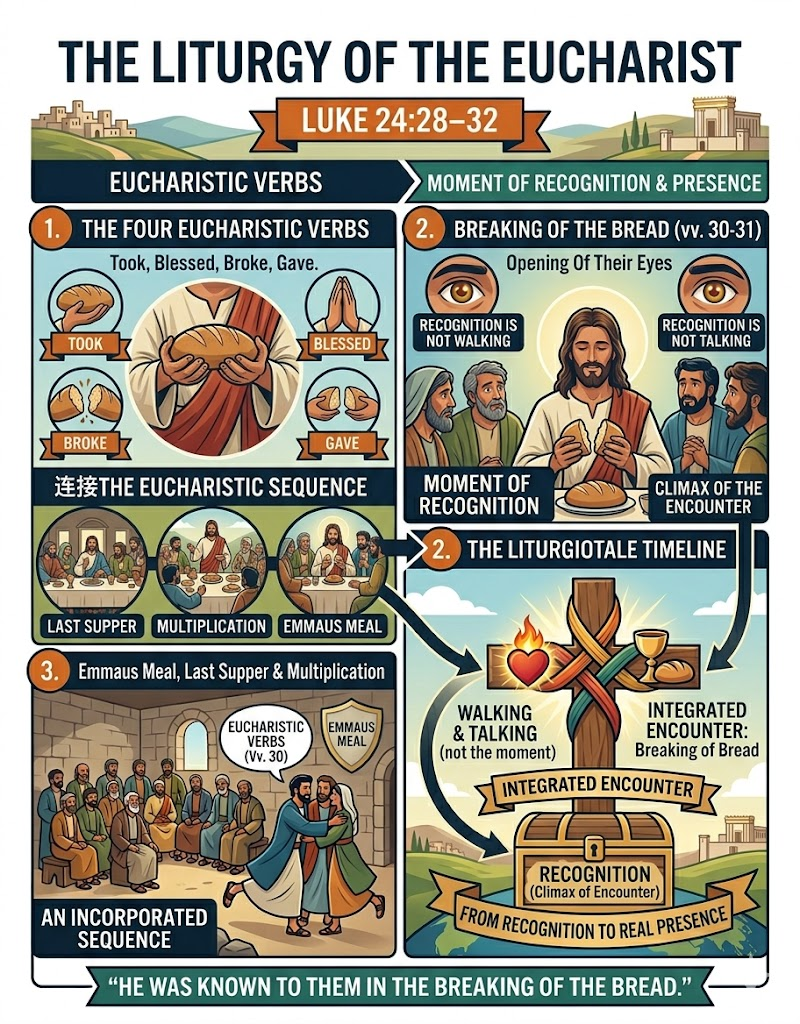
The Liturgy of the Eucharist (vv. 28–32)
The Four Eucharistic Verbs:
- Took, Blessed, Broke, Gave.
- These verbs link the Emmaus meal to the Multiplication of the Loaves and the Last Supper.
The Moment of Recognition:
- Recognition happens not during the walking or the talking, but specifically in the breaking of the bread.
- The opening of their eyes as the climax of the encounter.
The Real Presence:
- Jesus vanishes the moment He is recognized to emphasize His permanent presence in the Sacrament.
- "He was known to them in the breaking of the bread."
Non-profits have permission to use this infographic in their ministry.
Transformation and Mission (vv. 33–35)
Changing Direction:
- The disciples immediately rise and return to Jerusalem (the place they had previously fled).
- Conversion leads to a reversal of the path of defeat.
Rejoining the Community:
- Returning to the "Eleven" and the gathered disciples.
- Confirmation of the faith: "The Lord has risen indeed!"
Proclaiming the Encounter:
- The duty to share the "good news" of what happened on the road.
- The integration of personal encounter (hearts burning) and sacramental encounter (breaking of bread) as the foundation of Christian witness.
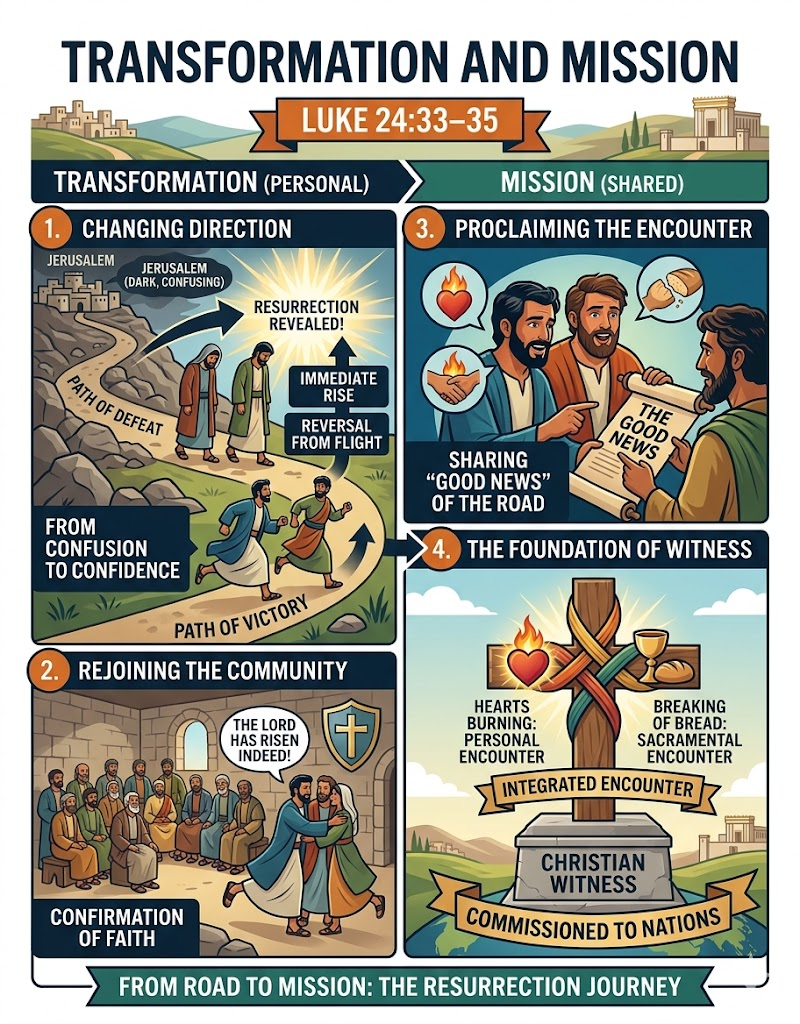
Non-profits have permission to use this infographic in their ministry.
3rd Sunday of Easter (A)
INSIGHTS FOR HOMILY
PREPARATION
Returning Home
Bring a compassionate and scholarly depth to your preaching on the Road to Emmaus with Larry Broding’s commentary. By moving beyond a simple historical retelling, Broding frames this journey as the universal experience of the “return”—addressing the discouragement, hesitation, and “self-absorbing pity” that lead many to walk away from the community of faith. His analysis of Luke’s narrative structure provides a roadmap for helping your congregation recognize that it is God, not mere circumstance, who seeks us out and turns us back toward home.
Why this commentary matters for your homily:
- Pastoral Psychology: Broding identifies the “self-pity” and “spiritual blindness” that accompany doubt, providing homilists with a relatable way to address those who feel distant from God or the Church.
- Linguistic Precision: The commentary clarifies the literal meaning of being “sixty stades distant” and the nuance of Jesus standing “in the opinion of” the people, grounding your sermon in the authentic Greek context.
- Liturgical Synthesis: It beautifully highlights the “liturgical overtones” of the encounter, showing how the movement from the opening of Scripture to the breaking of the bread mirrors the Mass itself as the place where we recognize the Risen Lord.
- Theological Framework: Drawing on the Catechism, Broding distinguishes between “involuntary doubt” and “active rejection,” offering a hopeful path for those struggling with faith to move toward a deeper understanding.
- Narrative Movement: The commentary tracks the physical and spiritual “turning around” of the disciples, helping you preach on how Jesus transforms our walk from one of retreat into one of proclamation and return to the community.
Read Larry Broding’s full commentary to help your congregation recognize Christ walking beside them in the Word and the Sacrament.
GO DEEPER
CATHOLIC AI PROMPTS FOR HOMILY PREPARATION
To assist in crafting a homily that is both theologically rigorous and pastorally sensitive, a preacher might ask an AI assistant the following questions (simply copy and paste a question into chat bot in the lower right corner of the page):
- Exploring the Greek Text: “Can you provide more context on the term ‘sixty stades’ in Luke 24:13? Specifically, how does the physical distance of the journey serve as a metaphor for the spiritual distance of the disciples from the Jerusalem community?”
- Theological Nuance: “In Luke 24:19, the phrase ‘before God and all the people’ refers to judgment or opinion. How can I use this to explain to my congregation the difference between Jesus’ status in the eyes of the world versus His status in the eyes of the Father?”
- Syntactical Insights: “Broding mentions a ‘confusing construction’ in 24:19-20 regarding ‘who’ Jesus was versus ‘what happened’ to Him. Can you help me draft a section for my homily that clarifies how our personal expectations of ‘who’ God is often clash with the reality of ‘what happens’ in our lives?”
- The Silence of God: “Looking at verse 24:21, the commentary suggests that to the disciples, ‘Jesus had done nothing’ for three days. How can I apply this to the modern experience of feeling like God is inactive or silent during our own ‘three-day’ periods of grief or waiting?”
- Faith and Doubt: “Based on CCC 2087-2089, how can I distinguish between ‘involuntary doubt’ (hesitation) and ‘voluntary doubt’ in a way that encourages parishioners who are struggling with their faith rather than making them feel judged?”
- Overcoming Self-Pity: “Broding notes that the disciples’ loss of faith led to ‘self-absorbing pity’ and ‘spiritual blindness.’ What are some contemporary examples of how focusing solely on our own agendas can prevent us from recognizing Christ walking beside us?”
- Liturgical Connections: “Can you help me develop the connection between the ‘proclamation of Scripture’ in verse 27 and the ‘breaking of the bread’ in verse 30 to show my congregation how the Mass is the primary ‘road’ where we encounter the Risen Lord?”
- The Heart’s Response: “The commentary translates the disciples’ state as being ‘slow in heart.’ How does this biblical concept of the ‘heart’ differ from our modern emotional definition, and how does Jesus ‘snap’ them out of it?”
- Biblical Typology: “Jesus interpreted ‘Moses and all the prophets’ to the companions. Can you provide three specific Old Testament prophecies or types that Jesus likely used to explain why it was ‘necessary’ for the Christ to suffer?”
- The Theology of the ‘Way’: “Broding uses the Greek term hodos (road/way) to symbolize the Christian lifestyle. How can I frame the conclusion of my homily to challenge the congregation to let Jesus ‘turn them around’ from their own path back toward the community of the Church?”