Children, Catholic Home School, Children’s Liturgy of the Word, Catholic Home School
Children, Catholic Home School, Children’s Liturgy of the Word, Catholic Home School
June 7, 2026







LITURGY OF
THE WORD


Body and Blood of Christ (A)
↩️ ↪️ Catholic Women Preach

NOTE: Summer Break Begins Next Week
Nature of the Eucharist
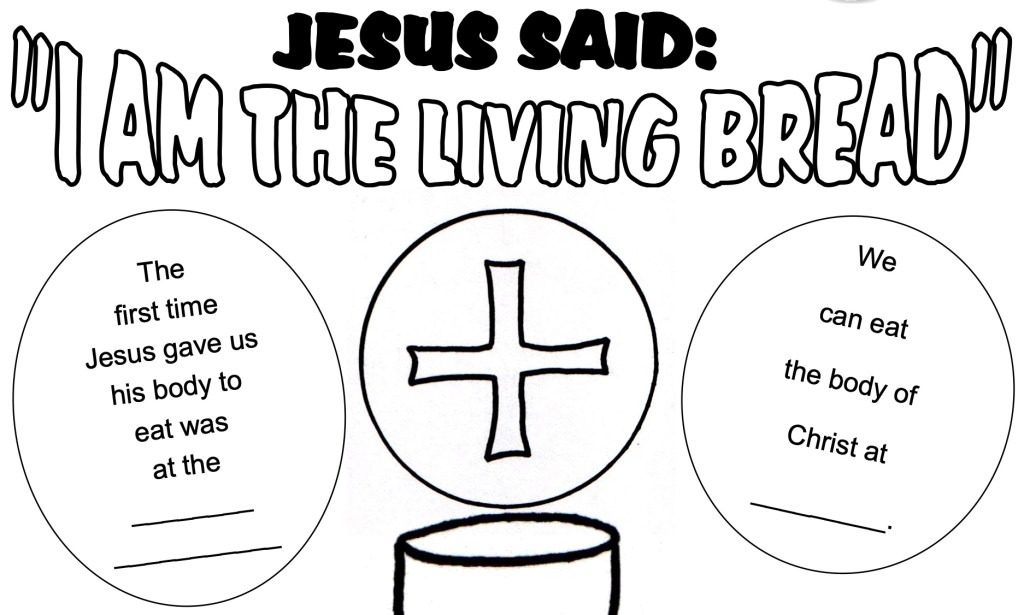
Q: What is the Catholic belief about Jesus’s presence in the Eucharist? A: Catholics believe Jesus, called the bread of life, is truly present in the Eucharist as the actual body and blood of Christ, not merely symbolic, a belief maintained for 2,000 years across Catholic and Christian communities worldwide.
Q: What is the Eucharist as a sacrament? A: The Eucharist is the sacrament through which Catholics receive Holy Communion, described as a precious gift that physically makes Jesus part of us through consuming his body and blood.
Purpose and Effects
Q: What does receiving Holy Communion accomplish for Catholics? A: Receiving Holy Communion serves to nourish and strengthen believers, enabling them to become more like Jesus and preparing them for heaven as part of their spiritual journey.
Q: How does the Eucharist support the Catholic spiritual journey? A: The Eucharist strengthens Catholics specifically for their journey to heaven, functioning as spiritual sustenance that transforms believers into Christ-like individuals through regular reception.
Liturgical Context
Q: What feast day is associated with this teaching? A: The video celebrates Corpus Christi, officially called the Solemnity of The Most Holy Body and Blood of Christ, emphasizing Jesus as the Living Bread sent from Heaven.
Q: What practical application does the video suggest for families? A: The teaching encourages viewers to take care of people in their life and share what they have with others, mirroring how Jesus provides for humanity as the bread of life.
↩️ ↪️ Jeff Cavins

Nature of the Eucharist
Q: How does the bread and wine become Christ’s body and blood? A: The priest blesses the bread (host) and wine behind the altar, and through the Holy Spirit’s power it becomes the true body and blood of Christ, which is a central belief in Catholic Mass rather than symbolic representation.
Q: What transformation occurs when receiving the Eucharist? A: Receiving the Eucharist transforms us to be more like Jesus and gives us eternal life in heaven, as we become one with Him through this true food and drink that literally becomes part of us.
Theological Connections
Q: How does the Eucharist compare to the manna in the desert? A: The manna was a temporary blessing that taught God’s people to trust in Him, while the Eucharist is a greater blessing that provides eternal life and creates permanent union with Jesus beyond physical sustenance.
Spiritual Access
Q: How can children receive Jesus before First Communion? A: Children not yet old enough for First Communion can still receive Jesus by loving others, since He lives in them too, demonstrating that loving others is an alternative way to receive Him into our hearts.
Sacrificial Meaning
Q: What is the sacrificial significance of the Eucharist? A: The Eucharist is a sacrificial gift of love with Jesus’ body broken and blood shed for our hope and salvation, which nourishes us for the journey and strengthens us through this gift.
Union with Christ
Q: What is the primary purpose of the Eucharist according to the Gospel of John? A: The Eucharist is the body and blood of Jesus that serves as a special gift that unites us with Him, creating a physical and spiritual connection as taught by Jesus in the Gospel of John.

↩️ ↪️ Bishop James Golka
The Eucharist as Divine Presence
Q: What does Corpus Christi Sunday celebrate in Catholic theology? A: Corpus Christi Sunday celebrates the real presence of Jesus in the Eucharist, where bread and wine become the body and blood of Christ, acknowledging Jesus’ love and call to discipleship.
Q: How does the Eucharist function as Jesus’ ongoing presence? A: Jesus instituted the Eucharist as the best gift to remain with believers always, enabling mutual indwelling where receiving Jesus at Mass means “we live with him and he lives in us.”
Jesus’ Universal Call and Mercy
Q: What does the Gospel story of Matthew reveal about Jesus’ mission? A: Jesus called Matthew, a tax collector, demonstrating he came to call sinners, not the righteous, revealing God’s forgiving heart and desire for mercy over judgment.
Q: How does Jesus’ love extend across social boundaries? A: Jesus loves everyone immensely regardless of status as sinners or saints, seeing all as special including the poor, rich, respectable, and outcasts with equal place in his heart.
Sacramental Significance
Q: What is the theological definition of the Eucharist as a sacrament? A: The Eucharist is the sacrament delivering the body and blood of Jesus in the form of bread and wine, serving as a reminder of Jesus’ immense love and desire to remain present.
Q: What practical encouragement does the program offer children? A: The program encourages children to keep loving Jesus, be happy knowing God loves them, and continue watching Uganda Catholic Television, emphasizing the importance of the Eucharist and Jesus’ love in daily life.
↩️ ↪️ Know Before You Go

Little Liturgies: June 7 2026 – Corpus Christi
Real Presence in the Eucharist
Q: What makes Corpus Christi the highest level feast in Catholicism?
A: Corpus Christi celebrates the real presence of Jesus in the Eucharist, where bread and wine literally become his body and blood, not symbolically but actually.
Q: What biblical foundation supports eating Jesus’ flesh and drinking his blood?
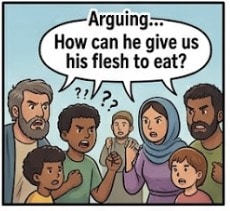
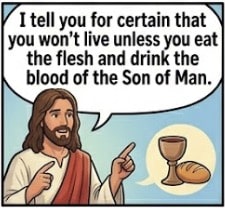
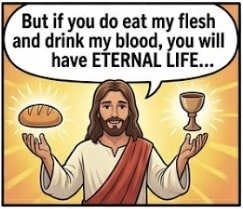
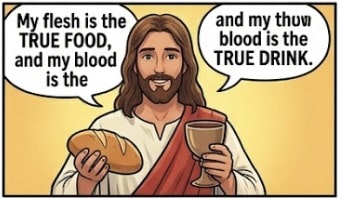
A: In John 6:51-59, Jesus teaches that eating his flesh and drinking his blood is necessary for eternal life, a teaching so intense that some disciples left after hearing it.
Encountering Jesus Through the Eucharist
Q: How does the Eucharist recreate the disciples’ experience with Jesus?
A: The Eucharist allows everyone to encounter Jesus like disciples did 2000 years ago through three ways: listening to his word, having meals with him, and participating in his sacrifice.
Eucharistic Practices and Rituals
Q: What is the purpose of Eucharistic processions on Corpus Christi?
A: Eucharistic processions honor Jesus’ real presence by displaying a large consecrated host in a monstrance, drawing public attention to the humble presence of Jesus in the Eucharist.
Q: What happens during Eucharistic adoration?
A: Adoration involves sitting quietly and praying before the monstrance, either sharing from the heart or simply being in Jesus’ presence, as he prefers to listen.
Q: How does Benediction differ from regular blessings?
A: Benediction is a special blessing where the monstrance containing the consecrated host is raised and used to bless the people, who then bless themselves in response.
↩️ ↪️ 1-Minute Homily

The Eucharist’s Biblical Foundation
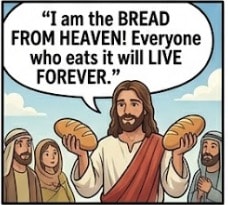
Q: What did Jesus mean when he called himself “the bread that came down from heaven”? A: In John 6:51, Jesus declared he is the bread from heaven and promised that whoever eats this bread will live forever, establishing the theological foundation for the Eucharist as eternal sustenance.
Q: How did Jesus transform bread and wine at the Last Supper? A: At the Last Supper, Jesus gave his disciples bread and wine saying “This is my body, this is my blood” (Matthew 26:26-28), literally transforming these elements into his body and blood.
The Mass Ritual Elements
Q: What specific items does the priest prepare on the altar for Mass? A: The priest prepares the altar with a clean white cloth, candles, crucifix, corporal, paten with bread, and chalice with wine, then pours water into the wine to symbolize Jesus and the world united.
Q: What is the precise moment when bread and wine become Jesus’s body and blood? A: The priest repeats Jesus’s exact words from the Last Supper while praying for the Holy Spirit to come down upon the gifts, and by the power of the Holy Spirit the bread and wine transform into the body and blood of Jesus.
Participation and Meaning
Q: How can children who cannot yet receive Eucharist participate meaningfully in Mass? A: Children can participate by closely watching the altar, observing the priest’s gestures, listening to the words of Jesus, and saying thank you to Jesus for wanting to be close to them in this holy meal.
Q: What does “Corpus Christi” and “Eucharist” literally mean? A: “Corpus Christi” is Latin for “the body of Christ”, while “Eucharist” means “thanksgiving”, and Saint Teresa of Kolkata called it “the greatest love” and “the best time” one can spend on Earth.
↩️ ↪️ Priests for Life
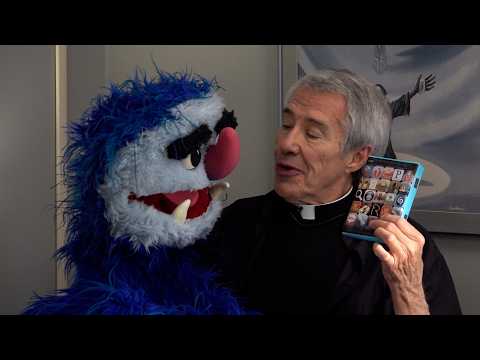

Big Al’s NEW phone!
Spiritual Growth and Access
Q: How is First Communion like upgrading from a limited phone?
A: First Communion transitions children from limited spiritual access to full access to Jesus through bread and wine, similar to how Big Al’s phone has restricted features for protection until he’s ready for complete functionality.
Daily Spiritual Practice
Q: What’s the difference between daily prayer and Eucharist in connecting to God?
A: Daily heart-centered prayer creates a real connection linking you to all people, living things, and goodness, while Eucharist is a special way to connect, making both practices complementary rather than exclusive.



QUESTIONS
Spiritual Fulfillment Through Christ
Q: How does Jesus’ “bread of life” differ from Old Testament manna? A: While manna sustained the Israelites physically in the wilderness and those who ate it eventually died, Jesus as the “bread that came down from heaven” leads to eternal life for those who partake, making him the new manna with spiritual rather than temporal effects.
Sacramental Practice
Q: What is the connection between Jesus’ bread of life teaching and Christian worship? A: Jesus’ declaration at the Last Supper “this is my body” when breaking bread directly connects to the Eucharist celebration, where Christians partake in the bread of life as the physical practice of accepting salvation and eternal life.
Belief as Consumption
Q: What does “eating” Jesus’ bread actually mean in John 6? A: Jesus’ statement in John 6:35 “whoever comes to me will never be hungry, and whoever believes in me will never be thirsty” reveals that eating his bread means believing in him, satisfying spiritual hunger and thirst for eternal life rather than physical needs.

Sunday Mass Activities
Daily Gospel Reflections
Catholic Momcast



Body and Blood of Christ (A)


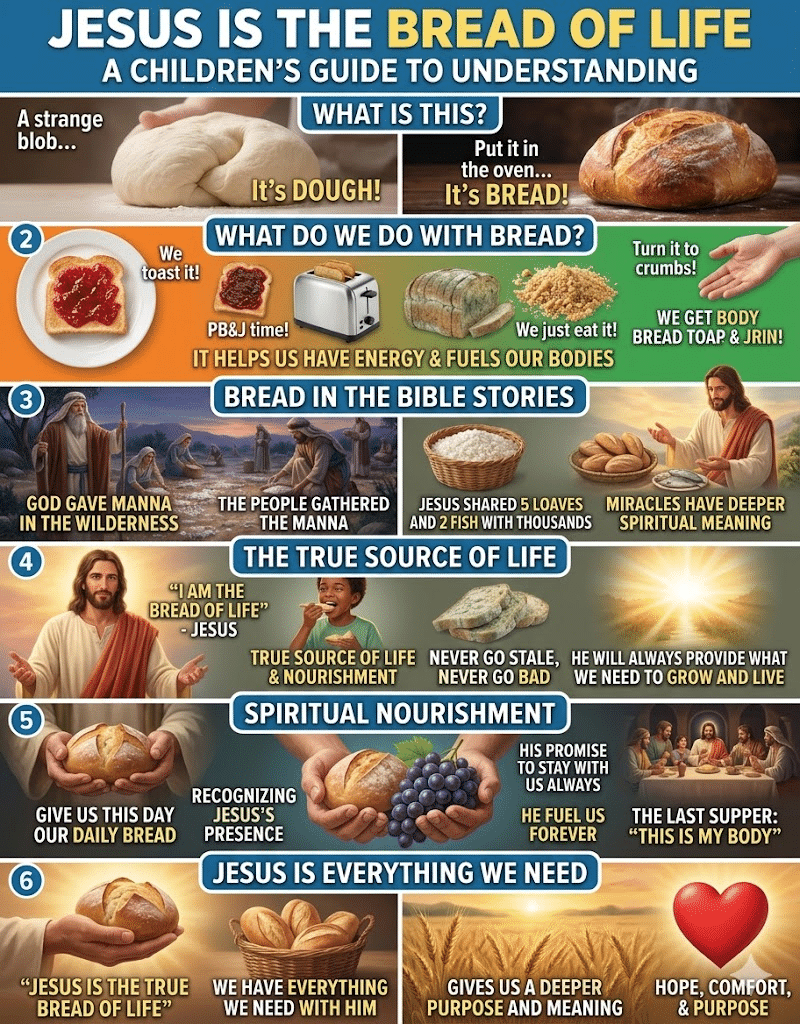
The Bread of Life
Jesus Christ referred to himself as the bread of life in the Gospel of John:
“I am the bread of life. Whoever comes to me will never be hungry, and whoever believes in me will never be thirsty.” (John 6:35)
He spoke these words after the feeding of the 5,000 people when he blessed bread and multiplied it to feed all who came to hear him teach. He goes on to connect this title to the Old Testament saying,
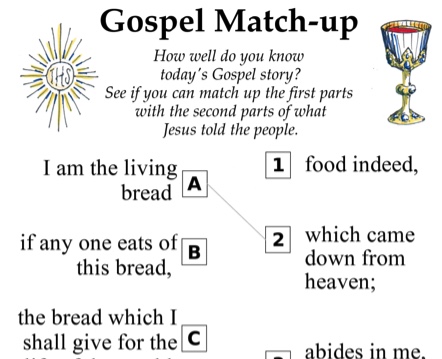
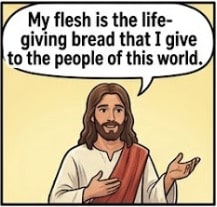
“I am the bread of life. Your ancestors ate the manna in the wilderness, and they died. This is the bread that comes down from heaven, so that one may eat of it and not die. I am the living bread that came down from heaven. Whoever eats of this bread will live forever, and the bread that I will give for the life of the world is my flesh.” (John 6:48-51)
The Israelites in the Old Testament wandered the desert and complained about the lack of food to eat. They were hungry and God provided food for them in the form of manna, a bread which came down from heaven.
What is the lesson in the bread of life for us as disciples? By making the connection to this manna of the Old Testament, Jesus expressed that he is now the manna from heaven. The difference is that his bread leads us to eternal life. We eat of his bread and will live forever.
The Catholic Church has made the connection between these words and the Eucharist throughout history. Remembering the Last Supper when Jesus broke bread and said, “this is my body,” Christians celebrate the breaking of bread. We partake in the bread of life and accept our salvation.

Our Sunday Visitor

THE WORD THIS WEEK infographics are created using using GOOGLE’S AI Gemini 3 Pro. You are free to use the above infographic in any non profit ministry. Please give credit to TheWordThisWeek.NET and Our Sunday Visitor.
QUESTIONS
Jesus as Spiritual Sustenance
Q: What does Jesus mean by calling himself the “bread of life”? A: Jesus declares in John 6:35 that he is the bread of life where whoever comes to him shall not hunger and whoever believes in him shall never thirst, positioning himself as the true source of spiritual life and nourishment unlike physical bread that perishes.
Q: How does Jesus’ bread differ from the manna God gave the Israelites? A: Jesus is the true bread from heaven that gives life to the world (John 6:33-34), contrasting with the temporary manna God gave the Israelites in the wilderness which was only a physical, short-term provision.
Daily Provision and Trust
Q: What does “daily bread” mean in the Lord’s Prayer? A: In the Lord’s Prayer, asking God to “give us this day our daily bread” means trusting that Jesus will provide everything we need for our lives, both physically and spiritually, as our complete sustainer.
The Last Supper and Self-Giving
Q: What did Jesus mean when he gave bread at the Last Supper saying “this is my body”? A: At the Last Supper before his death, Jesus gave his disciples bread saying “this is my body” as a sign of him giving himself for us and sharing himself with us in sacrificial love.
Eternal vs. Temporal Nourishment
Q: What makes Jesus’ spiritual bread superior to physical bread? A: Jesus offers a kind of bread that will never go stale or bad, providing eternal spiritual sustenance to grow, live, and thrive, unlike physical bread that gets stale and runs out.
Body and Blood of Christ (A)

Bread of Life
In this children’s message, students will be invited to consider what it means that Jesus Christ calls Himself the bread of life. He gives us all we need for spiritual nourishment, just as food gives us what we need for physical strength. Use bread and/or dough to explain what it means that Christ provides and IS our “daily bread”!


QUESTIONS
Remembering the Story
- Where did the workers take the weak baby monkey to help him get better?
- Even after the baby monkey became healthy and strong, how was he acting?
- What kind of animal did the little monkey make friends with?
- Why is it surprising that these two animals became such close friends?
Heart and Feelings
- The story says the baby monkey felt all alone before he met the pigeon. Have you ever felt lonely or left out? What helped you feel better?
- The white pigeon wasn’t afraid and allowed the monkey to be close. How does it feel when someone welcomes you and lets you sit next to them?
- Why do you think having a friend helped the monkey stop being so sad?
Living in Peace
- The Apostle Paul tells us to “live in peace.” What does living in peace look like when you are playing with your friends or siblings?
- The monkey and the pigeon were very different from each other, but they were still friends. How can we be friends with someone who likes different things or looks different than we do?
- What is one small thing you can do today to share friendship and bring peace to someone who might be feeling lonely?

In God’s Care
“I am the living bread which came down out of heaven. If anyone eats of this bread, he will live forever” (6:51).
Our Jewish friends eat bread called challah on the Sabbath and other holidays. It is a braided bread made with eggs and other ingredients such as flour, milk, yeast, and salt. Poppy seeds or sesame seeds are sprinkled on top. This bread symbolizes God’s care for the Israelites during the forty years they traveled in the desert.
We find this story in the Old Testament. At the time of Moses the Israelites were driven from Egypt and wandered in the wilderness. They became hungry and wondered how they would find enough food to survive. God said to Moses, “I am going to rain down bread from heaven for you, and each day the people shall go out and gather enough for that day.” (Exodus 16:4)
SOURCE: Sermon Writer – © 1997 – 2026 Richard Niell

Birthday
Celebrations
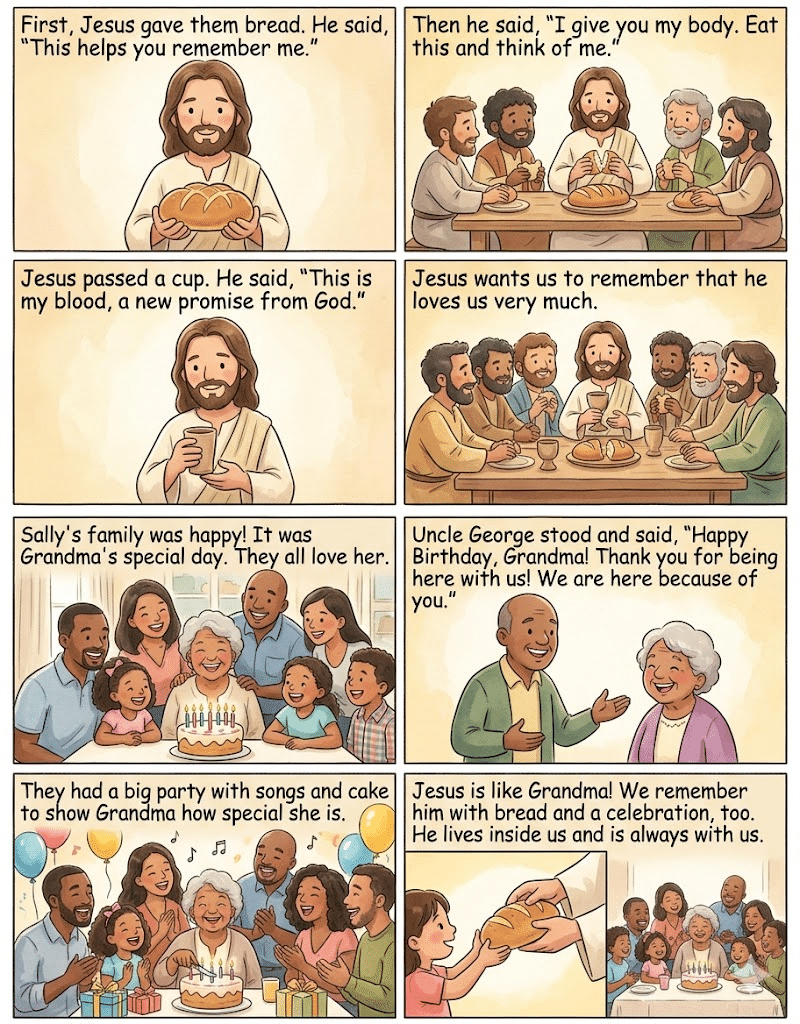
This story parallels a family celebrating a grandmother’s birthday with Christians celebrating Holy Communion.
It begins with the Last Supper, where Jesus establishes the bread and wine to remember his sacrifice until his return. The narrative then shifts to Sally’s family gathering for Grandma’s birthday. Rather than visually recalling her actual birth, they celebrate her ongoing impact and presence through community, gifts, and food.
Ultimately, the story concludes that when Jesus asks followers to “remember” him, he is calling for an active, celebratory gathering rather than just quiet contemplation. Just as a birthday honors a loved one, Communion celebrates Jesus’s resurrection and continuous, living presence within believers.
Body and Blood of Christ (A)
THE WORD THIS WEEK infographics are created using using GOOGLE’S AI Gemini 3 Pro Nano Banana and images from Unsplash. You are free to use the above infographic in any non-profit ministry. Please give credit to TheWordThisWeek.net and the Word-Sunday.
Entrance Song
Sacramental Presence
Q: What does receiving the Eucharist accomplish spiritually?
A: The Eucharist as Jesus’s body and blood brings eternal life, union with Christ, healing, reconciliation, and transformation through receiving him directly into oneself.
Personal Encounter
Q: How does the Eucharist enable intimacy with Christ?
A: Receiving the Eucharist creates intimacy with Christ by making the recipient one with his sacrifice and transforms them through his grace to endure any storm.
Perpetual Availability
Q: Where can believers access the Eucharistic presence?
A: The Eucharist remains holy and truly present in tabernacles everywhere, enabling deep personal connection with Jesus through abandonment to him at any time.
Body and Blood of Christ (A)
LIFE WITH MUSIC (2:49)

CATHOLIC KIDS WORLD (2:58)
Response & Acclaim

Response & Acclaim
CATHOLIC KIDS WORLD (2:58)
Communion
Understanding the Eucharist
Q: What makes the Mass the most important part of Catholic life? A: The Mass makes present Jesus’ sacrificial offering on the cross, where He gives His whole self in the Eucharist at each celebration.
Q: What is the true nature of the Eucharist? A: The Eucharist is Jesus Himself, who is God and love, and when received, Catholics are filled with His love directly.
Showing Reverence at Mass
Q: How can Catholics demonstrate love for Jesus during Mass? A: By being reverent through silence, paying attention, dressing and acting their best, preparing properly before receiving Communion, and telling Him they love Him afterward.
After Receiving Communion
Q: What should be done immediately after receiving Communion? A: Catholics should kneel, close their eyes to avoid distractions, and tell Jesus how grateful they are for His closeness, blessings, graces, and for giving Himself in the Eucharist.
Greatest Gift to Jesus
Q: What is the greatest gift Catholics can give to Jesus? A: To love Him above everything else, and to ask for the grace to always love Him above all things.
Practical Participation
Q: What specific elements of Mass require extra attention? A: The readings, prayers, and Communion require extra special attention, combined with telling Jesus how much they love Him and asking for grace to love Him always.
Body and Blood of Christ (A)

HOLY KIDS (5:01)
FR. JACK GREEN (8:00)

SHARE FAITH KIDS (3:12)

HOLY KIDS (4:40)
