Homilies
Homilies
March 8, 2026
April 12, 2026
2nd Sunday of Easter (A)



RECOMMENDED
The Augustinian Province of St. Thomas of Villanova maintains a dedicated “Homilies” page with reflections grounded in the Confessions and the Rule of St. Augustine.
✍️ Augustinian Province – Weekly Homilies
📺 Fr. Paul Galetto
📺 Fr. Tom McCarthy
✍️ Fr. Kieran J. O’Mahony
Core Charism: Interiority (searching for God within), community life (“one mind and one heart on the way to God”), and the restless heart that finds repose only in God.
2nd Sunday of Easter (A)
The Hook: Thomas thought he needed to touch the flesh to satisfy his heart, but his heart was already being tugged from within. “You were within me, and I was outside.”
The Approach: Focus on the “One mind and one heart on the way to God” (from the Rule of St. Augustine). The homily would reflect on how the community in Acts reflects the beauty of shared love, and how our own “restless hearts” find their Sabbath rest in the “Peace be with you” of the Risen Lord.
Key Phrase: “Our hearts are restless until they rest in Thee.”
RECOMMENDED
Many Benedictine Abbeys publish the Abbot’s homilies online. Quarr Abbey and Saint Meinrad Archabbey are excellent sources for traditional Benedictine “Lectio” style preaching.
✍️ Saint Meinrad Archabbey Reflections
✍️ Monastery of Christ in the Desert
✍️ Mepkin Abbey

Core Charism: Ora et Labora (Prayer and Work), Stability, Hospitality, Lectio Divina, Listening with the “ear of the heart.”
2nd Sunday of Easter (A)
The Hook: The first thing the Risen Lord does is establish a rule of life: Peace, Breath, and Forgiveness. He builds a “school for the Lord’s service” right there in the Upper Room.
The Approach: Focus heavily on Acts 2:42—the “steadfastness” (stabilitiatus) of the community. A Benedictine homily would emphasize that we find the Risen Christ not in individualistic “mountain-top” experiences, but in the daily, rhythmic commitment to the “breaking of the bread” and the common life.
Key Phrase: “Listen with the ear of your heart to the breath of Christ.”

LECTIO DIVINA
APRIL 2026 (PDF)
RECOMMENDED
The Carmelites offer a unique “Lectio Divina” style reflection for each Sunday through their international headquarters.
✍️ OCarm.org – Lectio Divina for Sundays
📺 Fr. Greg
Core Charism: Contemplation, The Desert, Prayer as Friendship, The Dark Night, Elijah, St. Teresa of Avila.
2nd Sunday of Easter (A)
The Hook: The doors were locked. Sometimes the doors of our souls are locked by dark nights and dry spirits. Christ does not knock; he simply is there, in the center of the soul.
The Approach: This perspective would look at 1 Peter 1:6—rejoicing even while suffering “various trials.” It would treat the Upper Room as a symbol of the “Interior Castle,” where the soul encounters the Beloved in the “sheer silence.” Thomas’s touch is a transition from external signs to internal union.
Key Phrase: “In the evening of life, we will be judged on love alone.”
RECOMMENDED
The Dominicans have one of the most robust preaching websites called “Torch.” It features a new homily every week from a different friar.
✍️ English Dominican Friars – Torch
Core Charism: Veritas (Truth), Preaching, Study, Combatting Error with Clarity, Contemplation passed on to others.
2nd Sunday of Easter (A)
The Hook: We often call him “Doubting Thomas,” but Thomas was actually the first to give the most complete theological confession in the Gospels: “My Lord and my God.”
The Approach: Focus on the “Apostolic Life” described in Acts—devotion to the teaching of the Apostles. The Dominican approach would unpack the intellectual necessity of the Resurrection and how “believing without seeing” is a supernatural gift of the intellect illuminated by grace.
Key Phrase: “Contemplate, and share the fruits of that contemplation.”
RECOMMENDED
St. Anthony Messenger and the various provinces often provide “Franciscan Spirit” reflections that focus on the Gospel of the day.
✍️ Franciscan Media – Sunday Homily Helps
📺 Fr. Paul Galetto
📺 Fr. Tom McCarthy
✍️ Fr. Kieran J. O’Mahony

Core Charism: Poverty, Minority (being “lesser”), Fraternity, and finding God in the grit of humanity and creation.
2nd Sunday of Easter (A)
The Hook: Imagine the smell of the locked room—fear, sweat, and stale air—suddenly pierced by the fragrance of peace. Francis didn’t just want to see Christ; he wanted to feel the wounds because that is where God meets our suffering.
The Approach: Focus on the “Minority” (being lesser). The Acts reading shows a community where no one was in need. A Franciscan homily would challenge the congregation to see the “wounds” of the poor in their own neighborhood as the place where the Risen Lord is currently hiding.
Key Phrase: “Peace is found in the palm of a wounded hand.”
RECOMMENDED
The Jesuits typically provide reflections through America Magazine or their provincial websites. Their “The Word” column is the gold standard for Ignatian preaching.

Core Charism: Ad Maiorem Dei Gloriam (For the Greater Glory of God), Discernment of Spirits, Finding God in All Things, Imaginative Contemplation.
2nd Sunday of Easter (A)
The Hook: Put yourself in Thomas’s sandals. You weren’t there for the “big reveal.” You feel left out, skeptical, and perhaps a bit resentful of the others’ joy. How do you handle the “interior movements” of doubt?
The Approach: Utilize the Ignatian “Application of the Senses.” The homily would explore the transition from the “desolation” of the locked room to the “consolation” of Christ’s breath. It emphasizes that faith isn’t the absence of doubt, but the decision to stay with the community despite it.
Key Phrase: “Doubt is the threshold of a deeper encounter.”
March/April 2026
RECOMMENDED
The Redemptorists of the Baltimore and Denver Provinces often provide weekly reflections, particularly through their “Missionaries of Hope” video series or Lenten booklets.
✍️ The Redemptorists (Baltimore Province) News & Reflections

Core Charism: Preaching “Plentiful Redemption” (Copiosa Redemptio), especially to the abandoned and sinners; Moral Theology (St. Alphonsus Liguori).
2nd Sunday of Easter (A)
The Hook: Look at the first gift of the Resurrection: the power to forgive sins. Christ doesn’t return with a sword of vengeance for those who abandoned him; he returns with a treasury of mercy.
The Approach: Rooted in the spirit of St. Alphonsus Liguori, this homily would focus on the “Plentiful Redemption” found in the wounds. It would be a direct invitation to the Sacrament of Reconciliation, emphasizing that no one is too far gone for the “Divine Mercy” celebrated this day.
Key Phrase: “With Him, there is plentiful redemption.”
2nd Sunday of Easter (A)
Bishop Robert Barron

Both His Wounds and His Peace

Friends, peace be with you—an echo of the words of the risen Jesus in our Gospel for the Second Sunday of Easter, also called Mercy Sunday. Christ gives his disciples the gift of “shalom” (peace). But there’s an exceptionally important juxtaposition here: He also shows them his wounds, a sign of humanity’s own sin and dysfunction. It’s not one or the other, his peace or his wounds; it’s both. To get this wrong is to get a lot of Christianity wrong.
2nd Sunday of Easter (A)
Featured Homily

First Communion Homily

This homily contrasts the novelty of the “Jesus Pan”—which imprints Christ’s face on pancakes—with the profound reality of the Eucharist. While physical reminders of Jesus hold value, Catholics do not need his face on food because the Eucharist is truly his body, blood, soul, and divinity. Delivered on Divine Mercy Sunday and addressing second graders receiving their First Communion, the message emphasizes seeing, touching, and believing in Christ’s Real Presence. By receiving the sacraments, believers are called to become living reflections of Christ’s light and mercy, actively serving the poor and the brokenhearted in the world.

GO DEEPER
PROMPTS TO KEEP YOU WRITING
Copy/paste one of these command prompts into the Catholic Assistant (bottom right corner). This tool can help you brainstorm and provide you with further ideas to keep you writing.
_
- Rewrite this sacramental reflection focusing on a humorous breakfast novelty item to introduce the Real Presence. AI, ensure you emphasize the transition from physical food to spiritual nourishment.
- Expand the theological connection between doubting Thomas and modern skepticism regarding the Eucharist. AI, write a persuasive paragraph focusing on the necessity of tangible faith in a skeptical world.
- Create a pastoral message linking a child's First Communion to the broader parish community. AI, emphasize the joy of witnessing new believers embracing the sacraments of initiation today.
- Draft a concluding exhortation urging believers to serve the poor, the sick, and the marginalized. AI, write a compelling call to action focusing on becoming living reflections of Christ.
- Develop a mystagogical explanation of the blood and water flowing from Christ's side. AI, direct your focus to writing about how these elements symbolize Baptism and the Eucharist.
- Compose a relatable introduction using a funny kitchen gadget to capture the audience's attention. AI, write an engaging opening hook that focuses on finding the sacred in everyday objects.
- Highlight the historical continuity of faith by mentioning medieval pancake traditions and vintage holy cards. AI, write a vivid section emphasizing how past generations physically manifested their spiritual beliefs.
- Connect the baptismal promises to the reception of the Eucharist using the imagery of light. AI, write a reflective transition focusing on how baptismal grace is an ongoing journey.
- Refine the spiritual interpretation of Saint John Paul II regarding the threefold nature of sacraments. AI, clearly write out the connections between sacrifice, communion, and the Real Presence.
- Formulate a clear contrast between superficial visual reminders of faith and profound inward transformation. AI, emphasize how authentic Christian living requires extending mercy to those who are suffering.
2nd Sunday of Easter (A)
Fr. Michael Chua
2026 HOMILIES | ARCHIVE: 2023 | 2020 | 2017 | 2014 | 2011
Touch These Wounds

Father Michael Chua explores the powerful paradox of “closed doors and open wounds” on Divine Mercy Sunday. While the disciples hid behind locked doors out of fear and regret for their betrayal, Christ entered regardless, proving that Divine Mercy transcends human barriers. He emphasizes that Jesus retained His wounds in His glorified body not as signs of defeat, but as “tokens of victory” and identity. These wounds reveal the price of sin and the depth of God’s love. By contemplating Christ’s pierced heart, the source of the Sacraments, believers are invited to move from shame to healing trust.

GO DEEPER
PROMPTS TO KEEP YOU WRITING
Copy/paste one of these command prompts into the Catholic Assistant (bottom right corner). This tool can help you brainstorm and provide you with further ideas to keep you writing.
_
- The Paradox of Doors explores the contrast between the disciples' locked room and Christ's open heart. Focus on the psychological weight of regret and fear before the AI writes a reflection.
- Mercy Beyond Barriers examines how physical obstacles like the tomb stone and wooden doors fail to stop God. Direct the AI to emphasize the unstoppable nature of Christ's resurrected presence.
- The Evidence of Wounds details why Jesus chose to keep His scars rather than healing them perfectly. Instruct the AI to focus on how these wounds serve as our salvation.
- Tokens of Victory utilizes the imagery of Julian of Norwich to reframe suffering as a triumphant mark of love. Direct the AI to write a celebratory passage on redemptive suffering.
- The Heart of the Matter focuses on the spear piercing Christ's side and the revelation of the Divine Mercy image. Direct the AI to emphasize the flow of sacramental grace.
- The Judgment of Scars analyzes how seeing Christ's wounds at the end of time will provoke either gratitude or shame. Direct the AI to write a sobering call to conversion.
- The Continuity of Priesthood connects Christ's earthly wounds to His eternal role as a High Priest interceding in heaven. Direct the AI to focus on Christ’s ongoing advocacy for us.
- The Invitation to Thomas reimagines the moment of physical contact between the doubter and the Risen Lord. Direct the AI to emphasize the transition from skepticism to radical adoration.
- Sacraments from the Side explains how Baptism and the Eucharist were born from the wound in Christ’s heart. Direct the AI to focus on the Church’s origin at the Cross.
- The Call to Touch encourages the modern believer to spiritually touch the wounds of Jesus through prayer and devotion. Direct the AI to write an inviting, pastoral conclusion to this theme.
2nd Sunday of Easter (A)
Dominican Blackfriars
2026 HOMILIES | ARCHIVE: 2023 | 2020 | 2017 | 2014 | 2011 | 2008 | 2005 | 2002
The Web of Love
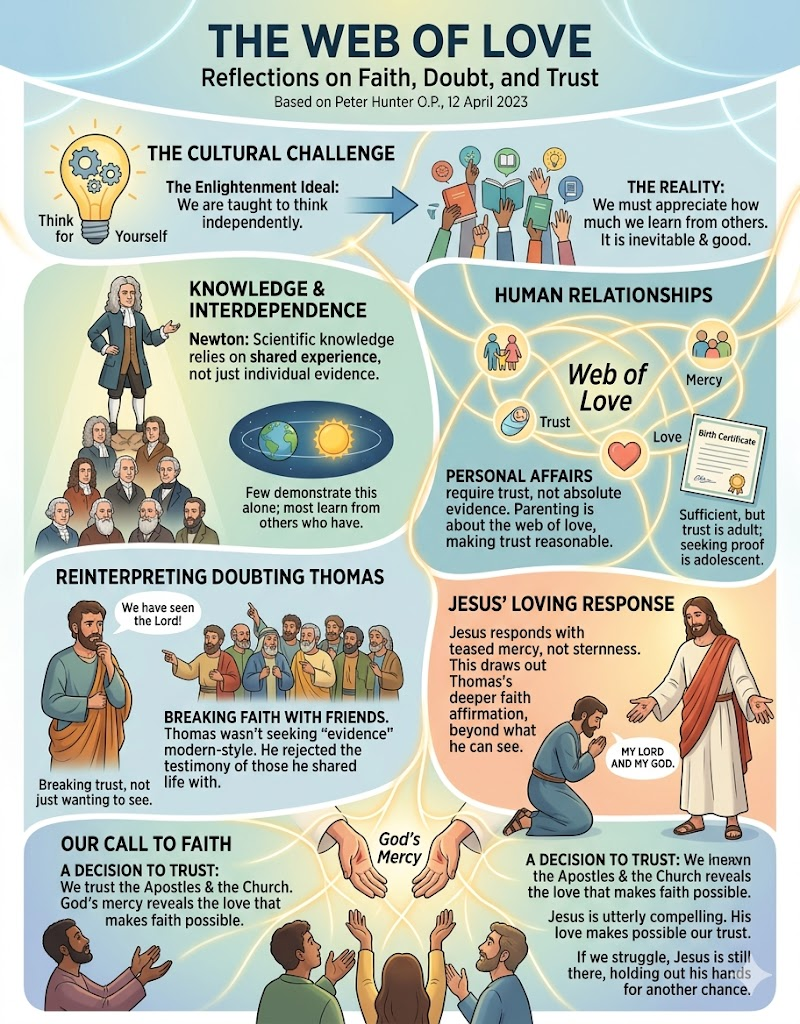
Father Peter Hunter, O.P., challenges the modern Western ideal of “thinking for oneself” by highlighting our fundamental dependence on others. He argues that science, personal identity, and human relationships all rely on a “web of love” and trust rather than raw evidence. Thomas’s doubt was not a scientific inquiry but a breakdown of trust in his community. Faith, therefore, is not a conclusion reached in a vacuum but a decision to trust the testimony of the Apostles and the Church. Ultimately, God’s mercy provides the love that makes this trust—and the confession “My Lord and my God”—possible.
GO DEEPER
PROMPTS TO KEEP YOU WRITING
Copy/paste one of these command prompts into the Catholic Assistant (bottom right corner). This tool can help you brainstorm and provide you with further ideas to keep you writing.
_
- The Myth of Independence critiques the Enlightenment ideal of thinking for oneself by showing how much we actually inherit from others. Direct the AI to focus on the irony of individualism.
- Shoulders of Giants uses the example of scientific progress to illustrate that we all rely on communal knowledge. Direct the AI to emphasize our debt to the witnesses of the past.
- The Parent Metaphor explores how we trust our parents' identity without DNA evidence through a "web of love." Direct the AI to focus on trust as a sign of maturity.
- Breaking the Web reframes the doubt of Thomas as a rejection of his friends rather than a quest for truth. Direct the AI to emphasize the communal nature of faith.
- The Strangers Testimony contrasts believing a random stranger with believing a community you have shared a life with. Direct the AI to focus on the weight of shared history.
- The Teasing Savior imagines Jesus's interaction with Thomas not as a stern rebuke, but as a loving invitation. Direct the AI to emphasize Christ's gentleness with the doubter.
- Beyond the Senses analyzes how the confession "My Lord and my God" requires a supernatural gift of faith. Direct the AI to focus on the limits of physical evidence.
- Deciding to Trust argues that faith is a choice made within the context of the Church's long history. Direct the AI to emphasize the apostolic foundation of our belief.
- The Compelling Figure describes Jesus as a person whose love makes the risk of trust possible. Direct the AI to focus on the relational attraction of Christ's character.
- Holding Out Hands depicts the mercy of God as a constant offer of a "second chance" to touch His wounds. Direct the AI to write a comforting, pastoral invitation.
2nd Sunday of Easter (A)
Fr. Austin Fleming

2026 HOMILIES | ARCHIVE: 2023 | 2020 | 2017 | 2014 | 2011 | 2008
Doubts About God
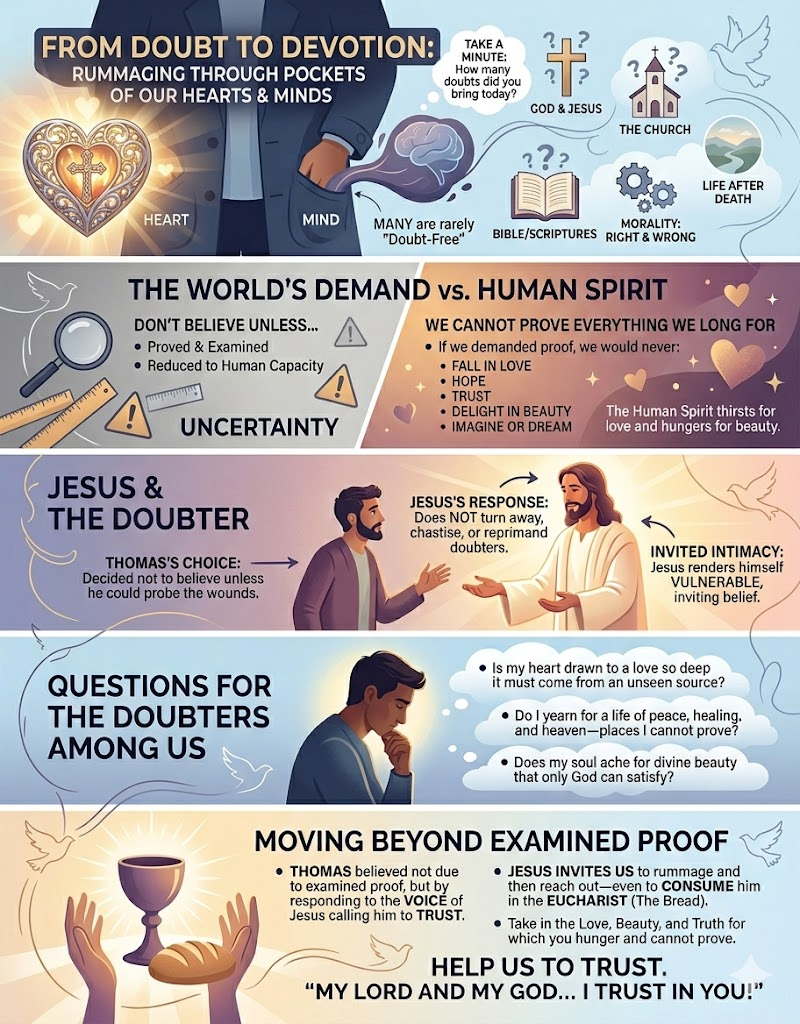
Father Austin Fleming invites the faithful to “rummage through the pockets” of their hearts to acknowledge their doubts regarding God, the Church, and the afterlife. He argues that demanding absolute proof for everything would stifle the human capacity to love, hope, or appreciate beauty. While Thomas initially chose doubt over trust, Jesus responded not with rejection, but with an invitation to deeper intimacy. Ultimately, our persistent hunger for a love and beauty we cannot prove points toward a Divine source. Faith, then, is a response to Christ’s voice calling us to trust beyond our intellectual comprehension.
GO DEEPER
PROMPTS TO KEEP YOU WRITING
Copy/paste one of these command prompts into the Catholic Assistant (bottom right corner). This tool can help you brainstorm and provide you with further ideas to develop your homily.
_
- Pockets of Doubt explores the various uncertainties people bring into the sanctuary regarding God, scripture, and morality. Direct the AI to focus on the honesty of "rummaging" for truth.
- The Limits of Proof argues that a life lived only by what is provable would exclude love, hope, and beauty. Direct the AI to emphasize the necessity of the unprovable.
- Hunger for the Infinite describes the human spirit's yearning for a love that never fails and beauty that never fades. Direct the AI to focus on the "aching" for God.
- A Choice to Doubt analyzes Thomas’s "unless" statement as a deliberate decision to withhold trust rather than a simple lack of information. Direct the AI to focus on the will.
- Vulnerable Resurrection depicts Jesus offering His wounds to Thomas as an act of extreme intimacy rather than a reprimand. Direct the AI to emphasize Christ's gentleness with seekers.
- The Preacher as Doubter incorporates the speaker's own admission of uncertainty to build a bridge to the congregation. Direct the AI to focus on shared human vulnerability.
- Evidence of the Heart suggests that our longing for a place of total peace (Heaven) is a valid reason to believe. Direct the AI to focus on internal desire.
- Hearing the Voice focuses on Thomas coming to faith not through the "examined proof" but by recognizing the voice of Jesus. Direct the AI to emphasize relational recognition.
- Beyond the Mind explores how the human mind is too small to grasp the entirety of God, yet the heart still thirsts. Direct the AI to focus on intellectual humility.
- Eucharistic Intimacy concludes by inviting the faithful to touch and consume the Lord in the bread of the Eucharist. Direct the AI to focus on the fulfillment of spiritual hunger.
2nd Sunday of Easter (A)
Monsignor Peter Hahn

A Lifetime Celebration
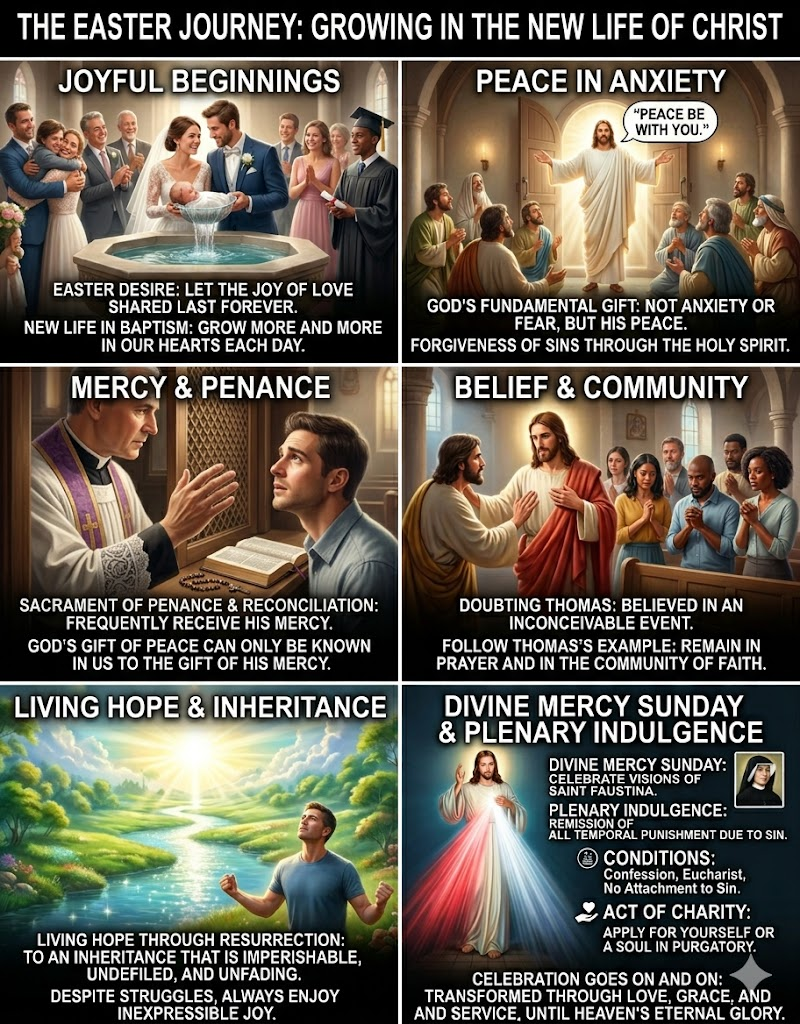
Msgr. Peter Hahn frames Easter as a “joy-filled celebration” meant to last a lifetime, rather than a single day. Drawing from the Octave and the 50-day season, he emphasizes that God’s primary action is to bestow peace, consolation, and the forgiveness of sins through the Holy Spirit. He defends St. Thomas, suggesting his doubt is a common human experience, but highlights that Thomas remained within the community of faith to find his answers. Finally, he connects the Resurrection to Divine Mercy Sunday, explaining the specific graces of the plenary indulgence as a transformative encounter with God’s infinite love.
GO DEEPER
PROMPTS TO KEEP YOU WRITING
Copy/paste one of these command prompts into the Catholic Assistant (bottom right corner). This tool can help you brainstorm and provide you with further ideas to develop your homily.
_
- The Eternal Celebration describes Easter as an event that transcends a single day and grows through Baptism. Direct the AI to focus on the continuity of joy.
- The Peace of God explores how God’s primary action is always to provide consolation and hope despite our anxieties. Direct the AI to emphasize the gift of peace.
- Mercy and Reconciliation connects the gift of the Holy Spirit to the practical necessity of the Sacrament of Penance. Direct the AI to focus on the healing of sin.
- Thomas in the Community highlights how Thomas stayed with the Apostles despite his uncertainty. Direct the AI to focus on the Church as the place where doubts are quelled.
- A Living Hope meditates on the "imperishable and unfading" inheritance promised in the letters of Saint Peter. Direct the AI to focus on the glory of heaven.
- The Transforming Event analyzes how the Resurrection creates a "different" life for believers compared to the world around them. Direct the AI to focus on sincerity of heart.
- Divine Mercy Sunday introduces the visions of Saint Faustina and the iconic image of Jesus as Mercy. Direct the AI to focus on the historical context of the devotion.
- Removing the Deficit explains the theological mechanics of a plenary indulgence and the remission of temporal punishment. Direct the AI to focus on the grace of a clean slate.
- Charity for the Souls discusses applying mercy to those in Purgatory as an act of selfless love. Direct the AI to focus on the intercession for the departed.
- Service and Glory concludes with the call to live out the Resurrection through love and service until we reach eternity. Direct the AI to focus on the mission of the believer.
2nd Sunday of Easter (A)
Fr. Charles E. Irvin
Garden of Restoration

Father Irvin presents the Resurrection as the “Garden of the Restoration,” where Christ breathes the Holy Spirit into the Church to undo the separation caused in Eden. He traces the Spirit’s movement from the dawn of Creation to the Cross, where Jesus “handed over His Spirit.” This gift is not a passive presence but a dynamic, sanctifying power that makes us a “new creation.” Central to this is the Sacrament of Reconciliation, which Father Irvin identifies as a unique, stupendous gift of a “second chance” that empowers us to share divine forgiveness with a broken world.

GO DEEPER
PROMPTS TO KEEP YOU WRITING
Copy/paste one of these command prompts into the Catholic Assistant (bottom right corner). This tool can help you brainstorm and provide you with further ideas to develop your homily.
_
- The Time of Handing Over explores the transition from Jesus’s physical presence to the indwelling of the Holy Spirit. Direct the AI to focus on the continuity of God's action.
- Genesis to John traces the Spirit from the brooding waters of creation to the breath of the Risen Christ. Direct the AI to emphasize the Spirit as the bringer of order.
- The Restoration of Presence contrasts the loss of God in Eden with the restoration of God in the Garden of the Resurrection. Direct the AI to focus on intimacy.
- Dynamic Sanctification explains that the Holy Spirit is an energizing force within us, not a passive observer. Direct the AI to focus on the power to make us holy.
- The Second Chance frames the Sacrament of Reconciliation as the divine response to the human plea for a fresh start. Direct the AI to emphasize the joy of innocence.
- Ministry of Reconciliation analyzes St. Paul’s teaching on the "New Creation" and the entrustment of the message of peace. Direct the AI to focus on the passing of the old.
- The Power of Pentecost connects the "handing over" on the Cross to the public manifestation of the Church's strength. Direct the AI to focus on overcoming fear.
- Uniquely Catholic Mercy argues that the specific power to forgive sins distinguishes the Christian faith from all other religions. Direct the AI to focus on the Sacrament's value.
- Generosity in Forgiveness challenges the believer to share the mercy they have received with those who have sinned against them. Direct the AI to focus on Christian duty.
- Temples of the Spirit meditates on the dignity of every baptized person as a dwelling place for God. Direct the AI to focus on the internal reality of grace.
2nd Sunday of Easter (A)
Fr. Joe Jagodensky, SDS
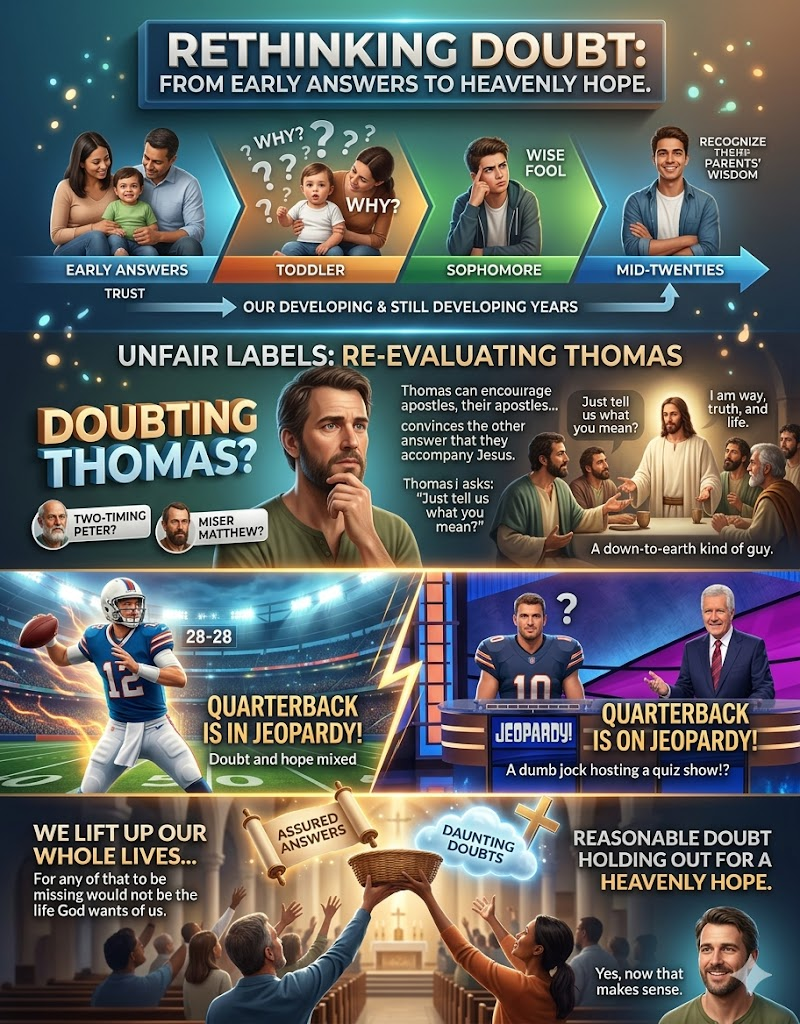
“Doubting Thomas?” Think Again

Father Joe Jagodensky challenges the conventional labeling of “Doubting Thomas,” arguing that Thomas was actually a “down-to-earth,” plain-spoken man who sought clarity rather than blind imagination. Using the analogy of the “wise fool” (sophomore) and the evolving relationship we have with parental wisdom, Jagodensky suggests that faith is a lifelong development. He reframes doubt not as a failure, but as a necessary component of a complete life offered to God at Mass. By weaving in humor about “dumb jocks” and “Jeopardy,” he highlights how our snap judgments and labels often fail to capture the complex reality of a person’s faith.
GO DEEPER
PROMPTS TO KEEP YOU WRITING
Copy/paste one of these command prompts into the Catholic Assistant (bottom right corner). This tool can help you brainstorm and provide you with further ideas to develop your homily.
_
- The Undeserved Handle critiques the way we label Saint Thomas while ignoring the flaws of other Apostles. Direct the AI to focus on the injustice of reductive labeling.
- Parental Wisdom and Faith compares the development of human maturity to the lifelong process of spiritual growth. Direct the AI to emphasize the "wise fool" stage of life.
- Thomas the Realist re-examines Thomas’s role in the raising of Lazarus to show his courage and loyalty. Direct the AI to focus on his down-to-earth nature.
- Clarity over Poetry analyzes the interaction where Thomas asks Jesus to "tell us what you mean" regarding the Way. Direct the AI to focus on the quest for truth.
- Offertory of Doubts explores the idea of bringing our uncertainties to the altar during the Mass. Direct the AI to focus on the sacrifice of our whole lives.
- The Developing Soul argues that the "developing years" of faith never actually end during our earthly lives. Direct the AI to emphasize constant spiritual evolution.
- Doubt and Hope Mixed uses the analogy of a fourth-quarter football game to show how doubt and hope coexist. Direct the AI to focus on "heavenly hope."
- The Jeopardy Analogy uses the humor of a "dumb jock" hosting a quiz show to challenge our preconceived notions. Direct the AI to focus on surprising transformations.
- A Life God Wants explains that a faith without questions is not the complete life God desires from His children. Direct the AI to focus on authentic vulnerability.
- Answers in the Offertory connects the assured answers of our youth to the complex realities of adulthood. Direct the AI to focus on the integration of faith and experience.
2nd Sunday of Easter (A)
Deacon Greg Kandra
My Lord and My God
Deacon Greg Kandra uses the modern-day conversion of Texas atheist Patrick Greene to illustrate the transformative power of Divine Mercy. Greene, who once sued to remove a Nativity scene, was moved to faith not by intellectual argument, but by the radical, sacrificial love of a Baptist congregation when he began losing his sight. Kandra parallels this with St. Thomas, noting that Christ does not dismiss the doubter but “comes back” to break through the locked doors of the heart. The homily concludes by framing Divine Mercy Sunday as a universal “second chance” to leave the tombs of our own making.

GO DEEPER
PROMPTS TO KEEP YOU WRITING
Copy/paste one of these command prompts into the Catholic Assistant (bottom right corner). This tool can help you brainstorm and provide you with further ideas to develop your homily.
_
- The Modern Thomas explores how the "New Atheism" creates a culture of doubt similar to the apostle's experience. Direct the AI to focus on the public square.
- Turning the Cheek narrates the decision of Jessica Crye and her church to help their vocal opponent. Direct the AI to focus on radical Christian love.
- Shaken Disbelief examines the moment Patrick Greene realized his own atheism couldn't withstand the outpouring of charity he received. Direct the AI to focus on internal change.
- The Star of Athens reflects on the irony of an atheist buying a star for the Nativity scene he once tried to sue. Direct the AI to focus on gratitude.
- Breaking Locked Doors uses the Gospel imagery of the Upper Room to describe how Christ enters the stubborn human heart. Direct the AI to focus on God’s initiative.
- The Return of Christ emphasizes that Jesus did not abandon Thomas in his anger but returned specifically for him. Direct the AI to focus on second chances.
- The Tomb of Self challenges the listener to identify the personal "tombs" of sin or selfishness they need to leave. Direct the AI to focus on the Resurrection.
- Wounds of Understanding reflects on how Jesus’s scars show He knows our hurts, infirmities, and human weaknesses. Direct the AI to focus on Christ’s empathy.
- Eyes of Faith contrasts the loss of physical eyesight with the gaining of spiritual vision through the experience of love. Direct the AI to focus on wondrous discovery.
- Divine Mercy Encounter connects the story of Thomas and Greene to the specific graces available on Divine Mercy Sunday. Direct the AI to focus on the Sacrament of Reconciliation.
2nd Sunday of Easter (A)
Fr. Langeh, CMF

The Church as the Community of Forgiveness
Father Langeh presents the Church as the essential “community of forgiveness,” established by Christ on Divine Mercy Sunday. Drawing from the visions of Saint Faustina and the communal life of the early Church in Acts, he argues that the power to forgive sins is a gift given to the collective body, not just the individual. He provides a catechetical breakdown of the Sacrament of Reconciliation—highlighting contrition, confession, and satisfaction—and echoes Pope Francis’s teaching that God’s mercy transcends specific jubilee years, remaining a permanent, “tender” foundation for the life of every believer.

GO DEEPER
PROMPTS TO KEEP YOU WRITING
Copy/paste one of these command prompts into the Catholic Assistant (bottom right corner). This tool can help you brainstorm and provide you with further ideas to develop your homily.
_
- Depths of Tenderness explores the origin of Divine Mercy Sunday through the visions given to Saint Faustina in the 1930s. Direct the AI to focus on Christ's desire for celebration.
- The Forgiveness Community analyzes why the power to forgive sins requires a believing community rather than being a private act. Direct the AI to focus on Church fraternity.
- Miracles of Togetherness draws parallels between the signs worked by the early apostles and the communal life of the parish today. Direct the AI to focus on shared prayer.
- The Holy Breath examines the moment Jesus gave the apostles the Holy Spirit specifically for the administration of divine forgiveness. Direct the AI to focus on apostolic authority.
- Sacramental Titles reflects on the different names for Confession, such as the Sacrament of Conversion and the Sacrament of Penance. Direct the AI to focus on the treasury of faith.
- Heartfelt Contrition provides a guide for the faithful on being truly sorry for offenses against both God and neighbor. Direct the AI to focus on the interior disposition.
- The Act of Confession details the practice of stating sins in words to God through the priest, even those that are not grave. Direct the AI to focus on verbalizing truth.
- Meaningful Satisfaction explains the role of penance as an intention to make up for the effects of sin in a token way. Direct the AI to focus on spiritual healing.
- Mercy Beyond Time discusses Pope Francis’s teaching that God’s mercy is not confined to a specific Jubilee year or timeframe. Direct the AI to focus on eternal grace.
- Mercy and Misery meditates on the encounter between human sinfulness and Divine love as presented in the letter "Misericordia Et Misera." Direct the AI to focus on the Church’s mission.
2nd Sunday of Easter (A)
Deacon Peter McCulloch
2026 HOMILIES | ARCHIVE: 2023 | 2020
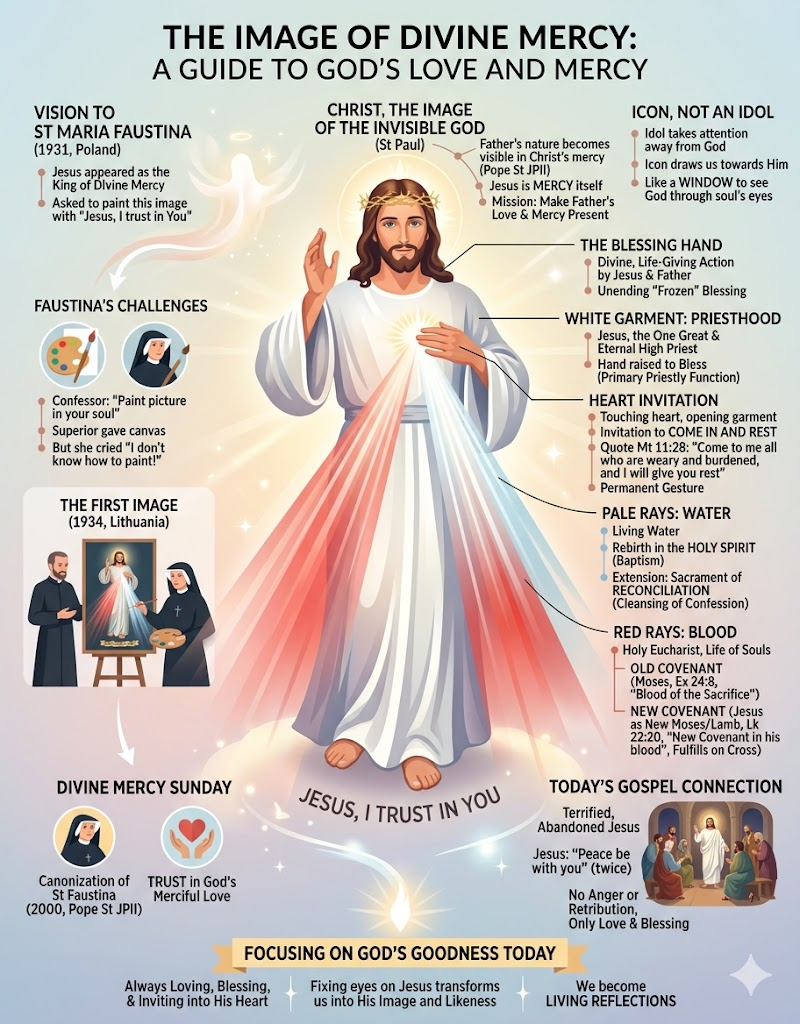
The Image of Divine Mercy
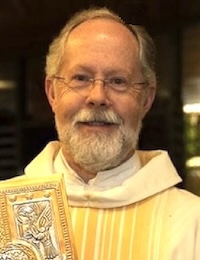
Deacon Peter explores the “Image of Divine Mercy” as a sacramental window into the heart of God. Tracing the image’s origin from St. Faustina’s 1931 vision to its artistic realization in 1934, he distinguishes between an idol and an icon, the latter serving as a portal for the soul. He provides a detailed “reading” of the image: Christ’s raised hand denotes an eternal priestly blessing, while His left hand invites the weary to find rest in His heart. The red and pale rays symbolize the life-giving sacraments of the Eucharist, Baptism, and Reconciliation, all flowing from the “New Moses.”
GO DEEPER
PROMPTS TO KEEP YOU WRITING
Copy/paste one of these command prompts into the Catholic Assistant (bottom right corner). This tool can help you brainstorm and provide you with further ideas to develop your homily.
_
- The Vision of Faustina narrates the 1931 apparition in Poland and the command to paint the King of Mercy. Direct the AI to focus on the initial struggle and the signature.
- Windows to the Soul explains the theological difference between an icon and an idol in Christian worship. Direct the AI to emphasize the icon as a spiritual window.
- Visible Mercy of the Father explores how Christ makes the invisible nature of the Father tangible through His mission. Direct the AI to focus on the Father’s love.
- The Eternal High Priest analyzes the symbolism of the white garment and the raised hand of blessing. Direct the AI to focus on Christ’s priestly function.
- A Permanent Invitation reflects on the gesture of Christ opening His garment to invite the weary into His heart. Direct the AI to focus on rest and safety.
- Rays of Living Water connects the pale rays of the image to the promises of Baptism and the cleansing of Confession. Direct the AI to focus on spiritual rebirth.
- Blood of the New Covenant explores the red rays as a fulfillment of the Mosaic sacrifice through the Eucharist. Direct the AI to focus on the life of souls.
- From Terror to Peace reimagines the scene in the Upper Room where fear is replaced by a double blessing. Direct the AI to focus on the absence of retribution.
- The Living Reflection argues that contemplating the image of Jesus leads to a transformation of the believer into His likeness. Direct the AI to focus on spiritual growth.
- The Canonization of Mercy discusses St. John Paul II’s role in establishing the feast and spreading the devotion worldwide. Direct the AI to focus on the trust in God.
2nd Sunday of Easter (A)
Msgr. Charles Pope
From Fear to Faith for the Second Sunday of Easter
RELATED: Msgr. Pope’s homily Perfect Mercy with Divine Mercy Sunday focus.
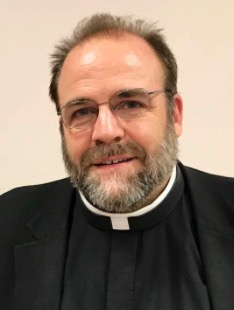
Msgr. Charles Pope argues that faith is fundamentally communal, asserting that those who seek “Jesus without the Church” block their own blessings. Using St. Thomas as a cautionary tale of isolation, he outlines how the Sunday Mass is the essential “gathering” where Christ chose to reveal His Resurrection, peace, and the power to forgive sins. Thomas’s doubt was not just intellectual but a “faltering fellowship”—a refusal to believe the Church’s collective testimony. Ultimately, Msgr. Pope emphasizes that spiritual clarity is like a stained-glass window: its beauty and truth can only be seen from the inside.

GO DEEPER
PROMPTS TO KEEP YOU WRITING
Copy/paste one of these command prompts into the Catholic Assistant (bottom right corner). This tool can help you brainstorm and provide you with further ideas to develop your homily.
_
- Blocking the Blessing analyzes how Thomas’s absence from the first Sunday gathering caused him to miss the initial encounter with the Risen Lord. Direct the AI to focus on the necessity of Mass.
- Fearful but Present describes the Apostles huddled in fear behind locked doors yet remaining in the right place for a blessing. Direct the AI to focus on the value of showing up.
- The Liturgical Encounter explores how the Word and Sacrament reorder our lives, providing hope, clarity, and a "new mind." Direct the AI to focus on the Mass as transformative.
- Juridical Forgiveness examines the extraordinary moment Christ gave the Apostles the specific authority to forgive or retain sins. Direct the AI to focus on the biblical roots of Confession.
- The Bible's Mother argues that the Scriptures are a product of the Church’s tradition and cannot be separated from her authority. Direct the AI to focus on the Church as an object of faith.
- Faltering Fellowship defines Thomas’s doubt as a break in communion with the apostolic testimony rather than just a personal struggle. Direct the AI to focus on communal belief.
- Inside the Window utilizes the stained-glass metaphor to show that Church teachings are only beautiful when viewed from a position of fellowship. Direct the AI to focus on interior perspective.
- The Second Sunday Blessing narrates Thomas’s return to the group and his subsequent encounter with Christ's wounds. Direct the AI to focus on working out doubt within the Church.
- No Christ Without Church asserts that Jesus is found in His Body and Bride, the assembly, rather than in solitary "mountaintop" experiences. Direct the AI to focus on the Lamb of God.
- The Gift of Shalom reflects on how the Risen Lord’s greeting of "Peace" transforms a room full of discouraged and angry men. Direct the AI to focus on divine serenity.
2nd Sunday of Easter (A)
Father Kevin Rettig

2026 HOMILIES | ARCHIVE: 2023 | 2020
Believing Thomas
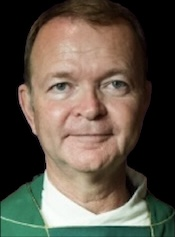
Father Kevin reframes “Doubting Thomas” as “Believing Thomas,” arguing that doubt is not a curse but a sign of a lively, growing faith. He contrasts the fear of the other Apostles—who huddled behind locked doors—with the courage of Thomas, who ventured out despite his uncertainty. Father Kevin posits that the opposite of faith is not doubt, but fear. By refusing to settle for secondhand reports and craving a personal encounter with the Risen Lord, Thomas became the first person in history to explicitly profess Jesus as “God,” proving that questioning leads to deeper spiritual conviction.

GO DEEPER
PROMPTS TO KEEP YOU WRITING
Copy/paste one of these command prompts into the Catholic Assistant (bottom right corner). This tool can help you brainstorm and provide you with further ideas to develop your homily.
_
- The Gift of Doubt explores how questioning is a sign of a lively faith that prevents us from locking ourselves behind closed doors. Direct the AI to focus on spiritual growth.
- Adam's Suit narrates the story of a child finding a pressed leaf in a Bible and viewing it through the eyes of faith. Direct the AI to focus on childhood conviction.
- The Burning Bush Craving describes the human need for a personal, "burning bush" experience of God rather than secondhand reports. Direct the AI to focus on spiritual hunger.
- Faith vs Fear contrasts the fearful Apostles hiding in the Upper Room with Thomas’s courage to venture out into the world. Direct the AI to focus on moving beyond barriers.
- The Devil's Advocate explains how the Church uses a healthy dose of skepticism and doubt to discern visions and claims to sainthood. Direct the AI to focus on institutional wisdom.
- Touching the Wounds analyzes the unique privilege granted to Thomas to physically touch the Risen Lord because he sought more than just sight. Direct the AI to focus on intimacy.
- The First Proclamation highlights that Thomas was the first person in history to explicitly call Jesus "God" following his period of doubt. Direct the AI to focus on conviction.
- A Room for Questions reflects on how the College of Apostles remained a community even when Thomas did not believe the same things as the others. Direct the AI to focus on unity.
- Deepening the Roots argues that if we stop questioning or doubting, our faith will never grow or discover the richness of God. Direct the AI to focus on constant deepening.
- Believing Thomas reframes the apostle as a model of strong faith whose doubts led him to a truth far beyond his companions. Direct the AI to focus on the value of the probe.
2nd Sunday of Easter (A)
Fr. George Smiga
A Body to Touch

Father Smiga addresses the “strange and gruesome” invitation to touch Christ’s wounds by situating the Gospel of John within the early Church’s struggle against Docetism. He explains that by emphasizing a physical, touchable body, the Gospel rejects the Greek notion that the material world is valueless. This theology of the body is central to our mission: salvation is not an escape from the physical world into a “pure spirit” state, but the transformation of the earth. Touching the wounds of Jesus reminds us to confront the real, physical wounds of poverty, violence, and injustice in our own world.

GO DEEPER
PROMPTS TO KEEP YOU WRITING
Copy/paste one of these command prompts into the Catholic Assistant (bottom right corner). This tool can help you brainstorm and provide you with further ideas to develop your homily.
_
- The Docetist Debate explores why the Gospel of John emphasizes the physical touch of Jesus’ wounds to counter early heresies. Direct the AI to focus on the Greek term "Dokeo."
- Valuing Creation argues against the Greek idea that the physical world is valueless, showing instead that all of creation has worth. Direct the AI to focus on the goodness of bodies.
- Bringing Heaven Down contrasts the goal of "escaping to heaven" with the Christian mission of bringing God's kingdom to the earth. Direct the AI to focus on the Lord's Prayer.
- Actual Human Woundedness analyzes how Jesus’ physical scars represent God’s commitment to healing the brokenness of our material world. Direct the AI to focus on divine solidarity.
- Touching Contemporary Wounds draws a parallel between probing Jesus’ side and confronting modern issues like poverty, war, and prejudice. Direct the AI to focus on social mission.
- A Body of Flesh reflects on the significance of Jesus being "like us in all things but sin" and having a literal body. Direct the AI to focus on the Incarnation.
- The Goal of Faith redefines the Christian life not as an escape from evil but as a commitment to changing the world for the better. Direct the AI to focus on justice.
- Every Body's Destiny explains that because Christ’s body was raised, our own physical bodies and the whole of creation are destined for glory. Direct the AI to focus on hope.
- Confronting the Gash examines the "strange and gruesome" nature of Thomas’s invitation as a testament to the reality of the Resurrection. Direct the AI to focus on the physical evidence.
- Committing to the Earth concludes with a call to work until God's will is done in the "flesh and blood" realities of our sisters and brothers. Direct the AI to focus on service.
2nd Sunday of Easter (A)