Fr. Tony’s Homily starters, anecdotes and life messages with infographics for use in parish bulletins, presentations, bible studies, and teaching @ Fr. Tony’s Homilies. Ezekiel 37:12-14 Romans 8:8-11 John 11:1-45

Fr. Tony’s Homily, Life Messages, Homily Starters, Anecdotes

Homily Starters, Fr. Tony’s Homily

Homily Starters, Fr. Tony’s Homily

March 8, 2026

March 29, 2026

Palm Sunday A

  • ANECDOTES
  • EXEGESIS
  • LIFE MESSAGES

Palm Sunday (A)

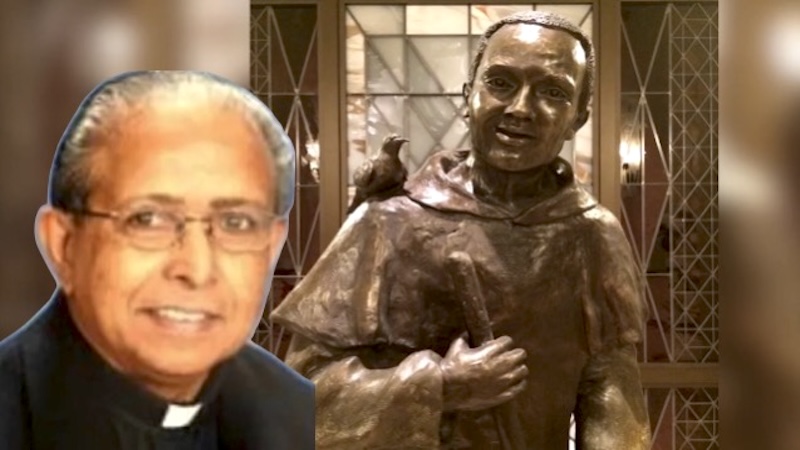
St. Martin de Porres

YouTube player
VISUAL AID

He took the form
of a slave

There is an event in the life of the black Dominican friar, St. Martin de Porres, that is worth recalling on Passion Sunday. Most readers will know something about this lay brother of Lima, Peru. He was born in 1579, died in 1639, and was proclaimed a saint in 1962. Back in Peru’s colonial days, the ruling Spaniards brought over thousands of African blacks as slaves. Some of the slaves eventually won their freedom, most did not; and there was as much racial discrimination in South America as there has been in the United States. In his own person, Martin summarized the woes of the kidnapped black race. His Mother, Anna Velasquez, was a free black woman; his father a Spanish nobleman – in rank if not in character. When Anna showed Juan de Porres his baby boy, he exclaimed, “I won’t accept him as mine. He’s too dark!” Eventually, he came around and acknowledged his legal paternity. But he did very little to help his son, so Martin had to live out the role of a half-caste on the fringe of Liman society. Another mulatto might have soured on life. Not Martin. He chose sanctity over cynicism. Joining the Dominican Order, he spent his life in utter humility and service of others. One day this unselfish lay brother learned that his superior, faced with a shortage of funds to run the monastery, had set out for the market to sell some of the house’s most valuable items. Martin ran after the priest and caught up with him before he had reached the marketplace. “Please don’t sell our possessions,” the saint blurted out. “Sell me! I’m not worth being kept in the order, anyhow; and I am strong and can work!” The superior, deeply touched, shook his head, “Go back to the monastery.” he said gently, “you are not for sale!”

St. Martin de Porres sincerely tried to imitate the Christ who did “empty Himself and took on the form of a slave… obediently accepting even death, death on a cross.” (Phil 2:7-8.


Palm Sunday (A)

Superman Ducked

YouTube player
VISUAL AID

Superman Ducked

Jesus rides upon a donkey fulfilling an ancient prophecy, but clearly is in total control. He knows what will happen to Him in Jerusalem. Still He rides on. He does not seek to avoid the task to which He has been called. — This reminds me of a routine comedian David Brenner used to do about Superman in the movies. Go back with me in your minds. Picture this scene. Superman is confronting one of the bad guys. The bad guy would fire at Superman with a gun. Superman would smirk and throw his chest out. The bullets would bounce harmlessly away. But did you ever notice what happened next? Brenner said, “And then when the guy ran out of bullets, he would throw the gun at Superman. And Superman ducked.”

Superman ducked! I’ll bet you never thought about that before. Bullets bounced off of him, but when a gun was thrown at him, Superman ducked. Perhaps that amusing insight will serve to remind us that Jesus did not have to enter Jerusalem on Palm Sunday. He could have ducked His mission. But still He rode on. 


Palm Sunday (A)

King for a Day

YouTube player


King for A Day

Before television, there was radio.  One of the most popular daytime radio programs in those days was called Queen for a Day.  Each day four or five women from the studio audience would tell the host what they would like to do if they could be “Queen for a Day.”  Then, on the basis of applause, one woman was chosen, and insofar as they were able, the sponsors fulfilled her wildest desires.  She was given a number of valuable prizes and for one day she reigned as “Queen.” 

That sounds like what happened to Jesus, doesn’t it?  Jesus was crowned “King for a Day” on that first Palm Sunday.

1st Reading | 2nd Reading | Gospel

i need something grand that is visually appealing. create 8.5×11 infographic with large sweeping photo realistic images that span the page either vertically or horizontally and with large bold arial fonts.

[Overall Constraint]: Create a photorealistic infographic on an 8.5×11 inch page with a grand, sweeping, cinematic design.

[Main Title]: The title at the top in massive, bold, gold and white Arial font is: “[YOUR MAIN TITLE HERE]”.

[Top Section – Full Width]: Below the title, a dramatic, full-width photorealistic image captures [DESCRIBE THE EPIC TOP SCENE – e.g., a mountain peak at sunrise with blinding light]. A large, transparent banner across this section reads in bold Arial text: “[YOUR TOP SECTION SUMMARY OR THEOLOGICAL POINT]”.

[Middle Section – Split Panel]: The middle section is a sweeping image split vertically down the center by a subtle divider.

Left Panel: On the left, a photorealistic scene shows [DESCRIBE SCENE A – e.g., Moses at the burning bush]. A banner above/below it reads: “[TITLE FOR SCENE A]”. Below that, bold text overlay states: “[DESCRIPTIVE TEXT FOR SCENE A]”.

Right Panel: On the right, a contrasting photorealistic scene shows [DESCRIBE SCENE B – e.g., Elijah in the cave with wind and fire]. A banner above/below it reads: “[TITLE FOR SCENE B]”. Below that, bold text overlay states: “[DESCRIPTIVE TEXT FOR SCENE B]”.

(Optional Central connector): A central banner connects the two panels reading: “[TEXT LINKING THE TWO CONCEPTS]”.

[Bottom Section – Full Width]: The bottom section is another sweeping, emotional photorealistic image showing [DESCRIBE THE FINAL SCENE – e.g., modern people walking towards a light, or a biblical conclusion]. A large banner reads: “[YOUR FINAL THEOLOGICAL CONCLUSION OR CALL TO ACTION]”. Below it, bold text overlay reads: “[SUPPORTING SCRIPTURE REFERENCE OR FINAL THOUGHT]”.

[Style Summary]: All text must be in large, bold, clear Arial font, using a color palette of gold, white, and deep rich tones (blues, purples, earth tones) against atmospheric backgrounds. The entire image must have a cinematic, epic quality with dramatic lighting, vast landscapes, and high detail.

SHOW/HIDE TEXT

In the middle section of the book of the prophet Isaiah, chapters 40-55, there are four short passages which scholars have called the Songs of the Suffering Servant.  Today’s first reading is the third Servant Song. These four songs are about a mysterious figure whose suffering brings about a benefit for the people.  In the original author’s mind, the servant was probably a figure for the people of Israel, or for a faithful remnant within the people. The Songs portrayed the antithesis of Israel’s messianic expectations, because Israel expected a triumphant Messiah while the prophet foresaw a “suffering servant” Messiah. Jesus saw aspects of his own life and mission foreshadowed in the Servant Songs, and the Church refers to them in this time of solemn meditation on the climax of Jesus’ earthly life. These songs foretell Jesus’ conscious, active choice to remain faithful to his saving mission no matter what the cost: “I have not … turned back” and “I gave my back to those who beat me.” The kingship of Jesus was to mean suffering and humiliation, not just publicity and grandeur. In today’s Responsorial Psalm, (Ps 22), the Psalmist puts his trust in Yahweh for deliverance and salvation.  The context of this day’s worship also conveys Jesus’ confidence in God’s protection in the midst of His trial and crucifixion. The passage encourages us to be companions of Jesus in suffering by offering our own sufferings in union with the redemptive sufferings of Christ, so that we may become collaborators in that suffering. The passage also challenges us to accept what we cannot change, so that we may endure the difficulty for as long as it is necessary, just as Christ did.

Personal application of the suffering servant prophecy: This prophecy is  speaking to you and me on at least two levels. First, we meditate on the prophet’s words, and recognize how much suffering  Jesus went through for our salvation. Such meditation can only lead us to love him more and to desire that our will accord with his will at all times. Now at another level, we put ourselves into that prophetic scene. Wherever we see the word “I” or “me” we change that by inserting our own first name. In this way we will see that the Lord is calling us to imitate him. It can be an “aha” moment for us, a sudden understanding and a sudden call for a decision.

Isaiah 50:4-7


1st Reading | 2nd Reading | Gospel

Palm Sunday (A)

SHOW/HIDE TEXT

This section of  Paul’s Letter to the Philippians is an ancient Christological hymn representing a very early Christian understanding of Who Jesus is  and how his mission saves us from sin and death.  It is a message that Paul received from those who had been converted to Christ, summarizing ‘the great mysteries of our redemption,’ and it rightly serves as a preview for the events of Holy Week. It describes how Jesus, though Son of God, emptied himself’” of divine glory and “took the form of a slave”—a man like us in all things except sin. Out of love and obedience, he willingly accepted his death, “even death on a cross.” Because Jesus humbled himself and did not cling to any of his special privileges as God’s Son, “God greatly exalted him and bestowed on him the Name which is above all names.”

We are called to have the same attitude of humility and obedience that Christ, our Lord, had. Christians reading this passage today are joining the first people who ever pondered the meaning of Jesus’ life and mission.  We’re singing their song and reciting their creed during this special time of the year, when we remember the most important things Our Lord did. God humbled himself for us! Jesus’ triumph was his self-giving on the cross to open for us the road to the Father. All we can do in response is to bow our heads in awe, and present our loving, contrite hearts to God, begging for mercy. God wants our  heart to be humbled, contrite, and truly repentant because only is that condition is it open,  and so able, to receive His Mercy and His Love.


1st Reading | 2nd Reading | Gospel

Palm Sunday (A)
SHOW/HIDE TEXT

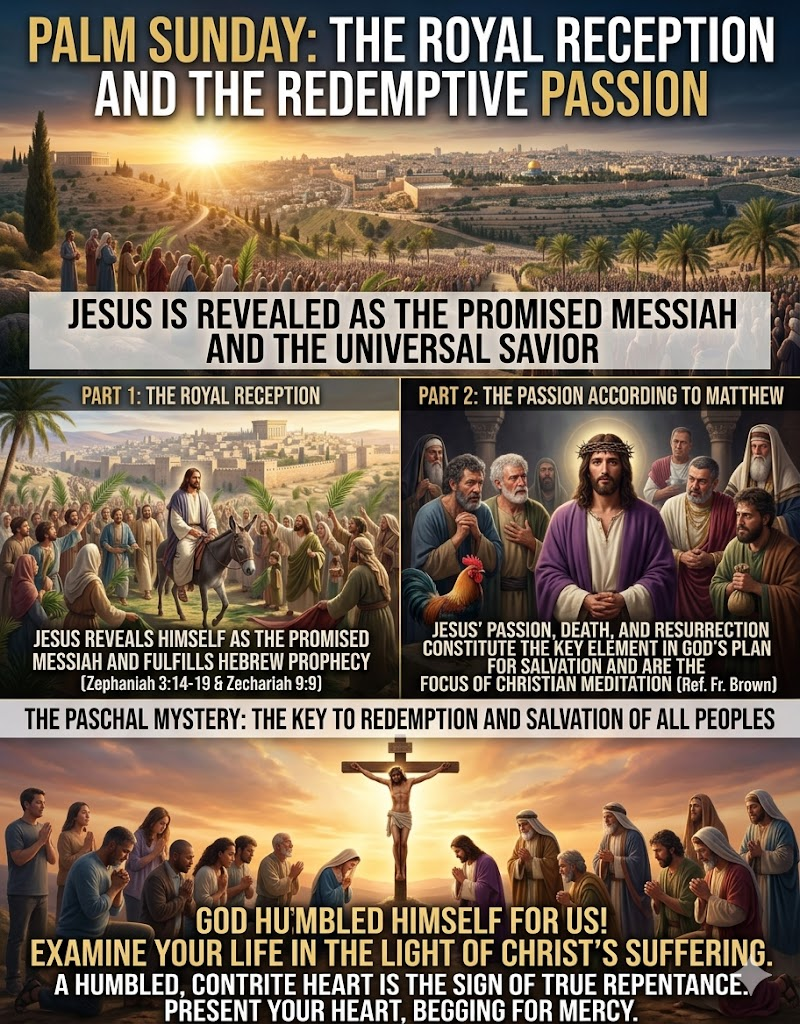
The first part of today’s Gospel describes the royal reception which Jesus received from His admirers, who paraded with Him for a distance of two miles:  from the Mount of Olives to the city of Jerusalem.  Two-and-a-half million people were normally present to celebrate the Jewish feast of Passover.  Jesus permitted such a royal procession for two reasons: 1) to reveal to the general public that He was the promised Messiah, and 2) to fulfill the prophecies of Zephaniah (3:14-19): “Shout for joy, O daughter Zion, …. The King of Israel, the Lord, is in your midst, you have no further misfortune to fear;” and of Zechariah (9:9): “Say to daughter Zion, ‘Behold, your king comes to you, meek and riding on an ass….” The traditional “Palm Sunday Procession” at Jerusalem began in the fourth century AD when the Bishop of Jerusalem led the procession from the Mount of Olives to the Church of the Ascension.

In the second part of today’s Gospel, we listen to/participate in the reading of the Passion of Christ according to Matthew. Jesus’ passion, death, and resurrection constituted the most important aspect of his life and ours. According to Fr.  Raymond E. Brown, “Theologically, Christians have interpreted the death of Jesus on the cross as the key element in God’s plan for the justification, redemption, and salvation of all. Spiritually, the Jesus of the passion has been the focus of Christian meditation for countless would-be disciples who take seriously the demand of the Master to take up the cross and follow him. Pastorally, the passion is the centerpiece of Lent and Holy Week, the most sacred time in the liturgical calendar.” [The Death of the Messiah, Vol. I, (New York: Doubleday1994).] Taking into account the Jewish heritage as well as the increasingly Gentile complexion of his Church, Matthew presents Jesus as the Messiah, foretold in Hebrew Scripture, and as the universal Savior of all peoples.

We are challenged to examine our own lives in the light of some of the characters in the story — like Peter who denied Jesus, Judas who betrayed Jesus, Pilate who acted against his conscience, Herod who ridiculed Jesus, and the leaders of the people who preserved their position by getting rid of Jesus.  God humbled himself for us! All we can do in response is to bow our heads in awe, and present our loving, contrite hearts to God, begging for mercy. God wants a humbled, contrite heart as the sign of our true repentance.


SHOW/HIDE TEXT

Notes on Palm Sunday Events

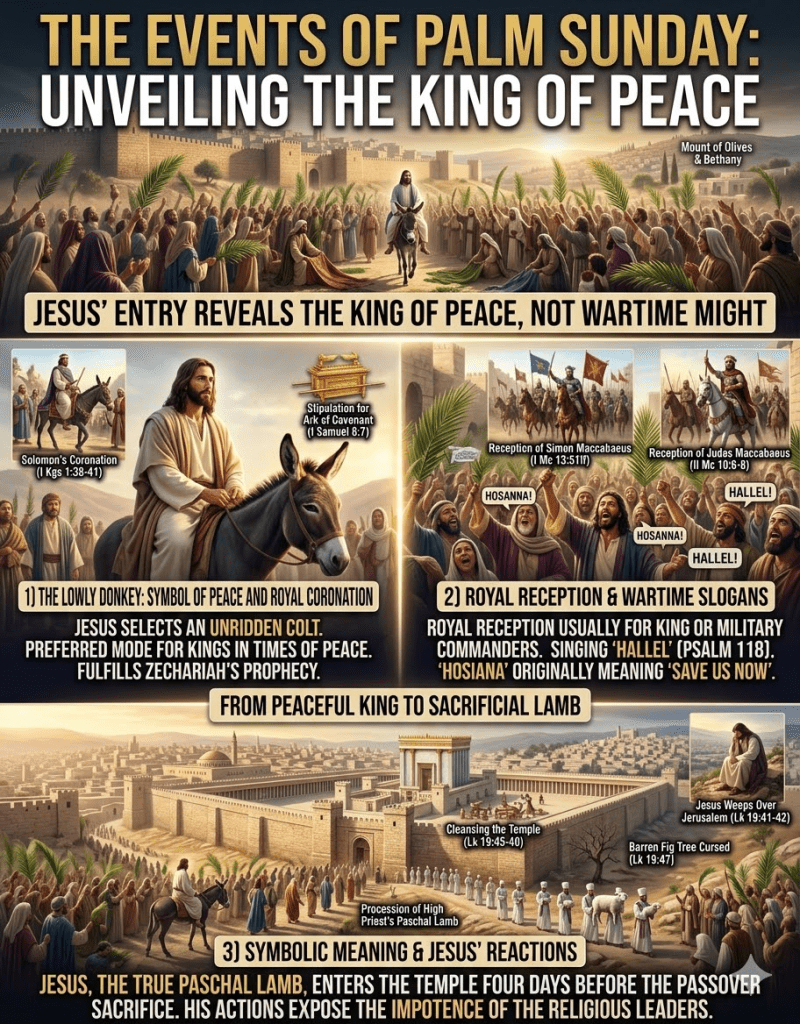
1) Jesus rides on a lowly donkey:  Doesn’t it seem odd that Jesus would walk 90 miles from the Galilee to Bethany and then secure a donkey for the final two miles to Jerusalem? In those days, Kings used to travel in such processions on horseback during wartime, but preferred to ride a donkey in times of peace.  I Kgs 1:38-41 describes how Prince Solomon used his father David’s royal donkey for the ceremonial procession on the day of his coronation.  Jesus entered the Holy City as a King of Peace, fulfilling the prophecy of Zechariah.  The Gospel specifically mentions that the colt Jesus selected for the procession was one that   had not been ridden before, reminding us of a stipulation given in I Samuel 6:7 concerning the animal that was to carry the Ark of the Covenant.

2) The mode of reception given:   Jesus was given a royal reception usually reserved for a king or military commander.  I Mc 13:51ff describes such a reception given to the Jewish military leader Simon Maccabaeus in 171 BC.  II Mc 10:6-8 refers to a similar reception given to another military general, Judas Maccabaeus, who led the struggle against the Greek Seleucid Emperor, Antiochus IV Epiphanes, and liberated the Temple from pagan control in 163 BC.

3) The slogans used: The participants sang the “Hallel” psalm (Psalm 118), and shouted the words of Psalms 25 and 26.  The Greek word “hosiana” originally meant “save us now” (II Sm 14:4).  The people sang the entire Psalm 118 on the Feast of the Tabernacles when they marched seven times around the Altar of the Burnt Offering.  On Palm Sunday, however, the people used the prayer “Hosanna” as a slogan of greeting.  It meant “God save the king of Israel.”

4) The symbolic meaning of the Palm Sunday procession: Nearly 25,000 lambs were sacrificed during the feast of the “Pass Over,” but the lamb which was sacrificed by the High Priest was taken to the Temple in a procession four days before the main feast day.  On Palm Sunday, Jesus, the true Paschal Lamb, was also taken to the Temple in a large procession.

5) Reaction of Jesus:  Before the beginning of the procession, Jesus wept over Jerusalem (Lk 19:41-42), and when the procession was over, he cleansed the Temple (Lk 19:45-46).  On the following day, he cursed a barren fig tree. Jesus cursed a fig tree for lying with its leaves. It looked good from the outside, but there was nothing there. Surely, he must have intended a reference to the Temple. The religious folk of his day were impotent and infertile. They had taken a good thing, religion, and made it into a sham.


Message #2


Message #3

Infographics were created using Google Gemini 3 and Nano Banana Pro. Inspiration take from Fr. Tony’s Homilies; Non-profits may freely use this infographic in their publications and/or ministry. Please give credit or a shout out to TheWordThisWeek.NET.