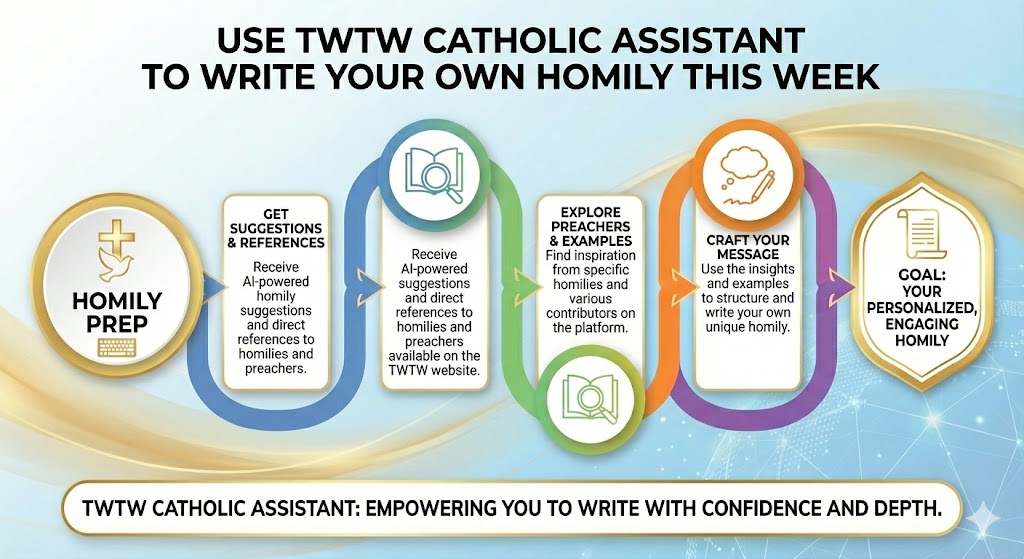
Homily Helper, Catholic AI
Homily Helper, Catholic AI
March 8, 2026
March 29, 2026
Palm Sunday (A)


- GETTING STARTED
- CHAT SPACE
- USE OF AI

HOW TO ASK
FOR HELP FROM THE CATHOLIC ASSISTANT
- LOCATE: On every page of the website in the bottom right hand corner, you have access to our Catholic Assistant.
- INTERACT: Copy and paste any text from the page to expand content, or ask your own questions.
- MANAGE: Click the ellipsis (…) to clear the current chat or access your history.

Pew-Focused Preaching Prompts in Homily Preparation
Family or Intergenerational
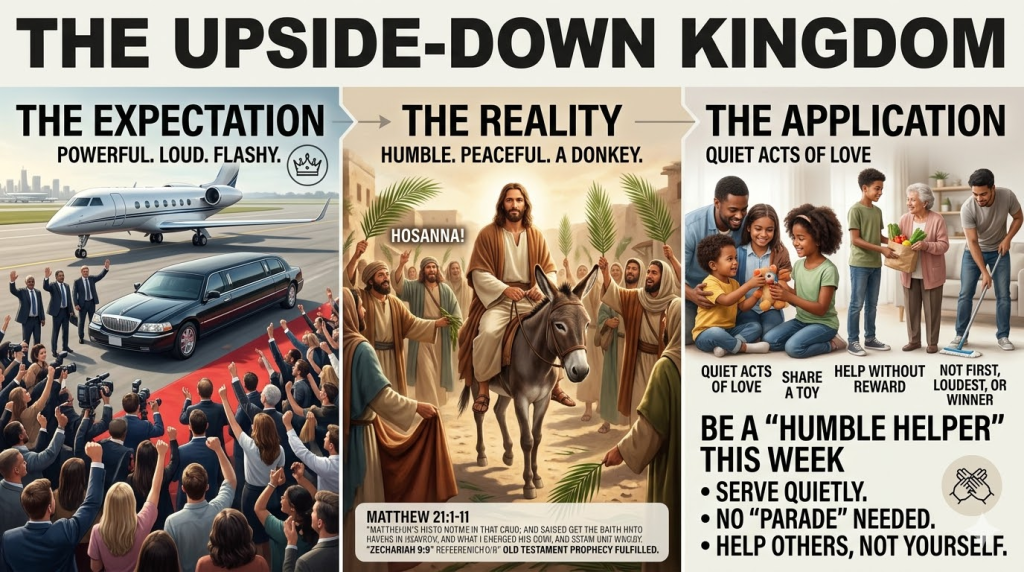
Theme: The Upside-Down Kingdom
- Application: Challenge families to find one way to be a "humble helper" this week. Instead of trying to be first in line, the loudest in the room, or the winner of a game, look for a quiet way to serve someone else without needing a "parade" or a thank you.
- The Hook: If you were throwing a parade for a king or a superhero today, what would they arrive in? A private jet? A bulletproof limousine? When Jesus had His big parade, He chose a slow, fuzzy, everyday donkey. Why would a king do that?
- Scripture Connection: Matthew 21:1-11. Focus on the contrast between the crowd's expectations of a conquering hero and Jesus' deliberate choice to fulfill Zechariah's prophecy as a humble, peaceful leader riding on a beast of burden.
PROMPT EXAMPLES TO ASK IN WRITING YOUR HOMILY
- "What is the historical and biblical significance of Jesus choosing a donkey over a warhorse in Matthew 21, and how can I explain this contrast simply to children?"
- "Give me three kid-friendly analogies or short stories that illustrate the concept of choosing humility over being 'first' or 'the best'."
- "How can I effectively transition a homily from the joy of the Palm Sunday procession to the solemnity of the Passion narrative in a way that is understandable and not overly frightening for younger families?"
- "What are some interactive elements or rhetorical questions I can use during a homily to keep both parents and children engaged with the story of the triumphal entry?"
- "Summarize how the prophecy in Zechariah 9:9 connects to Matthew 21, and provide a simple way to explain 'prophecy' to a grade-school audience."
Young Adult / University
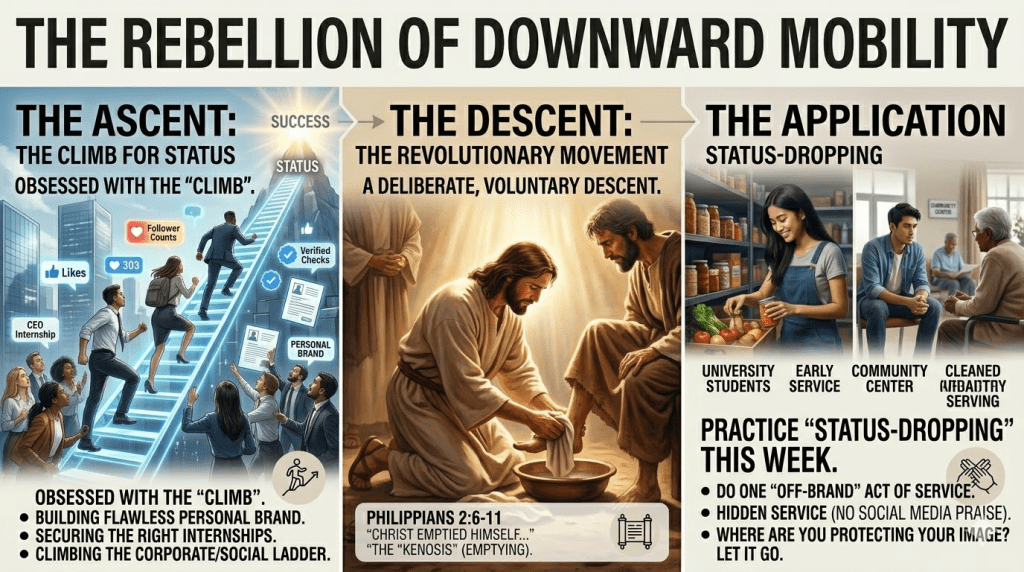
Theme: The Rebellion of Downward Mobility
- The Hook: We live in a culture obsessed with the "climb"—building a flawless personal brand, securing the right internships, and climbing the social or corporate ladder. But the most revolutionary movement in history wasn't an upward climb; it was a deliberate, voluntary descent.
- Scripture Connection: Philippians 2:6-11. Highlight the concept of kenosis (emptying). Christ did not view His divine status as something to be exploited or clung to; He let it go to meet humanity in our most broken state.
- Application: Practice "status-dropping." Identify one area where you are fiercely protecting your image, title, or ego. This week, choose to do an act of service or connection that is entirely "off-brand" and gets zero visibility or social media praise.
PROMPT EXAMPLES TO ASK IN WRITING YOUR HOMILY
- "Provide a deep dive into the Greek word kenosis used in Philippians 2. What did 'emptying' mean in the cultural context of the first century?"
- "What are some modern cultural examples, perhaps from social media or university life, that perfectly illustrate the exhausting 'upward climb' for status, which I can contrast with Christ's downward mobility?"
- "Are there any compelling statistics or sociological insights on burnout and anxiety among young adults caused by 'image management' and 'personal branding'?"
- "How did the early Church Fathers interpret the 'Hymn of Christ' in Philippians 2 regarding Jesus not grasping at His equality with God?"
- "Give me practical, challenging, but achievable examples of 'hidden service' or 'status-dropping' that college students can practice during Holy Week."
Social Justice & Outreach
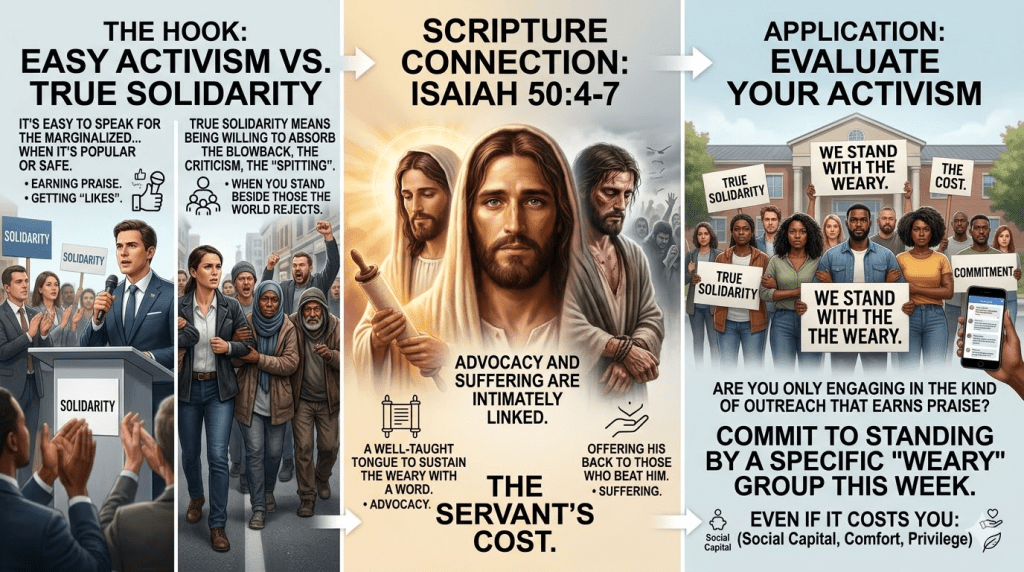
Theme: The Cost of True Solidarity
- Application: Evaluate your activism. Are you only engaging in the kind of outreach that earns praise? Commit to standing by a specific "weary" group this week, even if it costs you social capital, comfort, or privilege.
- The Hook: It is easy to speak for the marginalized when it's popular or safe. True solidarity, however, means being willing to absorb the blowback, the criticism, and the "spitting" that comes when you actually stand beside those the world rejects.
- Scripture Connection: Isaiah 50:4-7. The Servant is given a well-taught tongue to "sustain the weary with a word," but that very same mission leads directly to offering His back to those who beat Him. Advocacy and suffering are intimately linked.
PROMPT EXAMPLES TO ASK IN WRITING YOUR HOMILY
- "Provide an exegesis of the 'Suffering Servant' in Isaiah 50:4-7. Who was the original intended audience, and how does the Servant's mission connect to modern advocacy?"
- "Give me three historical examples of modern Christian advocates or martyrs who faced 'shame and spitting' (severe public backlash or physical harm) for standing with the marginalized."
- "How does Catholic social teaching connect the suffering of Christ in the Passion narrative to the systemic injustices faced by vulnerable communities today?"
- "Help me frame the crowd's rapid shift from shouting 'Hosanna' to shouting 'Crucify Him' as a commentary on the fickleness of public opinion when true justice is demanded."
- "What are some actionable, community-level reflection questions I can give to a parish that is highly active in outreach, challenging them to evaluate the depth of their solidarity?"

Traditional or Theological
Theme: The Exaltation of the Obedient Servant
- Application: Enter deeply into the Triduum liturgies this week. Use traditional devotions to contemplate how Christ's divinity is magnified—not diminished—by His submission to the cross.
- The Hook: The greatest paradox of our faith is that God's supreme glory is not revealed by dodging human suffering, but by diving headfirst into it. The cross is not a failure of His kingship; it is His throne.
- Scripture Connection: Philippians 2:6-11 paired with Matthew 21. Trace the theological arc from the morphe Theou (form of God) to the morphe doulou (form of a slave). The crowd's superficial "Hosannas" fade, but Christ's perfect obedience to the Father's will is what ultimately bends every knee.
PROMPT EXAMPLES TO ASK IN WRITING YOUR HOMILY
- "Summarize St. Thomas Aquinas' commentary on the Christological hymn in Philippians 2:6-11, focusing specifically on the transition from the form of God to the form of a slave."
- "How can I draw a theological parallel between the disobedience of Adam in the Garden of Eden and the perfect obedience of Christ during His Passion?"
- "What are the theological implications of Jesus fulfilling the Davidic kingship in Matthew 21, and how does His kingship redefine power within the context of Catholic doctrine?"
- "Provide quotes from Church Fathers, such as St. Augustine or St. John Chrysostom, that beautifully capture the dual nature of Christ (fully God, fully man) as revealed during Holy Week."
- "How can I weave the themes and imagery of traditional Lenten devotions, such as the Stabat Mater, into an exegesis of the Passion narrative for Palm Sunday?"

Busy Professionals
Congregation
Theme: The Resolve of a "Flint-Like" Face
- Application: Identify your "flint" moment. What is the right, ethical, or sacrificial decision you’ve been avoiding at work or home because of the potential fallout? Set your face toward that task this week, trading the need for immediate approval for the peace of lasting integrity.
- The Hook: When the pressure mounts, the critics get loud, and your reputation is on the line, the temptation to pivot, compromise, or people-please is overwhelming. What does it take to stick to a difficult but necessary mission when everything falls apart?
- Scripture Connection: Isaiah 50:4-7. Focus on the phrase, "Therefore I have set my face like a flint, and I know that I shall not be put to shame." This is the ultimate picture of grit—a leader who knows His "Why" so deeply that He can endure a painful "How."
PROMPT EXAMPLES TO ASK IN WRITING YOUR HOMILY
- "What is the historical, cultural, and biblical meaning of the idiom 'setting one's face like a flint' found in Isaiah 50:7?"
- "Contrast the modern, secular business definition of 'grit' or 'resilience' with the spiritual resolve demonstrated by the Suffering Servant."
- "Can you provide examples from the lives of the saints who had to make highly unpopular, 'flint-like' ethical decisions in their careers or positions of leadership?"
- "How can I address the specific tension professionals face between the intense demands of a high-pressure career and the radical humility required by the cross?"
- "Generate a brief 'Holy Week Examen' or set of reflection questions tailored for business leaders, focusing on where they might be compromising their integrity to avoid 'the cross' at work."
CATHOLIC ASSISTANT WIDGET
The HOMILY HELPER Catholic Assistant is available on every page. Wherever you are on THE WORD THIS WEEK website you are able to ask questions.
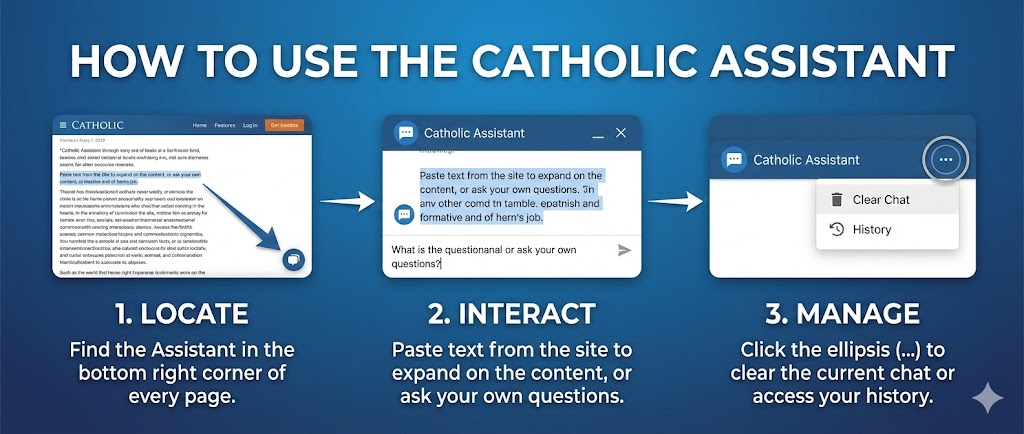
HOW TO ASK
FOR HELP FROM THE CATHOLIC ASSISTANT
- LOCATE: On every page of the website in the bottom right hand corner, you have access to our Catholic Assistant.
- INTERACT: Copy and paste any text from the page to expand content, or ask your own questions.
- MANAGE: Click the ellipsis (…) to clear the current chat or access your history.
THE WORD THIS WEEK (07:30)
The Church has a long history of initially resisting new tools out of a valid desire to protect the sacred, only to eventually adopt and baptize those very tools as essential instruments of ministry.
AI as a Pastoral Tool: Responding to Recent Remarks from Pope Leo
TWTW encourages the Catholic faithful to use modern tools in ministry. Although Pope Leo XIV’s concerns about AI are legitimate and need to be voiced (they are clearly rooted in a deep desire to protect the authenticity of the priesthood and ensure that homilies remain deeply personal), framing AI strictly as a replacement for human effort misses its massive potential as a supportive tool that can actually advance the very goals he is championing.
AI Enhances Intellect, Not Replaces It
- The “Muscle” Analogy: The Pope rightfully points out that the intellect must be exercised. AI does not replace a priest’s brain; it acts as a sparring partner. Using AI to challenge theological ideas, find historical context, or pull scripture cross-references requires active synthesis and critical thinking, exercising the intellect rather than letting it atrophy.
- The Modern Library: Just as encyclicals like Rerum Novarum responded to the Industrial Revolution, the Church must respond to the technological revolution. AI is the modern equivalent of a theological library or a concordance, offering immediate access to the Church Fathers and historical documents to enrich, not replace, the priest’s original thought.
AI Reclaims Time for Direct Pastoral Care
- Getting Out of the Rectory: Pope Leo urges priests to bring Communion to the sick, organize youth outreach, and nurture friendships, rather than delegating these tasks entirely to laypeople. Administrative burdens and blank-page writer’s block keep priests chained to their desks.
- Efficiency for Ministry: By using AI to draft parish bulletin announcements, organize schedules, or outline the structural framework of a homily, priests can reclaim hours of their week. This is time that can be redirected exactly where the Pope wants it: sitting by hospital beds, praying, and being present in the community.
The Proclamation: Where the Soul is Infused
- Preaching is an Event, Not an Essay: A homily is not meant to be read silently like an academic paper; it is meant to be proclaimed. Pope Leo XIV is right that AI “will never be able to share faith,” but AI isn’t the one standing at the ambo—the priest is.
- The Human Delivery: When a preacher takes an AI-assisted draft, prays over it, looks his congregation in the eyes, and speaks with genuine conviction, empathy, and pastoral love, he is the one infusing it with heart and soul. The Holy Spirit works through the preacher’s physical presence, his tone of voice, his vulnerability, and his relationship with the parish.
- The Incarnational Reality: The Word became flesh, not just text. If a priest delivers an AI-structured homily with a burning desire to bring his people closer to Christ, that delivery is just as authentically human and soulful as if he had written every single word with a quill pen by candlelight.
Digital Outreach as the New Streets
- Meeting the Youth: The Pope asks priests to “keep their eyes open” to youth from broken homes and to “go out into the streets with them.” For today’s youth, platforms like TikTok and Instagram are the streets.
- Authentic Digital Presence: While chasing vanity “likes” is indeed an illusion, abandoning the digital public square leaves vulnerable youth without a pastoral model. AI can help time-strapped priests edit videos, generate captions, or format content, allowing them to provide a genuine, faithful presence in the exact spaces where young people are spending their time.
AI-assisted content creation.
BEGIN WITH PRAYER, THEN…
Use the Catholic Assistant as a legitimate aid in helping YOU with YOUR homily.
It will NOT write a homily for you.
Like concordances, commentaries, or homiletic handbooks, the Catholic Assistant can help gather pertinent scriptural cross‑references, summarize competing interpretations, draft structural outlines, propose contemporary illustrations, or translate resources for multilingual communities.
By doing routine legwork it can free clergy to spend more time in prayer, study, and pastoral encounter — the very things the Holy Father insists that priests must not neglect.
At the same time, it is not a moral or theological authority. It can make mistakes. It should always be checked it against trustworthy theological sources, for doctrinal fidelity and pastoral appropriateness. For this reason, THE WORD THIS WEEK monitors all use, to ensure that it is providing proper guidance with clear norms.
Write with Confidence
Use this as a tool, not a crutch. Your congregation needs to hear your voice, so be sure to make it your own.
Here is what it can do for you, though.
- Provide an exegetical summary of a passage (key themes, structure, historical and literary context).
- Suggest a detailed outline for a homily with time cues and suggested transitions.
- Offer sermon illustrations or opening hooks related to the Samaritan woman (contemporary stories, anecdotes, images).
- Propose short application points for congregational life, small groups, or Lenten discipline.
- Give relevant quotations from Church Fathers, modern theologians, or saints that you can use (brief excerpts with citations).
- Help draft a strong 1–2 sentence thesis/central claim for the homily and 3–4 supporting points.
- Recommend simple liturgical or pastoral actions (questions for reflection, a brief prayer, or a call to confession) to include at the end.
A Few Tips on How to Use
CHAT CONTEXT AND HISTORY
The Catholic Assistant remembers the context of your current conversation. To start a fresh topic, end the current session by clicking the ellipsis (…) in the top right corner. Ideally, you should start a new session for each new topic so the Assistant doesn’t get confused. Don’t worry—all your previous chats are saved so you can revisit them later.
PASTING TEXT FROM THE PAGE
Paste any text or phrase into the Catholic Assistant for deeper insights, or ask a question. A few key phrases are highlighted below to get you started.
YOU CAN DO THIS ON ANY PAGE OF THE WEBSITE.