Commentary Intro to Mass Readings Sunday Readings
CommentaryIntro to Mass Readings Sunday Readings
July 12, 2026
⭐⭐⭐ Hearers of the Word—PDF | VIDEO


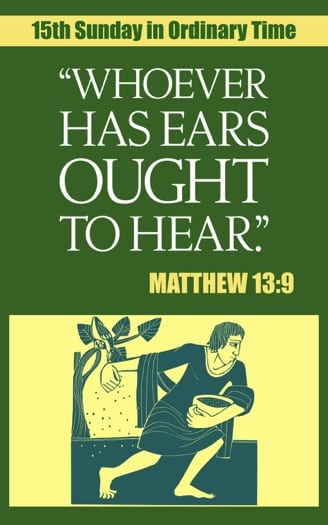
July 12, 2026
Our Sunday Readings *
Edrianne Ezell
Scripture Study for Catholics *
Vince Contreras
Hearers of the Word *
Fr. O’Mahony OSA
Friar Musings, OFM *
Fr. George Corrigan, OFM
Echoing God’s Word *
Fr. Clement Thibodeau


Fr. Francis Martin

Brant Pitre

Kevin Aldrich

15th Sunday of Year A
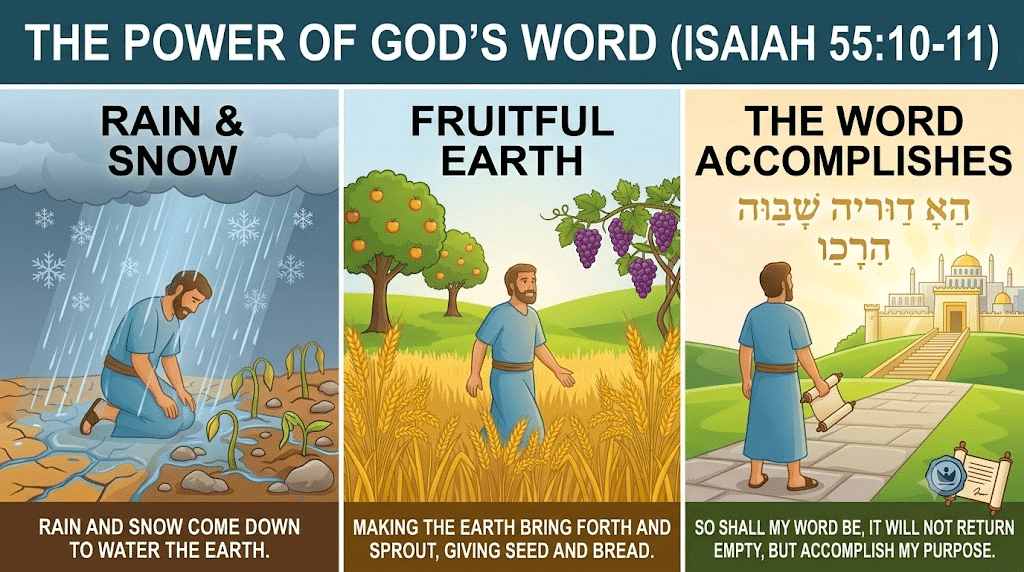
Isaiah 55:10-11
Create a verse by verse (NAB) commentary relating xxxxxxxxxxxxx TO CATHOLIC doctrine and practice. Give real life applications when appropriate
XXXXXXXXXXXXXXXXXXXXXXX list ten questions divided into sections, with each section having a
title, based on the following that a preacher could ask an AI Catholic assistant for help with as the preacher prepares his homily. Do not use phrases such as “The text notes refer to” “The commentary suggests”. Instead use “xxxxxxx refers” and “xxxxxxx suggests” . Whenever possible though it is best to cite a specific verse or verses of the reading when writing the question. Do not place questions in quotation marks.
Isaiah 55:10
"For just as from the heavens the rain and snow come down and do not return there till they have watered the earth, making it fertile and fruitful, giving seed to the one who sows and bread to the one who eats,"
Catholic Doctrine & Theology
This verse beautifully illustrates the concept of divine condescension—God lowering Himself to meet us where we are—and the efficacious nature of grace.
- The Incarnation and Grace: Just as rain and snow descend from heaven to change the earth, God’s grace descends from above. In Catholic theology, grace is not merely a legal status; it is an active, supernatural reality that fundamentally transforms human nature from within, making a soul "fertile and fruitful" (Dei Verbum, 2).
- The Eucharistic Connection: The imagery of "seed to the sower and bread to the eater" immediately points to Christ as the Bread of Life and the Word sown into the world (as in the Parable of the Sower). Saint Augustine and other Church Fathers frequently noted that the ultimate "bread" provided by God’s descending Word is the Holy Eucharist, which sustains supernatural life.
Real-Life Application
- Cultivating the Soil of the Heart: Rain falls unconditionally, but its effect depends entirely on the soil. In daily life, this means our spiritual dryness is never due to a lack of God's grace, but our receptivity.
- Actionable Step: Before going to Mass or reading Scripture, pray a simple prayer of availability: "Lord, make my heart fertile ground today for whatever seed you want to plant."
Isaiah 55:11
"So shall my word be that goes forth from my mouth; It shall not return to me empty, but shall do what pleases me, achieving the end for which I sent it."
Catholic Doctrine & Theology
This is one of the most powerful scriptural foundations for the sacramental and liturgical worldview of the Catholic Church.
- The Word as Power (Ex Opere Operato): In Catholic theology, God’s Word is never merely informative; it is performative. When God speaks, reality changes (e.g., "Let there be light," and there was light). This is the basis for the Sacraments. When a priest pronounces the words of absolution ("I absolve you...") or consecration ("This is my body"), it is Christ's powerful Word working ex opere operato (by the very fact of the action being performed). The Word accomplishes exactly what it says.
- The Liturgy of the Word: In the Mass, Christ is truly present in His Word. The Catechism of the Catholic Church (CCC 1100) teaches that the Holy Spirit makes the spoken Word of God alive and active in the hearts of the faithful, ensuring it does not return to Him empty but bears fruit in the assembly.
Real-Life Application
- Trusting the Power of Intercession and Evangelization: Parents often worry about children who have left the Faith, or individuals feel their prayers are hitting a brick wall. Isaiah reminds us that no word spoken in alignment with God's will is wasted.
- Actionable Step: When sharing the faith or praying for someone, detach from the immediate timeline. Trust that the truth you plant or the prayer you offer has an invisible, guaranteed efficacy because it is backed by God's promise. It will achieve its purpose, even if that purpose unfolds in hidden or delayed ways.
Algorithmically generated text
A wonderful pastoral instinct—abstract spiritual diagnoses rarely move hearts, but a vivid, recognizable portrait can make a parishioner suddenly whisper to themselves, "That's me." Let me offer you a gallery of concrete, parish-life illustrations of the "footpath heart" from Matthew 13:19.
First, the Diagnosis to Keep in View
Recall the NAB rendering of Matthew 13:19: "The seed sown on the path is the one who hears the word of the kingdom without understanding it, and the evil one comes and steals away what was sown in his heart."
The footpath is compacted—trodden hard by constant traffic until nothing can penetrate. The defining trait is not hostility to the word but imperviousness: the seed lies exposed on the surface, never sinking in, and so is easily snatched. Your examples should capture this quality of a heart so trafficked, hardened, or distracted that the word never gets below the surface.
Examples from Parish Life
1. The "Sunday Phone-Checker"
The parishioner whose body is in the pew but whose mind is on the phone in their pocket—mentally answering emails during the homily, planning the afternoon, scrolling through worries. The word is proclaimed, but a thousand competing footsteps have packed the soil so tightly that nothing lands. By the parking lot, they couldn't tell you the Gospel reading. The birds took it before the engine started.
2. The "Routine Catholic"
The one who has heard it all before—or thinks they have. They've attended Mass for sixty years, and familiarity has hardened into a crust. The words wash over them like a recording they've stopped hearing. Their heart isn't rebellious; it's calloused by repetition without reflection. The path is hard precisely because so many homilies have walked across it without ever being let in.
3. The Over-Committed Volunteer
A poignant and counterintuitive one. The parishioner so busy doing for the parish—running the festival, chairing committees, organizing everything—that they never receive. Their hearts are a thoroughfare of activity, so trodden by service that the Word itself can't find a quiet patch to take root. Martha, not Mary. Activity has paved over interiority.
4. The Cynic at the Coffee Hour
The one who deflects every spiritual prompting with a joke or a hardened "I've seen too much to believe that." When the word is sown, cynicism functions like asphalt—an instant, reflexive hardness that the seed cannot pierce. The evil one need not even work hard; the surface was sealed before the sower arrived.
5. The Distracted Parent of Young Children
A gentle, sympathetic example your families will recognize. The harried mother or father wrestling toddlers through Mass, exhausted, who genuinely wants to hear but whose attention is shattered into a hundred pieces. Here the footpath is not cynicism but overwhelm—and the pastoral note is hopeful: this hardness is circumstantial, not chosen, and grace can soften it. (Be careful to preach this one tenderly.)
6. The "Checklist" Penitent
The one who comes to Confession or Mass to get it done—to check the box—rather than to encounter the living God. The transaction is completed, the obligation satisfied, but the heart was never actually open. The seed was placed on the receipt, not in the soil.
7. The Noise-Addicted Soul
The modern parishioner who cannot bear silence—who fills every commute with podcasts, every meal with a screen, every quiet moment with stimulation. They arrive at Mass having trained their hearts to deflect anything that asks for stillness. The Word requires silence to germinate, and they have paved every quiet path within them.
The Crucial Pastoral Frame
When you offer these, hold two things in tension so you challenge without condemning:
- The footpath can be tilled. A path is not a permanent condition; it is compacted soil that can be broken up. The prophet Hosea pleads, "Break up for yourselves a fallow ground" (Hosea 10:12). No heart is beyond the plow of grace. This is your message of hope.
- The remedy is to slow down and let the Word in. The antidote to the footpath is receptivity—silence, lectio divina, attentive listening, the deliberate de-cluttering of the heart. Where the thorny soil needs weeding and the rocky soil needs depth, the footpath needs plowing: the breaking-open of a hardened surface.
A Homiletic Turn You Might Use
"The frightening thing about the footpath is that it doesn't hate the seed—it simply never feels it. The danger for many of us is not that we will reject the Gospel, but that we will sit through it, week after week, and never once let it land. The good news is that no path is paved forever. Bring God the plow of a quiet heart, and even the hardest ground can be broken open."tic thread: the King we welcome on Palm Sunday with palm branches is the same King we follow to the Cross by Friday. The donkey of peace leads to the throne of the Cross—and that is precisely how He conquers.
Algorithmically generated text
What a tender and timely question—few sorrows weigh on faithful parents more heavily than watching a child they raised in the faith walk away from it. And Isaiah 55:11 is precisely the verse to bring them, because it speaks directly to the fear that their words have "returned empty." Let me offer pastoral counsel grounded in this beautiful promise.
The Promise at the Heart of the Verse
In the NAB, Isaiah 55:11 reads: "so shall my word be that goes forth from my mouth; it shall not return to me empty, but shall do what pleases me, achieving the end for which I sent it."
Here is the foundational comfort: the promise that the word will not return empty is God's promise about God's word. The grieving parent's relief is this—the success of the seed does not ultimately rest on the parent's shoulders, but on the faithfulness of God. The parent who planted the word of faith planted God's word, and God Himself has pledged that it will accomplish its purpose. The parent is not the guarantor of the harvest; God is.
Pastoral Counsel for Heartbroken Parents
1. God's Timeline Is Not Ours
The verse promises the word will accomplish its purpose—but it does not promise it will do so on our schedule. A seed planted in childhood may lie dormant for decades before it germinates. The classic consolation here is St. Monica, who wept and prayed for years over her wayward son Augustine before he returned—and became one of the greatest saints of the Church. Tell your grieving parents: Your child's story is not over, and a dormant seed is not a dead one.
2. The Word Is Already at Work, Unseen
Even in a child who has left, the word planted in their formative years remains within them—in their conscience, their memory of grace, the prayers they once prayed, the love they witnessed at home. Isaiah's image is of water and snow that soak into the earth invisibly (Isaiah 55:10) before they ever produce a visible harvest. The word may be doing its quiet work beneath a surface that looks barren.
3. You Sowed Faithfully—That Was Your Charge
Remind parents of the Parable of the Sower they likely know well: the sower's job is to sow, not to control the soil. Parents are responsible for planting the faith faithfully—which they did—not for forcing the harvest, which belongs to God and to the free will of the child. This distinction can lift an enormous and false burden of guilt.
4. Free Will Is Part of God's Design
Gently help parents see that a child's freedom to leave is the same freedom that makes a genuine return possible. God Himself does not coerce love; He invites it. A faith that is freely abandoned can one day be freely—and far more deeply—reclaimed. The very freedom that grieves them now is what will make their child's return, when it comes, authentic and their own.
5. The Most Powerful Sowing Continues: Prayer and Witness
Counsel parents that their work is not finished—it has changed form. They now sow not primarily through words (which may fall on hardened ground) but through prayer and the silent witness of an unwavering, loving faith. As St. Monica's tears availed for Augustine, so a parent's persevering prayer becomes a continual planting. And a home that remains warm, welcoming, and faithful—without nagging or condemnation—keeps the door open for the child's return.
6. Keep the Relationship, Keep the Door Open
A crucial practical word: warn parents against letting the disagreement over faith rupture the relationship. The prodigal son returned because he knew there was a father waiting to run to him (Luke 15:20). Parents should love their children unconditionally in the meantime, so that when grace stirs, there is a loving home to return to. Preserve the bridge across which the child may one day walk back.
A Word on Their Guilt and Grief
Many such parents are tormented by the question, "Where did I go wrong?" Address this directly and tenderly:
- Even God's own children leave Him. The Father in the parable was a perfect parent, and still the son departed. A child's departure is not proof of parental failure; it is part of the mystery of human freedom.
- Their grief is itself a form of love and intercession. Like Monica's tears, a parent's sorrow over a child's faith is precious to God and is never wasted.
A Homiletic or Counseling Closing You Might Offer
"You spoke the word of God to your children, and God has promised that His word does not return to Him empty. You may not see the harvest in the season you long for—you may not see it in your lifetime. But the promise is not that you will see it; the promise is that it will not fail. So keep watering with your prayers and your love, and entrust the harvest to the One who never breaks His word."
Algorithmically generated text
What a beautifully encouraging angle on this parable—and a much-needed one. So many faithful, ordinary parishioners quietly believe their hidden lives of fidelity "don't count" because they aren't producing dramatic, visible results. The thirty-sixty-hundredfold yields are precisely the antidote to that discouragement. Let me offer you some homiletic approaches.
The Heart of the Image
In the NAB, Matthew 13:23 reads: "But the seed sown on rich soil is the one who hears the word and understands it, who indeed bears fruit and yields a hundred or sixty or thirtyfold."
The first and most liberating observation: all three yields are praised. All three are "rich soil." The thirtyfold is not a failure or a consolation prize—it is named alongside the hundredfold as genuine, abundant fruit. Christ does not say, "the hundredfold is good soil, and the rest fell short." He gathers all three under the same blessing. This is your foundational comfort: fruitfulness is fruitfulness, even when it is not spectacular.
Homiletic Approaches to Comfort the "Ordinary" Parishioner
1. Thirtyfold Is Still an Astonishing Harvest
Place the number in perspective. In the agriculture of Jesus's day, a yield of tenfold was considered an excellent harvest. So even the "lowest" yield Christ names—thirtyfold—would have struck His listeners as miraculous abundance. Tell your parishioners: what you dismiss as "ordinary" fruit is, in the eyes of Heaven, an extraordinary harvest. The God who multiplies sees thirtyfold where you see "just an ordinary life."
2. The Soil Is Praised, Not the Quantity
Notice that Christ's commendation falls on the receptivity of the soil—"hears the word and understands it"—not on the size of the yield. The grade given is for faithfulness in receiving, not for productivity. The quiet mother, the faithful laborer, the patient caregiver who simply receives the word and lets it grow has already passed the test that matters. The yield is God's business; the receptivity is theirs.
3. The Different Yields Are a Gift, Not a Ranking
Reframe the numbers not as a hierarchy of holiness but as a portrait of God's diverse design. Just as St. Paul speaks of varied gifts in one body (1 Corinthians 12), so the Sower scatters seed that bears fruit according to each person's God-given capacity, vocation, and circumstance. The parent of a large family, the cloistered nun, the office worker, and the homebound widow each bear fruit proper to their calling. To compare yields is to misunderstand the parable—God assigns the measure.
4. We Do Not See the Whole Harvest
A deeply consoling point: the fruit of an ordinary life is largely hidden, even from the one who bears it. The kind word that changed a stranger's day, the example of faith a child absorbed silently, the prayers offered in secret—these are fruits the parishioner will never count this side of Heaven. What feels like "thirtyfold" to them may, in God's accounting, be a far greater harvest whose full measure will only be revealed in eternity.
5. The Little Way of St. Thérèse
Here is your perfect saintly anchor. St. Thérèse of Lisieux taught that small acts done with great love are precisely what God treasures—her "Little Way." She never did anything spectacular by worldly standards, yet she is a Doctor of the Church. Her life is the canonization of the "ordinary" yield. Offer her to your parishioners as proof that hidden fidelity is the very stuff of sanctity.
6. Faithfulness, Not Greatness, Is the Measure
Connect this to the parable of the talents (Matthew 25:21), where the master says, "Well done, my good and faithful servant"—not "my successful servant" or "my impressive servant." God's commendation is for faithfulness, which the ordinary parishioner offers in full. The thirtyfold servant hears the same "well done" as the hundredfold servant.
The Crucial Reframe: Dramatic ≠ Fruitful
Help your parishioners dismantle the false equation that fruitful must mean dramatic. The most fruitful life ever lived—Christ's own—was spent for thirty of its thirty-three years in the utter hiddenness of Nazareth: ordinary work, ordinary family life, no recorded miracles. If the Son of God consecrated obscurity, then the obscure, faithful life is not a lesser path to holiness. It is the very path He chose.
A Homiletic Closing You Might Use
"Do not measure your harvest by whether the world can see it. Christ Himself spent thirty hidden years in Nazareth before a single sermon. The God who calls thirtyfold a rich and blessed yield is not waiting for you to become spectacular—He is delighting, right now, in the quiet, faithful fruit of an ordinary life lived in love. Bring Him your thirtyfold. He calls it good soil."
Algorithmically generated text


When was the last time you felt discouraged? Who helped you climb out of your “funk?”
These verses come from Second Isaiah who wrote toward the end of the Babylonian exile. With the elite of the nation in a foreign land and Jerusalem in ruins, a general malaise fell over the Jews in Babylon. Not only were they cut off from their land, they could not worship their God through sacrifice. It was as if the heart was torn out of the people.
But the winds of change blew from the east. Cyrus led a vast Persian army on a westward conquest. Babylon was next. There was hope in the air. For the Jews, the idea of return could be thinkable!
Second Isaiah tried to capitalize on this hope. Yes, the people would return because it was God’s command. As certain as the rain cycle, God’s word had an effect. He was a God that worked in the lives of people!
When we are down, even at the point of despair, we should remember who our God is. He will give us hope even in the most dire times. Why? Because he is a God who works in our lives!
When was the last time God worked in your life? How did he act? How did he raise your hopes?
Create a simple, modern infographic illustrating [INSERT BIBLE PASSAGE OR TOPIC]. Use a [SPLIT-SCREEN / 3-PANEL] layout. The style should be clean, high-quality digital art or vector illustration.
Visuals:
Panel 1: Show [DESCRIBE SCENE 1 – e.g., a stormy sea].
Panel 2: Show [DESCRIBE SCENE 2 – e.g., Jesus calming the waves].
Text & Typography:
Font: Use EXTRA LARGE, BOLD, SANS-SERIF FONT (like Arial). Ensure high contrast so text is easily readable.
Header: Write “[INSERT MAIN TITLE]” at the top.
Captions: Include short, punchy text summaries in the panels: “[TEXT FOR PANEL 1]” and “[TEXT FOR PANEL 2]”.
Overall Vibe: Professional, educational, and uncluttered. Avoid small details; focus on big images and big text.
Non-profits have permission to use this infographic in their ministry.

15th Sunday of Year A
Romans 8:18-23
XXXXXXXXXXXXXXXXXXXXXXX list ten questions divided into sections, with each section having a
title, based on the following that a preacher could ask an AI Catholic assistant for help with as the preacher prepares his homily. Do not use phrases such as “The text notes refer to” “The commentary suggests”. Instead use “xxxxxxx refers” and “xxxxxxx suggests” . Whenever possible though it is best to cite a specific verse or verses of the reading when writing the question. Do not place questions in quotation marks.
Romans 8:18
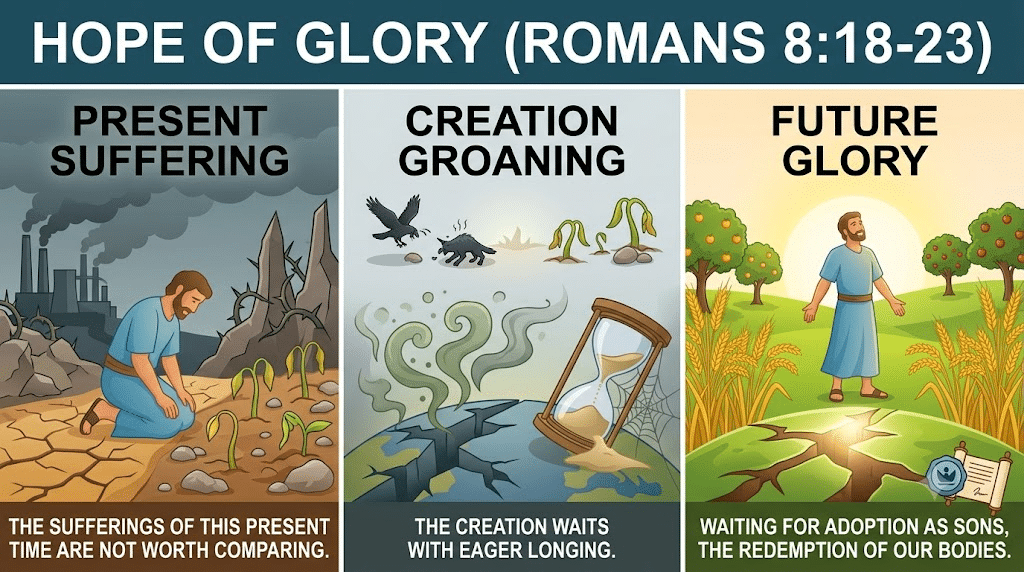
"I consider that the sufferings of this present time are as nothing compared with the glory to be revealed for us."
Catholic Doctrine & Theology
This verse forms the bedrock of the Catholic theology of salvific suffering and eschatological hope (our ultimate hope in eternal life).
- Redemptive Suffering: Catholicism does not view suffering as meaningless or merely something to be avoided. When united to the Passion of Christ, our current trials take on supernatural value. As Saint Paul notes elsewhere, we "fill up what is lacking in the afflictions of Christ" (Colossians 1:24).
- The Weight of Glory: The Catechism of the Catholic Church (CCC 1821) highlights that Christian hope relies not on our own strength, but on the grace of the Holy Spirit and the promise of heaven. The "glory to be revealed" is the Beatific Vision—the ultimate, direct contemplation of God in His glory, which infinitely eclipses any earthly pain.
Real-Life Application
- Offering It Up: The traditional Catholic practice of "offering it up" is the direct application of this verse. It turns a passive, frustrating experience into an active, prayerful offering.
- Actionable Step: The next time you experience an unwanted difficulty—whether it is chronic physical pain, a professional disappointment, or simply sitting in frustrating gridlock traffic—consciously pray: "Lord, I unite this small suffering to your Cross for the salvation of souls." This reframes momentary pain through the lens of eternity.
Romans 8:19
"For creation awaits with eager expectation the revelation of the children of God;"
Catholic Doctrine & Theology
Paul introduces a profound cosmic dimension to salvation history. The physical universe itself is bound up with humanity's destiny.
- The Communion of Creation: In Catholic theology, the material world is inherently good, having been created by God. Human beings are the stewards and "priests" of creation, bridging the material and spiritual worlds. Therefore, when humanity fell, creation suffered a fracture; when the "children of God" are fully revealed in glory, the physical universe will share in that restoration.
- The Sacramental Principle: This interdependence is why Catholicism uses physical matter—water, oil, bread, wine, human touch—to communicate divine grace. The material world is already being prepared and sanctified for its future transformation.
Real-Life Application
- Environmental Stewardship as Faith in Action: Because creation is waiting for redemption, our care for the environment is not merely a secular civic duty; it is a spiritual responsibility. As emphasized in Catholic Social Teaching, harming creation abuses what God intends to redeem.
- Actionable Step: Practice a "sacramental awareness" of nature. When you spend time outdoors, recognize the beauty of the physical world as a signpost pointing toward the greater glory to come, and make a conscious effort to treat your local environment with respect and care.
Romans 8:20-21
"for creation was made subject to futility, not of its own accord but because of the one who subjected it, in hope that creation itself would be set free from slavery to corruption and share in the glorious freedom of the children of God."
Catholic Doctrine & Theology
These verses address the consequences of Original Sin and the promise of the New Creation.
- The Consequences of the Fall: The "futility" and "slavery to corruption" describe the natural world's subjection to decay, disease, natural disasters, and death. The CCC teaches that the harmony of original justice was broken, and as a consequence, visible creation became alien and hostile to man (CCC 400).
- The New Heavens and New Earth: Salvation is not an escape from the physical body or the physical world (which is the ancient heresy of Gnosticism). Catholic doctrine firmly holds to the resurrection of the body and the ultimate renewal of the cosmos. At the end of time, the universe will be transformed so completely that Scripture calls it a "new heaven and a new earth" (CCC 1042-1044).
Real-Life Application
- Facing Decay and Disappointment: We live in a world where things break, bodies age, and systems fail. Recognizing this "futility" saves us from the trap of expecting perfect happiness from material things.
- Actionable Step: When facing the inevitable frustrations of living in a fallen world (e.g., dealing with a failing appliance, a declining physical ability, or a broken system), remind yourself: This is temporary. Re-anchor your ultimate desire for perfection away from earthly constants and toward the "glorious freedom" promised in eternity.
Romans 8:22
"We know that all creation is groaning in labor pains even until now;"
Catholic Doctrine & Theology
Paul uses the powerful image of child birth to describe the current state of the world.
- Eschatological Tension: The Church lives in an "already but not yet" tension. Christ has won the definitive victory over sin and death on the Cross (already), but the full manifestation of that victory is still unfolding (not yet).
- Labor Pains vs. Death Throes: Crucially, the world is not experiencing death throes; it is experiencing labor pains. This means the suffering we observe globally and personally is not a sign of meaningless destruction, but the painful, necessary birth of something entirely new and beautiful.
Real-Life Application
- Responding to Global Distress: When watching the news—seeing war, poverty, and tragedy—it is easy to fall into despair or cynicism.
- Actionable Step: Reframe global anxiety through the lens of labor pains. Instead of throwing your hands up in despair, channel that "groaning" into intercessory prayer. Pray the Memorare or a decade of the Rosary specifically for those currently enduring the sharpest parts of the world's labor pains.
Romans 8:23
"and not only that, but we ourselves, who have the firstfruits of the Spirit, we also groan within ourselves as we wait for adoption, the redemption of our bodies."
Catholic Doctrine & Theology
This verse focuses directly on the individual believer's experience and the Resurrection of the Body.
- The Firstfruits of the Spirit: Through the Sacraments of Initiation (Baptism and Confirmation), Catholics receive the indwelling of the Holy Spirit. These are the "firstfruits"—a down payment or foretaste of heavenly life. Yet, because we still live in mortal flesh, an internal tension remains.
- The Redemption of Our Bodies: This is a vital point of Catholic dogma stated clearly in the Nicene Creed: "I look forward to the resurrection of the dead." Our souls are baptized, but our bodies still suffer, age, and die. Ultimate salvation means our physical bodies will be raised from the dead, glorified, and reunited with our souls, modeled after the Risen Christ.
Real-Life Application
- Navigating Spiritual Desolation and Physical Decline: Even the holiest people experience an interior "groaning"—a deep, spiritual homesickness for God, or the physical burden of an aging body. This verse validates that experience; it is normal to feel incomplete here.
- Actionable Step: When you experience physical limitations, illness, or the loss of physical youth, look at it as a reminder of what is to come. Treat your body with dignity (as a temple of the Holy Spirit), but actively practice detaching your core identity from your physical appearance or athletic utility. Your true, fully redeemed body is yet to come.
Algorithmically generated text
Romans 8:18 offers a profound lens through which your parishioners can reframe their present sufferings. Let me offer some thoughts on helping them hold this contrast in proper balance.
The Heart of Paul's Contrast
In the NAB translation, Romans 8:18 reads: "I consider that the sufferings of this present time are as nothing compared with the glory to be revealed for us."
Paul is not minimizing suffering—he is weighing it. The Greek verb logizomai ("I consider/reckon") is an accounting term, suggesting a deliberate calculation. Paul, who endured beatings, shipwrecks, imprisonment, and constant hardship (2 Cor 11:23-28), is no stranger to suffering. This gives his words credibility: he speaks not as a theorist but as one who has borne the weight.
Pastoral Strategies for Balance
Here are some approaches to help your parishioners avoid two common errors—either dismissing their pain or being crushed by it:
1. Validate the reality of present suffering first.
Notice that Paul calls them "the sufferings of this present time." He acknowledges they are real and immediate. A parishioner grieving a spouse or battling illness needs to hear that the Gospel does not ask them to pretend their pain is illusory. Balance begins with honesty.
2. Emphasize "incomparability" rather than mere "comparison."
Paul does not say glory is somewhat greater than suffering—he says present suffering is "as nothing" compared to it. This is a disproportion of scale. The parallel passage in 2 Corinthians 4:17 helps here: our "momentary light affliction" produces "an eternal weight of glory beyond all comparison." The Greek imagery is of a feather on one side of a scale and an immeasurable weight on the other.
3. Frame suffering as productive, not merely endured.
The surrounding verses (Rom 8:19-23) speak of creation "groaning in labor pains." Labor pain is real and intense, yet it is oriented toward new life. Help your people see their trials not as meaningless but as birth pangs of the glory to come. This connects to the Catholic understanding of redemptive suffering—uniting our trials to Christ's Cross (cf. Col 1:24).
4. Anchor hope in something already begun.
Paul roots this hope in the indwelling Spirit (Rom 8:23, "the first fruits of the Spirit"). The glory is not a distant fantasy but a reality already inaugurated within us. This guards against a hope that feels like wishful thinking.
A Homiletic Image to Consider
You might offer your parishioners the image of a pregnant mother, or of an artist whose masterpiece is still hidden under scaffolding. Or consider the classic image from the Church Fathers: present suffering is like the brief darkness before dawn—real while it lasts, but already conquered by the coming light.
St. Paul's confidence is ultimately Christological: because Christ has been raised, our glory is guaranteed. The contrast is not optimism but resurrection faith.es are..." Make the path to restoration concrete and accessible.
Algorithmically generated text
Romans 8:22 gives you one of Scripture's most powerful metaphors—creation itself in the throes of childbirth—and the beauty of labor pains is that they translate so naturally into the lived experience of family life. Let me offer several homiletic bridges.
The Foundational Insight of the Metaphor
In the NAB, Romans 8:22 reads: "We know that all creation is groaning in labor pains even until now."
The genius of Paul's image is its paradox: labor pain is simultaneously the most agonizing and the most hopeful of sufferings. No one endures labor for its own sake; the pain is wholly oriented toward the joy of new life. This is the key that unlocks every family application—the groaning is not the end of the story, but the prelude to birth. Jesus himself uses this same image in John 16:21, where a woman forgets her anguish "because of her joy that a child has been born into the world."
Homiletic Metaphors for Family Life
1. The "Growing Pains" of the Home
Every parent recognizes that growth is rarely comfortable. The sleepless nights with a newborn, the friction of a toddler's tantrums, the turbulence of adolescence—these are the household's labor pains. Help your parishioners see that the strain of raising children is not a sign that something is wrong, but often a sign that something is being born: maturity, virtue, character. The groaning of a stressful season may be the labor of a soul coming into its own.
2. The Tension of the "Not Yet"
Paul's word "until now" captures the family that lives in the gap between the home they have and the home they long for. The parent praying for a wayward child, the spouse waiting for healing in a strained marriage, the family enduring financial hardship—all of them groan in the "not yet." The metaphor reassures them that waiting itself can be fruitful, that God is at work in the labor of patience.
3. Pruning and Cultivation
You might pair Romans 8:22 with the image of the garden (drawing on John 15). A family's trials can feel like being cut back, but the gardener prunes precisely what he loves and intends to bear fruit. The "groaning" of being pruned is the discomfort that precedes a richer harvest.
4. Contractions Come in Waves
A pastorally tender point: labor does not come as one unending agony but in waves, with rest between. So too the trials of family life come in seasons. Encourage your parishioners to recognize the "between-contraction" graces—the ordinary joys of a shared meal, a child's laughter, a reconciled argument—as God's mercy sustaining them through the longer labor.
5. The Whole Family Labors Together
Note that Paul says all creation groans together (the Greek systenazei implies a shared, communal groaning). A family does not suffer in isolated silos; they labor as one body. This is a beautiful corrective to the modern tendency to bear burdens alone. The metaphor invites family members to groan with and for one another, bearing one another's burdens (Gal 6:2).
Connecting to Catholic Doctrine
This passage beautifully supports the Catholic understanding of the domestic church—the family as a school of love where, through ordinary trials, members are sanctified. It also resonates with redemptive suffering: the daily aggravations and heartaches of family life, when united to Christ, become labor pains that participate in the bringing forth of God's Kingdom.
A Practical Homiletic Closing
You might leave your parishioners with this turn: The opposite of a groaning creation is not a peaceful creation—it is a barren one. The very fact that their families ache, strive, and long is evidence that life is being brought forth. The pain is the proof that something good is on its way.
Algorithmically generated text
An excellent question—and a crucial one, because "first fruits" is one of those phrases that would have struck Paul's original audience with immediate force but can sail right over the heads of a modern congregation. Let me help you both unpack the Old Testament background and translate it for contemporary ears.
The Old Testament Background (For Your Own Grounding)
In the NAB, Romans 8:23 reads: "and not only that, but we ourselves, who have the first fruits of the Spirit, we also groan within ourselves as we wait for adoption, the redemption of our bodies."
The concept of "first fruits" (Hebrew bikkurim) comes from Israel's agricultural feasts. The Law commanded that the very first and best portion of the harvest be offered to God before the rest was gathered (Exodus 23:19; Deuteronomy 26:1-11; Leviticus 23:10). This offering carried two meanings:
- A pledge or guarantee: The first fruits were a down payment on the full harvest to come. If the first sheaves were ripe, the rest of the field was certainly coming.
- An act of trust and consecration: By giving God the first portion before the rest was secured, the Israelite expressed faith that God would provide the whole harvest.
Paul's brilliance is to apply this to the Holy Spirit: the Spirit we have now is the first installment of the glory we will have fully in the resurrection. It is the same logic he uses in 2 Corinthians 1:22 and Ephesians 1:14, where the Spirit is called the arrabōn—the "first installment" or pledge.
Translating "First Fruits" for a Modern Audience
Here are several contemporary metaphors that capture the same logic without requiring agricultural knowledge:
1. The Down Payment or Deposit
This may be the most accessible. When someone puts down a deposit on a house, the deposit is real money—but it is also a guarantee of the full purchase to come. The Holy Spirit is God's deposit on our redemption: a genuine first portion that secures the whole. (This is, in fact, exactly Paul's own image in Ephesians 1:14.)
2. The Engagement Ring
A beautiful and pastorally warm image. An engagement ring is genuinely precious in itself, yet its deeper meaning is that it points forward to the wedding. The Spirit is God's "engagement ring" to the Church—a real gift now, and a promise of the full union of heaven.
3. The Free Sample or "First Taste"
The first bite of a meal, or a sample at a bakery, gives a real and genuine experience of what the whole will be. The Spirit lets us truly taste the life of heaven now—joy, peace, love—even as we await the full feast.
4. The Trailer or Preview
A modern audience knows movie trailers. The Spirit is the "preview" of glory: not the full film, but an authentic and thrilling foretaste that makes us long for the whole.
5. The First Sign of Spring
The first warm day or the first crocus pushing through the snow is small, but it guarantees that summer is coming. The Spirit is the springtime of the soul, the first sign that the winter of sin and death is ending.
The Crucial Theological Point to Preserve
Whatever metaphor you choose, hold onto the dual meaning that makes "first fruits" so rich:
- It is genuinely real now. The Spirit is not a mere promise on paper; the down payment is real currency. Our experience of grace, joy, and divine sonship is authentic.
- It is incomplete and oriented forward. Precisely because we have a real foretaste, we "groan" for the fullness. The first fruits intensify our longing rather than satisfying it.
This guards against two errors: the despair that says "we have nothing yet" and the complacency that says "we have everything already."
The Sacrificial Fulfillment (Connecting to Christ)
You asked specifically about the sacrificial fulfillment—a wonderful instinct. Here is the connection to draw:
Christ himself is called "the firstfruits of those who have fallen asleep" (1 Corinthians 15:20, 23). His Resurrection is the first sheaf of the great harvest of the dead. Just as the Old Testament first fruits were offered to God as a sacrifice of consecration, so Christ—risen and offered to the Father—is the first fruits who guarantees our own resurrection.
This connects beautifully to the Eucharist and to Catholic teaching on the resurrection of the body: in the Mass, the fruits of the earth ("which earth has given and human hands have made") are offered and transformed, a foretaste of the new creation. The Holy Spirit given to us is the pledge that what happened to Christ's body will happen to ours—"the redemption of our bodies," as the very verse concludes.
A Homiletic Closing You Might Use
"When God gives us the Holy Spirit, He is not giving us a promise written on paper—He is giving us a piece of heaven itself, handed over in advance. It is real. You can taste it. And the very fact that it leaves you hungry for more is the surest sign that the full banquet is being prepared."
Algorithmically generated text
What sort of dreams and aspirations have you had? How many have been fulfilled? How many are still to be realized?
In these few verses, Paul flatly stated that what we suffer now is insignificant to the glory that lies ahead. For Paul, the view of the end times was an aspiration, not a fear. Unlike the tone of the Our Father (“…lead us not into temptation (that will come with the Tribulation), but deliver us from the Evil One…”), Paul confidently anticipated the Final Judgment. He saw God’s glory, not his condemnation.
Indeed, Paul saw this anticipation in cosmic proportions. All of creation yearned for the reversal of the curses wrought from Adam’s sin. Instead of disease, suffering, and death within nature’s cycles, the cosmos itself would share in the blessings of a saved humanity. With Christ, the new Adam, death had been vanquished. When he reigns in glory, nature would return to its pristine, uncorrupted place.
The clock for the end time began with the death and resurrection of Christ. Knowledge of this revelation came from the Spirit. With the Spirit dwelling within us, Paul insisted, we become acutely aware of our limitations in this world, and of our expectation in the next. The gift of the Spirit is the “first fruit” of salvation. With the Spirit, we can recognize the movement toward the end times, and we can clearly see when we will stand before our Master, body and soul united. Then, we will be complete.
Until that time, we look forward.
How does the Spirit help you to look forward in hope despite the troubles of the day?
Create a simple, modern infographic illustrating [INSERT BIBLE PASSAGE OR TOPIC]. Use a [SPLIT-SCREEN / 3-PANEL] layout. The style should be clean, high-quality digital art or vector illustration.
Visuals:
Panel 1: Show [DESCRIBE SCENE 1 – e.g., a stormy sea].
Panel 2: Show [DESCRIBE SCENE 2 – e.g., Jesus calming the waves].
Text & Typography:
Font: Use EXTRA LARGE, BOLD, SANS-SERIF FONT (like Arial). Ensure high contrast so text is easily readable.
Header: Write “[INSERT MAIN TITLE]” at the top.
Captions: Include short, punchy text summaries in the panels: “[TEXT FOR PANEL 1]” and “[TEXT FOR PANEL 2]”.
Overall Vibe: Professional, educational, and uncluttered. Avoid small details; focus on big images and big text.
Non-profits have permission to use this infographic in their ministry.


15th Sunday of Year A
Write an engaging description meant to get readers to read Larry Broding’s commentary which can be used to help preachers prepare their own homily. After a brief introduction give bulletin points of why this commentary matters for your homily. conclude with “Read Larry Broding’s full commentary to help your congregation…” Complete sentence. XXXXXXXXXXXXXXXXXXXXXXX
Matthew 13:1-23
XXXXXXXXXXXXXXXXXXXXXXX list ten questions divided into sections, with each section having a
title, based on the following that a preacher could ask an AI Catholic assistant for help with as the preacher prepares his homily. Do not use phrases such as “The text notes refer to” “The commentary suggests”. Instead use “xxxxxxx refers” and “xxxxxxx suggests” . Whenever possible though it is best to cite a specific verse or verses of the reading when writing the question. Do not place questions in quotation marks.
Matthew 13:1-3a
"On that day, Jesus went out of the house and sat down by the sea. Such large crowds gathered around him that he got into a boat and sat down, and the whole crowd stood along the shore. And he spoke to them at length in parables, saying:"
Catholic Doctrine & Theology
- The Teaching Authority of Christ: Jesus "sat down"—the traditional posture of a rabbi exercising authoritative teaching (Magisterium). By stepping into a boat to teach the crowd on the shore, early Church Fathers (like St. John Chrysostom) saw an image of the Church: Christ preaching from the safety of Peter’s barque (the boat) to a world standing on the shifting sands of the shore.
Real-Life Application
- Listening from the Shore: The crowd had to leave their routine to stand by the shore and listen. We must intentionally step away from our daily noise to sit at the feet of Christ's teaching authority, preserved in the Scripture and Tradition of the Church.
Matthew 13:3b-4
"“A sower went out to sow. And as he sowed, some seed fell on the path, and birds came and ate it up."
Catholic Doctrine & Theology
- The Universal Call to Grace: The Sower sows generously, even recklessly, throwing seed onto paths, rocks, and thorns. This reflects Catholic teaching on God’s universal salvific will—He desires all people to be saved and extends sufficient grace to everyone.
- The Path and Spiritual Blindness: The path represents a hardened heart, trampled by the constant traffic of worldly thoughts and philosophies. Because the soil is compacted, the Word cannot penetrate, leaving it vulnerable to the devil (the birds).
Real-Life Application
- Breaking Up the Footpath: When we become cynical, purely functional, or overly exposed to secular media, our hearts harden into a path.
- Actionable Step: Protect your mind from spiritual desensitization. Practice a "digital fast" for 15 minutes before attending Mass or praying, allowing your mind to quiet down so the seed of the Liturgy can actually penetrate.
Matthew 13:5-6
"Some fell on rocky ground, where it had little soil. It sprang up at once because the soil was not deep, and when the sun rose it was scorched, and it withered for lack of roots."
Catholic Doctrine & Theology
- Superficial Conversion vs. Sanctifying Grace: This points to an initial emotional response to faith that lacks a deep foundation. In Catholic dogmatic theology, justification is a progressive journey requiring ongoing cooperation with actual grace. Without deep roots—cultivated through a life of prayer and the Sacraments—a person falls into spiritual instability when trials ("the sun") emerge.
Real-Life Application
- Moving Past Emotional Faith: It is easy to feel spiritual on a parish retreat or after a moving homily, but emotion is not root system.
- Actionable Step: Build roots by establishing a routine of mental prayer (such as Lectio Divina or the Rosary) that you stick to even when you feel spiritually "dry." True roots are formed when you pray out of duty and love rather than warm feelings.
Matthew 13:7
"Some seed fell among thorns, and the thorns grew up and choked it."
Catholic Doctrine & Theology
- The Divided Heart (Concupiscence): The thorns represent our disordered desires and attachment to worldly anxieties and riches. Even if the soil is deep and soft, competing attachments will suffocate the life of grace (sanctifying grace) within the soul.
Real-Life Application
- Weeding the Garden of the Soul: We often try to grow in holiness without ever pulling the weeds of our bad habits.
- Actionable Step: Use the Sacrament of Reconciliation explicitly for weed control. Identify the one dominant "thorn" in your life right now—whether it is financial anxiety, material greed, or a specific vice—and bring that specifically to Confession, asking for the grace to uproot it.
Matthew 13:8-9
"But some seed fell on rich soil, and produced fruit, a hundred or sixty or thirtyfold. Whoever has ears ought to hear.”"
Catholic Doctrine & Theology
- Cooperation with Grace: The rich soil represents the soul that has been prepared, weeded, and fertilized. This verse highlights the synergy between God's grace and human free will. God provides the seed; we provide the disposition.
- Degrees of Glory: The variation in yield (100, 60, 30) aligns with the Catholic doctrine that there are degrees of merit and glory in heaven based on how faithfully a soul cooperated with the graces given to them on earth (Council of Trent).
Real-Life Application
- Accepting Your Yield: Not everyone is called to be a monastic mystic (a hundredfold yield). A mother or father managing a chaotic home, or a professional working honestly in a stressful environment, might produce thirtyfold—and that is entirely holy and pleasing to God. Focus on being the best soil you can be in your specific state of life.
Matthew 13:10-13
"The disciples approached him and asked, “Why do you speak to them in parables?” He said to them in reply, “Because knowledge of the mysteries of the kingdom of heaven has been granted to you, but to them it has not been granted. To anyone who has, more will be given and he will grow rich; from anyone who has not, even what he has will be taken away. This is why I speak to them in parables..."
Catholic Doctrine & Theology
- The Church as the Guardian of Mystery: Jesus draws a line between the inner circle (the Church/Disciples) and the outsiders. The "mysteries" (mysteria—the Greek root for Sacraments) are fully understood only from within the community of faith.
- Spiritual Momentum: "To anyone who has, more will be given." Grace builds upon nature. When a Catholic acts on a small grace, God rewards them with greater grace. Conversely, neglecting the spiritual life causes a degradation of our natural capacity for virtue.
Matthew 13:14-17
"“...Isaiah’s prophecy is fulfilled in them, which says: ‘You shall indeed hear but not understand...’ But blessed are your eyes, because they see, and your ears, because they hear. Amen, I say to you, many prophets and righteous people longed to see what you see but did not see it, and to hear what you hear but did not hear it.”"
Catholic Doctrine & Theology
- The Fulfillment of Salvation History: Catholics recognize that we live in the era of fulfillment. Every single Mass is a reality that Abraham, Moses, and Isaiah could only long for from afar. We do not just hear the Word; we consume the Word Incarnate.
Real-Life Application
- Overcoming Familiarity: It is incredibly easy to take the Sacraments for granted because they are available every week.
- Actionable Step: Next Sunday, as you walk up to receive Holy Communion, consciously remind yourself of verse 17: "Kings and prophets longed to see what I am about to receive." Let that shock you out of routine reception.
The Explanation of the Parable (Mt 13:18-23)
Soil Type | Dynamic | Catholic Doctrinal Reality | Remedy / Practice |
|---|---|---|---|
The Path (v. 19) | Word is snatched away immediately | Ignorance, lack of spiritual guardrails | Frequent Examen of Conscience |
Rocky Ground (v. 20-21) | Withers under persecution/tribulation | Lack of depth, external-only faith | Acts of Mortification, enduring trials |
Thorns (v. 22) | Choked by worldly anxiety/riches | Concupiscence, materialism | Almsgiving, radical trust in Divine Providence |
Rich Soil (v. 23) | Hears, understands, bears fruit | Soul in a State of Grace | Active participation in the Sacraments |
Matthew 13:18-19
"“Hear then the parable of the sower. The seed sown on the path is the one who hears the word of the kingdom without understanding it, and the evil one comes and steals away what was sown in his heart.”"
Catholic Doctrine & Theology
- Spiritual Warfare: Jesus explicitly names the devil as an active thief. In Catholic demonology, Satan's primary objective is not always dramatic possession, but the quiet, systematic theft of truth from the human heart before it can take root.
Matthew 13:20-21
"The seed sown on rocky ground is the one who hears the word and receives it at once with joy. But he has no root and lasts only for a time. When some tribulation or persecution comes because of the word, he immediately falls away."
Catholic Doctrine & Theology
- The Virtue of Fortitude: Rocky ground lacks the structural stability to withstand external pressure. Catholicism emphasizes the cardinal virtue of fortitude (courage), which ensures firmness and constancy in the pursuit of the good, especially in the face of social or cultural persecution.
Matthew 13:22
"The seed sown among thorns is the one who hears the word, but then worldly anxiety and the lure of riches choke the word and it bears no fruit."
Catholic Doctrine & Theology
- The Temptation of Autonomy: The "lure of riches" creates a false sense of security, convincing us we do not need God. The Church counters this through the evangelical counsel of poverty of spirit—detaching our hearts from earthly goods so they can be attached to God alone (CCC 2544).
Matthew 13:23
"But the seed sown on rich soil is the one who hears the word and understands it, who indeed bears fruit and yields a hundred or sixty or thirtyfold.”"
Catholic Doctrine & Theology
- The Fruits of the Holy Spirit: The final output of the rich soil is the production of supernatural fruit. As St. Paul lists in Galatians and the Church codifies, a soul living in intimacy with Christ naturally begins to manifest charity, joy, peace, patience, kindness, and self-control (CCC 1832). This fruit is the ultimate verification of a well-tended interior life.
Algorithmically generated text
A profound and pastorally urgent question. Matthew 13:19—the explanation of the seed sown along the path—gives you a wonderful opportunity to teach your congregation about vigilance over the heart. Let me draw on the wisdom of the Fathers and the Church's spiritual tradition.
The Heart of the Verse
In the NAB, Matthew 13:19 reads: "The seed sown on the path is the one who hears the word of the kingdom without understanding it, and the evil one comes and steals away what was sown in his heart."
Notice the diagnosis: the seed is snatched because it never penetrated—it lay on the path rather than in the soil. The Fathers consistently link this to a heart that is hardened, distracted, or unguarded. The remedy, therefore, is not merely to resist the devil at the moment of attack, but to cultivate the soil of the heart so the word can take root and cannot be easily stolen.
Practices from the Church Fathers and the Tradition
1. Custody of the Heart (St. John Cassian, the Desert Fathers)
The Desert Fathers spoke constantly of custodia cordis—guarding the heart by watching the thoughts (the logismoi) at their first appearance. Evagrius Ponticus and Cassian taught that sin enters in stages: first a suggestion, then engagement, then consent. The battle is won at the first suggestion. Recommend to your congregation the practice of noticing temptations early and dismissing them before they take hold—"nipping the serpent's head," as the Fathers vividly put it.
2. Vigilance and "Watchfulness" (Nepsis)
The Greek Fathers, especially in the tradition later gathered in the Philokalia, emphasized nepsis—a sober, attentive watchfulness over the inner life. For your congregation, this translates to spiritual attentiveness: regularly examining what they are allowing into their hearts through their eyes, ears, and imaginations (cf. the modern equivalent of guarding what one consumes through media).
3. The Examination of Conscience
A daily examen—reviewing the day to discern where one cooperated with grace and where one yielded to temptation—is the heir of the Fathers' practice of self-watchfulness. St. Ignatius of Loyola later systematized this, but its roots are ancient. This keeps the soil tilled and prevents hardness from settling in.
4. Frequent Recourse to Scripture (St. Antony, St. Athanasius)
In St. Athanasius's Life of Antony, the great hermit repeatedly repels the devil by quoting Scripture, just as Christ did in the desert (Matthew 4). The Word hidden in the heart becomes a weapon. Encourage your people to memorize short verses—"the sword of the Spirit" (Ephesians 6:17)—so the very thing the evil one wishes to snatch becomes their defense.
5. The Jesus Prayer and Invocation of the Holy Name
The Eastern tradition gave us the continual prayer "Lord Jesus Christ, Son of God, have mercy on me, a sinner." The Fathers taught that the demons cannot bear the Name of Jesus. A simple, repeated invocation of His Name throughout the day keeps the heart occupied with God and gives no vacancy for the enemy.
6. Fasting and Almsgiving
The Fathers never separated spiritual warfare from bodily discipline. Christ himself said certain demons depart "only by prayer and fasting" (Mark 9:29). Fasting disciplines the appetites that the enemy exploits, and almsgiving—as St. John Chrysostom often preached—"quenches sin as water quenches fire."
7. The Sacraments as the True Battleground
Most importantly, direct your congregation to the Sacraments, the Church's God-given armory. Frequent Confession uproots the footholds the enemy seeks, and the Eucharist is, in the words of St. Ignatius of Antioch, "the medicine of immortality." No private discipline substitutes for the grace of the sacraments, which St. Ambrose and others saw as our genuine fortification.
8. Humility—The Fathers' Master Virtue
The Desert Fathers were unanimous that humility is the one weapon the devil cannot counter. There is a famous saying among them that the demons can imitate every ascetic feat—fasting, sleeplessness, solitude—but they cannot imitate humility, for that is what cast them down. Encourage your people that a humble, contrite heart is itself a fortress.
The Armor of God (Your Scriptural Anchor)
You will want to root all of this in Ephesians 6:10-18, where Paul lays out the full armor of God—truth, righteousness, the gospel of peace, faith, salvation, the Word, and above all prayer. The Fathers loved to comment on this passage, and it gives your congregation a memorable, organized framework for the spiritual battle.
A Homiletic Synthesis You Might Offer
"The evil one cannot steal what has taken root. So the question is not only 'How do I fight the devil?' but 'How do I cultivate a heart so rich, so watered by prayer and sacrament, so tilled by humility, that the Word sinks deep and cannot be snatched away?' Guard the soil, and the harvest is secure."
Algorithmically generated text
This is a question that reveals your pastor's heart—the instinct to handle this verse sensitively is exactly right, because preached carelessly it could wound the very people who most need comfort. Let me offer some guidance on how to proclaim this truth without crushing the brokenhearted.
The Pastoral Danger to Avoid
In the NAB, Matthew 13:21 reads: "But he has no root and lasts only for a time. When some tribulation or persecution comes because of the word, he immediately falls away."
The danger is obvious: a parishioner in the depths of suffering may hear this and conclude, "I am the rootless soil. My pain proves my faith was never real." This is precisely the false conclusion you must dismantle. The most important distinction to draw is this:
The text describes the one who falls away—not the one who struggles. Tribulation is not the verdict; it is the test. The very fact that a suffering soul is still clinging, still grieving, still showing up to Mass in pain, is evidence of roots, not their absence.
The Crucial Distinction: Trial Is Not the Same as Falling Away
Help your parishioners see that Christ is not condemning those who experience tribulation—He is describing those who abandon the word because of it. Suffering itself is not a sign of shallow faith. Indeed, the saints suffered most of all. The distinction is between:
- The soul who suffers and walks away (the rootless soil), and
- The soul who suffers and holds on, even by a thread (the soul being deepened).
A trembling, doubting, anguished faith is still faith. As the father in Mark 9:24 cried, "I do believe, help my unbelief!"—and Jesus did not reject him.
The Dark Night Is the Opposite of Rootlessness
Here is a vital theological clarification you can offer with great pastoral tenderness. The dark night of the soul, as St. John of the Cross teaches, is not a sign of weak faith but often of advancing faith. It is a purification God permits in souls He is drawing closer, not pushing away. In the dark night, God withdraws consolation precisely so that the soul learns to love Him for Himself rather than for His gifts.
So the parishioner in a dark night is, in a sense, the very opposite of the rootless soil. The rootless soul falls away because it never had depth; the soul in the dark night is being driven deeper, its roots pushed down into the barren-seeming soil where God alone sustains it. St. Teresa of Ávila, St. Thérèse of Lisieux, and even St. Teresa of Calcutta endured profound spiritual darkness while remaining utterly faithful. Their darkness was the soil of saints.
How to Reframe Roots for the Suffering
You might explain that roots grow downward in darkness and drought. A tree does not deepen its roots in easy times; it sends them down precisely when water is scarce, searching for the hidden springs. So tribulation, far from proving rootlessness, can be the very season in which God deepens the roots of those who endure. The suffering parishioner is not failing the test—they are growing roots they cannot yet see.
Concrete Pastoral Counsel for the Homily
1. Preach to the strugglers as the faithful, not the failing.
Address them directly: "If you are here, hurting, and still holding on to God even when you cannot feel Him—you are not the rootless soil. You are the wheat being tested by the storm, and the storm reveals your roots are real."
2. Distinguish feeling from fidelity.
Comfort them that faith is an act of the will, not a feeling. To choose God in the absence of consolation is a higher faith than to praise Him in times of joy.
3. Point to Christ's own desolation.
On the Cross, Christ cried, "My God, my God, why have you forsaken me?" (Matthew 27:46). The sinless Son of God endured the experience of abandonment. The suffering soul is therefore in the most sacred company—walking the very path Christ walked, not the path of the apostate.
4. Offer the supports that grow roots.
Gently encourage the practices that deepen the soil even in darkness: clinging to Scripture and the sacraments, perseverance in prayer even when dry, spiritual direction, and the company of the believing community so no one endures the night alone.
A Tender Homiletic Closing
"To the one in the storm tonight: do not look at your suffering and conclude your faith was never real. The rootless soul leaves when it hurts. But you are still here. You are still holding His hand in the dark. That is not rootlessness—that is a root reaching down into the only ground that will never fail you. The night will not last forever, and the One who planted you will not let you be uprooted."
Algorithmically generated text
A masterful pastoral challenge—how to preach a genuine prophetic word against materialism while keeping your affluent parishioners in the pews and in the conversation rather than driving them away defensive. The good news is that Catholic Social Teaching (CST) is built precisely for this: it challenges materialism without condemning wealth as such. Let me show you how.
The Heart of the Verse
In the NAB, Matthew 13:22 reads: "The seed sown among thorns is the one who hears the word, but then worldly anxiety and the lure of riches choke the word and it bears no fruit."
Notice the precision of the language. Christ does not say riches choke the word—He says the lure of riches and worldly anxiety. The problem is not the possession of wealth but the grip it takes on the heart. This is your key to preaching sensitively: the enemy of the soul is not money but attachment, anxiety, and disordered desire. An affluent parishioner can hear this without feeling personally indicted, because the challenge is one every human heart faces regardless of income.
Catholic Social Teachings to Integrate
1. The Universal Destination of Goods
This is the foundational principle. The Church teaches that the goods of creation are destined for all of humanity. Private property is a genuine right, but it carries a "social mortgage"—St. John Paul II's memorable phrase. This reframes wealth not as something to renounce but as something to steward for the common good. You can tell your affluent parishioners: Your wealth is not condemned—it is commissioned. (See Catechism 2402-2406; Gaudium et Spes 69.)
2. The Principle of Stewardship
Drawing on the parable tradition itself, CST presents the wealthy not as owners but as stewards who will give an account. This is empowering rather than shaming: those with means have a unique capacity to do good, to fund the works of mercy, to build up the Kingdom. Wealth becomes a vocation and a responsibility.
3. The Preferential Option for the Poor
This need not alienate the affluent if framed correctly. It is not a condemnation of the rich but an invitation to see the poor—to let one's prosperity open one's eyes rather than insulate them. The "lure of riches" so easily blinds (recall Dives and Lazarus, Luke 16). The option for the poor is the antidote: it keeps the heart's vision clear. (See Evangelii Gaudium 186-216.)
4. The Dignity of the Human Person Over Possessions
CST insists on the priority of being over having—a theme St. John Paul II developed powerfully. A person's worth is never their net worth. This liberates the affluent from the very anxiety the verse names: their identity does not rest on what they own, so they are freed from the exhausting tyranny of accumulation.
5. Solidarity
St. John Paul II defined solidarity as "a firm and persevering determination to commit oneself to the common good" (Sollicitudo Rei Socialis 38). Preached well, this invites the wealthy into communion with others rather than positioning them as adversaries. It says: your gifts bind you to your brothers and sisters, not above them.
6. The Danger of Consumerism (a word for everyone)
Pope St. John Paul II in Centesimus Annus and Pope Francis in Laudato Si' both critique the "throwaway culture" and the reduction of the human person to a consumer. This critique lands on all of us—rich and poor alike are tempted by consumerism. Framing it as a shared cultural disease, rather than a sin of the rich, keeps everyone in the conversation.
The Pastoral Key: Anxiety as the Universal Thorn
Here is your bridge to every parishioner, regardless of income. The verse pairs "the lure of riches" with "worldly anxiety"—and anxiety about money is no respecter of bank accounts. The wealthy often worry more, not less, about losing what they have. By preaching to the anxiety, you address the rich and the struggling middle-class family alike. The Gospel's invitation—"Do not worry about your life… seek first the kingdom" (Matthew 6:25-33)—is liberation for all.
How to Avoid Alienating the Affluent
1. Examine your own heart aloud first.
Model the spirit of examination rather than accusation. "I feel these thorns in my own life…" disarms defensiveness.
2. Frame it as liberation, not condemnation.
The message is not "wealth is evil" but "do not let your possessions possess you." You are offering them freedom, not guilt.
3. Distinguish having from clinging.
Make explicit, as the verse itself does, that the sin is in the lure and the grip, not the goods. Abraham, Job, and Joseph of Arimathea were wealthy and holy.
4. Issue a positive call to generosity.
End not with what to renounce but with what to do: the works of mercy, tithing, supporting the poor and the parish. Give the affluent a vision of the magnificent good their resources can accomplish.
5. Remember the rich young man was loved.
Mark 10:21 notes that Jesus, "looking at him, loved him." Even as Christ issued the hardest of challenges about wealth, He did so in love. Let that be the tone of your homily.
A Homiletic Closing You Might Use
"Our Lord does not ask us to despise the good things of this world—He made them, and He called them good. He asks something harder and kinder: that we hold them with open hands. The thorns are not your possessions; the thorns are the worry and the grip. And the One who clears the thorns does not want to take from you—He wants to free you, so that everything you have can finally bear fruit."
Algorithmically generated text
The parable of the sower and the seed stood as a favorite parable in the early church. This shortened version from Matthew can be divided into three parts: the gathering of the crowds, the waste of the sower, and the abundant harvest.
The parable of the sower and the seed shocked Jesus’ audience for wasteful planting and the abundant harvest. Ancient people saw waste as an abuse of the rich. When they discussed economics, most ancient people agreed on two points. First, there was only a limited amount of wealth in the world. Second, God (or the gods) willed the distribution of that wealth within a rigid social class system. The rich (five percent of the population) held ninety percent of the wealth and the poor battled for survival. The ancients would consider our modern notions of creating wealth and individual betterment absurd.
Imagine the audience’s attitude toward waste. They would recycle any useful object and pick up any useful seed so they could replant it in good soil. Yet the farmer in the parable threw seed around without thought. Did he flaunt his wealth? Or, did he totally lack common sense?
In the end, however, the harvest vindicated the farmer’s sowing practices. When most people gained yields of two to five times the amount of grain planted, the farmer in the parable gained 30 to 100 times! The yield boggled the mind of the ancients.
Jesus considered this parable important enough to give it two emphatic statements: “Look!” at the beginning and “Those who have ears, listen!” at the end. Why? To emphasize the blessings of God’s Kingdom. God’s blessings seemed as irrational to Jesus’ audience as they do today. God blessed the wicked with riches while the good suffer. Yet, the suffering of the good led to much greater blessings. Such was God’s Kingdom.
Like any good story, the parables of Jesus had many levels of meaning. Jesus interpreted this parable for the missionary ministry of the apostles. In 13:18-23, he viewed the sower as the missionary preaching to the crowds. Some in the crowd reject the message outright (like seeds on the hardened path). Others receive the message but are immature and quickly lose interest in the face of opposition (like the seeds on rocky soil which the sun burnt). A third group become Christians but never enjoy spiritual growth, since worries of the world get in the way (like the seeds sown with thorn weeds). The last group grows abundantly in Christ, since they willingly place themselves at risk (like seeds in a deep, rich soil that is turned over and over).
Jesus meant his parables to shock and befuddle his audience for a reason. He told parables to make his audience think. Applied to our modern life, the parable of the sower and the seed still poses a challenge.
How can waste and abundance described blessings in God’s kingdom? How can we risk our hearts (like the soil in the parable) to receive God’s Word (like the seeds)?
Video courtesy of Larry Broding.
Knowledge of God has consequences, for it demands a response. For those under the Jewish Law, knowledge of YHWH required a duty to his Law. As the teachers of God’s Law, the Pharisees firmly believed that God punished the nation of Judea throughout history because the people ignored his Law. If people strove to keep his Law, they would arrive one day closer to his Kingdom. So, the Pharisees added guidelines, rulings, and regulations that kept the faithful from breaking the Law even by accident. Unfortunately, their rulings tightly controlled everyday life. [11:28]
Jesus countered this notion with the breath of fresh air. God would provide the means to people so they could please him. His Son was that means. Those who came to the Son would please the Father. Rules and regulations were not important. Relationship with Jesus was important.
Has faith become a burden, full of obligations? How can renewing a relationship with Jesus help you?
The yoke of Jesus stood for his Lordship. When someone says “yes” to Jesus, he or she placed Jesus above them. He is the Teacher. The follower became the student. But, because of his gentle compassion and his humility, the Lordship of Jesus had the weight of love, uplifting and empowering. [29-30] How is the yoke of Jesus easy? How does following the Lord help you in life?
Jesus praised God for his revelation and its loving consequences. We, too, should thank and praise God for his Kingdom and the Lordship of his Son.
How can I extend hospitality to other Christians, especially those in need?
Create a simple, modern infographic illustrating [INSERT BIBLE PASSAGE OR TOPIC]. Use a [SPLIT-SCREEN / 3-PANEL] layout. The style should be clean, high-quality digital art or vector illustration.
Visuals:
Panel 1: Show [DESCRIBE SCENE 1 – e.g., a stormy sea].
Panel 2: Show [DESCRIBE SCENE 2 – e.g., Jesus calming the waves].
Text & Typography:
Font: Use EXTRA LARGE, BOLD, SANS-SERIF FONT (like Arial). Ensure high contrast so text is easily readable.
Header: Write “[INSERT MAIN TITLE]” at the top.
Captions: Include short, punchy text summaries in the panels: “[TEXT FOR PANEL 1]” and “[TEXT FOR PANEL 2]”.
Overall Vibe: Professional, educational, and uncluttered. Avoid small details; focus on big images and big text.

Non-profits have permission to use this infographic in their ministry.