Liturgy, Liturgy Notes, Liturgy Planner, Sunday Prep, Planning for Mass
Liturgy Notes, Liturgy Planner, Sunday Prep, Planning for Mass
July 12, 2026
⭐⭐⭐ Learning the Language of God

⬅️  ➡️
➡️






The Church
Governments and Salvation of the World
Those Burdened by Adversity
Local Parish / Faith Community
SUNDAY PLANNING



RESOURCES
General Instruction of the Roman Missal
A Simple Guide to Liturgical Enviornment (DIocese of New Ulm PDF)
Common Questions on Liturgical Norms – by Father Edward McNamara, professor of liturgy at the Regina Apostolorum Pontifical Athenaeum

Video courtesy of Catholic Women Preach

THE WORD THIS WEEK infographics are created using using GOOGLE’S AI Gemini 2.5 Pro. You are free to use the above infographic in any non-profit ministry. Please give credit to TheWordThisWeek.net and Catholic Women Preach video series.
Growth, transformation, and living into one's purpose require the right environment and nurturing relationships, rather than forced perfection or self-reliance.
- 00:00 The speaker reflects on how the return of sunlight and warmth in late spring brings them back to life, rejuvenating their senses and connection to nature.
- 01:01 We need the right conditions to flourish, and like seeds, we require nourishing soil to discover our true selves and live into our purpose.
- 01:48 Ministry with adults with intellectual disabilities helps Olivia Hastie remember essential truths about herself and the world by reflecting her hidden imperfections.
- 02:26 Fruitful living comes from being tenderly nurtured and non-judgmentally supported, not from forced perfection, as exemplified by the parable of soil in today's gospel.
- 03:16 Vocation is not just about finding the right career or path, but also about discovering the communities and relationships that allow us to grow and become who God is calling us to be.
- 03:56 Jesus offers a different perspective on our struggles, suggesting that the problem may not be us, but rather the circumstances or environment in which we are trying to grow.
- 04:38 Meaningful growth and transformation occur when individuals receive care, belonging, and nurturing relationships that allow them to thrive.
- 05:05 We help create conditions for growth in each other's lives, holding onto hope for transformation even in desolate moments.
Understanding Vocation
Q: What is vocation really about?
A: Vocation is about finding communities and relationships that help us become who God calls us to be, not just about selecting the right career or ministry path.
Conditions for Growth
Q: What does good soil require to help seeds thrive?
A: Good soil must be tended to, softened, and nourished with water, sunlight, and time, requiring many test runs to find the right conditions that allow seeds to bear fruit.
Q: Where does meaningful transformation actually come from?
A: Meaningful transformation comes from others making room for our growth—through good teachers, nurturing parents, and supportive communities—not just from our own individual efforts.
Community Role
Q: What is our role in each other's spiritual lives?
A: We are called to be co-sowers in each other's lives, creating conditions for growth, encouraging one another, and helping navigate obstacles to joy, because none of us grows alone.
Hidden Growth
Q: What happens when visible growth isn't apparent?
A: Seeds remain alive and grow quietly beneath the surface even when physical growth isn't visible, as God is at work in the hidden, internal growth before it manifests externally.
Hope in Difficulty
Q: What does Pope Francis promise about difficult seasons?
A: Pope Francis reminds us that the deserts we walk through will become gardens in bloom, offering hope in the promise of growth and flourishing even during difficult times.
Summary for: https://youtu.be/YrWeViVD56w by Noiz — Transcript From YouTube Video
Video courtesy of Ascension Press

THE WORD THIS WEEK infographics are created using using GOOGLE’S AI Gemini 2.5 Pro. You are free to use the above infographic in any non-profit ministry. Please give credit to TheWordThisWeek.net and Sundays with Ascension video series "Encountering the Word."
The effectiveness of God's word in our lives depends on the condition of our hearts, and to bear fruit, we must receive, understand, and act on it.
- 00:00 Reflect on what kind of soil the Word of God is landing on in your life to bear fruit.
- 01:54 The speaker reflects on a common habit of standing up and sitting down during Mass, and how it can be a thoughtless action.
- 02:14 The effectiveness of God's word depends on the condition of our hearts, and only when it falls on "good soil" can it produce the intended fruit.
- 02:49 The path to spiritual growth can be hindered by a lack of roots, leading to a fleeting enthusiasm for faith that withers under tribulation or persecution.
- 03:32 The cares of the world and delight in riches can choke the word of God, making it unfruitful in our lives if we don't prioritize and reflect on it.
- 04:17 The person who hears and understands God's word bears fruit in varying degrees, yielding 100, 60, or 30 times the original.
- 04:28 Hearing in the Hebrew concept of "shama" means not just listening, but also obeying and acting on what is heard.
- 05:17 Focus on receiving God's word, understanding it, and putting it into practice to live a fruitful life, and consider discussing ways to deepen your connection with it.
Understanding and Action
Q: What does the Hebrew concept of "shama" reveal about properly receiving God's Word? A: The Hebrew word "shama" encompasses not merely hearing but also doing and obeying the Word, indicating that true reception requires action and implementation rather than passive listening.
Q: Why does rocky soil fail to produce fruit despite initial enthusiasm? A: Rocky soil receives the Word with joy but lacks root depth, causing believers to fall away when tribulation or persecution arises specifically on account of the Word they initially embraced.
Obstacles to Fruitfulness
Q: What specific forces prevent thorny soil from bearing fruit? A: Thorny soil allows the cares of the world and delights in riches to choke the Word, rendering it completely unfruitful despite initially hearing it.
Q: What distinguishes path soil from other unfruitful soil types? A: Path soil hears the Word but does not understand it, enabling the evil one to immediately snatch away what was sown in the heart before any growth occurs.
Cultivating Fruitfulness
Q: What practical steps cultivate good soil during Mass? A: Focus on receiving the Word with intent to understand and put it into practice while actively putting away cares of the world, riches, and worries during the liturgy.
Q: What fruit yield indicates good soil has properly received the Word? A: Good soil that hears, understands, and acts on the Word produces fruit at 30-fold, 60-fold, or 100-fold multiplication rates.
Summary for: https://youtu.be/XrKzTaI7RjA by Noiz — Download YouTube Subtitles

Video courtesy of the Diocese of Colorado Springs
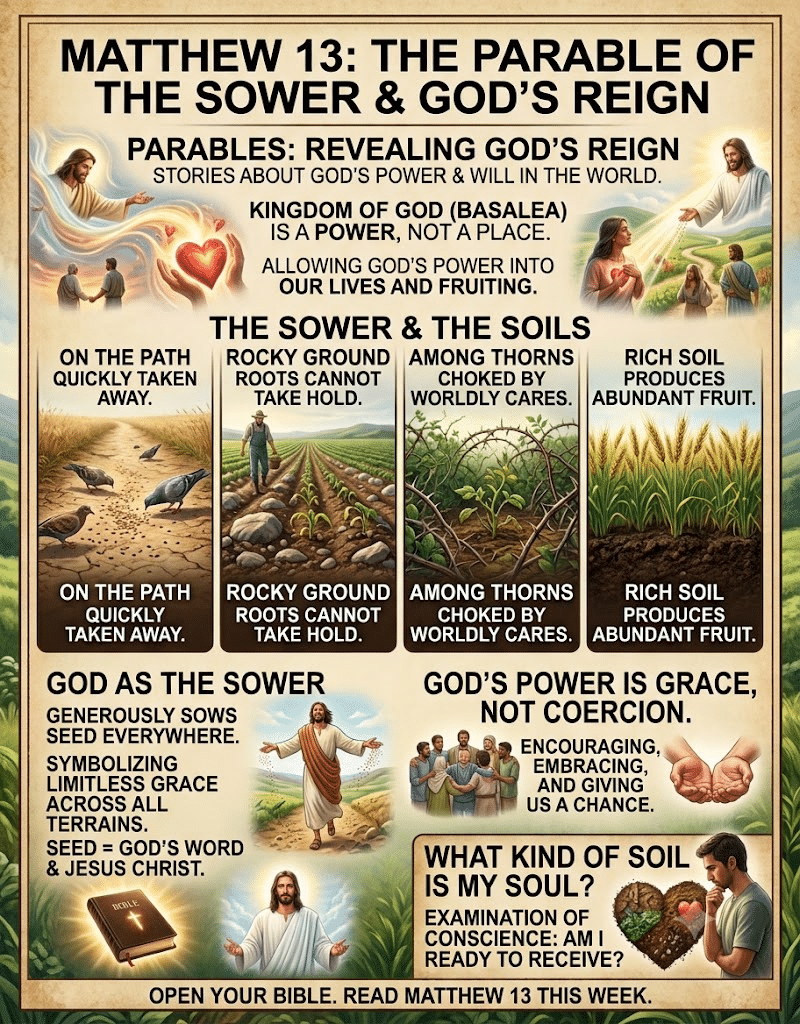
THE WORD THIS WEEK infographics are created using using GOOGLE’S AI Gemini 2.5 Pro. You are free to use the above infographic in any non-profit ministry. Please give credit to TheWordThisWeek.net and Diocese of Colorado Springs video series.
God's kingdom and power can be experienced in our lives when we allow His word to take root in us, and that this happens not through physical or coercive means, but through a gentle and generous approach that invites us to be receptive to Jesus.
- 00:00 Jesus' parables, particularly those in Matthew 13, teach us about God's power and will, revealing the kingdom of God as a reign or kingship, rather than a physical place.
- 00:57 The key to a fulfilling life is not just being in a certain place, but allowing God's power to enter and guide us, as illustrated by the parable of the sower.
- 01:28 God sows seeds everywhere, unlike farmers who meticulously keep track of every seed, reflecting a different approach to spreading His kingdom.
- 02:02 God's way is one of generosity, giving everyone a chance through His word, Jesus Christ, which is sown in all kinds of people, regardless of their readiness to receive Him.
- 02:35 God's power is a beautiful, non-coercive force that achieves its end through gentle means, inviting an examination of conscience.
- 02:54 Reflect on your spiritual soil and allow God's word to take root in your life by being receptive to Jesus and letting go of inner obstacles.
Nature of Biblical Parables
Q: How should parables in Matthew's Gospel be interpreted?
A: Parables like the parable of the sower function as metaphors that reveal God's way of operating in the world, expressing divine power and will, rather than literal instructional stories about actual events or farming practices.
God's Character Through the Sower
Q: What does the sower's indiscriminate seed-throwing reveal about God's nature?
A: God throws seed everywhere, including places where growth is unlikely, contrasting sharply with a careful farmer who sows only in optimal locations, demonstrating God's grace, generosity, and commitment to giving everyone a chance regardless of their receptivity.
Divine Power Redefined
Q: How does the parable redefine the nature of God's power?
A: The power of God operates through embracing, encouraging, lifting up, and giving chances rather than through coercion, violence, or threats, presenting a fundamentally non-threatening model of divine influence.
Personal Application
Q: What self-examination does the parable invite?
A: The parable prompts an examination of conscience about one's spiritual receptivity—whether one's soul resembles rich soil ready to receive Jesus and God's word, or rocky soil cluttered with obstacles that prevent God's word from taking root.
Summary for: https://youtu.be/jNjbwpndjuI by Noiz — Download YouTube Subtitles
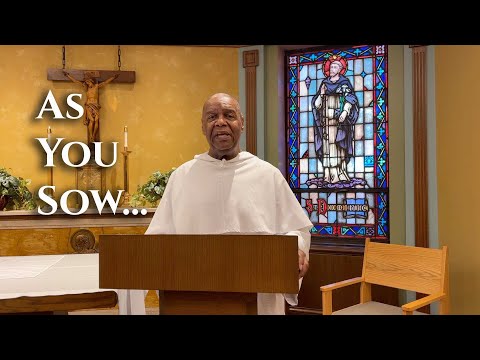
Video courtesy of Dominican Friars (Chicago)

THE WORD THIS WEEK infographics are created using using GOOGLE’S AI Gemini 2.5 Pro. You are free to use the above infographic in any non-profit ministry. Please give credit to TheWordThisWeek.net and Dominican Friars, Province of St. Albert the Great.
The effectiveness of our actions and efforts in life, including our relationships and personal growth, depends on the quality of the "ground" we sow in, and that reflecting on our actions and sowing positive seeds can help us navigate life's challenges and yield a desirable outcome.
- 00:00 The sower disperses seeds in an old-fashioned way, not precisely like modern farming, and some seeds fall on rocky ground.
- 00:43 The effectiveness of sowing seeds depends on the quality of the ground, as not all seeds will flourish or yield a bountiful harvest.
- 01:34 Faith gives us the proper measure to navigate life's ups and downs.
- 01:58 Depending on one another and sowing our best efforts will ultimately yield the best results, especially in times of uncertainty and violence.
- 02:43 Christians struggle with being perceived as hypocrites or bad people due to their actions, prompting a deeper reflection on how to live and reap a better harvest.
- 03:12 Parents must endure the challenging behavior of their pre-teen and teenage children, recalling that they too were likely a handful for their parents at a younger age.
- 03:56 We must reflect on our actions and consider how they may shape who we become, and ensure we are sowing positive seeds to reap a desirable outcome.
Understanding the Parable's Core Message
Q: What does the parable of the sower reveal about intentional faith practice? A: The parable teaches that haphazardly sowing seeds of faith leads to an uncertain harvest, requiring us to be intentional in how we live and sow the seeds God has given us, contrasting with modern machines that precisely lay seeds versus the sower who casts them carelessly.
Faith as a Framework for Life's Challenges
Q: How does faith help us navigate difficult realities in the world? A: Faith provides the proper measure to understand and navigate both good and bad times, helping us make sense of violence and injustice in the world as we depend on what we sow to reap a better harvest.
Q: How should Christians respond to hypocrisy and wrongdoing? A: Hypocrisy among Christians and wrongdoing in the world challenge our faith understanding, but examining how we handle our lives and relationships today enables choices that lead to a better harvest in the future.
The Principle of Spiritual Maturity
Q: What does reaping what we sow reveal about spiritual growth? A: Reaping what we have sown reflects our maturity, as looking back at past choices and recognizing missed opportunities to do better reveals our growth and understanding of the sow-reap principle.
Practical Application of the Parable
Q: What specific approach does scripture require for optimal spiritual results? A: Scripture tells us "what we sow, we shall reap," requiring us to give our best and be intentional in living our lives and sowing the seeds God has given us.
Q: What conditions are necessary for abundant spiritual yields? A: Abundant yields require intentionality and careful cultivation, as the parable's sower who casts seeds haphazardly demonstrates the contrast between careless and deliberate spiritual practice.
Summary for: https://youtu.be/YNNEedFN4B0 by Noiz — YouTube Transcripter
THE WORD THIS WEEK infographics are created using using GOOGLE’S AI Gemini 2.5 Pro. You are free to use the above infographic in any non-profit ministry. Please give credit to TheWordThisWeek.net and Dominican Friars, Province of St. Albert the Great.

Video courtesy of The Jesuit Post
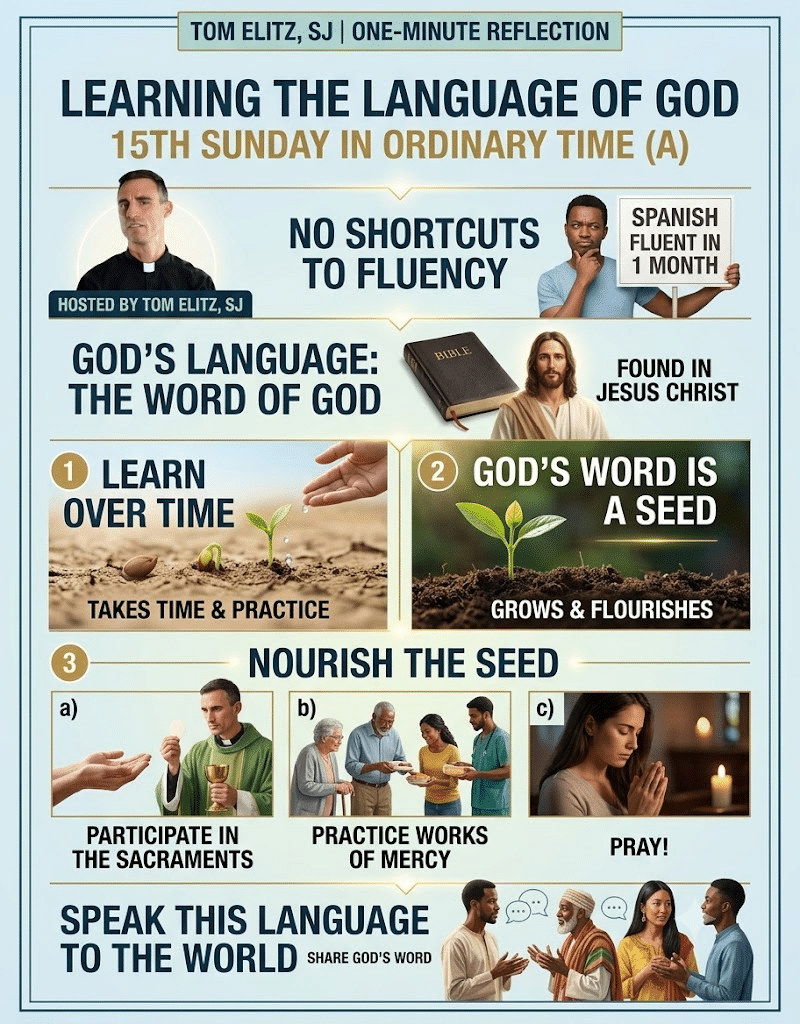
THE WORD THIS WEEK infographics are created using using GOOGLE’S AI Gemini 2.5 Pro. You are free to use the above infographic in any non-profit ministry. Please give credit to TheWordThisWeek.net and THE JESUIT POST.
Learning the language of God requires a commitment to spiritual growth through practices such as sacraments, mercy, and prayer.
- 00:00 Learning the language of God requires time, practice, and nourishment through spiritual activities such as participating in sacraments, practicing mercy, and prayer.
Learning God's Language
Q: How do you learn the language of God?
A: Learning the language of God requires the same approach as any other language—time and practice—found specifically in the life of Jesus Christ, nourished by participating in sacraments, practicing works of mercy, and praying to speak God's language to the world.
Q: Why should Christians be skeptical of quick spiritual fluency?
A: Advertisements promising fluency in weeks for language learning deserve skepticism because mastering any language, including God's language, demands long-term commitment rather than shortcuts.
Summary for: https://youtu.be/VCErWPaLslM by Noiz — YouTube Transcripter

Video courtesy of Priests for Life
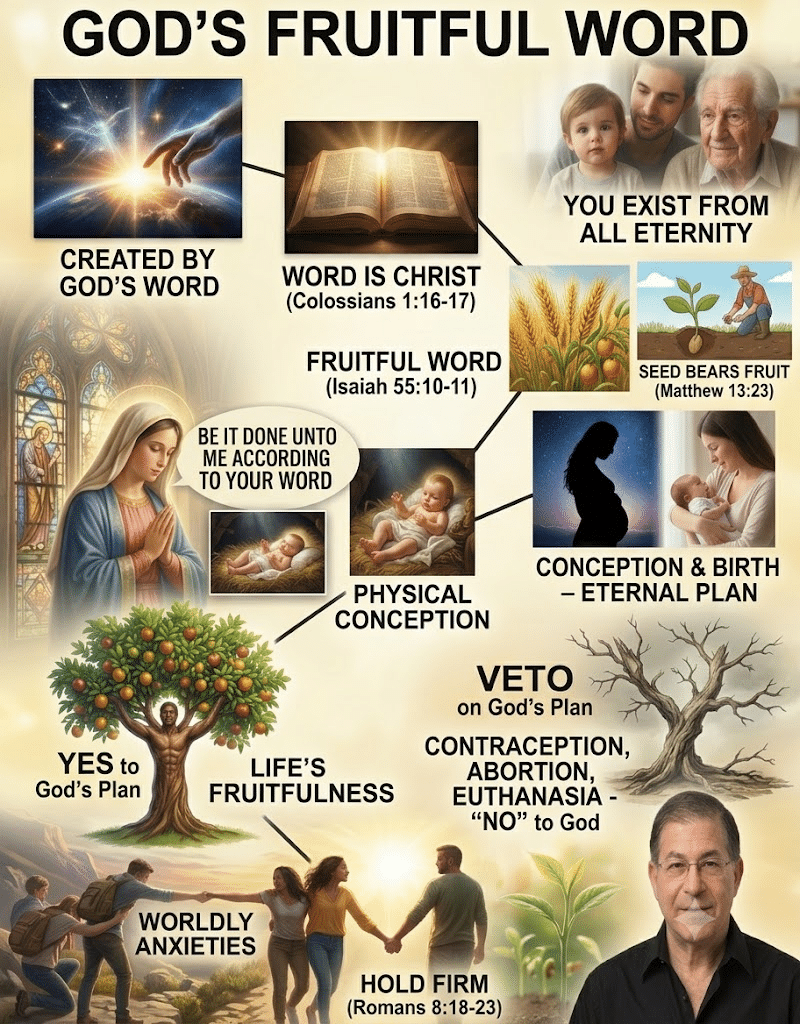
THE WORD THIS WEEK infographics are created using using GOOGLE’S AI Gemini 2.5 Pro. You are free to use the above infographic in any non-profit ministry. Please give credit to TheWordThisWeek.net and PRIESTS FOR LIFE.
God's plan for human life, including its conception, existence, and fruitfulness, is predetermined and unchangeable, and human actions such as contraception, abortion, and euthanasia cannot veto this plan.
- 00:00 The word of God, which is Christ, not only has spiritual fruitfulness but also physical, starting with the creation of human life itself.
- 01:07 The conception and birth of each human being is a fulfillment of God's promises, just as Mary's obedience led to Christ's conception.
- 01:24 God decided that each living person should exist from all eternity, with definitive plans for their life.
- 01:47 God's plan for each person's life, including their fruitfulness, cannot be vetoed by human actions like contraception, abortion, and euthanasia.
Creation and the Word
Q: How does Scripture connect Christ to the physical creation of all things?
A: According to Genesis, John's Gospel, and Colossians chapter 1, Christ as the Word of God was the "beginning" of creation, with all things created by Him and for Him, meaning God's creative word is not merely spiritual but fundamentally physical.
Conception as Divine Fulfillment
Q: What is the theological connection between Mary's conception and every human conception?
A: Mary's statement "Be it done unto me according to your word" resulted in the physical conception of Christ, establishing that every human conception and birth is a fulfillment of God's promises, with God deciding from all eternity that each person should exist with definitive plans for their life.
Opposition to Life as Veto
Q: How does the sermon characterize contraception, abortion, and euthanasia in relation to God's plan?
A: These practices constitute an offensive "No" to God's eternal Word, functioning as attempts to veto an eternal decision of God regarding the fruitfulness of each life, preventing His word from accomplishing the end for which it was sent as promised in Isaiah 55:10-11.
Anxiety and Life's Fruitfulness
Q: What role does worldly anxiety play in rejecting life according to the Gospel reading?
A: The "worldly anxiety" referenced in Matthew 13 creates temptation to cut off the fruitfulness of life, leading people to oppose God's plan through life-ending decisions driven by temporal concerns rather than eternal perspective.
Eschatological Perspective on Suffering
Q: How does Paul's second reading reframe life's difficulties in relation to childbirth?
A: Romans 8:18-23 invites believers to hold firm through life's difficulties by placing anxieties in an eschatological perspective, specifically using childbirth as the metaphor to describe the full unfolding of God's plan for all creation.
Physical and Spiritual Fruitfulness
Q: Why must the fruitfulness of God's Word be understood as both spiritual and physical?
A: Isaiah's declaration that God's word accomplishes the end for which it is sent and Jesus's parable about seed bearing fruit apply not only spiritually but begin with human life itself, making physical procreation the primary manifestation of divine fruitfulness.
Summary for: https://youtu.be/nLTFfCNRR-c by Noiz — YouTube Transcripter

Video courtesy of Society of Our Lady of the Most Holy Trinity

THE WORD THIS WEEK infographics are created using using GOOGLE’S AI Gemini 2.5 Pro. You are free to use the above infographic in any non-profit ministry. Please give credit to TheWordThisWeek.net and Society of Our Lady video series "Liturgy Prep."
Through our union with Christ, our sufferings can be transformed into a source of abundant spiritual fruit and future glory.
- 00:00 Christ's teachings and life help transform our "rocky and thorny" spiritual soil into rich soil, producing abundant fruit through our union with Him.
- 01:31 Sufferings in the present time are insignificant compared to the future glory that Christ can bring about through our struggles.
- 01:54 Suffering can reveal Christ's presence in our lives, as people often experience and recall God's closeness during difficult times.
- 02:32 Christ purifies us by uniting our sufferings to him, and in return, he produces abundant fruit in our lives by removing the stones and thorns in our hearts.
Understanding the Parable's Purpose
Q: What makes the parable of the sower unique among Jesus's parables?
A: The parable of the sower is the only parable where Jesus explicitly explains its meaning, revealing that parables intentionally hide truths from non-believers while revealing deeper meanings to those who reflect and seek understanding.
Applying the Message
Q: How should listeners practically engage with the parable of the sower?
A: The challenge is to identify which of the four soil types (path, rocky ground, thorns, or good soil) you currently are and commit to listening, reflecting, and growing in faith to become good soil that bears fruit 30-100 times what was sown.
Summary for: https://youtu.be/GFJWdrBxz4c by Noiz — YouTube Transcripter

Video courtesy of Eternal Word Television Network
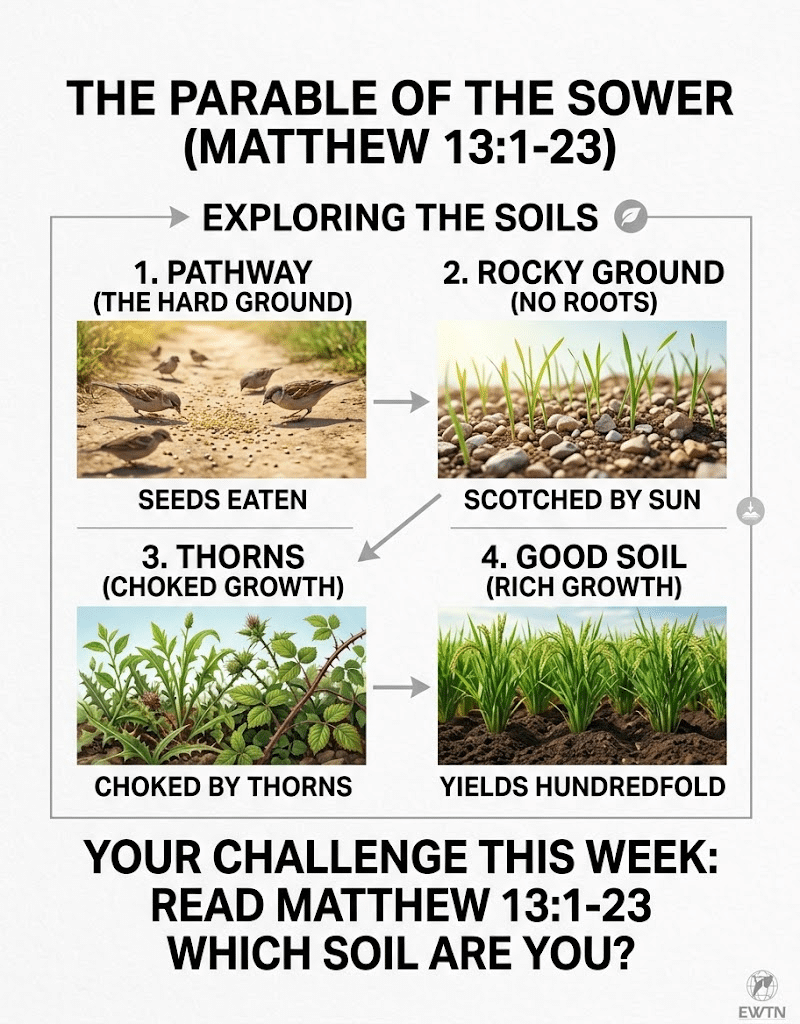
THE WORD THIS WEEK infographics are created using using GOOGLE’S AI Gemini 2.5 Pro. You are free to use the above infographic in any non-profit ministry. Please give credit to TheWordThisWeek.net and EWTN video series "The Word on the Word."
Jesus teaches through the parable of the sower, encouraging listeners to reflect on their spiritual receptivity and grow in faith by understanding God's word.
- 00:00 Jesus explains the parable of the sower, describing four types of soil, and reveals that he speaks in parables to hide the truth from those who do not believe.
- 00:49 This week's challenge is to read Matthew 13:1-23, reflect on which type of seed you are, and grow in faith by understanding God's word.
Summary for: https://youtu.be/GFJWdrBxz4c by Noiz — YouTube Video Summarizer
Rest and Transformation in Christ
Q: What does Jesus promise to those who come to him with their burdens? A: Jesus invites the burdened to come for rest (Matthew 11:28), offering a comforting response similar to a child running to a parent when scared, though he won't remove all hardships but will provide strength to endure them.
Q: How does Jesus transform suffering rather than eliminate it? A: The cross you bear may not go away but will be transformed by his grace, meaning followers receive endurance capacity rather than burden removal, acknowledging that being a follower of Christ in today's world has never been easy.
Q: What is the practical invitation Jesus extends regarding personal struggles? A: Jesus invites believers to let him enter whatever burdens they carry, positioning himself as an active participant in their difficulties rather than a distant problem-solver who simply removes obstacles.
Responding to Life's Burdens
Q: How should I respond when facing difficult or scary situations? A: Come to Jesus with your burdens the same way a child runs to a parent when something scary happens, bringing your heavy loads directly to him for rest and strength.
Transforming Suffering Through Faith
Q: What should I expect when I bring my struggles to Jesus? A: Understand that the cross you bear may not go away, but it will be transformed by his grace, changing not necessarily the circumstance but your capacity to endure it.
Enduring as a Modern Christian
Q: How can I handle the challenges of being a Christian today? A: Trust that Jesus will give you the strength to endure and walk through anything you might encounter, even when being a follower of Christ in today's world isn't always easy.
Liturgy Notes


15th Sunday of Year A
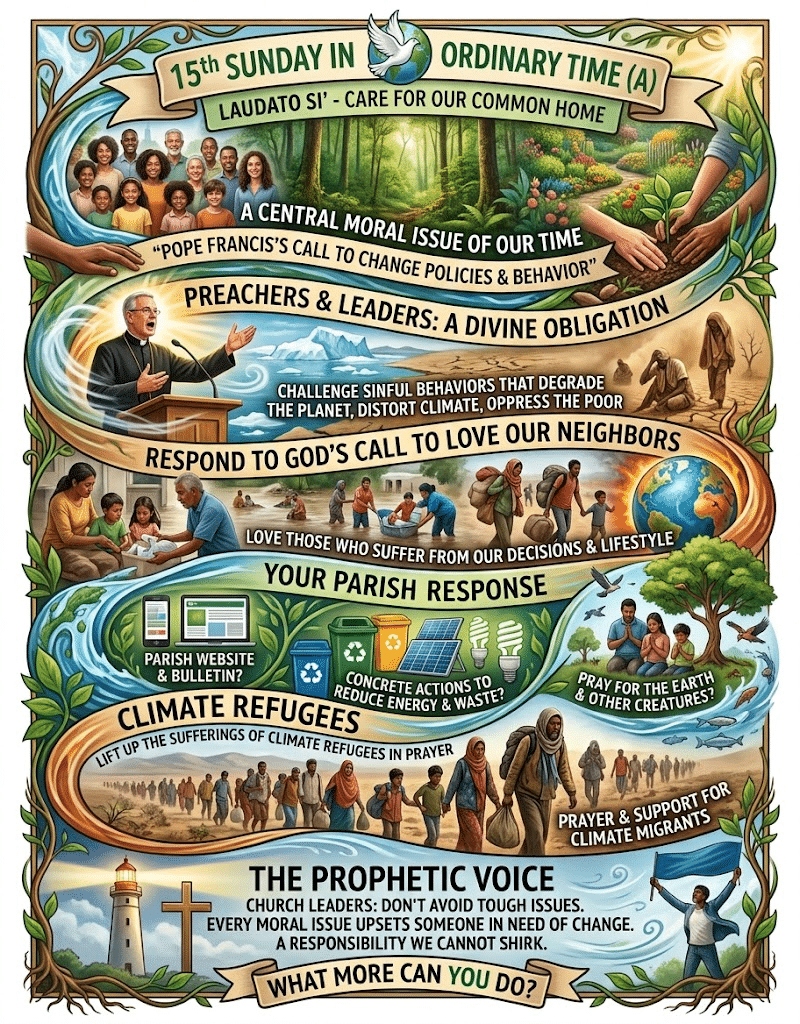
Care for Our Common Home
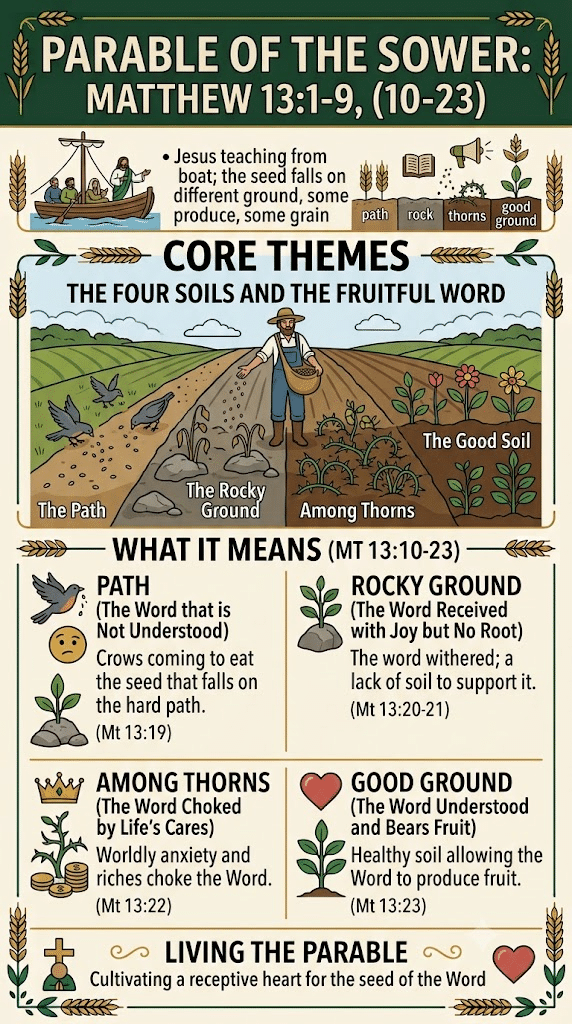
It can rightly be argued that the first reading and the Gospel are not really focused on care of creation. In the first reading, the prophet uses images from nature to speak of the power and efficacy of God’s word. In the Gospel, Jesus does something very similar using agricultural images to speak of the power of the word and the importance of how we receive it. Both of these passages, however, are linked to creation care. They both see the earth and its ability to provide food as gifts from God: both call us to heed God’s word, which certainly includes the command to care for God’s creation and to love the future generations who will inherit what we do to the earth.
The second reading is much more clearly focused on creation care, for Paul speaks of creation itself groaning as it waits to “be set free from slavery to corruption and share in the glorious freedom of the children of God.” This passage alone should make it clear that God cares about the earth, for it is intended to share in redemption. It is not dispensable. The “new heavens and new earth” we await are a transformed creation not a replacement for what God made and saw as “very good.”
Full Series: Cycle A Resources
OCP MUSIC

15th Sunday of Year A
Entrance
May Your Kingdom Come (Steve Angrisano, Sarah Hart and Curtis Stephan)
Spirit & Song #328
A song of the Kingdom to begin our celebration of Jesus’ teaching on the Kingdom of God.
Response & Acclaim
Response & Acclaim


The Seed that Falls on Good Ground (Curtis Stephan)
Spirit & Psalm 2026: p. 246
Curtis’s verbatim setting of Psalm 65 has a solid “anthem” feel that responds well to the First Reading from Isaiah.
2026 PLAYLIST (152 VIDEOS)

Alleluia: Mass of the Desert (Tom Booth)
Spirit & Psalm 2026: p. 248
The acclamation verse is a quick summary of the teaching of today’s Gospel.
2026 PLAYLIST (152 VIDEOS)
Presentation & Preparation
Presentation and Preparation

Cornerstone (Jackie Francois)
Spirit & Song #282
Verse 2 directly references the Parable of the Sower. “The seed that you planted within all our hearts will flourish and grow hundredfold.”
THE COMMONS / LITURGY BLOG
Communion
Communion

Tend the Ground (Curtis Stephan)
Breaking Bread #625
“Tend the Ground” sings of the importance of caring for God’s creation and is a response to the parable in today’s Gospel. “We till the earth, we tend the ground, sowing hope and peace where none is found.”
Sending Forth
Sending Forth

Rain Down (Jaime Cortez)
Spirit & Song #228; Never Too Young #25; Breaking Bread #589
Summer is a good time to sing the classics. Jaime’s beloved song underscores Isaiah’s rain imagery from the First Reading. We go forth from this Eucharist to water the earth with the Word of God.
THE COMMONS / OCP.ORG
Liturgy Blog is a weekly liturgy planning resource for musicians, liturgists, homilists, youth groups, faith sharing groups, and all who look to the liturgical readings for inspiration and nourishment. Join Ken Canedo as he breaks open the Scripture and suggests tracks from the Spirit & Song contemporary repertoire.
15th Sunday of Year A

Video courtesy of Lector with Lisa
NOT AVAILABLE
Isaiah 55:10-110

Courtesy of Greg Warnusz
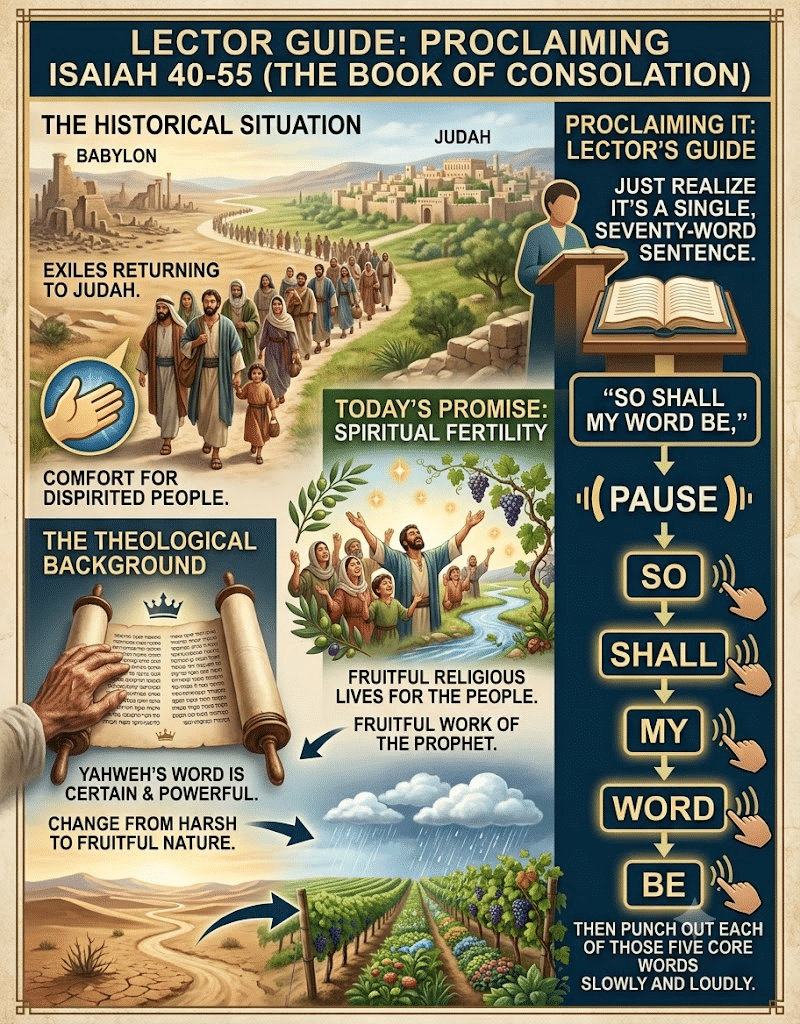
The Historical Situation: The prophecies collected in Isaiah, chapters 40-55, are known as the Book of Consolation (also called Second Isaiah or Deutero-Isaiah). Written while exiles were returning from Babylon to Judah, the chapters are meant to comfort dispirited people. There are promises of fertile land and restoration, water for the thirsty, secure defense against enemies, and more.
The Theological Background: Dan Nelson points out the similarity between this last paragraph of Deutero-Isaiah and its first paragraph, "in its description of the change of nature from harsh to fruitful as the result of Yahweh's power and mercy... Yahweh's word is certain and powerful. Like rain and snow that water the earth so that seeds may sprout and grow, God's word will accomplish its purpose to return the exiles back to their homes in peace. Their return shall be an everlasting memorial to the power of Yahweh's word."
So today's passage promises spiritual fertility. We might say it implies that God will make the peoples' religious lives fruitful, as he has done for their land. And it could bespeak a promise that God will make fruitful the work of the prophet, whose job it is, after all, to proclaim God's word. That should be some comfort to the lector, too.
Proclaiming It: Lector, by now you have meditated on the gospel, and perhaps on the hope that your listeners become spiritually fertile for hearing God's word. So it shouldn't be hard to prepare to proclaim the first reading. Just realize it's a single, seventy-word sentence. To make it sound right to the congregation, pause before "so shall my word be." Then punch out each of those five core words slowly and loudly.
15th Sunday of Year A
Video courtesy of Lector with Lisa
NOT AVAILABLE
Romans 8:18-23
Courtesy of Greg Warnusz
The Theological Background: In this passage, sentences about our spiritual distress surround sentences about nature's distress. Rightly does a modern person ask how these belong in the same paragraph. What does Paul mean by creation "eagerly awaiting the redemption of the children of God" and creation being "subject to futility"? Perhaps Paul has a vision more holistic than ours. He might mean that the sin of Adam, which, of course, looms large in the Letter to the Romans, brought corruption not just to humankind but to nature. Genesis 3:14-19 does describe nature turning against the convicted Adam and Eve. For Paul, then, what God is doing for us in Christ is so powerful that it will redeem not just us but the created world, too.
Proclaiming It: If we've interpreted Paul correctly, then he would have written this in an "Oh, wow!" frame of mind. God is reversing all of human and natural history! And we're witnessing, participating and announcing it! The theological subtleties are hard to get across in oral interpretation, and are best left to your assembly's preacher. But Paul's enthusiasm for his subject is something you can convey with your voice. Read this dramatically, emphasizing the glorious freedom of the children of God.

