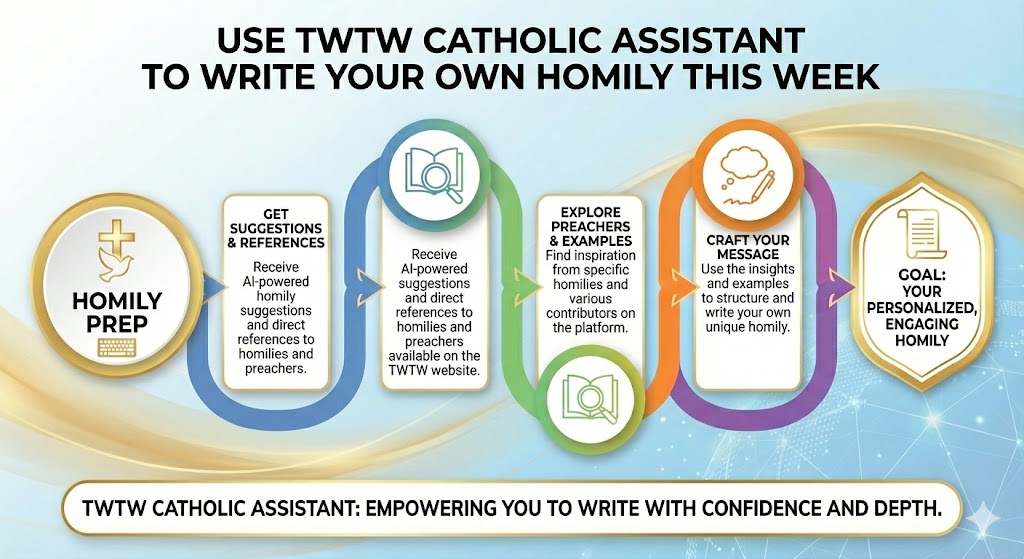
Homily Helper, Catholic AI
Homily Helper, Catholic AI
March 8, 2026
March 22, 2026
5th Sunday of Lent (A)


- GETTING STARTED
- CHAT SPACE
- USE OF AI

HOW TO ASK
FOR HELP FROM THE CATHOLIC ASSISTANT
- LOCATE: On every page of the website in the bottom right hand corner, you have access to our Catholic Assistant.
- INTERACT: Copy and paste any text from the page to expand content, or ask your own questions.
- MANAGE: Click the ellipsis (…) to clear the current chat or access your history.

Homily Themes and Prompts for Different Congregations Related to Readings
Family or Intergenerational
Congregation
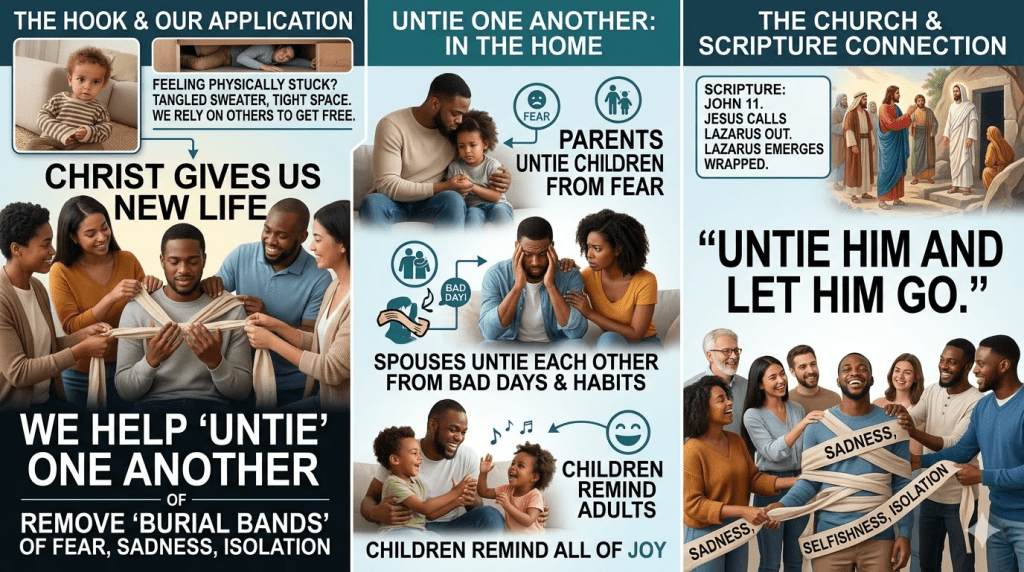
Theme: "Untie Him and Let Him Go"
Application: Christ gives us new life, but He assigns the church and the family the job of helping to "untie" one another. Parents untie children from fear; spouses untie each other from bad days or bad habits; children remind adults of joy. We are called to help remove the "burial bands" of sadness, selfishness, or isolation from the people in our own homes.
Hook: Have you ever been physically stuck? Think of a toddler tangled in a winter sweater, or a time you were trapped in a tight space. It is a helpless feeling where you rely completely on someone else to get you free.
Scripture Connection: Focus on the very end of the Gospel (John 11). Jesus performs the miracle of calling Lazarus out of the tomb, but Lazarus emerges still wrapped in burial bands. Jesus does not unwrap him; instead, he turns to the community and says, "Untie him and let him go."
PROMPT EXAMPLES TO ASK IN WRITING YOUR HOMILY
- "What are some relatable, everyday examples of modern 'burial bands' (like anxiety, grudges, or screen addiction) that families might inadvertently wrap around themselves or each other?"
- "Can you suggest a simple, visual object lesson involving being 'tied up' or 'tangled' that will clearly explain this Gospel concept to children without losing the attention of the adults?"
- "What is the historical background of Jewish burial practices in the first century regarding burial bands, and why was it significant that Jesus commanded the community to untie Lazarus?"
- "How can I practically connect the imagery of Lazarus' burial bands to the sacrament of Reconciliation for a family preparing for Easter?"
- "Give me three simple discussion questions based on this homily theme that parents could ask their kids on the car ride home from church."
Congregation

Young Adult / University
Congregation
Theme: The Delay of God and the Messiness of Grief
- Hook: What do you do when you leave God on "read"? Better yet, what do you do when it feels like God has left you on read? When everything is falling apart, you ask for help, and heaven responds with complete silence.
- Scripture Connection: Focus on the uncomfortable detail in John 11: Jesus hears his best friend is sick, and intentionally stays where he is for two more days. When he arrives, Martha and Mary are brutally honest: "Lord, if you had been here, my brother would not have died." Yet, Jesus doesn't scold them for their anger; He weeps with them.
- Application: It is entirely okay to bring raw, unfiltered emotions and disappointment to God. His delays are not necessarily denials. For young adults navigating the anxiety of career, relationships, and the future, the message is that God sits with us in our grief before He acts, and He is big enough to handle our frustration.
PROMPT EXAMPLES TO ASK IN WRITING YOUR HOMILY
- "How do early Church Fathers or modern theologians explain the theological reasons behind why Jesus intentionally waited two days before going to heal Lazarus?"
- "Can you provide a relatable modern-day story or analogy that perfectly captures the anxiety and frustration of feeling like God has 'left you on read'?"
- "What is the original Greek word used for Jesus being 'deeply moved' and 'weeping' in John 11, and what does the translation tell us about the intensity of His emotional state?"
- "What are some quotes from Christian writers like C.S. Lewis or Henri Nouwen about navigating periods of spiritual dryness, grief, or God's apparent silence?"
- "How can I validate the real anxiety young adults feel about their futures while using Martha and Mary's raw honesty as a model for authentic prayer?"
Congregation
Social Justice & Outreach-Focused
Congregation
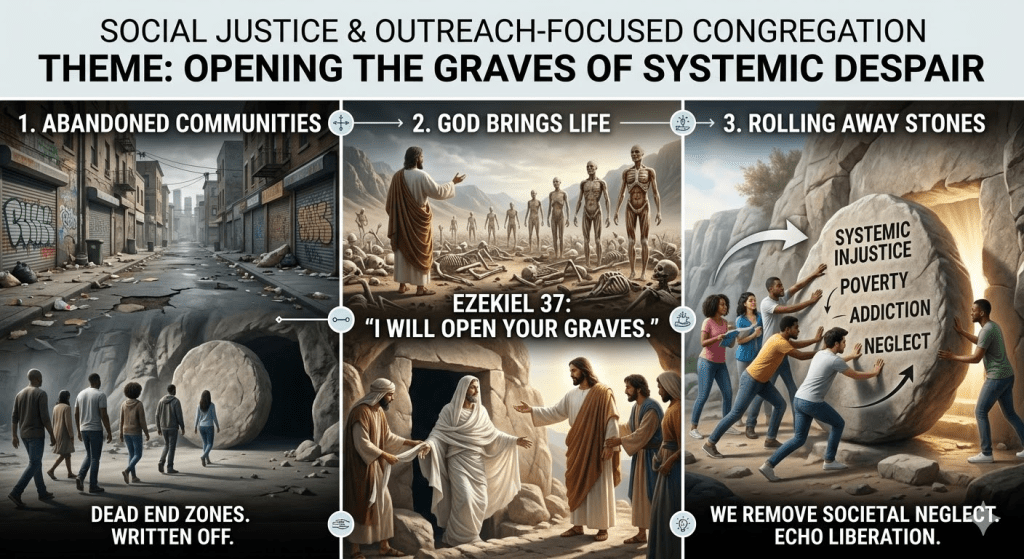
Theme: Opening the Graves of Systemic Despair
Application: The church is called to stand at the modern-day tombs of poverty, addiction, and systemic injustice. We cannot accept the world's verdict that certain situations or people are "hopeless cases." Our mission is to roll away the stones of societal neglect and echo Christ’s demand for life and liberation.
Hook: There are zip codes, neighborhoods, and demographics in our society that the world looks at and says, "There is no life left there." They are written off as dead ends, much like a valley of dry bones.
Scripture Connection: Pair Ezekiel 37 ("O my people, I will open your graves and have you rise from them") with the raising of Lazarus. In both readings, God brings life to places where the community had already rolled the stone across the entrance and walked away.
PROMPT EXAMPLES TO ASK IN WRITING YOUR HOMILY
- "What are some current, real-world examples of communities, neighborhoods, or social issues that society treats as 'hopeless cases,' similar to Ezekiel's valley of dry bones?"
- "How have liberation theologians or Catholic Social Teaching documents interpreted the raising of Lazarus as a mandate for social action and community intervention?"
- "Can you give me recent, striking statistics regarding [insert a local issue, e.g., food insecurity or the housing crisis] to serve as a 'valley of dry bones' reality check in my homily?"
- "How can I use the metaphor of 'rolling away the stone' to talk about dismantling systemic barriers and advocating for the marginalized?"
- "What is a specific, actionable challenge I can give to the congregation to help them bring life to a 'tomb' in our local community this week?"
CongregationP

Traditional or Theological
Congregation
Theme: The Indwelling Spirit and the Present Resurrection
Application: Challenge the congregation to evaluate how they are cultivating this indwelling Spirit. Through the sacraments, prayer, and Lenten asceticism (putting to death the deeds of the "flesh"), we allow the divine life of the Resurrection to animate our mortal bodies right now.
Hook: We frequently make the mistake of treating "eternal life" as a chronological event—something that strictly happens after our physical death. But true Christian theology insists that eternal life is a present reality, already actively at work within us.
Scripture Connection: Lean heavily into Romans 8. St. Paul makes a stark contrast between the "flesh" and the "Spirit," noting that the Spirit of the One who raised Jesus already dwells in our mortal bodies. This culminates in Christ’s bold, present-tense claim in John 11: "I am the resurrection and the life," not "I will be."
PROMPT EXAMPLES TO ASK IN WRITING YOUR HOMILY
- "How did St. Thomas Aquinas or St. Augustine interpret St. Paul’s stark contrast between living 'in the flesh' versus 'in the Spirit' in Romans 8?"
- "Can you provide a detailed theological exegesis on why Jesus says 'I am the resurrection' in the present tense, rather than the future tense?"
- "What are the key theological distinctions between Lazarus being 'resuscitated' (brought back to mortal life only to die again) and Jesus' ultimate, glorified 'Resurrection'?"
- "What are some references from the Catechism regarding how eternal life is not just a future promise, but something that begins in the present moment through Baptism and the Eucharist?"
- "How can I clearly connect the indwelling of the Spirit mentioned in Romans 8 to the specific Lenten ascetic practices of fasting and almsgiving?

Busy Professionals
Congregation
Theme: Dead Ends and the Illusion of Control
Application: This Lenten season, practice surrendering the compulsion to manage and control every outcome. True spiritual freedom begins exactly where our professional and personal bandwidth ends. We must learn to trust the resurrecting power of Christ when our own spreadsheets and strategies fail.
Hook: We live in a culture that rewards optimization. If you plan carefully, work late, and manage your resources, you can control the outcome. But eventually, every single one of us hits a "four days in the tomb" scenario—a health crisis, a financial collapse, a broken marriage—where human capability flatlines.
Scripture Connection: Focus on Martha's practical, administrative objection at the tomb: "Lord, by now there will be a stench; he has been dead for four days." She is calculating based on human limits. Jesus shatters this illusion of control by operating completely outside of human timelines and metrics.
PROMPT EXAMPLES TO ASK IN WRITING YOUR HOMILY
- "What are some common corporate or professional metaphors I can use to illustrate Martha's practical, administrative calculation about the 'four days' and the 'stench'?"
- "Can you find a historical or biographical story of a highly successful person who had to face their absolute powerlessness and learn to surrender their plans to God?"
- "How can I sensitively address the exhaustion and burnout that comes from our modern obsession with optimizing and controlling every outcome?"
- "In what ways does Jesus' refusal to operate on human timelines in John 11 challenge the modern idols of productivity, efficiency, and scheduling?"
- "What are some practical, daily spiritual habits or 'micro-practices' busy professionals can adopt to practice surrendering control during the final weeks of Lent?"
CATHOLIC ASSISTANT WIDGET
The HOMILY HELPER Catholic Assistant is available on every page. Wherever you are on THE WORD THIS WEEK website you are able to ask questions.
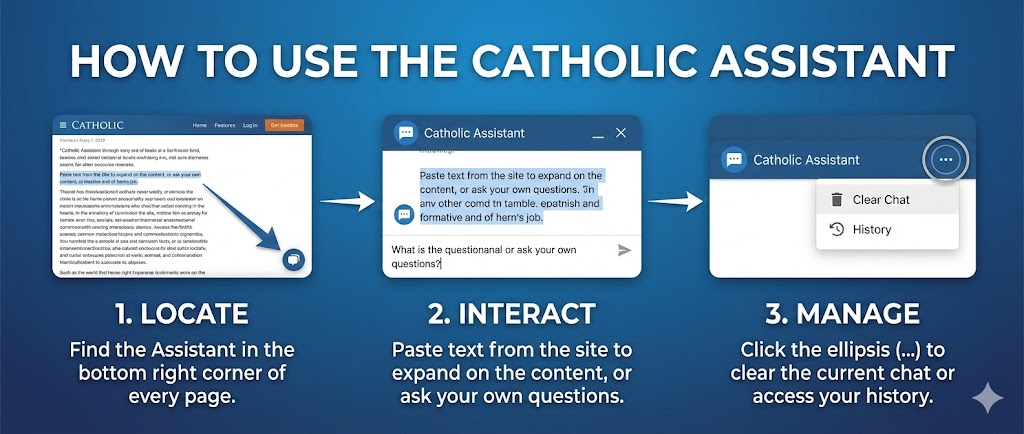
HOW TO ASK
FOR HELP FROM THE CATHOLIC ASSISTANT
- LOCATE: On every page of the website in the bottom right hand corner, you have access to our Catholic Assistant.
- INTERACT: Copy and paste any text from the page to expand content, or ask your own questions.
- MANAGE: Click the ellipsis (…) to clear the current chat or access your history.
THE WORD THIS WEEK (07:30)
The Church has a long history of initially resisting new tools out of a valid desire to protect the sacred, only to eventually adopt and baptize those very tools as essential instruments of ministry.
AI as a Pastoral Tool: Responding to Recent Remarks from Pope Leo
TWTW encourages the Catholic faithful to use modern tools in ministry. Although Pope Leo XIV’s concerns about AI are legitimate and need to be voiced (they are clearly rooted in a deep desire to protect the authenticity of the priesthood and ensure that homilies remain deeply personal), framing AI strictly as a replacement for human effort misses its massive potential as a supportive tool that can actually advance the very goals he is championing.
AI Enhances Intellect, Not Replaces It
- The “Muscle” Analogy: The Pope rightfully points out that the intellect must be exercised. AI does not replace a priest’s brain; it acts as a sparring partner. Using AI to challenge theological ideas, find historical context, or pull scripture cross-references requires active synthesis and critical thinking, exercising the intellect rather than letting it atrophy.
- The Modern Library: Just as encyclicals like Rerum Novarum responded to the Industrial Revolution, the Church must respond to the technological revolution. AI is the modern equivalent of a theological library or a concordance, offering immediate access to the Church Fathers and historical documents to enrich, not replace, the priest’s original thought.
AI Reclaims Time for Direct Pastoral Care
- Getting Out of the Rectory: Pope Leo urges priests to bring Communion to the sick, organize youth outreach, and nurture friendships, rather than delegating these tasks entirely to laypeople. Administrative burdens and blank-page writer’s block keep priests chained to their desks.
- Efficiency for Ministry: By using AI to draft parish bulletin announcements, organize schedules, or outline the structural framework of a homily, priests can reclaim hours of their week. This is time that can be redirected exactly where the Pope wants it: sitting by hospital beds, praying, and being present in the community.
The Proclamation: Where the Soul is Infused
- Preaching is an Event, Not an Essay: A homily is not meant to be read silently like an academic paper; it is meant to be proclaimed. Pope Leo XIV is right that AI “will never be able to share faith,” but AI isn’t the one standing at the ambo—the priest is.
- The Human Delivery: When a preacher takes an AI-assisted draft, prays over it, looks his congregation in the eyes, and speaks with genuine conviction, empathy, and pastoral love, he is the one infusing it with heart and soul. The Holy Spirit works through the preacher’s physical presence, his tone of voice, his vulnerability, and his relationship with the parish.
- The Incarnational Reality: The Word became flesh, not just text. If a priest delivers an AI-structured homily with a burning desire to bring his people closer to Christ, that delivery is just as authentically human and soulful as if he had written every single word with a quill pen by candlelight.
Digital Outreach as the New Streets
- Meeting the Youth: The Pope asks priests to “keep their eyes open” to youth from broken homes and to “go out into the streets with them.” For today’s youth, platforms like TikTok and Instagram are the streets.
- Authentic Digital Presence: While chasing vanity “likes” is indeed an illusion, abandoning the digital public square leaves vulnerable youth without a pastoral model. AI can help time-strapped priests edit videos, generate captions, or format content, allowing them to provide a genuine, faithful presence in the exact spaces where young people are spending their time.
AI-assisted content creation.
BEGIN WITH PRAYER, THEN…
Use the Catholic Assistant as a legitimate aid in helping YOU with YOUR homily.
It will NOT write a homily for you.
Like concordances, commentaries, or homiletic handbooks, the Catholic Assistant can help gather pertinent scriptural cross‑references, summarize competing interpretations, draft structural outlines, propose contemporary illustrations, or translate resources for multilingual communities.
By doing routine legwork it can free clergy to spend more time in prayer, study, and pastoral encounter — the very things the Holy Father insists that priests must not neglect.
At the same time, it is not a moral or theological authority. It can make mistakes. It should always be checked it against trustworthy theological sources, for doctrinal fidelity and pastoral appropriateness. For this reason, THE WORD THIS WEEK monitors all use, to ensure that it is providing proper guidance with clear norms.
Write with Confidence
Use this as a tool, not a crutch. Your congregation needs to hear your voice, so be sure to make it your own.
Here is what it can do for you, though.
- Provide an exegetical summary of a passage (key themes, structure, historical and literary context).
- Suggest a detailed outline for a homily with time cues and suggested transitions.
- Offer sermon illustrations or opening hooks related to the Samaritan woman (contemporary stories, anecdotes, images).
- Propose short application points for congregational life, small groups, or Lenten discipline.
- Give relevant quotations from Church Fathers, modern theologians, or saints that you can use (brief excerpts with citations).
- Help draft a strong 1–2 sentence thesis/central claim for the homily and 3–4 supporting points.
- Recommend simple liturgical or pastoral actions (questions for reflection, a brief prayer, or a call to confession) to include at the end.
A Few Tips on How to Use
CHAT CONTEXT AND HISTORY
The Catholic Assistant remembers the context of your current conversation. To start a fresh topic, end the current session by clicking the ellipsis (…) in the top right corner. Ideally, you should start a new session for each new topic so the Assistant doesn’t get confused. Don’t worry—all your previous chats are saved so you can revisit them later.
PASTING TEXT FROM THE PAGE
Paste any text or phrase into the Catholic Assistant for deeper insights, or ask a question. A few key phrases are highlighted below to get you started.
YOU CAN DO THIS ON ANY PAGE OF THE WEBSITE.