Fr. Tony’s Homily starters, anecdotes and life messages with infographics for use in parish bulletins, presentations, bible studies, and teaching @ Fr. Tony’s Homilies. Ezekiel 37:12-14 Romans 8:8-11 John 11:1-45

Fr. Tony’s Homily, Life Messages, Homily Starters, Anecdotes

Homily Starters, Fr. Tony’s Homily

Homily Starters, Fr. Tony’s Homily

March 8, 2026

March 22, 2026

5th Sunday of Lent A

  • ANECDOTES
  • EXEGESIS
  • LIFE MESSAGES

5th Sunday of Lent (A)

Dead Poets Society

YouTube player
VISUAL AID

“Carpe Diem. Seize the day.”

In the movie, Dead Poets’ Society, Robin Williams plays the role of John Keating, a transformational teacher in a rigid, regimented private school. On the first day of Literature class, Keating takes his students down to the school lobby where trophy cases display the photos of earlier graduating classes. “Look at these pictures, boys,” says Keating. “The young men you behold had the same fire in their eyes that you do. They planned to take the world by storm and make something magnificent of their lives. That was over 70 years ago. Now they are all fertilizing daffidols. If you will listen, they have a message for you.” As the students gazed at the class photographs, Keating begins whispering, “Carpe Diem, Carpe Diem, seize the day, seize the day.” 

Life is a gift here and now. Enjoy it as God wishes and be ever ready to share His eternal life.


5th Sunday of Lent (A)

Tiger Slam

YouTube player
VISUAL AID

The True Comeback

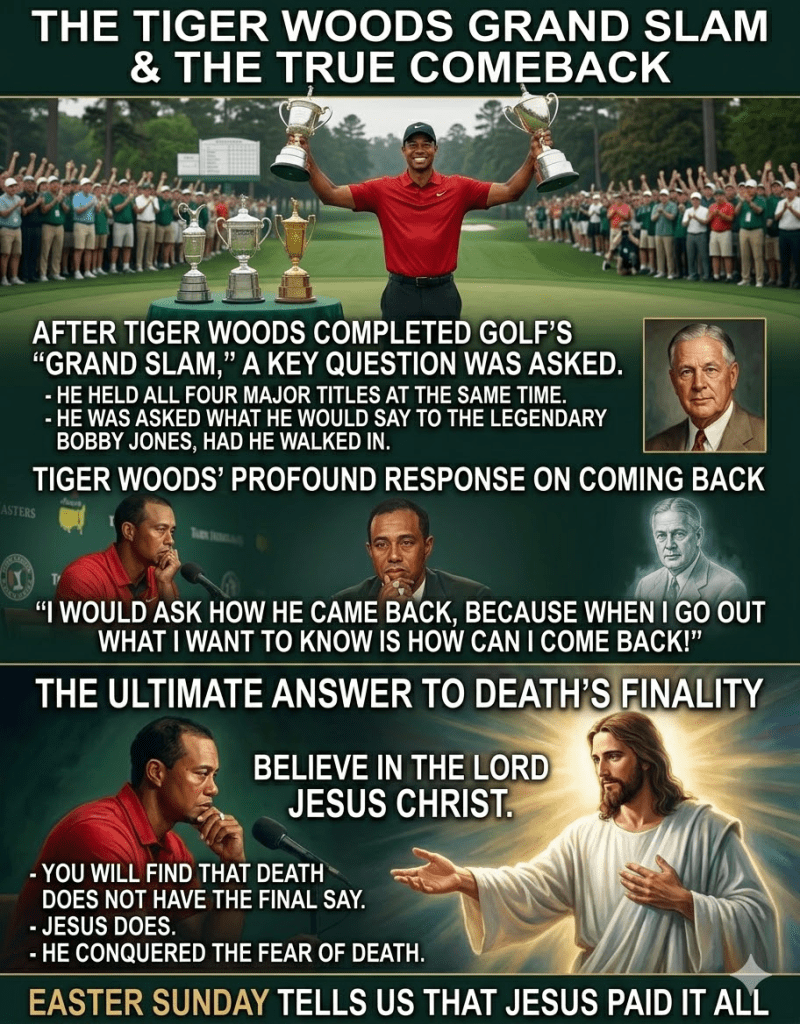
When Tiger Woods won the Masters and was holding at the same time, all four major titles to what is known as golf’s “Grand Slam,” he was asked in the press conference what he would say to the great golfer, Bobby Jones, if he walked into the room. Of course, Bobby Jones has been dead for many years and Tiger Woods said, “I would ask how he came back, because when I go out what I want to know is how can I come back!”

 I’ve got the answer for Tiger Woods – believe in the Lord Jesus Christ and you will find out that death does not have the final say – Jesus does. He has conquered the fear of death and He is the only hope because Easter Sunday tells us that Jesus paid it all. 


5th Sunday of Lent (A)

Mrs. Brezhnev’s Act of Faith

YouTube player


A Sign of Resurrection

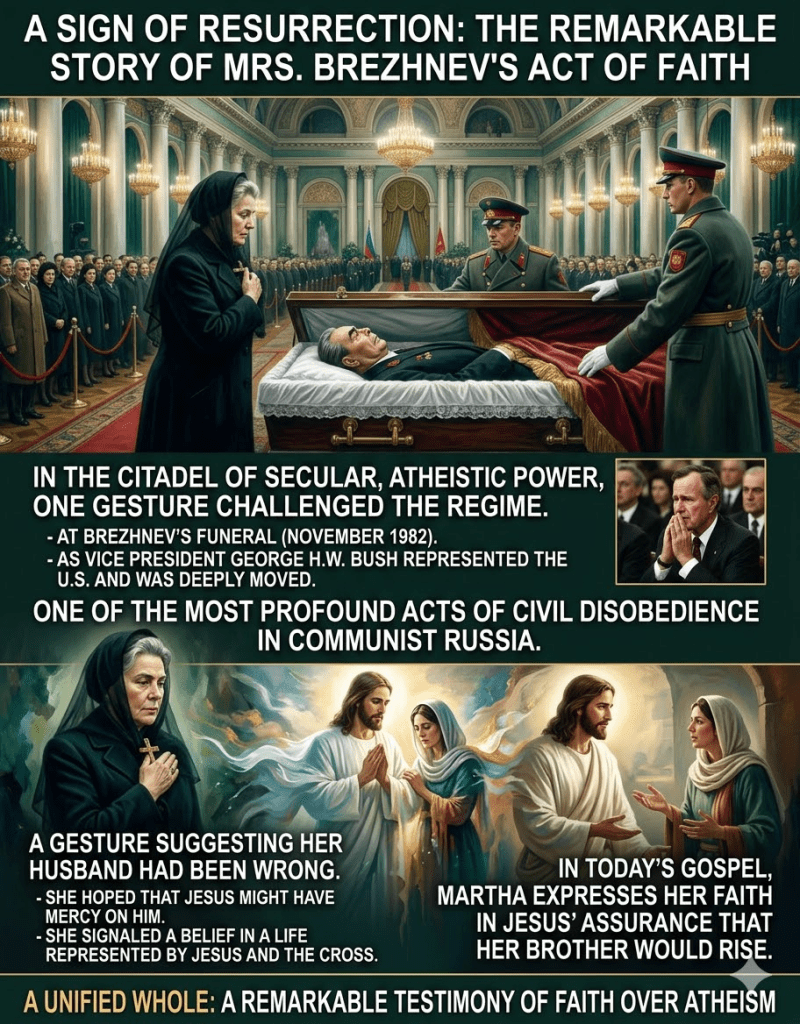
As Vice President, George H.W. Bush represented the U.S. at the funeral of former Soviet leader Leonid Brezhnev (November, 1982). Bush was deeply moved by a silent protest carried out by Brezhnev’s widow. She stood motionless by the coffin until seconds before it was closed. Then, just as the soldiers touched the lid, Brezhnev’s wife performed an act of great courage and hope, a gesture that must surely rank as one of the most profound acts of civil disobedience ever committed in Communist Russia: she made the sign of the cross on her husband’s chest.

There in the citadel of secular, atheistic power, the wife of the man who had run it all made a gesture suggesting that her husband had been wrong.  She hoped that there was another way of life – a life best represented by Jesus who died on the cross, and that this same Jesus might yet have mercy on her husband and raise him up on the Day of the Judgment.  In today’s Gospel, Martha expresses her Faith in Jesus’  assurance that her brother would rise. 
1st Reading | 2nd Reading | Gospel

i need something grand that is visually appealing. create 8.5×11 infographic with large sweeping photo realistic images that span the page either vertically or horizontally and with large bold arial fonts.

[Overall Constraint]: Create a photorealistic infographic on an 8.5×11 inch page with a grand, sweeping, cinematic design.

[Main Title]: The title at the top in massive, bold, gold and white Arial font is: “[YOUR MAIN TITLE HERE]”.

[Top Section – Full Width]: Below the title, a dramatic, full-width photorealistic image captures [DESCRIBE THE EPIC TOP SCENE – e.g., a mountain peak at sunrise with blinding light]. A large, transparent banner across this section reads in bold Arial text: “[YOUR TOP SECTION SUMMARY OR THEOLOGICAL POINT]”.

[Middle Section – Split Panel]: The middle section is a sweeping image split vertically down the center by a subtle divider.

Left Panel: On the left, a photorealistic scene shows [DESCRIBE SCENE A – e.g., Moses at the burning bush]. A banner above/below it reads: “[TITLE FOR SCENE A]”. Below that, bold text overlay states: “[DESCRIPTIVE TEXT FOR SCENE A]”.

Right Panel: On the right, a contrasting photorealistic scene shows [DESCRIBE SCENE B – e.g., Elijah in the cave with wind and fire]. A banner above/below it reads: “[TITLE FOR SCENE B]”. Below that, bold text overlay states: “[DESCRIPTIVE TEXT FOR SCENE B]”.

(Optional Central connector): A central banner connects the two panels reading: “[TEXT LINKING THE TWO CONCEPTS]”.

[Bottom Section – Full Width]: The bottom section is another sweeping, emotional photorealistic image showing [DESCRIBE THE FINAL SCENE – e.g., modern people walking towards a light, or a biblical conclusion]. A large banner reads: “[YOUR FINAL THEOLOGICAL CONCLUSION OR CALL TO ACTION]”. Below it, bold text overlay reads: “[SUPPORTING SCRIPTURE REFERENCE OR FINAL THOUGHT]”.

[Style Summary]: All text must be in large, bold, clear Arial font, using a color palette of gold, white, and deep rich tones (blues, purples, earth tones) against atmospheric backgrounds. The entire image must have a cinematic, epic quality with dramatic lighting, vast landscapes, and high detail.

SHOW/HIDE TEXT

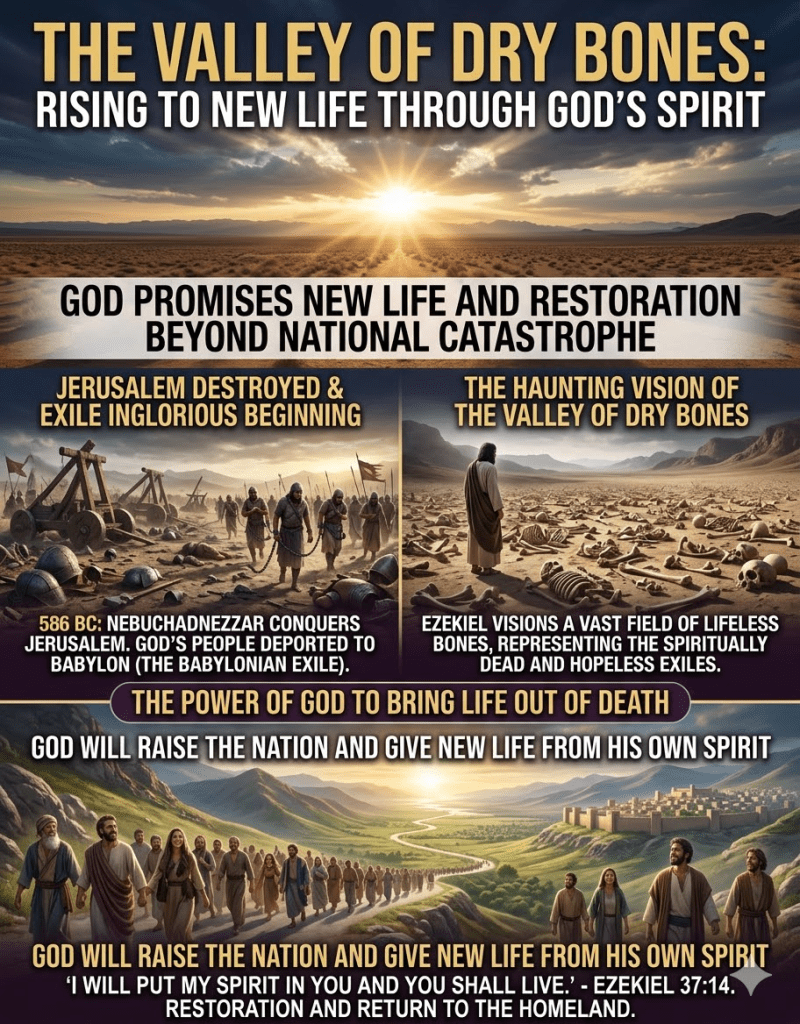
The haunting vision of the valley of dry bones described by Ezekiel (37:1-11), forms the background for today’s first reading.  The imagery may well have come from an actual battle site, probably that of the battlefield after the destruction of Jerusalem by Nebuchadnezzar, king of Babylon, in 586 BC.  After a few years, the Babylonian soldiers uprooted many of God’s people and dragged them into slavery in Babylon, some 750 miles east of their homeland.  This was the beginning of the period known as the Babylonian Captivity, or simply the Exile.  Ezekiel was a priest of the Temple of Jerusalem up to 597 B.C., when he was deported to Babylon with King Jehoiachin and the first deportees.  In his vision, the release of the Jews from the captivity and slavery of Babylon is described as a rising from their graves to return to a new life in their own homeland.  Through the prophet, God assures the exiles that they will live again.  They will be raised from death and filled with life.  They will experience new life, life that springs from God’s own Spirit.  The prophet urges his devastated nation to look beyond that catastrophe to a future that vindicates God’s justice and promises the restoration of the nation through the Spirit of God.

Ezekiel 37:12-14


1st Reading | 2nd Reading | Gospel

5th Sunday of Lent (A)

SHOW/HIDE TEXT

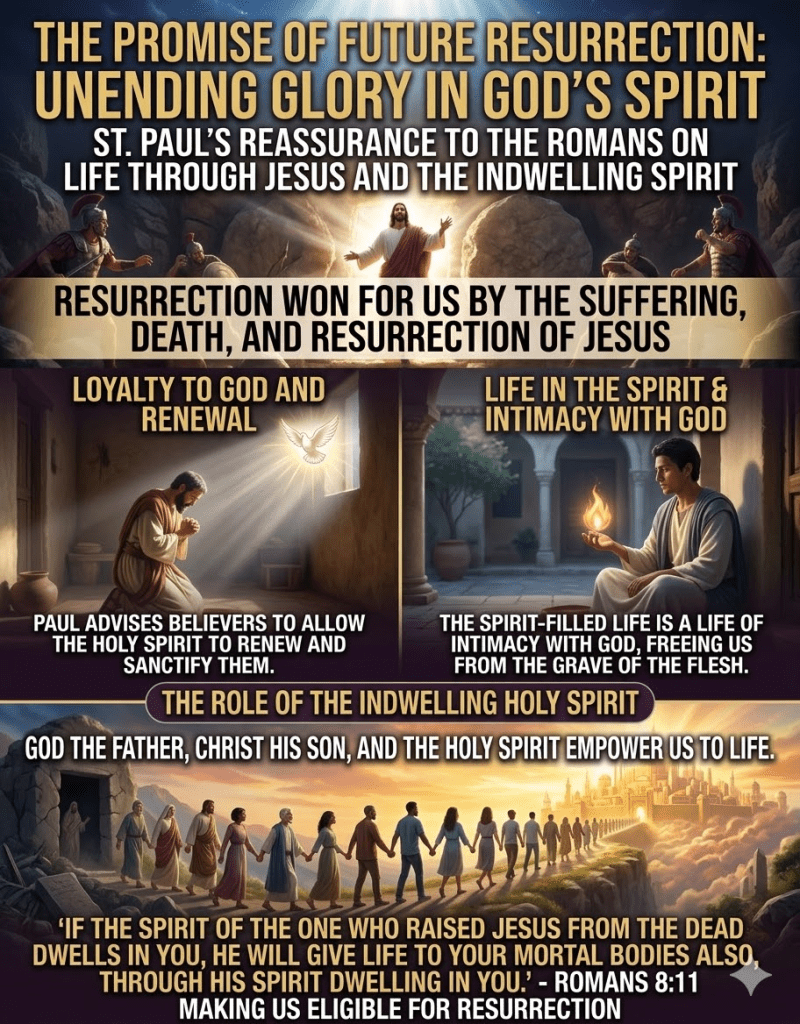
In the second reading, St. Paul reassures the Romans of a future resurrection to a life of unending glory for all those who during their time on earth have been loyal to God and His Son Jesus.  This coming resurrection has been won for us by the suffering, death, and Resurrection of Jesus.  Paul advises the Roman Christians, and us, to allow the Holy Spirit who dwells within each person to renew and sanctify them/us, thus making them/us eligible for resurrection.  “If the Spirit of the One who raised Jesus from the dead dwells in you, the One who raised Christ from the dead will give life to your mortal bodies also, through His Spirit dwelling in you.”  This indwelling Spirit of God, whom we have received in Baptism, will release us from the “grave” of the flesh and allow us to live the life of the Spirit. The Spirit-filled life is a life of intimacy with God.  In this passage, Paul stresses the empowering action of God the Father, Christ His Son, and the Holy Spirit.


1st Reading | 2nd Reading | Gospel

5th Sunday of Lent (A)

SHOW/HIDE TEXT

Picture of death and resurrection: The five Sundays of Lent, combined, give the picture of death and resurrection in faith and in life. 1) The first two Sundays depict Jesus’ own death and Resurrection in daily life:   Temptation/Desert/Rejection and Transfiguration/ Mountain/ Belovedness.  2) Then we have three Sundays with three scenarios of death and resurrection:
a) The Samaritan woman at the well (sociological death to become the first missionary) >>her Faith in Jesus >> her missionary approach to the people of her town. b) The Man Born Blind (Physical and spiritual death to growth in Faith >> he recognizes Jesus, the man >>Jesus the prophet >>finally Jesus the Lord è daring missionary to proclaim the healing and the Lord despite threats of ostracism)>> his Faith. c). Lazarus – (Physical death to actual revivification >> beloved to Mary and Martha and to Jesus >> their Faith. d.) Passion Sunday: Moving from another “mount” (donkey) >>to “Crucify him”! Life is a constant journey from Baptism to the desert to the Transfiguration to simple realities of our daily life and mission with occasional anniversaries and jubilees. (Quoted by Fr. Kayala). This is the longest single narrative/story in the four Gospels – 45 verses.  This story marks a key turning-point in John’s Gospel: not only is it the last and greatest “sign” Jesus will perform, concluding the “Book of Signs,” but it is effectively Jesus’ last public appearance before His Passion and death.


SHOW/HIDE TEXT

Jesus in our culture of death: We live in a world that has been caught up in death for a long time. We kill each other in acts of murder, abortion, euthanasia, execution, war, terrorist activities, and drunken, reckless driving. We kill ourselves through suicide, drug and alcohol abuse, smoking, overwork, stress, bad eating habits, and physical neglect.  We watch calmly as others die from poverty, hunger and malnutrition, homelessness, unemployment, poor education, disease, lack of health coverage, child abuse, human trafficking, arms proliferation, discrimination, pollution, destruction of the environment, unsafe working conditions, and all the laws, policies, practices and attitudes which contribute to these conditions. (Gerald Darring). “The right to life … is basic and inalienable. It is grievously violated in our day by abortion and euthanasia, by widespread torture, by acts of violence against innocent parties, and by the scourge of war. The arms race is an insanity which burdens the world and creates the conditions for even more massive destruction of life.” (Pope St. Paul VI, 1974). Jesus is the Resurrection and the Life. He is the God who will put His spirit in you that you may live. Our Lenten celebration must serve to remind us that the Paschal Mystery represents a victory over death.

The motives behind the miracle: According to John, the raising of Lazarus is the sixth of seven signs and it is the climactic culmination of Jesus’ public ministry. In addition to revealing Jesus as the Lord of life, the Lazarus story presents Jesus as the one whose ministry fulfilled the servant prophecies like Isaiah 42:7, 49:9, and Psalm 16:1-11. It is the longest single narrative/story in the four Gospels, covering 45 verses. It is also Jesus’ last public appearance before His Passion and death. In addition, it is the last and greatest of the miracles worked by our Lord to demonstrate that He is the Messiah, the Christ, the Son of God, and that through Faith in Jesus believers will receive eternal life.  In other words, Jesus wanted to make this miracle, the last recorded, a convincing demonstration that he is what he claims to be — the Messiah, sent by God to give new life, eternal life, to mankind.  As this miracle took place a few miles from Jerusalem, Jesus also knew it would give his enemies the impulse and motivation to carry out his condemnation death by crucifixion, which was the “debt” he, “the suffering servant” of God, was to pay for the sins of mankind.  Jesus explains the “why” of this miracle as, “It is for God’s glory, so that the Son of God may be glorified through it.” First, when Jesus brings Lazarus back to life, people will give God glory for the miracle.  Second, in this Gospel, Jesus’ glorification involves the cross, and verses 45-53 make it clear that Lazarus’ raising will lead to Jesus’ death and Resurrection.  This is another way of saying that Jesus’ death on the cross will lead to his glorification.  This miracle story, taking place as Jesus is on his final journey to Jerusalem, prepares us for his death and Resurrection. The story is presented in five distinct, self-contained scenes: Jesus receiving the news of Lazarus’ death, the disciples’ protesting Jesus’ return to Judea, Martha’s pleading with Jesus, Mary’s arrival as Jesus stands waiting in the road, and the miraculous raising of Lazarus.

The supporting community and the reassuring Jesus. Martha returned home and told her sister Mary that Jesus wanted to talk with her.  Mary went immediately, surrounded by grieving friends, to find Jesus.  Then comes that classic line, the shortest verse in the Bible.  “Jesus wept.”  The Greek translation literally means that Jesus “burst into tears.”  This showed that he was not only the Son of God, but also the Son of Man, fully human, sharing our grief and our sorrow and comforting us with his declaration, “Blessed are those who mourn for they shall be comforted.”  Mary’s friends who grieved with her are the model of a supporting Church community.  There is something therapeutic about having friends around us when we are grief-stricken.  Hence, the Church must be a community offering compassion and consolation to one another.  Often, in our busy and active culture, we don’t have time to live deeply with our feelings and to share deep love or deep sorrow.

The touch of human sentiments: While the miracle of raising Lazarus from grave shows Jesus’ Divine power over death itself it also shows him as a wonderfully sensitive human being.  His love for Lazarus and his sisters is palpable.  Martha’s and Mary’s complaint that Jesus’ presence would have averted Lazarus’ death shows us how real their friendship was.  So do Jesus’ tears.  The story also represents the best of that special human quality in Jesus of openly expressing real feelings.  This interpretive description of Jesus’ greatest miracle is also John’s reflection on the significance of the Resurrection.

Immortality and resurrection: Immortality and resurrection are quite different. “Immortality” tells us that life goes on but “Resurrection” tells us that life is transformed. Today’s liturgy calls us to meditate on life, immortality, and resurrection. Ezekiel speaks of the resurrection of Israel through the infusion of the Spirit. St. Paul tells us that the Spirit of God that raised Jesus will also raise us to new life. The raising of Lazarus is not only a great miracle ; it is a symbol of that deeper awakening to the fullness of Life that comes with Christian Faith. This transformation is the work of the same Spirit who raised Jesus to the new life of resurrection. That Spirit is already at work in us through Faith and Baptism. Our transformation, which will be completed at our resurrection, has already begun. The Spirit enables us to share in the risen life of Jesus and moves us to live that new life through acts of love, patient endurance, generosity, and self-control.


Message #2

Message #3

Infographics were created using Google Gemini 3 and Nano Banana Pro. Inspiration take from Fr. Tony’s Homilies; Non-profits may freely use this infographic in their publications and/or ministry. Please give credit or a shout out to TheWordThisWeek.NET.