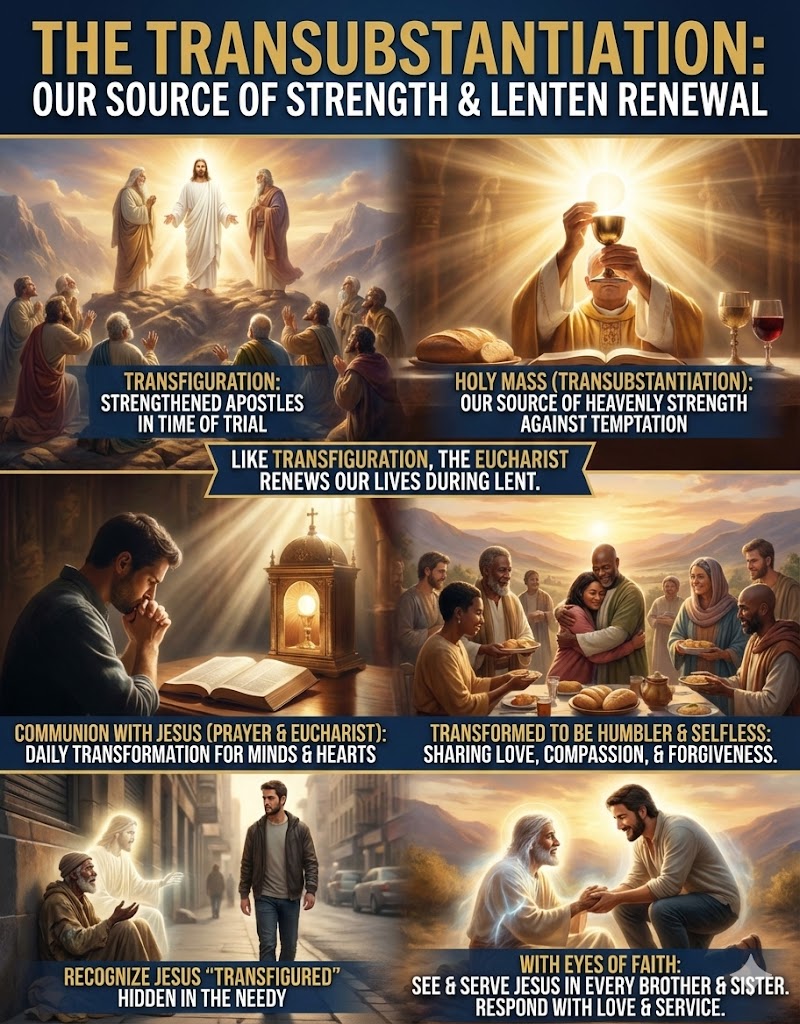
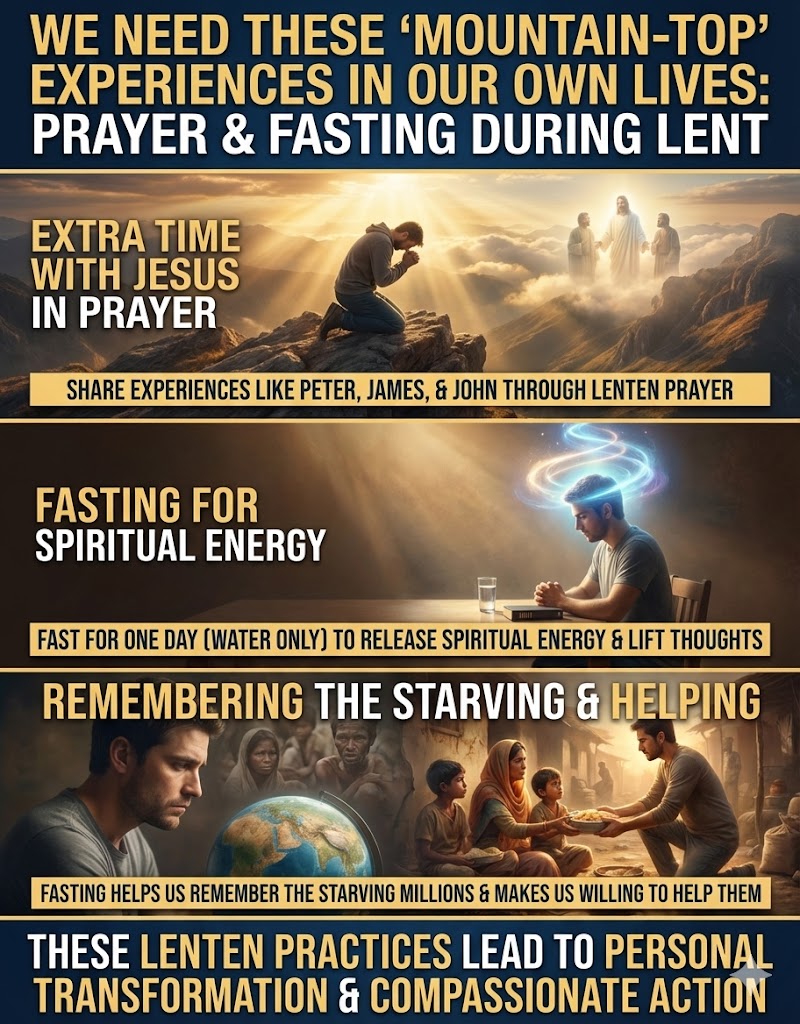
Fr. Tony’s Homily starters, anecdotes and life messages with infographics for use in parish bulletins, presentations, bible studies, and teaching @ Fr. Tony’s Homilies. Genesis 12:1-4a 2 Timothy 1:8b-10 Matthew 17:1-9

Fr. Tony’s Homily, Life Messages, Homily Starters, Anecdotes

Homily Starters, Fr. Tony’s Homily

Homily Starters, Fr. Tony’s Homily

March 1, 2026

March 1, 2026

2nd Sunday of Lent A

  • ANECDOTES
  • EXEGESIS
  • LIFE MESSAGES

2nd Sunday of Lent (A)

Sneak Peak

YouTube player
UNIVERSAL PICTURES (02:17) – His story begins. The official trailer for MICHAEL – in cinemas and IMAX April 24, 2026. Starring Jaafar Jackson, Nia Long, Laura Harrier, Juliano Krue Valdi, with Miles Teller, and Colman Domingo.
VISUAL AID

Movie Preview

You go into the movie theatre, find a seat that’s suitable. You find a place for your coat, sit down, and get ready to watch the movie. The house lights dim; the speakers crackle as the dust and scratches on the soundtrack are translated into static, and an image appears on the screen. It is not the film you came to see. It is the preview of coming attractions, a brief glimpse of the highlights of a film opening soon. The moviemakers and theater owners hope the preview will pique your interest enough to make you want to come back and see the whole film. 

On the Mount of the Transfiguration, Peter, James, and John, the inner circle of Jesus’ disciples, were given a preview of coming attractions. Today’s Gospel gives us a splendid preview of Jesus, radiant in Divine glory, his mortal nature brilliantly, though not permanently, transfigured — a dazzling preview of His Divinity, unalloyed and perfectly pure, shining in glory like the very sun. This was a “sneak preview, “ in other words, of Easter and of His final coming in Glory to take us Home, the triumphant climax of the epic love story between God and humanity.


2nd Sunday of Lent (A)

From Nymph to Wings

YouTube player
NATIONAL GEOGRAPHIC (1:46) – It’s spring in Asia’s animal kingdom, providing the nymph a buffet of tadpoles to prepare him for his life-changing transformation from nymph to a brand new thorax, a dragonfly.
VISUAL AID

Metamorphosis of a Grub into a Dragonfly

ou will recall from 7th-grade science class that metamorphosis is the process by which a caterpillar becomes a butterfly and a tadpole becomes a frog. It’s a gradual change on the inside that produces a total transformation on the outside.  Holo-metabolism, also called complete metamorphism, is a form of insect development which includes four life stages – as an embryo or egg, a larva, a pupa and an imago or adult. At the bottom of a pond some little grub worms or nymphs (larvae of dragonflies) are crawling around in the mud.  Perhaps they wonder what happens to their members who climb up the stem of the water lily and never come back.  They agree among themselves that the next one who is called to the surface will come back and tell them what happened.  The next grub worm (nymph) that finds itself drawn to the surface by nature, crawls out on a lily leaf and emerges from its last molting skin as a beautiful adult dragonfly.   It has been dark and murky down below, but the dragonfly sees that everything is bright and sunny in the upper world.   Suddenly something begins to happen. The transformed grub spreads out two huge, beautiful, colored wings and flies back and forth across the pond to convey the glad tiding of its transfiguration to its friends.  It can see the other grubs in the pond below, but they can’t see him.  It also realizes that it cannot dive into the pond to convey the glad tidings of its great transformation. 

This metamorphosis is nothing in comparison to the glorious transformation awaiting us after our death.


2nd Sunday of Lent (A)

Add Water…


Baby Powder and Christian Transformation

You might remember comedian Yakov Smirnoff. When he first came to the United States from Russia, he was not prepared for the incredible variety of instant products available in American grocery stores. He says, “On my first shopping trip, I saw powdered milk; you just add water, and you get milk. Then I saw powdered orange juice; you just add water, and you get orange juice. And then I saw baby powder, and I thought to myself, ‘What a country!’” Smirnoff was joking, but we make these assumptions about Christian Transformation—that people change instantly from sinners to saints. Catholics call it transformation through repentance and renewal of life, deriving strength through the word of God and the Sacraments to cooperate with God’s grace for doing acts of charity. Some other Christian denominations call it Sanctification of the believer. Whatever you call it, most denominations expect some quick fix for sin.  According to this belief, when someone gives his or her life to Christ, accepting Him as Lord and personal Savior, and confesses his or her sins to Him, there an immediate, substantive, in-depth, miraculous change in habits, attitudes, and character. 

Can we go to Church as if we are going to the grocery store to get Powdered Christian? The truth is that Disciples of Christ are not born by adding water to Christian powder, for there is no such powder, and disciples of Jesus Christ are not instantly born adult.  They are slowly raised through many trials, sufferings, and temptations and by their active cooperation with the grace of God, expressed through works of charity.

SOURCE: Adapted from James Emery White, Rethinking the Church, by Baker


2nd Sunday of Lent (A)

Mountain Top Experience
YouTube player


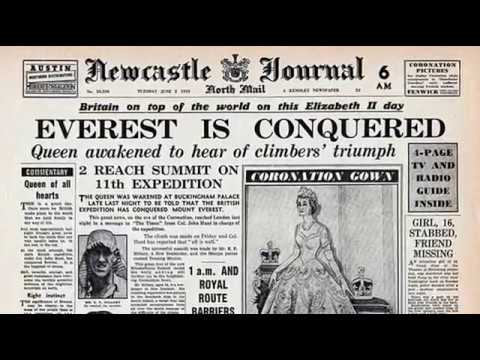
Edmund Hillary’s mountain-top experience on Mount  Everest

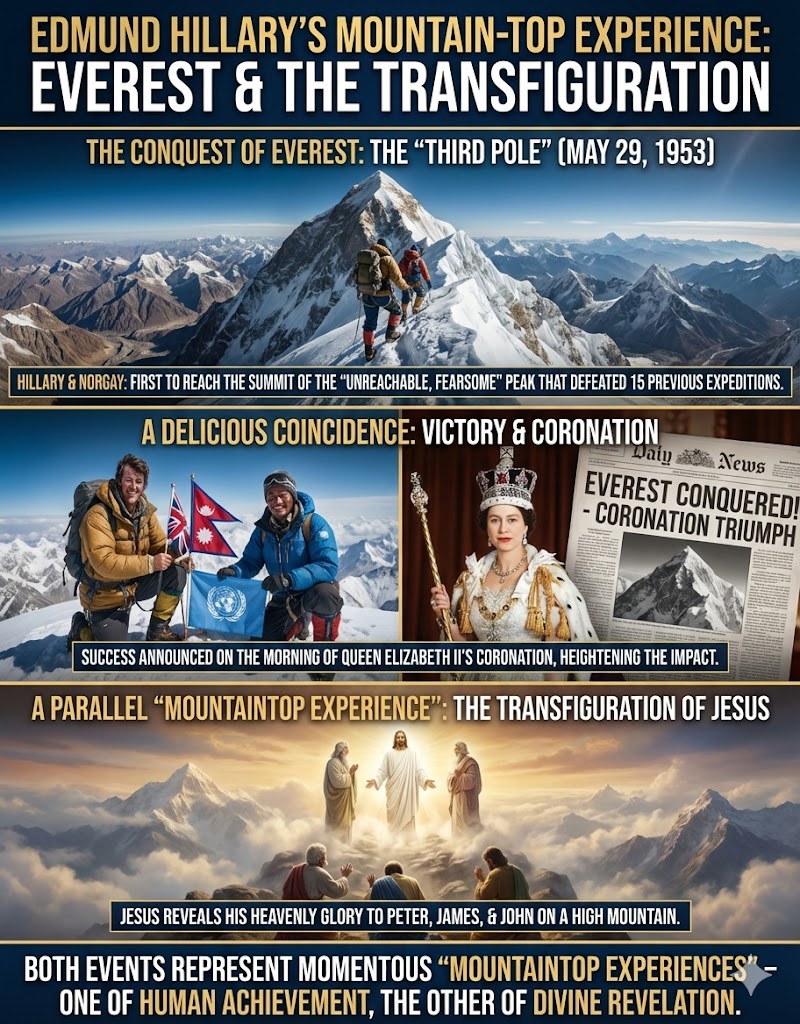
The seniors among us certainly recall that amazing story 70 years ago, May 29, 1953. A New Zealand beekeeper named Edmund Hillary and a Sherpa guide, Tenzing Norgay, were the first ever to reach Everest’s summit. Here was a mountain – unreachable, tantalizing, fearsome, deadly – that had defeated 15 previous expeditions. Some of the planet’s strongest climbers had perished on its slopes. For many, Everest represented the last of the earth’s great challenges. The North Pole had been reached in 1909; the South Pole in 1911. But Everest, often called the Third Pole, had defied all human efforts – reaching its summit seemed beyond mere mortals. Now success! And heightening the impact even further was the delicious coincidence of their arrival just before the coronation of Queen Elizabeth II and the dramatic announcement of their triumph on the morning of the coronation. It was literally a “mountaintop experience.”

The mountaintop experience recounted in today’s Gospel a moment ago had Jesus and His three closest Apostles – Peter, James, and John – going up on a high mountain where they experienced the miraculous Transfiguration undergone by Jesus, making His Heavenly glory visible to His disciples.

The 1st Reading Explained

i need something grand that is visually appealing. create 8.5×11 infographic with large sweeping photo realistic images that span the page either vertically or horizontally and with large bold arial fonts.

[Overall Constraint]: Create a photorealistic infographic on an 8.5×11 inch page with a grand, sweeping, cinematic design.

[Main Title]: The title at the top in massive, bold, gold and white Arial font is: “[YOUR MAIN TITLE HERE]”.

[Top Section – Full Width]: Below the title, a dramatic, full-width photorealistic image captures [DESCRIBE THE EPIC TOP SCENE – e.g., a mountain peak at sunrise with blinding light]. A large, transparent banner across this section reads in bold Arial text: “[YOUR TOP SECTION SUMMARY OR THEOLOGICAL POINT]”.

[Middle Section – Split Panel]: The middle section is a sweeping image split vertically down the center by a subtle divider.

Left Panel: On the left, a photorealistic scene shows [DESCRIBE SCENE A – e.g., Moses at the burning bush]. A banner above/below it reads: “[TITLE FOR SCENE A]”. Below that, bold text overlay states: “[DESCRIPTIVE TEXT FOR SCENE A]”.

Right Panel: On the right, a contrasting photorealistic scene shows [DESCRIBE SCENE B – e.g., Elijah in the cave with wind and fire]. A banner above/below it reads: “[TITLE FOR SCENE B]”. Below that, bold text overlay states: “[DESCRIPTIVE TEXT FOR SCENE B]”.

(Optional Central connector): A central banner connects the two panels reading: “[TEXT LINKING THE TWO CONCEPTS]”.

[Bottom Section – Full Width]: The bottom section is another sweeping, emotional photorealistic image showing [DESCRIBE THE FINAL SCENE – e.g., modern people walking towards a light, or a biblical conclusion]. A large banner reads: “[YOUR FINAL THEOLOGICAL CONCLUSION OR CALL TO ACTION]”. Below it, bold text overlay reads: “[SUPPORTING SCRIPTURE REFERENCE OR FINAL THOUGHT]”.

[Style Summary]: All text must be in large, bold, clear Arial font, using a color palette of gold, white, and deep rich tones (blues, purples, earth tones) against atmospheric backgrounds. The entire image must have a cinematic, epic quality with dramatic lighting, vast landscapes, and high detail.

2nd Sunday of Lent (A)

Genesis 12:1-4a

SHOW/HIDE FR. TONY'S EXEGESIS

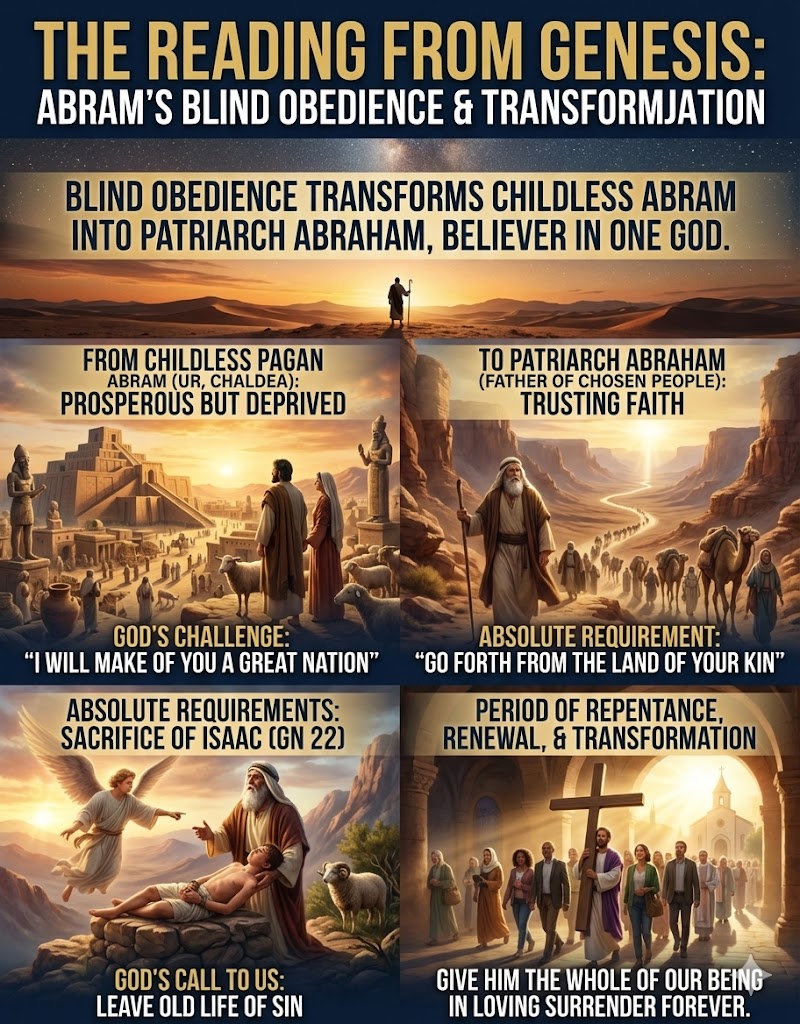
The reading from Genesis explains how  blind obedience to God transforms the childless and pagan Abram into a believer in the one true God, and, later in his story, from Abram into the Abraham who became the prototype of trusting Faith and the father of God’s Chosen People. Blind obedience to God at His command transformed childless Abram into the Patriarch Abraham, a believer in the one God.  Today’s passage is really the first encounter between Abram and God. Abram, a pagan, was prosperous in land and livestock, but he had no children, and that, to people of his time, was the most serious of all possible deprivations.  So  God challenged him with an offer: “I will make of you a great nation.” But God’s requirements were absolute: “Go forth from the land of your kin.”  Abram (from Ab, father, and ram, great) was from Ur in Chaldea (Gn 11:31) and, as one of Terah’s sons, journeyed with his family to Haran in upper Mesopotamia, about 900 miles north of Ur.The requirements were to become even more absolute when, after Abraham finally had a son, God asked him to sacrifice that same son (Gn 22:1-18).  God asks us, too, to leave our old life of sin behind, to go forth with Him into a period of repentance, renewal of life and transformation, and to give Him the whole of our being in loving surrender forever.


The 2nd Reading Explained

2nd Sunday of Lent (A)
2 Timothy 1:8b-10

SHOW/HIDE FR. TONY'S EXEGESIS

St. Paul’s letter to Timothy explains the type of Lenten life-transformation expected of us.  We should be ready to bear hardship for the Gospel’s sake, and to be thankful to God for our call to holiness, not trusting in our own merits but in His grace to live obedient, loving,  Faith-filled lives:  “Bear your share of hardship for the Gospel with the strength that comes from God.”  This passage has the following Lenten themes: a) bearing hardship for the sake of the Gospel; b) understanding that we are called not because of our own good works, but by undeserved grace; c) allowing God to make our belief, that we were drawn into Jesus from before time began, the central reality in our daily living; and d) facing death while hoping for immortality, a share in the Resurrection.  The phrase “manifest through the appearance of our Savior,” meaning after Jesus’ Resurrection from the dead, may also be a reference to today’s Gospel story of Jesus’ Transfiguration, traditionally read on the second Sunday of Lent.


The Gospel Reading Explained

2nd Sunday of Lent (A)

Matthew 17:1-9

SHOW/HIDE FR. TONY'S EXEGESIS

The objectives and the time of the Transfiguration:The primary purpose of Jesus’ Transfiguration was to consult his Heavenly Father in order to ascertain His plan for Our Lord’s suffering, death and Resurrection.  The secondary aim was to make Jesus’ chosen disciples aware of His Divine glory, so that they might discard their worldly ambitions about a conquering political Messiah. A third purpose was to strengthen their Faith and Hope and to encourage them to persevere through the future ordeal (CCC #568). The Transfiguration took place in late summer, probably in AD 29, just prior to the Feast of Tabernacles.  Hence, the Orthodox tradition celebrates the Transfiguration at about the time of the year when it actually occurred in order to connect it with the Old Testament Feast of Tabernacles.  Western tradition celebrates the Transfiguration twice, first at the beginning of Lent with this Gospel account and second on August 6 with a full Feast Day liturgy.

The location of the Transfiguration was probably Mount Hermon in North Galilee, near Caesarea Philippi, where Jesus had camped for a week before the Transfiguration.  The 9200-foot mountain was desolate.  The traditional oriental belief that the transfiguration took place on Mount Tabor is based on Psalm 89:12.   Mount Tabor, on the other hand, is a hill in the south of Galilee, less than 1000 feet high with a Roman fort on top of it, an unlikely place for solitude and prayer. But, says modern Bible scholar John McKenzie “It is far more probable that this mountain, like the mountain of the Sermon (Mt 5:11) has no geographical location. It is the symbolic mountain on which the events of Sinai are re-enacted in the life of the new Moses.”


SHOW/HIDE FR. TONY'S EXEGESIS

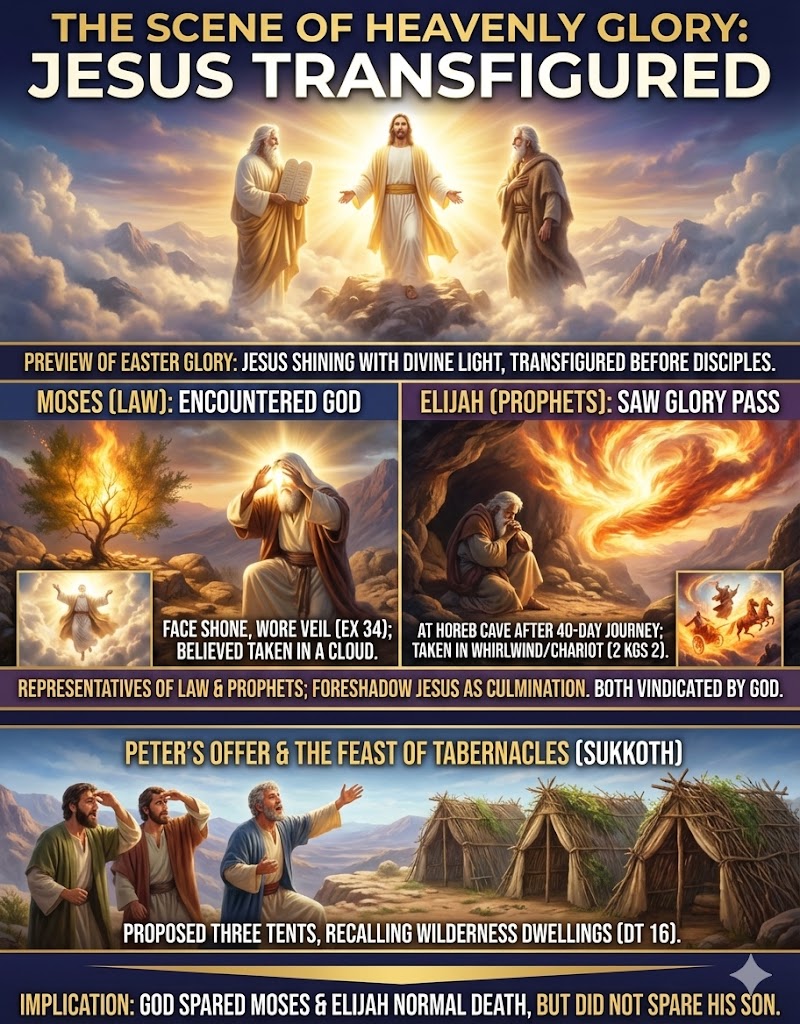
The scene of Heavenly glory: The disciples received a preview of the glorious figure Jesus would become at Easter and beyond. While praying, Jesus was transfigured into a shining figure, full of Heavenly glory.  This reminds us of Moses and Elijah who also experienced the Lord in all His glory.  Moses had met the Lord in the burning bush at Mount Horeb (Ex 3:1-4).  After his later encounter with God, Moses’ face shone so brightly that it frightened the people, and Moses had to wear a veil over his face (Ex 34:29-35). The luminosity of the face of Moses is also meant to signal the loving, welcomed invasion of God. Into his soul. The Jews believed that Moses was taken up in a cloud at end of his earthly life (Josephus, Antiquities of the Jews, 4. 326).  Elijah had traveled for forty days to Mt. Horeb on the strength of the food brought by an angel (1 Kgs 19:8).  At Mt. Horeb, Elijah sought refuge in a cave as the glory of the Lord passed over him (1 Kgs 19:9-18).  Finally, Elijah, was taken directly to Heaven in a chariot of fire without experiencing death (2 Kgs 2:11-15). In addition, “Moses led his people out of slavery in Egypt, received the Torah on Mount Sinai and brought God’s people to the edge of the Promised Land. Elijah, the great prophet in northern Israel during the ninth century B.C., performed healings and other miracles and stood up to Israel’s external enemies and the wicked within Israel. Their presence in Matthew’s Transfiguration account emphasizes Jesus’ continuity with the Law (Moses) and the prophets (Elijah) in salvation history.” (Fr. Harrington S. J.)

These representatives of the Law and the Prophets, foreshadowed Jesus who is the culmination of the Law and the Prophets.  Both prophets were initially rejected by the people but were vindicated by God.  The Jews believed that these men did not die, because God Himself took Moses (Dt 34:5-6), and Elijah was carried to heaven in a whirlwind (2 Kgs 2:11).  So, the implication is that although God spared Moses and Elijah the normal process of death, He did not spare His Son. Peter’s offer to pitch three tents (vs. 4) is an allusion to the feast of Sukkoth (Tabernacles, Tents, Booths) which commemorated the wilderness period when the Israelites lived in tents (Dt 16:13-15).


SHOW/HIDE FR. TONY'S EXEGESIS

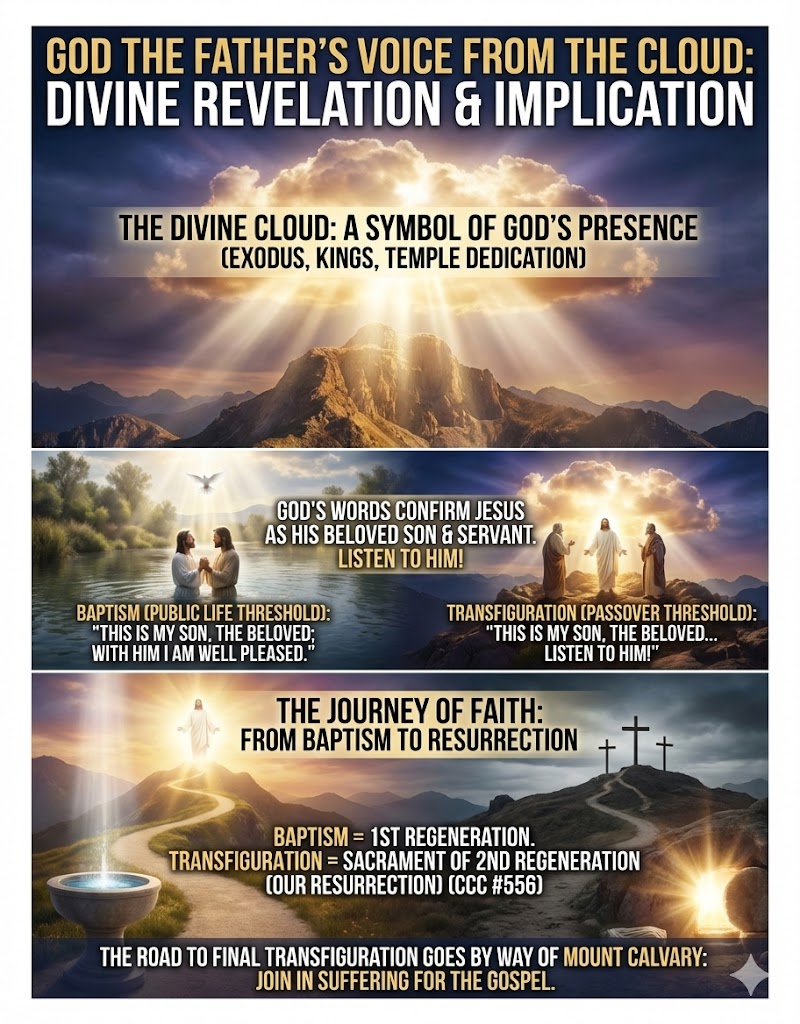
God the Father’s Voice from the Cloud: The book of Exodus describes how God spoke to Moses at Mount Sinai from the Cloud.  God often made appearances in a cloud (Ex 24:15-17; 13:21-22; 34:5; 40:34; 1 Kgs 8:10-11).  I Kgs 8:10 tells us how, by the cover of a cloud, God revealed His presence over the Ark of the Covenant and in the Temple of Jerusalem on the day of its dedication.  The Jews generally believed that the phenomenon of the Cloud would be repeated when the Messiah arrived.  God the Father, Moses, and Elijah approved the plan for Jesus’ suffering, death and Resurrection.  God’s words from the Cloud: “This is my Son, the Beloved; with Him I am well pleased; listen to Him,” are the same words used by God at Jesus’ baptism (Mk 3:17).  They summarize the meaning of the Transfiguration: on this mountain: God reveals Jesus as His Son — His beloved — the One in Whom He is well pleased and to Whom we must listen.  The Catechism of the Catholic Church, #556, underlines the implication of the Lord’s baptism and his Transfiguration for our life: “On the threshold of the public life: the baptism; on the threshold of the Passover: the Transfiguration. Jesus’ baptism proclaimed the mystery of the first regeneration, namely, our Baptism. The Transfiguration is the sacrament of the second regeneration: our own Resurrection.” In the transfigured Jesus we see a preview of where we are going on this journey of faith: to a transfigured humanity. But going down from the mountain he reminds us of the costs of this journey. Jesus, God’s Son and servant, is called to be a suffering servant. The road to the final transfiguration goes by way of Mount Calvary. Paul reminds us of this when he calls us to join him in suffering for the Gospel.

Message #1


Message #2


Message #3

Infographics were created using Google Gemini 3 and Nano Banana Pro. Inspiration take from Fr. Tony’s Homilies; Non-profits may freely use this infographic in their publications and/or ministry. Please give credit or a shout out to TheWordThisWeek.NET.