Fr. Tony’s Homily starters, anecdotes and life messages with infographics for use in parish bulletins, presentations, bible studies, and teaching @ Fr. Tony’s Homilies. Exodus 17:3-7 Romans 5:1-2, 5-8 John 4:5-42

Fr. Tony’s Homily, Life Messages, Homily Starters, Anecdotes

Homily Starters, Fr. Tony’s Homily

Homily Starters, Fr. Tony’s Homily

March 8, 2026

March 8, 2026

3rd Sunday of Lent A

  • ANECDOTES
  • EXEGESIS
  • LIFE MESSAGES

3rd Sunday of Lent (A)

Woman at the Well

YouTube player
Lalaland481 (02:36) – A modern day monologue version of the what the Woman at the well said to Jesus. This story can be found in John 4:3-30 in the Holy Bible.
VISUAL AID

3rd Sunday of Lent (A)

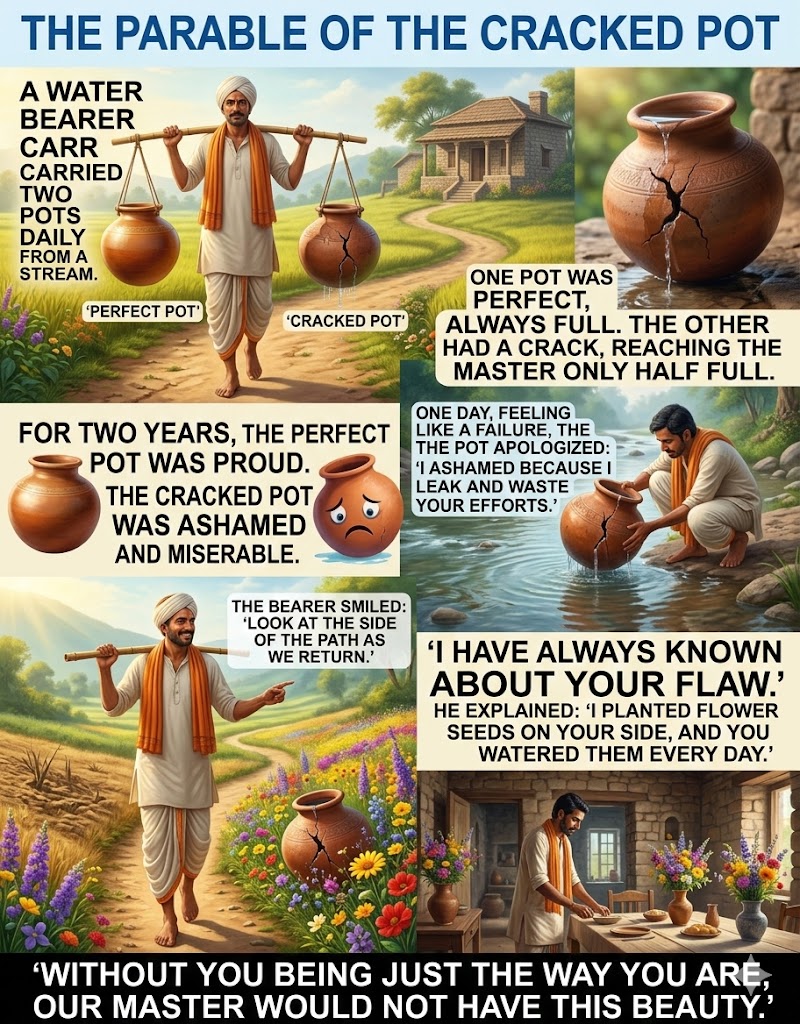
The Cracked Pot

YouTube player
ECHOED SUB (01:44) – This gentle story shows that our weaknesses can serve a purpose. What we see as a burden may be the very thing that brings life and color to the world around us.
VISUAL AID

Water-Bearers and Water-Sharers

Centuries ago, a waterman used to carry water from the river to the king’s palace in two earthen pots – one perfect, another cracked – and was paid according to the amount of water he brought. Unfortunately, the waterman was poorly paid since much water leaked through his cracked pot. Dejected, the cracked-pot cried, “Master, I’m cracked and bring you less money. Discard me!” The waterman replied, “No! Watch carefully!” Then, he took the two pots back to the river, filled them, and told the cracked pot to look at the pathway on its side. The cracked pot was surprised to see beautiful flowers beneath it. “See that?” explained the waterman, “I knew you’re a cracked-pot, so I sowed seeds along the way. You’ve sprayed water on them and made the king’s pathway beautiful!”

Like the king’s waterman, today’s readings describe water-bearers. Two of them, Moses and Jesus bring water to the thirsty.

SOURCE: Francis Gonsalves in Sunday Seeds for Daily Deeds; quoted by Fr. Botelho


3rd Sunday of Lent (A)

The Divine Seduction

YouTube player
FACTS VERSE (8:20)  – Elizabeth Taylor was a Golden Age icon that became a Hollywood star at the age of just 12 when she appeared in 1944’s National Velvet. Elizabeth had made her film debut several years previously and went on to have an unmatched career in the industry that lasted for several decades before she eventually decided to retire from acting. 
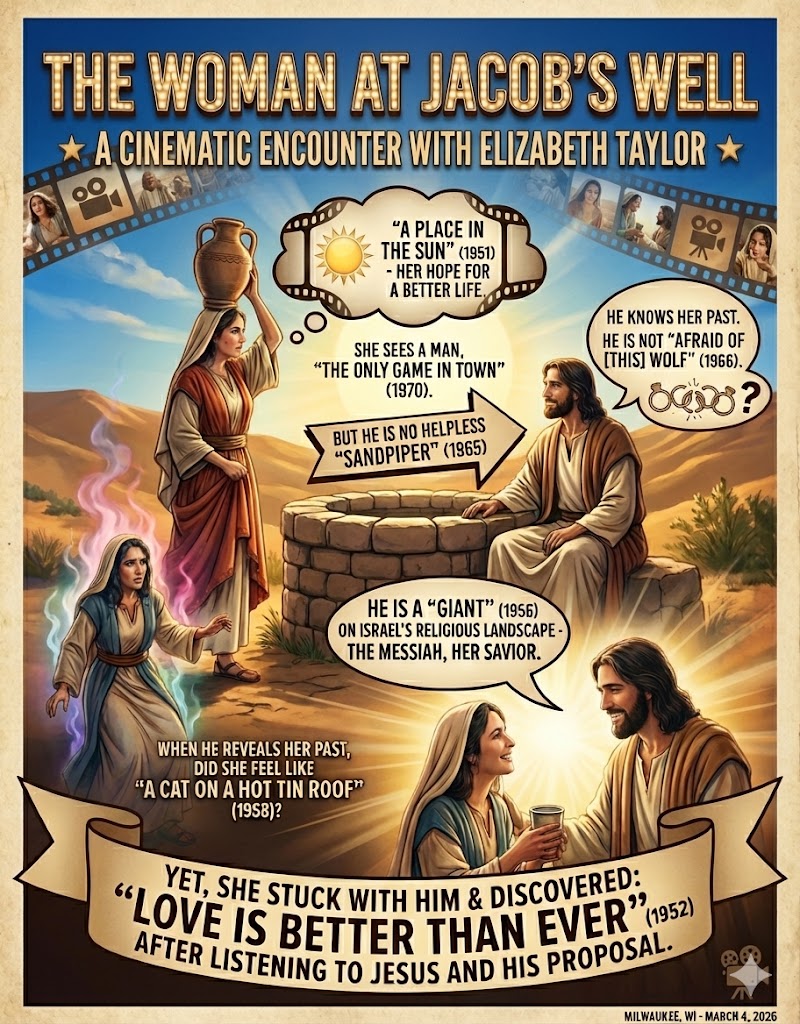
VISUAL AID - A CINEMATIC ENCOUNTER
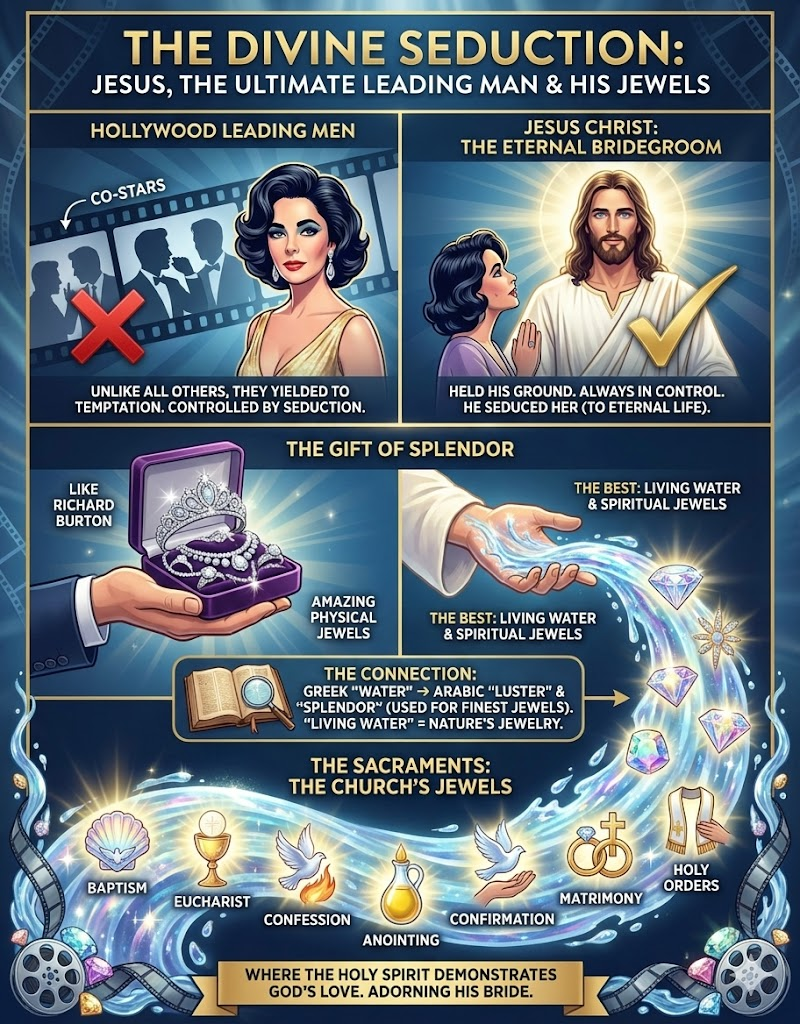
VISUAL AID - JESUS THE ULTIMATE LEADING MAN & HIS JEWELS

Using the titles of seven of Liz Taylor’s films, here is a summary of what we just heard in today’s Gospel:

The woman who came to draw water at Jacob’s well may well have believed that on this day she would have her “Place in the Sun” (1951), for she sees a man who happens to be “The Only Game in Town” (1970). But the man she meets is NOT a helpless “Sandpiper” (1965) who needs attention, but rather a “Giant” (1956) on Israel’s religious landscape. He is the Messiah, her savior, and her encounter with him would be unlike any other.

Jesus knows all about how she lured five men into destructive marriages, and yet He’s not “Afraid of [this] wolf” (1966). In fact, when He reveals to her that he knows all about her past relationships I wonder if she felt like
“A Cat on a Hot Tin Roof” (1958).

Yet, to her credit, she stuck with him and discovered that “Love is better than ever” (1952) after listening to Jesus and his proposal.

Unlike all the characters of the men who co-starred with Taylor, Jesus held his ground.He was always in control, and never yielded to temptation. In other words, she did not seduce him. He seduced her. (We are speaking of eternal life here). Jesus wanted to give her the best, and like Richard Burton, was able to give this woman at the well the most amazing set of jewels imaginable.

Just as a husband’s desire is to adorn his bride with jewelry, Jesus wants to give the woman and us “living water.” Let me explain. The Greek word that Jesus uses for “water” comes from an Arabic word meaning “luster” and “splendor” which is used in describing the finest jewels. Just as one could say that “living” or “flowing” water is nature’s jewelry, accenting the beauty of the landscape, it is the SACRAMENTS OF THE CHURCH which are its JEWELS, where the Holy Spirit demonstrates for us the Love of God.

SOURCE: Fr. Don’s Homily preached following Taylor’s death in 2011.


3rd Sunday of Lent (A)

My Soul Thirsts…
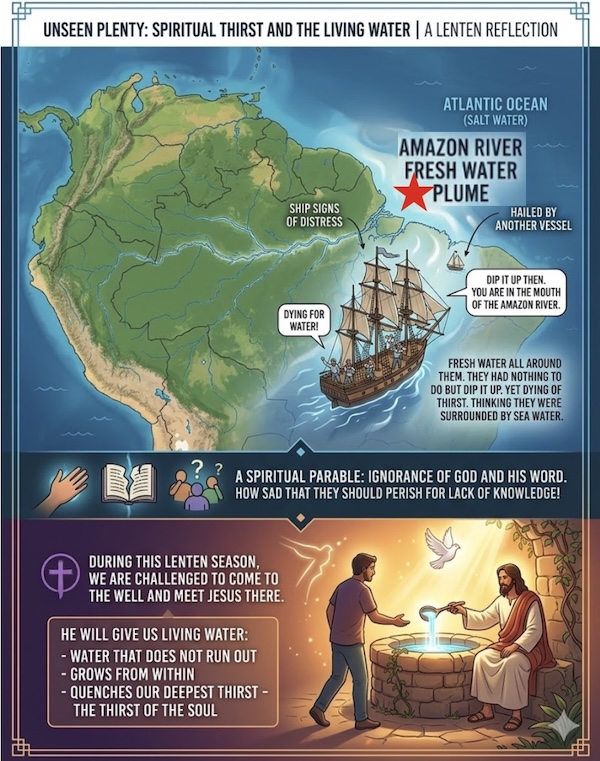

Dying for Water!

It is said that some years ago a vessel sailing on the northern coast of the South American continent was observed to make signals of distress. When hailed by another vessel, they reported themselves as “Dying for water!” “Dip it up then,” was the response. You are in the mouth of Amazon river.” There was fresh water all around them, and they had nothing to do but to dip it up, and yet they were dying of thirst because they thought themselves surrounded by sea water.

People are often ignorant of God and without His Word. How sad that they should perish for lack of knowledge! During this Lenten Season, we are challenged to come to the well and meet Jesus there. He will give us living water, which is water that does not run out because it grows from within, and it quenches our deepest thirst – the thirst for God. “My soul thirsts for God, the living God!” And this is the Good News of today.

SOURCE: Fr. Lakra


3rd Sunday of Lent (A)

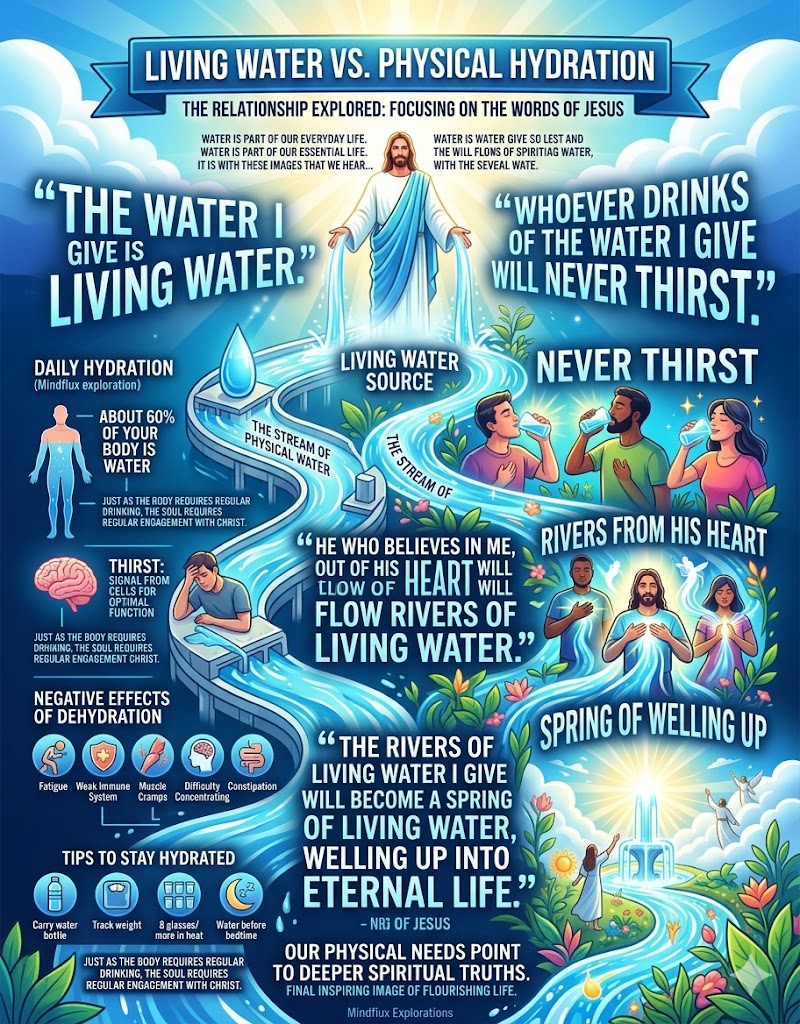
Living Water

YouTube player


Jesus the Source of Living Water

It never ceases to amaze me that my body is composed of seventy percent water. It is hard to imagine that seventy percent of the flesh standing before you today is water. That means about 154 pounds of water is standing before you right now. I am not going to tell you what I weigh but I can guarantee you that 70% of my body weight and your body weight is composed of water. There are two and a half quarts of water in my blood. There are fifteen quarts of water in the extra plasma in my body. There are thirty quarts of water in the cells of my body, allowing all those little cells to grow. It always amazes me that 154 pounds of water are standing before you today at this moment. Truly, I am living water. Some people say that I am a bag of wind. Others say that I am a bag of hot air. But I am really a bag of water. I am a great big bag of water. Standing before you today is walking, breathing, living water. I am truly living water. Water is important to my diet It amazes me that I cannot live without water, that water is more important to my diet than food. It amazes me that I can exist for thirty days without food, but I can exist only one to four days without water. I cannot live without water. It amazes me how absolutely necessary water is for by body to exist. Likewise, it always amazes me that during my first nine months of life, I was in the water of my mother’s womb. I began in a bag of living water. I lived as a fetus for nine months in my mother’s womb. I could not live without that water surrounding me and in me. Truly, as a fetus, I was surrounded by living water. The water around me was truly the water of life. The bag of water around you as a fetus and me as a fetus was living water. 

Water is part of our everyday life. Water is part of our essential life. It is with these images that we hear the great words of Jesus when he says, “The water I give is living water. Whoever drinks of the water I give will never thirst. He who believes in me, out of his heart will flow rivers of living water. The rivers of living water I give will become a spring of living water, welling up into eternal life.

1st Reading | 2nd Reading | Gospel

i need something grand that is visually appealing. create 8.5×11 infographic with large sweeping photo realistic images that span the page either vertically or horizontally and with large bold arial fonts.

[Overall Constraint]: Create a photorealistic infographic on an 8.5×11 inch page with a grand, sweeping, cinematic design.

[Main Title]: The title at the top in massive, bold, gold and white Arial font is: “[YOUR MAIN TITLE HERE]”.

[Top Section – Full Width]: Below the title, a dramatic, full-width photorealistic image captures [DESCRIBE THE EPIC TOP SCENE – e.g., a mountain peak at sunrise with blinding light]. A large, transparent banner across this section reads in bold Arial text: “[YOUR TOP SECTION SUMMARY OR THEOLOGICAL POINT]”.

[Middle Section – Split Panel]: The middle section is a sweeping image split vertically down the center by a subtle divider.

Left Panel: On the left, a photorealistic scene shows [DESCRIBE SCENE A – e.g., Moses at the burning bush]. A banner above/below it reads: “[TITLE FOR SCENE A]”. Below that, bold text overlay states: “[DESCRIPTIVE TEXT FOR SCENE A]”.

Right Panel: On the right, a contrasting photorealistic scene shows [DESCRIBE SCENE B – e.g., Elijah in the cave with wind and fire]. A banner above/below it reads: “[TITLE FOR SCENE B]”. Below that, bold text overlay states: “[DESCRIPTIVE TEXT FOR SCENE B]”.

(Optional Central connector): A central banner connects the two panels reading: “[TEXT LINKING THE TWO CONCEPTS]”.

[Bottom Section – Full Width]: The bottom section is another sweeping, emotional photorealistic image showing [DESCRIBE THE FINAL SCENE – e.g., modern people walking towards a light, or a biblical conclusion]. A large banner reads: “[YOUR FINAL THEOLOGICAL CONCLUSION OR CALL TO ACTION]”. Below it, bold text overlay reads: “[SUPPORTING SCRIPTURE REFERENCE OR FINAL THOUGHT]”.

[Style Summary]: All text must be in large, bold, clear Arial font, using a color palette of gold, white, and deep rich tones (blues, purples, earth tones) against atmospheric backgrounds. The entire image must have a cinematic, epic quality with dramatic lighting, vast landscapes, and high detail.

SHOW/HIDE TEXT

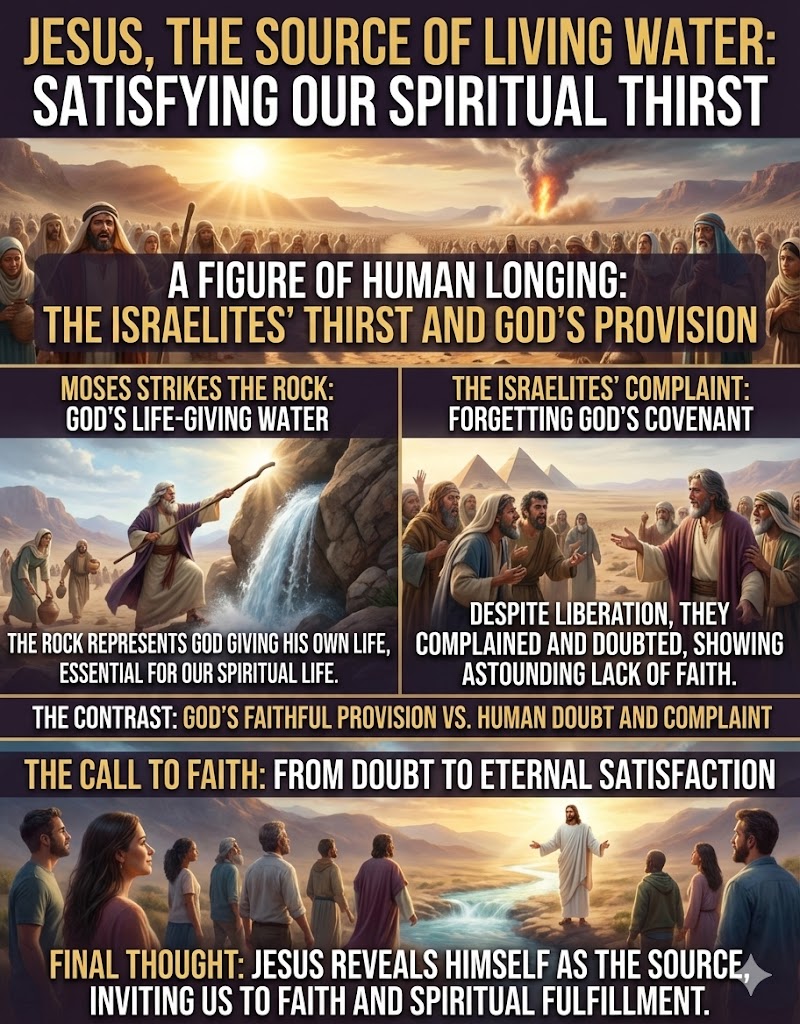
Today’s Gospel gives us  Jesus’ revelation of himself as the Source of Living Water. Hence, the passage chosen from Exodus tells of the Jews’ complaining about their thirst, a figure of human longing for God and spiritual satisfaction. The rock which Moses strikes represents God who gives the water (God’s own life), essential for our spiritual life.  This reading shows us a time when God’s people literally thirsted, and God satisfied them.  The Israelites had been slaves for several generations in Egypt, and for the most part, they had forgotten their ancestral religion and their God’s Covenant with their patriarch Abraham.  Now their new leader, Moses, was telling them that their ancient Lord had at last heard their cries and was now leading their escape from Egypt back to their homeland.  In spite of the mighty deeds God had done for their liberation from Egypt, the former slaves complained that in Egypt, at least they were not thirsty. It is astounding to see their lack of Faith.

Exodus 17:3-7


1st Reading | 2nd Reading | Gospel

3rd Sunday of Lent (A)
SHOW/HIDE TEXT

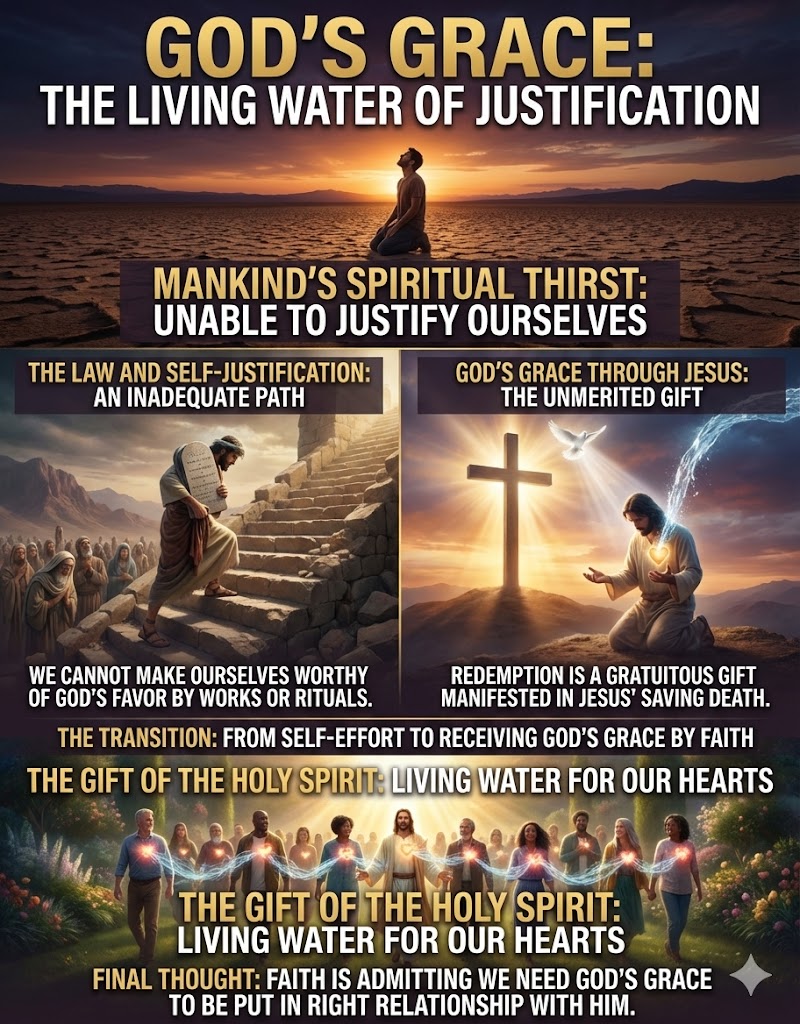
In the second reading, Saint Paul asserts that, as the Savior of mankind, Jesus poured the living water, or the gift of the Holy Spirit, into our hearts.  We need the Holy Spirit to sustain us spiritually, just as we need water to sustain us physically.  Through Jesus, God gave us the Spirit when we were dying of thirst.  Paul realized that he and all the Jews who kept the Law of Moses were trying to become justified on their own.  But keeping the Law is not an adequate means of justification because we are unable to make ourselves worthy of God’s favor, whether by good works, by keeping the Commandments, by rituals, or by prayers.  The word grace, in this context, means the gratuitous, unearned, undeserved love and favor of God for us.  By living water in today’s Gospel, Jesus is referring to this grace as a relationship with God and an active participation in His life.  According to Paul, redemption or justification is the gratuitous gift of God manifested in Jesus’ saving death on the cross.  By virtue of his death, Jesus has made just, or put in right relationship with God, every sinner who will appropriate His saving gifts by Faith.  Faith, then, is the admission that one cannot justify oneself, and that it is God who will grant us justification by His grace.


1st Reading | 2nd Reading | Gospel

3rd Sunday of Lent (A)

SHOW/HIDE TEXT

The background history: The mutual hostility between the Jews and the Samaritans had begun centuries earlier when the Assyrians carried the northern tribes of Israel into captivity.  The Jewish slaves betrayed their heritage by intermarrying with the Assyrians, thus diluting their bloodline and creating a “mongrel race” called the Samaritans.  The Assyrian men who were relocated to Israel married Jewish women, thus producing a mixed race in Israel as well. Hence, southern Jews considered all Samaritan bloodlines and their heritage impure.  By the time the Samaritan Jews returned to their homeland, their views of God had been greatly contaminated.  By contrast, when the southern Hebrew tribes were carried off into captivity, they stubbornly resisted the Babylonian culture.  They returned from Babylon to Jerusalem, proud that they had compromised neither their religious convictions nor their culture.  So, when the Samaritans offered to help to rebuild the Jerusalem Temple, the southern Jews who had returned from exile vehemently rejected Samaritan assistance.  Consequently, the rejected and ostracized Samaritans built their own temple on Mount Gerizim.  But in 129 B.C. a Jewish General destroyed it, a slap in the face for Samaritan dignity that continued to sting for centuries, deepening the mutual scorn and hostility between Samaritans and Jews.


SHOW/HIDE TEXT

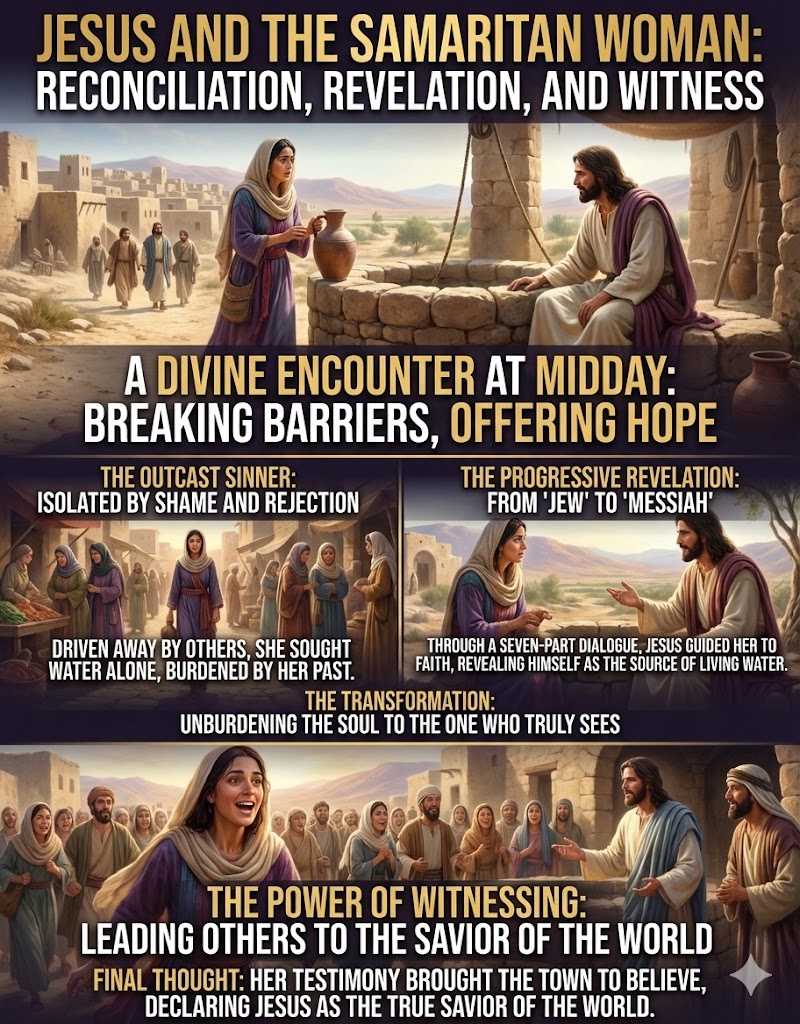
The Divine touch and conversion: So, the water-seeking Samaritan woman who faced Jesus that day belonged to a heritage rejected by the Jews.  In addition, she expected scorn simply because she was a woman, for in the ancient Middle East, men systematically degraded women.  Finally, this Samaritan woman seemed unwanted by her own people.  Since she had had five “husbands,” and was living with a sixth “lover,” she seems to have been considered by fellow villagers a social leper, and she seems to have been driven from the common well of the town by the decent women.  Perhaps she had not stopped wishing that somewhere, sometime, some way, God would touch His people — that He would touch her!  Jesus’ meeting the Samaritan woman at Jacob’s well illustrates the principal role of Jesus as the Messiah: to reconcile all men and women to the Father.  Hence, Jesus deliberately placed himself face-to-face with this person whom, apparently, no one else wanted.  Jesus saw, in this social outcast and moral wreck, a person who mattered to God.  The Samaritan woman must have unburdened her soul to this stranger because she had found one Jew with kindness in his eyes instead of an air of critical superiority.  She was thirsting for love that would last, love that would fill her full and give purpose to her life. Just as Jesus confronted the woman at the well with the reality of her own sinfulness and brokenness, so we must, with God’s grace, confront our own sinfulness and, in doing so, realize our need for God.

The conversion leading to witnessing: Jesus not only talked with the woman, but, in a carefully orchestrated, seven-part dialogue, he guided her progressively from ignorance to enlightenment, and from misunderstanding to clearer understanding, thus making her the most carefully and intensely catechized person in this entire Gospel.  Jesus always has a way of coming into our personal lives.  When Jesus became personal with this woman and started asking embarrassing questions about her five husbands, she cleverly tried to change the subject and talk about religion.  She didn’t want Jesus to get personal.  But Jesus wanted to free her, forgive her, shape her life in a new direction, and change her.  He wanted to offer this woman Living Water. [Scholars have debated as to precisely what Jesus meant when he referred to living water. As Raymond E. Brown has explained, there are two possibilities: living water means the revelation or teaching which Jesus came to give, and it also means the Spirit which Jesus bestows (The Gospel According to John, Anchor Bible, Vol. 29, Doubleday, New York: 1966).] The living water may refer to Baptism and the gift of the Spirit, the source of life.  It may also refer to Jesus as the source of life.  At the end of their long, heart-to-heart conversation, Jesus revealed himself to the woman as the Messiah, which in turn led her to Faith in him.  This growth in understanding on the part of the woman moved through several stages: first, she called him a Jew, then Sir or Lord, then Prophet, and finally Messiah.  When the Samaritans came to hear Jesus because of her testimony, their affirmation of Faith reached its climax as they declared that Jesus was the Savior of the world, and that they believed in him not just because of what she had said “for we have heard for ourselves, and we know that this is truly the Savior of the world.”   Step-by-step Jesus had led the  marginalized woman in her Faith journey, and her enthusiastic response, powerful personal testimony and brave witnessing with its dramatic results in her town, stand in vivid contrast to Nicodemus’ hesitance (3:9), the crowd’s demand for proof (6:25-34) and the Pharisees’ refusal to acknowledge the hand of God in the healing of a blind man (9:24-34).


Message #2


Message #3

Infographics were created using Google Gemini 3 and Nano Banana Pro. Inspiration take from Fr. Tony’s Homilies; Non-profits may freely use this infographic in their publications and/or ministry. Please give credit or a shout out to TheWordThisWeek.NET.