Commentary Intro to Mass Readings for Sunday
CommentaryIntro to Mass Readings for Sunday
March 8, 2026
March 8, 2026
3rd Sunday of Lent (A)


Content produced, written, and narrated by Larry Broding. Copyright 2017. Titles and infographics created by TWTW, 2026. Permission given for personal use or for use in any non-profit ministry. Content may not be sold or used for personal financial gain.

How a Water Fountain Transforms a Backyard
Gospel: John 4:5–42

What does your backyard look like? With the popularity of gardening on the rise, many of us are tearing out grass and designing our yards with native and exotic plants. These plants add a texture and a color palette that turf just doesn’t provide. It is a sensual appeal that makes a well-designed garden easy on the eyes and soothing to the soul.
Yet without a centerpiece, many gardens seem disjointed, even haphazard. One popular centerpiece that can bring a garden together and increase the sensual appeal is a water fountain. A fountain adds motion and sound to a gardenscape. It also places its focus on one of life’s fundamental elements, water. Rushing water has a universal appeal, for it represents cleansing, recreation, and nurturing. The bubbling or spray of a fountain adds a dynamic character to a garden, compared to the placid atmosphere of plants. Rushing water seems to bring a garden to life.

Jesus and the Samaritan Woman
In the time of Jesus, rushing water was either the result of gravity, as in the case of a man-made fountain, or underground pressure, as in the case of an artesian spring. Both were rare, but not unheard of sights. Both gave rise to the notion that a dynamic movement of water from a single source was somehow alive. This living water nurtured and cleansed. It was alive and gave life. It’s not surprising that many springs in the ancient world became spas with claims of healing properties.
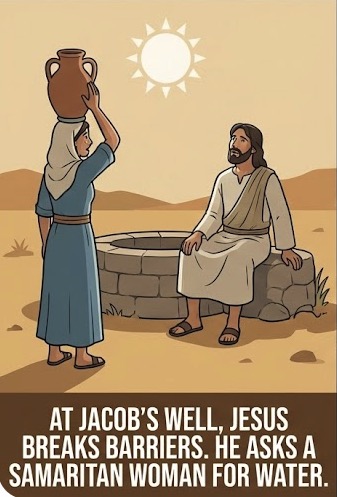
In the Gospel of John, Jesus encountered a Samaritan woman at Jacob’s well. Because of her presence at noon, when only men did business in gathering places as the well, and because of her own admission of marital status, it’s clear she was a prostitute. Many scholars see the responses of the woman in the scene as coy negotiation. She was playing with Jesus. Jesus ignores her play, and reaches to her heart with an offer of living water, a dynamic flow that would lead to eternal life.
The water was the spirit of God, and the source of the water was Jesus. The spirit would cleanse and nurture a people in a dynamic way. The spirit would lead a people to true worship, not necessarily in Gerizim or in Jerusalem, but in the heart of the believer. And, since the spirit came from God, Jesus identified himself as God. “I AM,” Jesus said, “The one speaking to you now.” In Jesus, God revealed himself to a woman considered unclean by Jews according to race, gender, and occupation.
Spiritual Funk: Lessons from the Exodus
She was so excited that she spread the news that this man saw who SHE TRULY WAS, and yet showed her who HE REALLY WAS. We all desire a dynamic spiritual life, a place where we can be washed clean and be given a drink of the spirit. Sometimes we are tempted to expect it. When it doesn’t happen, do we grouse and wallow in our spiritual funk? “God, why aren’t you acting in my life the way I want you to?”
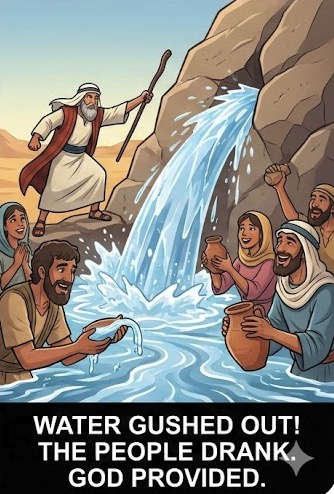
This echoes the spiritual morass of those wandering in the desert during the Exodus. They complained about their lack of food and water, but more to the point, they complained about the seeming absence of God in their struggle. “Where are you, God?” They had to be reminded again that God is always present. Moses gave them that reminder when he struck the rock at Horeb and water rushed forth.
Witnessing vs. Bragging: Who is in Charge of Your Spiritual Life?
We all desire a dynamic spiritual life, but sometimes we are tempted to brag about it. See, see everybody? God’s really working in my life. While witness to the power of God in life is really good, bragging about it isn’t, for bragging assumes that I’m in charge of my spiritual life. That’s wrong. St. Paul wrote the church at Rome that God’s in charge.
He’s the one who sent his Son into the world to die for us. He’s the one who poured the spirit into our hearts. He’s the one who made us right with him, now and at the final judgment.
He is the source of that living water that springs into eternal life.
Conclusion
What does your backyard look like? Have you succumbed to the fountain fad in gardening? I have. I have two fountains in my backyard. There are times that my wife and I simply sit and lose ourselves in the sight and sounds of flowing water.
It’s at these moments that the words of Jesus come to mind. If you knew the gift of God and who said to you, give me a drink, you would ask him and he would have given you living water.
Yes, Lord, give me that water. Please give me your spirit. Give me a dynamic spiritual life and a humble heart that points only to you. But most of all, give me your life, for your life is eternal life.



Larry Broding
Word-Sunday

Exodus 17:3-7
“Testing” and “Contention”
When is “enough” not enough?
Are your parishioners struggling to see God amidst the discomfort of their Lenten sacrifices? Larry Broding’s commentary on Exodus 17:3-7 offers a compelling roadmap for connecting the ancient Israelites’ wilderness wanderings to our modern spiritual dryness. This reflection explores the stark contrast between human impatience and God’s constant presence, providing the theological depth needed to turn a familiar story into a transformative message.

Why this commentary matters for your homily:

- Connects History to Theology: It bridges the gap between the initial complaints in Exodus and the consequences in Numbers 20:1-13, offering a richer context for why the locations were named Massah (“Testing”) and Meribah (“Contention”).
- Highlighting the Human Condition: It articulates the tension of the “needy attitude”—how easy it is to demand immediate fulfillment and overlook the freedom we have already received.
- Lenten Application: It provides a direct pastoral application, framing Lenten discomfort not as a punishment, but as a challenge to look beyond pettiness and recognize the Lord’s imminent presence.
Read Larry Broding’s full commentary to help your congregation move past their own complaints and discover the water of life flowing even in the driest deserts.

THE WORD THIS WEEK infographics on this page were created using using GOOGLE’S AI Gemini 3 Pro. You are free to use the them in any non-profit ministry. Proper attribution, however, must be given to Larry Broding at Word-Sunday.com.
Larry Broding
Word-Sunday


Romans 5:1-2, 5-8
Justified by Faith
What do people of faith have
to show for their efforts?
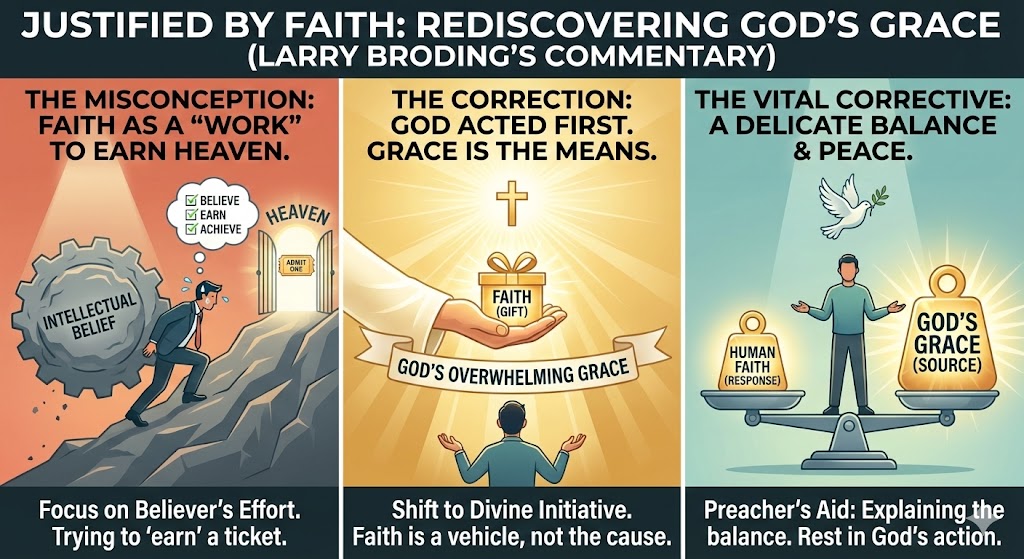
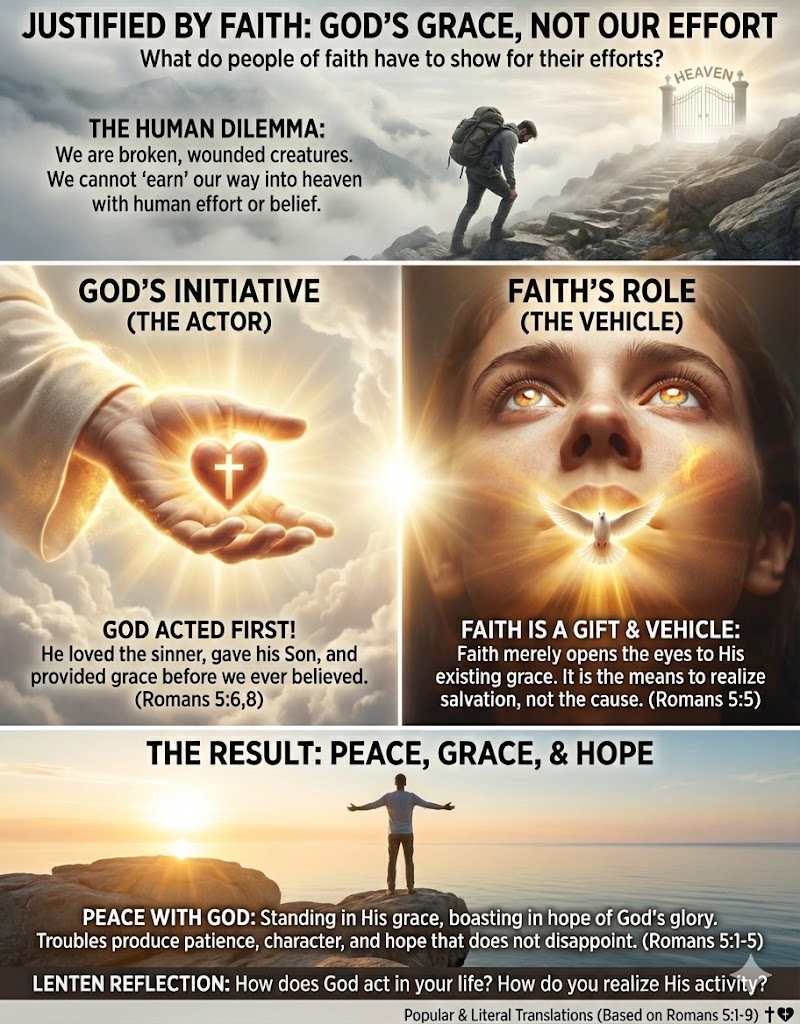
The phrase “justified by faith” is a cornerstone of Christian theology, yet it is often misunderstood as another form of “work”—as if our intellectual belief is what earns us a ticket to heaven. Larry Broding’s commentary tackles this misconception head-on, shifting the spotlight away from the believer’s effort and placing it firmly back on the Divine. This reflection offers a vital corrective for any preacher hoping to explain the delicate balance between human faith and God’s overwhelming grace.
Why this commentary matters for your homily:
- Clarifies Theological Confusion: It effectively debunks the idea that we can “believe” our way into God’s good graces, distinguishing clearly between faith as a cause and faith as a vehicle.
- Refocuses on Divine Initiative: It reminds the congregation that God is the primary actor in salvation—He loved, gave, and provided before we ever believed.
- Redefines Faith’s Role: It offers a beautiful metaphor of faith not as a transaction, but as “opening the eyes” to the grace that is already present, ensuring your listeners understand that justification begins and ends with God alone.
Read Larry Broding’s full commentary to help your congregation stop striving to earn their salvation and start resting in the peace of God who acted first.
THE WORD THIS WEEK infographics on this page were created using using GOOGLE’S AI Gemini 3 Pro. You are free to use the them in any non-profit ministry. Proper attribution, however, must be given to Larry Broding at Word-Sunday.com.
Larry Broding
Word-Sunday


John 4:5-42
Conversing About The Wellspring Within
When was the last time you were in a conversation with a stranger?
What was it about?

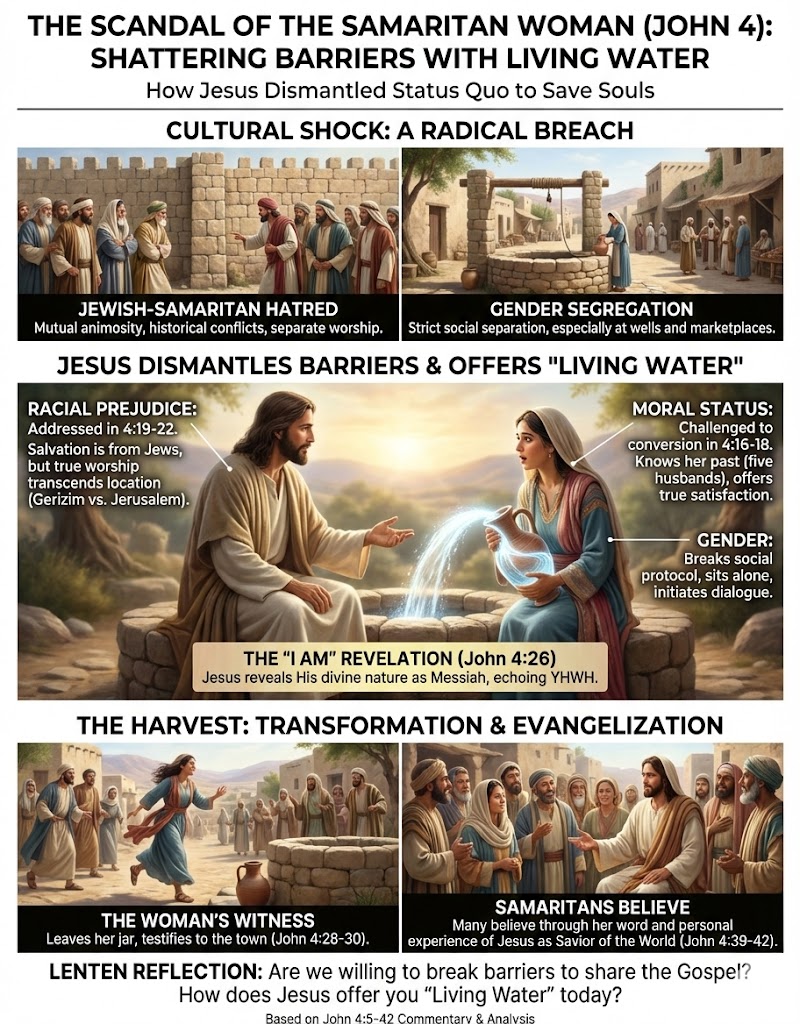
Americans are famous for making small talk with strangers, but in the ancient Near East, Jesus’ conversation with the Samaritan woman wasn’t just friendly chatter—it was a radical breach of social protocol. Larry Broding’s commentary digs deep into the cultural shock of John 4, revealing how Jesus dismantled barriers of gender, race, and morality to offer “Living Water.” This resource provides the historical nuance necessary to show your parishioners that the Gospel is not just about being nice; it is about shattering the status quo to save souls.
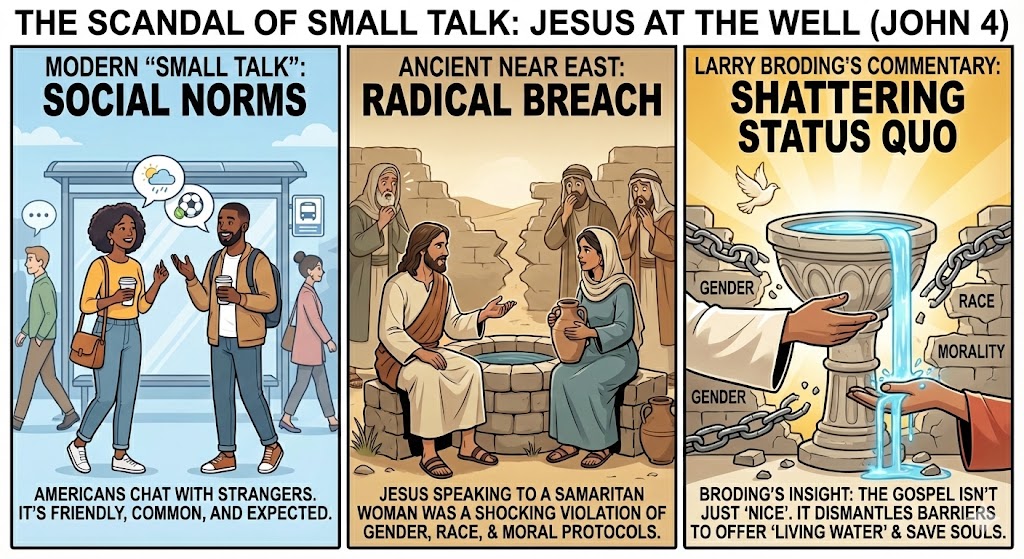
Why this commentary matters for your homily:
- Cultural Context: It explains the significance of details often lost on modern readers, such as why the “sixth hour” (noon) implies the woman’s social isolation and why “sharing dishes” was a matter of racial purity.
- Theological Depth: It unpacks the complex Greek concepts behind “worship in Spirit and Truth,” moving the definition beyond simple location to a relationship driven by God’s inner dynamic power.
- The “I AM” Revelation: It highlights the profound moment Jesus reveals his divinity using the Yahwistic title “I AM,” connecting the dusty well in Samaria to the burning bush of Exodus.
- Model of Evangelization: It contrasts the confusion of the disciples (focused on physical food) with the immediate missionary zeal of the woman, who leaves her water jar behind to harvest a town for Christ.
Read Larry Broding’s full commentary to help your congregation look past their own social barriers and recognize the Savior who offers living water to even the most unlikely candidates.

THE WORD THIS WEEK infographics on this page were created using using GOOGLE’S AI Gemini 3 Pro. You are free to use the them in any non-profit ministry. Proper attribution, however, must be given to Larry Broding at Word-Sunday.com.