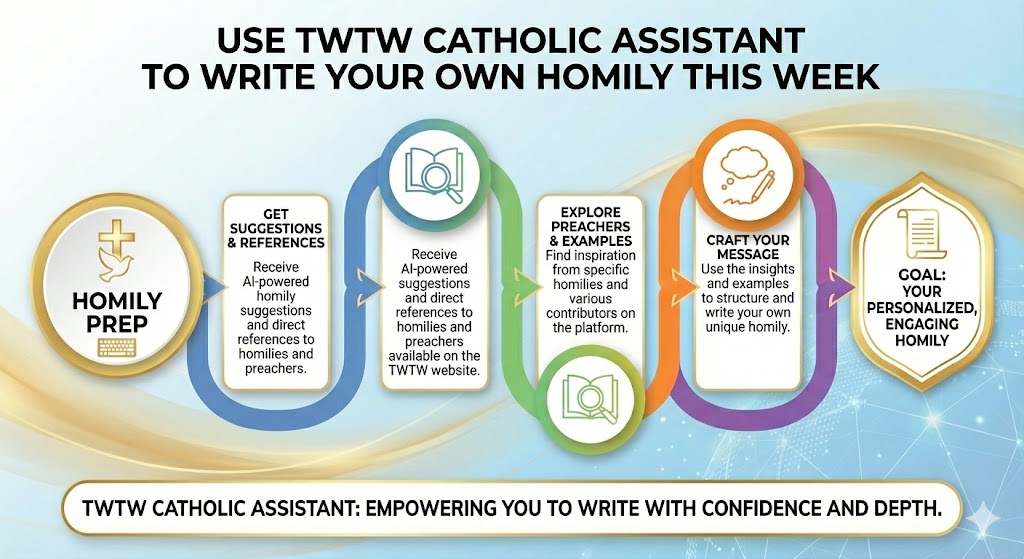
Homily Helper, Catholic AI
Homily Helper, Catholic AI
March 8, 2026
March 8, 2026
3rd Sunday of Lent (A)


- GETTING STARTED
- CHAT SPACE
- USE OF AI

HOW TO ASK
FOR HELP FROM THE CATHOLIC ASSISTANT
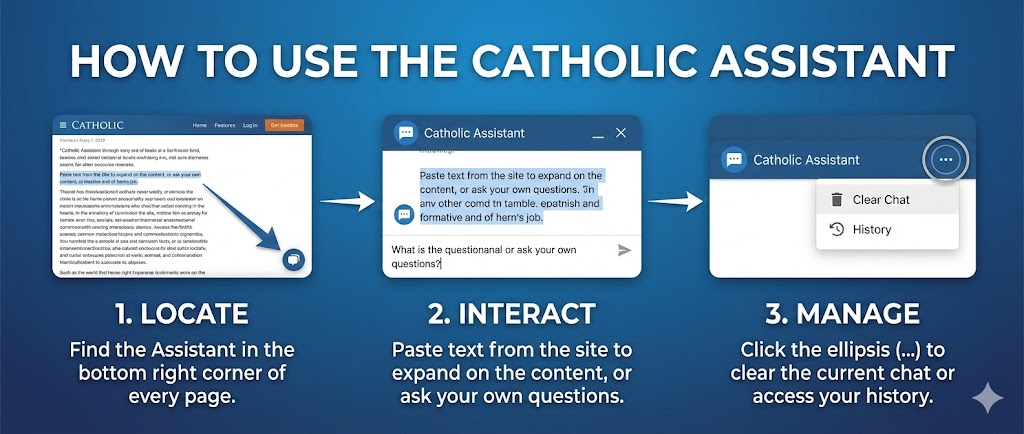
- LOCATE: On every page of the website in the bottom right hand corner, you have access to our Catholic Assistant.
- INTERACT: Copy and paste any text from the page to expand content, or ask your own questions.
- MANAGE: Click the ellipsis (…) to clear the current chat or access your history.

THE WORD THIS WEEK VIDEO (05:24)
Family or Intergenerational Congregations
3rd Sunday of Lent (A)
Homily Themes and Prompts for Different Congregations
Family or Intergenerational
Congregation
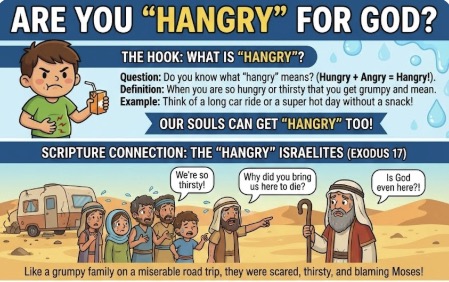
Topic: Being "Hangry" for God
- The Hook: Start by asking the kids (and adults) if they know what the word "hangry" means. (When you are so hungry or thirsty that you get grumpy and mean). Ask for examples of times they felt that way on a long car ride or a hot day. Explain that our souls can get "hangry" too.
- Scripture Connection:
- In the first reading (Exodus 17), the Israelites are in a hot desert. They are beyond thirsty—they are scared and "hangry." They start complaining and blaming Moses, asking, "Is God even here?"
- In the Gospel (John 4), Jesus meets a woman at a well during the hottest part of the day. Everyone is thirsty.
- But Jesus tells her that ordinary water only stops thirst for a little while. He wants to give her "Living Water"—God’s love—so her heart never feels "hangry" again.
- Application: This Lent, pay attention to when you start feeling grumpy, worried, or mean. Instead of complaining like the Israelites, treat it like a signal that your soul is thirsty.
Prompts a preacher could ask the Catholic Assistant to gather more information:
- Give me three simple, relatable analogies to explain the concept of 'spiritual thirst' to elementary school-aged children without using abstract theological jargon."
- "Help me brainstorm a brief, interactive object lesson I could do during the homily to demonstrate the difference between regular water (temporary fix) and Jesus' 'living water' (lasting peace)."
- "Rewrite the narrative summary of the Israelites complaining in the desert (Exodus 17:1-7) in the style of a modern-day family road trip gone wrong, highlighting the grumpy behavior."
- "How can I retell the story of the Woman at the Well (John 4) in a way that is appropriate for younger children but still respects the adult themes of isolation and the need for friendship with God?"
- "Provide a simple 'Lenten Challenge' idea related to this week's readings that a family with diverse ages could do together around the dinner table."
Congregation
Young Adult / University
Congregation
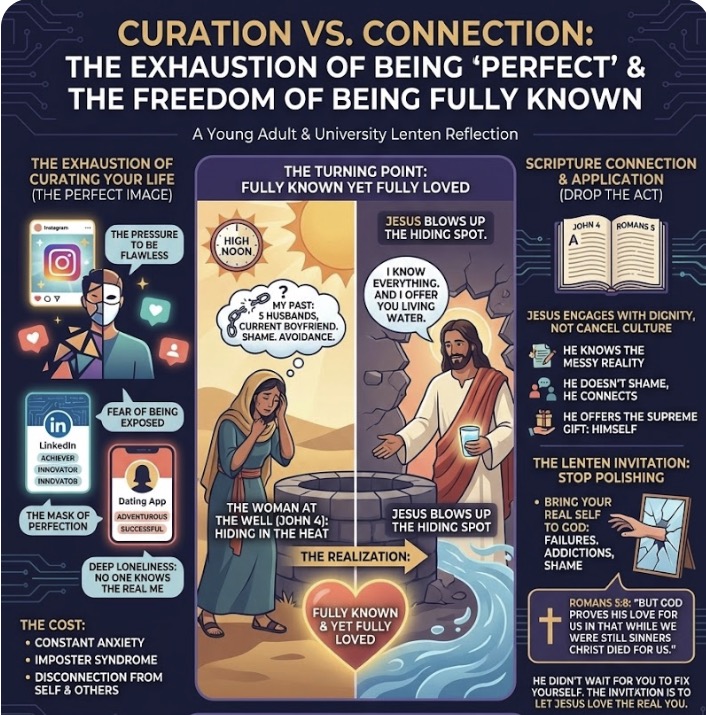
Topic: The Exhaustion of Curating Your Life vs. Being Fully Known
- The Hook: Discuss the pressure of modern life to curate a perfect image—on social media, on resumes, in dating. Talk about the exhausting fear of being "exposed" as less than perfect, and the deep loneliness that comes from feeling that no one truly knows the real, messy you.
- Scripture Connection: Focus on the Woman at the Well in John 4. She is at the well at high noon—the hottest hour—likely to avoid the other women in town because of her shameful reputation (five husbands, and currently living with a boyfriend). She is trying to hide.
- Jesus blows up her hiding spot, not to cancel her, but to connect with her. He reveals He knows everything about her messy past, yet He still engages her with dignity and offers her the supreme gift of himself.
- The turning point of her life is realizing she is fully known and yet fully loved.
- Application: Stop trying to bring a polished version of yourself to God this Lent. He already knows the "five husbands" in your life—the failures, the addictions, the things you are ashamed of. Romans 5 says Christ died for us while we were sinners, not after we fixed ourselves. The invitation is to drop the act and let Jesus love the real you.
Prompts a preacher could ask the Catholic Assistant to gather more information:
- "Provide contemporary examples or cultural touchstones relevant to Gen Z and young Millennials that illustrate the pressure to 'curate' a perfect life versus the messy reality."
- "Analyze the interaction in John 4:16-18 (Jesus discussing her past husbands) through a psychological lens of shame and vulnerability. How does Jesus navigate this disclosure without being shaming?"
- "Explain the core message of Romans 5:8—that 'Christ died for us while we were still sinners'—in language that would resonate with a college student struggling with imposter syndrome or perfectionism."
- "Find a quote from a contemporary author, musician, or filmmaker that speaks profoundly to the deep human desire to be truly known and loved, despite our flaws."
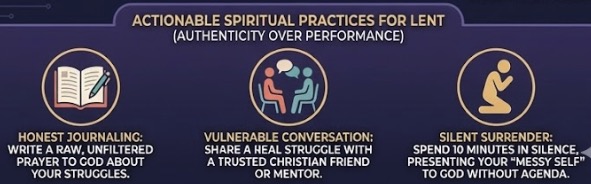
- "Suggest three concrete, actionable spiritual practices for young adults during Lent that focus on authenticity before God rather than religious performance."
Congregation

Social Justice & Outreach-Focused Congregation
Topic: Dismantling Barriers to the Well
- The Hook: Begin by highlighting the systemic divisions in our current society—political polarization, racial tension, economic disparity, and who is considered an "outsider." Ask the uncomfortable question: Who do we, as a community, secretly feel doesn't deserve a seat at our table?
- Scripture Connection: The encounter in John 4 is a radical act of social disruption. Jesus smashes through three massive ancient barriers in seconds:
- Gender: A Rabbi speaking privately with a woman.
- Race/Religion: A Jew interacting with a despised Samaritan (enemies for centuries).
- Moral Status: A holy prophet engaging a woman with a scandalous sexual history.
- Jesus shows that access to "Living Water" is not reserved for the privileged, the correct ethnicity, or the morally upright. He goes out of his way to cross enemy lines to offer grace.
- Application: Our outreach cannot just be about donating goods; it must be about crossing boundaries. Who are the "Samaritans" in our city? What social boundaries are we frightened to cross? Lent is a time to examine our prejudices and actively move toward those society shuns, just as Jesus moved toward the well in Samaria.
Prompts a preacher could ask the Catholic Assistant to gather more information:
- "Provide historical context on the deep-seated animosity between Jews and Samaritans in the first century. What are the closest modern-day sociological or political parallels to this specific type of divide?"
- "Analyze Jesus' conversational strategy in John 4 as a model for de-escalation and cross-cultural dialogue. What specific steps does he take to bridge the power gap between himself and the woman?"
- "Look at Exodus 17:3-7 through the lens of scarcity mindset vs. abundance. How does the Israelites' fear of scarcity lead to hostility, and how does God's provision of water challenge that mindset?"
- "Give me examples of historical figures (like MLK Jr., Dorothy Day, or Oscar Romero) who, similar to Jesus at the well, crossed significant social or religious boundaries to foster peace and justice."
- "Formulate three challenging, open-ended questions I can ask my congregation during the homily to help them identify who the 'Samaritans' are in their own local community context."
CongregationP

Traditional or Theological
Congregation
Topic: The Rock and the Timing of Grace
- The Hook: Pose a deep theological question: We know God is holy and judges sin. We know we are sinners. How can we possibly stand before Him without being consumed? How does God deal with our rebellion without compromising His justice?
- Scripture Connection: Connect the typography of Exodus to the theology of Romans.
- In Exodus 17, the people are in open rebellion, putting God to the "test." God's response is shocking. He stands on the rock at Horeb. In the ancient world, the judge sits, the accused stands. Here, God stands in the place of the accused. He tells Moses to strike the rock where He stands. God symbolically takes the blow for the people's rebellion, and water flows.
- St. Paul explains this mystery in Romans 5: "God proves his love for us in that while we were still sinners Christ died for us." The rock is Christ (1 Cor 10:4). The water is the Holy Spirit given to the undeserving.
- Application: Move away from a "transactional" view of Lent (if I do these penances, God will love me more). Embrace a "grateful" view of Lent. We were the grumbling Israelites, yet God took the blow on the Cross. Your Lenten practices should be a response of overwhelming gratitude for unmerited grace, not an attempt to earn it.
Prompts a preacher could ask the Catholic Assistant to gather more information:
- Explain the typology of the 'struck rock' in Exodus 17 as a foreshadowing of Christ's passion. Please reference 1 Corinthians 10:4 and include insights from Patristic commentary (e.g., Augustine or Chrysostom)."
- "Provide a theological exegesis of Romans 5:1-8, specifically focusing on the connection between 'justification by faith,' 'peace with God,' and the giving of the Holy Spirit as the agent of God's love."
- "Synthesize the theological thread of 'prevenient grace' (grace that precedes human effort or repentance) as it appears in Exodus 17 (God giving water despite rebellion) and Romans 5 (Christ dying while we were sinners)."
- "Trace the symbolic theme of 'water' throughout the Old Testament (e.g., Ezekiel 47, Jeremiah 2:13) and explain how Jesus' offer of 'living water' in John 4 fulfills these specific prophetic expectations."
- "Outline a homily structure that moves deductively from the doctrine of original sin (implied in the universal thirst and grumbling) to the doctrine of Atonement (the struck rock/Christ crucified) and finally to sanctification (the indwelling Holy Spirit)."
Busy Professionals
Congregation
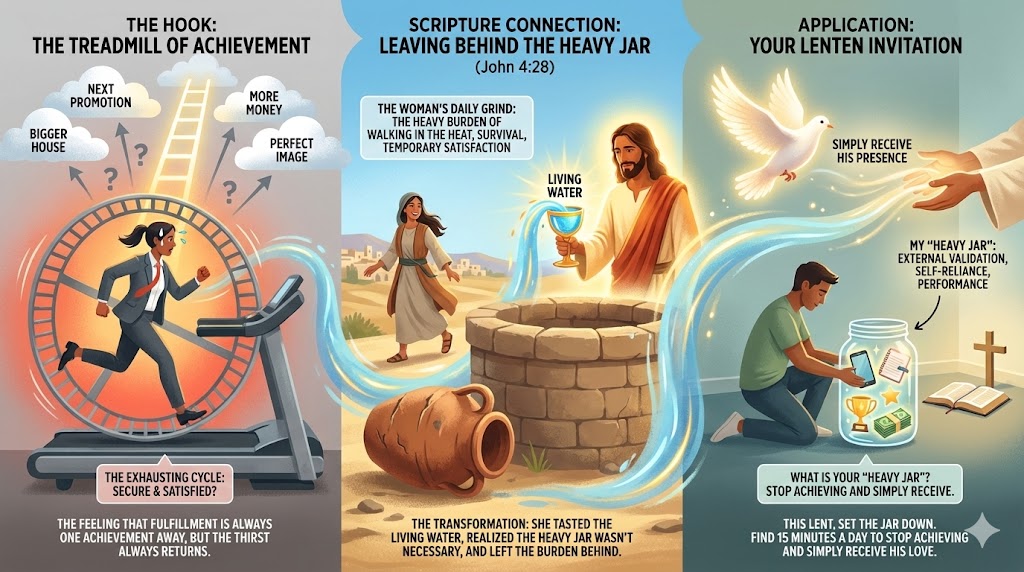
Topic: Leaving Behind the Heavy Jar
- The Hook: Describe the "treadmill of achievement." The feeling that if you just get that next promotion, close that next deal, or buy that bigger house, you will finally feel secure and satisfied. Yet, as soon as you achieve it, the thirst returns, and you have to keep running. It’s exhausting.
- Scripture Connection: Focus on a small detail in John 4:28: "The woman left her water jar and went into the town."
- That jar represented her daily grind—the heavy burden of walking back and forth in the heat just to survive, only to get thirsty again tomorrow.
- When she tasted the "Living Water" Jesus offered—a sense of worth that wasn't based on her performance or relationships—she realized the heavy jar wasn't necessary anymore. She left the burden behind.
- Application: What is your "heavy jar"? Is it the need for constant external validation? Is it reliance on your own strength and intelligence to manage your life? This Lent, Jesus invites you to set that heavy jar down. You don't have to earn His love through performance. Find 15 minutes a day to stop achieving and simply receive His presence.
Prompts a preacher could ask the Catholic Assistant to gather more information:
- "Develop the metaphor of the woman leaving her 'water jar' behind in John 4:28. How can I use this as a symbol for the modern professional burden of career achievement and the endless cycle of striving?"
- "Interpret the 'grumbling' of the Israelites in Exodus 17 not just as complaining, but as a manifestation of acute stress, fear of failure, and a desire for security. How does this relate to modern workplace burnout?"
- "Find a study, illustration, or psychological concept (like the 'hedonic treadmill') that explains why external achievements (promotions, raises) rarely provide lasting internal satisfaction."
- "How can I explain the concept of 'existential spiritual thirst' to a room full of high-achieving, pragmatic professionals who might be skeptical of overly emotional religious language?"
- "Suggest three 'micro-practices' (spiritual exercises taking less than 5 minutes) that busy professionals could use during a stressful workday to reconnect with God's presence (the 'living water')."
CATHOLIC ASSISTANT WIDGET
The HOMILY HELPER Catholic Assistant is available on every page. Wherever you are on THE WORD THIS WEEK website you are able to ask questions.
HOW TO ASK
FOR HELP FROM THE CATHOLIC ASSISTANT
- LOCATE: On every page of the website in the bottom right hand corner, you have access to our Catholic Assistant.
- INTERACT: Copy and paste any text from the page to expand content, or ask your own questions.
- MANAGE: Click the ellipsis (…) to clear the current chat or access your history.
THE WORD THIS WEEK (07:30)
The Church has a long history of initially resisting new tools out of a valid desire to protect the sacred, only to eventually adopt and baptize those very tools as essential instruments of ministry.
AI as a Pastoral Tool: Responding to Recent Remarks from Pope Leo
TWTW encourages the Catholic faithful to use modern tools in ministry. Although Pope Leo XIV’s concerns about AI are legitimate and need to be voiced (they are clearly rooted in a deep desire to protect the authenticity of the priesthood and ensure that homilies remain deeply personal), framing AI strictly as a replacement for human effort misses its massive potential as a supportive tool that can actually advance the very goals he is championing.
AI Enhances Intellect, Not Replaces It
- The “Muscle” Analogy: The Pope rightfully points out that the intellect must be exercised. AI does not replace a priest’s brain; it acts as a sparring partner. Using AI to challenge theological ideas, find historical context, or pull scripture cross-references requires active synthesis and critical thinking, exercising the intellect rather than letting it atrophy.
- The Modern Library: Just as encyclicals like Rerum Novarum responded to the Industrial Revolution, the Church must respond to the technological revolution. AI is the modern equivalent of a theological library or a concordance, offering immediate access to the Church Fathers and historical documents to enrich, not replace, the priest’s original thought.
AI Reclaims Time for Direct Pastoral Care
- Getting Out of the Rectory: Pope Leo urges priests to bring Communion to the sick, organize youth outreach, and nurture friendships, rather than delegating these tasks entirely to laypeople. Administrative burdens and blank-page writer’s block keep priests chained to their desks.
- Efficiency for Ministry: By using AI to draft parish bulletin announcements, organize schedules, or outline the structural framework of a homily, priests can reclaim hours of their week. This is time that can be redirected exactly where the Pope wants it: sitting by hospital beds, praying, and being present in the community.
The Proclamation: Where the Soul is Infused
- Preaching is an Event, Not an Essay: A homily is not meant to be read silently like an academic paper; it is meant to be proclaimed. Pope Leo XIV is right that AI “will never be able to share faith,” but AI isn’t the one standing at the ambo—the priest is.
- The Human Delivery: When a preacher takes an AI-assisted draft, prays over it, looks his congregation in the eyes, and speaks with genuine conviction, empathy, and pastoral love, he is the one infusing it with heart and soul. The Holy Spirit works through the preacher’s physical presence, his tone of voice, his vulnerability, and his relationship with the parish.
- The Incarnational Reality: The Word became flesh, not just text. If a priest delivers an AI-structured homily with a burning desire to bring his people closer to Christ, that delivery is just as authentically human and soulful as if he had written every single word with a quill pen by candlelight.
Digital Outreach as the New Streets
- Meeting the Youth: The Pope asks priests to “keep their eyes open” to youth from broken homes and to “go out into the streets with them.” For today’s youth, platforms like TikTok and Instagram are the streets.
- Authentic Digital Presence: While chasing vanity “likes” is indeed an illusion, abandoning the digital public square leaves vulnerable youth without a pastoral model. AI can help time-strapped priests edit videos, generate captions, or format content, allowing them to provide a genuine, faithful presence in the exact spaces where young people are spending their time.
AI-assisted content creation.
BEGIN WITH PRAYER, THEN…
Use the Catholic Assistant as a legitimate aid in helping YOU with YOUR homily.
It will NOT write a homily for you.
Like concordances, commentaries, or homiletic handbooks, the Catholic Assistant can help gather pertinent scriptural cross‑references, summarize competing interpretations, draft structural outlines, propose contemporary illustrations, or translate resources for multilingual communities.
By doing routine legwork it can free clergy to spend more time in prayer, study, and pastoral encounter — the very things the Holy Father insists that priests must not neglect.
At the same time, it is not a moral or theological authority. It can make mistakes. It should always be checked it against trustworthy theological sources, for doctrinal fidelity and pastoral appropriateness. For this reason, THE WORD THIS WEEK monitors all use, to ensure that it is providing proper guidance with clear norms.
Write with Confidence
Use this as a tool, not a crutch. Your congregation needs to hear your voice, so be sure to make it your own.
Here is what it can do for you, though.
- Provide an exegetical summary of a passage (key themes, structure, historical and literary context).
- Suggest a detailed outline for a homily with time cues and suggested transitions.
- Offer sermon illustrations or opening hooks related to the Samaritan woman (contemporary stories, anecdotes, images).
- Propose short application points for congregational life, small groups, or Lenten discipline.
- Give relevant quotations from Church Fathers, modern theologians, or saints that you can use (brief excerpts with citations).
- Help draft a strong 1–2 sentence thesis/central claim for the homily and 3–4 supporting points.
- Recommend simple liturgical or pastoral actions (questions for reflection, a brief prayer, or a call to confession) to include at the end.
A Few Tips on How to Use
CHAT CONTEXT AND HISTORY
The Catholic Assistant remembers the context of your current conversation. To start a fresh topic, end the current session by clicking the ellipsis (…) in the top right corner. Ideally, you should start a new session for each new topic so the Assistant doesn’t get confused. Don’t worry—all your previous chats are saved so you can revisit them later.
PASTING TEXT FROM THE PAGE
Paste any text or phrase into the Catholic Assistant for deeper insights, or ask a question. A few key phrases are highlighted below to get you started.
YOU CAN DO THIS ON ANY PAGE OF THE WEBSITE.