Homily Helper, Catholic AI
Homily Helper, Catholic AI
March 1, 2026
March 1, 2026
2nd Sunday of Lent (A)


- GETTING STARTED
- CHAT SPACE
- HOW TO USE

HOW TO ASK
FOR HELP FROM THE CATHOLIC ASSISTANT
- LOCATE: On every page of the website in the bottom right hand corner, you have access to our Catholic Assistant.
- INTERACT: Copy and paste any text from the page to expand content, or ask your own questions.
- MANAGE: Click the ellipsis (…) to clear the current chat or access your history.


SHARE YOUR OWN AT BOTTOM OF PAGE
Click on COMMENTARY banners at right for insights from Larry Broding at Word-Sunday.com and why his commentary matters for your upcoming homily. Infographics and clip art for bulletins are also provided.
TIP: Paste any text or phrase into the Catholic Assistant for deeper insights, or ask a question.
YOU CAN DO THIS ON ANY PAGE OF THE WEBSITE.
The Readings at a Glance
The Unifying Theme: The Journey of Transfiguration
The readings for this Sunday are perfectly stitched together by the concepts of call, journey, and vision.
- Past: Abram is called to leave the familiar for a promise he cannot yet see.
- Present: St. Paul (to Timothy) bridges the two, reminding us that we “bear our share of hardship” now, sustained by the grace that has “brought life and immortality to light.”
- Future: The Transfiguration offers a glimpse of the future glory of the Resurrection to sustain the disciples through the coming scandal of the Cross.
The Call of Abram
- The Radical “Go”: The Hebrew command Lech Lecha (“Go forth”) is emphatic. God asks Abram to sever his three deepest roots of identity: his land (political/economic security), his kinship (social network), and his father’s house (inheritance/identity).
- Faith as Movement: Abram is 75 years old. In a culture that valued stability and ancestry, he becomes a wanderer based on a voice. This sets the stage for Lent not just as “giving up chocolate,” but as moving away from sources of false security toward God.
- The Purpose of Blessing: God promises to bless Abram, but the climax of the promise is: “All the communities of the earth shall find blessing in you.” We are blessed so that we may be a blessing. The election of one is for the salvation of all.
Hardship and Holiness
- The Context of Suffering: Paul is writing from prison, likely facing death. When he tells Timothy to “bear your share of hardship,” it isn’t theoretical; it is very real.
- Grace Precedes Works: Paul emphasizes that our call to holiness is “not according to our works but according to his own design.” This is crucial Lenten theology: we do not do penance to earn God’s love; we do penance to clear the way for the grace already given.
- “Brought to Light”: The Greek word used for “appearance” (epiphaneia) suggests a sudden dawning. The Transfiguration is the visual manifestation of this truth: Christ has already destroyed death; the light is just now breaking through our blindness.
The Transfiguration
- “Six Days Later”: In Matthew’s Gospel, this event happens six days after Peter confesses Jesus as Messiah and Jesus predicts his own death (Mt 16). The Transfiguration is the divine counter-balance to the prediction of the Passion. It answers the question: “Why follow a Messiah who will die?” Answer: “Because He is the Lord of Glory.”
- Moses and Elijah: They represent the Law and the Prophets, but also two figures who had mountain-top encounters with God (Sinai and Horeb) and faced rejection by their people. Their conversation with Jesus (Luke tells us they spoke of his “exodus”) validates that the Cross is not a mistake, but the fulfillment of Israel’s history.
- The Father’s Voice: “Listen to him.” At the Baptism, the voice was addressed to Jesus (“You are my beloved Son”). Here, it is addressed to the disciples. It is an imperative. When the vision fades, and the glory is gone, the command remains.
- The Touch: Matthew alone records that Jesus “came and touched them” when they were face-down in fear. This is the same touch that healed lepers and raised the dead. It is the touch that says, “You can stand up now; the glory is real, but so is my presence with you in the fear.”
Homiletic Applications
Here are the homiletic applications you requested, structured as you prefer.
1. Modernize the Call of Abram
The Application: To make the call of Abram resonate with a modern congregation, we must translate the ancient categories of “land,” “kinsfolk,” and “father’s house” into the psychological and social securities we cling to today. The call to “Go forth” (Lech Lecha) is a call to leave behind the three false idols of modern stability.
- Leaving “Your Land” (The Idol of Control):
- Ancient Meaning: Land was economic security and physical safety.
- Modern Parallel: Today, “land” is our planning, our 401(k)s, our five-year plans, and our obsession with controlling outcomes. God is calling us to leave the illusion that we can secure our own future.
- Homily Hook: “Abram didn’t have a map; he had a Voice. We are often paralyzed because we won’t move until we see the destination. Faith is moving when you only hear the command.”
- Leaving “Your Kinsfolk” (The Idol of Approval):
- Ancient Meaning: The clan was your social safety net and your reputation.
- Modern Parallel: Today, “kinsfolk” is our “tribe”—our political party, our social media bubble, the people whose approval we desperately seek. It is the echo chamber that tells us we are right.
- Homily Hook: “God called Abram out of his echo chamber. You cannot hear the voice of God if you are only listening to the voices that agree with you. Lent is the time to unsubscribe from the noise and step into the silence where God speaks.”
- Leaving “Your Father’s House” (The Idol of Identity/Past):
- Ancient Meaning: This was your inheritance, your status, and your history.
- Modern Parallel: This represents the baggage of our past—our wounds, our grudges, or the labels we’ve accepted about ourselves (“I’m just a worrier,” “I’m unlovable”).
- Homily Hook: “As long as Abram stayed in his father’s house, he was just Terah’s son. To become Abraham, the father of nations, he had to leave. We cannot become who God created us to be if we insist on staying where we have always been.”
2. Lenten Disciplines and the Transfiguration
The Application: We can reframe the traditional Lenten disciplines (Prayer, Fasting, Almsgiving) not as grim duties, but as the necessary “equipment” for climbing the mountain of Transfiguration. You cannot see the glory if you are weighed down by the world.
- Fasting as “Climbing Weight”:
- The Connection: Just as Peter, James, and John had to physically climb the high mountain (likely Tabor or Hermon), we must ascend. Gravity pulls us down; fasting breaks the gravitational pull of our appetites.
- Homily Hook: “We don’t fast because food is bad. We fast because we are too heavy to climb. We are weighed down by our need for comfort and satisfaction. Fasting lightens the load so we can follow Jesus up the mountain.”
- Prayer as “Listening to Him”:
- The Connection: The Father’s command in the cloud is simple: “This is my beloved Son… Listen to him.”
- Homily Hook: “Prayer in Lent isn’t about giving God a list of requests. It is about obeying the command to ‘Listen.’ It is the discipline of shutting up. Peter wanted to build tents and talk; God interrupted him and said, ‘Listen.’ Silent prayer is how we stop building tents and start hearing God.”
- Almsgiving as “Touching the Fear”:
- The Connection: At the end of the Gospel, the disciples are face-down in fear. Jesus “came and touched them” to raise them up.
- Homily Hook: “When we give alms, we are doing what Jesus did. We are reaching out to touch those who are face-down in life—face-down in poverty, in loneliness, in fear. We become the hand of Jesus saying, ‘Rise, and do not be afraid.’ We give away our money to prove that fear does not own us.”


Family or
Intergenerational
Congregation
Theme: “The Great Adventure”
The Anecdote: “Think about the first time you learned to ride a bike without training wheels. Your mom or dad held onto the back of the seat, and they promised, ‘I’ve got you! Don’t look back, just pedal!’ You had to decide in that split second: do I trust the person behind me more than I fear the pavement in front of me? You pedaled into the ‘unknown’ because you believed in the voice cheering you on.”
- The Pivot: “Today, we meet Abram, who was told to ‘pedal’ into a whole new country, and Peter, who had to learn that following Jesus means moving forward even when the training wheels of comfort are taken away.”
- The Hook: Ask the children (and adults) what they would pack if they were told they were moving tomorrow but didn’t know where they were going.
- Scripture Connection: Focus on Genesis 12. Abram is 75 years old when God tells him to “Go.” It’s a family road trip into the unknown, fueled entirely by a promise.
- The Application: Faith isn’t a stagnant building; it’s a journey. Encourage families to identify one “brave step” they can take together this Lent—perhaps inviting a new neighbor over or starting a family prayer routine—trusting that God is already in the “unknown” place waiting for them.

Young Adult / University
Congregation
Theme: “Peak Experiences vs. The Valley Floor”
The Anecdote: “We live in the era of the ‘aesthetic’—we spend hours trying to capture the perfect golden-hour photo for Instagram or the perfect cinematic clip for a ‘Day in the Life’ video. We want to freeze the vibe, to stay in the filter. But have you ever noticed how, the moment you stop to take the photo, you actually stop experiencing the moment? You’re so busy trying to curate the memory that you stop living the reality.”
- The Pivot: “Peter falls into this ‘curator’ trap on the mountain. He sees the glow, he sees the celebrities of the faith—Moses and Elijah—and his first instinct is to build a booth and stay in the photo. But Jesus knows that the ‘aesthetic’ of the mountain is only meant to fuel the ‘grind’ of the valley.”
- The Hook: Talk about the “post-event blues”—the letdown that happens after a massive concert, a retreat, or a graduation. Why can’t we just stay in that high?
- Scripture Connection: Focus on Matthew 17:1-9. Peter wants to build “dwellings” (booths) to freeze time on the mountain. But Jesus leads them back down to the valley where the work is.
- The Application: Spiritual “mountain-top” moments are meant to sustain us, not define us. Challenge students to see their education and career prep as the “valley” where the light of the Transfiguration must be applied. How does a glimpse of the Divine change how you treat people in the campus dining hall?

Social Justice &
Outreach-Focused
Congregation
Theme: “The Courage to Suffer for the Gospel”
The Anecdote: “There’s a story about a community organizer who spent thirty years working in a neighborhood that many had given up on. When a journalist asked her how she avoided burnout in the face of so much systemic injustice, she pointed to a small, framed picture on her desk—not of the neighborhood as it was, but an artist’s rendering of what it could be. She said, ‘I don’t work for what I see with my eyes; I work for what I’ve seen with my heart.'”
- The Pivot: “The Transfiguration is that ‘artist’s rendering.’ It is a glimpse of the world—and the humanity—as God intended it to be: radiant, holy, and free. Paul tells Timothy that this vision is what gives us the strength to ‘suffer for the Gospel’ without losing hope.”
- The Hook: Mention a modern-day activist or saint who left a life of privilege to stand with the marginalized. What gave them the “holy grit” to keep going?
- Scripture Connection: Focus on 2 Timothy 1:8b-10. Paul tells Timothy not to be ashamed of the Gospel, but to “join with me in suffering” through the power of God.
- The Application: Transfiguration isn’t just a light show; it’s a revelation of the “Son” who will eventually go to the Cross. True justice work requires a “metamorphosis” (the Greek root of transfiguration) of our own hearts. We don’t serve out of pity, but because we have seen the divine dignity in every person.

Traditional or
Theologically-Minded
Congregation
Theme: “The Continuity of the Covenant”
The Anecdote: “Imagine walking into a grand cathedral that has been under construction for centuries. You see a stained-glass window in the basement that looks beautiful but feels incomplete. Then, you climb to the highest gallery, and suddenly, the sun hits a central prism, and a beam of light connects the basement, the altar, and the spire in one single, blinding line of continuity. You realize the architect didn’t change the plan; he simply revealed how it all fits together.”
- The Pivot: “On Mount Tabor, the ‘architectural’ plan of salvation becomes clear. Moses and Elijah aren’t just guests; they are the foundation. In the Transfiguration, the ‘Old’ and ‘New’ are joined by the light of Christ, proving that God’s covenant is not a series of pivots, but one unfolding masterpiece.”
- The Hook: Use the image of a “bridge.” How does the Old Testament connect to the New without breaking?
- Scripture Connection: Focus on the appearance of Moses and Elijah alongside Jesus in Matthew 17. Moses represents the Law; Elijah represents the Prophets. Jesus stands as the fulfillment of both.
- The Application: Explore the concept of Grace as the thread connecting Abram’s call to Paul’s exhortation. Encourage the congregation to study the “unmerited favor” of God—Abram didn’t earn his call, and we don’t earn our salvation. It is a gift “manifested through the appearance of our Savior.”

Busy Professionals
Congregation
Theme: “Interrupting the Grind”
The Anecdote: “A high-level CEO once shared that his most productive ‘tool’ wasn’t a new app or a double espresso; it was a 20-minute train ride through a tunnel where he lost all cell service. For those 20 minutes, he couldn’t check emails, he couldn’t look at his calendar, and he couldn’t fix problems. He was forced to just sit in the dark. He said it was the only time he actually remembered he was a human being and not just a ‘human doing.'”
- The Pivot: “God ‘loses the cell service’ for the disciples on the mountain. He pulls them out of their busy itinerary of traveling and preaching and puts them in a cloud. Why? Because before they could do any more work, they needed to ‘Listen to Him.’ Today is about the power of the holy pause.”
- The Hook: Describe the “efficiency trap”—the feeling that if we aren’t producing, we aren’t valuable. Even our hobbies become “optimized.”
- Scripture Connection: Focus on the voice from the cloud in Matthew 17:5: “This is my beloved Son… listen to him.” Before Jesus does anything on the mountain, the Father affirms his identity.
- The Application: Lent is an intentional interruption of our “doing” to focus on our “being.” Challenge the congregation to practice 10 minutes of “mountain-top silence” daily this week—not to plan or strategize, but simply to listen. Your value is not your output; it is your identity as a child of God.
2nd Sunday of Lent (A)
Core Charism: Interiority (searching for God within), community life (“one mind and one heart on the way to God”), and the restless heart that finds repose only in God.
The Hook: Peter says, “Lord, it is good that we are here.” Have you ever experienced a moment of pure beauty or love that you just wanted to freeze in time? That deep longing to hold onto the transcendent is the mark of the human soul.
The Approach with Application: St. Augustine famously wrote, “Our hearts are restless until they rest in Thee.” The Transfiguration is a momentary glimpse of that final rest—the Beatific Vision—that our souls crave. Peter wanted to seize that ultimate rest prematurely. The application links back to Abram. Like Abram, we are pilgrims on a journey. We cannot settle down yet. Lent is a time to examine our interior lives: What are we using to try and satisfy our restless hearts other than God? We must journey together in community (Peter, James, and John were together), supported by grace, using the memory of Tabor to sustain our restless seeking until we reach our true homeland.
Key Phrase: “Lord, it is good that we are here.” (The cry of the restless heart seeking rest).

2nd Sunday of Lent (A)
Core Charism: Ora et Labora (Prayer and Work), stability, obedience, listening with the “ear of the heart,” and the rhythm of liturgy.
The Hook: The very first word of the Rule of St. Benedict is “Listen.” On Mount Tabor, the imperative command from the Father to the disciples—and to us—is precisely that: “Listen to him.”
The Approach with Application: The Transfiguration is an icon of monastic prayer—the arduous ascent up the mountain, away from the noise of the crowd, to encounter the divine silence. But Benedictine spirituality is also rooted in stability and community life (the valley). We don’t just stay in the clouds. The application is to cultivate the rhythm of ora et labora this Lent. Like Abram, we must obediently leave behind distractions. We need the “mountaintop” times of scheduled, quiet prayer (lectio divina) where we truly “listen” to Christ. But we must then carry that transfigured silence back down into the “valley” of our daily work and our life in the family or community, seeing the stability of our daily duties as the place where the transfiguration is lived out.
Key Phrase: “Listen… with the ear of your heart.” (Adapting Mt 17:5 to the Benedictine Rule).
2nd Sunday of Lent (A)
Core Charism: Contemplative prayer, detachment, the ascent of the “mountain” of God, entering the “dark night” to reach union with God, with Elijah as a spiritual father.
The Hook: The Gospel tells us a “bright cloud cast a shadow over them.” A cloud that is bright, yet casts a shadow. This is the paradox of deep prayer—where God is so present that it feels like darkness to our human senses.
The Approach with Application: The Carmelite tradition views the spiritual life as an ascent of Mount Carmel (a direct link to Elijah’s presence in the Gospel). To climb a mountain, like Abram, you must leave heavy things behind—this is detachment. The goal of the ascent is union with God, depicted by the Transfiguration. The application for Lent is a call to embrace the “dark nights” of prayer. Sometimes Lent feels dry; sometimes God feels absent. Carmel teaches that entering that “shadow,” that cloud of unknowing where we cannot rely on our senses or emotions, is actually the closest we get to the divine essence on this side of eternity. We must be willing to enter the cloud to be transformed.
Key Phrase: “A bright cloud cast a shadow over them.” (The mystical experience of God).
2nd Sunday of Lent (A)
Core Charism: Preaching the Truth (Veritas), rigorous study of Scripture and doctrine, contemplating truth and sharing the fruits of that contemplation with others.
The Hook: The disciples are on the mountain, and suddenly they are surrounded by history. It’s a dazzling sight, but it is also a theological seminar. Why are Moses and Elijah there? This isn’t just a light show; it’s a revelation of doctrine.
The Approach with Application: A Dominican homily would likely focus on the truth revealed in the Transfiguration. This event is the doctrinal linchpin proving who Jesus is. Moses represents the Law; Elijah represents the Prophets. Their presence confirms that Jesus is the fulfillment of all Israel’s history. Furthermore, the voice of the Father reveals the divinity of the Son. The application comes from 2 Timothy: holding fast to sound teaching. In a world of confusing ideologies, Lent is a time to study our faith deeply. We cannot rely on fleeting emotional experiences of God; we need the solid foundation of Truth revealed on Tabor so we can bear our share of hardship for the Gospel without wavering.
Key Phrase: “This is my beloved Son, with whom I am well pleased.” (The revelation of doctrinal Truth).

2nd Sunday of Lent (A)
Core Charism: The restless heart searching for God (“Our hearts are restless until they rest in Thee”), interiority, community “of one mind and heart,” understanding sin as disordered love.
The Hook: What are you truly hungry for? What is the deep ache inside you that you try to fill with food, or doom-scrolling, or busy-ness?
The Approach with Application:
- Augustine taught that sin is fundamentally “disordered love”—loving lesser things more than God. Eve’s sin was loving the “pleasing to the eye” fruit more than the Creator. She tried to satisfy an infinite hunger with a finite object.
- The temptations of Jesus are assaults on his loves. The devil tries to get Jesus to love bread, glory, and power more than the Father. Jesus shows us a properly ordered heart: “You shall worship the Lord, your God, and him alone shall you serve.”
- Application: Lent is a journey of “interiority”—going inward to examine what we love. We use fasting to re-order our loves. We deny our physical appetite for bread so that our spiritual appetite for God can grow sharper. We quiet the noise so our restless hearts can find their true bearing.
Key Phrase: “Re-ordering our restless loves.”

2nd Sunday of Lent (A)
Core Charism: Finding God in all things, discernment of spirits (consolation and desolation), being “contemplatives in action,” and the magis (the greater glory of God).
The Hook: Have you ever had a spiritual “mountaintop experience”—a retreat, a moment in prayer, a brilliant sunset—where everything felt crystal clear and God felt incredibly close? And then, have you crashed back down into the messy reality of Monday morning?
The Approach with Application: Ignatius of Loyola understood the dynamics of the soul. He would view the Transfiguration as a profound moment of spiritual consolation granted by God to strengthen the disciples for the terrible desolation of the Passion that was soon to come. Peter’s mistake wasn’t enjoying the moment; it was trying to cling to the consolation rather than moving forward with the mission. The application is Ignatian discernment. We must “listen to Him” (Mt 17:5) to understand how to move between the mountaintop of prayer and the valley of service. We savor the consolations God gives us in prayer not as ends in themselves, but as fuel to serve God in the gritty reality of the world below the mountain.
Key Phrase: “Listen to Him.” (The foundation of discernment).

2nd Sunday of Lent (A)
Core Charism: Preaching “plentiful redemption” particularly to the poor and most abandoned; a very practical, approachable moral theology that emphasizes God’s mercy over rigorism.
The Hook: Look at the disciples in this Gospel. They are sleeping when they should be awake. They are terrified. They say foolish things. They are not spiritual superheroes; they are very much like us—flawed and easily overwhelmed.
The Approach with Application: A Redemptorist approach focuses on the astounding mercy of God revealing His glory to such imperfect vessels. The second reading from Timothy nails this charism: God saved us and called us “not according to our works but according to his own design and the grace bestowed on us.” The Lenten application is one of hope for the sinner. The Transfiguration is not a reward for the disciples’ good behavior; it is a free gift of plentiful redemption to sustain them when they inevitably fail during the Passion. Lent isn’t about proving our worth to God through severe penances; it’s about allowing Jesus to touch us in our fear and sinfulness and hearing him say, “Rise, do not be afraid.”
Key Phrase: “Not according to our works but according to his… grace.” (2 Timothy 1:9).
ASK THE CATHOLIC ASSISTANT FOR HELP
On every page of the website in the bottom right hand corner, you have access to THE WORD THIS WEEK Catholic Assistant. Click the ellipsis on the right side of the header to CLEAR CHATS and/or access earlier chats.
Copy and paste into the assistant any sentence or paragraph on the page you are looking at to expand content and learn more, or ask you own questions.
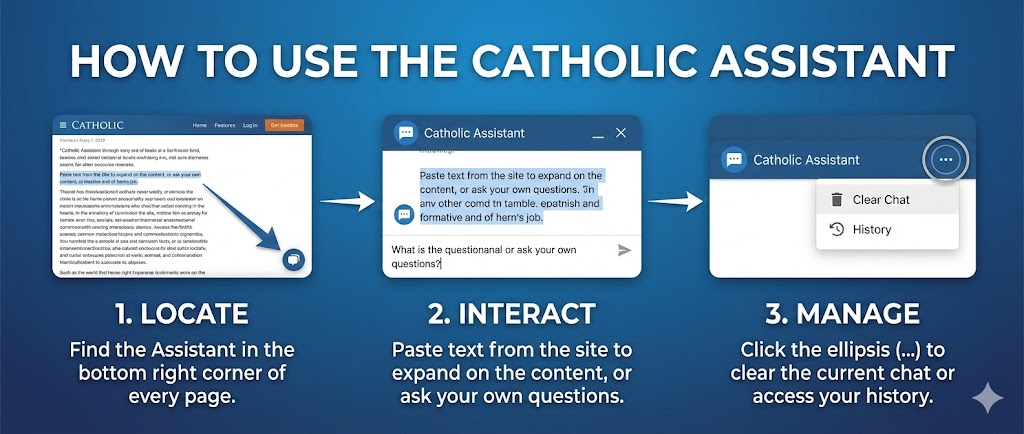
CATHOLIC ASSISTANT WIDGET
The HOMILY HELPER Catholic Assistant is available on every page. Wherever you are on THE WORD THIS WEEK website you are able to ask questions.
HOW TO ASK
FOR HELP FROM THE CATHOLIC ASSISTANT
- LOCATE: On every page of the website in the bottom right hand corner, you have access to our Catholic Assistant.
- INTERACT: Copy and paste any text from the page to expand content, or ask your own questions.
- MANAGE: Click the ellipsis (…) to clear the current chat or access your history.
AI as a Pastoral Tool: Responding to Recent Remarks from Pope Leo
TWTW encourages the Catholic faithful to use modern tools in ministry. Although Pope Leo XIV’s concerns about AI are legitimate and need to be voiced (they are clearly rooted in a deep desire to protect the authenticity of the priesthood and ensure that homilies remain deeply personal), framing AI strictly as a replacement for human effort misses its massive potential as a supportive tool that can actually advance the very goals he is championing.
Other Historical Technological Shifts
The Church has a long history of initially resisting new tools out of a valid desire to protect the sacred, only to eventually adopt and baptize those very tools as essential instruments of ministry.
BEGIN WITH PRAYER, THEN…
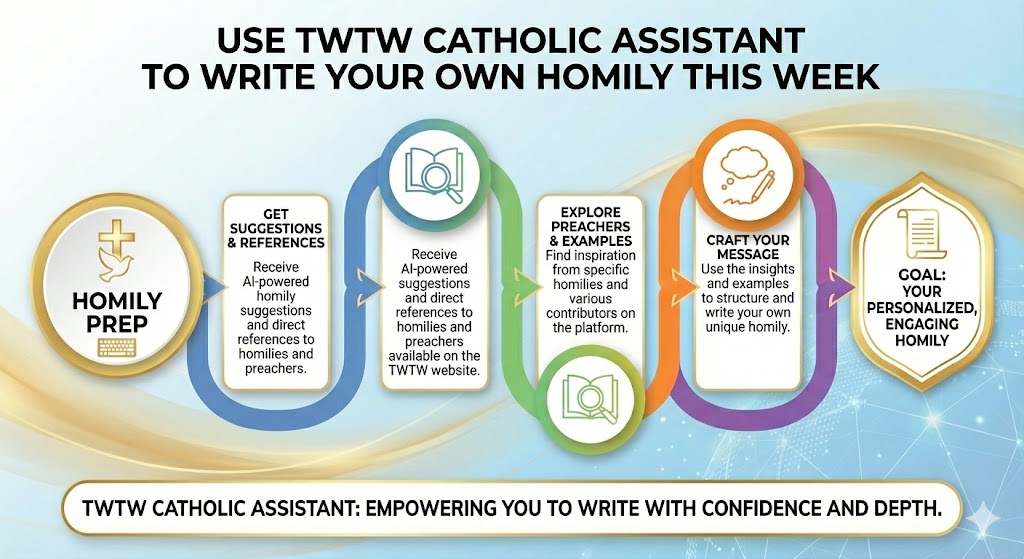
Use the Catholic Assistant as a legitimate aid in helping YOU with YOUR homily.
It will NOT write a homily for you.
Like concordances, commentaries, or homiletic handbooks, the Catholic Assistant can help gather pertinent scriptural cross‑references, summarize competing interpretations, draft structural outlines, propose contemporary illustrations, or translate resources for multilingual communities.
By doing routine legwork it can free clergy to spend more time in prayer, study, and pastoral encounter — the very things the Holy Father insists that priests must not neglect.
At the same time, it is not a moral or theological authority. It can make mistakes. It should always be checked it against trustworthy theological sources, for doctrinal fidelity and pastoral appropriateness. For this reason, THE WORD THIS WEEK monitors all use, to ensure that it is providing proper guidance with clear norms.
Write with Confidence
Use this as a tool, not a crutch. Your congregation needs to hear your voice, so be sure to make it your own.
Here is what it can do for you, though.
- Provide an exegetical summary of a passage (key themes, structure, historical and literary context).
- Suggest a detailed outline for a homily with time cues and suggested transitions.
- Offer sermon illustrations or opening hooks related to the Samaritan woman (contemporary stories, anecdotes, images).
- Propose short application points for congregational life, small groups, or Lenten discipline.
- Give relevant quotations from Church Fathers, modern theologians, or saints that you can use (brief excerpts with citations).
- Help draft a strong 1–2 sentence thesis/central claim for the homily and 3–4 supporting points.
- Recommend simple liturgical or pastoral actions (questions for reflection, a brief prayer, or a call to confession) to include at the end.
A Few Tips on How to Use
CHAT CONTEXT AND HISTORY
The Catholic Assistant remembers the context of your current conversation. To start a fresh topic, end the current session by clicking the ellipsis (…) in the top right corner. Ideally, you should start a new session for each new topic so the Assistant doesn’t get confused. Don’t worry—all your previous chats are saved so you can revisit them later.
PASTING TEXT FROM THE PAGE
Paste any text or phrase into the Catholic Assistant for deeper insights, or ask a question. A few key phrases are highlighted below to get you started.
YOU CAN DO THIS ON ANY PAGE OF THE WEBSITE.

SHARE YOUR OWN INSIGHTS BELOW
What are you preaching on this week? Have a unique angle? Help enrich this page by sharing your preaching insights for this week below.