Homilies
Homilies
March 1, 2026
March 1, 2026
2nd Sunday of Lent (A)



DEEP DIVE PODCAST
FEATURING Fr. Rettig, Fr. Austin Fleming, and Fr. George Smiga.

This episode focuses on highlights several hooks used by TWTW contributors when giving a homily on the Transfiguration.
- Pop Culture Analogy / The “Spoiler Alert” – Fr. Rettig
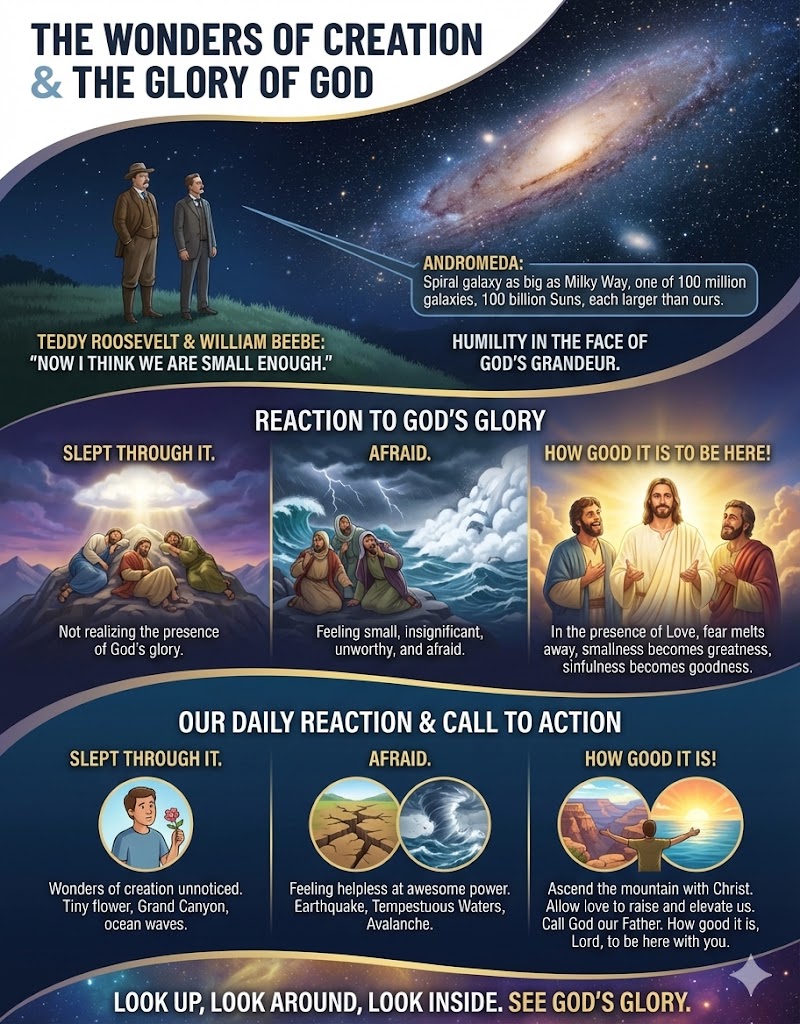
- Historical Anecdote/ Teddy Roosevelt. – Fr. Rettig
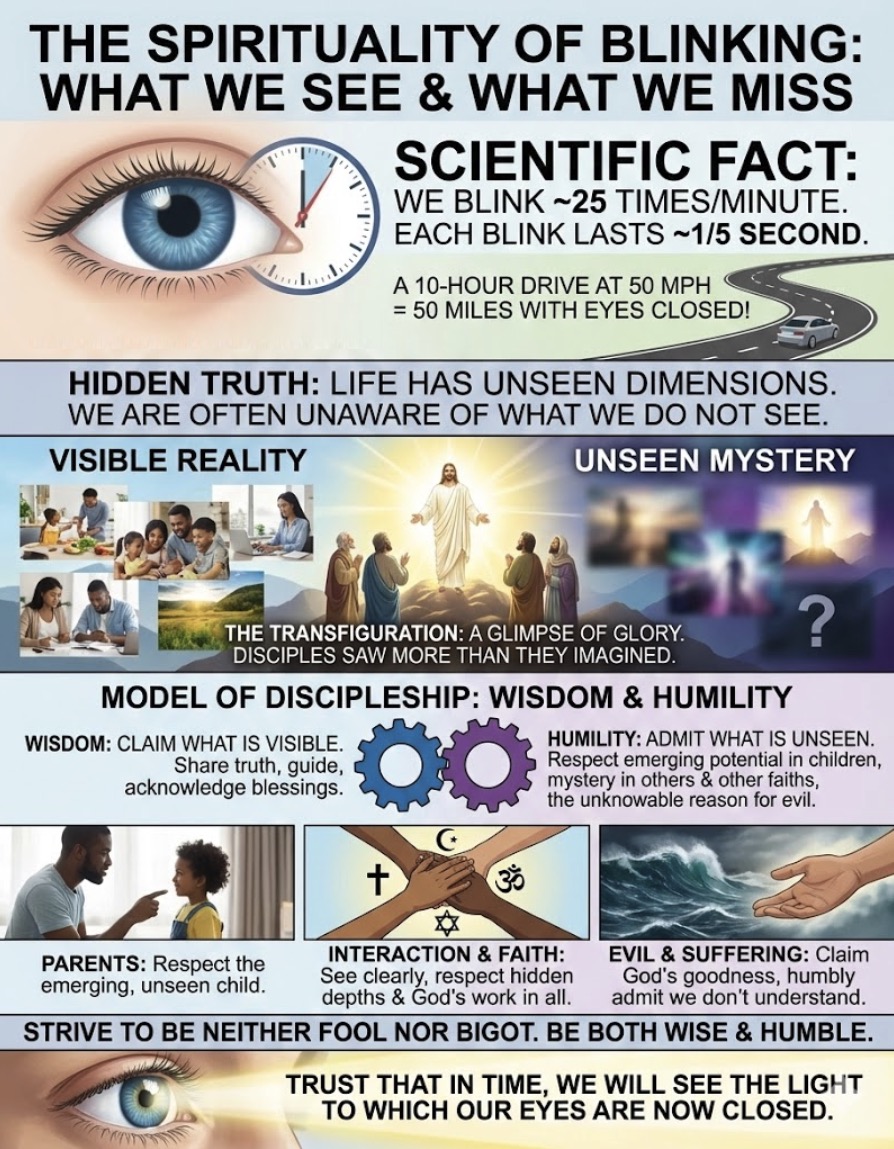
- The Scientific Fact / Blinking/Driving . – Fr. Smiga
- The Personal Vulnerability / The priest’s struggle – Fr. Fleming
The ppodcast provides actionable advice for clergy on how to use hooks in their homilies, and how to avoid making them feel gimmicky or disconnected from the actual scripture.
I. Introduction: The Sunday Morning Disconnect
- Setting the Scene: Describes the reality of a distracted churchgoer (thinking about grocery lists, football games, lack of sleep).
- The Problem: Identifies the "disconnect" between the mundane reality of the pew and the "high concept/special effects" nature of the Transfiguration Gospel reading.
- The Consequence: Notes that instead of drawing people in, high theology often pushes them out because it feels irrelevant to daily worries (e.g., mortgages).
- The Mission: Introduces the goal of the episode: analyzing the "craft of preaching" through four specific types of "hooks."
II. Pop Culture (The "Spoiler Alert")
- The Homily: Introduces Father Kevin’s homily titled "Spoiler Alert."
- The Statistic: Cites a study stating 85% of people would not want to know the date of their death or if their marriage would end in divorce.
- The Skeptical Question: Challenges whether using Netflix/streaming references risks trivializing the Gospel.
- The Takeaway: Summarizes the theological point: The "Messianic Secret" (silence) isn't punishment; it preserves the integrity of the journey. Not knowing the future allows for trust in the "director."
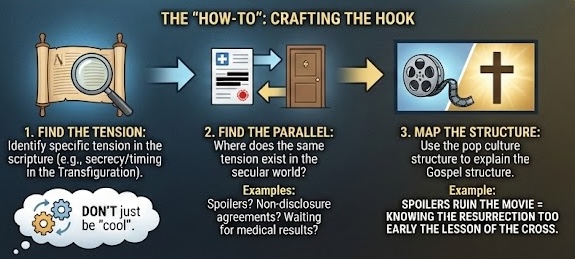
- The "How-To":
- Find the Tension: Don't just look for a movie reference to be "cool." First, identify the specific tension in the scripture (e.g., the secrecy/timing in the Transfiguration).
- Find the Parallel: Ask where that same tension exists in the secular world. Is it spoilers? Non-disclosure agreements? Waiting for medical results?
- Map the Structure: Use the structure of the pop culture moment to explain the structure of the Gospel. (e.g., "Spoilers ruin the movie" = "Knowing the resurrection too early ruins the lesson of the Cross.")
- The Goal: To validate the congregation's feelings (e.g., fear of the unknown) and show that the text understands their reality.
III. History (The "Cosmic Humility" Hook)
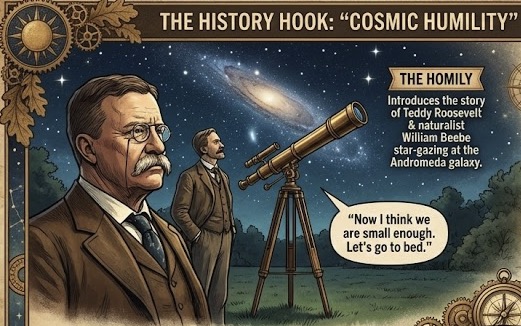
- The Homily: Introduces the story of Teddy Roosevelt and naturalist William Beebe looking at the Andromeda galaxy.
- The Mechanism: Highlights the shift from fear/anxiety to "awe."
- The Insight: Notes that the homily validates feeling small; it turns humility into a prerequisite for encountering God.
- The Method: Summarizes the "how-to" as looking for habits of famous people that mirror Gospel behavior (secular spiritual habits).
- The "How-To":
- Look for Rituals: Do not just look for quotes. Look for behaviors or habits of famous secular figures (generals, scientists, artists) that mirror prayer or worship.
- Find the Awe: Look for moments where these figures engage in "awe" or make themselves feel small (e.g., Teddy Roosevelt reciting astronomy facts to feel insignificant).
- The Goal: To give the person in the pew permission to access spiritual emotions without feeling like they have to be a mystic. It grounds high concepts in "dirt and history."
IV. Science (The "Scientific Jolt")
- The Homily: Introduces Father George Smiga’s hook regarding biological blinking.
- The Reaction: Expresses shock at the math (driving 50 miles with eyes closed during a 10-hour trip).
- The Analysis: Identifies this as a move from biology to theology to ethics.
- The Connection: Highlighting that if we miss physical truths (blinking), we likely miss spiritual truths and the reality of our neighbors (bias).
- The Challenge: Asks how preachers can use facts without sounding like a "trivia night."
- The "How-To":
- Find the Counterintuitive: Look for facts or statistics that sound wrong but are factually true (e.g., "You drive 50 miles with your eyes closed due to blinking"). Avoid facts that just confirm what people already believe.
- Disrupt Autopilot: Use the fact to "wake up" the brain and resolve the conflict between perception and reality.
- The Pivot: You must pivot immediately from the physical fact to a spiritual/ethical metaphor (Biology $\to$ Theology $\to$ Ethics).
- The Guardrail: If the fact is just interesting, it is trivia. It is only a sermon hook if it exposes a limitation in how we see the world (e.g., physical blinking = spiritual bias).
V. Personal Vulnerability (The "Breaking the Pedestal")
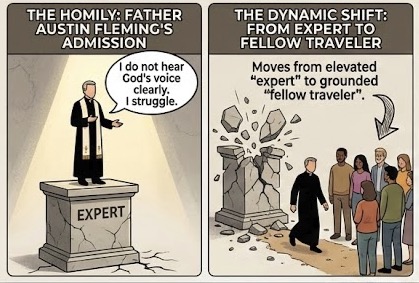
- The Homily: Introduces Father Austin Fleming’s admission that he does not hear God’s voice clearly.
- The Dynamic Shift: Notes that this moves the priest from "expert" to "fellow traveler."
- The Imagery: Responds to the visceral image of the "stiff neck" on the park bench—refusing to look at Jesus.
- The Critical Question: Asks about the danger of narcissism or oversharing (the "therapy session" risk).
- The Resolution: Summarizes that vulnerability should be used to illuminate the text, not the speaker.
- The "How-To":
- Step Down: Metaphorically step down from the pulpit. Stop being the "expert" and become the "fellow traveler."
- Share the Process: focus on the struggle and the failure, not just the victory. (e.g., "I struggled to pray for decades," not "I prayed and God fixed it.")
- The "Hero Test": Before telling a story about yourself, ask: "Am I the hero who saves the day, or am I the one learning the lesson?" If you are the hero, cut the story.
- The Goal: To illuminate the text, not yourself. You are pointing to the moon; you are not the moon.
VI. The Service Rule
Asks if these techniques are merely "entertainment" or "gimmicks."
The Core Principle
- Definition: The illustration must serve the Gospel; the Gospel must never serve the illustration. It is a one-way street.
- The Function: The hook (the story, fact, or joke) should provide the vocabulary or the lens through which the congregation understands the rest of the sermon.
- Example: In the "Spoiler Alert" sermon, the concept of a "spoiler" became the container for understanding the theology of the Resurrection.
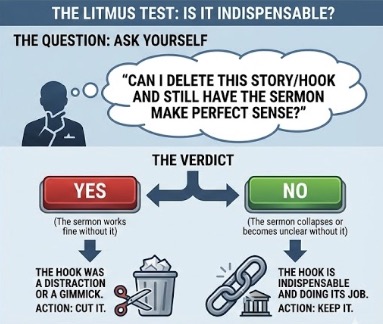
The Litmus Test
- The Question: Ask yourself: "Can I delete this story/hook and still have the sermon make perfect sense?"
- The Verdict:
- If the answer is YES (the sermon works fine without it), the hook was a distraction or a gimmick. Cut it.
- If the answer is NO (the sermon collapses or becomes unclear without it), the hook is indispensable and doing its job.
The Philosophy: Hook as Hospitality
- Hospitality: A good hook isn't about being clever; it is an act of hospitality toward the listener.
- Opening the Door: It acknowledges the reality of the person in the pew (their Netflix account, their commute, their anxiety) and "meets them in the parking lot."
- The Result: It unlocks the "front door" of the text. If the door is locked (too abstract) or too high up (too theological), the listener cannot enter.
The Final Challenge (The Ultimate Service Rule)
- Trailer vs. Spoiler: The rule extends beyond the pulpit to the life of the believer.
- The Trailer: Does your life make people want to "buy a ticket" to the full movie of Christianity? (Service).
- The Spoiler: Does your life (hypocrisy, judgment) ruin the ending for them before they even walk in the door? (Disservice).
“Have a question? Say hello to our Catholic Assistant down in the corner.”
Bishop Robert Barron
2nd Sunday of Lent (A)
Listen!

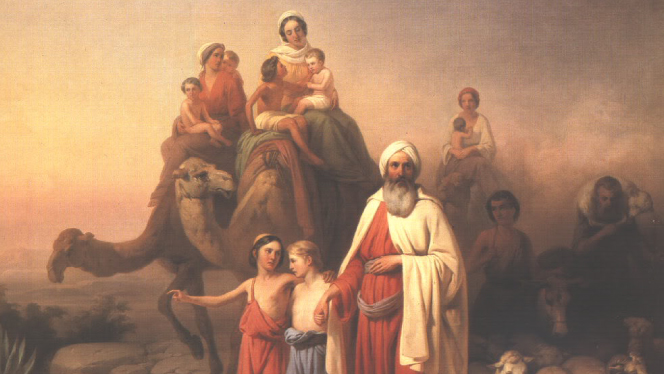
PODCAST—Our magnificent first reading is a short passage from the beginning of the twelfth chapter of the book of Genesis. We see that at this point in the creation story jealousy, rivalry, anger, murder, imperialism, arrogance, drunkenness, indeed a wickedness has spread over the entire face of the earth. So what does God do? He sends a rescue operation! The rescue operation is going to come in the form of a people trained to listen again to the voice of the Lord. During this season of Lent we must also become a people trained to listen so as to be rescued by the Resurrection.
2nd Sunday of Lent (A)
A Friend of the Lord Jesus
Friends, the readings for the Second Sunday of Lent brought to mind my good friend Bishop David G. O’Connell, who was killed [in February 2023]. He was one of the most Christ-like people I have ever known—a man of deep spiritual conviction, with a profound sense of the power of the Holy Spirit. Like Abraham, he followed the Lord’s call from his homeland of Ireland to serve in the United States, working among the poor and with members of gangs. He called those he served to a deep life of prayer and spiritual transformation in Christ, a mystery revealed in the Gospel account of the Transfiguration.

2nd Sunday of Lent (A)
The Adventure of Salvation
Friends, on this Second Sunday of Lent, our first reading about Abraham and Matthew’s account of the Transfiguration orient us to a basic biblical principle. God has made us to go out from ourselves, to experience the splendor of reality. The more we let go of ourselves and our prerogatives—and the less we try to grasp and hang on to things—the more alive we become. Salvation, therefore, has a lot to do with adventure.
Fr. Michael Chua
Permission granted for non-profits to use in ministry
The infographic was created using Nano Banana, Google's Revolutionary AI Image Generator. Infographic may not be sold or used for personal financial gain. Please show your appreciation by letting others know about TheWordThisWeek.NET.
2nd Sunday of Lent (A)
A Glimpse of Heaven

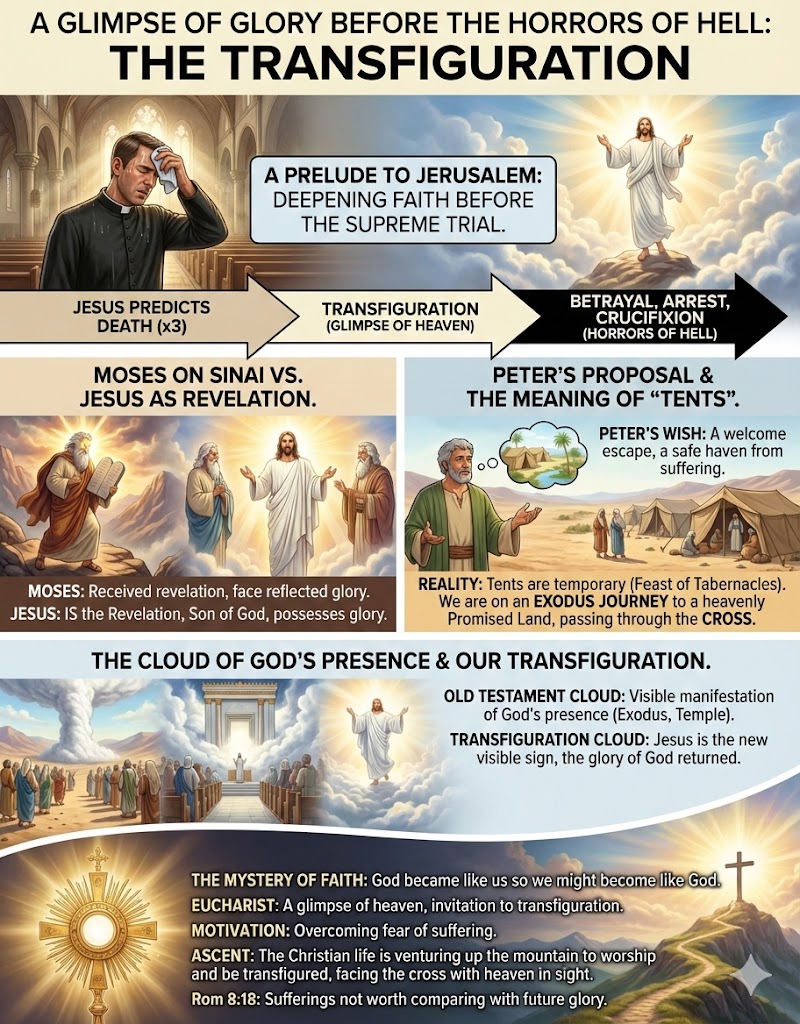
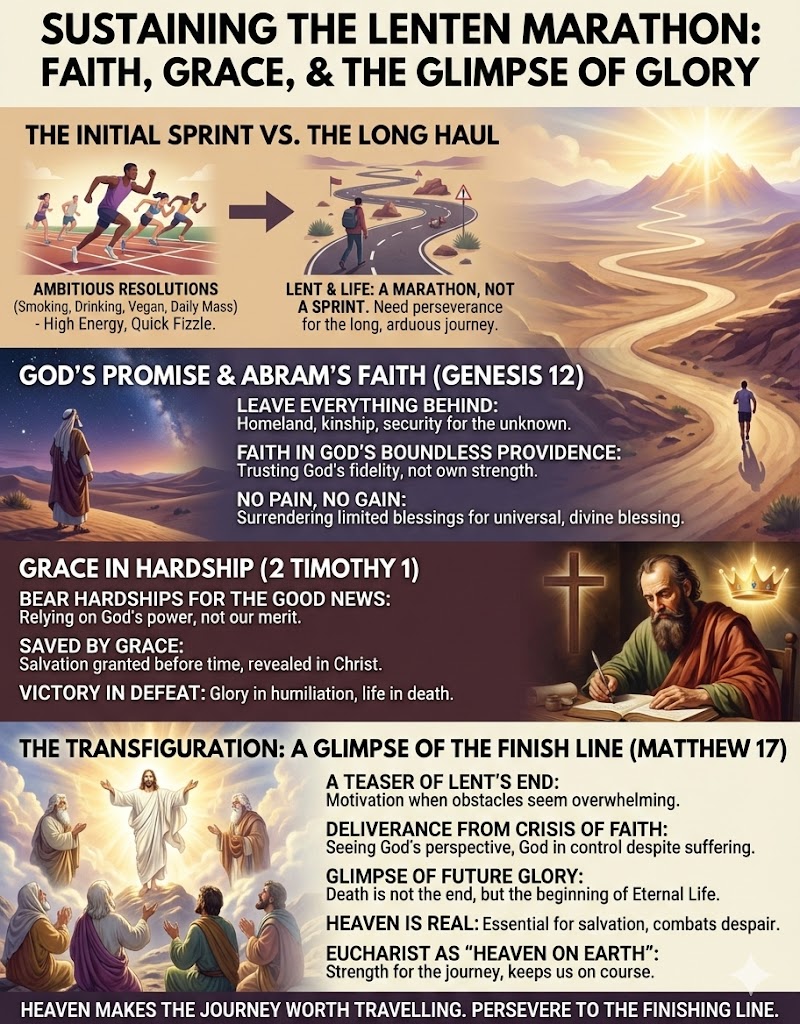
The light that radiates from Jesus’ flesh is the same light that spoke the universe into creation. It’s the same light that the world awaits with groaning and labour pains and sighs too deep for words. It’s the light that will one day make all of creation a burning bush, afire with God’s glory but not consumed by it. The transfiguration therefore anticipates our flesh being remade into God’s image so that we may be united with Him. Just as Christ’s humanity is transfigured by glory without ceasing to be human, so too will our humanity be deified, without our ceasing to be creatures. That’s the plot of scripture. That’s the mystery of our faith. This is what makes the suffering of the cross bearable. Without a vision of heaven, our painful experiences in this life would remain hellish and unbearable. And this is the reason why at every Mass, we have a glimpse of heaven. Eucharistic adoration is an invitation to a transfiguration experience. You see, heaven is not just a destination, it is also a motivation. The Eucharistic transfiguration, this desire for heaven, helps us to overcome all fear of suffering for the sake of Christ.
The Christian life is not about going back down the mountain. Rather the entire Christian life is a sort of ascent, venturing further and further up the mountain, to worship and adore the transfigured Christ and, in so doing, to be transfigured ourselves. But if we have accompanied our Lord up the mountain of transfiguration to witness the glory that awaits us one day, we must first accompany Him up the hill where He offers His life in atonement for the sins of the world. But now we do so with less trepidation. Once we have tasted heaven, we would be able to face the torments of what seems to feel like hell. Let us not be discouraged by the ugliness and suffering of the world that does not recognise or accept us, but rather “let us bear the hardships for the sake of the Good News” and persevere in love through holding the vision of a transfigured life before us. For as St Paul tells us (Rom 8:18), “I consider that the sufferings of this present time are not worth comparing with the glory that will be revealed to us.”
Permission granted for non-profits to use in ministry
The infographic was created using Nano Banana, Google's Revolutionary AI Image Generator. Infographic may not be sold or used for personal financial gain. Please show your appreciation by letting others know about TheWordThisWeek.NET.
2nd Sunday of Lent (A)
Heaven Keeps Us On Course
The cause of a crisis of faith often arises from the way in which we see people and things around us. Death, suffering, separation seem to be defining moments in our lives. The disciples needed a vision from God’s point of view, to see that in spite of the death sentence hanging over the head of Jesus, God was still with Him, God was still in control of events, God would see to it that in the end, He would be victorious over His foes, even over death. In the Transfiguration, Peter, James and John saw that there was more to Jesus than what they could see and hear and touch; they got a glimpse of the future glory of the Lord’s resurrection. His death would not be the end; it would only inaugurate the beginning of Eternal Life.
An important truth shines forth from the centre of this mystery. Glimpses of this transfigured world are not only good for our mental health but are essential for our salvation. They help us see through the illusions cast by the devil who constantly tempts us with his greatest weapon, which is despair. Our dreams of an earthly utopia, where we will be shielded from all pain, trouble, and disappointment is merely delusional. Unlike utopia, heaven is real. Heaven is not the elusive Promised Land which the patriarchs and Israelites sought for generations, but an eternal reality awaiting us at the end of our earthly journey as long as we remain faithful to God and stay on course. The disciples saw it, or at least a glimpse of it in the Transfiguration. We too see it at every Eucharist where mere bread and wine become the Body and Blood of Christ, truly, really and substantially. Every Mass gives us an experience of “heaven on earth!” Heaven makes the journey worth travelling. Heaven helps us to see that giving up all our worldly securities is worth the sacrifice. Heaven provides the strength to bear the weight of our tribulations. Heaven keeps us on course, away from the distractions that tie us to this earthly life and its lies. Heaven must exist, or our present suffering will lose its meaning. Heaven must exist, if we are to persevere and keep running till we reach the finishing line.

Permission granted for non-profits to use in ministry
The infographic was created using Nano Banana, Google's Revolutionary AI Image Generator. Infographic may not be sold or used for personal financial gain. Please show your appreciation by letting others know about TheWordThisWeek.NET.
2nd Sunday of Lent (A)
Boast of the Lord
Our God has no need of our praise. He is not so conceited (unlike us) that He constantly desires our adulations. He doesn’t crave for our attention or affirmation as we obsessively do. It is also good to remember that God is not diminished by the lack of praises offered to Him, neither is He empowered by any amount of praise which we can offer Him. But it is we who are diminished when we forget to praise Him, to thank Him, to adore Him. We are made for this purpose. We were made to worship God, to give Him all glory and praise. So, when we fail to do so, we become less than human. When we do not worship God, we end up worshipping something else and in this age of acute narcissism, the most popular object of worship is ourselves. This is the reason why it is more common to boast of our own achievements than it is to boast of God’s goodness and graces.
And that is also the reason why the Holy Mass, the highest form of worship to God, is the greatest antidote to our narcissism. Why do so many people complain that Mass is boring? My answer is simply this – the Mass is inherently boring because it is not about us but about God. God is worshipped, not man. The Mass is not another opportunity to showcase our talents or achievements. When we examine what it means to experience “boredom”, it is that we are not the centre of the attention. Something or some activity is described as boring because we are not getting the attention we want from others.
So let us boast by praising not ourselves but God, not for anything we have of ourselves, but for what He has given us! This is at the heart of our worship rendered in the Holy Sacrifice of the Mass which is our Thanksgiving offered to God. Let our hearts and our minds nurture His gifts, until He grants us our reward, that we may sing His praises forever in heaven! All glory and all praise belong to Him and Him alone!
Dominican Blackfriars

Permission granted for non-profits to use in ministry
The infographic was created using Nano Banana, Google's Revolutionary AI Image Generator. Infographic may not be sold or used for personal financial gain. Please show your appreciation by letting others know about TheWordThisWeek.NET.
2nd Sunday of Lent (A)
Consecrated in Prayer

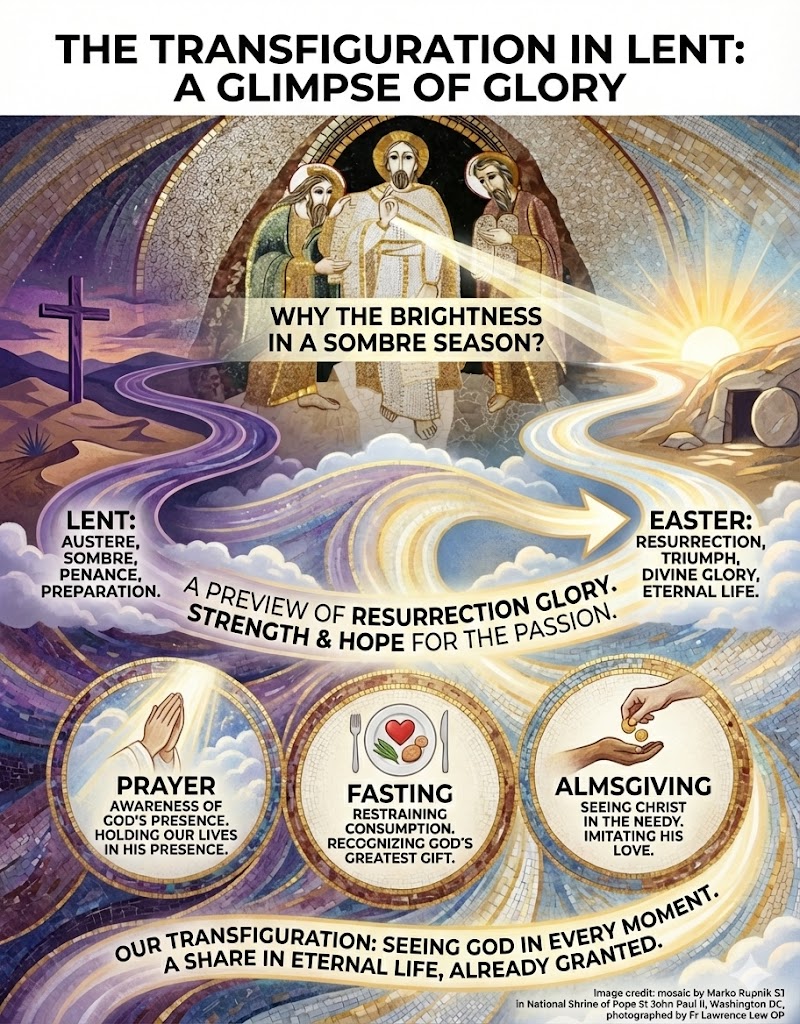
Second Sunday of Lent (C) Fr Robert Gay encourages us to find time to encounter God in prayer because he transforms all our Lenten observances and lightens our burdens.
Our second Sunday in Lent puts before us a great manifestation of the Glory of God which happens on Mount Tabor. It is a theophany, a manifestation of the Divine, and has features both old and new, and shows itself as such in its details. First, let’s look at the features it has in common which other such manifestations in the Scriptures. For a start, it happens on a mountain, a high place that was often seen as the place of encounter with God in the Old Testament. There is a sense of leaving the ordinary places of daily life, and doing so deliberately in order to have an encounter with God. And indeed, the two men who are seen in our Gospel, Moses and Elijah, were just such men, who themselves had the experience of an encounter with God on the mountain. The book of Exodus recalls how Moses climbed Mount Sinai, and he encountered the Lord, who gave him the Law. In the book of Kings, we hear of Elijah, who had an experience of the Lord’s awesome yet gentle presence on mount Horeb after forty days and nights of journey. The presence of these two great men itself is a reassuring sign that God is present, and is manifesting himself on Mount Tabor.
Despite the similarities, there are two things that are markedly different about this moment of revelation. First, it is not a lone experience of one key character as the theophanies of old, but the experience of three disciples, Peter, James and John who are with Jesus. There is a group of witnesses to what happen, and will be able to make this remarkable encounter known, but only, Jesus himself makes clear, after his resurrection. And most significant of all, is that this revelation of God’s glory happens, not simply in Jesus’s presence, but to Jesus himself, showing clearly, unmistakably, his Divine identity.
Permission granted for non-profits to use in ministry
The infographic was created using Nano Banana, Google's Revolutionary AI Image Generator. Infographic may not be sold or used for personal financial gain. Please show your appreciation by letting others know about TheWordThisWeek.NET.
2nd Sunday of Lent (A)
Our Transfiguration
Second Sunday of Lent. Fr Gregory Pearson ponders on the appearance of the transfiguration story in this Lenten season.
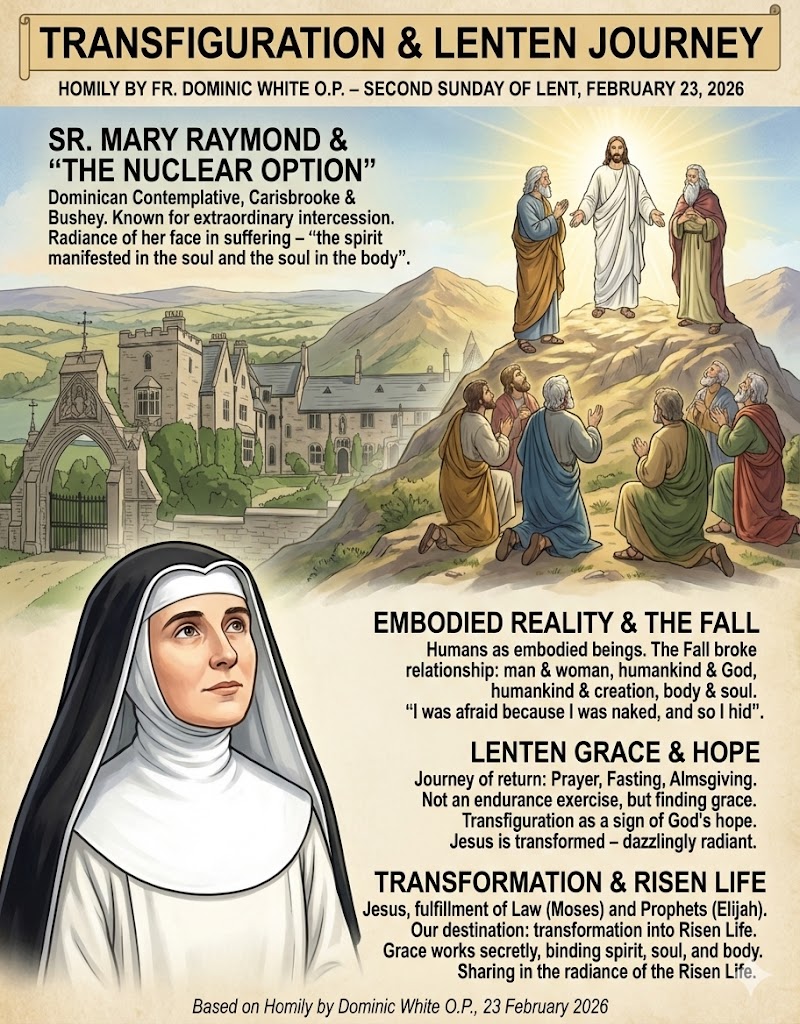
There may well be some readers of this sermon who could justifiably question the necessity of preaching, once again, the traditional ecclesiastical teaching of Lenten penance, at a time when many people are being stretched to the limit of their self-denial by a combination of inflation, increasing mortgage and rental costs and the threat of strikes that could result in a decrease in real incomes.
But this is a Torch sermon and not a Wall Street Journal ‘economic forecast’!
And so it seems more than opportune to take a look at what scripture has to say about this Lenten season in the Church’s calendar, when we are encouraged to prepare for the celebration of Christ’s Passion and death and the even greater joy of Easter and the Resurrection that follows.
Linked to that are the many references in Old and New Testament passages of the traditional observances of Lent as a time when we pause, and give ourselves time to pray, to fast and to give alms to those who are in the most need; part of what it means to be a Christian.
Permission granted for non-profits to use in ministry
The infographic was created using Nano Banana, Google's Revolutionary AI Image Generator. Infographic may not be sold or used for personal financial gain. Please show your appreciation by letting others know about TheWordThisWeek.NET.
2nd Sunday of Lent (A)
On the Road to Life
Second Sunday of Lent. Fr Dominic White is inspired by his memories of a Dominican nun.
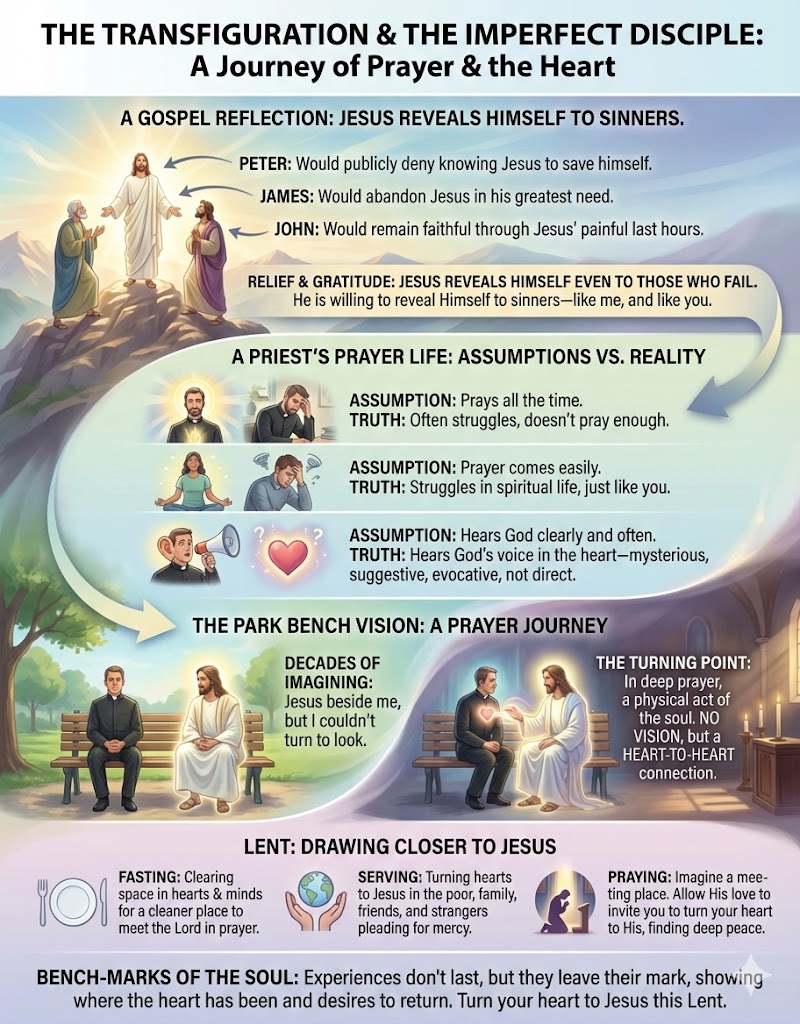
What might a holy person look like? Some years ago, when I was first ordained and working in the parish of the Rosary Shrine in London, one Sunday afternoon Fr Dermot, who was then the Prior, took me to visit a Dominican contemplative nun. Sr Mary Raymond was someone I knew a lot about but had never met. She was a schoolfriend of my godmother’s, and answered the call to the Dominican contemplative life at an early age, joining the enclosed community at Carisbrooke on the Isle of Wight. She had often prayed for my family in times of need, and had such an extraordinary gift for intercession that she was known as ‘The Nuclear Option’. In 1988 the Carisbrooke monastery closed, and she and some of the other nuns were given a home by our Dominican Sisters in Bushey, near London. When I finally got to meet her, she was in hospital, and didn’t have long to live. She was in Intensive Care and the nurse warned us she could only manage ten minutes with us. She brought us in and there was Sr Mary Raymond sitting in bed, surrounded by tubes and machines, and immediately identifiable by her Dominican veil.
I don’t remember what she said to us. But I will never forget her warmth, and above all the radiance of her face. Many years later, reading the great poet and Doctor of the Church, St Ephrem the Syrian, on how in the Resurrection we will be radiant, ‘the spirit manifested in the soul and the soul in the body,’ I realised this wasn’t just a mental image or metaphor. Rather, it was something physical. For we are embodied beings. In every culture and epoch we have found this reality of being human very difficult. Either we have tried to escape into mental fantasy, or else tried to silence the yearnings of the soul by living a purely material life. Neither will make us happy. The root of this problem is the Fall. This origin story of the mystery of sin reveals a multiple breakdown in relationship: between man and woman, humankind and God, humankind and creation – and between body and soul: ‘I was afraid because I was naked, and so I hid’ (Gen. 3:10). For the first time Adam looked at himself from outside, as if his soul was someone different from his body.
Fr. Austin Fleming

Permission granted for non-profits to use in ministry
The infographic was created using Nano Banana, Google's Revolutionary AI Image Generator. Infographic may not be sold or used for personal financial gain. Please show your appreciation by letting others know about TheWordThisWeek.NET.
2nd Sunday of Lent (A)
Lent is a Time of Drawing Closer to Jesus
Every time I read this gospel I’m reminded of the fact that of the three Jesus led up the mountain, Peter and James would abandon Jesus in his hour of greatest need, and that Peter would publicly deny even knowing Jesus in an effort to save his own neck. Only John would be faithful and present until and through the painful events of Jesus’ last hours before his death. I reflect on all of this with some amount of relief and gratitude, knowing that Jesus will reveal himself even to those who selfishly deny and cowardly betray him . In other words: Jesus is willing to reveal himself to sinners – like me, and like you. While I’d like to think that if Jesus would take me up a mountain and be transfigured in glory before my very eyes – well, certainly THEN, I’d become a more faithful follower, a more loyal disciple, a more courageous witness – than I am. But the example of our brothers, Peter and James, tell a different story. I’m continually surprised by the assumptions that many make about the relationship a priest has with Jesus and about the prayer life a priest keeps.
Monsignor Peter Hahn


Permission granted for non-profits to use in ministry
The infographic was created using Nano Banana, Google's Revolutionary AI Image Generator. Infographic may not be sold or used for personal financial gain. Please show your appreciation by letting others know about TheWordThisWeek.NET.
2nd Sunday of Lent (A)
Embracing Lenten Change
2020 HOMILY – Msgr. Hahn reflects on the nature of change, noting that while it often elicits fear when life is comfortable, we long for it when mired in dysfunction. He presents Lent as a season dedicated to the most necessary change: turning away from sin to reconcile with Christ. Using the Gospel of the Transfiguration, Hahn explains that Jesus’ physical transformation on the mountain did not make Him a different person but revealed His true identity as the Son of God.
Similarly, Lent calls believers to “go up the mountain” through prayer, fasting, and almsgiving—not to become someone new, but to be “transfigured” into their authentic selves. Hahn argues that sin obscures our true identity as God’s adopted children, while holiness reveals it. He emphasizes that we cannot change ourselves; true transformation is a gift from God, offered through baptism, the Eucharist, and grace. He concludes by inviting the congregation to embrace Lenten disciplines and the upcoming 40 Hours Devotion, allowing God to break their sinful habits so they may shine fully as His beloved sons and daughters.
Fr. Charles E. Irvin
2nd Sunday of Lent (A)
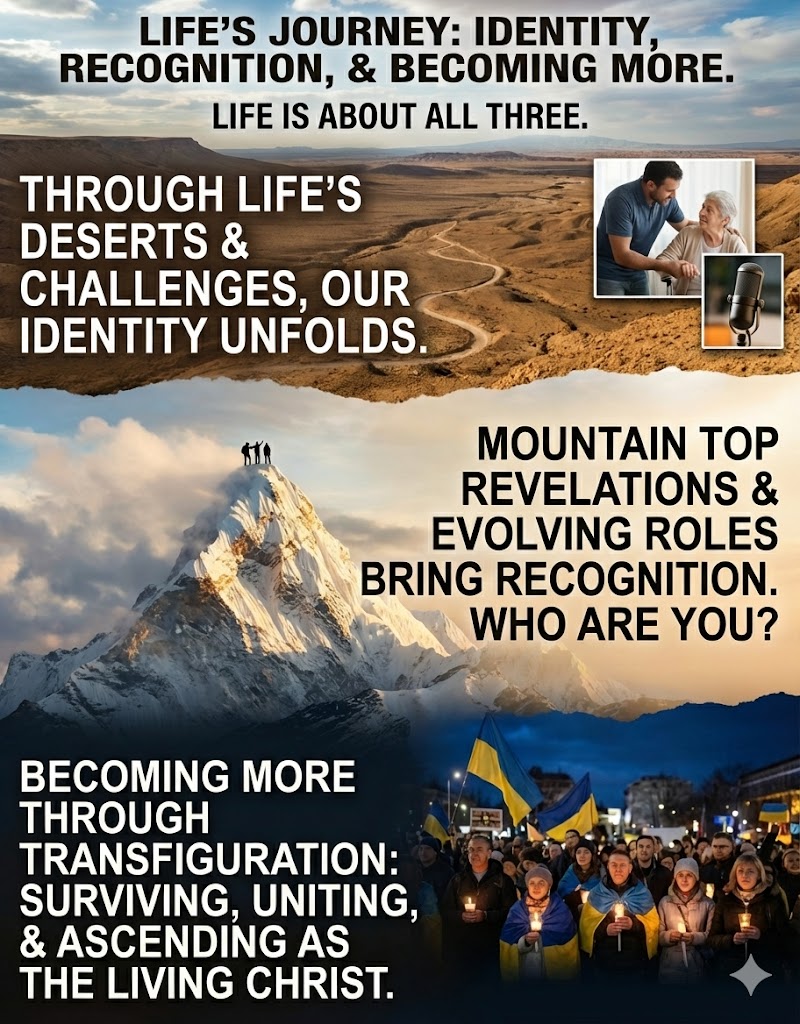
Lent as a Journey

Abraham made new room for God. So did Moses. And Jesus totally emptied himself in order to be completely filled with God’s Holy Spirit.
We speak of Lent as a journey, a moving from one place to a new and better place. We follow in the footsteps of Jesus from Bethlehem where He was born, to Nazareth where He was raised, out into the desert, then to Jerusalem where He was crucified and died, and into the tomb in which He was buried, and then into the Garden of the Resurrection, the new Garden of Eden. One day we will follow in His path by joining Him in His Ascension into heaven along with the Assumption of His mother Mary who was also taken up from this alien world into the home God has prepared for us.
The tomb of Jesus is empty because the things of this world are all destined to turn into dust. Inside of them, all of the things of this world are as empty as the tomb of Jesus. Why? Because reality is something spiritual, not material. We are dust, and unto dust we shall return, along with all of the glitter of this world. Our citizenship and our home are elsewhere and our hearts will not rest until they rest in the home God has prepared for us.
Fr. Joe Jagodensky, SDS
Permission granted for non-profits to use in ministry
The infographic was created using Nano Banana, Google's Revolutionary AI Image Generator. Infographic may not be sold or used for personal financial gain. Please show your appreciation by letting others know about TheWordThisWeek.NET.
2nd Sunday of Lent (A)
“Transfiguration,” Jesus’ and Ours

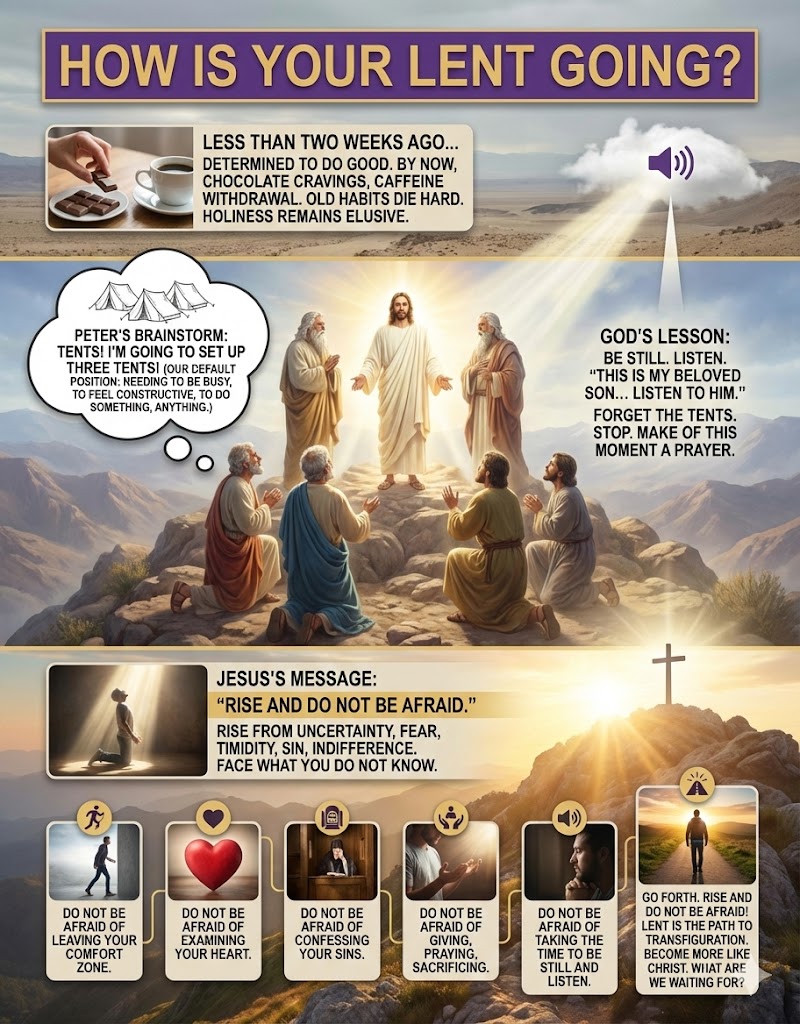
I’ve mentioned before the most asked question of Jesus is not whether you’re going to heaven or not. Or, how many times you missed weekend Mass. The most asked question of Jesus is, “Who are you?” Who are you to me? Who am I to you? Who am I with you? Just think of all the identities we can place upon the Son of God.
But, what if? What if? Jesus as an adult. Finds a steady job as a carpenter, his father teaches him well. Joins a union with decent pay. Finds a good wife, couple of kids, Jesus, Jr., and MaryAnn; retire at fifty-five with a substantial pension and solid investments. Kids are now on their own, and Jesus and the misses become Arizona snowbirds between November through March. They return for Easter. Oh, wait. There is no Easter. Ahhh. Where’s Frank Sinatra singing, “Oh, the good life..”
Identity, recognition. A boy becomes a man, then dad, then grand, and sometimes even reaching great added before his name. I’m a freshly ordained priest, and my dad keeps calling me “Father.” I said to him, “We can’t keep doing this Dad. I’m Joe.” (“Hi Father. Oh, hi Father…”)
Deacon Greg Kandra
Permission granted for non-profits to use in ministry
The infographic was created using Nano Banana, Google's Revolutionary AI Image Generator. Infographic may not be sold or used for personal financial gain. Please show your appreciation by letting others know about TheWordThisWeek.NET.
2nd Sunday of Lent (A)
Rise and Do Not be Afraid
How is your Lent going?
Less than two weeks ago, we marched out into the world with ashes on our brows, determined to do good and be better — to pray more, to give up those things we love, to be more charitable, more loving, more generous.
Of course, by now, it hasn’t always worked out that way. The first idealistic rush of Ash Wednesday has given way to chocolate cravings, caffeine withdrawal, and the desire to scream at everyone on Facebook. Old habits die hard.
Holiness, for most of us, remains elusive.
But at just the right moment, the Church gives us this remarkable Gospel, one with a powerful lesson for Lent — and for living.
It couldn’t have come at a better time.
We find ourselves on a mountaintop with Peter, James and John, where we have been led by Jesus to witness something astonishing — the only event of its kind recorded in the Gospels, the Transfiguration.
— originally published in 2020
Fr. Langeh, CMF

2nd Sunday of Lent (A)
Go Up to the Mountain

Today’s First Reading tells us of Abraham’s call and manifestation of faith in God. His faith warrants him to be called our Father of Faith. He accepts to go to an unknown destination and he believed in an unknown God. God blessed him and he received the promise of becoming the father of a multitude. Later, in the reading of Genesis, Abraham had difficulties having a biological son from his union with his legitimate wife Sarah. Even when he finally had a son, God ordered him to offer Isaac in sacrifice on the mountain. Lent is also the passage by mount Tabor, that of Transfiguration. Jesus’ life that ends on the Cross is connected with the heavenly visit he receives on this mountain. God reassures Him of His salvation mission. The Father encourages Jesus to go on as He shall be with Him. The event on this mountain reveals what will happen to Jesus. As God led Moses and Elijah to the Holy Mountain to witness His glory (Ex 33:18; 1K 19:9), so too does Jesus lead the apostles. They also climb the mountain and there Jesus manifests His glory to them. In the transfiguration, the Holy Apostles were introduced to a new range of ideas, into a new sphere of contemplation and into the glimpse of a new heaven. The transfiguration is one of the most important manifestations of God in the New Testament. Some scholars call it the “summary of all revelation.” The Law and the Prophets spokesmen, Moses and Elijah, (all of the Old Testament) presents Christ to the Apostles Peter, James and John who will be responsible for preaching the Gospel.
Deacon Peter McCulloch
Permission granted for non-profits to use in ministry
The infographic was created using Nano Banana, Google's Revolutionary AI Image Generator. Infographic may not be sold or used for personal financial gain. Please show your appreciation by letting others know about TheWordThisWeek.NET.
2nd Sunday of Lent (A)
On Restoring Our Divinity
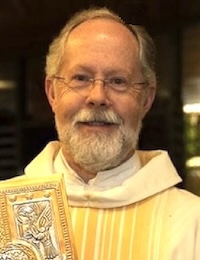
On the ceiling of the Sistine Chapel in Rome is Michelangelo’s painting of two hands reaching out to each other. It depicts the moment when God created Adam in his own image and likeness (Gen.1:27). But as we know, Adam tarnished that divine image at the Fall, when he and Eve chose to turn away from God in the Garden of Eden (Gen.3). Mankind has been struggling with sin and suffering ever since.
God has not abandoned us, however. He’s still determined to share his divine life with us. That’s why he sent his Son to live among us, and that’s why his Holy Spirit is still with us (Jn.3:16; Jn.14:16). As St Athanasius put it, ‘God became human, so that humans might become like God’. [i]
So, there’s another way to read Michelangelo’s famous painting. It represents God the Father continually reaching out to Adam (and to us) as he tries to restore the divinity embedded in our all-too-human selves. Through Jesus Christ, our heavenly Father is constantly trying to draw us back into his divine life (2Pet.1:3-4).
St Paul says that we are called to be imitators of God, as his beloved children (Eph.5:1). We all came from God, and by the grace of baptism we have been formally received into God’s family as his adopted daughters and sons. This means that we really are God’s children, for we have been deified and made holy.
Permission granted for non-profits to use in ministry
The infographic was created using Nano Banana, Google's Revolutionary AI Image Generator. Infographic may not be sold or used for personal financial gain. Please show your appreciation by letting others know about TheWordThisWeek.NET.
2nd Sunday of Lent (A)
The Number Three
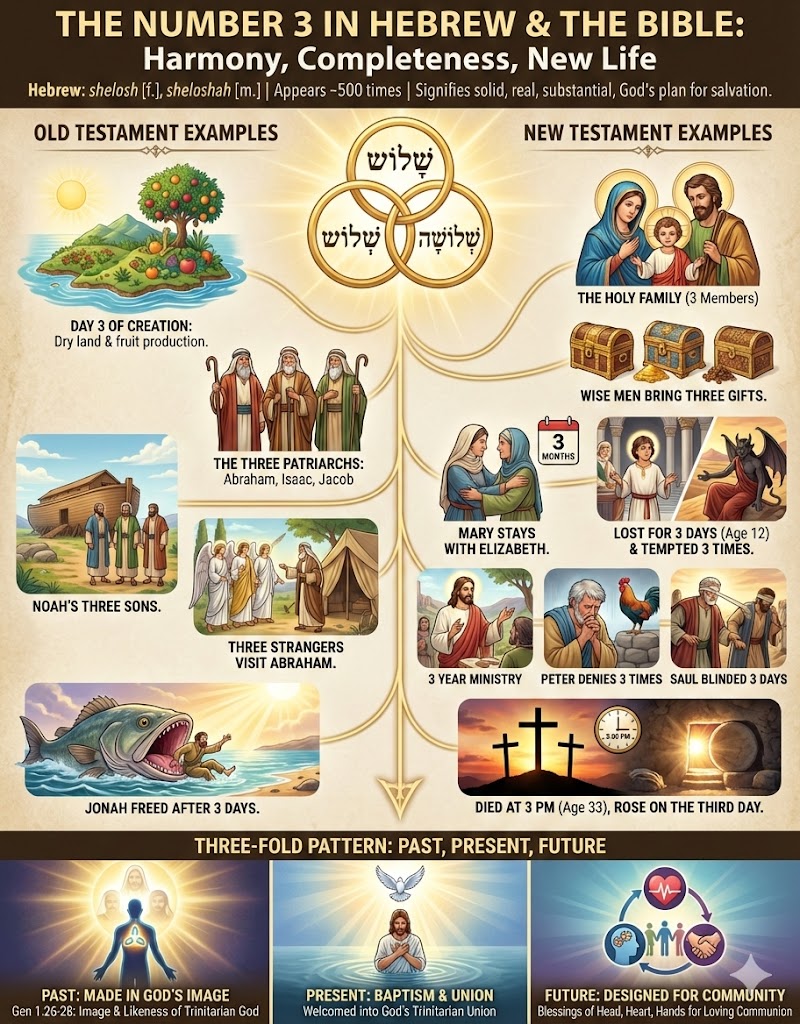
Some people love numbers; they’re fascinated by the patterns they find in them. So, today I’d like to talk about the number 3.
In ancient Greece, the philosopher Pythagoras (c.570 – 495 BC) taught that numbers have meaning and that 3 is the perfect number because it represents harmony, wisdom and understanding.
In the Hebrew language, numbers also have meaning, and this is reflected in the Bible which is full of numbers. Indeed, numbers are never used randomly in Scripture; they always mean something.
In Hebrew, the number 3 (shelosh [f.], sheloshah [m.]) represents harmony, completeness and new life, and it appears in the Bible almost 500 times. When it does, this number typically represents something that’s solid, real and substantial, and it points to something important, such as God’s plan for our salvation.
Consider these examples from the Old Testament. On the third day of Creation, God made the dry land and it began producing fruit. Abraham, Isaac and Jacob were the three fathers of Israel. Noah had three sons. Three strangers visited Abraham, and Jonah was freed after three days inside the belly of a whale.
In the New Testament, the Holy Family has three members. The Wise Men bring three gifts. Mary stays with Elizabeth for three months. Jesus is lost for three days at the age of twelve. He is tempted three times in the desert. His public ministry lasts for three years. Peter denies Jesus three times. Saul is blinded for three days. Jesus prays three times in the Garden of Gethsemane. And at the age of 33, Jesus also dies at 3.00pm, and rises from the dead on the third day.

Permission granted for non-profits to use in ministry
The infographic was created using Nano Banana, Google's Revolutionary AI Image Generator. Infographic may not be sold or used for personal financial gain. Please show your appreciation by letting others know about TheWordThisWeek.NET.
2nd Sunday of Lent (A)
Mountain Light
Lent isn’t just about giving things up. It’s also about being transformed, by letting grace strip away what is false in us so that we can become more like Jesus Christ.
That’s why the disciples become fearful, for transformation can be challenging. And that’s why Peter offers to build tents, because it’s easier to stay on the mountain than face the valley below.
But a voice from the cloud says: ‘This is my beloved Son… listen to Him.’ So, they all follow Jesus off the mountain.
John Paul II left the mountain to confront totalitarianism with hope. Mother Teresa left the mountain to touch Christ in the poorest of the poor. And you and I come down from the mountain each week after receiving the Eucharist. For every Mass is our Tabor. Every Communion is a flash of divine light. And every prayerful encounter with Jesus strengthens us for mission.
But we’re not meant to stay on the mountain. Our task is to carry that light back down into the valley, into our world of sadness and confusion, of conflict and fear.
Msgr. Charles Pope
Permission granted for non-profits to use in ministry
The infographic was created using Nano Banana, Google's Revolutionary AI Image Generator. Infographic may not be sold or used for personal financial gain. Please show your appreciation by letting others know about TheWordThisWeek.NET.
2nd Sunday of Lent (A)
Every Round Goes Higher

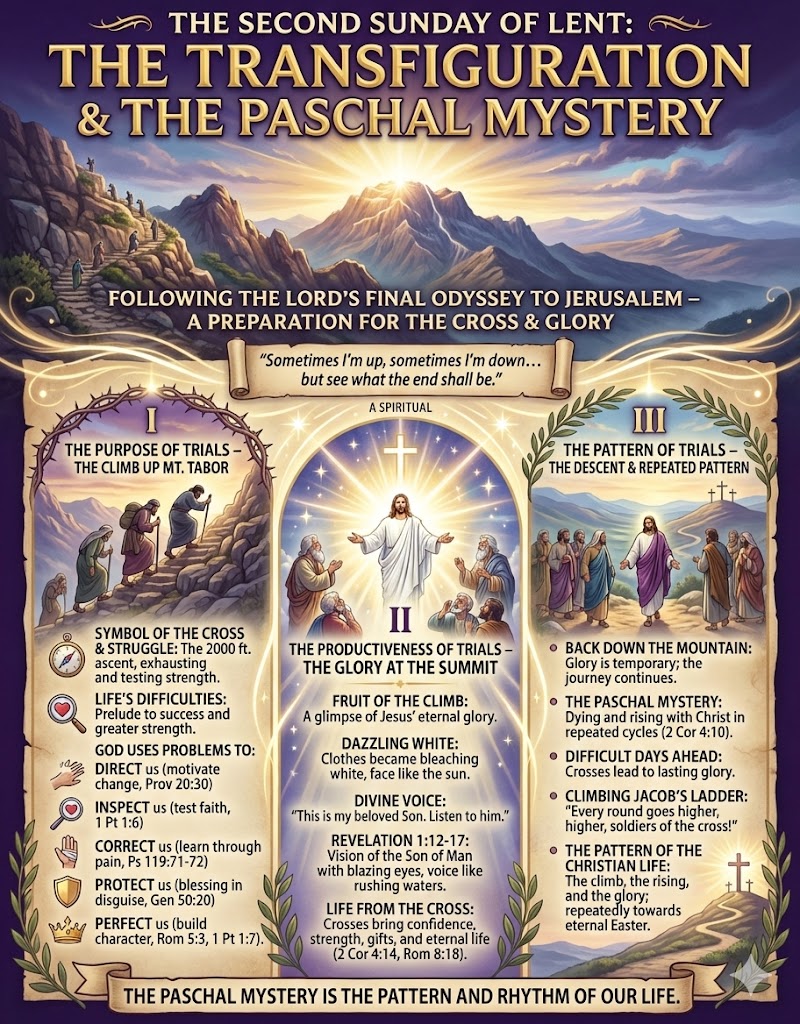
The second Sunday of Lent always features the Transfiguration. This is because we are following the Lord on His final odyssey to Jerusalem, and this journey up Mt. Tabor was one of His stops (with Peter, James, and John).
It is commonly held that Jesus did this to prepare His apostles for the difficult days ahead. There’s a line from an old spiritual that says, “Sometimes I’m up, sometimes I’m down, sometimes I’m almost on the ground … but see what the end shall be.” This is what the Lord is doing here: He is showing us what the end shall be. There is a cross to get through but there is glory on the other side.
The purpose in placing the account of the Transfiguration here is that it helps describe the pattern of the Christian life, which is the paschal mystery. We are always dying and rising with Christ in repeated cycles as we journey to an eternal Easter (cf 2 Cor4:10). This Gospel shows forth the pattern of the cross: the climb, the rising, and the glory of the mountaintop. Then it is back down the mountain again only to climb another one (Golgotha), and through it find another glory (Easter Sunday). Let’s look at today’s Gospel in three stages.
I The Purpose of Trials
II The Productiveness of Trials
III. The Pattern of Trials
Father Kevin Rettig


Permission granted for non-profits to use in ministry
The infographic was created using Nano Banana, Google's Revolutionary AI Image Generator. Infographic may not be sold or used for personal financial gain. Please show your appreciation by letting others know about TheWordThisWeek.NET.
2nd Sunday of Lent (A)
Spoiler Alert

In this age of television and movies in this age of quick communication and reviews and internet type and buzz we can hear all about a story or a show or a film before actually seeing or reading it. This can be very helpful in deciding what we are willing to go see so that we do not waste time and money on something we do not enjoy. We are curious to know all about the story beforehand. So by the time we actually experience it before we see the film or read the book. It’s quite familiar to us. Now that’s all well and good but there are many things that are best left unknown as knowing them ahead of time ruins. The whole experience for us. We are so curious to know the ending but the ending is the one thing we should not know can you imagine enjoying an Agatha Christie novel or an Alfred Hitchcock film without the suspense. Without the surprise. There would be no point. A new term has even entered the English language spoiler alert that happens when we are listening to a discussion about a movie or a story and we are told to hold our ears if we haven’t seen it yet because an important detail about the plot is about to be revealed something that would spoil it all for us. It is one thing to know before the movie starts that the Titanic is going to go down but it is quite another thing to be told whether your favorite characters are going to survive it.

Permission granted for non-profits to use in ministry
The infographic was created using Nano Banana, Google's Revolutionary AI Image Generator. Infographic may not be sold or used for personal financial gain. Please show your appreciation by letting others know about TheWordThisWeek.NET.
2nd Sunday of Lent (A)
Good to Be Here
Fr. Kevin opens with the story of violinist Giuseppe Tartini, who composed his greatest work after a vivid dream where the devil played magnificent music. This illustrates that even encounters with evil can lead to something valuable. Fr. Kevin notes that while we are often shocked by pain and unpleasant people, Jesus found His true mission through encountering evil in the desert.
Referencing Solzhenitsyn, he reminds us that the line between good and evil runs through every human heart, not just externally in others. We must therefore learn from unpleasant experiences. Fr. Kevin shares a story of a preacher who valued a constantly critical parishioner as a necessary “thorn” that helped him grow; without resistance, we stagnate. Ultimately, we must embrace all aspects of life—deserts and darkness alongside gardens and light—for God often composes the most beautiful parts of our life’s song during our darkest moments.

2nd Sunday of Lent (A)
Moving Stairs
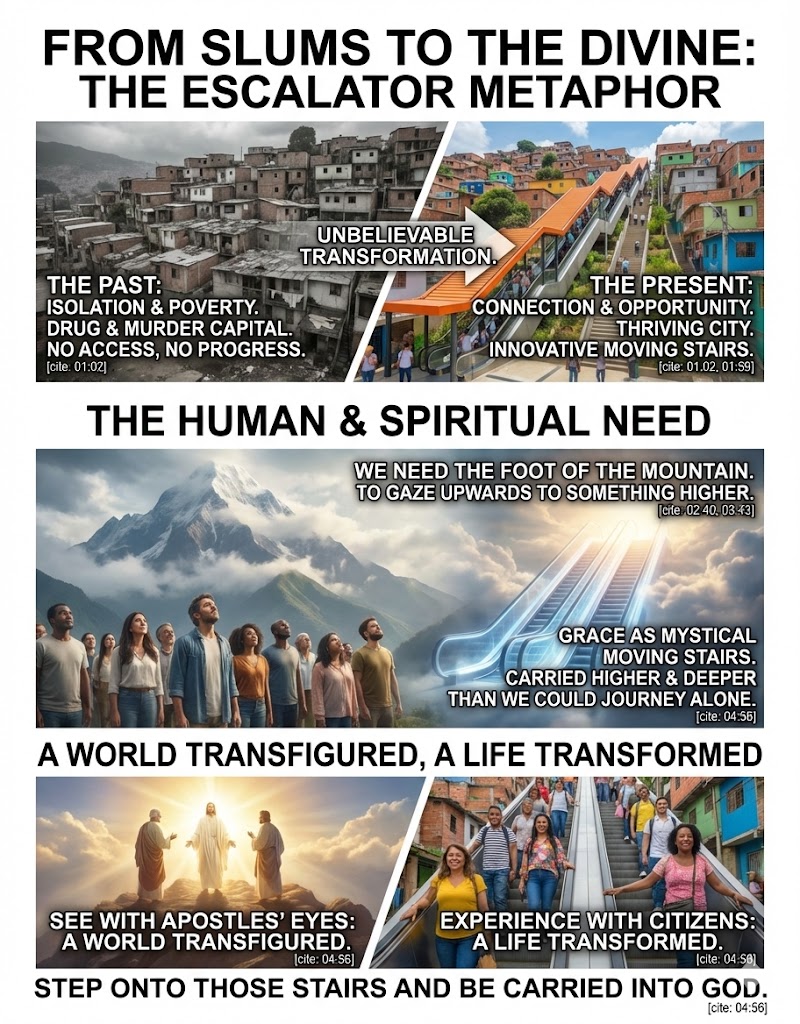
We all have a deep seated need to ascend the heights, but also a need to come down to earth. As the mountain of the Transfiguration brought the people higher, it also took them deeper into their souls. We cannot be long on a mountain top, for we always need to look toward something higher; looking up is our nature.
Fr. George Smiga
Permission granted for non-profits to use in ministry
The infographic was created using Nano Banana, Google's Revolutionary AI Image Generator. Infographic may not be sold or used for personal financial gain. Please show your appreciation by letting others know about TheWordThisWeek.NET.
2nd Sunday of Lent (A)
The Truth of Blinking

2008 HOMILY – This homily supports the notion that there are more things to life than our eyes can see. In today’s Gospel, the disciples experience the transfiguration and receive a glimpse of Jesus’ glory which normally they did not see. This experience tells us that there is more to others than we can see, such as different races, nationalities, sexual orientations and religious beliefs. We must be humble when we interact with them and remember that there are still things we don’t understand. The same applies to evil and suffering in this world. We must accept and respect our limitations by trusting that in time, with God’s help, the light to which our eyes are closed will be revealed.