Homilies
Homilies
February 22, 2026
February 22, 2026
1st Sunday of Lent (A)



DEEP DIVE PODCAST
FEATURING Deacon Peter McCulloch, Msgr. Pope, Deacon Kandra, Fr. Joe Pellegrino, Fr. Rettig, Bishop Barron, Fr. Smiga, Fr Leo Edgar (Dominican Blackfriar).

Sunday’s Homily Hooks, Theology, and Strategy
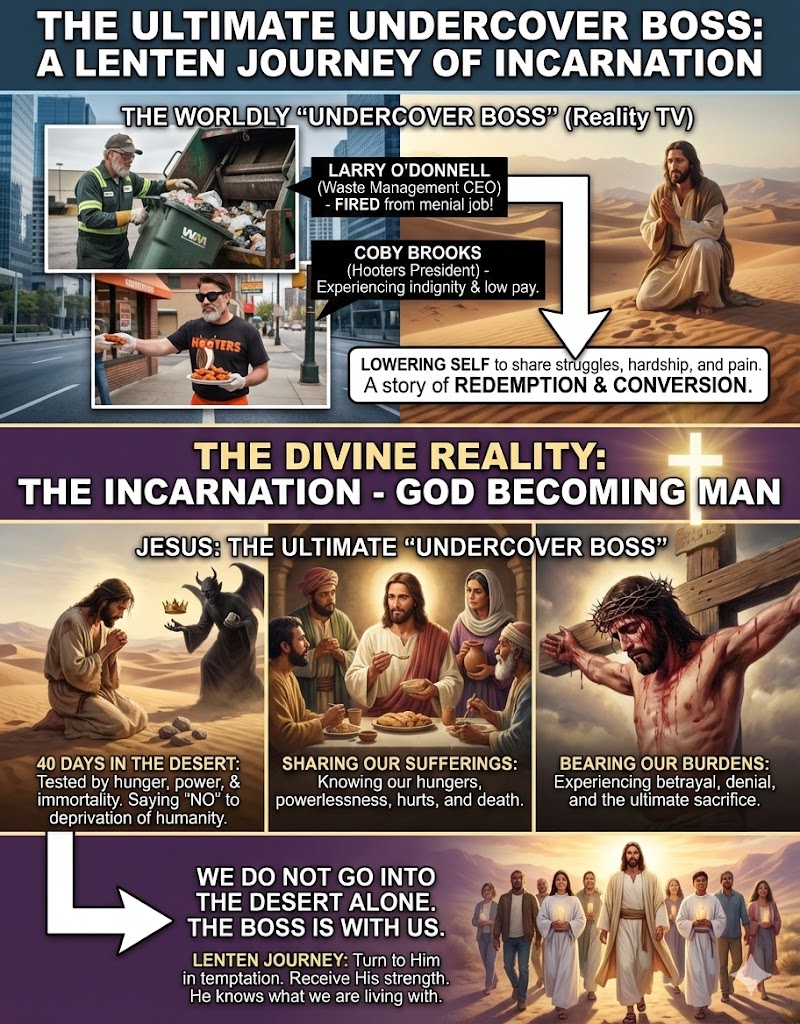
This episode focuses on the Temptation of Christ. It highlights and discusses several vivid metaphors featured homilists on this page have used in their homilies, such as the “Undercover Boss” representing Jesus’s solidarity with human struggle and the “Gazelle Trap” illustrating how temptation works through gradual seduction rather than force. The hosts discuss how evil acts as “distorted goods” targeting our strengths and conclude by challenging believers to become “angels” ministering to one another
Bishop Robert Barron

1st Sunday of Lent (A)
Back to Basics

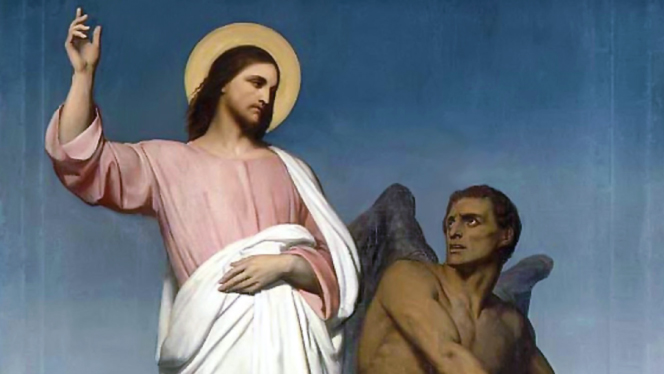
PODCAST—For the first Sunday of Lent, the church brings us back to spiritual training camp and encourages us to review the basics. We are in the garden with Adam and Eve and in the desert with Jesus. When the devil approaches us, do we respond as they did, or as he did? Everything else will flow from that decision.
1st Sunday of Lent (A)
Thre Shortcuts from the Cross
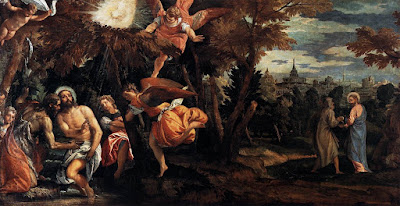
PODCAST—Our Gospel for the first Sunday of Lent covers the three “shortcuts” the Devil offered Jesus to lure him away from his central mission of the cross. The Devil chose these temptations because he knew that Jesus would not be primarily a social reformer, or a wonder-worker, or a political operator. He would be the Lamb of God who takes away the sins of the world. Knowing who Jesus is and what he is about is indispensable as we commence the Lenten season.
1st Sunday of Lent (A)
The Disobedience of Adam and Eve
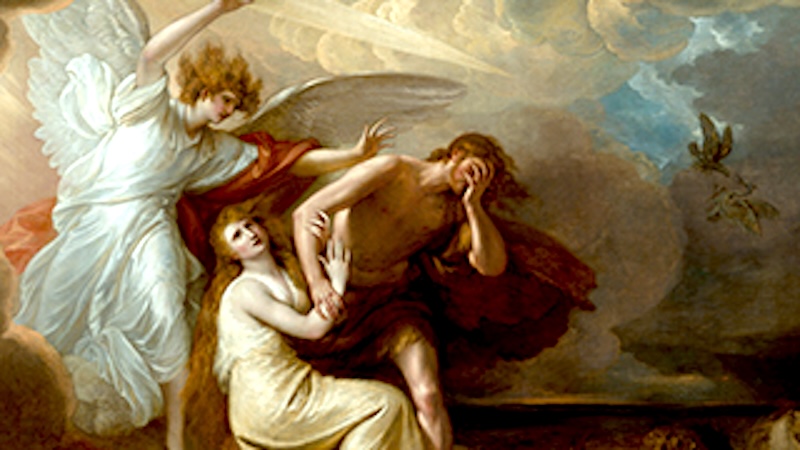
PODCAST—We enter once more into the very holy season of Lent: a time of preparation; a desert time; a time of prayer, fasting, and almsgiving; a time to return to the basics. And so how wonderful that the Church gives us, for this first Sunday of Lent, a passage from the very beginning of the Bible, a story of universal and enduring significance. We hear of the creation and fall of mankind. But we will not properly understand this epic tale until we see that it has to do with us.

1st Sunday of Lent (A)
Time to Get Back to Basics
Friends, we come now to the holy season of Lent, our preparation for Easter. I’ve often said that Lent is a time to get back to basics. It’s like when you’re starting the football season and have to get back to fundamentals of the game, or when you’re getting back to playing golf after a long winter away and have to remember the fundamentals of the swing. So in the spiritual order there are certain fundamental truths, and the readings for this first Sunday of Lent are especially good at getting us in touch with them.

1st Sunday of Lent (A)
Coming Soon
Friends, today we come to the third Sunday of Advent, and the great image from Isaiah is that of the blooming desert. Many of us pass through desert times, dry periods of trial and training. But perhaps the Lord has drawn us into the desert to awaken a deeper sense of dependence upon him. We must be patient; and in this season of waiting, we look toward Christmas—the great blooming in the desert.
Fr. Michael Chua
Permission granted for non-profits to use in ministry
The infographic was created using Nano Banana, Google's Revolutionary AI Image Generator. Infographic may not be sold or used for personal financial gain. Please show your appreciation by letting others know about TheWordThisWeek.NET.
1st Sunday of Lent (A)
The Heart of Temptation

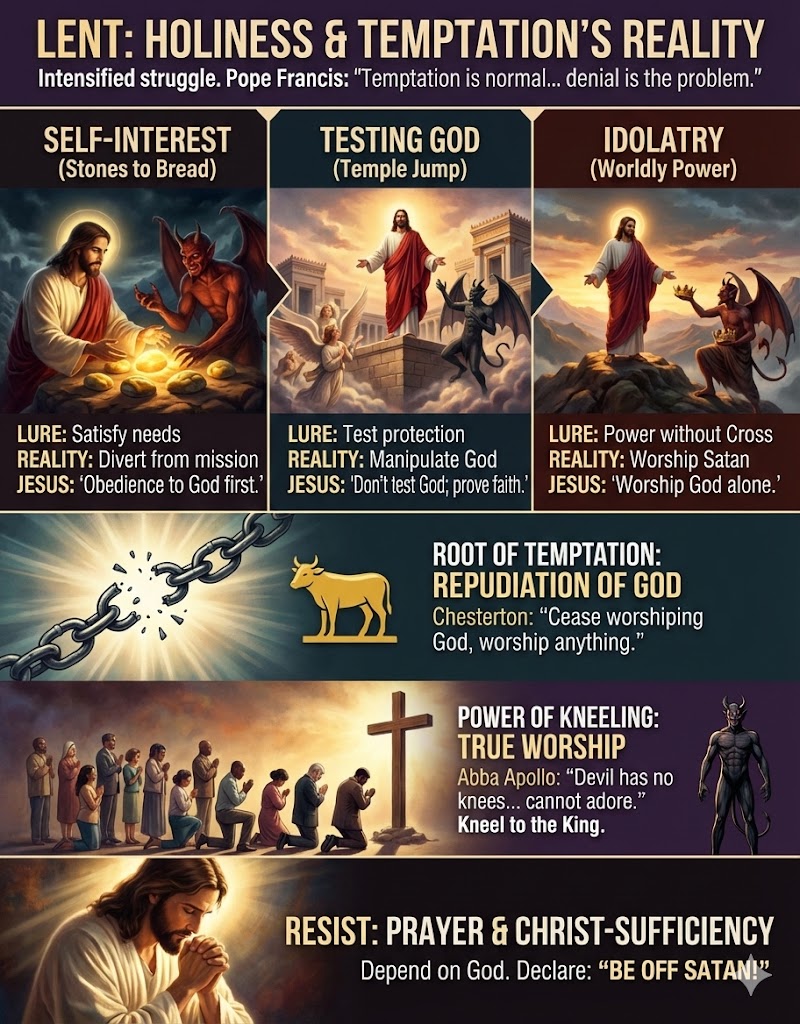
It’s Lent again, time to double or triple our efforts to get holy. Strangely enough, this is the time of the year, when temptation doesn’t get any sweeter or more alluring. The more we wish to grow in intimacy with God, the greater would be Satan’s effort to frustrate that goal. At the beginning of his pontificate, our Holy Father, Pope Francis, who is fond of speaking about the devil as a real being rather than just some impersonal concept, had this to say about temptation: “Temptation is a normal part of life’s struggle, and anyone who claims to be immune from it is either a little angel visiting from heaven or “a bit of an idiot.”” He added that the biggest problem in the world isn’t temptation or sin, rather it is people deluding themselves into believing that they’re not sinners and losing all sense of sin. That is why the Church begins this First Sunday in Lent with a meditation of the temptation of Christ. Yes, it is both challenging and comforting to acknowledge that no one is immune to temptation. Not even a hero. Not even a nobody. Not even people like you and me. And certainly not even Christ, the sinless One, the Son of God.
From the waters of the Jordan, the Spirit leads our Lord into the harsh wilderness to be tempted by Satan. The gospel presents this ordeal as an escalating series of three temptations. The first temptation is most subtle, seems harmless, innocent and even rationally necessary. The second is less so, but yet the lure of an audience could be interpreted as giving glory to God for a wondrous miracle. But the third temptation is the most blatant and audacious. All three are attempts by the Enemy to divert our Lord from the path of human suffering, the way of the cross, and ultimately from the obedience to the Father’s plan that His mission entails.
Permission granted for non-profits to use in ministry
The infographic was created using Nano Banana, Google's Revolutionary AI Image Generator. Infographic may not be sold or used for personal financial gain. Please show your appreciation by letting others know about TheWordThisWeek.NET.
1st Sunday of Lent (A)
Not Everything which Looks Good is Good
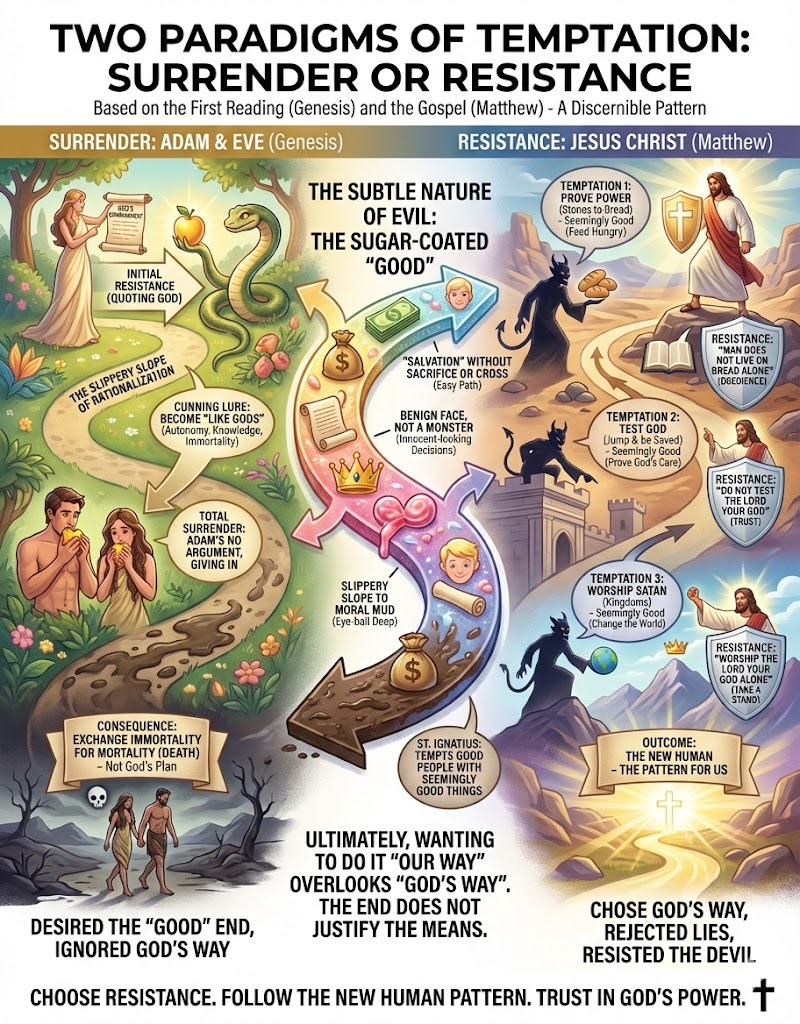
The first reading and the gospel provides us with two paradigms of dealing with temptation – we can either surrender or resist at all cost. In the first reading, Eve surrendered to the serpent’s temptation of rationalising disobedience to God’s will. But in case one is tempted to blame her for man’s fall, we need to commend her for at least putting up a fight in initially resisting the serpent’s temptation by quoting God’s commandments. We can’t say the same for Adam. He gave in to his wife’s offer without any argument. No resistance, no fight, no struggle.
The serpent’s temptation is insidiously cunning. It provides an end that seems most desirable – becoming “like gods” who would autonomously know what is right and wrong. This ambition to be god-like has been man’s perennial temptation – hoping to achieve it through knowledge, through technological advancement, through medical discoveries which seek to prolong one’s life and perhaps one day, guarantee immortality. The irony in the story of the Fall, is that in desiring to be immortal gods, both Adam and Eve surrendered their natural gift of immortality (symbolised by the tree of life and its fruits which were available to them) and exchanged it for mortality – death, which was not part of God’s original plan for them, but because they chose to disobey God’s warning, death became their lot and that of their descendants.
In today’s gospel, the devil tempts Jesus three times. He tempts Jesus to prove that He is the Son of God by turning stones into bread. He tempts Jesus to test God and see if God will really save Him, and he deceitfully promises Jesus all the kingdoms of the earth if He will worship him. Unlike the first human beings, Jesus does not succumb to the devil’s temptations. Unlike Adam and Eve, Jesus chooses to resist the devil, reject his lies and took a stand for God. Rather than challenge and disobey God, He obeys God and trusts in God’s power to save Him. Jesus is the New Human Being, the pattern for what we must become.


Permission granted for non-profits to use in ministry
The infographic was created using Nano Banana, Google's Revolutionary AI Image Generator. Infographic may not be sold or used for personal financial gain. Please show your appreciation by letting others know about TheWordThisWeek.NET.
1st Sunday of Lent (A)
Boast of the Lord
Our God has no need of our praise. He is not so conceited (unlike us) that He constantly desires our adulations. He doesn’t crave for our attention or affirmation as we obsessively do. It is also good to remember that God is not diminished by the lack of praises offered to Him, neither is He empowered by any amount of praise which we can offer Him. But it is we who are diminished when we forget to praise Him, to thank Him, to adore Him. We are made for this purpose. We were made to worship God, to give Him all glory and praise. So, when we fail to do so, we become less than human. When we do not worship God, we end up worshipping something else and in this age of acute narcissism, the most popular object of worship is ourselves. This is the reason why it is more common to boast of our own achievements than it is to boast of God’s goodness and graces.
And that is also the reason why the Holy Mass, the highest form of worship to God, is the greatest antidote to our narcissism. Why do so many people complain that Mass is boring? My answer is simply this – the Mass is inherently boring because it is not about us but about God. God is worshipped, not man. The Mass is not another opportunity to showcase our talents or achievements. When we examine what it means to experience “boredom”, it is that we are not the centre of the attention. Something or some activity is described as boring because we are not getting the attention we want from others.
So let us boast by praising not ourselves but God, not for anything we have of ourselves, but for what He has given us! This is at the heart of our worship rendered in the Holy Sacrifice of the Mass which is our Thanksgiving offered to God. Let our hearts and our minds nurture His gifts, until He grants us our reward, that we may sing His praises forever in heaven! All glory and all praise belong to Him and Him alone!
Dominican Blackfriars
Permission granted for non-profits to use in ministry
The infographic was created using Nano Banana, Google's Revolutionary AI Image Generator. Infographic may not be sold or used for personal financial gain. Please show your appreciation by letting others know about TheWordThisWeek.NET.
1st Sunday of Lent (A)
Battle Ready

First Sunday of Lent (A) | Br Samuel Burke surveys our battleplan for Lent.
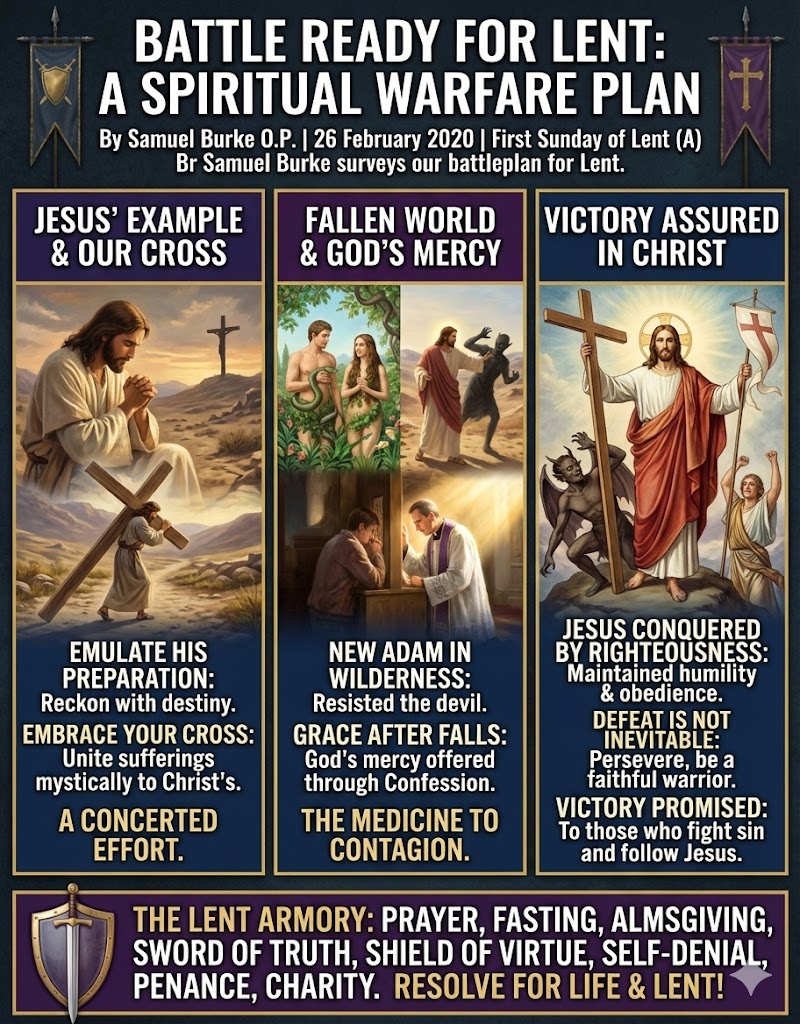
Lent can be thought of as battle! It’s a time when we engage in a kind of assault against spiritual evils in order to ebb away at those things that come between us and God. Perhaps that might sound a little swashbuckling? But for good reason, many prayers and writings in the Christian tradition talk about spiritual warfare and describe Lent especially in militaristic terms. This idiom is appropriate in that a good Lent calls for nothing less than a concerted and consistent effort. For just as a war is won over the course of several battles, our striving to follow Christ is a long road, which includes many trials. In Lent especially, we survey that road and resolve to make some progress in the spiritual life, by the grace of God.
Like any military operation, we need maps and a good battle-plan, which guide and details our strategy. We need to adopt an approach in which we focus on some concrete objectives and anticipate weaknesses. Then there’s the weaponry. The traditional armoury for the Lent campaign consists in prayer, fasting and almsgiving. To this might be added what old tomes of chivalry refer to as the sword of truth and the shield of virtue. Extending the analogy even further, we might like to think of some cavalry, besides: self-denial, penance, spiritual exercises, and active works of charity. But whilst plans and equipment are essential, they are useless without a certain resolve, without a certain faith. The enemy of such determination is fear. Fear can take many forms. A common fear is the fear of failure. One can even wonder despondently whether victory is even possible. To this debilitating malaise, this Sunday’s readings offer some important things to say to us.


Permission granted for non-profits to use in ministry
The infographic was created using Nano Banana, Google's Revolutionary AI Image Generator. Infographic may not be sold or used for personal financial gain. Please show your appreciation by letting others know about TheWordThisWeek.NET.
1st Sunday of Lent (A)
Lenten Exercises
First Sunday of Lent. Fr Leo Edgar suggests that our Lenten preparation can be aided by our certain confidence in the power of Christ.
There may well be some readers of this sermon who could justifiably question the necessity of preaching, once again, the traditional ecclesiastical teaching of Lenten penance, at a time when many people are being stretched to the limit of their self-denial by a combination of inflation, increasing mortgage and rental costs and the threat of strikes that could result in a decrease in real incomes.
But this is a Torch sermon and not a Wall Street Journal ‘economic forecast’!
And so it seems more than opportune to take a look at what scripture has to say about this Lenten season in the Church’s calendar, when we are encouraged to prepare for the celebration of Christ’s Passion and death and the even greater joy of Easter and the Resurrection that follows.
Linked to that are the many references in Old and New Testament passages of the traditional observances of Lent as a time when we pause, and give ourselves time to pray, to fast and to give alms to those who are in the most need; part of what it means to be a Christian.

Permission granted for non-profits to use in ministry
The infographic was created using Nano Banana, Google's Revolutionary AI Image Generator. Infographic may not be sold or used for personal financial gain. Please show your appreciation by letting others know about TheWordThisWeek.NET.
1st Sunday of Lent (A)
How to be Happy
Fourth Sunday of the Year. Fr Robert Verrill explains the relationship between the Beatitudes and the life of virtue.
Those who are poor in spirit have actively turned away from prizing worldly goods, since they have set their hearts on the kingdom of heaven. Those who mourn let go of their worldly aspirations, and instead long for the conversion of sinners. Those who are meek are in complete control of their emotions, so that they can wait with tranquil hearts for the promises of Christ. Those who hunger and thirst for righteousness actively pursue works of justice which bring such delight to God. Those who are merciful are full of generosity, actively sharing the mercy they have received from God. Those who are pure in heart have a single-minded devotion to the will of God in all that they do. Those who are peacemakers build up harmonious communities whose members recognize each other’s dignity as children of God. And those who are persecuted for righteousness’ sake actively pick up their cross and follow Christ, confident that He is leading them to the kingdom of heaven.
Modern notions of happiness diverge from the true happiness of Jesus Christ when people seek complete autonomy in their actions and independence from God. The mistake is to view God’s activity and our activity as being in competition. But in reality, there is no competition, for God is the very source of our being – He is closer to us than we are to ourselves. So if we allow God to move us from within, we will be truly happy, we will be truly blessed, for dwelling with God is the activity for which we were made.tead he moves to Capernaum, a town, we are told, on the borders of Zebulun and Naphtali, two of the twelve tribes of Israel.
Fr. Austin Fleming
Permission granted for non-profits to use in ministry
The infographic was created using Nano Banana, Google's Revolutionary AI Image Generator. Infographic may not be sold or used for personal financial gain. Please show your appreciation by letting others know about TheWordThisWeek.NET.
1st Sunday of Lent (A)
By What Measure of Goodness do We Measure Ourselves?
Two great scenes in the scriptures this morning: first, a naked couple in a garden of paradise and then the desert drama of Jesus going one-on-one with the devil himself! And at the heart of these two stories – two invitations: an invitation to temptation and an invitation to conversion. Conversion…
Writing about conversion, Thomas Merton said:
It is relatively easy to convert the sinner.
But good people are often completely un-convertible
– simply because they do not see any need for conversion*
I think that might be many of us, and I know it would be me, too much of the time. “I’m a good guy! At least I like to think I’m a good guy. And people tell me I’m a good pastor (well, not all, but a lot of people do!). What conversion do I need? What needs turning around in my life?”
And how about YOU? You’re good folks! ‘Nary a drug-dealer, bank-robber or murderer among you. You work hard, you try to do the right thing. You believe in God. Hey! You’re in church on Sunday morning, right? Why would you need conversion?

Monsignor Peter Hahn
Permission granted for non-profits to use in ministry
The infographic was created using Nano Banana, Google's Revolutionary AI Image Generator. Infographic may not be sold or used for personal financial gain. Please show your appreciation by letting others know about TheWordThisWeek.NET.

1st Sunday of Lent (A)
Our Shared Darkness and God’s Infinite Mercy

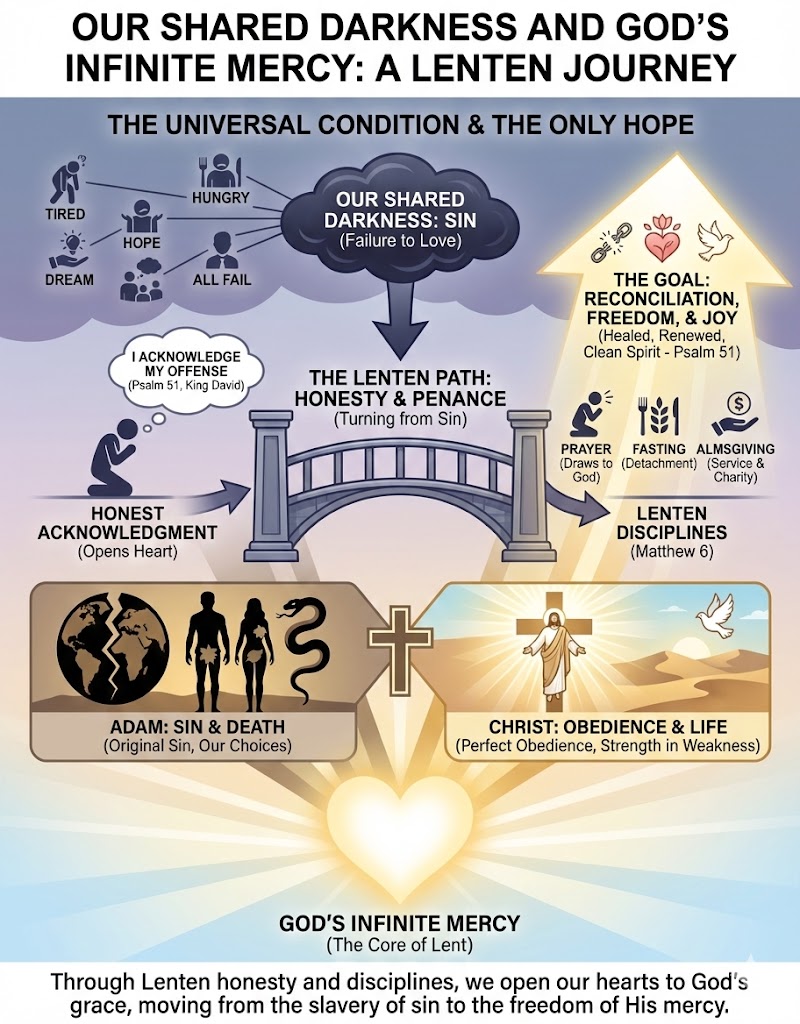
2020 HOMILY – Msgr. Hahn asserts that while humanity shares many experiences, our darkest unifying factor is sin—our failure to love God adequately. Therefore, our only real hope lies in God’s infinite mercy. This dynamic of honestly acknowledging sin to open our hearts to grace is the core of Lent.
Citing King David’s penitential Psalm 51, Hahn urges us to admit our offenses to escape sin’s slavery and find freedom in God’s mercy. He contrasts Adam bringing death through sin with Christ bringing life through obedience. In the Gospel, Jesus fasts in the desert, associating Himself with our weakness and demonstrating the strength gained through prayer and fasting against temptation. Hahn presents Lent as a gift, using the disciplines of prayer, fasting, and almsgiving to detach us from transient worldly things, conquer sin, and achieve spiritual healing and joy.
Fr. Charles E. Irvin
1st Sunday of Lent (A)
Deliver Us From Evil, O Lord

Satan is known as the Great Seducer, the one who seeks to remain in power and control by capitalizing on our human weakness. He hides his real agenda, his lust for power, behind our human weakness. “Oh, everybody’s doing it, so I can do it” is the sentiment that Lucifer puts deep within us all. But what about being faithful to what is right no matter how many people don’t care about what is right? The kingdom, the power, and the glory belong to God… Jesus knew that and remained faithful to that. In Christ’s humility Satan’s pride was overcome.
Christ knows full well what’s deep within the human heart. He knows how easily we can be swayed and how powerfully the “easy way” tempts us. When, therefore, we are beset by trials and sufferings, when we are tempted to try any way but God’s way, we need to keep focused and to turn to our Higher Power, the powerful love of God.
May this holy season of Lent be an opportunity for you and me to take stock of what’s in our souls, to see what we’re really made of, to get in touch once again with God’s powerful Holy Spirit who abides within us, and then face life with all of life’s trials, temptations, and testings, nourished as we are by the Living Bread God puts here on our table for us each and every day.
Fr. Joe Jagodensky, SDS
Permission granted for non-profits to use in ministry
The infographic was created using Nano Banana, Google's Revolutionary AI Image Generator. Infographic may not be sold or used for personal financial gain. Please show your appreciation by letting others know about TheWordThisWeek.NET.
1st Sunday of Lent (A)
Some “How To’s” for Lent

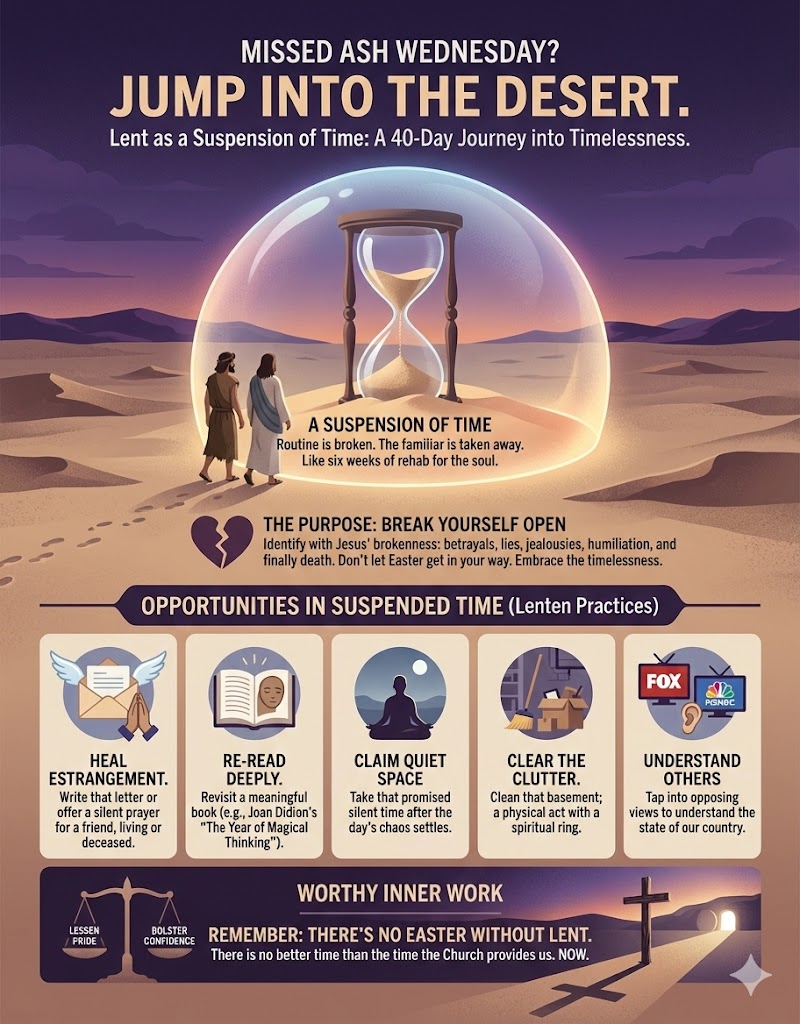
So you missed Ash Wednesday. Lent’s begun and there is always time to jump into the desert as John and Jesus did.
If Advent is grounded in hope and promise then Lent is a suspension of time. Spending forty days in the desert can erase time quickly. Just like John and Jesus – free of time yet full of its open minutes and hours. (And I don’t mean the desert of Palm Springs.)
During suspended time your routine is broken and the familiar is taken away from you, at least for forty days. Just think of six weeks of rehabilitation after knee surgery and you get what I’m getting at.
Within suspended time you are able to break yourself open, just a little, in order to identify with the brokenness Jesus felt during betrayals, lies, jealousies, humiliation and finally death. Don’t let Easter get in your way. Lent is a time of timelessness. A true faith-filled suspension.
Deacon Greg Kandra
Permission granted for non-profits to use in ministry
The infographic was created using Nano Banana, Google's Revolutionary AI Image Generator. Infographic may not be sold or used for personal financial gain. Please show your appreciation by letting others know about TheWordThisWeek.NET.
1st Sunday of Lent (A)
The Ultimate ‘Undercover Boss’

Not so long ago, that was a common question in a world where people unabashedly smoked cigars, cigarettes and pipes. It meant: Got a match? Or a lighter? It was usually muttered as a mumble by some guy with a cigarette already between his lips. (Watch any old movie on TCM and you’ll see what I mean.)
Now that public smoking has gone the way of public telephones — again, watch old movies to see what I’m talking about — I think this question has a new resonance for Christians, offering us a way to look at our lives.
Here, in three little words, we find what amounts to a potent examination of conscience. Are we giving off light? Affirmation? Hope?
Looked at another way: Are we still on fire with the flame we received at baptism? Or has the spark started to sputter and fade?
As we slide deeper into Ordinary Time — and for much of the world, deeper into the icy grip of winter — this is no small concern. Consider the very element we’re talking about. Light throws off illumination, warmth and energy. It scatters shadows and dispels fear. It makes it possible to see.
— originally published in 2010
Fr. Langeh, CMF

1st Sunday of Lent (A)
Resisting Temptation

Lent is a forty-day penitential season spent preparing for Easter. Forty is symbolic indicating a special time spent preparing before a substantial encounter with God. The ashes received at the beginning of Lent reminds Catholic Christians that their bodies are dust (Gen 2:7), and when humans die they return to “dust and ashes” (Gen 18:17). During Lent, emphasis will be laid on conversion. In effect “Lent is a favourable season for deepening our spiritual life through the means of sanctification offered us by the Church: fasting, prayer and almsgiving” (2020 Lenten Message). These empower Christians to fight temptation. The First Sunday of Lent generally focuses on the theme of Jesus’ temptation. The temptation account given in the Gospel of Mathew is very elaborate, showing the seducer’s efforts to pull down the Son of God. It was very easy to seduce our first parents Adam and Eve. The First Reading uses the image of the serpent to represent the tempter. In effect “the Hebrew word used to describe the serpent ‘nahash’, implies something much more deadly than a garden- variety snake. It is used throughout the Old Testament to refer to powerful evil creatures. (cf. Scott Hahn, Understanding the Scriptures, 56). The word “nahash” is used in the book of Numbers 21 to describe the “fiery serpents” which attacked the Israelites in the Desert. Isaiah 27:1 uses the word to depict the great mythical dragon, Leviathan, and in the book of Job 26:13, “nahash” is used to refer to great sea monsters. It is this terrible creature that our parents chose to lead them to spiritual death which left the mark of original sin on our soul.
Deacon Peter McCulloch
Permission granted for non-profits to use in ministry
The infographic was created using Nano Banana, Google's Revolutionary AI Image Generator. Infographic may not be sold or used for personal financial gain. Please show your appreciation by letting others know about TheWordThisWeek.NET.
1st Sunday of Lent (A)
On a Trap for the Unwary
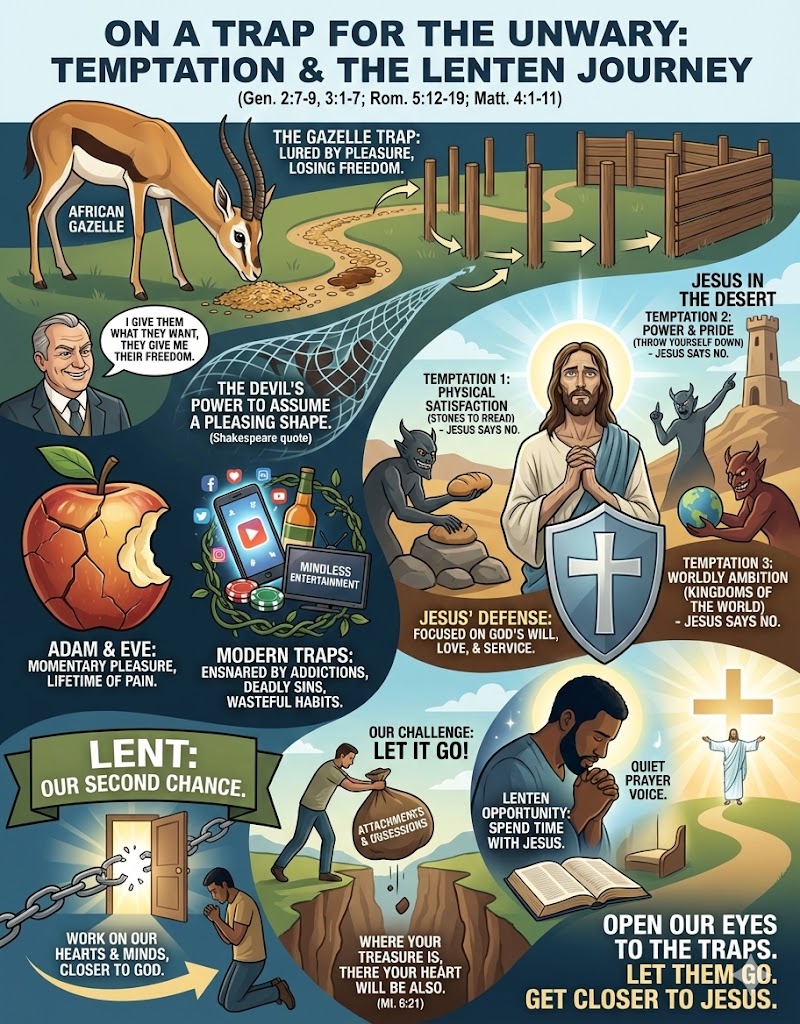
In Hamlet, Shakespeare wrote, ‘the devil has the power to assume a pleasing shape’.[ii] What he’s saying is that Satan is very good at making something evil appear good. He seduces people until they’re trapped.
That’s how people become addicted to alcohol, drugs and gambling. That’s how we get ensnared by the seven deadly sins. That’s how we fall into wasteful habits, like spending too much time on our Smartphones or watching TV.
The first step is easy and it’s often very pleasant. But an ounce of pleasure is sometimes followed by a ton of regret. Adam and Eve learnt that. When they ate that forbidden fruit, their momentary pleasure was followed by a lifetime of pain.
Have you been seduced into a way of life or a behaviour you now regret? Do you feel trapped? Well, this Lent we’ve all been given a second chance.ly can’t understand the goodness and love of Jesus Christ if we ignore the very foundation of his mission – the Old Testament.
Permission granted for non-profits to use in ministry
The infographic was created using Nano Banana, Google's Revolutionary AI Image Generator. Infographic may not be sold or used for personal financial gain. Please show your appreciation by letting others know about TheWordThisWeek.NET.
1st Sunday of Lent (A)
Temptation
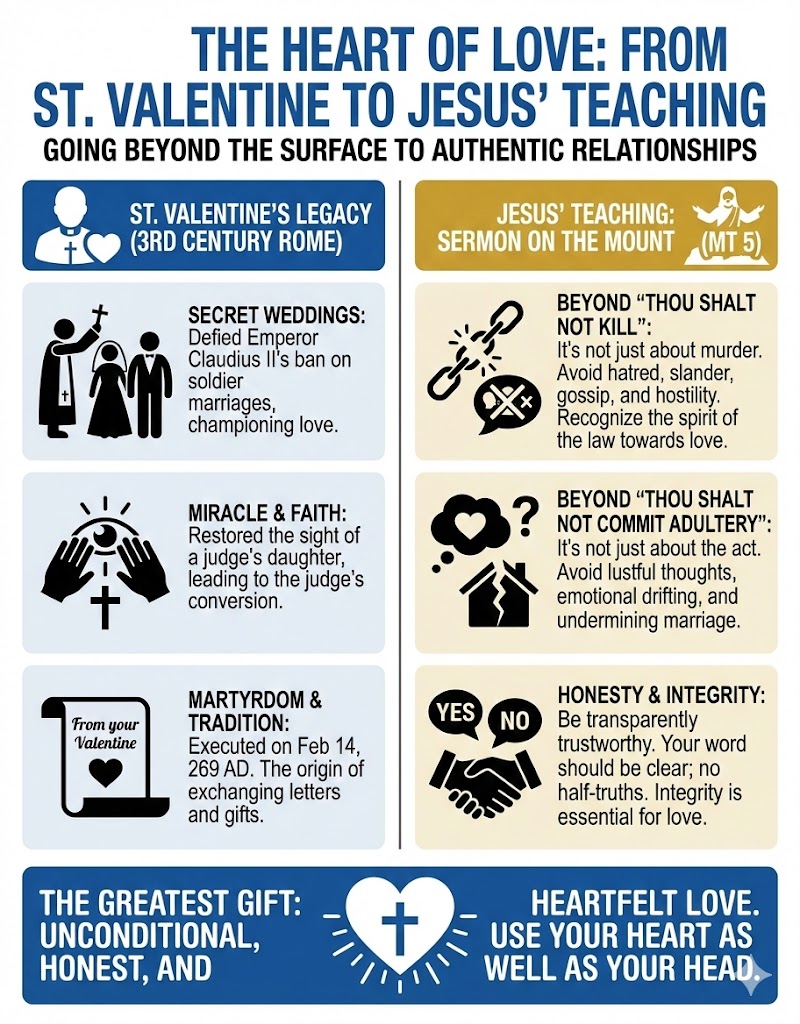
All around the world on 14 February, millions of couples will be celebrating their passion, friendship and love.
Not much is known about St Valentine, but it’s said that he was a Catholic priest who lived in 3rd Century Rome, during the Christian persecution. At one point, Emperor Claudius II insisted that his soldiers’ first love should be Rome itself, so he made it illegal for them to marry.
Valentine responded by conducting secret weddings, but he was caught and gaoled. A judge then offered to release him if he restored his blind daughter’s vision. Valentine placed his hands on her eyes and her sight was restored. The judge was delighted and did release him, and even became a Christian himself.
But the persecution continued, and Claudius had Valentine executed on 14 February, in 269 AD. Legend tells us that just before he died, he wrote to that girl, signing his letter ‘from your Valentine’.
Now on every Valentine’s Day, millions of couples celebrate their friendship and love by exchanging letters, poems and gifts. This wonderful tradition highlights for us just how important love is to us all. Indeed, Martin Luther King once described love as the greatest force in the universe.
Permission granted for non-profits to use in ministry
The infographic was created using Nano Banana, Google's Revolutionary AI Image Generator. Infographic may not be sold or used for personal financial gain. Please show your appreciation by letting others know about TheWordThisWeek.NET.
1st Sunday of Lent (A)
Beyond the Bare Minimum
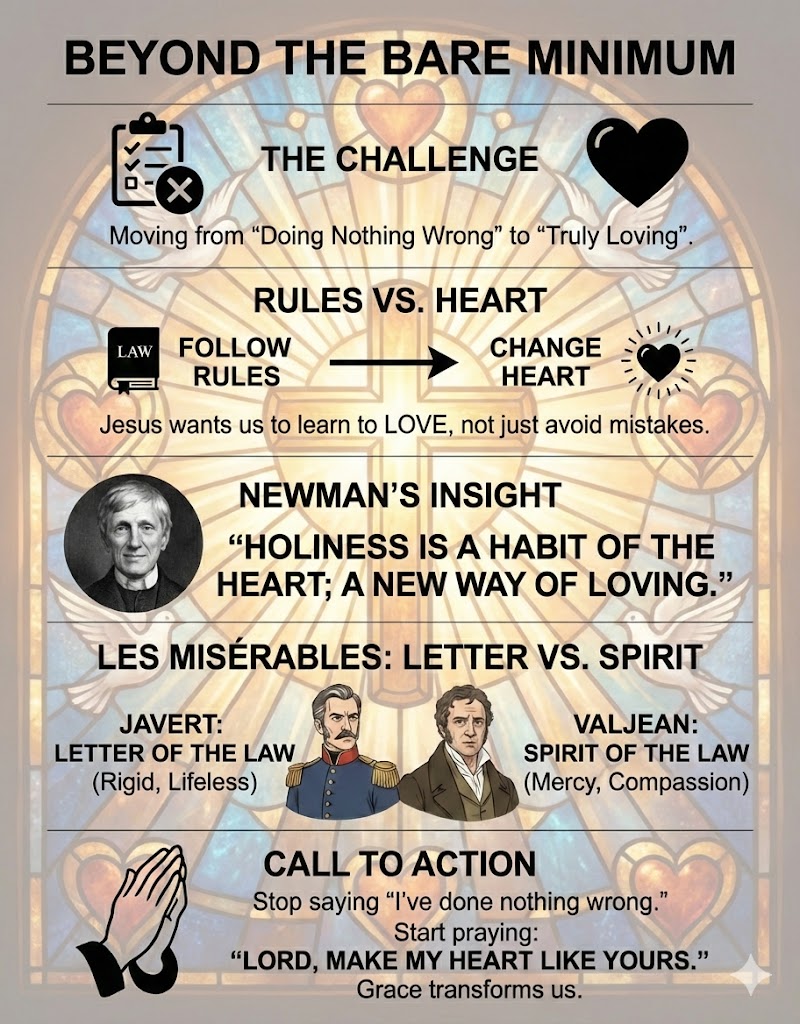
I expect we all know someone who likes to say, ‘Well, I haven’t done anything wrong.’
It’s a familiar attitude, as if the whole point of Christian living were simply to avoid the major sins and to stay out of trouble.
In today’s Gospel, Jesus challenges this thinking. He invites us to go beyond the bare minimum, beyond a faith that is defined by ‘not hurting anyone,’ towards a life that centres on the heart.
A heart that truly loves, and not just hands that stay clean.
‘You have heard it said… but I say to you…’ Jesus says. Not just ‘don’t murder,’ but be reconciled. Not just ‘don’t commit adultery,’ but let your heart be pure. Not just ‘don’t swear false oaths,’ but let your whole life be truthful.
Jesus isn’t interested in whether we have ‘done nothing wrong.’ He wants to know whether we have truly learnt how to love.
Fr. Carmen Mele, O.P.

Permission granted for non-profits to use in ministry
The infographic was created using Nano Banana, Google's Revolutionary AI Image Generator. Infographic may not be sold or used for personal financial gain. Please show your appreciation by letting others know about TheWordThisWeek.NET.
1st Sunday of Lent (A)
The Lenten Proving Ground

Look at the people at mass with you. Most of them probably have gray hair, at least at their roots. In large numbers both young people and adults have stopped attending Mass. Not a few of these consider those who go to church superstitious. And if churchgoers express doubts about abortion, gay marriage, or reparations for slavery, they may consider them chauvinists and racists as well.
Despite the world’s suspicion, we know that being a practicing Catholic Christian does not hurt us. On the contrary, it is our salvation and the salvation of the world from perverse ideologies like communism or hedonism. But are we Christians worthy of the name? That is, are we true sons and daughters of God? We can prove ourselves so together with Jesus in the gospel today. Let us not doubt that the devil tempts us every day as he tempts Jesus here.
The devil never offers sin as something destructive. Rather, he always presents us with something bad under a semblance of good. In the first reading, the serpent offers the woman the forbidden fruit, but he emphasizes that eating it will make her wise. Jesus is very hungry when the devil dares him to change the stones into bread. In the same way he entices us to satisfy our craving for food, drink, and sexual pleasure. Jesus rejects the devil’s offer because he gives more importance to attending to the word of God the Father than to eating. Following him, we must remember the need for moderation in matters of appetite.
Msgr. Joseph Pellegrino
1st Sunday of Lent (A)
Temptation

They had lost their innocense. The first effects of their sin was that their eyes were opened, and they realized that they were naked. Of course I am speaking about Adam and Eve in the account of the Original Sin. Adam and Eve could no longer be comfortable with themselves. They ate from tree of knowledge of good and evil, and now they had knowledge of evil. In Scripture to know means to experience. Adam and Eve had an experience of evil. It was horrible. They were exposed, vulnerable, full of guilt, full of shame. Their choice of sin was a turning away from the Lord of Life. They chose that which is not life. They chose death. And all mankind suffered the result of their choice. All people would suffer from sin and the result of sin, death.
We experience this suffering every day of our lives, as good people, innocent people, die. We experience this as our children are assaulted by the media, by the immoral aspects of society, by all who would take advantage of them. We experience this as evil grabs people and chokes the joy for life from them. We experience this as we also suffer the results of evil that we have committed as well as suffer from what others have done. Sin makes us all uncomfortable with ourselves.
Msgr. Charles Pope

Permission granted for non-profits to use in ministry
The infographic was created using Nano Banana, Google's Revolutionary AI Image Generator. Infographic may not be sold or used for personal financial gain. Please show your appreciation by letting others know about TheWordThisWeek.NET.
1st Sunday of Lent (A)
Tackle Tempation or Risk Ruination

The Gospel today says that Jesus was tempted by the Devil in the desert… Let’s look at the three temptation scenes.
Scene I: The Temptation of Passions.
Scene II. The Temptation of Presumption
Scene III. The Temptation of Possessions
Father Kevin Rettig
Permission granted for non-profits to use in ministry
The infographic was created using Nano Banana, Google's Revolutionary AI Image Generator. Infographic may not be sold or used for personal financial gain. Please show your appreciation by letting others know about TheWordThisWeek.NET.

1st Sunday of Lent (A)
Zen Garden

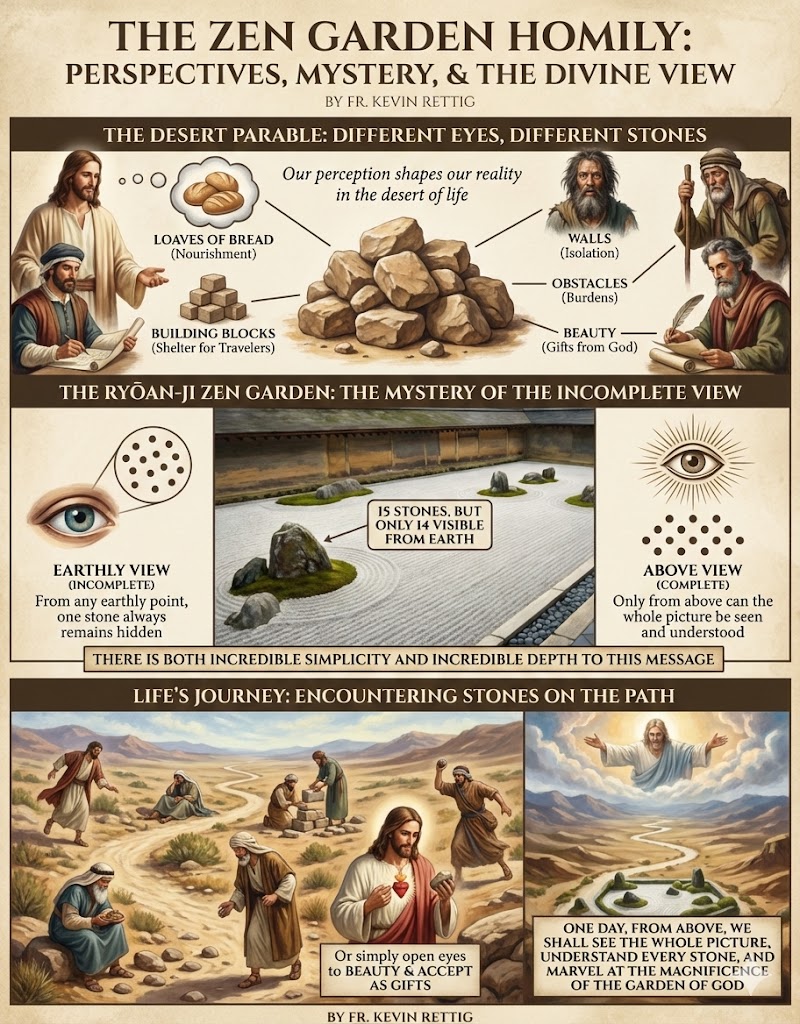
Fr. Kevin Rettig’s homily opens by illustrating how different individuals perceive desert stones according to their own dispositions: Jesus saw potential bread, a contractor saw building materials for shelter, a madman saw walls for isolation, a traveler saw obstacles, and a poet saw beauty.
Fr. Kevin connects these varied perspectives to the famous Ryoan-ji Zen rock garden in Kyoto. The garden features fifteen stones arranged so that, from any earthly vantage point, only fourteen are visible simultaneously. To see all fifteen, one must look from above. He uses this as a spiritual metaphor for life’s journey through the “desert.” We encounter “stones”—various life events—and choose how to react: stumbling over them, building with them, weaponizing them, or accepting them as gifts. He concludes that while on earth, we cannot grasp the complete picture; only from God’s perspective “above” will the full magnificence of His garden be revealed.
Permission granted for non-profits to use in ministry
The infographic was created using Nano Banana, Google's Revolutionary AI Image Generator. Infographic may not be sold or used for personal financial gain. Please show your appreciation by letting others know about TheWordThisWeek.NET.

1st Sunday of Lent (A)
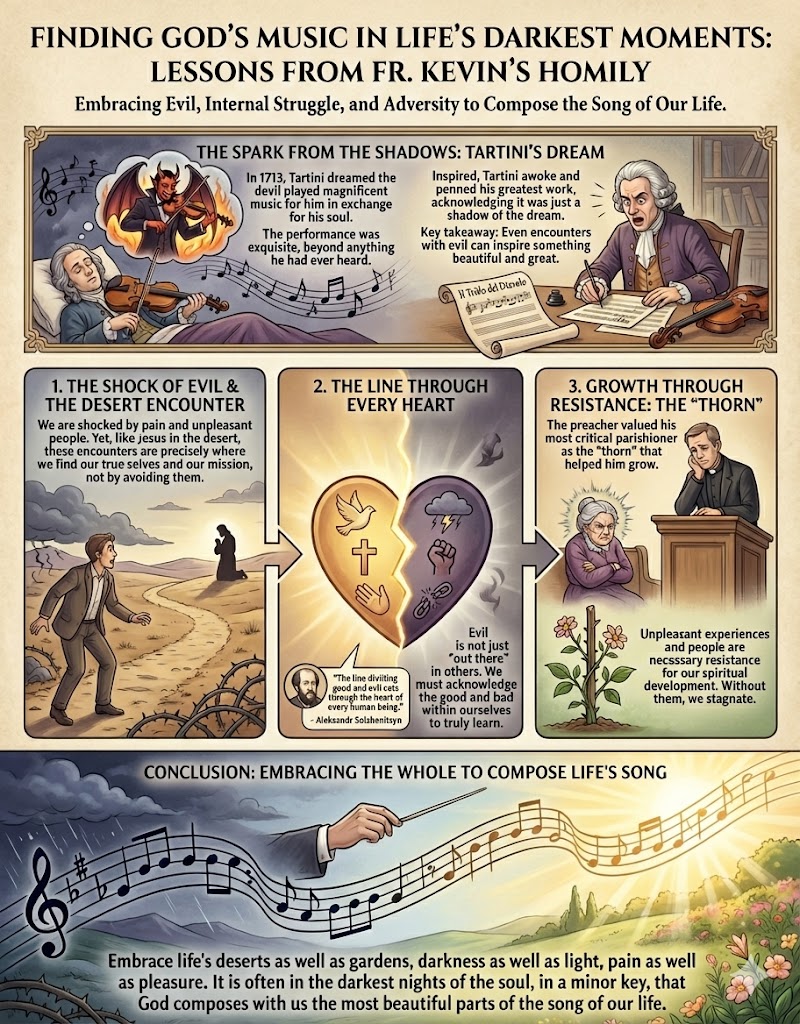
Life in a Minor Key
Fr. Kevin opens with the story of violinist Giuseppe Tartini, who composed his greatest work after a vivid dream where the devil played magnificent music. This illustrates that even encounters with evil can lead to something valuable. Fr. Kevin notes that while we are often shocked by pain and unpleasant people, Jesus found His true mission through encountering evil in the desert.
Referencing Solzhenitsyn, he reminds us that the line between good and evil runs through every human heart, not just externally in others. We must therefore learn from unpleasant experiences. Fr. Kevin shares a story of a preacher who valued a constantly critical parishioner as a necessary “thorn” that helped him grow; without resistance, we stagnate. Ultimately, we must embrace all aspects of life—deserts and darkness alongside gardens and light—for God often composes the most beautiful parts of our life’s song during our darkest moments.

1st Sunday of Lent (A)
The Sin of Not Noticing
Fr. Ruttig’s homily explores sacrificial love through the Cross. It confronts our tendency to feel that God is distant in our pain and reveals the Cross as God’s defin
Fr. George Smiga
Permission granted for non-profits to use in ministry
The infographic was created using Nano Banana, Google's Revolutionary AI Image Generator. Infographic may not be sold or used for personal financial gain. Please show your appreciation by letting others know about TheWordThisWeek.NET.
1st Sunday of Lent (A)
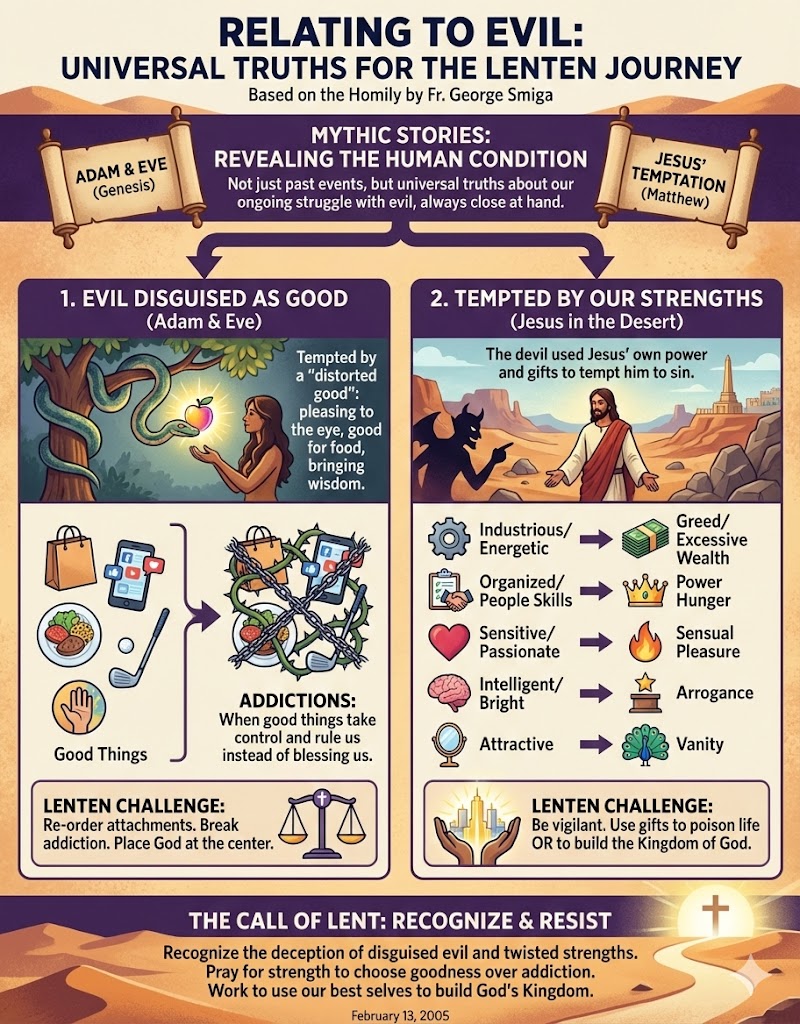
Relating to Evil

2005 HOMILY – Evil comes to us as a distorted good. The choices that we make to do what is wrong usually occur because we have convinced ourselves that we are choosing something that is good. What evil does is take good things in our life and twist them, so that instead of being blessings, they in fact do us harm.
A word that conveys this truth about evil is the word “addiction.” Usually when we think of addiction, we think of someone under the sway of alcohol or drugs. But the truth is that all of us are addicted to something. We might be addicted to eating or to shopping or to the need to help or make others happy. We might be addicted to the latest thing, the hottest trend, most popular fashion. We might be addicted to our computer, our electronic games, our favorite band, our golf clubs. All of these things are in themselves good. But when we give them control over our lives, when we make them necessary, they rule us instead of bless us.
Now the challenge of Lent is not to stop eating or to throw away our computer or our golf clubs. The challenge of Lent is to allow the good things in our life to find their proper place so that we can free ourselves from the addiction to them. There is only one thing which can occupy the center of our life, that is our relationship to God.