Papal Homilies
February 22, 2026
February 22, 2026
1st Sunday of Lent (A)



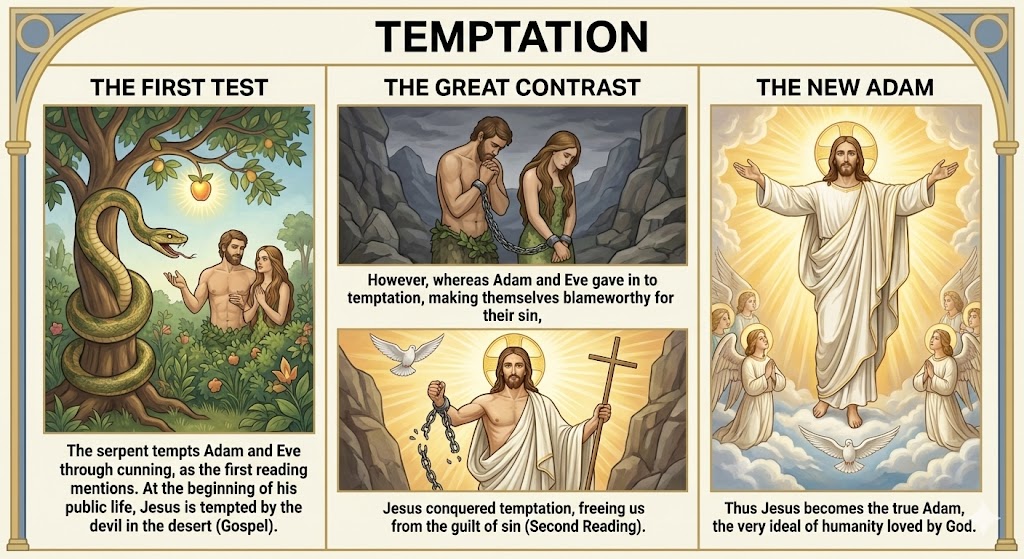
The word temptation seems to be key in the daily liturgy. The serpent tempts Adam and Eve through cunning, as the first reading mentions. At the beginning of his public life, Jesus is tempted by the devil in the desert (Gospel). However, whereas Adam and Eve gave in to temptation, making themselves blameworthy for their sin, Jesus conquered temptation, freeing us from the guilt of sin (Second Reading). Thus Jesus becomes the true Adam, the very ideal of humanity loved by God.
Doctrinal Message
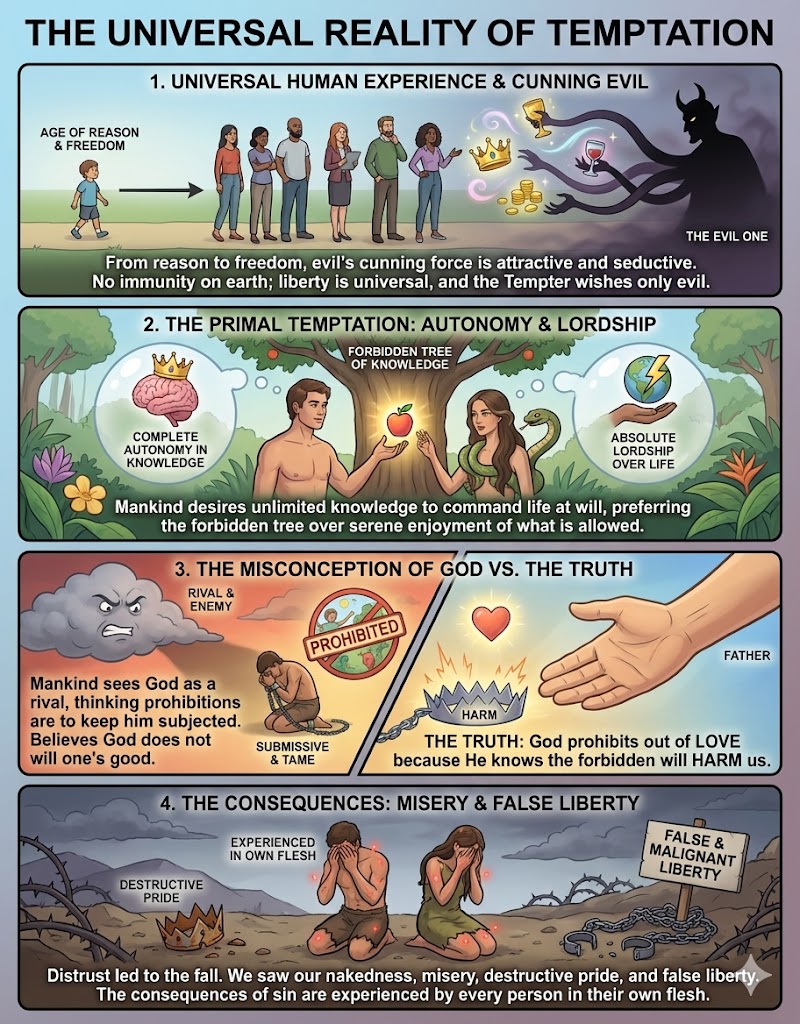
The Universal Reality of Temptation Temptation is a fact of human experience. From the moment a person has the use of reason and is responsible and free, from that moment evil in all its innumerable varieties, and the Evil One in all his cunning, can irrupt in one’s life with attractive and seductive force. There is no temptation from which one is immune on earth, as liberty is universal and the Tempter is the “prince of this world” who only wishes evil. Adam and Eve had a double temptation: they wanted complete autonomy in knowledge and absolute lordship over life. From the beginning of humanity until its end, mankind desires unlimited knowledge, to command life at will. One prefers to stretch his hand to the forbidden tree, than to enjoy serenely and happily what is allowed. One believes God has prohibited things because he does not will one’s good, and wants to keep mankind subjected and submissive, like a tame dog. Mankind sees God, therefore, not as a Father but as a rival and an enemy. The truth is the very opposite: if God prohibits something, it is because he loves us and knows the forbidden will harm us. Sadly, man was not convinced, did not trust, stretched his hand toward the tree … and saw himself in all the nakedness of his misery, of his destructive pride, and of his false and malignant liberty. The consequences of sin are experienced by every person in their own flesh.
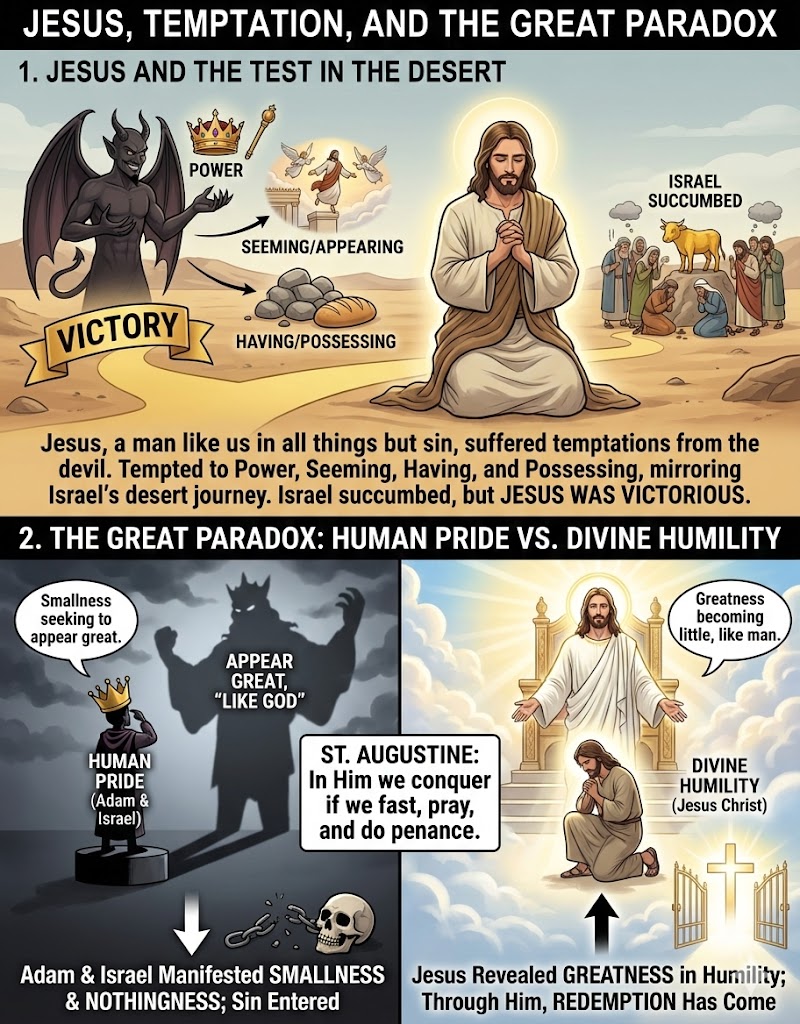
Jesus and the Test in the Desert Jesus, a man like us in all things but sin, also suffered temptations from the devil. Jesus was tempted several times in his life, but Saint Matthew concentrates on the temptation he suffered before beginning his public ministry. He was tempted in the same way as the people of Israel when crossing the desert toward the Promised Land: tempted to power, to seeming, to having, and to possessing. The people of Israel succumbed to the temptations, but Jesus was victorious.
The Great Paradox: Human Pride vs. Divine Humility According to Saint Augustine, in him we have conquered our temptations, if we behave like him, that is, if we fast, pray and do penance. In essence, the great temptation of man has been, in his smallness, to appear to be great, “like God,” to believe himself, and to seem to others to be, a god. The great teaching of Jesus Christ is that, although he had the very greatness of God, he became little, like man, to the point of being subject to temptation. Adam and the people of Israel manifested their smallness and nothingness in face of temptation. Jesus, on the other hand, at that very moment revealed all his greatness. Consequently, as through Adam sin entered the world, through Jesus Christ, true prototype of man, redemption has come to the world.
© 2004-05 Dicastery for the Clergy
Pastoral Suggestions
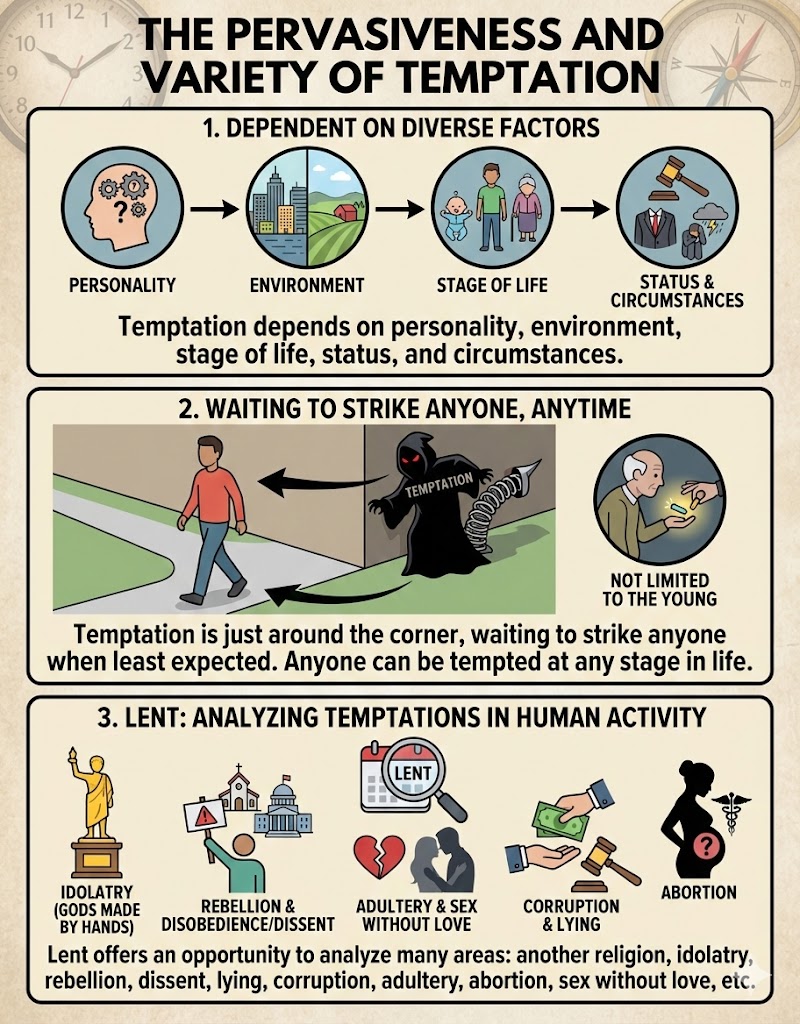
The Pervasiveness and Variety of Temptation The ways one is tempted depend a lot on personality, on the environment in which one moves, on the stage of life, on legal or professional status, and on circumstances and situations. Nevertheless, temptation is just around the corner, waiting to strike any one, when least expected. On temptation, it is important to stress anyone can be tempted at any stage in life; it must not be thought temptations are limited to the young. Lent offers a good opportunity to analyze the topics of temptation and sin in many areas of human activity: the temptation of “another religion,” to one that is easier and more pleasing, or the temptation to idolatry of gods made by human hands, the temptation to rebellion and to civil or ecclesial disobedience, the temptation to dissent for the sake of dissenting, the temptation to lie, to corruption, to adultery, to abortion, to sex without love, etc. These and many other temptations beset us and our brothers and sisters.
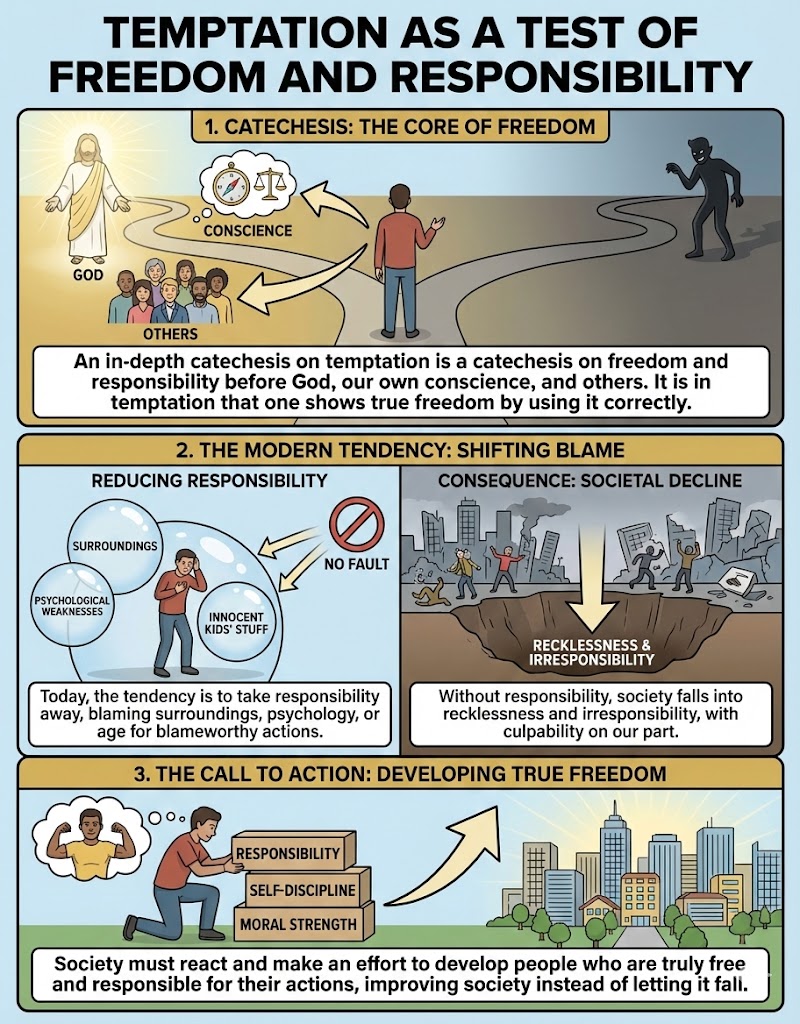
Temptation as a Test of Freedom and Responsibility An in-depth catechesis on temptation is a catechesis on freedom and responsibility before God, our own conscience, and others. It is precisely in temptation one shows whether or not one is truly free, that is, that if freedom is used correctly. Today the tendency is to take responsibility away from man for his actions, chalking up to surroundings, psychological weaknesses and abnormalities, “innocent kids’ stuff,” what is, in fact, blameworthy. Without removing altogether the weight such reasons might carry, I believe society must react, and instead of decreasing responsibility, make an effort to develop people who are truly free and responsible for their actions. Otherwise, instead of improving society, we will let it fall, with greater or lesser culpability on our part, into recklessness and irresponsibility.
© 2004-05 Dicastery for the Clergy
Infographic was designed using Nano Banana Pro with Gemini 3.0. It draws inspiration from the commentary from the 2004-05 Dicastery for the Clergy Notes (YEAR A | B | C cf. text above), but is not officially associated with or endorsed by the Holy See. It may be copied for personal use or for use in any non-profit ministry.

In this First Sunday of Lent, the Gospel introduces us to the journey toward Easter, revealing Jesus as he remains in the desert for 40 days, subjected to the temptations of the devil (cf. Mt 4:1-11). This episode takes place at a precise moment in Jesus’ life: immediately after his Baptism in the River Jordan and prior to his public ministry. He has just received the solemn investiture: the Spirit of God has descended upon him, the heavenly Father has declared him “my beloved Son” (Mt 3:17). Jesus is now ready to begin his mission; and as this mission has a declared enemy, namely, Satan, He confronts him straight away, “up close”. The devil plays precisely on the title “Son of God” in order to deter Jesus from the fulfillment of his mission: “If you are the Son of God” (4:3, 6); and proposes that He perform miraculous acts — to be a “magician” — such as transforming stones into bread so as to satiate his hunger, and throwing himself down from the temple wall so as to be saved by the angels. These two temptations are followed by the third: to worship him, the devil, so as to have dominion over the world (cf. v. 9).
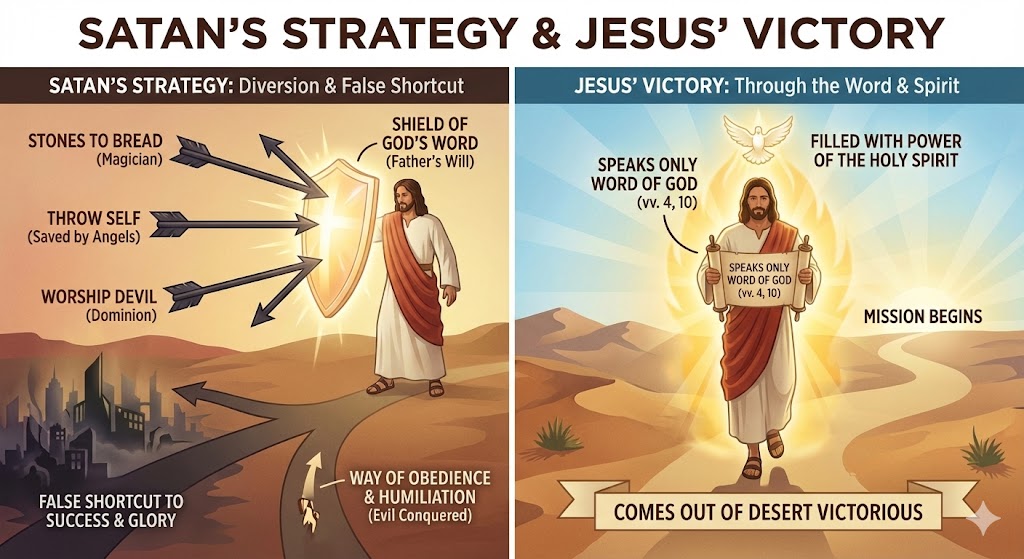
Through this three-fold temptation, Satan wants to divert Jesus from the way of obedience and humiliation — because he knows that in this way, on this path, evil will be conquered — and to lead Him down the false shortcut to success and glory. But the devil’s poisonous arrows are “blocked” by Jesus with the shield of God’s Word (vv. 4, 10), which expresses the will of the Father. Jesus does not speak a word of his own: He responds only with the Word of God. Thus the Son, filled with the power of the Holy Spirit, comes out of the desert victorious.
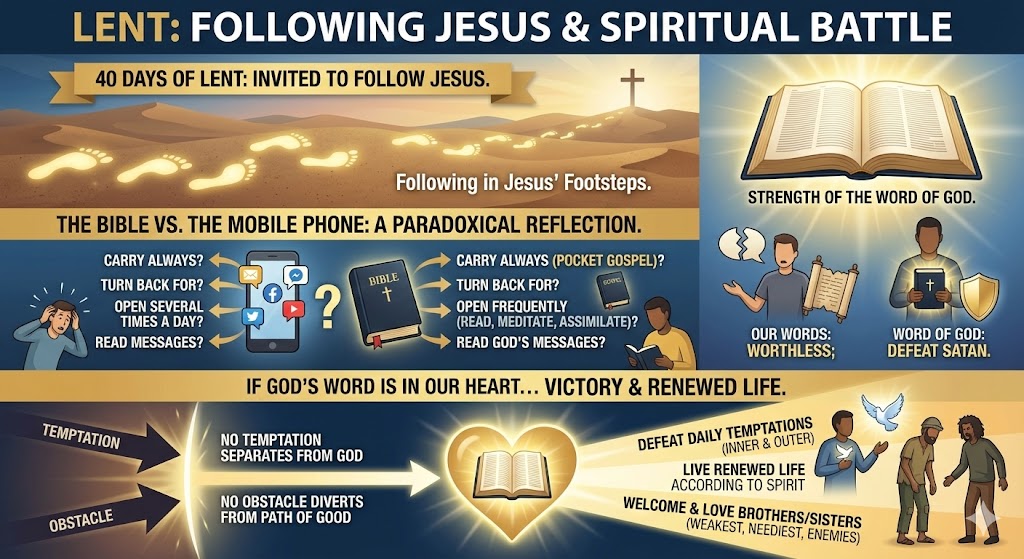
During the 40 days of Lent, as Christians we are invited to follow in Jesus’ footsteps and face the spiritual battle with the Evil One with the strength of the Word of God. Not with our words: they are worthless. The Word of God: this has the strength to defeat Satan. For this reason, it is important to be familiar with the Bible: read it often, meditate on it, assimilate it. The Bible contains the Word of God, which is always timely and effective. Someone has asked: what would happen were we to treat the Bible as we treat our mobile phone?; were we to always carry it with us, or at least a small, pocket-sized Gospel, what would happen?; were we to turn back when we forget it: you forget your mobile phone — ‘oh! I don’t have it, I’m going back to look for it’; were we to open it several times a day; were we to read God’s messages contained in the Bible as we read telephone messages, what would happen? Clearly the comparison is paradoxical, but it calls for reflection. Indeed, if we had God’s Word always in our heart, no temptation could separate us from God, and no obstacle could divert us from the path of good; we would know how to defeat the daily temptations of the evil that is within us and outside us; we would be more capable of living a life renewed according to the Spirit, welcoming and loving our brothers and sisters, especially the weakest and neediest, and also our enemies.
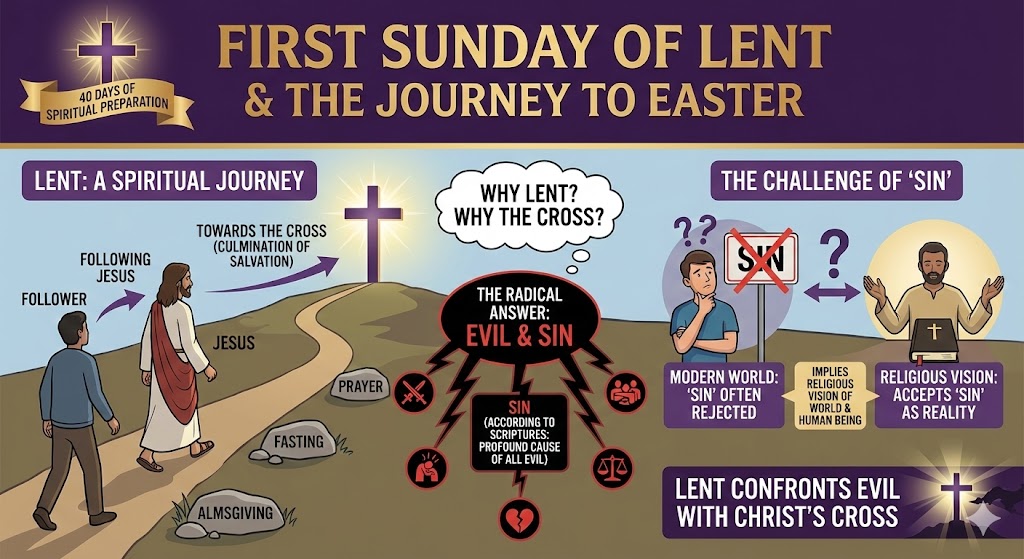

This is the First Sunday of Lent, the liturgical Season of 40 days which constitutes a spiritual journey in the Church of preparation for Easter. Essentially it is a matter of following Jesus who is walking with determination towards the Cross, the culmination of his mission of salvation. If we ask ourselves: “Why Lent? Why the Cross?”, the answer in radical terms is this: because evil exists, indeed sin, which according to the Scriptures is the profound cause of all evil. However this affirmation is far from being taken for granted and the very word “sin” is not accepted by many because it implies a religious vision of the world and of the human being.
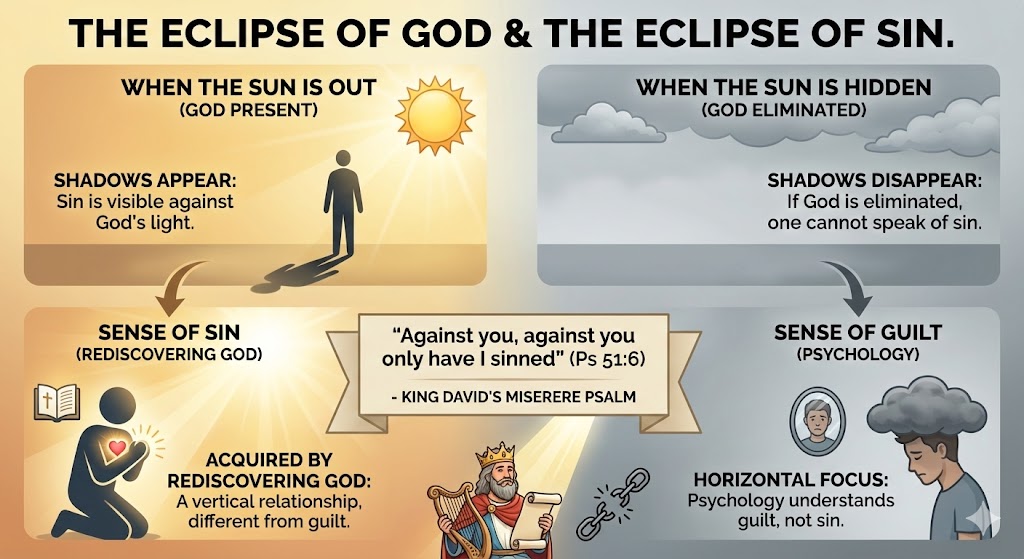
In fact it is true: if God is eliminated from the world’s horizon, one cannot speak of sin. As when the sun is hidden, shadows disappear. Shadows only appear if the sun is out; hence the eclipse of God necessarily entails the eclipse of sin. Therefore the sense of sin — which is something different from the “sense of guilt” as psychology understands it — is acquired by rediscovering the sense of God. This is expressed by the Miserere Psalm, attributed to King David on the occasion of his double sin of adultery and homicide: “Against you”, David says, addressing God, “against you only have I sinned” (Ps 51(50):6).
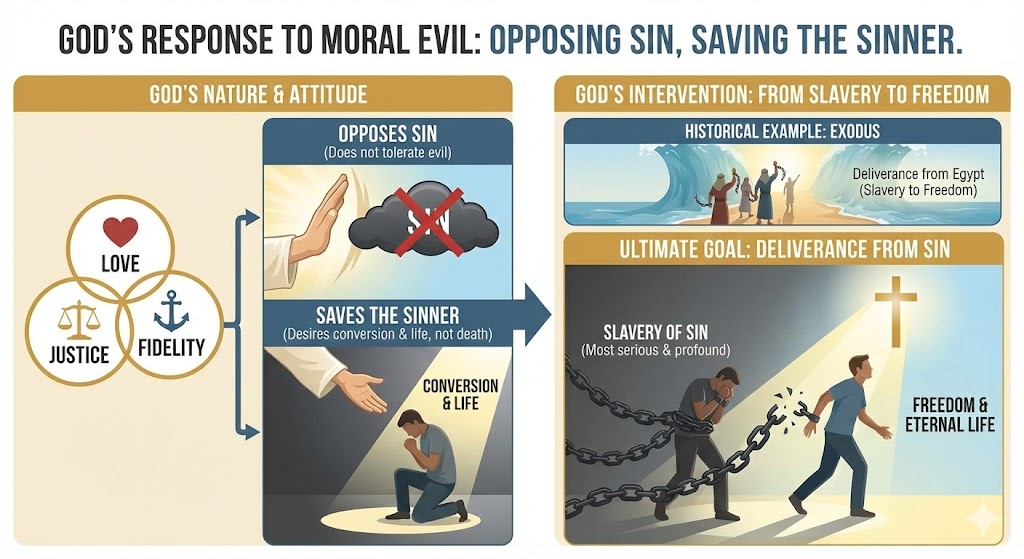
In the face of moral evil God’s attitude is to oppose sin and to save the sinner. God does not tolerate evil because he is Love, Justice and Fidelity; and for this very reason he does not desire the death of the sinner but wants the sinner to convert and to live. To save humanity God intervenes: we see him throughout the history of the Jewish people, beginning with the liberation from Egypt. God is determined to deliver his children from slavery in order to lead them to freedom. And the most serious and profound slavery is precisely that of sin.
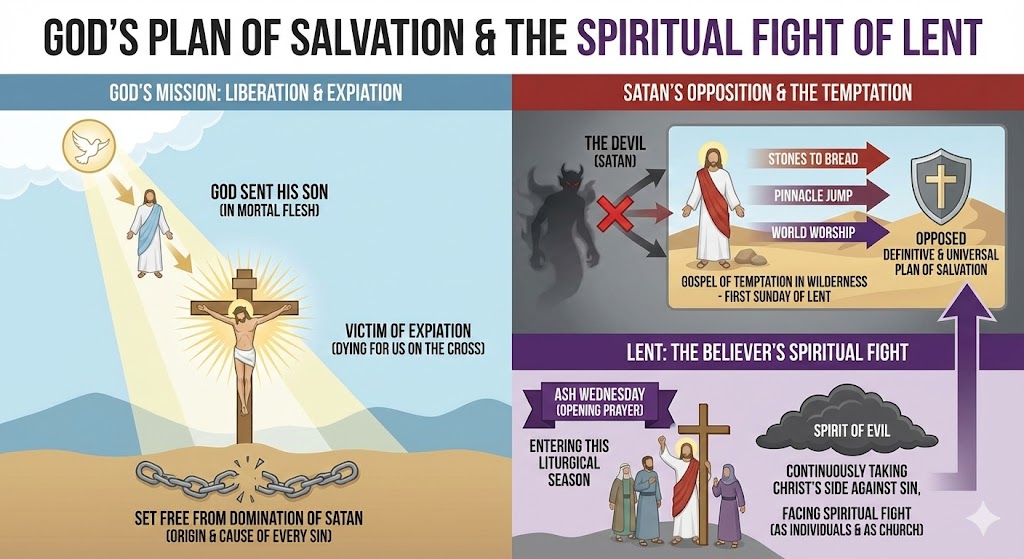
For this reason God sent his Son into the world: to set men and women free from the domination of Satan, “the origin and cause of every sin”. God sent him in our mortal flesh so that he might become a victim of expiation, dying for us on the Cross. The Devil opposed this definitive and universal plan of salvation with all his might, as is shown in particular in the Gospel of the temptation of Jesus in the wilderness which is proclaimed every year on the First Sunday of Lent. In fact, entering this liturgical season means continuously taking Christ’s side against sin, facing — both as individuals and as Church — the spiritual fight against the spirit of evil each time (Ash Wednesday, Opening Prayer).
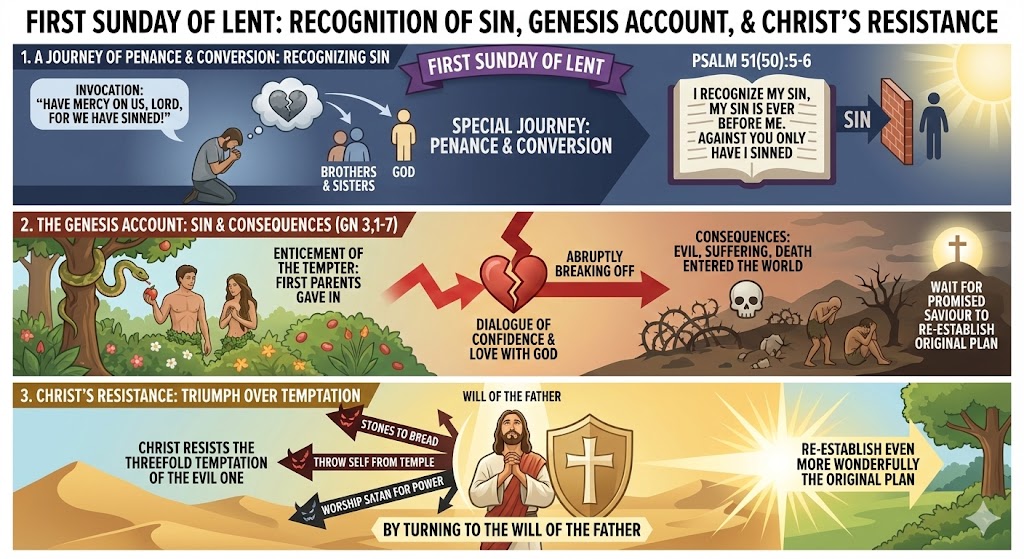
1. “Have mercy on us, Lord, for we have sinned!“. The invocation of the responsorial psalm which we have just heard, expresses the sentiment that motivates us on this First Sunday of Lent. We are at the beginning of a special journey of penance and conversion. We realize that this is a favourable opportunity to recognize sin that clouds our relationship with God and with our brothers and sisters. “I recognize my sin“, the Psalmist proclaims, “for I know my transgressions and my sin is ever before me. Against you, you only, have I sinned, and done that which is evil in your sight” (Ps 50 [51],5-6).
The passage from the Book of Genesis that we have just heard (cf. Gn 3,1-7), clearly shows what sin is and what are its consequences for the life of the human being. Our first parents gave in to the enticement of the tempter, abruptly breaking off their dialogue of confidence and love with God. Evil, suffering and death entered the world and one will have to wait for the promised Saviour to re-establish, even more wonderfully, the original plan of the Creator (cf. ibid., 3,8-24).
By turning to the will of the Father, Christ resists the threefold temptation of the Evil One

2. The Messiah did not avoid the insidious action of the Evil One, as St Matthew tells in today’s Gospel: “Jesus was led up by the Spirit into the wilderness to be tempted by the devil” (Mt 4,1). In the desert, He is subjected to a threefold temptation, which however, he resisted with firmness. Jesus firmly asserted that it is not lawful to put God to the test; it is not permissible to worship any other god; one cannot determine by oneself one’s own fate. For every believer the final source of guidance is the Word that proceeds from the mouth of the Lord.
In these few lines I have outlined the programme of our Lenten journey. We too are called to cross the desert of everyday life, facing the recurring temptation to create distance between ourselves and God. We are invited to imitate the attitude of the Lord, who willingly obeys the Word of his heavenly Father, and in this way re-establishes the hierarchy of values according to the original plan of God…

5. “As through the disobedience of one man all have been made sinners, so now through the obedience of one man all have been made just ” (Rom 5,19). This consoling word of the Apostle Paul to the Romans comforts us on our spiritual journey. Over the world, in which evil and sin often hold sway, the light of Christ shines victoriously. With his passion and resurrection he has defeated sin and death, opening to believers the gates of eternal salvation. The liturgy today gives us this encouraging message.
To participate fully in the victory of Christ, relying on the light of the word of God, we should dedicate ourselves to changing our way of thinking and acting.
“Create in me a clean heart, O God, and put a new and steadfast spirit within me” (Ps 50 [51],10). Let us make our own the prayer of the Psalmist. It is a most fitting prayer for the time of Lent.
Create, Lord, a clean heart in me! Renew us in your love! O Virgin Mary obtain for us a new heart and a steadfast spirit. May we come to celebrate Easter, renewed and reconciled with God and our brothers and sisters.