Papal Homilies
February 15, 2026
February 15, 2026
6th Sunday of Year A



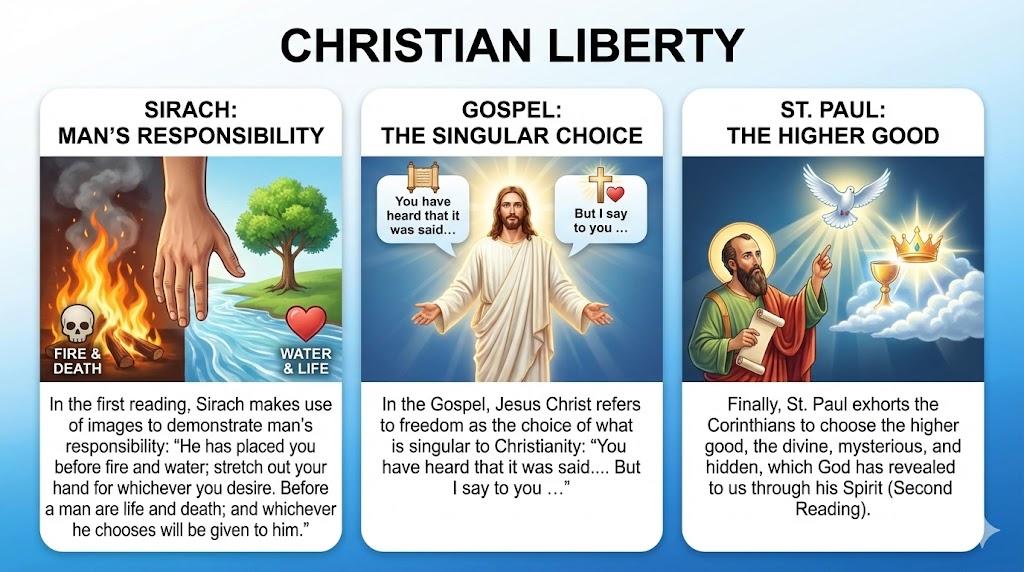
Liberty is an eminently Christian virtue and value. Today’s readings are centered on true Christian liberty. In the first reading, Sirach makes use of images to demonstrate man’s responsibility: “He has placed you before fire and water; stretch out your hand for whichever you desire. Before a man are life and death; and whichever he chooses will be given to him.” In the Gospel, Jesus Christ refers to freedom as the choice of what is singular to Christianity: “You have heard that it was said…. But I say to you …” Finally, St. Paul exhorts the Corinthians to choose the higher good, the divine, mysterious, and hidden, which God has revealed to us through his Spirit (Second Reading).
Doctrinal Message
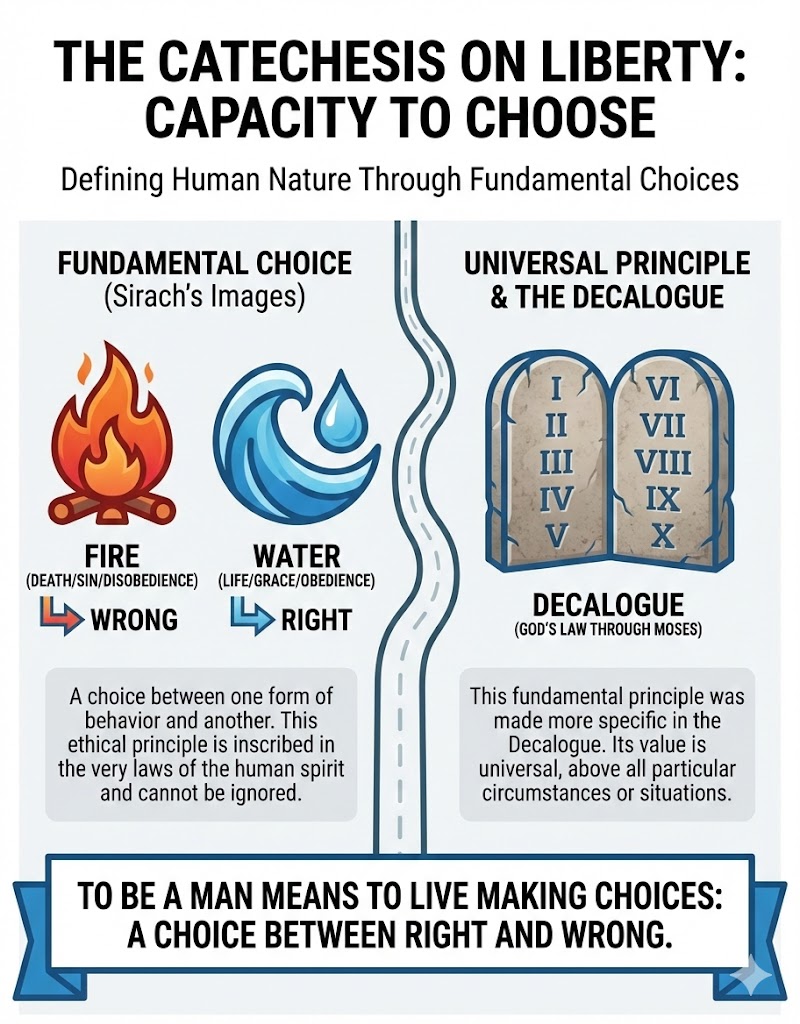
The catechesis on liberty begins with an explanation of liberty as the capacity to choose. To be a man means to live making choices, choosing between one thing and another, between one form of behavior and another. The little every day choices are guided by the fundamental choice, the choice which Sirach presents clearly through images: a choice between fire and water, life and death, obedience and disobedience of the commandments, grace and sin. In other words, ” a choice between right and wrong.” This ethical principle is not optional, it is inscribed in the very laws of the human spirit and, therefore, cannot be ignored, without ignoring one’s very humanity.This fundamental principle was made more specific in the Decalogue God gave the Jewish people through Moses, but its value is universal, because above all particular circumstances or situations.
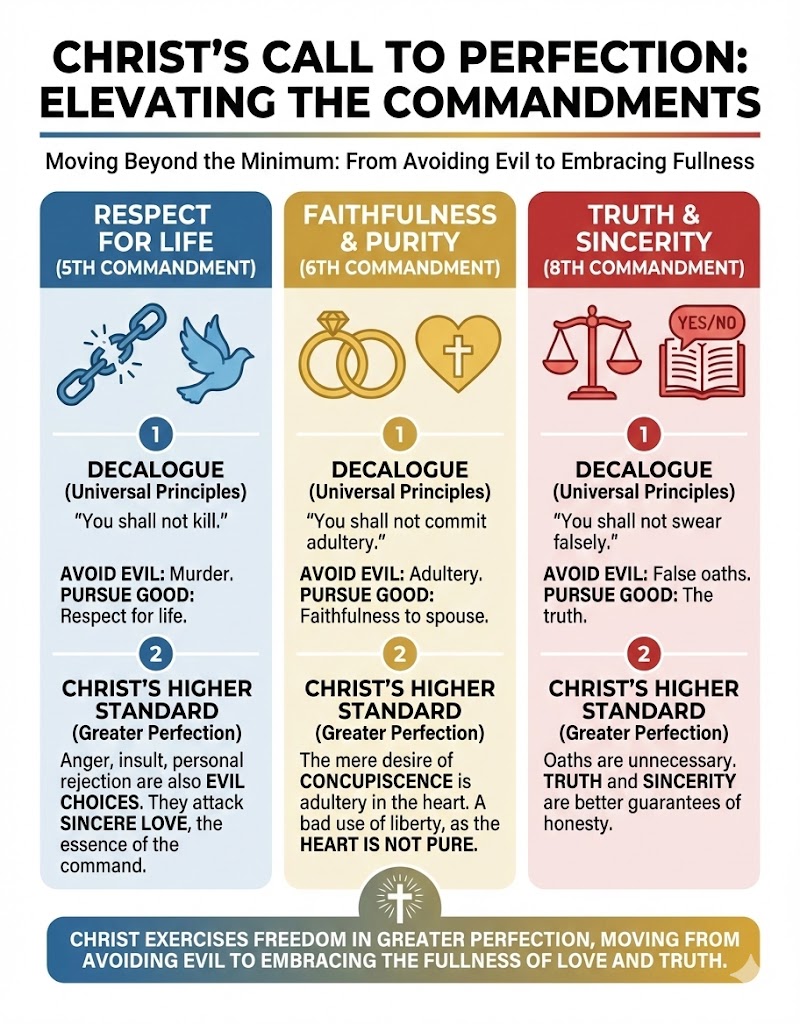
In today’s Gospel, Jesus Christ reminds us of some of these commandments (fifth, sixth and eighth). “You shall not kill.” “You shall not commit adultery.” “You shall not swear falsely.” Human freedom finds in these formulations the evil he must avoid and, implicitly, the good he must pursue: respect for life, faithfulness to one’s spouse, the truth. These are principles valid for all men, Christian and non-Christian alike, especially in the negative formulation. Jesus Christ, however, proposes a higher standard in order to exercise freedom in greater perfection. He makes the commandments more specific than the Decalogue. For Christians to opt for anger, insult, personal rejection are evil choices, violating the fifth commandment and attacking sincere love for one’s neighbor, the essence of the fifth commandment. In so far as the sixth commandment is concerned, the mere desire of concupiscence is adultery in the heart, a bad use of liberty, for the heart is not pure. Finally, Jesus Christ points to truth and sincerity as better guarantees of honesty than oaths.
The Christian, who is truly free, loves truth and goodness. This Christian freedom, which always seeks the best, is not the wisdom of the world. It comes from God, revealed to us through his Spirit. Where the Spirit is, there is true liberty. This wisdom of liberty is neither known nor understood by non-Christians. This is the reason why at times they attack it as irrational and at others admire it as heroic. In any event, it is mysterious and hidden, even for Christians who know it and try to apply it. It is the freedom of the children of God who do not “need” other laws to behave well. As Christians, they have the law of the Spirit.
© 2004-05 Dicastery for the Clergy
Pastoral Suggestions
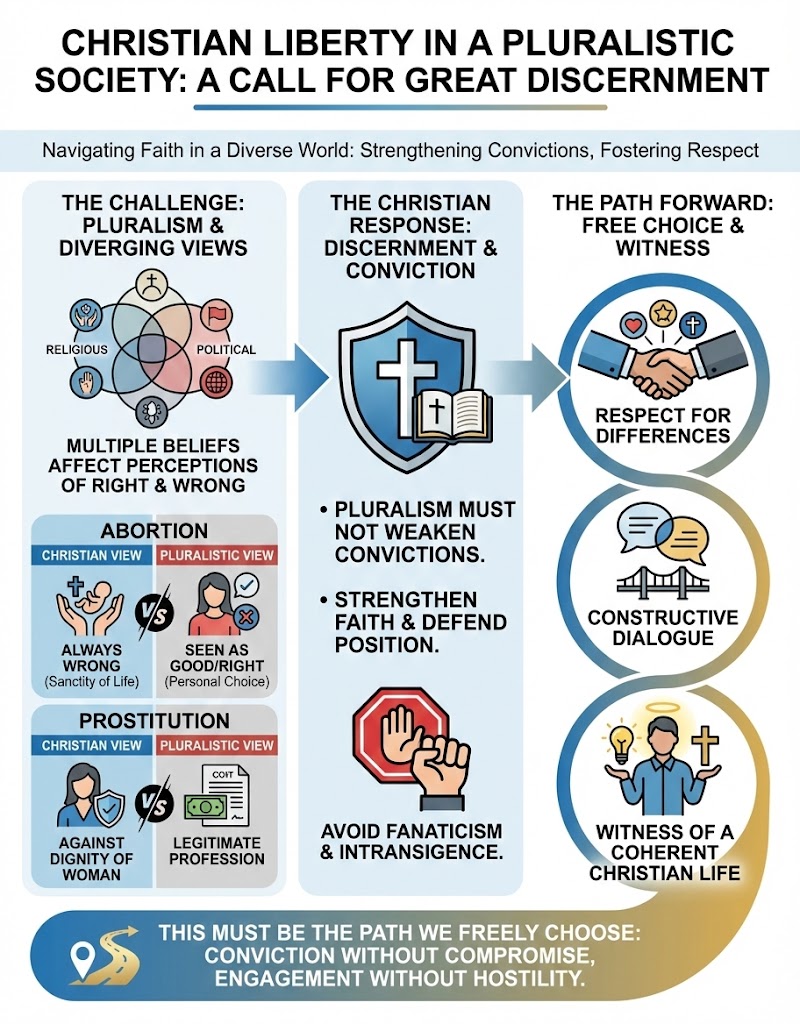

1. Christian liberty in a pluralistic society requires great discernment. Today the Christian faithful live in religious, political and cultural pluralism. This pluralism can affect the way we see right and wrong, and, consequently, the important options in personal or social life. For a Christian, voluntary abortion is always wrong, but in a pluralist society there are those who think it is a good. For a Christian, prostitution goes against the dignity of woman, but there are those who consider it a “profession,” as good and legitimate as any other, etc. This pluralism must not weaken our convictions. It should strengthen them and help us defend our faith and our position, but it must not impel us to fanaticism or intransigence with those who do not share our faith and our morals. Respect for differences, constructive dialogue and, above all, the witness of a coherent Christian life, must be the path we freely choose.
2. The Spirit of freedom. Every Christian, in the right exercise of freedom, acts under the inspiration of the Spirit. Discernment, through the action of the Spirit, and docility to this same Spirit allow the Christian the fullest use of freedom, in taking the step from the good to the best, from what is not commanded by society but which conscience dictates: from simple help to others, to limitless generosity. The more docile the soul to the action of the Holy Spirit , the more free his fundamental options and little every day decisions.
© 2004-05 Dicastery for the Clergy
Infographic was designed using Nano Banana Pro with Gemini 3.0. It draws inspiration from the commentary from the 2004-05 Dicastery for the Clergy Notes (YEAR A | B | C cf. text above), but is not officially associated with or endorsed by the Holy See. It may be copied for personal use or for use in any non-profit ministry.
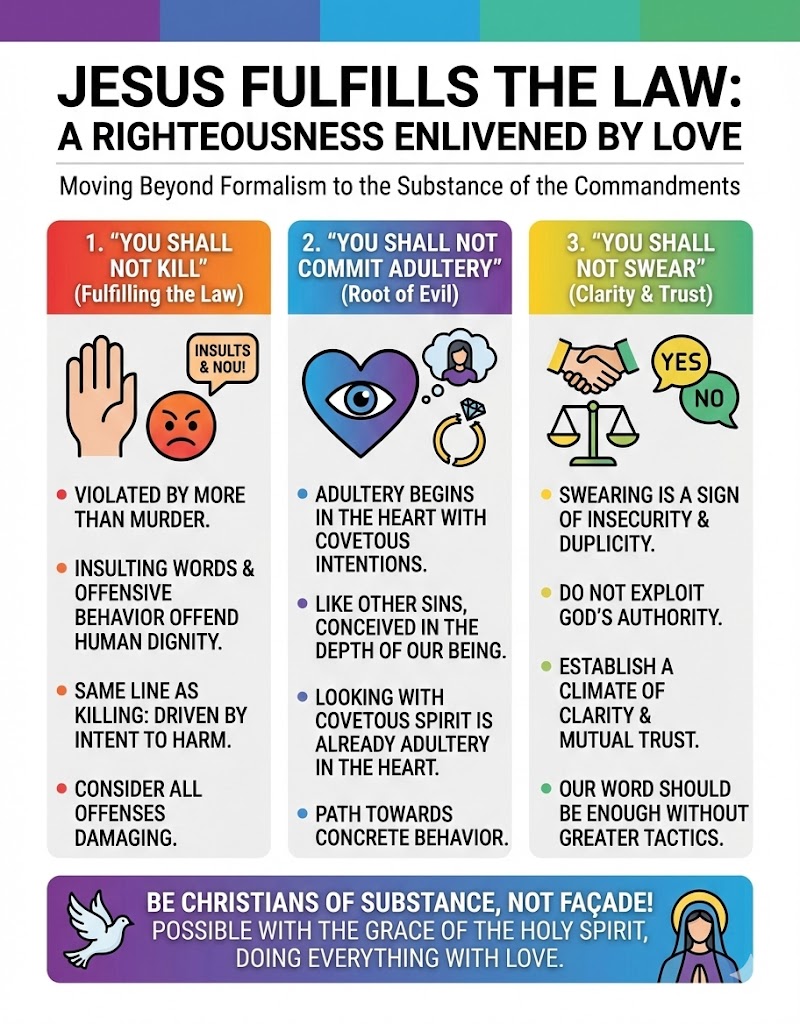
Today’s liturgy presents us with another passage of the Sermon on the Mount, which we find in the Gospel of Matthew (cf. 5:17-37). In this passage, Jesus wants to help his listeners to reread the Mosaic law. What had been said in the ancient covenant was true, but that was not all: Jesus came to bring to fulfillment and to promulgate in a definitive way the Law of God, up to the last iota (cf. v. 18). He manifests its original aims and fulfils its authentic aspects, and he does all this through his preaching and, even more, with the offering of himself on the Cross. In this way, Jesus teaches how to fully carry out God’s will, and he uses these words: with a ‘righteousness’ that ‘exceeds’ that of the scribes and the Pharisees (cf. v. 20). A righteousness enlivened by love, charity, mercy, and hence capable of fulfilling the substance of the commandments, avoiding the risk of formalism. Formalism: this I can, this I cannot; up to this point I can, up to this point I cannot…. No: more, more.
In particular, in today’s Gospel, Jesus examines three aspects, three commandments [that regard] murder, adultery and swearing.
With regard to the commandment ‘you shall not kill’, he states that it is violated not only by murder in effect, but also by those behaviours that offend the dignity of the human person, including insulting words (cf. v. 22). Of course, these insulting words do not have the same gravity and culpability as killing, but they are set along the same line, because they are the pretext to it and they reveal the same malevolence. Jesus invites us not to establish a ranking of offences, but to consider all of them damaging, inasmuch as they are driven by the intent to do harm to one’s neighbour. Jesus gives an example. Insulting: we are accustomed to insulting; it is like saying “good morning”. And that is on the same line as killing. One who insults his brother, in his heart kills his brother. Please do not insult! We do not gain anything….
Another fulfillment is generated by the matrimonial law. Adultery was considered a violation of man’s property right over the woman. Instead, Jesus goes to the root of the evil. As one comes to killing through injuries, offences and insults, in this way one reaches adultery through covetous intentions in regard to a woman other than one’s own wife. Adultery, like theft, corruption and all the other sins, are first conceived in the depth of our being and, once the wrong choice is made in the heart, it is carried out in concrete behaviour. Jesus says: one who looks with a covetous spirit at a woman who is not his own is an adulterer in his heart, has set off on the path towards adultery. Let us think a little bit about this: about the wicked thoughts that go along this line.
Jesus then tells his disciples not to swear, as swearing is a sign of the insecurity and duplicity with which human relationships unfold. God’s authority is exploited so as to guarantee our human narrative. Instead, we are called to establish among ourselves, in our families and in our communities, a climate of clarity and mutual trust, so that we can be considered sincere without resorting to greater tactics in order to be believed. Mistrust and mutual suspicion always threaten peace!
May the Virgin Mary, a woman of listening and joyful obedience, help us to draw ever closer to the Gospel, to be Christians not ‘of façade’, but of substance! This is possible with the grace of the Holy Spirit, who allows us to do everything with love, and thus to wholly fulfil the will of God.
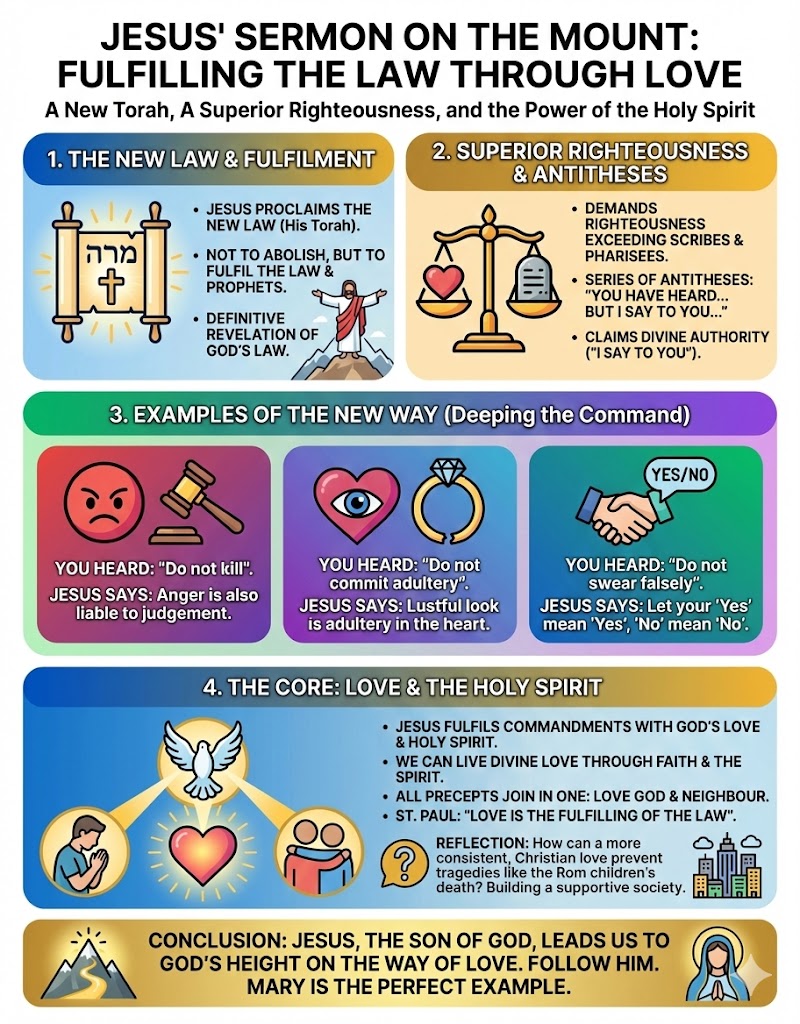
In this Sunday’s Liturgy we continue to read Jesus’ so-called “Sermon on the Mount”. It is contained in chapters 5, 6 and 7 of Matthew’s Gospel. After the Beatitudes, which are the programme of his life, Jesus proclaims the new Law, his Torah, as our Jewish brothers and sisters call it. In fact, on his coming, the Messiah was also to bring the definitive revelation of the Law and this is precisely what Jesus declares: “Think not that I have come to abolish the Law and the Prophets; I have come not to abolish them but to fulfil them”.
And addressing his disciples, he adds: “unless your righteousness exceeds that of the Scribes and Pharisees, you will never enter the Kingdom of Heaven” (Mt 5:17,20). But what do this “fullness” of Christ’s Law and this “superior” justice that he demands consist in?
Jesus explains it with a series of antitheses between the old commandments and his new way of propounding them. He begins each time: “You have heard that it was said to the men of old…”, and then he asserts: “but I say to you”…. For example, “You have heard that it was said to the men of old, ‘you shall not kill; and whoever kills shall be liable to judgement’. But I say to you that everyone who is angry with his brother shall be liable to judgement” (Mt 5:21-22).
And he does this six times. This manner of speaking made a great impression on the people, who were shocked, because those words: “I say to you” were equivalent to claiming the actual authority of God, the source of the Law. The newness of Jesus consists essentially in the fact that he himself “fulfils” the commandments with the love of God, with the power of the Holy Spirit who dwells within him. And we, through faith in Christ, can open ourselves to the action of the Holy Spirit who makes us capable of living divine love.
So it is that every precept becomes true as a requirement of love, and all join in a single commandment: love God with all your heart and love your neighbour as yourself. “Love is the fulfilling of the Law”, St Paul writes (Rom 13:10).
With regard to this requirement, for example, the pitiful case of the four Rom children, who died last week when their shack caught fire on the outskirts of this city, forces us to ask ourselves whether a more supportive and fraternal society, more consistent in love, in other words more Christian, might not have been able to prevent this tragic event. And this question applies in the case of so many other grievous events, more or less known, which occur daily in our cities and our towns.
Dear friends, perhaps it is not by chance that Jesus’ first great preaching is called the “Sermon on the Mount”! Moses went up Mount Sinai to receive the Law of God and bring it to the Chosen People. Jesus is the Son of God himself who came down from Heaven to lead us to Heaven, to God’s height, on the way of love. Indeed, he himself is this way; all we have to do in order to put into practice God’s will and to enter his Kingdom, eternal life, is to follow him.
Only one creature has already scaled the mountain peak: the Virgin Mary. Through her union with Jesus, her righteousness was perfect: for this reason we invoke her as Speculum iustitiae. Let us entrust ourselves to her so that she may guide our steps in fidelity to Christ’s Law.
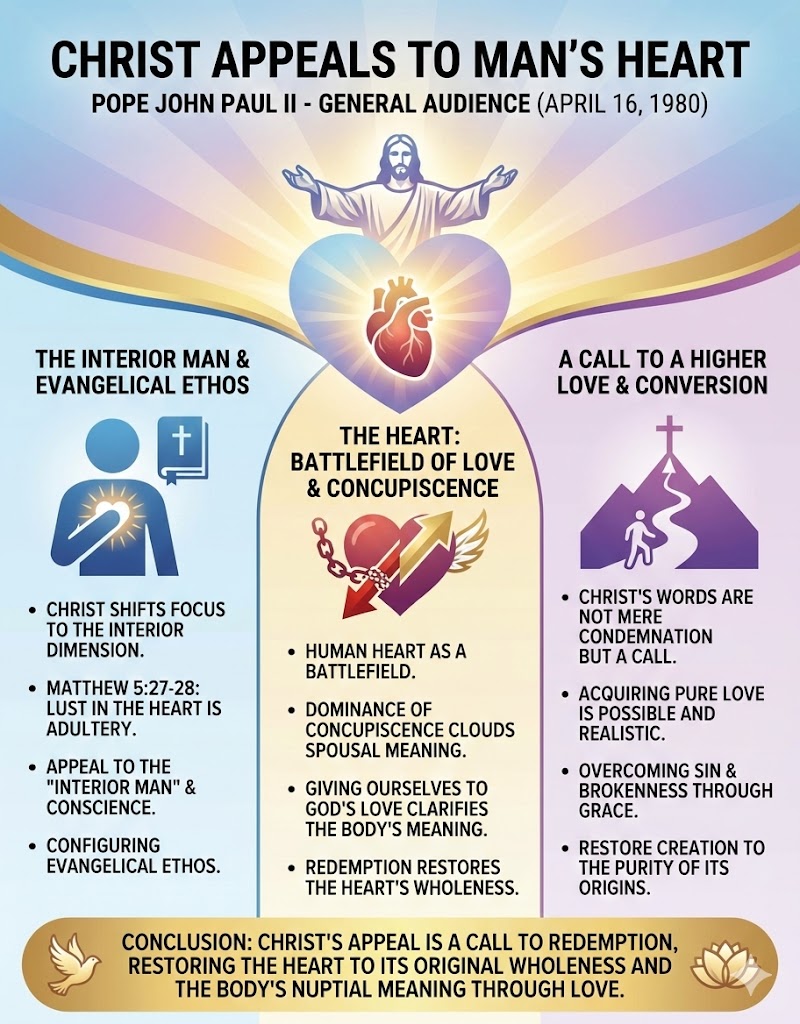
6th Sunday of Year A
16 April, 1980 | Catechesis on the Sermon on the Mount
During the General Audience in St. Peter’s Square on 16 April, the Holy Father gave the following address, which is the first of a series of talks on the analysis of the text of Mt. 5:27-28.
1. As the subject of our future reflections—at the Wednesday meetings—I wish to develop the following statement of Christ, which is part of the Sermon on the Mount: “You have heard that it was said, ‘You shall not commit adultery.’ But I say to you that everyone who looks at a woman lustfully has already committed adultery with her in his heart” (Mt 5:27-28).
This passage seems to have a key meaning for the theology of the body, like the one in which Christ referred to the “beginning,” which served as the basis of the preceding analyses. We then realized how wide was the context of a sentence, or rather of a word, uttered by Christ. It was a question not only of the immediate context, which emerged in the course of the conversation with the Pharisees, but of the global context. We could not penetrate that without going back to the first chapters of Genesis (omitting what refers there to the other books of the Old Testament). The preceding analyses have shown what an extensive content Christ’s reference to the “beginning” involves.
Need of fulfilment of the Law
The statement to which we are now referring, Matthew 5:27-28, will certainly introduce us not only to the immediate context in which it appears. It will also introduce us to its wider context, the global context, through which the key meaning of the theology of the body will be revealed to us. This statement is one of the passages of the Sermon on the Mount in which Jesus Christ fundamentally revises the way of understanding and carrying out the moral law of the old covenant. It refers, in order, to the following commandments of the Decalogue: the fifth, “You shall not kill” (cf. Mt 5:21-26); the sixth, “You shall not commit adultery” (cf. Mt 5:27-32)—it is significant that at the end of this passage there also appears the question of the “certificate of divorce” (cf. Mt 5:31-32), already mentioned in the preceding chapter—and the eighth commandment, according to the text of Exodus (cf. Ex 20:7): “You shall not swear falsely, but shall perform to the Lord what you have sworn” (cf. Mt 5:33-37).
Significant, above all, are he words that precede these articles— and the following ones—of the Sermon on the Mount, the words in which Jesus declares: “Think not that I have come to abolish the law and the prophets; I have come not to abolish them but to fulfill them” (Mt 5:17). In the sentences that follow, Jesus explains the meaning of this opposition and the necessity of the fulfillment of the law in order to realize the kingdom of God: “Whoever…does them [these commandments] and teaches them shall be called great in the kingdom of heaven” (Mt 5:19). “The kingdom of heaven” means the kingdom of God in the eschatological dimension.
The fulfillment of the law fundamentally conditions this kingdom in the temporal dimension of human existence. However, it is a question of a fulfillment that fully corresponds to the meaning of the law, of the Decalogue, of the individual commandments. Only this fulfillment constructs that justice which God the legislator willed. Christ the Teacher urges us not to give such a human interpretation to the whole law and the individual commandments contained in it that it does not foster the justice willed by God the legislator: “Unless your righteousness exceeds that of the scribes and Pharisees, you will never enter the kingdom of heaven” (Mt 5:20).
Aspects of fulfilment
2. In this context there appears Christ’s statement according to Matthew 5:27-28, which we intend to take as the basis for the present analyses, considering it together with the other statement in Matthew 19:3-9 (and Mark 10) as the key to the theology of the body. Like the other one, this one has an explicitly normative character. It confirms the principle of human morality contained in the commandment, “You shall not commit adultery.” At the same time, it determines an appropriate and full understanding of this principle, that is, an understanding of the foundation and at the same time of the condition for its adequate fulfillment. The latter is to be considered precisely in the light of the words of Matthew 5:17-20, already quoted, which we have just drawn attention to.
On the one hand, it is a question here of adhering to the meaning that God the legislator enclosed in the commandment, “You shall not commit adultery.” On the other hand, it is a question of carrying out that “justice” on the part of man. This justice must superabound in man himself, that is, it must reach its specific fullness in him. These are the two aspects of fulfillment in the evangelical sense.
At the heart of “ethos”
3. We find ourselves in this way at the heart of ethos, that is, in what can be defined as the interior form, almost the soul, of human morality. Contemporary thinkers (e.g., Scheler) see in the Sermon on the Mount a great turning point in the field of ethos.(1) A living morality in the existential sense is not formed only by the norms that invest the form of the commandments, precepts and prohibitions, as in the case of “You shall not commit adultery.” The morality in which there is realized the meaning of being a man—which is, at the same time, the fulfillment of the law by means of the “superabounding” of justice through subjective vitality—is formed in the interior perception of values, from which there springs duty as the expression of conscience, as the response of one’s own personal “ego.” At the same time ethos makes us enter the depth of the norm itself and descend within the human subject of morality. Moral value is connected with the dynamic process of man’s intimacy. To reach it, it is not enough to stop at the surface of human actions. It is necessary to penetrate inside.
Interior justice
4. In addition to the commandment, “You shall not commit adultery,” the Decalogue has also, “You shall not covet your neighbor’s wife.”(2) In the Sermon on the Mount, Christ connects them with each other, in a way: “Everyone who looks at a woman lustfully has already committed adultery with her in his heart.” However, it is not so much a question of distinguishing the scope of those two commandments of the Decalogue as of pointing out the dimension of the interior action, referred to also in the words: “You shall not commit adultery.”
This action finds its visible expression in the “act of the body,” an act in which the man and the woman participate against the law of matrimonial exclusiveness. The casuistry of the books of the Old Testament aimed at investigating what constituted this “act of the body” according to exterior criteria. At the same time, it was directed at combating adultery, and opened to the latter various legal “loopholes.”(3) In this way, on the basis of the multiple compromises “for hardness of heart” (Mt 19:8), the meaning of the commandment as willed by the legislator underwent a distortion. People kept to legalistic observance of the formula, which did not superabound in the interior justice of hearts.
Christ shifts the essence of the problem to another dimension when he says: “Everyone who looks at a woman lustfully has already committed adultery with her in his heart.” (According to ancient translations, the text is: “…has already made her an adulteress in his heart,” a formula which seems to be more exact).(4)
In this way, therefore, Christ appeals to the interior man. He does so several times and under different circumstances. In this case it seems especially explicit and eloquent, not only with regard to the configuration of evangelical ethos,but also with regard to the way of viewing man. Not only the ethical reason, but also the anthropological one makes it advisable to dwell at greater length on the text of Matthew 5:27-28, which contains the words Christ spoke in the Sermon on the Mount.