Bible Study Discussion Questions
February 15, 2026
February 15, 2026
6th Sunday of Year A

DOWNLOAD (PDF)

Edrianne Ezell
OUR SUNDAY READINGS offers a weekly PDF handout that can be used in various settings, including church bulletins, Bible study groups, homeschooling, and small group discussions. This resources is provided courtesy of Edrianne Ezell who has a Master of Divinity, Weston Jesuit School of Theology.
Sirach 15:15-20
Reading closely
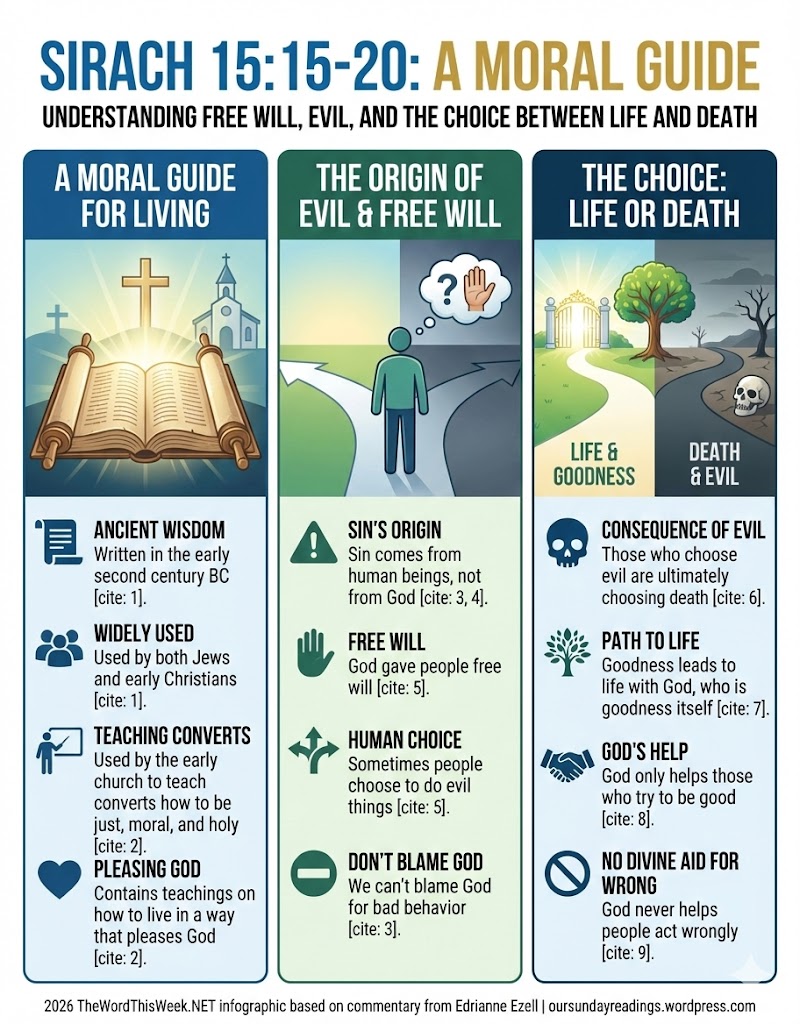
1. What are the main points of this passage? The primary point of this passage is the reality and gravity of human free will. The author emphasizes that God has placed before humanity a clear choice between keeping His commandments (which corresponds to "life" and "good") and rejecting them (which corresponds to "death" and "evil"). Furthermore, it stresses that while God is all-powerful and all-seeing, He is absolutely not responsible for human sin; He commands no one to act unjustly and gives no license to sin.
2. What idea most stands out to you? (While subjective for every reader, a common theological standout is this): The idea that most stands out is the stark clarity of the moral responsibility placed upon the individual. The statement, "Before man are life and death, good and evil, whichever he chooses shall be given him," removes the possibility of blaming fate, circumstances, or even God for our moral failures. It highlights the immense dignity and terrifying responsibility of possessing free will.
3. What imagery does the author use? How does it reinforce each point? The author uses the elemental imagery of contrasting opposites—"fire and water"—set before a person. This reinforces the point that the moral choice is binary and clear-cut; one cannot simultaneously choose both good and evil. The instruction to "stretch forth your hand" reinforces the necessity of active human deliberation and action in making this choice. Additionally, the imagery of the "eyes of God" being on His creatures reinforces the point that while we are free, our choices are made in the full view of an all-knowing God who understands every deed.
4. What questions or concerns does this passage seem to address? This passage addresses the human tendency toward fatalism (the belief that our actions are predetermined) or the temptation to blame God for our own shortcomings. It answers the concern: "If God is all-powerful, isn't He responsible when I sin?" The author forcefully rejects this by clarifying that God's power is used to grant freedom, not to coerce evil.
Living the word
5. What makes it difficult to do God’s will? In the context of Catholic teaching, doing God's will is made difficult by the lingering effects of original sin, often called concupiscence, which is an inclination toward selfishness and contrary to right reason. Difficulty also arises from external pressures in a culture that often values self-gratification over obedience to God's law, fear of the sacrifices required by virtue, and sometimes a lack of trust that God's commandments lead to true "life" rather than restriction.
6. When have you seen particular choices lead either to life or death? (This requires personal reflection by the participants, but here is a guided example): In a spiritual sense, we see choices leading to "life" when someone chooses honesty when deception would be easier, resulting in a clear conscience and stronger trust in relationships. We see choices leading to a type of spiritual "death" when someone chooses to nurture resentment rather than offer forgiveness, leading to isolation, bitterness, and a hardening of the heart.
Matthew 5:17-37
Reading closely
1. How do you think Jesus fulfills the law? The law laid the groundwork for Jesus’ ministry. Jesus fulfills the law by adapting it in order to show people how to be part of God’s kingdom.
2. How should Jesus’ disciples treat the law? Jesus wants his disciples to do an even better job of following God’s law than their religious leaders, the scribes and Pharisees.
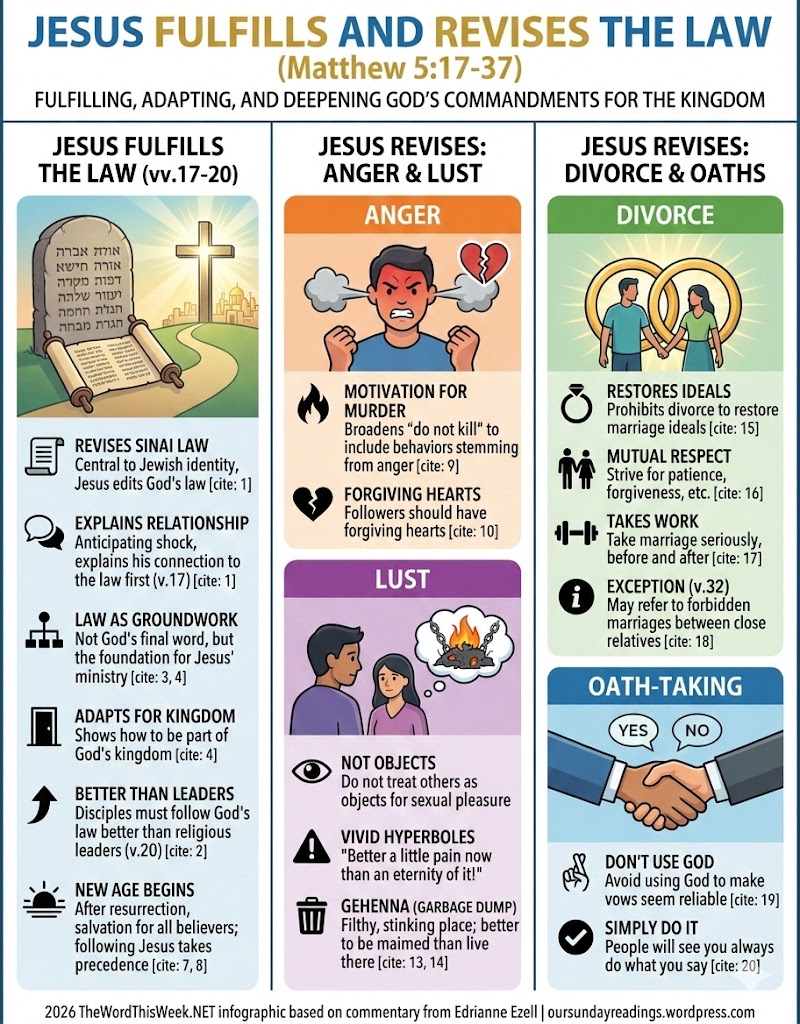
3. How does Jesus revise particular laws? Jesus revises the law given to Moses at Mount Sinai in several ways. Regarding anger, he broadens the commandment "do not kill" to include any behavior that springs from anger. Regarding lust, he warns us not to treat others as objects for sexual pleasure. He prohibits divorce to restore the ideals of marriage. Regarding oath-taking, he teaches that instead of using God to make vows seem reliable, we should simply do what we say we will do.
4. Do you think Jesus’ commandments are easier or harder than the original laws? The text indicates that Jesus wants his disciples to do an "even better job" of following God's law than the religious leaders. Regarding lust, Jesus offers "vivid hyperboles" that mean it is "better a little pain now than an eternity of it" in Gehenna.
5. How might people have reacted to Jesus? Jesus knows that his fellow Jews will be shocked that he edits God’s law, as this law was central to Jewish identity.
6. The following questions zero in on a particular teaching.
a. How do verses 23-24 about anger help you prepare for our eucharistic celebrations? The text states that Jesus wants his followers to have forgiving hearts.
b. Does our culture support healthy, respectful sexual relationships? The provided text does not contain information to answer this question.
c. What are good and bad reasons for getting married? The text implies that marriage involves striving for "mutual respect, patience, forgiveness, etc.". Jesus knows marriage takes work and wants people to take it seriously both before and after they marry.
d. Do you know anyone who struggles with Jesus’ prohibition of divorce? While this is a personal reflection question, the text offers context: By prohibiting divorce, Jesus restores the ideals of marriage. The text also notes that the exception in verse 32 might refer to marriages between closely related people, which were forbidden in Judaism.
e. Do you always follow through on what you say you’re going to do? The text advises that instead of promising to do something, we should simply do it; people will soon see that we always do what we say we’ll do.
7. Which of these teachings do you find especially challenging? The provided text does not contain information to answer this question.
Click on banner above for answers to questions.
Create an 8.5×11 infographic with a clean, modern design and large images. Title: [Insert Title Here]. Layout: Three vertical panels with a large header and footer. Style: Colorful, high-contrast, professional, and easy to read.
Footer text: ‘2026 TheWordThisWeek.NET infographic based on commentary from Edrianne Ezell | oursundayreadings.wordpress.com’
Content: [Paste the First Reading/Gospel/Meditation text here]”


Feel free to use TWTW‘s AI generated visual summaries of Edrianne Ezell ‘s commentary. They are not intended to replace it. Please use them in conjunction with her guide. You can cut, copy and paste any portion of them to use as clip art for your bulletin, or use them as is. When using above infographics please give credit to TWTW and Our Sunday Readings.
Matt Zemanek
Join the community of Saint Timothy Catholic Church in Laguna Niguel, CA for our weekly Bible study every Monday night from 7-8PM as we study the Gospel for the upcoming Sunday!


Vince Contreras
SUNDAY SCRIPTURE STUDY FOR CATHOLICS offers a weekly PDF handout that can be used in various settings, including church bulletins, Bible study groups, homeschooling, and small group discussions.
The 1st Reading (Sirach 15:15-20)
Q: In the 1st Reading, we can see that God expected even the people of the Old Testament to do their utmost to keep the moral law. Along with a higher standard, what does Jesus also give us to enable us obey his commandments (Romans 6:9-14)?
A: In the Sermon on the Mount, Jesus definitely raises the bar, moving from external observance to internal transformation. If we were left to our own devices, this higher standard would be crushing. However, as St. Paul indicates in Romans 6, Jesus doesn't just give us new commands; He gives us a new power. Through Baptism, we share in Christ's death and resurrection. We are "dead to sin and living for God in Christ Jesus." We are no longer under the law as a mere external constraint but are "under grace." This grace is the indwelling power of the Holy Spirit, which enables us to live a life that was previously impossible for fallen human nature. The New Law is not just a text to read; it is the grace of the Holy Spirit given to the faithful through faith in Christ (cf. CCC 1967).
The 2nd Reading (1 Corinthians 2:6-10)
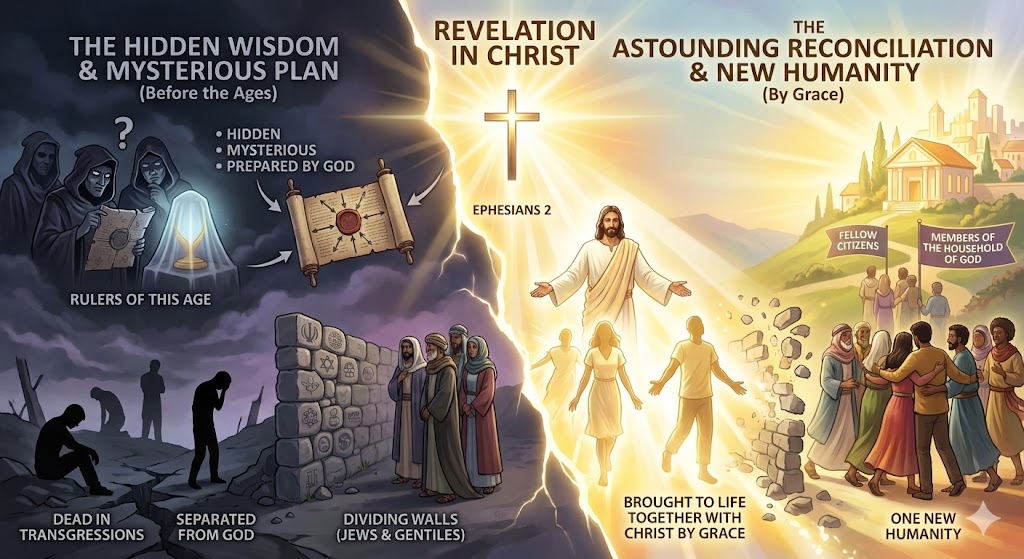
Q: In the 2nd Reading, in verse 9, St. Paul pulls verses from Isaiah 64:4 and Sirach 1:10 to express his wonderment at the mystery of God’s plan for the world. What is this plan? (see Ephesians 2)
A: Paul is speaking of wisdom that is "hidden" and "mysterious" to the rulers of this age. Looking at Ephesians 2, we see that this mysterious plan, which God prepared before the ages for our glory, is the astounding reconciliation of humanity to God through Christ. It is the plan to take us, who were dead in our transgressions, and bring us to life together with Christ by grace. Furthermore, it is the plan to break down the dividing walls between diverse peoples (like Jews and Gentiles) to create "one new humanity" in Christ, making us all fellow citizens and members of the household of God.
The Gospel (Matthew 5:17-37)
Q: In the Gospel, what attitude to you think Jesus wants you to take regarding the observance of his law (Mt 5:17-20)? How can your righteousness exceed that of the scribes and the Pharisees?
A: Jesus makes it clear that He has not come to abolish the Law or the Prophets, "but to fulfill them." The Catechism teaches that Jesus, the beloved Son, perfectly fulfilled the Law of Sinai and revealed its ultimate meaning (CCC 577). Therefore, our attitude toward the moral law should be one of deep reverence and seriousness.
The righteousness of the scribes and Pharisees was often characterized by strict, detailed external observance—following the letter of the law while sometimes missing the heart of God behind it. For our righteousness to "exceed" theirs, it must go deeper than outward behavior. It must penetrate the heart. It is not merely avoiding the bad action (murder, adultery) but rooting out the interior attitudes that lead to them (anger, lust). It means allowing the New Law, the law of the Gospel, to be written on our hearts, transforming our very desires so that we obey out of love rather than fear or pride (cf. CCC 1967, 2053-2054).
Q: How much do you struggle with anger and unforgiveness (verses 21-26)? How does this affect the quality of the service and worship you offer to God? How can you offer a more pure worship to God?
A: (This is a question for personal reflection). Jesus teaches us that festering anger, insults, and holding grudges are serious spiritual wounds—He even equates them with the root of murder because they kill communion between brothers and sisters. Jesus teaches that our relationship with neighbor and our relationship with God are inseparable. We cannot offer pure worship to the Father if we are actively cherishing hatred for one of His children. Holding onto unforgiveness creates a blockage in our spiritual life.
To offer purer worship, we must take seriously Jesus’ instruction: "leave your gift there at the altar, go first and be reconciled with your brother." This means actively seeking reconciliation whenever possible. It also means utilizing the Sacrament of Reconciliation (Confession), where we are reconciled with God and with the Church, the Body of Christ, which is wounded by our sins (CCC 1424).
Q: If you are married, how well does your marriage mirror Jesus’ high standard for the state of holy matrimony (verses 27-32)? How can you sharpen that image? If you are not married, how can you help and encourage those near you who are married to have holier, more godly, marriages?
A: (This is a question for personal reflection). Jesus calls for a purity of heart that rejects not only adulterous actions but adulterous thoughts (lust). He also reaffirms the permanence of the marriage bond as God intended from the beginning.
- For the married: Sharpening the image of Christ's high standard means practicing "custody of the eyes" and the heart, protecting the exclusive intimacy of the spouse. It also means daily renewing the commitment to indissolubility, choosing to love even when it is difficult, and relying on the grace of the Sacrament of Matrimony to sustain the bond.
- For the unmarried: We can encourage holy marriages by praying for married couples, respecting the sacred boundaries of their union, speaking positively about the vocation of marriage, and offering practical support to families to alleviate stress.
Q: Oaths and vows are an important part of any civil society. In your private life, however, do you feel it necessary to bolster your word with a private oath? What is the standard of personal integrity that Jesus wants his disciples to have (verses 33-37)? How can you maintain that standard?
A: Jesus calls His disciples to a standard of radical honesty and integrity. He teaches that we should not need to swear by heaven, earth, or Jerusalem to convince others we are telling the truth. The need for many oaths suggests a general climate of mistrust or duplicity.
As the Catechism states, in teaching that our "Yes" should mean "Yes" and our "No" should mean "No," Jesus is calling for a purification of our speech that honors God's presence in all our interactions (CCC 2153). We maintain this standard by practicing truthfulness in the small matters of daily life, avoiding exaggeration, white lies, or evasive language. Our character should be so transparent that our simple word is enough.tached to worldly comforts rather than being "poor in spirit," or because we harbor resentment rather than being "merciful.")
Click on banner above for answers to questions.


FR. KIERAN O’MAHONY
TWTW infographics below were created using core concepts from the PDF above.
Gospel
Initial Observations & Kind of Writing
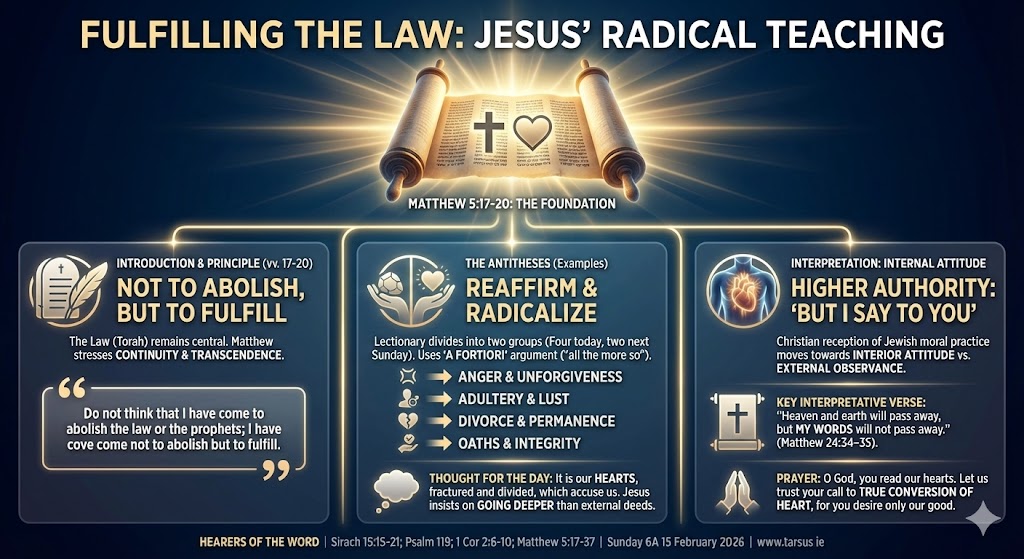
Gospel
Old Testament Background

Gospel
New Testament Foreground

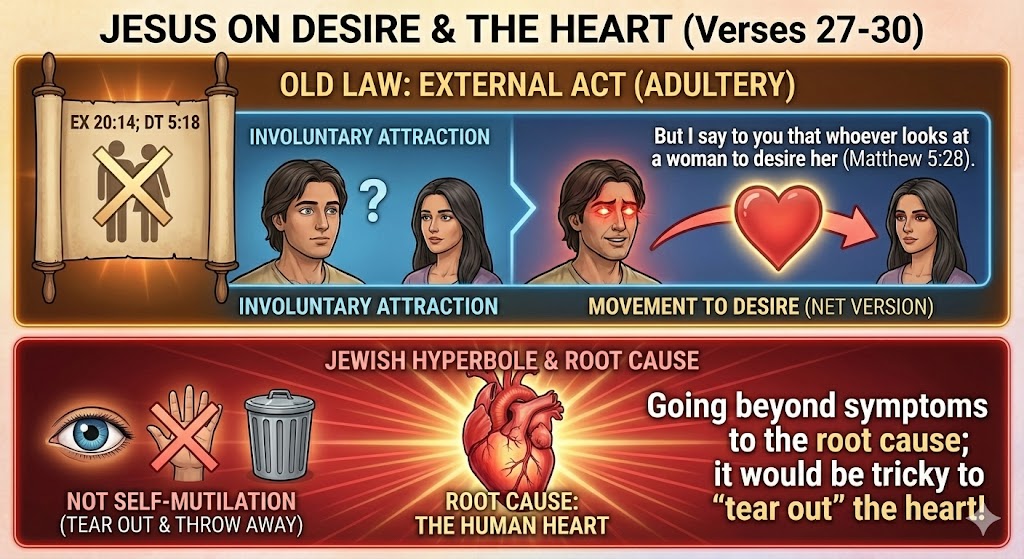
Gospel
Pointers for Prayer

First Reading
Pointers for Prayer

TWTW infographics on this page present Fr. Kieran’s “GOSPEL COMMENTARY” and “POINTER FOR PRAYER” which are presented after each reading’s commentary. Please cross-reference the slides with the PDF if you notice any errors. Non-profits are welcome to utilize the provided graphics in their materials and presentations. Please acknowledge Fr. Kieran O’Mahony, OSA, and his website, taurus.ie. The graphics were designed by TheWordThisWeek.net using Gemini Pro 3 and Nano Banana. Proper attribution is appreciated.

Discussion Pointers / Answers
Echoing God’s Word – Portland Diocese

Positive Contributions of Christians
Question: List and discuss the positive values and virtues that Christians bring to the Church and to the world for the good of both. How is the Church made better by the spiritual gifts that its holy members bring to it? How is the world enriched and enlightened by the holiness and virtues of holy Christians?
Answer: Christians are called to embody values that reflect the character of Jesus Christ, serving as both the internal lifeblood of the Church and an external transformative force in the world. These positive contributions can be categorized broadly into theological virtues, cardinal virtues, and specific spiritual gifts (charisms).
Values and Virtues brought to the Church and World: At the core are the Theological Virtues—Faith, Hope, and Charity (Love). Faith provides a foundation of meaning beyond the material world. Hope offers resilience in the face of suffering and despair. Charity, the highest virtue, drives selfless action towards others. Alongside these are the Cardinal Virtues—Prudence, Justice, Fortitude, and Temperance—which guide practical moral behavior, ensuring fairness, courage in adversity, and self-control. Further essential Christian values include humility, mercy, compassion, integrity, and generosity.
How the Church is Made Better by Spiritual Gifts: Within the Church, the Holy Spirit bestows diverse "charisms" or spiritual gifts upon individuals not for their own glory, but for the building up of the "Body of Christ."
- Edification and Unity: Gifts such as teaching, administration, prophecy (speaking divine truth), and encouragement ensure the community is educated, organized, and spiritually nourished.
- Service and Care: Gifts of healing, mercy, and hospitality ensure that the vulnerable within the community—the sick, the lonely, the poor—are cared for, making the Church a true sanctuary.
- Vitality of Worship: Artistic and musical gifts enrich liturgy, helping the community encounter the divine. When members exercise their specific gifts in holiness, the Church functions organically and healthily, rather than relying solely on clerical structures.
How the World is Enriched by Christian Holiness: In the secular world, holy Christians act as what Jesus termed "salt" (preservation and flavor) and "light" (illumination).
Hope and Reconciliation: In a polarized world, Christian virtues of forgiveness, mercy, and peacemaking offer pathways to reconciliation that political or secular solutions often lack. By embodying hope that transcends current circumstances, they enrich a world often struggling with despair.
A Moral Compass: By living lives of integrity and justice, Christians provide a counter-narrative to prevailing cultural trends of greed, extreme individualism, or moral relativism. They uphold the dignity of every human life.
Alleviation of Suffering: Historically and currently, Christian virtues drive the creation of hospitals, schools, orphanages, and relief organizations. The virtue of charity translates into concrete action for the marginalized, regardless of their faith.
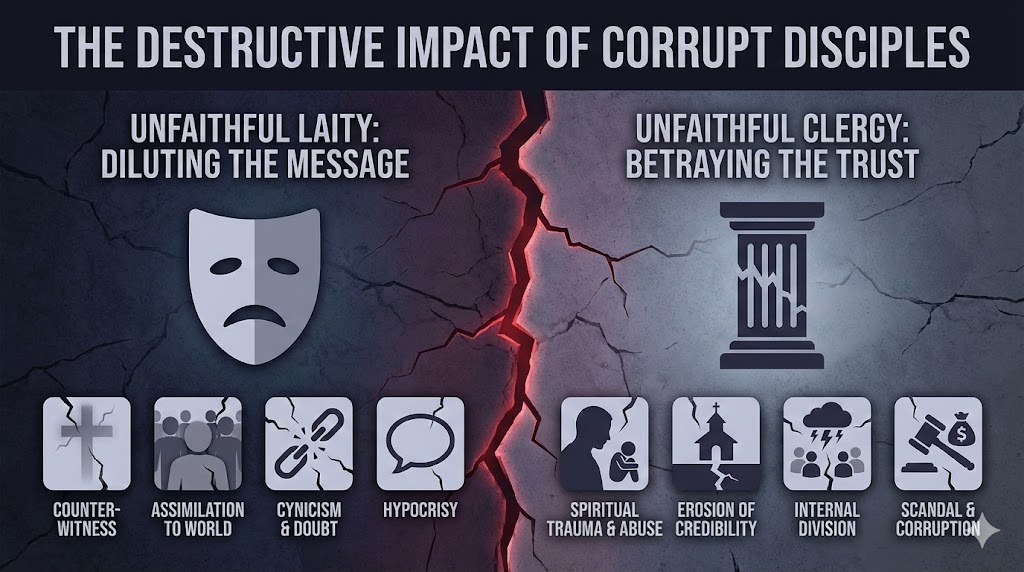
Negative Impacts of Corrupt Disciples
Question: List and discuss the sins and vices that corrupt disciples bring to the Church and to the world in which they live. What is the negative impact of those who are unfaithful to their vocations among the laity and among the clergy?
Answer: Just as virtues build up, sins and vices tear down. When baptized Christians—who are meant to be representatives of Christ—succumb to corruption, they cause profound damage both internally to the faith community and externally to its credibility.
Sins and Vices brought to the Church and World: The primary vices are often rooted in the traditional "seven deadly sins," particularly pride (placing oneself above God and community), greed (pursuing material gain over people), and lust (objectifying others). However, specific vices that damage the Church’s mission include hypocrisy (saying one thing but doing another), judgmentalism (condemning others while ignoring one's own faults), apathy (indifference to suffering or spiritual duty), and the abuse of power.
Negative Impact of Unfaithful Laity: When laypeople are unfaithful to their Christian vocation, the primary impact is the dilution of the Gospel message and the fostering of cynicism.
- Counter-Witness: If a Christian is known to be ruthless in business, dishonest in relationships, or filled with prejudices during the week, their presence in church on Sunday appears as a hollow performance. This hypocrisy suggests to the secular world that faith makes no practical difference in a person's life.
- Assimilation into Worldliness: When lay Christians adopt the vices of the surrounding culture—consumerism, hyper-sexualization, or partisan hatred—the Church loses its distinct "saltiness" and becomes indistinguishable from the world it is meant to transform.
Negative Impact of Unfaithful Clergy: The unfaithfulness of the clergy carries a uniquely destructive weight due to their position of authority, trust, and sacramental leadership. The ancient maxim holds true: corruptio optimi pessima (the corruption of the best is the worst).
- Scandal and Spiritual Trauma: Clerical sins, particularly sexual abuse of minors or vulnerable adults, and financial malfeasance, shatter lives. They cause deep spiritual trauma, often destroying the victim's ability to trust God or religious institutions entirely.
- Erosion of Institutional Credibility: When leaders preach virtue but practice vice, the entire institutional Church is viewed with suspicion. This moral failure provides ammunition for secular critics to dismiss religion entirely as a tool for control or a haven for predators.
- Internal Division: Corrupt leadership breeds factionalism, resentment, and a loss of morale among the faithful clergy and laity, distracting the Church from its mission of evangelization to focus on damage control.
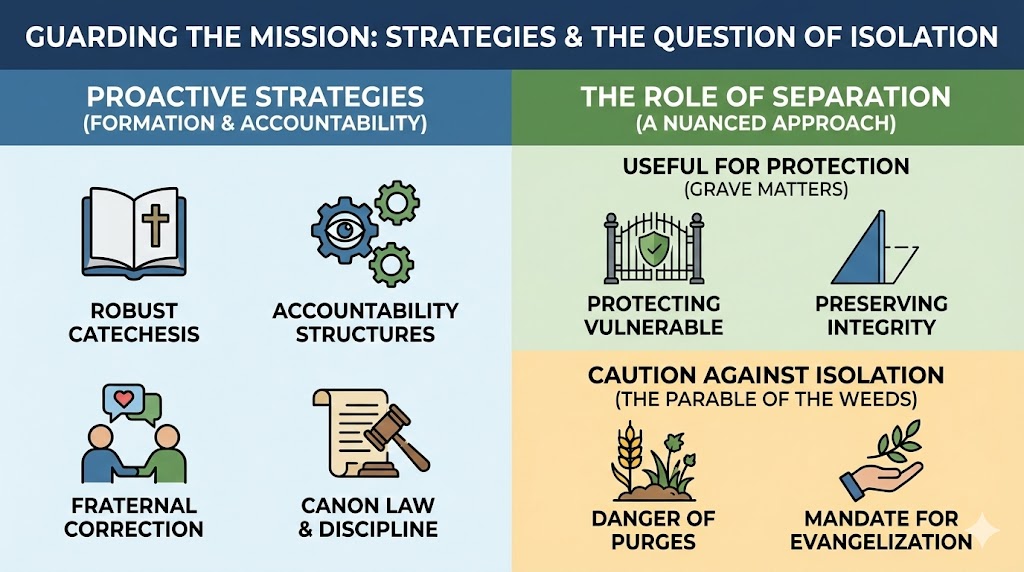
Strategies for Protection and the Question of Isolation
Question: Discuss the strategies that the faith community uses to guard itself and its mission from the evils of false disciples. Is it useful to separate and isolate evil?
Answer: The Church faces a perpetual tension: it is a "hospital for sinners" obligated to mercy, yet it must also protect its integrity and its vulnerable members from predation and corruption. Strategies to guard the mission involve a mix of proactive formation and reactive discipline.
Strategies for Guarding the Faith Community:
- Robust Catechesis and Formation: The primary defense is proactive. By thoroughly educating members in doctrine and morality, and fostering deep spiritual lives through prayer and sacraments, the community forms consciences that are resistant to vice and heresy.
- Accountability Structures: Especially in response to modern scandals, the Church has had to implement rigorous structural safeguards. This includes financial transparency policies, lay oversight boards, and strict "safe environment" protocols (background checks, mandatory reporting) to prevent abuse by clergy or volunteers.
- Fraternal Correction: Based on biblical principles (e.g., Matthew 18), communities are encouraged to practice direct, private confrontation of sinful behavior before escalating issues, hoping for repentance.
- Canon Law and Discipline: The Church maintains a legal system to address grave violations. This includes penalties ranging from removing a person from ministry or office to, in extreme cases, excommunication.
Is it useful to separate and isolate evil? The answer is complex and requires nuance; it is sometimes necessary, but rarely a complete solution.
- When Separation IS Useful (The Protective Function): Separation is essential when the "evil" behavior poses an immediate threat to the physical, spiritual, or moral safety of others.
- Protecting the Vulnerable: Abusive clergy or lay leaders must be permanently separated from ministry and isolated from potential victims. Here, isolation is a mandatory act of justice and protection.
- Preserving Integrity: In cases of obstinate, public heresy that causes deep division and confusion among the faithful, formal separation (like excommunication) serves a medicinal purpose—to make the offender realize the gravity of their actions—and protects the community's doctrinal integrity.
- When Isolation IS NOT Useful (The Parable of the Weeds): Jesus’ parable of the wheat and the tares (weeds) suggests caution against trying to prematurely create a perfectly pure community.
- The Danger of Purges: An overzealous attempt to root out everyone deemed a "sinner" leads to judgmentalism, cult-like insularity, and the inevitable damaging of the "wheat" (the good members) alongside the weeds.
- The Mandate for Evangelization: If the Church completely isolates itself from sinners, it fails its mission to call them to repentance. Total separation thwarts mercy. The goal of discipline is ultimately restoration, whenever possible, not permanent rejection.
In summary, the Church uses separation as a necessary tool for protection in grave matters, but relies on engagement, mercy, and formation as its primary strategy for dealing with the reality of sin within its membership.
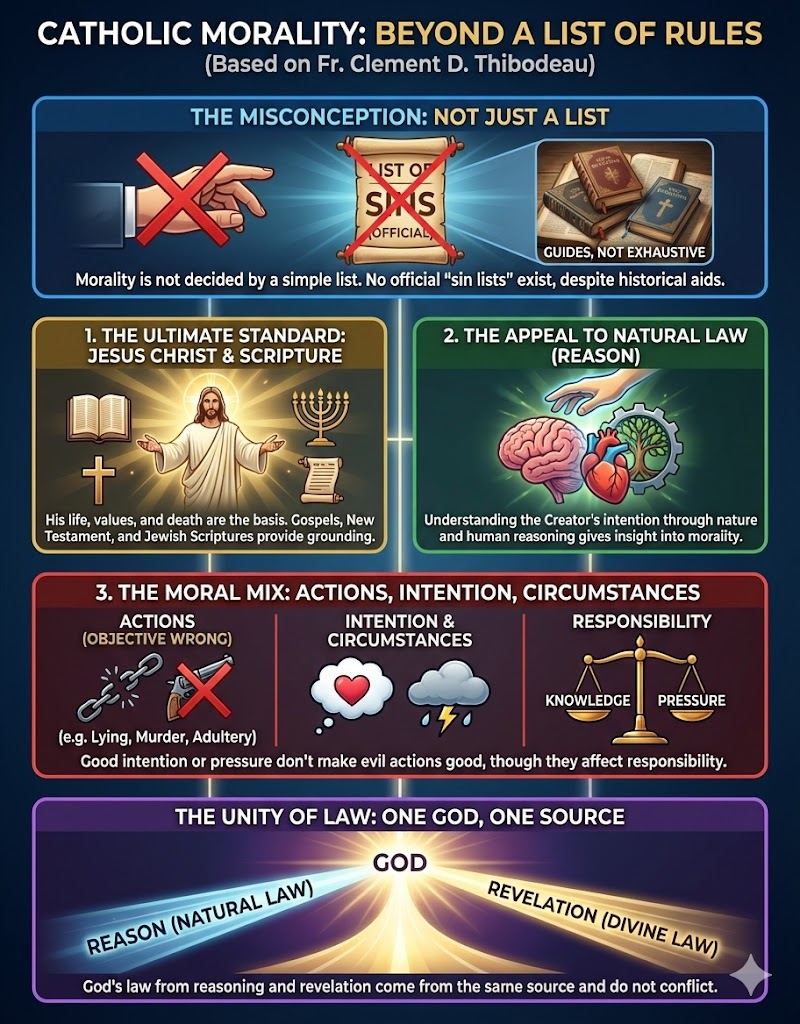
create an 8.5×11 inch infographic with images based on an essay of Fr. Clement D. Thibodeau.
create an 8.5×11 inch infographic with images on a white background based on an essay of Fr. Clement D. Thibodeau.
Catholic Doctrine

The above bulletin insert was created using Nano Banana Pro with Gemini 3.0. The infographics draw inspiration from the content found in Fr. Clement Thibodeau’s Echoing The Word weekly column which was published nearly a decade ago. It may be used by any non-profit ministry.


Friar Musings — Fr. Corrigan, OFM
Catholic Lectionary – Fr. Felix Just, S.J.
As we soon get into Lent, some good materials might be:
https://catholic-resources.org/Lectionary/40-Days-Nights.htm
https://catholic-resources.org/Lectionary/1998USL-Lent.htm
https://catholic-resources.org/Lectionary/2002USL-Weekdays-Lent.htm
For the Scrutiny Gospels (3rd, 4th, 5th Sundays of Lent), see:
https://catholic-resources.org/John/Outline-John04.html
https://catholic-resources.org/John/Outline-John09.html
https://catholic-resources.org/John/Outline-John11.html
For Palm Sunday:
https://catholic-resources.org/Bible/Matthew-Passion.htm
and more generally
https://catholic-resources.org/Bible/Passion.htm
For the Easter Triduum:
https://catholic-resources.org/John/Outline-John13.html