Fr. Tony’s Homily, Homily Starters
Fr. Tony’s Homily, Homily Starters
October 11, 2026

⬅️  ➡️
➡️


RELATED
PAGES




Mass with Helium Balloons?
28th Sunday of Year A

At an Evangelical church conference in Omaha, people were given helium-filled balloons and told to release them at some point in the service when they felt joy in their hearts. All through the service worshippers kept releasing balloons, but at the end of the service it was discovered that most of them still had their balloons unreleased. — If this experiment were repeated in our Church today, how many of us would still have our balloons unreleased at the end of the Mass? Many of us think of God’s House as a place for seriousness, a place to close one’s eyes and pray, but not a place of celebration, a place of joy.
The parable of the Great Supper in today’s Gospel paints a different picture. The Christian assembly is a gathering of those who are called to the Lord’s party. In the Eucharist, we say of ourselves, “Blessed are those called to the Supper of the Lamb.” The Lord invites us to a supper, a banquet, a feast. Can you imagine a wedding feast in which everyone sits stone-faced, cold and quiet?
Churchill’s Blunder
28th Sunday of Year A
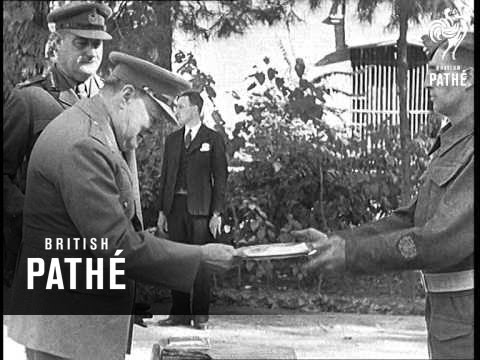
The Big Three in Teheran (1943)
At the end of World War II, the Russian head-of-state Joseph Stalin gave an elaborate banquet to honor the British Prime Minister Winston Churchill. The Russians arrived in their best formal wear — military dress uniforms — but their honored guest did not. Churchill arrived wearing his famous zipper coveralls that he had worn during the German bomb attack in London. He thought it would provide a nostalgic touch the Russians would appreciate. They did not. They were humiliated and insulted that their prominent guest-of-honor had not considered their banquet worthy of his best clothes.
Wearing the right clothing to a formal dinner honors the host and the occasion; neglecting to wear the right clothing is an insult. Weddings were such an important occasion in Palestine in Christ’s days that people were expected to wear the proper clothing to show appreciation and respect for the invitation — clothing, in fact, provided by the host!
SOURCE: Flor McCarthy in New Sunday and Holy Day Liturgies; quoted by Fr. Botelho
In today’s Gospel, Jesus demands, and provides, the wedding garment of righteousness from his followers.
Warnings Ignored
28th Sunday of Year A

“We didn’t know you had Catholic Grandparents”
Huey Long was a very colorful Louisiana politician who had hopes of running for the presidency in 1936. He began as an unschooled farm boy and ended up in the governor’s mansion, one of the most popular politicians in the history of the state. Long was born in the central part of Louisiana, and when he first campaigned for governor, he was given some advice about the voters in the New Orleans area.
“South Louisiana is different from the northern part of the state,” he was told. “We have a lot of Catholic voters down here.”
Long nodded knowingly and went out to make his speech.
“When I was a boy, I’d get up at six every Sunday morning, hitch our old horse up to the buggy, and take my Catholic grandparents to Mass. I’d bring them home and then take my Baptist grandparents to Church.”
The speech was a rousing success. Afterward, a New Orleans political boss said, “Huey, you’ve been holding out on us. We didn’t know you had Catholic grandparents.” Huey looked at him slyly and said, “We didn’t even have a horse!”
SOURCE: Joe Claro, The Random House Book of Jokes (New York: Random House, Inc., 1990)
28th Sunday of Year A

Late have I come for the Heavenly Banquet! An old couple, having been married almost 60 years, died in a car crash. They had been in good health for the previous ten years mainly due to the wife’s interest in health, food, and exercise. When they reached the pearly gates, St. Peter took them to their mansion which was decked out with a beautiful kitchen and master bath suite, Jacuzzi and lavish buffet breakfast. “How much does it cost to eat?” asked the old man. “Don’t you understand?” Peter replied. “This is Heaven, it’s all free!” After a sumptuous breakfast the old couple went to the clubhouse of Heaven’s extensive golf grounds and saw the lavish buffet lunch. “Well, where are the low-fat and low-cholesterol tables?” the old man asked timidly. Peter replied, “That’s the best part…you can eat as much as you like of whatever you like and you never get fat and you never get sick. This is Heaven.” — The old man looked at his wife angrily and said, “This is all your fault! If it weren’t for your bran muffins and sugar-free diet, we could have been here ten years ago!”
Heavenly Banquet
28th Sunday of Year A
The clipart is from the archive of Father Richard Lonsdale © 2000. It may be freely reproduced in any non-profit publication.
Today’s Scripture readings offer us a standing invitation to the everlasting joy of the Heavenly Banquet and a loving warning to stay ready always for this Heavenly banquet by constantly wearing the wedding garment, i.e., remaining in a state of grace by avoiding sins and by doing good.
Isaiah 25:6-10a

In the first reading Isaiah describes the Messianic banquet on the Lord’s Mountain. The prophet sees the mountain of the Holy City transformed into a grand banquet hall full of life and good things. He paints the picture of “a feast of rich food and choice wines.” The Responsorial Psalm (Ps 23) describes how, like a totally committed shepherd, God spares nothing in order to provide nourishment for His flock.
The first reading (Is 25:6-10) explained: The prophet Isaiah (742-700 B.C.) describes, under the image of a great banquet, the blessings and happiness that the Messianic Kingdom will bring.
Isaiah is referring to Heaven, the second and final stage of the Messianic Kingdom. He gives a graphic description of the great banquet that the Lord will prepare for his people, expressing a grand prophetic vision of the universality of Salvation. The imagery Isaiah uses is that of a great banquet on the Lord’s Mountain, Mt. Zion: a feast for all people, doing away with death, wiping away tears from every face, and removing their reproach from the earth. Isaiah announces, “good news and bad news.” The banquet is certainly going to take place, but Yahweh is planning to invite not only His “Chosen People” but “all peoples,” who “on that Day” will sing together, “Let us rejoice and be glad that He has saved us.” It took a courageous prophet to speak of a God Whose loving care extended beyond the Jews, who prided themselves on their status as the only Chosen People. In some ways, Isaiah’s ideal state parallels Jesus’ parable about the King’s Wedding Banquet (Mt 22:1-14). Let us remember that Heaven with its great Banquet is ours for the receiving. God the Father intends it for all of us, God the Son has earned it for all of us, and God the Holy Spirit is ready at every moment of our lives to assist all of us to obtain it — if we so choose.
Phil 4:12-14, 19-20

In the second reading, Paul tells Philippians about the high expectations he has for them, reminding them that they need to become fruit-producing Christians by praying and giving thanks to God and by practicing justice, purity, and graciousness in their lives.
The second reading (Philippians 4:12-14, 19-20) explained: On several occasions, Paul has received generous financial support from the Christians at Philippi, so his words are a “thank you” note to them from prison. In today’s lesson, Paul emphatically proclaims, “In Him who is the source of my strength, I have strength for everything.” When the Apostle thanks his friends for their kindness toward him, he does so in these words: “My God in turn will supply your needs fully, in a way worthy of His magnificent riches in Christ Jesus.” Paul claims that his strength comes from Jesus and his future hope revolves around Jesus. Referring to the vast spiritual benefits he enjoys as a man of Faith, Paul tells his friends in Philippi about the contrasts in his life: he knows the experience “of living in abundance and of being in need.” Because of his Faith, it makes no difference to Paul whether he lives “in humble circumstances or in abundance.” His whole existence has been transformed by his being joined to Jesus in His death and Resurrection: “I have learned,” he writes, “the secret of being well-fed and of going hungry.” Paul reminds us of our need for a complete and unquestioning trust in God and for the firm conviction that He is regulating the affairs of our lives.
Matthew 22:1-14

In the Gospel, Jesus describes the eschatological banquet of Heaven. He characterizes the reign of God as a wedding feast, a banquet of “calves and fatted cattle.” When the banquet is rejected by the chosen guests, it is offered to all and sundry. Thus, all the readings suggest that God loves His people and provides for their eternal salvation. Today’s Scripture readings give us the strong warning that if we do not accept God’s love, if we reject His gift, we can have no place with Him. We have to stay prepared for the freely offered Heavenly Banquet by getting (in Baptism), and wearing every day, the freely given wedding garment of grace always. We “wear” the garment by cooperating with God’s grace in prayer, in attending Mass and receiving the Sacraments with devotion, in doing good and avoiding evil, and in responding to His love by lovingly sharing our blessings with others. The parable warns us that membership in a Church alone does not guarantee our eternal salvation.
Gospel Exegesis: The context: The parable of the royal banquet is a parable about the Kingdom of God and about the people who will eventually belong to it. It is also the first of three parables that challenge the legitimacy of the Jewish leadership. The parables all contrast the true Israel with the attitudes and lives of the Pharisees, demonstrating the claims of the Pharisees as false. In addition, the Parable of the Royal Banquet and the Wedding Garment is Jesus’ interpretation of the History of Salvation. It is also one of the three parables of judgment or “rejection parables” that Jesus told at the Temple in Jerusalem during the last week of his public life, addressing the “chief priests and elders of the people,’ i.e., Israel’s religious and civic leaders. This parable was delivered by Jesus during his last visit to the Temple — the day we know as the Tuesday of Holy Week. The encounter was part of the Master’s last confrontation with those who saw Jesus as their enemy, before they had him arrested. The actual parable is the disturbing story of a King Who celebrated the wedding feast of His Son. When the VIP guests who had been invited refused to come, He brought street people in to take their places. Here, Jesus combines the parable of the marriage feast with another rabbinic parable, the parable of the wedding garment.
The objective: Along with the parable of the landlord and the wicked tenants, this, too, is an allegory unfolding the whole of salvation history. The parable was intended to be a fitting reply to the accusation that Jesus was unfit to teach because He was mingling with the publicans and sinners. It also answers the question of Jesus’ authority to teach in the Temple of Jerusalem. Jesus hints in the parable that he is befriending the sinners and preaching the Good News of God’s salvation to them because the scribes and Pharisees have rejected him and his message, while the sinners (whom they have neglected and scorned), have accepted him wholeheartedly. That is why he compares God to a King who gives orders to invite the ordinary folk from the waysides as guests for his son’s royal banquet. Jesus also declares that the source of his authority is God his Father Who has sent His Son to preach the Good News of Salvation. In Luke’s Gospel, Jesus tells this parable in reply to the statement made by one of his listeners: “Blessed are those who are invited to take part in the Messianic Banquet in Heaven.” This parable is based on the Jewish marriage customs of Jesus’ day and contains both a local and a universal lesson.
The Jewish wedding customs and political overtones: Since accurate timepieces were unavailable and preparation for a banquet was time-consuming, invitations to such events were sent and accepted well in advance. Once the banquet was ready, the host would send the guests a message — rather like our custom of making medical appointments in advance and receiving a reminder call a day ahead. Attendance at the royal prince’s wedding by prominent citizens was a necessary expression of the honor they owed the king and an expression of their loyalty to the legitimate successor to his throne. Even at ordinary weddings, it was insulting to the host if someone refused to participate in the wedding feast after agreeing to do so at the first invitation. Hence, “refusal of a king’s invitation by the VIPs, without any valid reason suggested rebellion and insurrection” (The Interpreter’s Bible). That is why the king sent soldiers to suppress the rebellion. Thus, the parable of the wedding feast has major political overtones. Another approach to the parable is that it is a prophetic allusion to the destruction of the Temple in 70 A.D., which is interpreted to be a sign of God’s judgment against the unbelieving Jews.
Was the King rude and unkind? In royal banquets, special wedding garments would be provided by the host and given, outside the banquet hall, to those who could not afford proper dress. In other words, when kings would invite everyone to the feast, they, knowing that many would be poor and not have proper vesture, would normally send out the royal tailors to make proper clothing for everyone who was invited or in some other way provide the fitting clothing. Hence it is s not difficult to recognize why the king would be so upset about seeing this improperly attired man who was so lazy, or stubborn, perhaps, that he deliberated refused to wear the clothing that was required and made freely available.
The code words and their direct meaning in the parable: The King in the parable is God and the King’s Son is Jesus. The marriage is symbolic of the Incarnation of Jesus Christ, the union of Christ’s Divine and human natures in one Person (St. Gregory). During the nearly 2000 years between Abraham and Christ, God sent Moses and the Prophets to call His Covenant people to the great wedding feast of the Gospel. The invited guests were the Jewish people. At first, Jesus, the Christ (the Messiah), invites the people of the Old Covenant, the Jews, to join this great marriage feast which is now ready — but they fail to respond. The messengers the King had sent to invite the people were the Hebrew prophets. The second and third sets of messengers are the Christ Himself and then Christian missionaries. The burned city (v. 7) is Jerusalem. A few VIP invitees offer flimsy and insulting excuses, implying that tending to their business is much more important than the wedding of the crown prince. The other invited guests challenge the king’s honor directly by seizing his slaves who bring the invitation, beating, and killing them. Clearly this action demands reprisal, and the King obliges. Mt 22:7 tells how the King sent His armies against those who refused the invitation and burned their city. Later, Christians tended to see the destruction of Jerusalem in 70 A.D. as a similar judgment of God upon the people who had rejected the invitation by Christ to the eschatological banquet.
The universal call and rejection of the Jews: The “good and bad” (v. 10), in the parable constitute the mixed memberships of the Church: the sinners and the righteous. The people in the highways and the byways stand for the sinners and the Gentiles, who never expected an invitation into the Kingdom. God’s invitation includes an offer of the correct dress for the feast, namely, the robe of Christ’s righteousness of which Paul speaks in Philippians 3:7-11. Since this parable was directed to the chief priests and elders, Jesus contrasts their rigid observance of the Law with the open-hearted generosity expressed by the King: “Invite everyone you find.” This is obviously more than a story about a king and a banquet. It is the story of Salvation History in which God sent prophets and Christian evangelists with Good News. The first-invited are now rejected, but strangers are accepted. In other words, the Gentiles have replaced the Jews who refused to respond to Yahweh’s call. This was the way that first-century Christians looked at the Jewish rejection of Jesus.
Lessons taught by the parable: The word “Church” is derived from the Greek word ekklesia, which means those having been called or invited. We are the ones who have responded to Jesus’ invitation. Hence, the first lesson taught by the parable is that God invites everyone, but each of us needs to give God’s invitation priority over every other good and important thing in life. The second lesson for all of us is that it’s not enough just to show up. We must be properly “dressed up.” In his Letter to the Colossians, Paul directs his converts, “As God’s chosen ones, holy and beloved, clothe yourselves with compassion, kindness, humility, meekness, and patience. … Above all, clothe yourselves with love, which binds everything together in perfect harmony” (Col 3:12-14). In the Letter to the Ephesians, he talks about our clothes as a spiritual armor: “Therefore put on the whole armor of God: … fasten the belt of truth around your waist and put on the breastplate of righteousness. As shoes for your feet put on whatever will make you ready to proclaim the Gospel of Peace. With all of these, take the shield of Faith, with which you will be able to quench all the flaming arrows of the evil one. Take the helmet of salvation, and the sword of the Spirit, which is the word of God” (Eph 6:11-17). It’s easy to get the picture: the wedding garments God wants us to don are woven with acts of Faith, Love, Hope, kindness, compassion, humility, patience, meekness, Truth, and Holiness. There is an extended meaning or universal lesson taught by this parable. Christians are invited to the endless joy of the Heavenly Banquet. If, in our preoccupation with passing, time-tied pleasures and duties, we refuse this invitation, our greatest pain after our death will be the realization of the precious things we have forfeited. The invitation to the ordinary people from the byways tells us that God’s invitation to each one of us is purely an act of grace and not something that we deserve by our good works. The parable also warns us that God will judge those who refuse His invitation, giving them the misery they have chosen for themselves
The Parable of the Wedding Garment: This parable is a modification of two rabbinic stories well-known to Jesus’ audience. In those days, participants in a banquet were expected to dress in clothes that were superior to those worn on ordinary days. Guests who could afford it would wear white, but it was sufficient for ordinary people to wear garments as close to white as possible. It was customary for the rich hosts to provide their guests with suitable apparel. For royal weddings, special outfits were given to any guests who could not afford to buy their own. Hence, to appear in ordinary, soiled working clothes would show contempt for the occasion, and would be an unspoken refusal to join in the King’s rejoicing.
“Wearing the wedding garment” means living out the Gospel message. We are called to live the moral and ethical values embodied in Jesus’ life in earth in flesh and time, and in his teachings. In other words, the “wedding garment” in the parable refers to true discipleship rather than uncommitted membership. The parable means that when one freely accepts Christ as one’s Lord and Savior, one must dedicate one’s life to Jesus. In other words, the Christian must be clothed in the spirit and teaching of Jesus. Grace is a gift and a grave responsibility. Hence, a Christian must be clothed in a new purity and a new holiness. In other words, while God, through the Church, opens wide His arms to the sinner, the sinner can only accept His invitation to this relationship of mutual love by loving Him back, and so by making some effort to repent and change his life. It is not enough for one to say, “I believe,” and then simply to continue living one’s life in one’s accustomed sinful ways. Although Jesus accepted the tax collectors and prostitutes, he demanded that they abandon their evil ways (“Go, and sin no more!”) The permanent and universal lesson taught by the parable has nothing to do with the actual clothing we wear when we go to Church. But it has everything to do with the spirit in which we enter God’s House. It is true that Church-going must neither be a fashion parade nor an occasion of scandal for others, but the garments of the mind and of the heart we wear when we go to worship God are more important than our material clothing. The wedding garments are the garments of penitence, Faith, reverence and Love. The parable ends on a slightly pessimistic note: “For many are called, but few are chosen.” It is a sad fact that, although everyone is called to experience the love of God, relatively few will really try to follow His teachings.
Here is Bible scholar Daniel Harrington’s comment on the wedding garment: “Mere acceptance of the invitation, however, does not guarantee participation in the banquet … Guests at a wedding banquet would be expected to appear in clean and neat clothing. When the king (God the Father) sees a man who is not dressed properly, he questions him in a cool manner (“My friend”) and has him ejected from the banquet hall. Being a tax collector or prostitute is no more a guarantee of salvation than being a Pharisee or chief priest; rather, one must receive Jesus’ invitation and act upon it so that when the banquet actually begins, one will be properly prepared to participate … The invitation to the kingdom has been offered to all kinds of people, but only a few of them act upon it in such a way as to be allowed to participate in the banquet of the kingdom.”
Fathers of the Church on the parable: St. Gregory the Dialogist, a bishop of Rome, writes that the King is God Himself, and the marriage is symbolic of the Incarnation of Jesus Christ, the union of Christ’s Divine and human natures in one Person. The feast is symbolic of Christ’s Church, which exists, we remember, in Heaven, in Purgatory, and on earth. St. John Chrysostom’s commentary is similar to this interpretation. He adds that, at first, Christ invites the people of the Old Covenant, the Jews, to join this great marriage feast, which is the Church. But they fail to respond. He invites them a second time, and they are too busy with earthly concerns, an attitude about which St. John Chrysostom warns us, “when spiritual things call us, there is no press of business that has the power of necessity.” When Christ persists with His invitations to the Jews, they kill Him by having the Romans crucify Him. Similarly, they killed the Old Testament Prophets through whom God had convicted them of their wrong-doing. Chrysostom comments that Christ sought to bring to conversion those who were conspiring to have Him killed before His crucifixion, and again with the coming of the Holy Spirit. Even after that, “He still urges them, striving to win them over.” However, they continue to refuse Him, and so it is then that the ordinary people of the “highways,” the Gentiles, are invited, since the wedding feast, the Church, must be filled. Chrysostom writes that when the Jews “were not willing to be present at the marriage, then He called others.” He called you and me.
Life Messages
28th Sunday of Year A
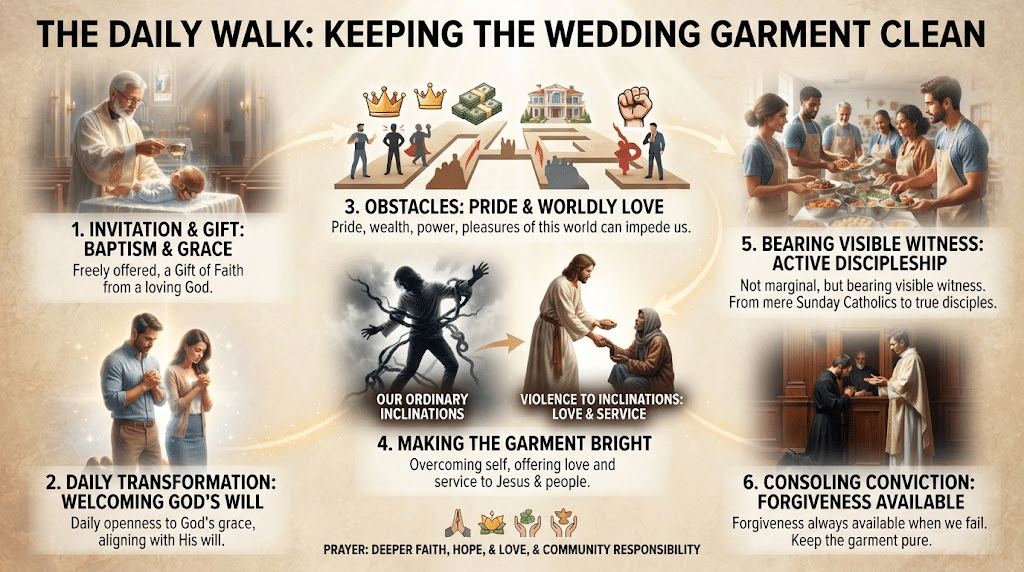
We need to be grateful to Christ for the invitation to the Heavenly banquet

From the moment of our Baptism, we have been invited to the Heavenly Banquet and provided with the Wedding Garment of Sanctifying Grace. These great privileges and blessings are freely offered to all, and they are given to us who accept His Gift of Faith, by a loving God. These daily Divine invitations to salvation are to be welcomed with a willingness to be daily transformed by God’s grace and according to God’s will. But the same obstacles which prevented the Pharisees from entering the Kingdom –- pride, love of this world, its wealth, its power, and its pleasures –- can impede us, too. Hence, we must be prepared to do violence to our ordinary inclinations and to offer ourselves in love and service to Jesus and to his people. That is how we will make, and keep, our Wedding Garment clean and bright every day. Receiving these gifts of God fully also demands that, instead of remaining marginal members of our parish community, we bear visible witness to our beliefs. Let us have the consoling conviction that, while as Church members we are expected to contribute actively to its life and witnessing, the forgiveness of God and of the community is always available whenever we fail, and betray its ideals in our weak moments. Therefore, let us pray that we may keep our Wedding Garments pure and spotless, and that we may become disciples who really practice the teachings of Jesus, rather than remaining mere Sunday Catholics. Let us pray for a deeper Faith, Hope, and Love, and a better spirit of responsibility to our community.
What do we do to make sure that the “banquet halls” of our Churches are filled with people on Sunday mornings? Are we concerned enough to do something about it if they are not full or lively? The first part of the parable has some strong connections with our worship services. Does not God invite us there? Aren’t we also called to be the Lord’s messengers who are instructed to go and tell the invitees (the whole world) that everything is ready? Or do we absent ourselves because we have other “pressing” business that we think is more important? Do we remain mired in oppressive attitudes and discriminatory relationships even if our bodies are in Church? Do we ever prefer revenge to forgiveness? Do we see victimization of others and blame the victim? We must all work with God to rid ourselves of such attitudes.
We need to wear our Wedding Garment for the Eucharistic banquet
Catechism of the Catholic Church (CCC #1402-1405,CCC #2837) teaches that the Eucharist is the foretaste of the Messianic Banquet. God Incarnate waits for us in His House of Worship, offering Himself for us on our altars and inviting us to the sumptuous Banquet of His own Body and Blood for the nourishment of our souls in the Holy Eucharist. Hence, we should never approach to receive Jesus in Holy Communion “improperly dressed”—that is, without being in the state of Sanctifying Grace given us in Baptism.
St. Paul says we eat and drink condemnation on ourselves when we approach the Sacrament in mortal sin (1 Cor 11:27-32). Just as the king provides clothes for the guests, so Jesus provides the Sacrament of Penance to cleanse our soul, but if we don’t go to confession and instead come to Communion unworthily, we’re just like the person in the parable who nonchalantly tries to show up for the banquet in his own dirty clothes rather than in the vesture given.
According to St. Gregory, men and women who come to the Wedding Feast with hatred in their hearts do not wear the acceptable garment spoken of in the parable. Men and women whose Faith and love are cold, who attend Church only for social reasons, to show off their clothes and jewelry, or to visit with acquaintances, are not dressed in a Wedding Garment pleasing to the King, Christ Jesus.
Our Wedding Garment is made of our grace-assisted works of justice, charity, and holiness. Let us examine ourselves to see whether we have fully accepted God’s invitation to the Messianic banquet, and let us remember that banqueting implies friendship and intimacy, trust, and reconciliation with Christ Who loves us every day of our lives.