PDF Small Group Discussion guides for bible study on the Mass readings for 5th Sunday in Ordinary Time Year A Isaiah 58:7-10 1 Corinthians 2:1-5 Matthew 5:13-16

Bible Study Discussion Questions

Bible Study Discussion Questions

Bible Study Discussion Questions

February 8, 2026

February 8, 2026

5th Sunday of Year A

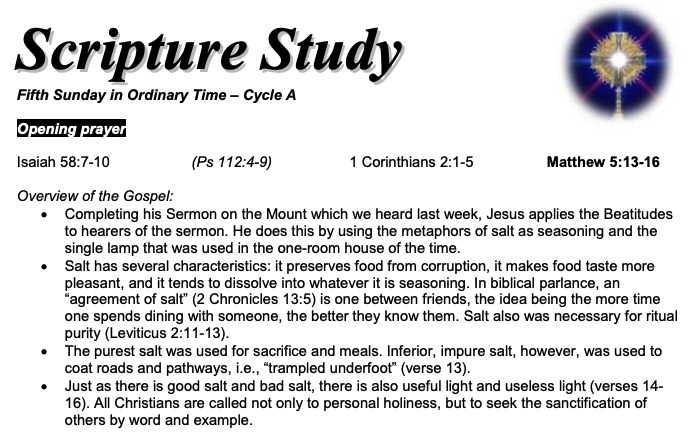
OUR SUNDAY READINGSSCRIPTURE STUDYHEARERS OF THE WORDECHOING GOD'S WORD

Edrianne Ezell

ANSWER KEY & DISCUSSION PROMPTS


Isaiah 58:7-10

Reading Closely

1. To whom is the prophet speaking? The prophet is speaking to the people of Israel (the Jews) who had returned to Jerusalem after the Babylonian exile. Specifically, he is addressing those who were performing religious rituals like fasting but were neglecting the poor and oppressed.

2. What are all the things God wants the people to do? God wants the people to:

  • Share their bread with the hungry.
  • Bring the homeless and poor into their homes.
  • Cover the naked when they see them.
  • Not "hide themselves from their own flesh" (meaning not ignoring their own kin).
  • Remove the "yoke" (oppression) from their midst.
  • Stop pointing fingers (accusing others) and speaking wickedness.
  • Satisfy the needs of the afflicted.

3. What does God promise to do for the people? If the people obey, God promises to:

  • Make their light break forth like the morning (turning their darkness into light).
  • Bring them speedy healing.
  • Let their righteousness go before them.
  • Be their "rear guard" (protection) with His glory.
  • Answer immediately when they call (saying, "Here I am").
  • Turn their gloom into "noonday" brightness.

4. What does life seem to be like for the people at the moment? Life appears to be difficult, dark, and disappointing. The text implies they are living in "darkness" and "gloom" (v. 10). The context note explains that life in the city was hard, they were traumatized by their past losses, and they were disappointed that their rebuilt nation and temple were not as grand as they had been in the "good old days."

5. How might the people have felt about these words?

  • Convicted: They likely felt guilty or challenged because they realized their religious rituals (fasting) were empty without acts of charity.
  • Hopeful: The promise that God would finally answer them ("Here I am") and heal their trauma would have been very encouraging.
  • Defensive: Some might have felt defensive, feeling that they were already doing enough by rebuilding the temple and fasting.

6. Why do you think some people weren’t helping those in need?

  • Scarcity: As the notes mention, life was "hard," so people likely felt they didn't have enough resources to share.
  • Misunderstanding of Faith: They believed that following rituals (fasting, sacrifices) was all God required, ignoring the parts of the Law about social justice.
  • Trauma: They were focused on their own recovery and survival after the exile, which can make people turn inward rather than outward.

Living the Word

7. Why do people set limits on helping others? People often set limits due to fear—fear of running out of money, energy, or time. They may also set limits due to "compassion fatigue" (feeling overwhelmed by the sheer amount of need in the world) or because they judge those in need as being responsible for their own problems.

8. What’s the connection between worshiping God and helping others? Isaiah 58 teaches that true worship is inseparable from helping others. You cannot honor God inside the temple while ignoring His children outside the temple. Acts of justice and mercy are the "proof" that one's worship is authentic; without them, rituals are hollow.

9. Do you think worship is more important than service and acts of justice? Based on this passage, God rejects worship that is disconnected from service. While worship is directed toward God, God makes it clear that He will not accept it if the worshiper ignores the poor. Therefore, service and acts of justice are essential to make worship valid. They are two sides of the same coin.wn lives: Do we use "white lies" to protect our image? Do we manipulate the truth to get ahead? Being part of God’s faithful remnant requires a radical commitment to truth in a world that often rewards deception.


Matthew 5:13-16 

Reading closely

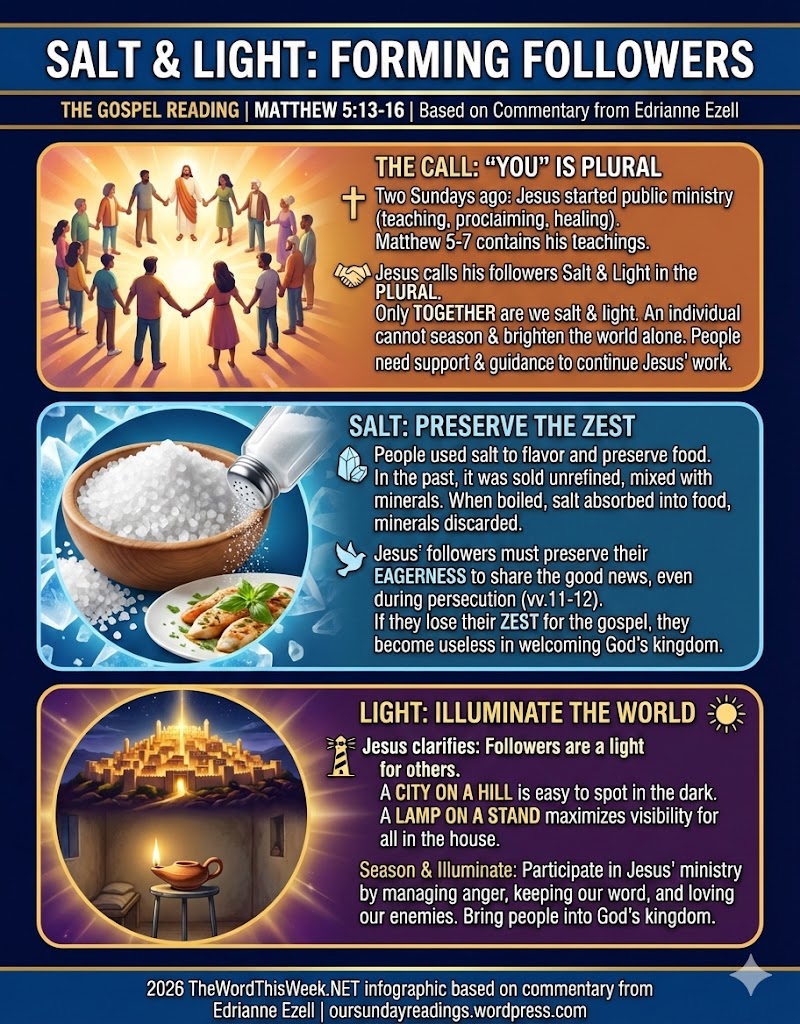
1. To whom is Jesus speaking? Jesus is speaking to his followers (his disciples). The commentary notes that he uses the plural form of "you," indicating he is speaking to the community of believers as a whole, rather than just isolated individuals.

2. When must people be salt and light? People must be salt and light constantly in their daily lives. The text implies this is an ongoing identity for followers who are called to "continue Jesus’ work in the world" and bring people into God’s kingdom.

3. How might people lose their flavor? According to the text, followers lose their flavor if they "lose their eagerness to share the good news with others" or lose their "zest for the gospel," particularly when facing persecution or difficulty.

4. Why can’t people become salty again? In the historical context provided, salt was not refined; it was a mixture of salt and other minerals. Once the actual salt content was boiled out or absorbed into food, only the tasteless, useless minerals remained. You cannot put the salt back into that residue once it is gone.

5. What could thrown out and trampled underfoot mean? This phrase refers to the leftover minerals from the unrefined salt mixture. Once the salty flavor was gone, the remaining residue was useless for seasoning or preservation, so it was "discarded" and thrown on the ground, serving no purpose other than to be walked upon.

6. How might people of this era react to the sight of an illuminated city on a mountain? They would view it as a beacon of safety and guidance. In a world without electricity where landscapes were pitch black at night, a city on a hill would be "easy to spot," serving as a clear landmark and a symbol of civilization and presence amidst the darkness.

7. Why would someone put a light under a basket? Logically, no one would do this if they intended to see. However, spiritually, someone might hide their light under a "basket" out of fear of persecution, shame, or a desire to avoid the responsibility that comes with being a visible follower of Jesus.

8. What’s the purpose of being salt and light? The purpose is to "season and brighten the world." Specifically, the text notes the purpose is to "help others learn about and welcome God’s kingdom" and to participate in Jesus' ministry.

9. Why do you think Jesus said this? Jesus said this to emphasize that faith is not a private matter but a public vocation. He wanted to encourage his followers that they are essential to his mission—they are the preservatives of the truth and the illuminators of the way to God.

10. How do you think people reacted to this teaching? They likely felt a mix of empowerment and weightiness. To be told they are the "light of the world" is a high honor, but it also carries the heavy responsibility that if they fail to live out their faith, they become "useless" to the mission.

Living the word

11. How public should your faith be? Faith should be highly visible, like a "city built on a high hill" or a lamp placed on a stand in the "middle of the room." It should not be hidden but should be evident to everyone in the "house" (the world) through our actions and character.

12. What makes you lose flavor or become dark? You lose flavor or become dark when you let fear of persecution silence you, when you compromise your integrity (e.g., failing to keep your word, succumbing to anger or lust as mentioned in "Season & illuminate"), or when you stop caring about sharing the Good News with others.

13. Share a time you or someone else was drawn to Christ because of a good deed. Self-reflection prompt: Think of a moment when someone’s kindness, patience, or integrity surprised you. Often, we are drawn to Christ not by a sermon, but by seeing a Christian forgive an enemy, care for the poor without seeking credit, or stay honest when it would be easier to lie. (This question invites personal group sharing).owing? (Reflection) This is the examination of conscience. Do we get more upset when we lose money (cultural beatitude) or when we lose our temper (Jesus' beatitude)? Our reactions to stress usually reveal which list we truly trust to bring us happiness.

Click on banner above for answers to questions.

create a 8.5×11 infographic on the following text.

Create an 8.5×11 infographic with a clean, modern design and large images. Title: [Insert Title Here]. Layout: Three vertical panels with a large header and footer. Style: Colorful, high-contrast, professional, and easy to read.

Footer text: ‘2026 TheWordThisWeek.NET infographic based on commentary from Edrianne Ezell | oursundayreadings.wordpress.com’

Content: [Paste the First Reading/Gospel/Meditation text here]”

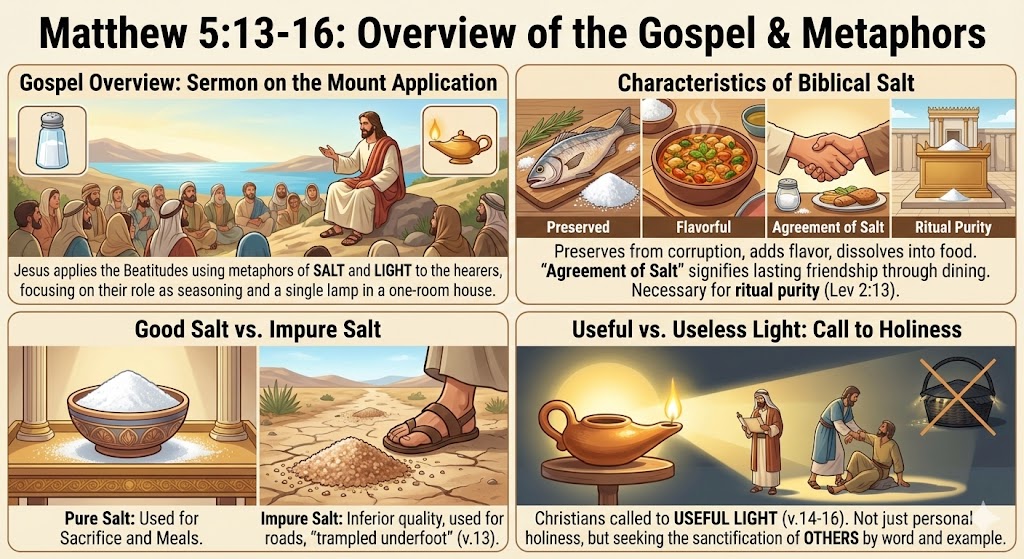
Infographic titled 'Salt & Light: Forming Followers' illustrating the concepts of salt and light as metaphors for followers of Jesus.
Free Clip Art

Vince Contreras

ANSWER KEY & DISCUSSION PROMPTS


The 1st Reading (Isaiah 58:7-10)

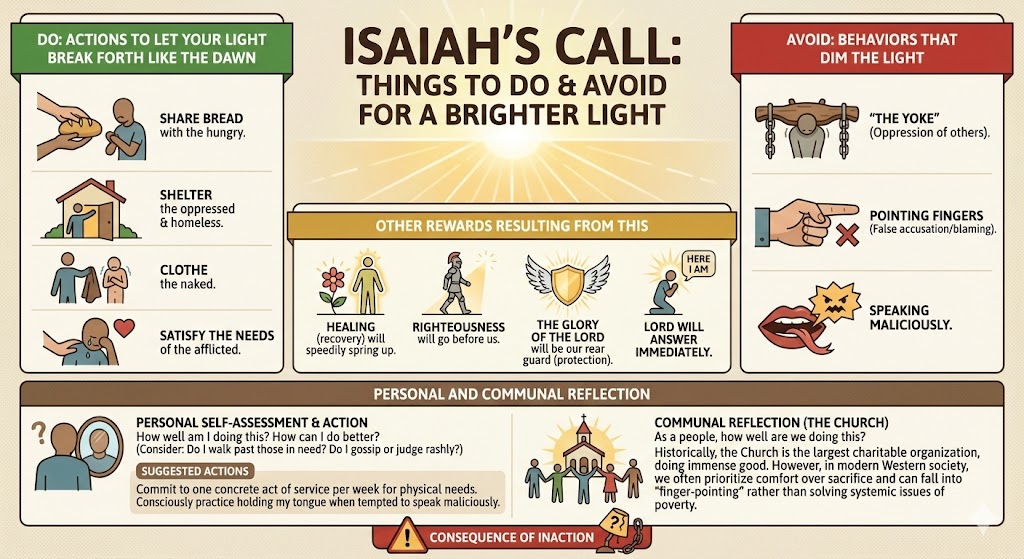
Things to do and avoid to make our light shine brighter: The prophet Isaiah is very specific. To let our light break forth like the dawn, we must:

  • DO: Share bread with the hungry, shelter the oppressed and homeless, clothe the naked, and satisfy the needs of the afflicted.
  • AVOID: "The yoke" (oppression of others), pointing fingers (false accusation/blaming), and speaking maliciously.

Other rewards resulting from this: Besides our light shining, God promises healing (recovery) will speedily spring up, righteousness will go before us, the glory of the Lord will be our rear guard (protection), and when we call out in prayer, the Lord will answer immediately, saying, "Here I am."

Personal and Communal Reflection:

How well am I doing this? How can I do better? (This is for personal reflection. Consider: Do I walk past those in need? Do I gossip or judge rashly? To do better, I could commit to one concrete act of service per week that addresses physical needs in my community, or consciously practice holding my tongue when tempted to speak maliciously.)e path to becoming this humble remnant.

As a people, how well are we doing this? Historically, the Church is the largest charitable organization in the world, doing immense good in these areas. However, in modern Western society, we often prioritize comfort over sacrifice and can sometimes fall into "finger-pointing" rather than solving systemic issues of poverty.


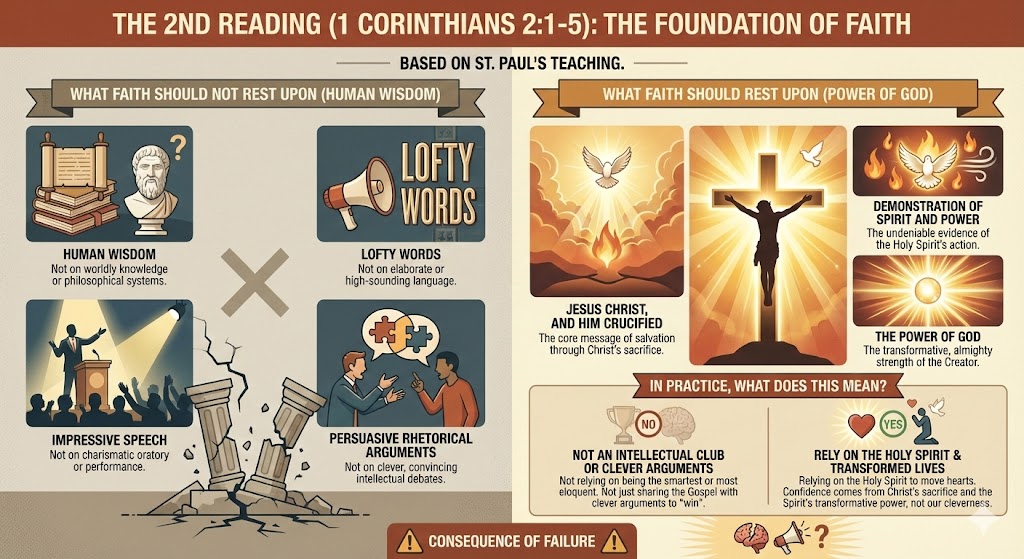
The 2nd Reading (1 Corinthians 2:1-5)

What St. Paul tells readers not to base their faith upon: St. Paul urges them not to base their faith on "human wisdom," "lofty words," "impressive speech," or persuasive rhetorical arguments.

What faith should rest upon: Faith should rest upon "the demonstration of Spirit and power" and "the power of God," centered specifically on "Jesus Christ, and him crucified."

In practice, what does this mean? It means that our faith is not an intellectual club where the smartest or most eloquent person wins. It means that when we share the Gospel, we shouldn't rely solely on clever arguments to "win" someone over. Instead, we should rely on the Holy Spirit to move hearts. It means our confidence comes from the reality of Christ’s sacrifice and the transformative power of the Holy Spirit in our lives, not our own cleverness.


The Gospel (Matthew 5:13-16)

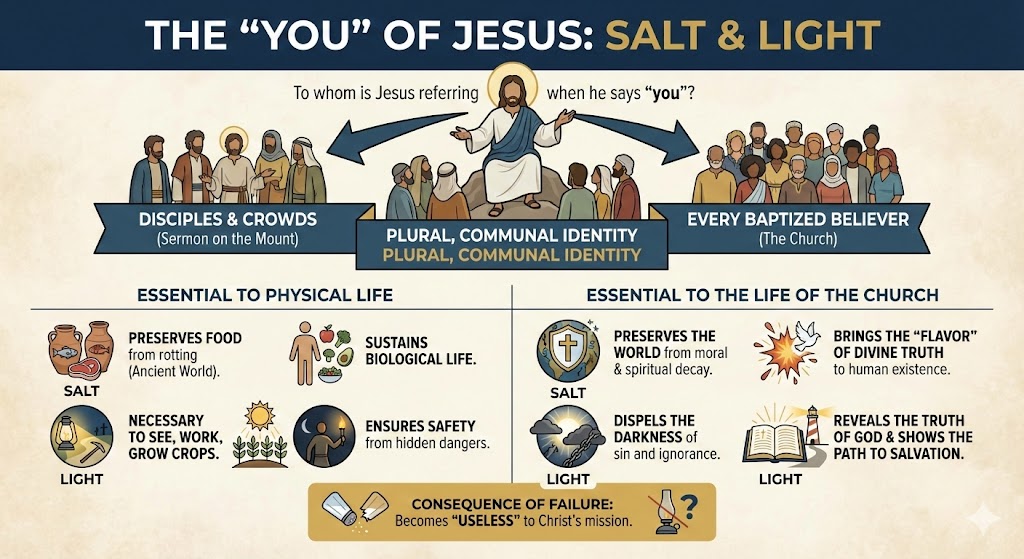
To whom is Jesus referring when he says "you"? Jesus is addressing his disciples and the crowds gathered for the Sermon on the Mount. By extension, he is addressing the entire Church—every baptized believer. The "you" is plural; it is a communal identity.

Why is salt and light essential to life? Why essential to the life of the Church?

  • To physical life: Salt is necessary to preserve food from rotting (especially in the ancient world) and to sustain biological life. Light is necessary to see, to work, to grow crops, and for safety from hidden dangers.
  • To the Church: The Church is essential because, like salt, it is meant to preserve the world from moral and spiritual decay and to bring the "flavor" of divine truth to human existence. Like light, the Church is meant to dispel the darkness of sin and ignorance, revealing the truth of God and showing the path to salvation. If the Church fails to do this, it becomes "useless" to Christ's mission.

How are the Beatitudes related to being salt and light? How are Christians called to penetrate society?

  • Connection: The Beatitudes (verses 1-12) describe the character of a disciple—poor in spirit, meek, merciful, pure in heart, etc. Being salt and light (verses 13-16) is the action or the impact that naturally results from having that character. You cannot effectively be salt and light if you are not living the Beatitudes.
  • Penetrating Society: Christians penetrate society like salt penetrates food—by being fully present within it, not isolated from it, yet remaining distinct. We do this by living out the Beatitudes in our workplaces, schools, and politics—bringing mercy where there is judgment, peacemaking where there is conflict, and integrity where there is corruption.

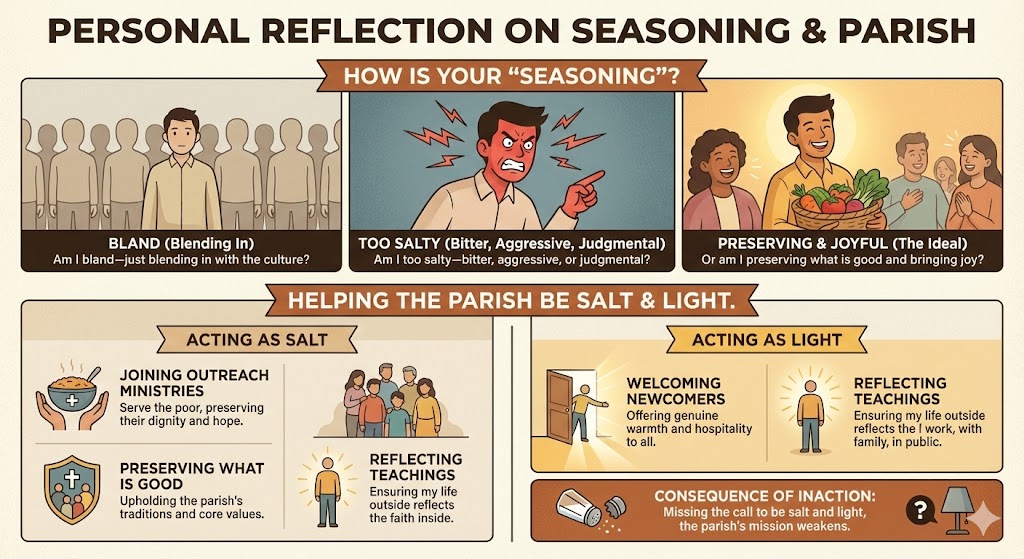
Personal Reflection on Seasoning and Parish

  • How is your “seasoning”? (Personal reflection: Am I bland—just blending in with the culture? Am I too salty—bitter, aggressive, or judgmental? Or am I preserving what is good and bringing joy?)
  • Helping the parish: I can help my parish be salt and light by moving beyond just attending Mass. This might mean joining outreach ministries that serve the poor (acting as salt), welcoming newcomers with genuine warmth (acting as light), or ensuring my own life outside the parish walls reflects the teachings I hear inside them.

Personal Reflection on Light Intensity

How can Jesus enable you to “shine brighter”? Jesus is the source of the light (John 8:12). We shine brighter only by drawing closer to Him. This happens through regular reception of the Eucharist (the fuel for our light), frequent Confession (cleaning the smudge off the lamp chimney), daily prayer, and specifically asking for the grace to live one specific Beatitude that we struggle with.

Based on the Beatitudes, is the light in your life shining like a 300-watt bulb? A 100-watt bulb? A night-light? A tiny spark? Why? (This requires honest self-assessment. Often we are dim because we fear persecution, or because we are attached to worldly comforts rather than being "poor in spirit," or because we harbor resentment rather than being "merciful.")

Click on banner above for answers to questions.
create a dynamic and engaging infographic with large images that show the relationship between the following themes. Keep design clean and simple. Overview of the Gospel:
Free Clip Art

FR. KIERAN O’MAHONY

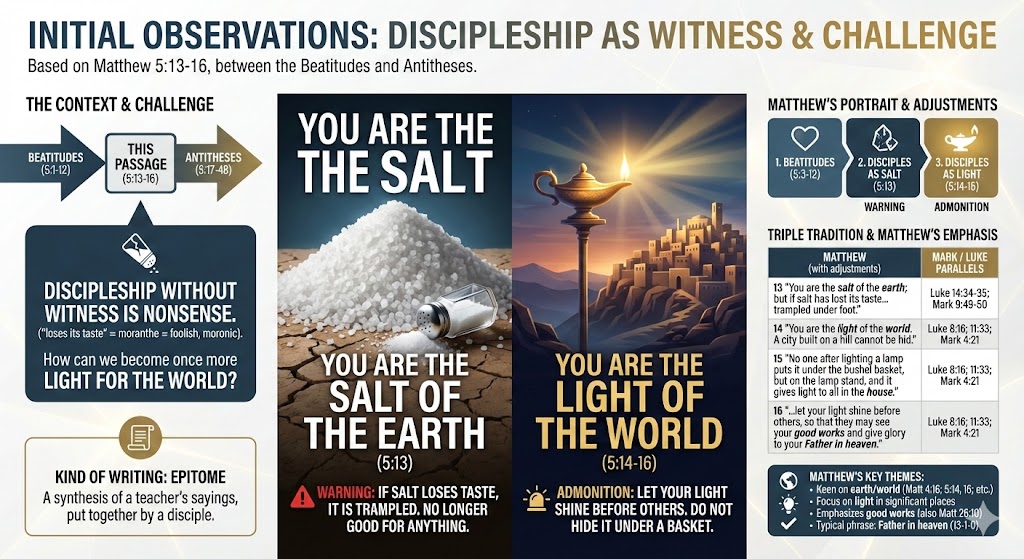
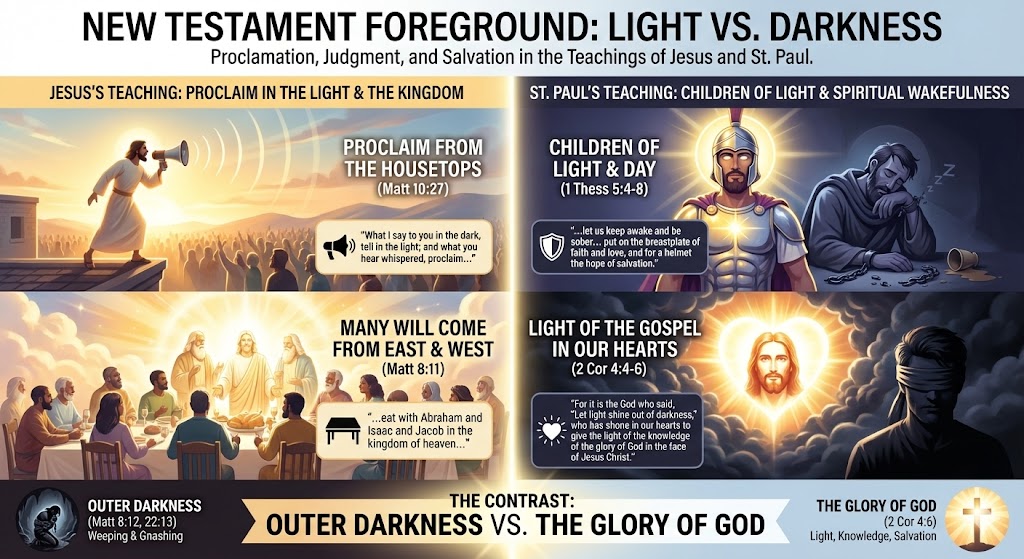
TWTW infographics below were created using core concepts from the PDF above.

Gospel

Initial Observations & Kind of Writing
Gospel

Old Testament Background

Gospel

New Testament Foreground
Gospel

Pointers for Prayer
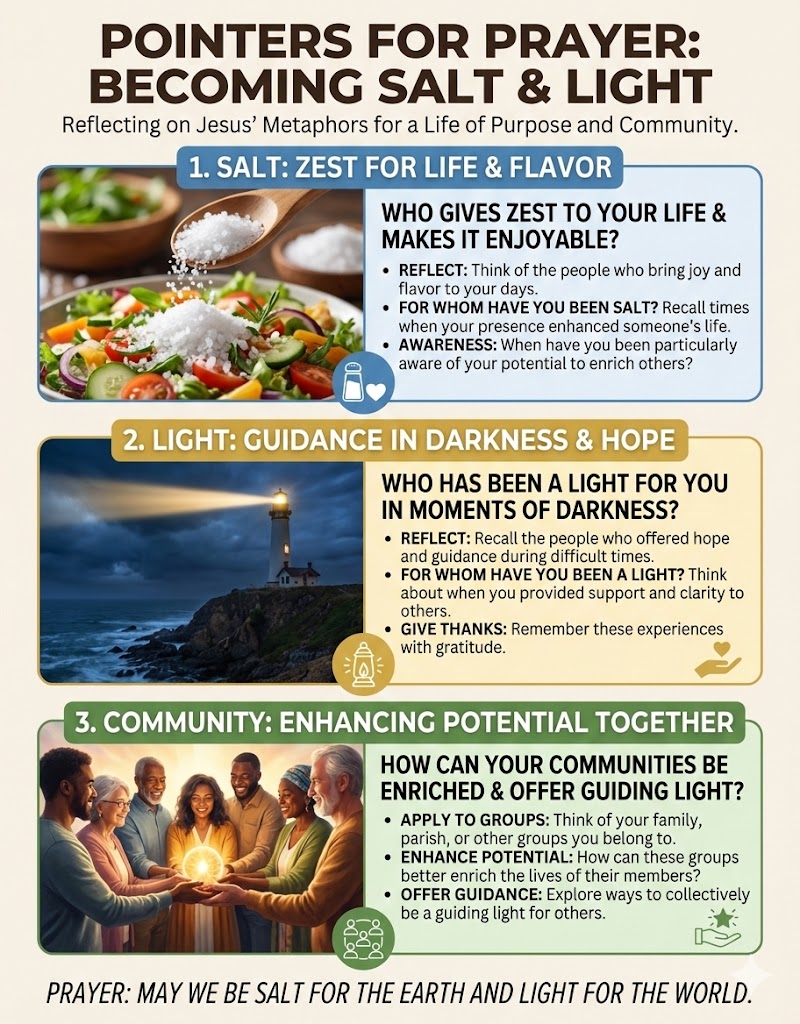
First Reading

Pointers for Prayer
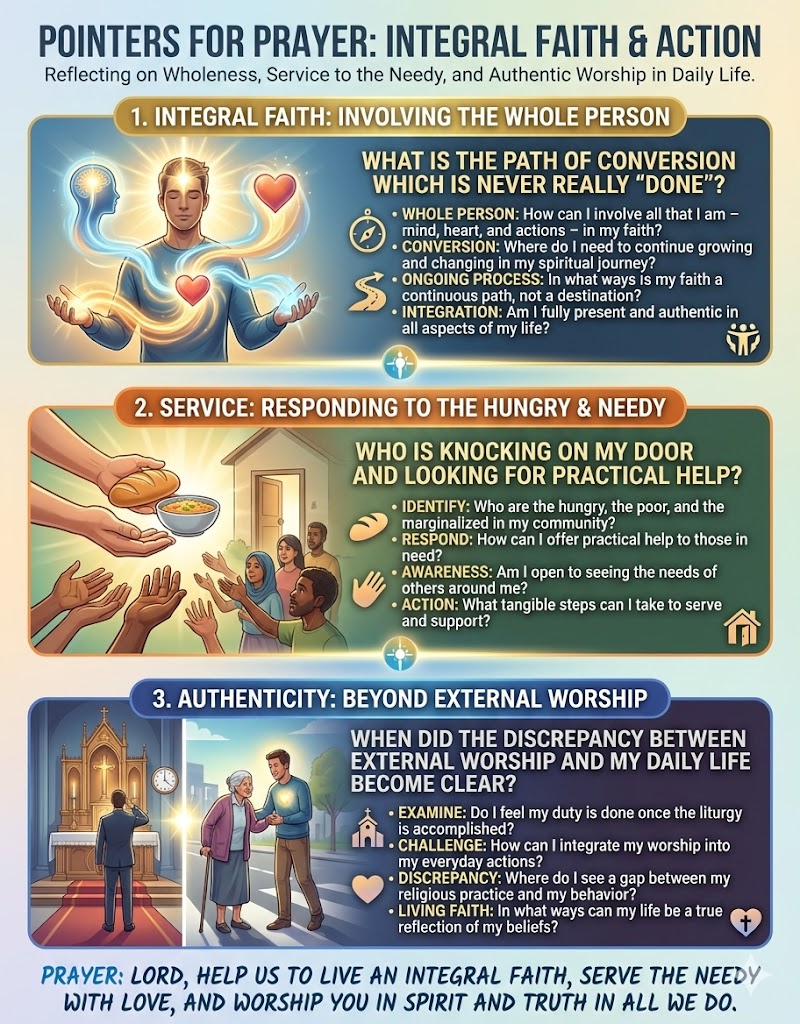
TWTW infographics on this page present Fr. Kieran’s “GOSPEL COMMENTARY” and “POINTER FOR PRAYER” which are presented after each reading’s commentary. Please cross-reference the slides with the PDF if you notice any errors. Non-profits are welcome to utilize the provided graphics in their materials and presentations. Please acknowledge Fr. Kieran O’Mahony, OSA, and his website, taurus.ie. The graphics were designed by TheWordThisWeek.net using Gemini Pro 3 and Nano Banana. Proper attribution is appreciated.

Free Clip Art

Discussion Pointers / Answers

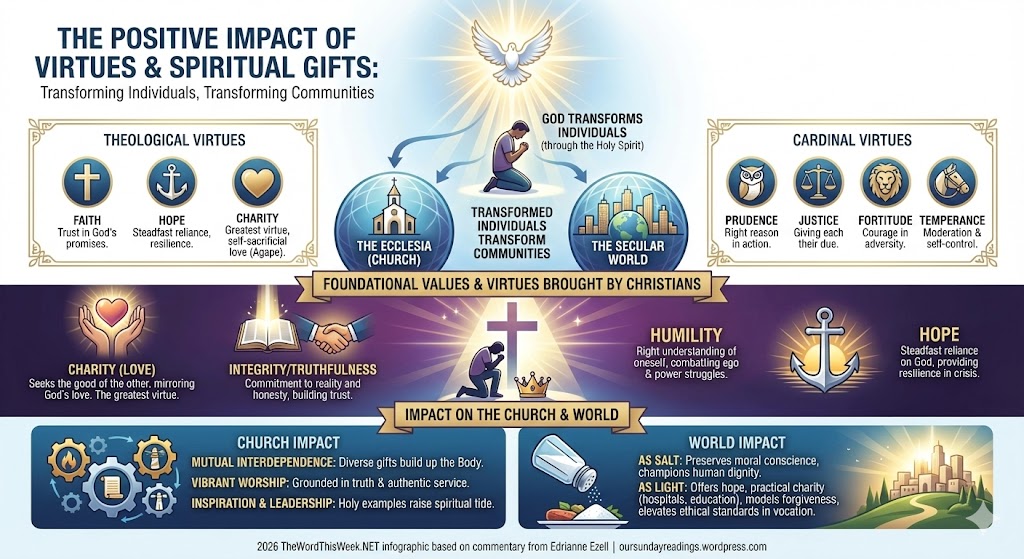
THE POSITIVE IMPACT OF VIRTUES & SPIRITUAL GIFTS

The Positive Impact of Virtues and Spiritual Gifts

The Christian premise is that God transforms individuals through the Holy Spirit, and these transformed individuals then transform the communities they inhabit—both the Ecclesia (Church) and the secular world.

Positive Values and Virtues Christians Bring:

The foundational virtues Christians bring are the Theological Virtues (faith, hope, and charity) and the Cardinal Virtues (prudence, justice, fortitude, and temperance). Beyond these, scripture emphasizes humility, patience, kindness, forgiveness, integrity, and self-sacrificial love (agape).

  • Charity (Love): The greatest virtue, which seeks the good of the other for their own sake, mirroring God’s love.
  • Integrity/Truthfulness: A commitment to reality and honesty that builds trust.
  • Humility: A right understanding of oneself in relation to God and others, which combats ego and power struggles.
  • Hope: A steadfast reliance on God’s promises, which provides resilience in times of crisis.

.

How the Church is made better by spiritual gifts:

The New Testament (particularly Romans 12, 1 Corinthians 12, and Ephesians 4) teaches that the Holy Spirit bestows diverse "charisms" or spiritual gifts upon the faithful, not for their own glory, but for the building up of the Body of Christ.

  • Mutual Interdependence: When members exercise gifts like teaching, exhortation, administration, service, or evangelism, the Church functions as a healthy organism. No one part can say to another, "I don't need you."
  • Vibrant Worship and Sound Doctrine: Gifts related to teaching and prophecy ensure the community remains grounded in truth, while gifts of service ensure practical needs are met, allowing worship to be authentic rather than hypocritical.
  • Inspiration and Leadership: Holy members act as "pacemakers" for the community. Their example of prayer and virtue inspires others to strive for holiness, raising the spiritual tide of the entire parish or congregation.

How the World is enriched and enlightened by holy Christians:

Jesus used the metaphors of "Salt" and "Light" to describe this impact.

Vocation: A holy Christian doctor, lawyer, mechanic, or artist approaches their work not just as a means to wealth, but as a service to God and neighbor, elevating the ethical standards of their profession..
NEGATIVE IMPACT OF VICE & CORRUPTION

The Negative Impact of Vices and Corruption

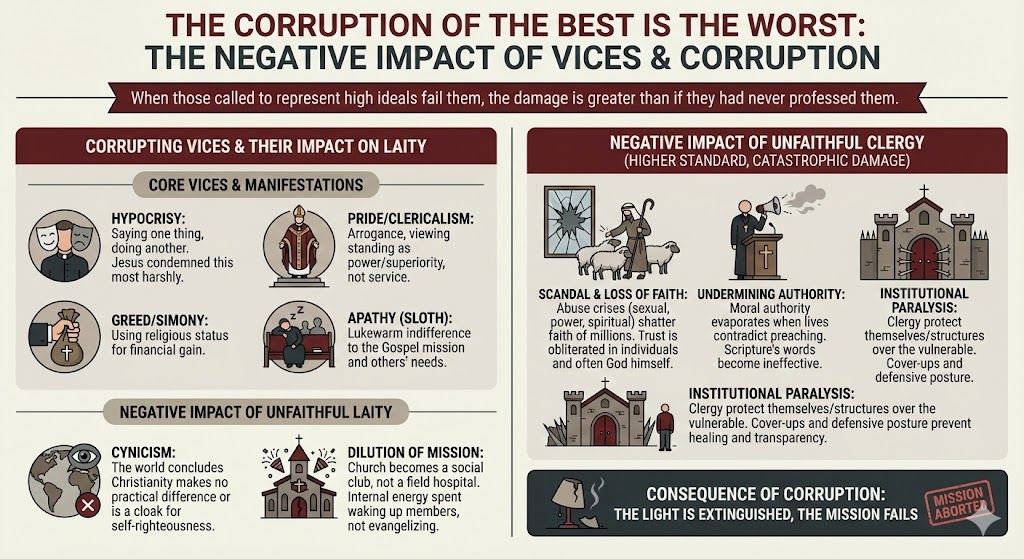
The old adage, "The corruption of the best is the worst," applies heavily here. When those called to represent high ideals fail them, the damage is often greater than if they had never professed those ideals at all.

Sins and Vices Corrupt Disciples Bring:

The core vices are the "Seven Deadly Sins" (pride, greed, lust, envy, gluttony, wrath, sloth), but certain manifestations are particularly damaging to the communal witness:

  • Hypocrisy: Saying one thing and doing another. This is perhaps the vice Jesus condemned most harshly.
  • Pride/Clericalism: An arrogance that views ones standing in the Church as a source of power or superiority rather than service.
  • Greed/Simony: Using religious status for financial gain.
  • Apathy (Sloth): A lukewarm indifference to the mission of the Gospel and the needs of others.

Negative impact of unfaithful Laity:

When lay Christians lead bifurcated lives—acting pious on Sunday but being ruthless in business, unfaithful in marriage, or judgmental in their neighborhoods during the week—they inoculate the world against the Gospel.

  • Cynicism: The secular world looks at unfaithful laypeople and concludes that Christianity makes no practical difference in a person's life, or worse, that it is a cloak for self-righteousness.
  • Dilution of Mission: Apathy among the laity turns the Church into a social club rather than a field hospital for sinners. The internal energy of the Church is spent trying to wake up its own members rather than evangelizing the world.

Negative impact of unfaithful Clergy:

Because clergy are held to a higher standard as public leaders and sacramental signs, their corruption is catastrophically damaging.

  • Scandal and Loss of Faith: The abuse crises (sexual, power, and spiritual) have shattered the faith of millions. When a shepherd abuses the sheep, trust is obliterated not just in the individual, but often in God himself. "If the representative of God is evil, God must not be there."
  • Undermining Authority: When clergy preach about chastity while living unchaste lives, or preach about poverty while living in luxury, their moral authority evaporates. The very words of Scripture become ineffective in their mouths because their lives contradict their message.
  • Institutional Paralysis: Corrupt clergy often protect themselves and their structures rather than the vulnerable, leading to cover-ups and a defensive institutional posture that prevents healing and transparency.
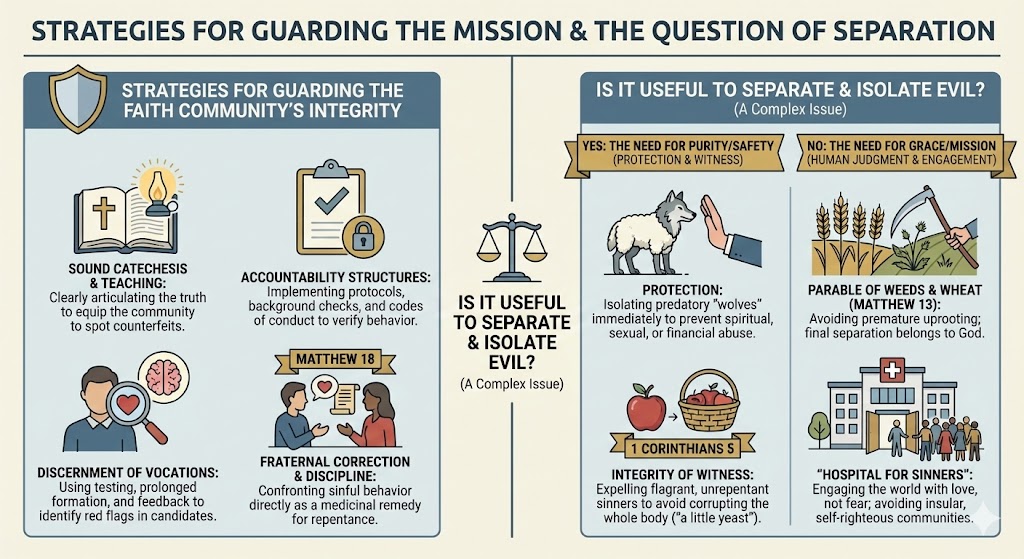
STRATEGIES FOR GUARDING THE MISSION

Strategies for Guarding the Mission and the Question of Separation

The faith community faces a perpetual challenge: maintaining its integrity without becoming a closed, pharisaic sect.

Strategies the faith community uses to guard itself:

  • Sound Catechesis and Teaching: The first line of defense is clearly articulating the truth. If the community knows what the authentic Gospel looks like, they are better equipped to spot counterfeits or abusive theology.
  • Accountability Structures: Especially in light of modern scandals, the Church has had to implement rigorous "safe environment" protocols, background checks, and codes of conduct for clergy, staff, and volunteers. This moves reliance away from just "trusting" individuals to verifying behavior.
  • Discernment of Vocations: Seminaries and religious orders use psychological testing, prolonged periods of formation, and community feedback to try and identify red flags in candidates before they are ordained or take final vows.
  • Fraternal Correction and Church Discipline: Based on Matthew 18, communities are called to confront sinful behavior directly. Historically, this includes canon law and, in extreme cases, excommunication—not as a punishment intended to destroy, but as a medicinal remedy meant to shock the offender into repentance and protect the community from scandal.

Is it useful to separate and isolate evil?

This is a complex issue requiring nuance. The biblical response holds two realities in tension:

  • The Argument for Separation (The Need for Purity/Safety): Yes, sometimes it is necessary.
    • Protection: If a "wolf" is predatory—spiritually, sexually, or financially abusing members—they must be isolated from potential victims immediately. To allow a known predator access to the flock under the guise of "inclusion" is negligence.
    • Integrity of Witness: St. Paul argues in 1 Corinthians 5 that the community should expel an unrepentant, flagrant sinner because their presence implies the Church approves of the sin, which corrupts the whole body ("a little yeast leavens the whole dough").
  • The Argument against Isolation (The Need for Grace/Mission): No, total separation is impossible and dangerous.
    • The Parable of the Weeds and Wheat (Matthew 13): Jesus warns against prematurely trying to rip out the "weeds" (sons of the evil one) within the Kingdom, lest you uproot the wheat along with them. He suggests human judgment is flawed and final separation belongs to God at the end of time.
    • The "Hospital for Sinners": If the Church isolated everyone who struggles with sin, it would be empty. The Church exists to transform sinners, which requires proximity to them.
    • Pharisaism: An over-emphasis on separating from "evil" creates self-righteous, insular communities that fear the world rather than engaging it with love.

Conclusion on Separation: Separation is a useful, sometimes vital, tactic for dealing with unrepentant predatory behavior or persistent destructive heresy. However, it cannot be the primary strategy of the Church, which is called to be in the world (though not of it), seeking the lost just as Christ did.

create an 8.5×11 inch infographic with images based on an essay of Fr. Clement D. Thibodeau.

create an 8.5×11 inch infographic with images on a white background based on an essay of Fr. Clement D. Thibodeau.

Catholic Doctrine

The above bulletin insert was created using Nano Banana Pro with Gemini 3.0. The infographics draw inspiration from the content found in Fr. Clement Thibodeau’s Echoing The Word weekly column which was published nearly a decade ago. It may be used by any non-profit ministry.

Free Clip Art