Homilies
Homilies
February 8, 2026
February 8, 2026
5th Sunday of Year A


DEEP DIVE PODCAST
Salt Burns and
Light Leads Home
This episode looks at 8 homilies that interpret Jesus’ call to be “Salt of the Earth” and “Light of the World” as a mandate for “extroverted” discipleship. Faith is “good for nothing” if it remains private; just as salt must leave the shaker to have purpose, Christians must turn their faith from static “nouns” into active “verbs” like sheltering the homeless and feeding the hungry.
FEATURED: Deacon Peter McCulloch, Msgr. Charles Pope, Fr Martin Ganeri, Deacon Kandra, Fr. Jagodenski, Fr. Kevin Rettig, Bishop Barron, and Fr. George Smiga.
Bishop Robert Barron

5th Sunday of Year A
Light of the World, Salt of the Earth

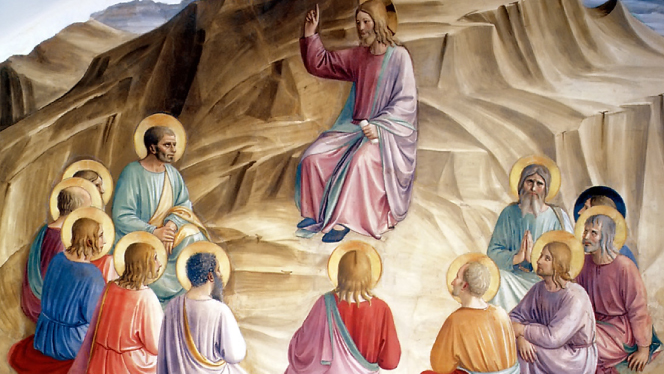
PODCAST—At the beginning of the Sermon on the Mount, we hear the eight beatitudes. These are a summons to be liberated from the various addictions–to material things, to power, to good feeling, to the esteem of others–that keep us from following the will of God.
5th Sunday of Year A
Blessed Are We
PODCAST—As we look into the famous “Beatitudes” described in this weeks Gospel, we learn that the Divine Mercy is the path to true joy. The more we allow the Divine Mercy to flow through us the more it grows in us. Once we eliminate the idolatrous rivals of wealth, pleasure, power, and honor and make Christ the priority in our lives we begin to live like saints.

5th Sunday of Year A
Love as Panacea
PODCAST—I would like to concentrate on the marvelous passage from chapter 58 of the prophet Isaiah, which is our first reading for this weekend. This final section of Isaiah was written, the scholars tell us, after the return of the captives from Babylon, when Israel was trying once again to find its way. And so we find some very practical spiritual advice about engaging in concrete acts of love.

5th Sunday of Year A
You Are the Salt of the Earth
Friends, we are reading from the marvelous Sermon on the Mount in the Gospel of Matthew. This week, we hear Jesus compare his disciples to three things: the salt of the earth, the light of the world, and a city set on a mountain. What do all three of these things have in common? They do not exist for themselves; rather, they exist for something else. How is your Christianity impacting the world around you—making it better and getting in the way of evil and wickedness?

5th Sunday of Year A
Become Someone for Others
Friends, a great professor of mine at Mundelein Seminary, Dr. Richard Issel, once said, “If you want to be happy, stop worrying about being happy and get on with becoming fulfilled.” We find something similar in Jordan Peterson’s observation that “self-consciousness is equivalent to misery.” In short, we’re most unhappy when we’re turned inward, fussing about ourselves. If you want to be psychologically healthy, forget about yourself and move out toward others. I always think of this when I come across our Gospel for today from the great Sermon on the Mount.
Fr. Michael Chua

Permission granted for non-profits to use in ministry
The infographic was created using Nano Banana, Google's Revolutionary AI Image Generator. Infographic may not be sold or used for personal financial gain. Please show your appreciation by letting others know about TheWordThisWeek.NET.
5th Sunday of Year A
Salt, Light and City

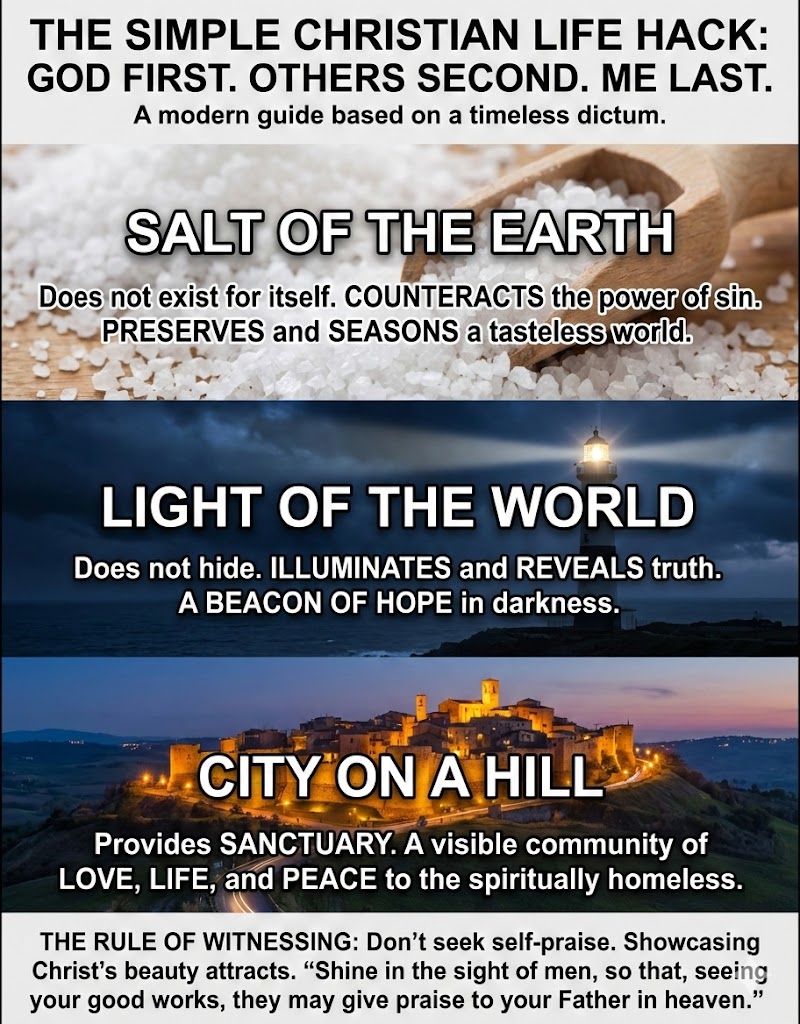
What do we Christians have to offer others when we think of these three metaphors? The first is attraction. Good food attracts, beautiful lights attract, well-planned cities attract. This is a reminder that one of the most powerful ways of evangelisation is by showcasing the beauty of Christ, the beauty of the Christian faith and the beauty of the Church. Our Holy Father, Pope Francis reminds us that “it is not by proselytising that the Church grows, but by attraction.” (Evangelii Gaudium # 15) St. Francis de Sales, who drew many Protestants back to the Catholic faith through his gentle evangelisation, tells us that “a spoonful of honey attracts more flies than a barrel full of vinegar.” His example shows us that a life of Christian charity, virtue, and devotion can draw many souls to Christ and His Church.
But these metaphors also remind Christians that we are also meant to reveal, to expose and finally to defend. What is most immediately obvious in these metaphors is the implication that there is something deficient in the world that we live in. By saying that we are the “salt of the earth,” is implying that the world is tasteless. There is a rot setting in which is tearing our world apart. Also, with the image of light that our Lord introduces, there is the implication that this world is a dark place. The world is in need of refreshing light—life-giving light. People are wandering about, lost, unable to see, bumping into all kinds of hidden dangers in the dark, not knowing where to go or how to live life well. People are filling the void with stuff and senseless pleasures, countless things that do not satisfy. Life is tasteless and dark for far too many.
As “salt”, the Christian is to counteract the power of sin. As “light” we are to illuminate or make visible. As a “city on a hill” we are meant to provide a sanctuary to those who are lost or spiritually homeless. Our lives are to be an on-going witness to the reality of Christ’s presence in our lives. As salt, light and a city built on a hill, we are meant to give testimony to the profound joy of walking with God…

Permission granted for non-profits to use in ministry
The infographic was created using Nano Banana, Google's Revolutionary AI Image Generator. Infographic may not be sold or used for personal financial gain. Please show your appreciation by letting others know about TheWordThisWeek.NET.
5th Sunday of Year A
Let Your Light Shine
One of the most condescending put-downs is when you tell someone, “Don’t try to be so holy!” I guess it would be far too generous to accord any value to these words. But in all fairness, what the person may have wanted to say is that we shouldn’t be flaunting our piety in public. Did not the Lord Himself caution us to not parade our good deeds among men? Although, the ‘good deed’ may always be a good thing, showing off or virtue signalling, is always a bad thing. The former springs from charity, the second is a form of boasting which springs from pride. Nonetheless, the danger is that the advice risked reinforcing modern culture’s penchant for relegating faith to the private sphere. In a world, where the “coming out” of the closet of every sordid lifestyle is celebrated, it is ironic that many would insist that faith should remain locked up in the darkest dungeons.
Detrich Bonheoffer in The Cost of Discipleship writes about this idea of the privatisation of faith when he says that flight into the invisible is a denial of the call. In other words, when Christians think they can conceal their faith and just sort of fade into the background, when the Church ceases to be a prophetic sign confronting the evils of every era with her life-giving message, when we buy into the idea that conforming to the values of the mainstream will ensure our survival or at least buy us more time, we have literally denied what it means to be followers of Christ. Pope Francis, in his first encyclical, Lumen Fidei, reminds us that our Christian faith is unabashedly and unapologetically public. To privatise faith or to hide it is to make a travesty of it. The Church is no secret society. We are meant to be the “salt of the earth” and the “light of the world.”
These metaphors are meant to stir things up. We are meant to make a difference in the world around us rather than simply conform to the values of the culture that surrounds us. Jesus tells us, “Your light must shine in the sight of men, so that, seeing your good works, they may give praise to your Father in heaven.” To paraphrase, “Christians must come out of their closets!”

Permission granted for non-profits to use in ministry
The infographic was created using Nano Banana, Google's Revolutionary AI Image Generator. Infographic may not be sold or used for personal financial gain. Please show your appreciation by letting others know about TheWordThisWeek.NET.
5th Sunday of Year A
God First, Others Second, Me Last
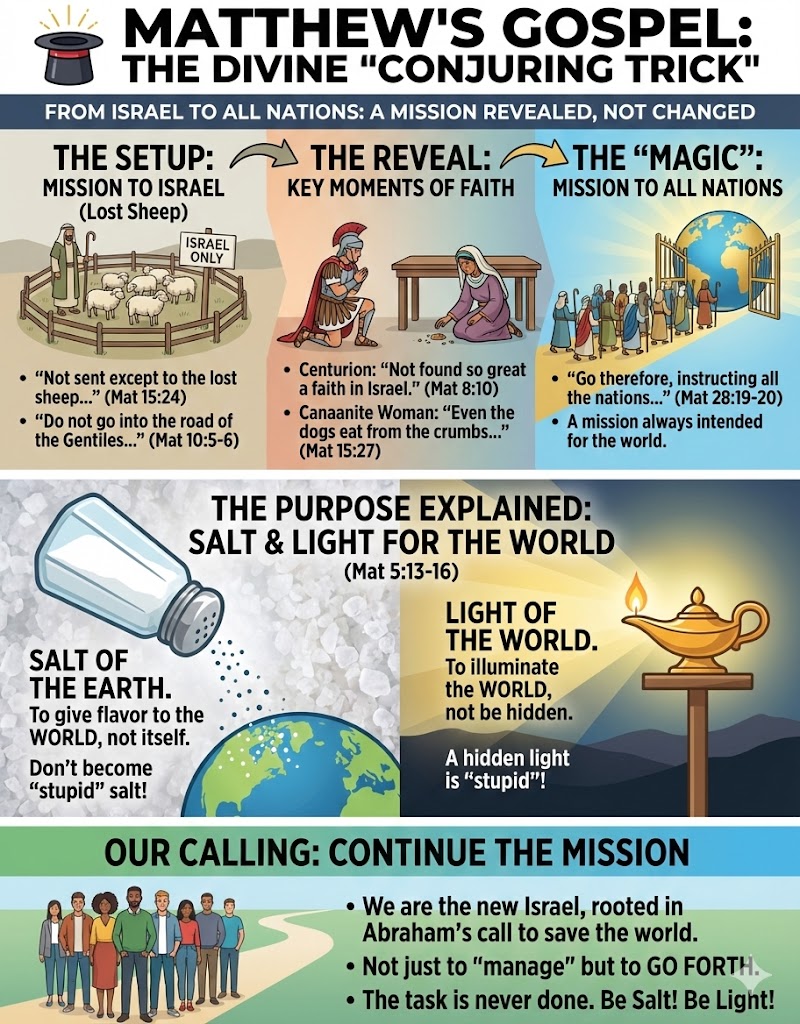
Many of you would know that I am not a man of few words. In fact, there will be some of you who will complain that I often suffer from the predilection of having too many words – a condition called verbal diarrhoea. So, if you would like me to just give you the summary of all that I’ve spoken of in a nutshell, I guess it would come in this simple life hack, “God first, others second, me last!”
Let’s take the first part of that dictum – God first above all else. We have St Paul in the second reading telling the Corinthians that his oratory skills were not meant for self-aggrandisement but rather he had come to them in weakness and with “great fear and trembling”, in order to demonstrate “the power of the Spirit.” His entire witnessing was not to showcase “human philosophy” or the greatness of human thinking, but rather to highlight or spotlight “the power of God.” It’s good for all of us to make this a rule of life. Instead of seeking to be in the spotlight, drawing attention to ourselves, seeking the praises and approval of others, let our every action rather be one which glorifies God and God alone, even at the expense of showing up our weakness and limitations.

Dominican Blackfriars
Permission granted for non-profits to use in ministry
The infographic was created using Nano Banana, Google's Revolutionary AI Image Generator. Infographic may not be sold or used for personal financial gain. Please show your appreciation by letting others know about TheWordThisWeek.NET.
5th Sunday of Year A
From Israel to the World
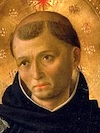
Fifth Sunday in Ordinary Time (A) | Fr Euan Marley considers the challenge of the universal mission contained in St Matthew’s Gospel.
The Gospel of St Matthew can be seen as a sort of conjuring trick. Conjurors like to misdirect us, make us look in one direction so that we can’t quite see what they are doing. Then they baffle us because they do something that seems like magic, but is really a series of logical steps, which change everything. What is it then that Matthew does which seems like a trick? Well if you read the Gospel from start to finish, it seems like a story about the mission of Christ to Israel, a mission in which he clearly states to the Canaanite women, who seeks a cure for her daughter beset by a demon, that ‘I was not sent except to the lost sheep of the house of Israel.’ (Matthew 15:24) Even when he sends the twelve apostles out, he says to them, ‘Do not go into the road of the Gentiles, and do not enter into a city of the Samaritans, but go rather to the lost sheep of the house of Israel’ to translate literally, Matthew 10:5-6. Yet the Gospel ends with these resonant words. ‘Go therefore, instructing all the nations, baptising them in the name of the Father, and of the Son, and of the Holy Spirit, teaching them to observe all things which I have commanded you, and behold! I am with you all the days until the consummation of the world.’ (Matthew 28:19-20)
So how does the mission to Israel become a mission to the world? Where does it change direction? At this point, let me say it does not actually change direction. The direction is the same, from Israel outwards, but there is a limit to how far down the road, the disciples are to go…

Permission granted for non-profits to use in ministry
The infographic was created using Nano Banana, Google's Revolutionary AI Image Generator. Infographic may not be sold or used for personal financial gain. Please show your appreciation by letting others know about TheWordThisWeek.NET.
5th Sunday of Year A
For the World
Fifth Sunday of Ordinary Time. Fr Dermot Morrin meditates upon St Matthew’s personal experience of Jesus.
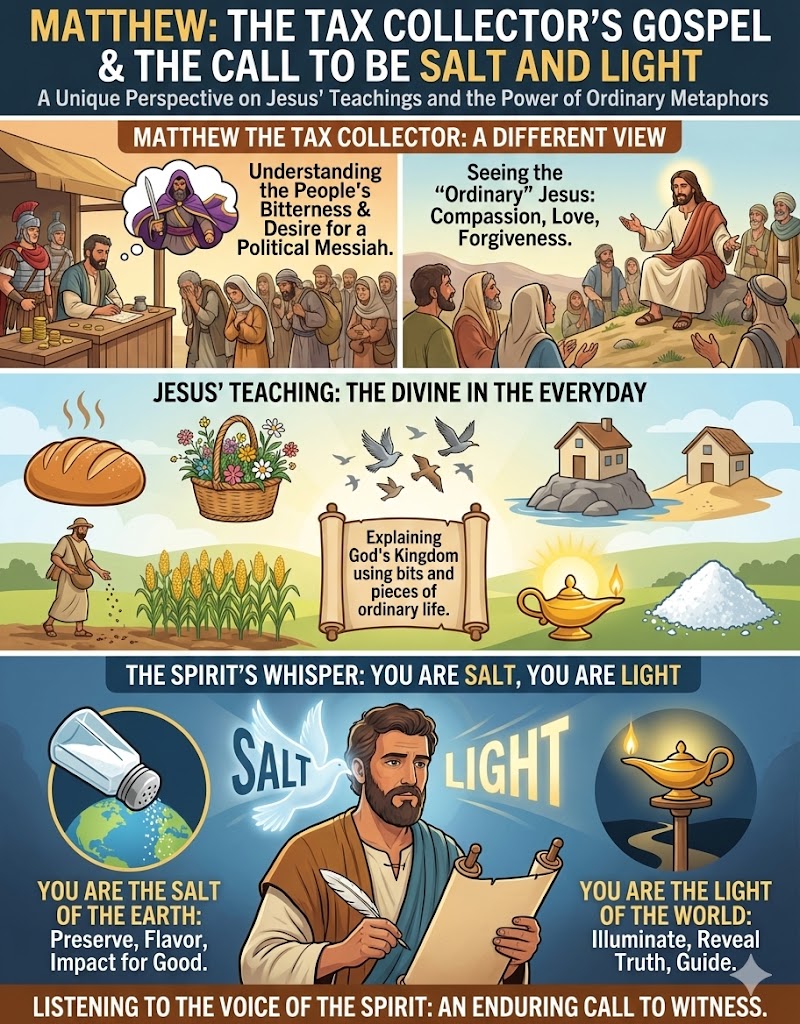
‘You are the salt of the earth.’ ‘You are the light of the world.’ Of the four evangelists only Matthew records these two sayings. Jesus doesn’t call Matthew the tax collector to follow him until later on. The most personal and pivotal event of his life is recorded in a single verse in chapter 9. He says more about the feast which followed and Jesus calling sinners to follow him. But if Matthew the evangelist and Matthew the tax collector are one and the same man, perhaps this tax collector was among crowds who followed Jesus up the mountain to hear him teach.
The tax collector would have a view of his compatriots which was different. Although the shameful way he made his living distanced him from others, it may also have given him another perspective. The man who wrote this gospel would have seen their plight. They came to him, no doubt, in poverty and humiliation, in anger and frustration at the Roman occupation, with deep resentment of the Roman taxes and a hatred of the likes of him because he made his living at their expense. The writer in Matthew would have understood with what ease they could conjure up an awaited king from their bitterness of heart and their powerlessness; how easily they could fashion for him a sword sharpened on the hard rock of their despair. They would have clothed their king in purple and cloth of gold; the one God would send to deliver them and usher in a new freedom of which they could only dream.
But when Matthew saw Jesus, didn’t he see just someone rather ordinary? Were not his hands those of a working man, hardened and callused from the lathe and the saw, not trained to hold a sword and the like?…


Permission granted for non-profits to use in ministry
The infographic was created using Nano Banana, Google's Revolutionary AI Image Generator. Infographic may not be sold or used for personal financial gain. Please show your appreciation by letting others know about TheWordThisWeek.NET.
5th Sunday of Year A
Here I am
Fifth Sunday of the Year. Fr David Goodill encourages us to stand boldly in the light.
Jesus uses two images in today’s Gospel to help us see how to live as his disciple. Christians are to be the salt of the earth and light to enlighten all peoples.
Salt preserves food and adds flavour. Before refrigeration salt was essential in helping to preserve food, and Christians are to act as salt in this world; preserving all that is good, working against all that is destructive and evil. Salt also adds flavour. Christians are not only to preserve the world; they are to make it a better place for all to live in. Just as salt when added to food spreads throughout the food Christians are to infuse the whole world with their goodness.
Light enables us to see and it guides us. The lamp on the lampstand spreads its light to the whole house and Christians are to spread the light of Christ to all people. The city set on a hill top provides light that will guide a traveller in the dark and Christians are to provide light to those who walk in darkness.
But how are we to go about this, what does it mean to be a disciple of Jesus Christ?
In the first reading, the Prophet Isaiah tells us what it is to be a servant of God. To share our bread with the hungry, to help those in need. In doing this your light will rise in the darkness, your shadows become like noon.

Fr. Austin Fleming

Permission granted for non-profits to use in ministry
The infographic was created using Nano Banana, Google’s Revolutionary AI Image Generator. Infographic may not be sold or used for personal financial gain. Please show your appreciation by letting others know about TheWordThisWeek.NET.





5th Sunday of Year A
You are the Salt, You are the Light!
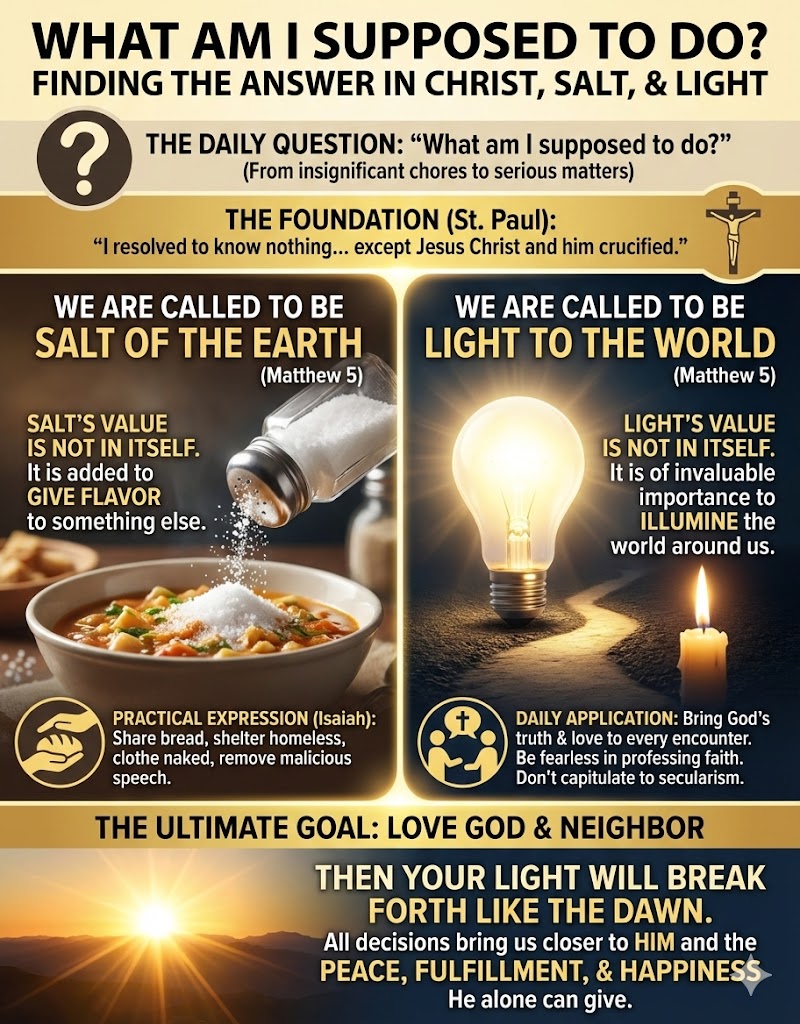
(In the course of preaching this homily I used several visuals: pouring from a canister of Morton Salt into a bowl; a salt shaker, a giant light bulb, a bushel basket, and a candle. You’ll notice, too, that at those points I depart a bit from the text below.)
Note carefully what Jesus says here – and what he doesn’t say: he doesn’t tell us to become the salt of the earth, he doesn’t tell us to be like the salt of the earth… and he doesn’t tell us become the light of the world or to reflect the light of the world…
Rather, he says: we ARE the salt of the earth and we ARE the light of the world. We are the salt…
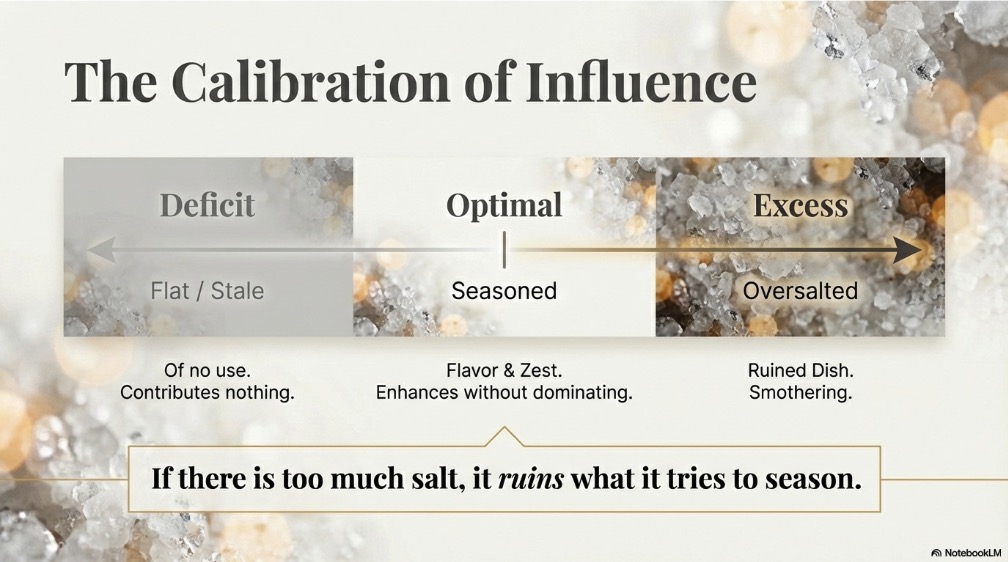
Salt brings out the flavor in food it brings out the best in what it seasons. But when salt goes flat, or when there’s too little, it’s of no use; or, if there’s too much salt it ruins what it tries to season… mWe are the light…
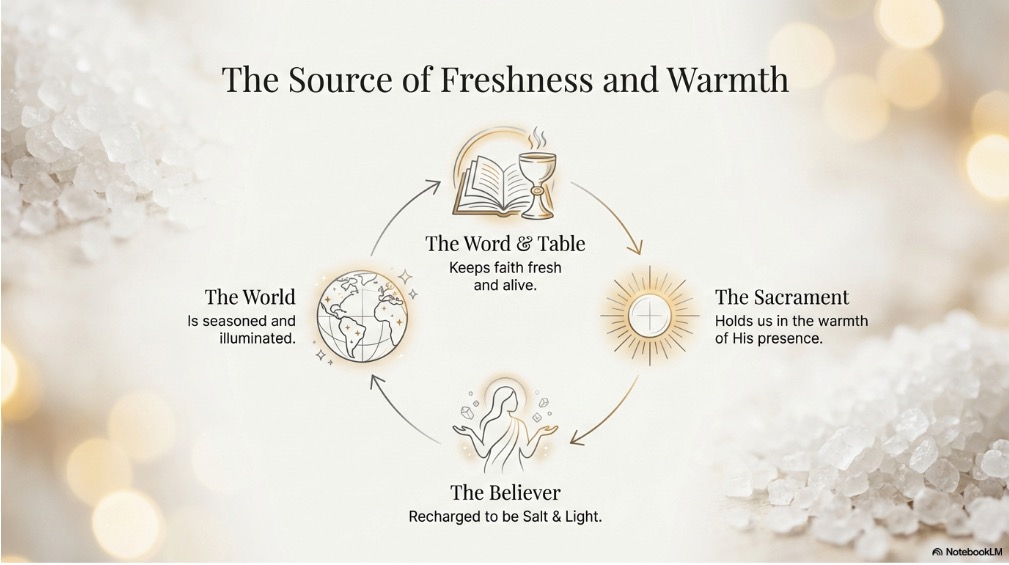
Light allows us to see what there is to be seen what is beautiful, what is true. and light brings the warmth of the energy which is its source. But when our light dims, we see only in shadows and when we hide our light it no longer serves anyone and the warmth begins to chill…

Salt and Light by Bernie Rosage, used with permission Visit the artist’s blog to see more of his work!
Monsignor Peter Hahn
Permission granted for non-profits to use in ministry
The infographic was created using Nano Banana, Google's Revolutionary AI Image Generator. Infographic may not be sold or used for personal financial gain. Please show your appreciation by letting others know about TheWordThisWeek.NET.

5th Sunday of Year A
What Am I Supposed to do?
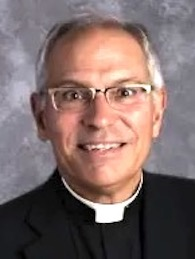
2020 HOMILY – Msg. Hahn discusses the importance of self-awareness, highlighting how understanding our thoughts, emotions, and behaviors can lead to personal growth. He emphasizes recognizing patterns, accepting flaws, and developing emotional intelligence. By cultivating self-awareness, we can improve relationships, make better decisions, and enhance overall well-being. The monsignor encourages viewers to reflect on their experiences, practice mindfulness, and seek feedback to deepen their self-knowledge. Ultimately, self-awareness is a key component of living a fulfilling and purposeful life.
Fr. Charles E. Irvin
5th Sunday of Year A
Public Witness to an Evangelical Faith

To be successful in achieving a goal we must take care at the beginning to determine the correct route, which of course, is obvious. What is not so obvious is to ask the right questions, the questions that will accurately focus us upon the right path. If we do not ask the right questions, we will not obtain the correct answers.
When it comes to spirituality, we must ask some first questions. One is “Do we find God, or does God seek us out and then present Himself to us?” Another such question is “Do I construct the way to God, or do I accept the way God has given me?”
Surrounding us is a huge array of spiritualties — Tibetan prayer wheels, sacred crystals, Tarot cards, Foursquare Christian Fellowship churches, mainline Protestant churches, Confucianism, and many others, not to mention numberless spiritualties presented in a wide range of Christian churches. We find ourselves in a gigantic Wall Mart of Christianity in which we are invited to pick and choose what we want and then walk out, having paid the cashier via the collection basket; bearing our bagful of Christian groceries to sustain us until our soul’s cupboard needs replenishing again. This suits our American consumerist mentality – we “buy” what we want from our local church, take it home, and then consume what we want, when we want, as often as we want. It’s all based on what we want – not what God deserves from us, consumerist religion. The fallacy of this approach is as obvious as it is dangerous. The danger is that it can be minimalist – I buy and assimilate only the minimums necessary to allow me to consider myself a “good Christian.”
Fr. Joe Jagodensky, SDS
Permission granted for non-profits to use in ministry
The infographic was created using Nano Banana, Google's Revolutionary AI Image Generator. Infographic may not be sold or used for personal financial gain. Please show your appreciation by letting others know about TheWordThisWeek.NET.
5th Sunday of Year A
Faith’s Nouns & Verbs

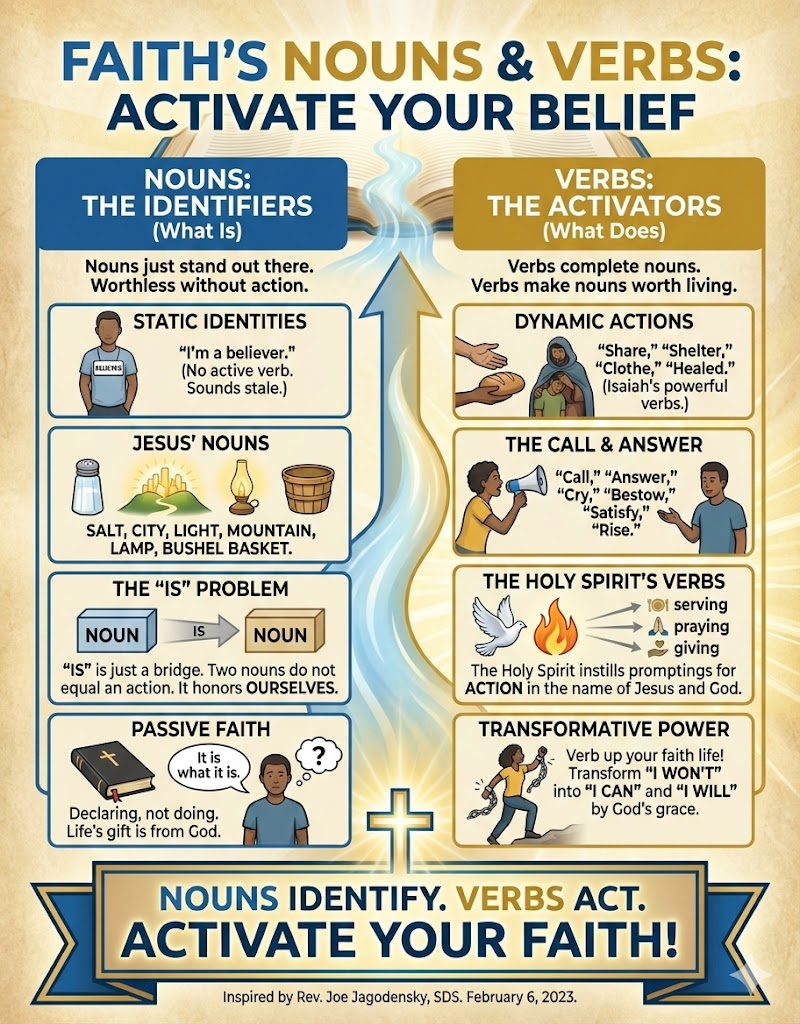
Jesus gives us life’s nouns. How many times do our prayers give glory, again and again, to the name of God. As if just saying the name justifies our faith life. Alas, those missing pesky verbs.
The nouns of Jesus this weekend? Easy. “Salt,” “city,” “light,” “mountain,” “lamp,” and finally, a “bushel basket,”
And those three sentences from St. Paul? It powerfully states that “It ain’t about me!”
Thank you Jesus for your nouns. How often we hear, “Is Jesus the Lord and Savior of my life?” Remember those who stopped you in the airport asking that question? I continued walking and yelled behind me, “I’m a priest!”The only verb we hear is, “is.” Pretty safe, secure, and truly stale. “Is” shouldn’t even be a verb. It’s simply a two-letter word getting from one noun to the next noun. Two nouns do not equal an action. It’s neither a good sentence. It’s only a declaring declaration to honor another noun. Ourselves. Life’s gift is from God. Jesus provides us with the nouns. The Holy Spirit instills within us the verbs prompting action in the name of the nouns we call Jesus and God.
Verb up your faith life. Verb it like you’ve never done before. In faith, because those verbs added to your vocabulary may very well transform your “I won’t” statements into “I can,” or better yet, “I will,” by the grace of the noun we call God.
So now you know what I feel like when hearing, “It is what it is.”
Deacon Greg Kandra
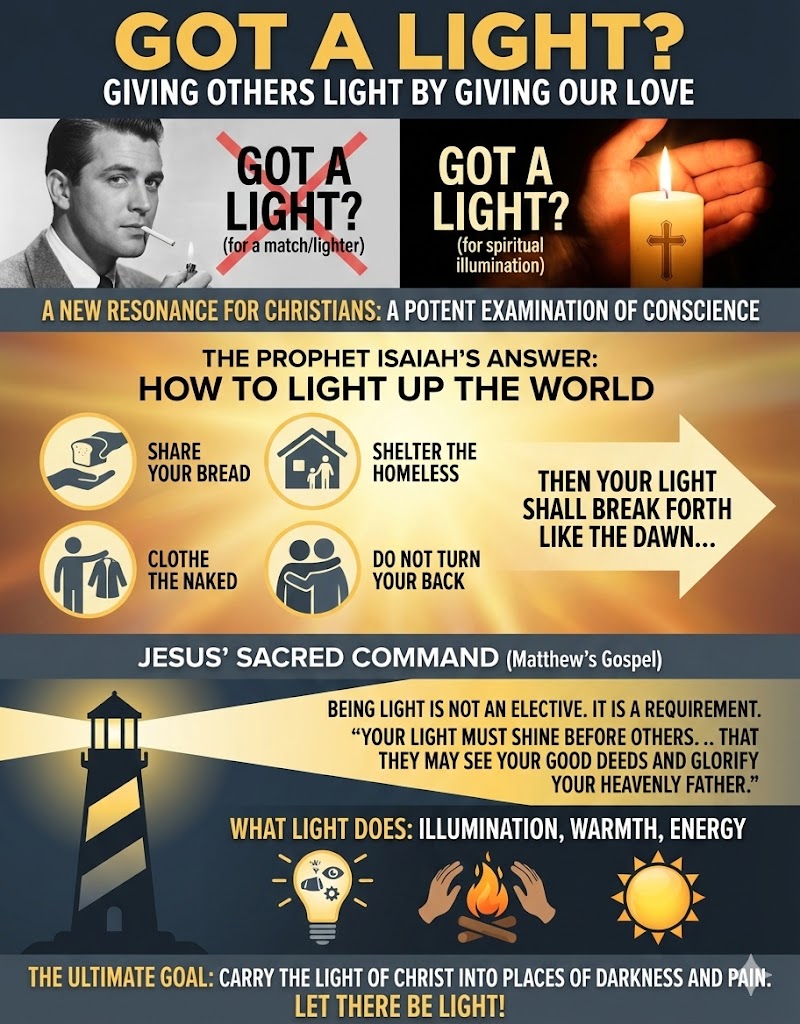
Permission granted for non-profits to use in ministry
The infographic was created using Nano Banana, Google's Revolutionary AI Image Generator. Infographic may not be sold or used for personal financial gain. Please show your appreciation by letting others know about TheWordThisWeek.NET.
5th Sunday of Year A
We Give Others Light by Giving Our Love
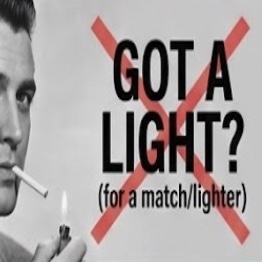
Not so long ago, that was a common question in a world where people unabashedly smoked cigars, cigarettes and pipes. It meant: Got a match? Or a lighter? It was usually muttered as a mumble by some guy with a cigarette already between his lips. (Watch any old movie on TCM and you’ll see what I mean.)
Now that public smoking has gone the way of public telephones — again, watch old movies to see what I’m talking about — I think this question has a new resonance for Christians, offering us a way to look at our lives.
Here, in three little words, we find what amounts to a potent examination of conscience. Are we giving off light? Affirmation? Hope?
Looked at another way: Are we still on fire with the flame we received at baptism? Or has the spark started to sputter and fade?
As we slide deeper into Ordinary Time — and for much of the world, deeper into the icy grip of winter — this is no small concern. Consider the very element we’re talking about. Light throws off illumination, warmth and energy. It scatters shadows and dispels fear. It makes it possible to see.
— originally published in 2023
Fr. Langeh, CMF

5th Sunday of Year A
Let Your Light Shine

An elementary school teacher was access pupils when you wake up in the morning. How can you tell if the night is over and the light of the day is shining many of the very intelligence pupils put their fingers up and give wonderful responses like this sir when I look outside in the morning when I look at the trees if I’m able to distinguish a mango tree from a guava tree. Then I know the night is over the second said sir. If I sit through animals running and I am able to make a difference between a dog and a good. Then it is daylight to the amazement the teacher told them. All your responses are false startled the waited patiently to hear the right response from the teacher that is just said if I look at the face of a man or of a woman in front of me and I see a brother or a sister created in the image and likeness of God. Then it is daylight I really doubt if these children. These pupils really understood the response of the teacher.
However this response fits exactly into the cry of Isaiah chapter 58 verse 7 to 10. In effect. Isaiah says vehemently then will the light shine like the dawn our light shine like the dawn whom we are able to fit the hungry shelter the homeless clothe. The naked in the face of the darkness that feels our world light can only shine.
Deacon Peter McCulloch

Permission granted for non-profits to use in ministry
The infographic was created using Nano Banana, Google's Revolutionary AI Image Generator. Infographic may not be sold or used for personal financial gain. Please show your appreciation by letting others know about TheWordThisWeek.NET.
5th Sunday of Year A
On Candle-lamps and Saltshakers
Our world is a dark place. So many people today are groping and stumbling about in spiritual darkness, trying to find their way. They’re looking for a light that will lead them to safety.
All through Scripture, God is referred to as light (Is.60:1-3; Ps.27:1; 1Jn.1:5), and Jesus calls himself the light of the world (Jn.8:12). Jesus wants us to absorb his divine light, to make it a part of ourselves. When we open ourselves up to him, when we let his light penetrate us, it changes us from within and we start to think and live like him. When that happens, God’s light shines through us, just as the sun lights up stained-glass windows.
It’s said that when the Scottish writer Robert Louis Stevenson was a boy, he once watched an old lamplighter lighting lamps in the street. He said to his nurse, ‘I’m watching a man put holes in the darkness’.
Who do you know who’s putting holes in the darkness today? Who is sharing their salt and light with the world? I can think of some examples: Fred Hollows, the eye doctor who has restored the sight of a million people around the world. Rosie Batty, who’s been campaigning against domestic violence ever since her partner killed their son.

Permission granted for non-profits to use in ministry
The infographic was created using Nano Banana, Google's Revolutionary AI Image Generator. Infographic may not be sold or used for personal financial gain. Please show your appreciation by letting others know about TheWordThisWeek.NET.
5th Sunday of Year A
Salt and Light
Someone once asked me, ‘To be a good Christian, is it enough to simply pray and learn about my faith?’
Let me tell you a story. There was once a great biblical scholar who was noted for his great piety. He spent hours every day secluded in his room, studying the Scriptures, praying and meditating.
One day a holy man visited the town where the scholar lived. When he heard about this, the scholar set out to look for him.
He first looked in the church, but he didn’t find him there. Then he looked in a local shrine, but he wasn’t there, either. He looked in other likely places, but couldn’t find him. Eventually, he found him in the marketplace.
On meeting him, he told the holy man who he was, and how he spent hours every day studying the Scriptures and in prayer and meditation. Then he said, ‘I have come to seek your advice on how I might grow in the service of God.’
The advice he got was simple and direct. The holy man said, ‘It’s easy to be a saint and a sage in your room. But you should go out into the marketplace and try to be a saint there.’
Permission granted for non-profits to use in ministry
The infographic was created using Nano Banana, Google's Revolutionary AI Image Generator. Infographic may not be sold or used for personal financial gain. Please show your appreciation by letting others know about TheWordThisWeek.NET.
5th Sunday of Year A
What About You?
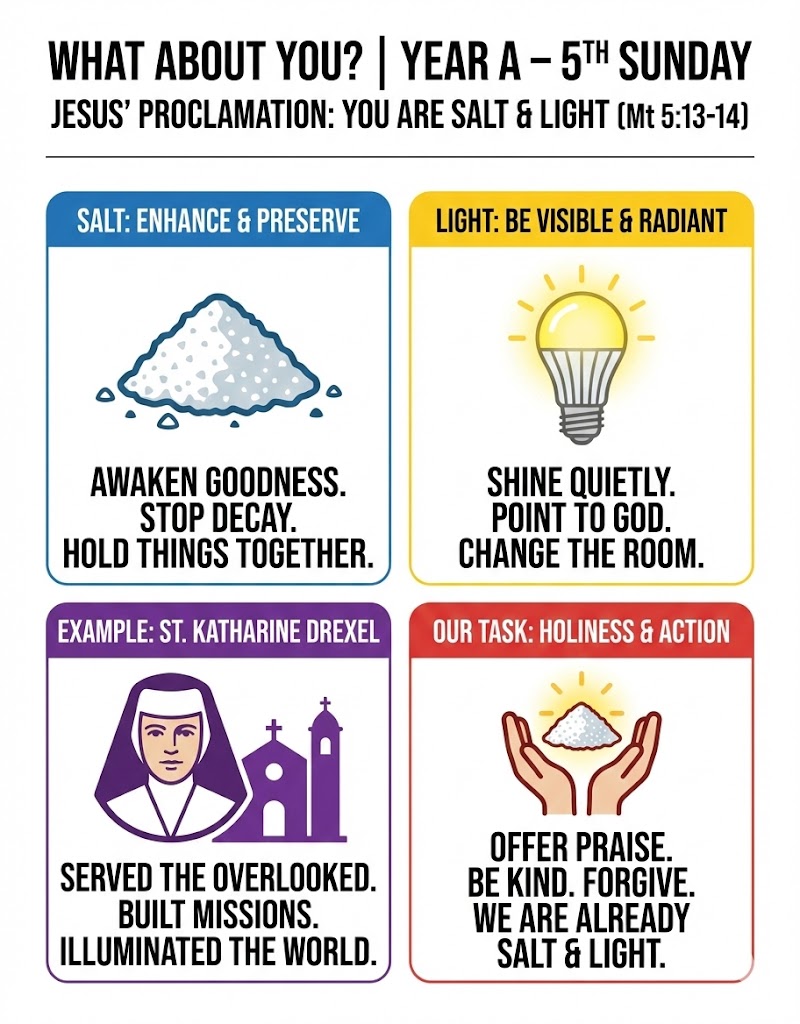
Today Jesus tells us that our light must shine in the sight of others, so that, seeing our good works, they may give praise to our Father in heaven.
This is holiness. The goal isn’t to let people think we are wonderful, but to help them see that God is wonderful. Katharine Drexel didn’t shine so that people would admire her. She shone so that people would discover the love of God.
That’s our task, too.
So, this week: let’s try to be salt for someone. Let’s try to bring out the goodness in them by offering a word of praise, a moment of patience or a sincere thank you.
And let’s be light where light is needed, by being kind, calm or forgiving.
We do it not to be noticed, but because light is meant to shine and salt is meant to season.
For we are already the salt of the earth, and light of the world.
Fr. Carmen Mele, O.P.

Permission granted for non-profits to use in ministry
The infographic was created using Nano Banana, Google's Revolutionary AI Image Generator. Infographic may not be sold or used for personal financial gain. Please show your appreciation by letting others know about TheWordThisWeek.NET.
5th Sunday of Year A
The Power of Faithful Living
A group of young people used to go to jail every Sunday. They were not criminals but university students. They visited the incarcerated to offer them support. When he saw them coming, one of the guards always made a sarcastic comment. He said to his companions: “Here come the do-gooders again.” The group ignored their detractor. They knew that they were there fulfilling the plan of Jesus laid out in the Sermon on the Mount. Last Sunday we listened to the beatitudes laid out at the beginning of the sermon telling about the ends of life. Today we hear what follows, a description with powerful images of what Christians are to be.
First, Jesus calls his disciples “the salt of the earth.” Salt is nothing if it is not useful. Even today we use sodium chloride in various ways. Among others, we put it in food to increase its flavor. Also, in cold climates it is used to melt ice on roads. In times past salt was even more advantageous. The ancients used it to preserve their perishable products, to heal their wounds, even to seal their compacts. By using the term in his Sermon, Jesus is indicating that his disciples should be helpful to other people. In addition to showing love, he knows that by helping others, they will draw many into the community of faith.
Salt may have a hundred uses, but the main use of light is ten times more valuable than any use of salt. Light facilitates sight and, therefore, at least metaphorically, understanding and wisdom. Being the light of the world, the disciples will show how Jesus Christ leads us to a more fulfilling life. It is living in such a way that everyone wants to imitate our ways, including, as Jesus indicates, giving praise to God the Father.
Msgr. Joseph Pellegrino
5th Sunday of Year A
What, Who and Why

Our lives mean more to God than they mean to anyone else in the world, including our parents, your husbands and wives, your best friends. Why? Why does He love us each of us so much? He loves us because He sees Himself in each one of us. He sees His Son.
He sees His Light. God sees the Light of Christ in each of us. “Now, take that Light,” the Gospel tells us, “and illuminate the world.” The Light we have been given is meant for others to escape the darkness of the world. The first reading from Isaiah says, “Share your bread with the hungry, shelter the oppressed and the homeless, clothe the naked when you see them and do not turn your back on your own, then your light shall break forth like the dawn..” Jesus says, “You are the Light of the world, your light must shine before others that they may see your good deeds and glorify your Heavenly Father.”
- So what are we? We are children of God.
- Who are we? We are each unique reflections of God on earth.
- And why do we do what we do as Christians, as Catholics? Our actions in words and deeds, our reaching out to others as well as our union with God, our charitable life and our prayer life, are ways that we lead others to glorify our Heavenly Father. What, who and why.
May we each of us have the courage to be all that God created us to be.
Msgr. Charles Pope
Permission granted for non-profits to use in ministry
The infographic was created using Nano Banana, Google's Revolutionary AI Image Generator. Infographic may not be sold or used for personal financial gain. Please show your appreciation by letting others know about TheWordThisWeek.NET.
5th Sunday of Year A
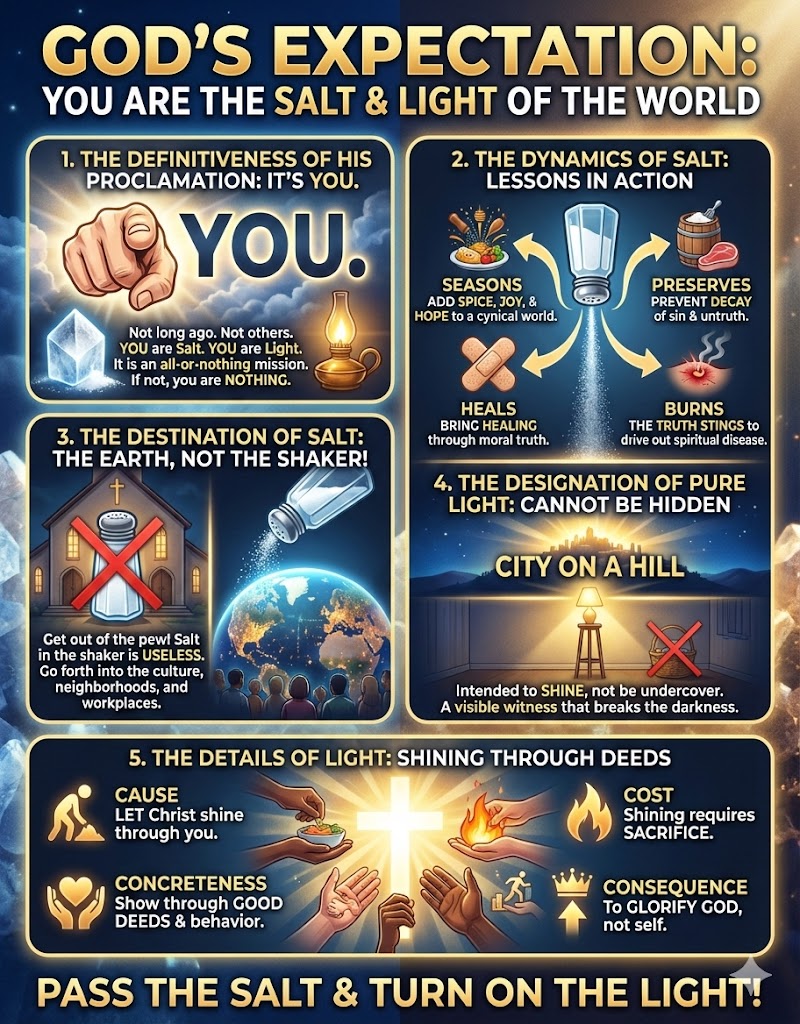
Pass the Salt and Turn on the Lights

In the Gospel today the Lord describes metaphorically what a Christian is and what He expects of us. Note five things about what God says:
I. The Definitiveness of His Proclamation
II. The Dynamics of Salt
III. The Destination of Salt
IV. The Designation of Pure light
V. The Details of Light
Father Kevin Rettig


5th Sunday of Year A
Soap of the World
Fr. Rettig's homily shares the story of Procter & Gamble's origins and transformation, symbolizing resilience and adaptation. Like the company, Christians face challenges but can find new purpose. Embracing one's role as light in the world, even in darkness, can bring positive change. By trusting in God and staying present, individuals can make a difference, much like Ivory soap's unexpected success. The message encourages believers to remain steadfast, knowing their divine nature enables them to impact the world.


5th Sunday of Year A
Francis and the Sultan
So often we seem to be living in a world of darkness where we struggle to find our way we are told. We are the light of the world but sometimes our light doesn't seem to want to turn on. We can't even see our own way much less light up the world around us. Sometimes the world just doesn't seem to have much use for candles anymore what if you can't always be a candle then try floating like a bar of ivory soap. You don't have to scrub you don't have to rub. You don't have to do anything just be and be aware of the divine that you are made of the stuff that candles and soap are made of be aware that you are meant to be exactly where you are now just float gently. In God's hands you will not sink. You will not be lost by your mere presence floating on the waters of life. You can wash out the hatred and the injustice and the prejudice and the ignorance in those waters soap or candle. We can transform the world for you and I are made of God.

5th Sunday of Year A
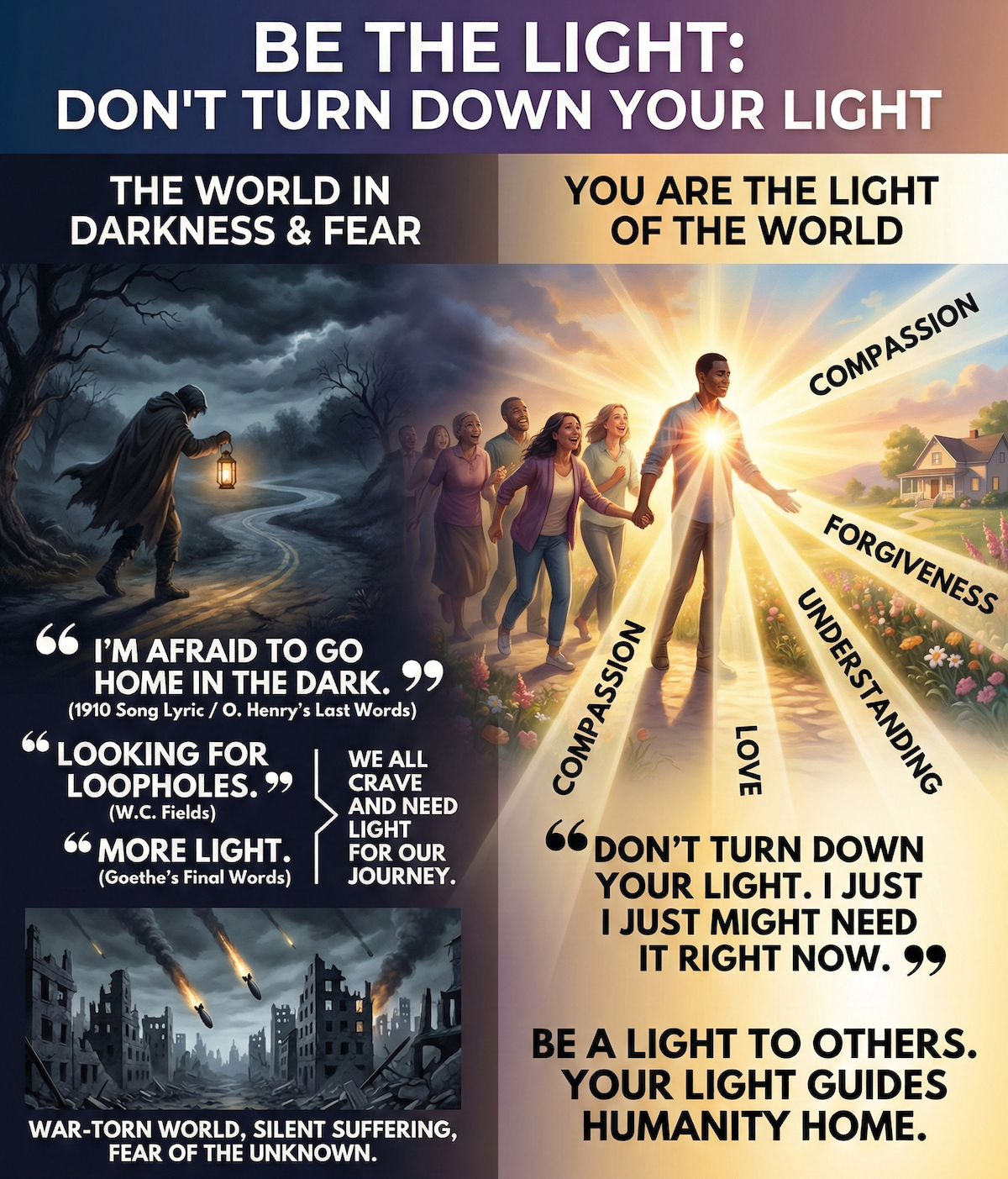
Don't Turn Down the Lights
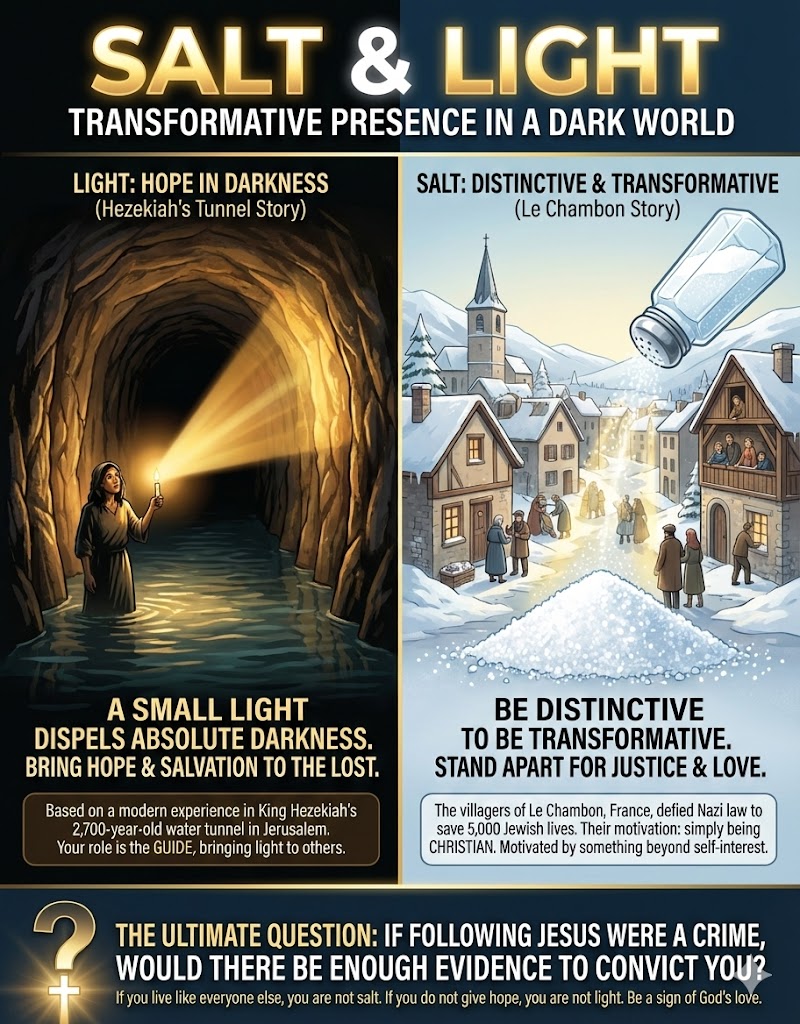
Fr. Ruttig explores the human fear of darkness and the universal need for light, both literally and spiritually. Using the 1910 song lyric, "I'm afraid to go home in the dark," it illustrates how essential light is for navigating life's journey without stumbling or fear.
Drawing on deathbed stories, he emphasizes this universal longing. It recounts how author O. Henry repeated the song's lyrics as he died, and how the German author Goethe’s final words were a cry for "More light!" Even the agnostic comedian W.C. Fields was found searching a Bible for "loopholes" in his final moments, seeking a last-minute ray of hope.
Fr. Ruttig explains that while the world often seems filled with darkness, the light humanity desperately craves is not physical but spiritual—the light of love, compassion, and understanding. It concludes with a powerful call to action: we are meant to be lights for one another. We must not hide our light, for others are depending on it to find their way home through the darkness.
Fr. George Smiga
Permission granted for non-profits to use in ministry
The infographic was created using Nano Banana, Google's Revolutionary AI Image Generator. Infographic may not be sold or used for personal financial gain. Please show your appreciation by letting others know about TheWordThisWeek.NET.
5th Sunday of Year A
Salt and Light

2011 HOMILY - Jesus tells us that we are the salt of the earth and the light of the world. What does he mean by these images? How are we light and salt? Two stories might help. The first story begins 2,700 years ago in the city of Jerusalem. The king at the time was King Hezekiah, and King Hezekiah had a problem. The water source for the city of Jerusalem lay outside its walls, therefore, making the city very vulnerable to attack. For if an army besieged the city, they could cut off the water supply and thus assure that in a very short time the city would have to surrender. King Hezekiah decided he was going to dig a tunnel, and he did so through solid rock—1,700 feet of tunnel that brought the water from the outside source into a pool within Jerusalem. Now the tunnel’s source was secret at the time so that the enemies would not know about it, but it has been recently discovered by archeologists. Today, if you go to Jerusalem, you can walk through King Hezekiah’s tunnel. This week I ran into an account of a pastor from Washington, DC, who did just that. Here’s how he describes it:
“You have to go with a guide and put on a bathing suit because the tunnel still has water in it. Because the tunnel is twisted and of different levels, you have to walk carefully because sometimes the water is at your waist and sometimes it comes up to your chest. Also, there are times when the ceiling is low and there is only just enough space to get your head through. The guide also gives a candle to each participant so that there would be some light...