Homilies
Homilies
February 1, 2026
February 1, 2026
4th Sunday of Year A


Bishop Robert Barron

4th Sunday of Year A
The Program for Freedom

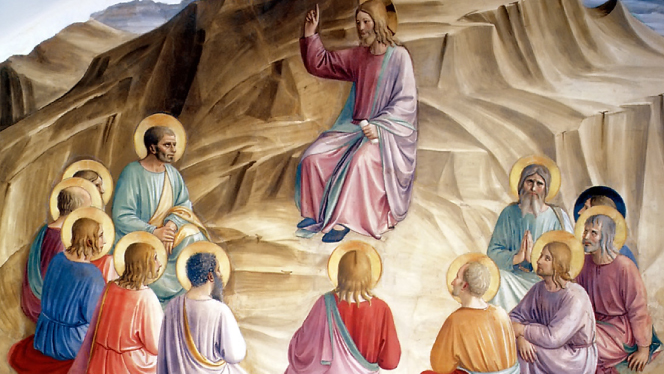
PODCAST—At the beginning of the Sermon on the Mount, we hear the eight beatitudes. These are a summons to be liberated from the various addictions–to material things, to power, to good feeling, to the esteem of others–that keep us from following the will of God.
4th Sunday of Year A
Blessed Are We
PODCAST—As we look into the famous “Beatitudes” described in this weeks Gospel, we learn that the Divine Mercy is the path to true joy. The more we allow the Divine Mercy to flow through us the more it grows in us. Once we eliminate the idolatrous rivals of wealth, pleasure, power, and honor and make Christ the priority in our lives we begin to live like saints.

4th Sunday of Year A
In the Land of Zebulon and Naphtali
PODCAST—Our first reading from the prophet Isaiah and our Gospel are tightly linked, for St. Matthew, in articulating the meaning of Jesus, cites (as is his wont) an Old Testament text—namely, our reading from the eighth and ninth chapters of Isaiah. The prophet speaks of conflict in the land of Zebulon and Naphtali, and then of a great light that shines in that area, signaling the victory of God.

4th Sunday of Year A
The Key to Happiness
True happiness and holiness come from emptying oneself, seeking holiness above all else, showing mercy and compassion, making peace, and enduring persecution for righteousness’ sake. The key to happiness is giving your life away and feeling sorrow for your sins. Being humble and forgetting about oneself leads to happiness and being close to reality. To find happiness, identify with the suffering of others and live a single-hearted life centered around one thing.

4th Sunday of Year A
Coming Soon
Friends, today we come to the third Sunday of Advent, and the great image from Isaiah is that of the blooming desert. Many of us pass through desert times, dry periods of trial and training. But perhaps the Lord has drawn us into the desert to awaken a deeper sense of dependence upon him. We must be patient; and in this season of waiting, we look toward Christmas—the great blooming in the desert.
Fr. Michael Chua
Permission granted for non-profits to use in ministry
The infographic was created using Nano Banana, Google's Revolutionary AI Image Generator. Infographic may not be sold or used for personal financial gain. Please show your appreciation by letting others know about TheWordThisWeek.NET.
4th Sunday of Year A
Joy is Hidden in Sorrow

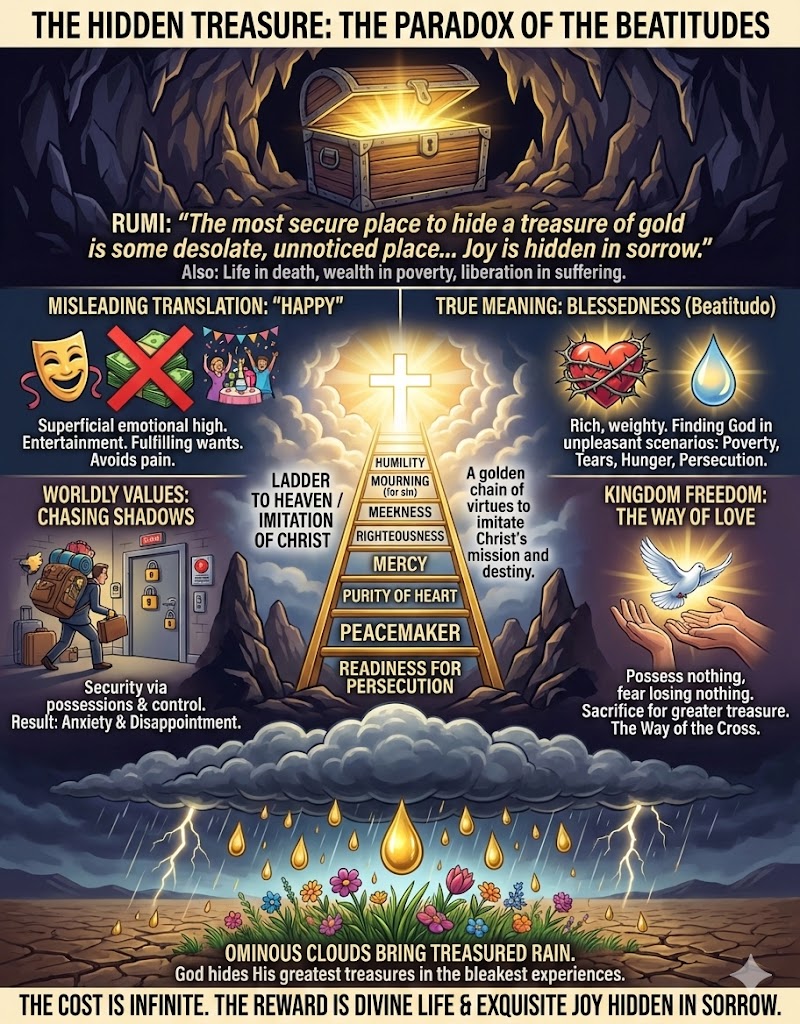
The 13th century Persian mystic Rumi wrote: “The most secure place to hide a treasure of gold is some desolate, unnoticed place. Why would anyone hide treasure in plain sight? And so it is said: ‘Joy is hidden in sorrow.’” I would like to add: life is hidden in death, wealth in poverty, relief and liberation in suffering. This is the wisdom of the Beatitudes – “a treasure of gold” hidden in the darkest and bleakest of human experience.
The word “beatitude” comes from the Latin beatitudo, meaning “blessedness.” The main translation in use at Mass (from the Jerusalem Bible version) has replaced “blessed”, a rich and weighty word, with this possibly misleading word, “happy”’. Why do I say that this could be misleading? Basically, because of the danger that we may come to think that the way the Christian religion makes us happy is something like giving us an emotional “high” through the use of drugs or alcohol, or through entertainment and pleasure, or by fulfilling all our wants and desires – making us popular, powerful and rich. But even a passing glance at the Beatitudes makes it clear they’re hardly anything but fun and happiness-invoking. Instead, these sayings are disturbing, threatening, and downright unpleasant. The Beatitudes predict that if we are to discover true happiness at all it has to be by way of a list of obviously unpleasant scenarios: poverty, tears, hunger, and even persecution. Hardly any cause for revelry. It is hard for anyone to understand how one can rejoice and be happy when oppressed, cursed and persecuted. It seems that all suffering leads naturally only to sorrow.


Permission granted for non-profits to use in ministry
The infographic was created using Nano Banana, Google's Revolutionary AI Image Generator. Infographic may not be sold or used for personal financial gain. Please show your appreciation by letting others know about TheWordThisWeek.NET.
4th Sunday of Year A
Seek the Kingdom, Seek Humility
At one time, Catholics were expected to learn and memorise the 10 commandments, a collection of Catholic prayers, the names of the seven sacraments and the Beatitudes. Most of us may still be able to make a fair stab at the first three. But how many of us can recall all eight beatitudes?
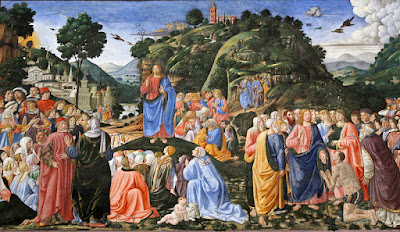
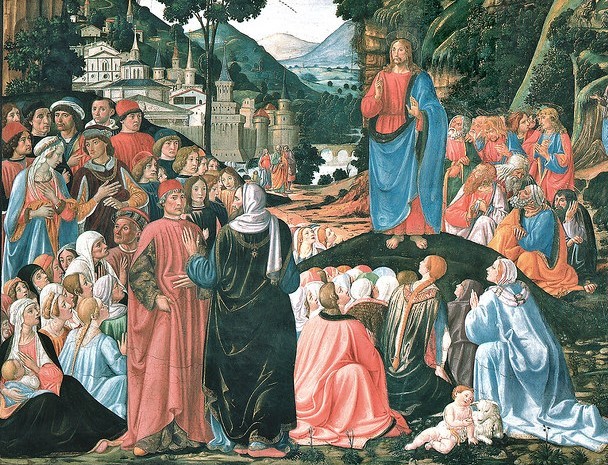
Today, we have a chance to listen to the list of Beatitudes which serves as the opening to the Sermon on the Mount. Saint Matthew clearly saw the Beatitudes as important, as crystallising Jesus’ teaching. They are the first words of teaching that Matthew quotes in his gospel. The “sermon” is given its name because Matthew tells us that the Lord had gone up to the mountain to teach (just as Moses did when he received the 10 commandments on Mount Sinai), and the Lord teaches sitting down, the traditional position of a rabbi when wanting to teach officially, not just off-the-cuff, throw-away lines while wandering along. Jesus and Matthew are telling us: this is important!
The Lord looks at those gathered around Him on that mountain. These are people who do not live easy, comfortable lives. They are people who for the most part live in poverty, for whom hunger, starvation even, is only one bad harvest away, for whom sickness and disease can all too readily lead to suffering and death, who are weak and vulnerable to the rapaciousness of the rich, to the violence of the powerful. He looks at them and tells them that if they follow the way of the kingdom, they will be “happy!” Try wrapping your head around this. To say to this group of poor, struggling people that one day they will be comforted, they will inherit the earth, they will see God, they will be called children of God, is just an extraordinary promise. To make such a radical connexion would require more than a few mental summersaults.


Permission granted for non-profits to use in ministry
The infographic was created using Nano Banana, Google's Revolutionary AI Image Generator. Infographic may not be sold or used for personal financial gain. Please show your appreciation by letting others know about TheWordThisWeek.NET.
4th Sunday of Year A
Boast of the Lord
Our God has no need of our praise. He is not so conceited (unlike us) that He constantly desires our adulations. He doesn’t crave for our attention or affirmation as we obsessively do. It is also good to remember that God is not diminished by the lack of praises offered to Him, neither is He empowered by any amount of praise which we can offer Him. But it is we who are diminished when we forget to praise Him, to thank Him, to adore Him. We are made for this purpose. We were made to worship God, to give Him all glory and praise. So, when we fail to do so, we become less than human. When we do not worship God, we end up worshipping something else and in this age of acute narcissism, the most popular object of worship is ourselves. This is the reason why it is more common to boast of our own achievements than it is to boast of God’s goodness and graces.
And that is also the reason why the Holy Mass, the highest form of worship to God, is the greatest antidote to our narcissism. Why do so many people complain that Mass is boring? My answer is simply this – the Mass is inherently boring because it is not about us but about God. God is worshipped, not man. The Mass is not another opportunity to showcase our talents or achievements. When we examine what it means to experience “boredom”, it is that we are not the centre of the attention. Something or some activity is described as boring because we are not getting the attention we want from others.
So let us boast by praising not ourselves but God, not for anything we have of ourselves, but for what He has given us! This is at the heart of our worship rendered in the Holy Sacrifice of the Mass which is our Thanksgiving offered to God. Let our hearts and our minds nurture His gifts, until He grants us our reward, that we may sing His praises forever in heaven! All glory and all praise belong to Him and Him alone!
Dominican Blackfriars
Permission granted for non-profits to use in ministry
The infographic was created using Nano Banana, Google's Revolutionary AI Image Generator. Infographic may not be sold or used for personal financial gain. Please show your appreciation by letting others know about TheWordThisWeek.NET.
4th Sunday of Year A
The Unity of the Kingdom
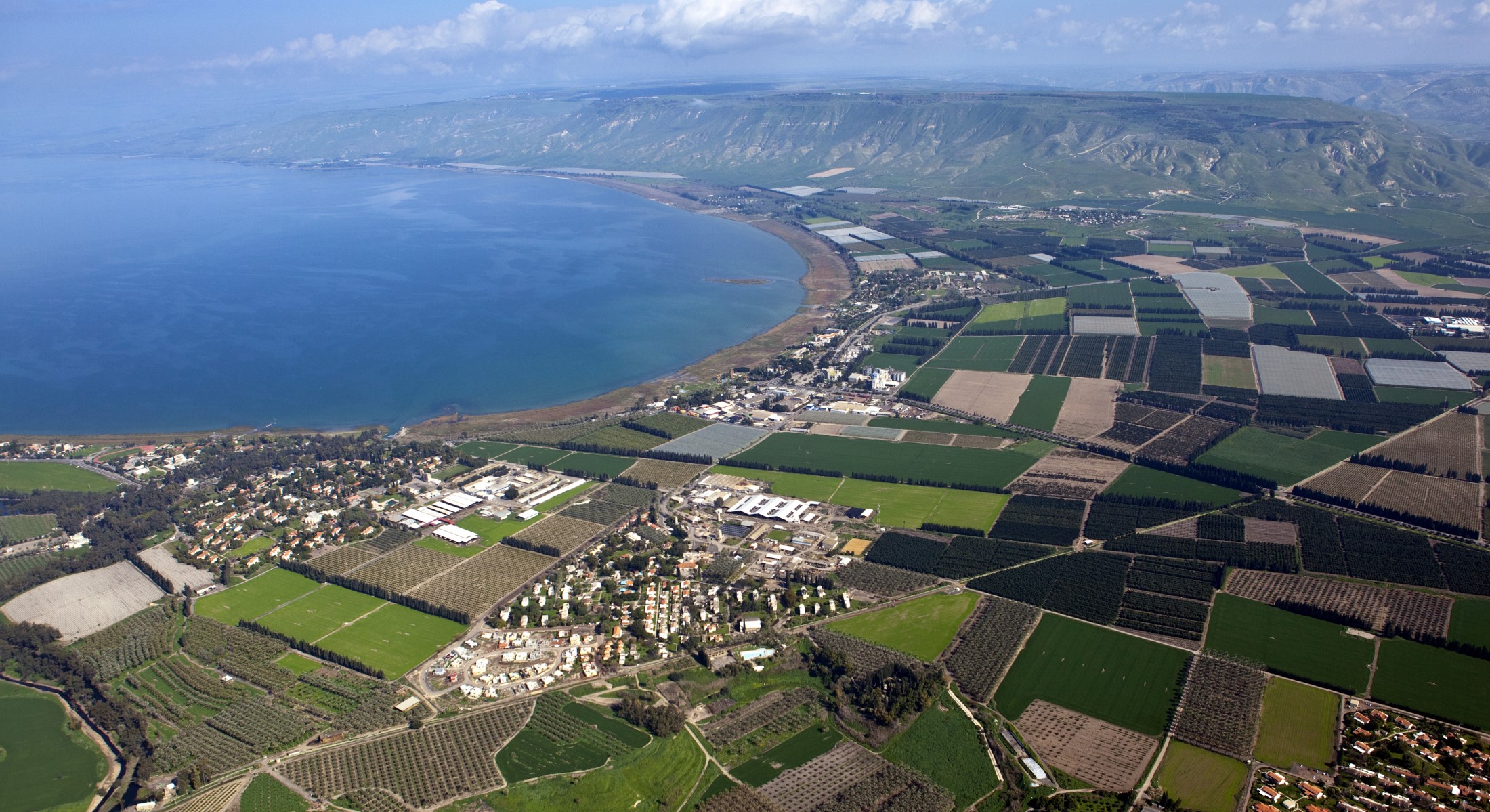
Third Sunday of the Year. Fr John Patrick Kenrick reminds us of the universal call to preach.
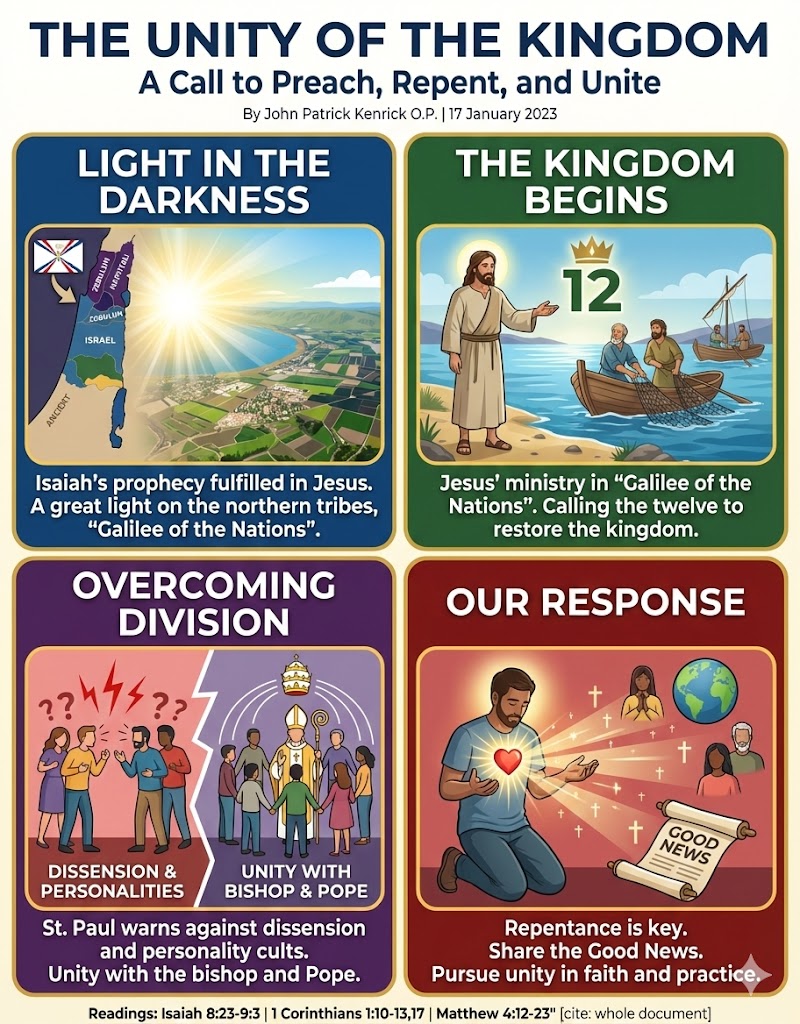
One of the many contributions that Pope Benedict made to the life of the Church was to draw our attention to the need to read scripture through the eyes of faith. Pope Benedict was not opposed to the historical-critical method of reading scripture. In fact he insisted that an attention to the context in which scripture had been written is an important part of understanding it. At the same time an exclusive attention to the original context would mean that we completely lose sight of the insight of faith – that the Holy Spirit inspires both scripture and tradition. The scriptures cannot be confined to one age. Their meaning unfolds through developing Church tradition as when, for example, the evangelists refer to OT passages. Today’s reading from Isaiah is a good example.
It refers to the lands of Zebulun and Naphtali. These were two of the ten lost tribes of Israel. Zebulun and Naphtali were the first two tribes of the northern kingdom of Israel to be deported by the Assyrians in 722BC. The Assyrians also resettled these lands with people who were not Jewish. Isaiah is predicting a time when, as he puts it, ‘a great light’ will shine on these northern territories, their fortunes will be restored, God Himself will confer glory on them. It will be, says Isaiah, ‘like the day of Midian’. The Day of Midian refers to the famous battle in which Gideon defeated the Midianites and enriched Israel with all the booty he captured.

Permission granted for non-profits to use in ministry
The infographic was created using Nano Banana, Google's Revolutionary AI Image Generator. Infographic may not be sold or used for personal financial gain. Please show your appreciation by letting others know about TheWordThisWeek.NET.
4th Sunday of Year A
No Light Squibs of Mirth
Fourth Sunday of the Year. | Fr Robert Ombres unpacks the profound vision of the Beatitudes.
Jesus is not promising ‘light squibs of mirth’ to his followers. The Beatitudes described in today’s gospel tell of a more rooted happiness, of a joy that can be unexpected and unlikely, a blessing that lasts even against the odds.
Jesus was in fact describing himself before he was offering us a sustaining vision. It is Christ who makes it possible for us to be transformed and to be transforming because what we might become and do is already and permanently achieved in him. Roots are generally invisible, yet what flourishes openly depends on them. Our happiness as Christians is rooted, and it flourishes because it is planted not only in human resources.
This kind of happiness leads to experiences of joy when situations of say mourning or persecution make them unexpected and unlikely. This side of heaven is not only a time of hopeful waiting for what will come in future, with no impact now. In the whole of the New Testament it is St Matthew who uniquely and repeatedly writes of the ‘Kingdom of Heaven’. Think of his account of parables. In Christ, the Kingdom of Heaven has come among us and actively transforms. Grace is an energy to act and behave in a certain way as well as a source of happiness. Our lives in Christ will include paradoxes and dislocations, and the teaching on the Beatitudes prepares us for this both as a reassurance and a task.

Permission granted for non-profits to use in ministry
The infographic was created using Nano Banana, Google's Revolutionary AI Image Generator. Infographic may not be sold or used for personal financial gain. Please show your appreciation by letting others know about TheWordThisWeek.NET.
4th Sunday of Year A
How to be Happy
Fourth Sunday of the Year. Fr Robert Verrill explains the relationship between the Beatitudes and the life of virtue.
Those who are poor in spirit have actively turned away from prizing worldly goods, since they have set their hearts on the kingdom of heaven. Those who mourn let go of their worldly aspirations, and instead long for the conversion of sinners. Those who are meek are in complete control of their emotions, so that they can wait with tranquil hearts for the promises of Christ. Those who hunger and thirst for righteousness actively pursue works of justice which bring such delight to God. Those who are merciful are full of generosity, actively sharing the mercy they have received from God. Those who are pure in heart have a single-minded devotion to the will of God in all that they do. Those who are peacemakers build up harmonious communities whose members recognize each other’s dignity as children of God. And those who are persecuted for righteousness’ sake actively pick up their cross and follow Christ, confident that He is leading them to the kingdom of heaven.
Modern notions of happiness diverge from the true happiness of Jesus Christ when people seek complete autonomy in their actions and independence from God. The mistake is to view God’s activity and our activity as being in competition. But in reality, there is no competition, for God is the very source of our being – He is closer to us than we are to ourselves. So if we allow God to move us from within, we will be truly happy, we will be truly blessed, for dwelling with God is the activity for which we were made.tead he moves to Capernaum, a town, we are told, on the borders of Zebulun and Naphtali, two of the twelve tribes of Israel.
Fr. Austin Fleming

Permission granted for non-profits to use in ministry
The infographic was created using Nano Banana, Google's Revolutionary AI Image Generator. Infographic may not be sold or used for personal financial gain. Please show your appreciation by letting others know about TheWordThisWeek.NET.
4th Sunday of Year A
What Does it Mean to be “Blessed?”
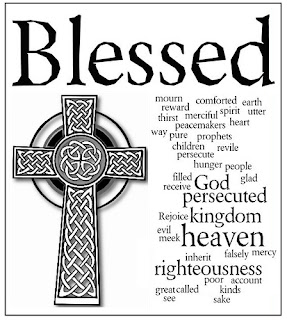
First, a few questions…What makes you happy?
What is there about you that’s deserving of honor?
What is there about your life that others might highly esteem?
The Greek word (makarioi) translated here as “blessed”
translates just as well as
“happy,” or “deserving of honor” or “highly esteemed.”
But Jesus’ categories of “blessed” or “happy” are very unusual.
Are we happy when we grieve and mourn?
Do we feel blessed when we’re insulted?
Do we esteem the meek?
Are they happy who hunger and thirst for justice?
Is it a blessing to be falsely accused? an honor to be persecuted?
Of course there are here those three more user-friendly categories:
Blessed are the merciful, the clean of heart, the peacemakers…
Monsignor Peter Hahn
Permission granted for non-profits to use in ministry
The infographic was created using Nano Banana, Google's Revolutionary AI Image Generator. Infographic may not be sold or used for personal financial gain. Please show your appreciation by letting others know about TheWordThisWeek.NET.

4th Sunday of Year A
Our Desire for Happiness
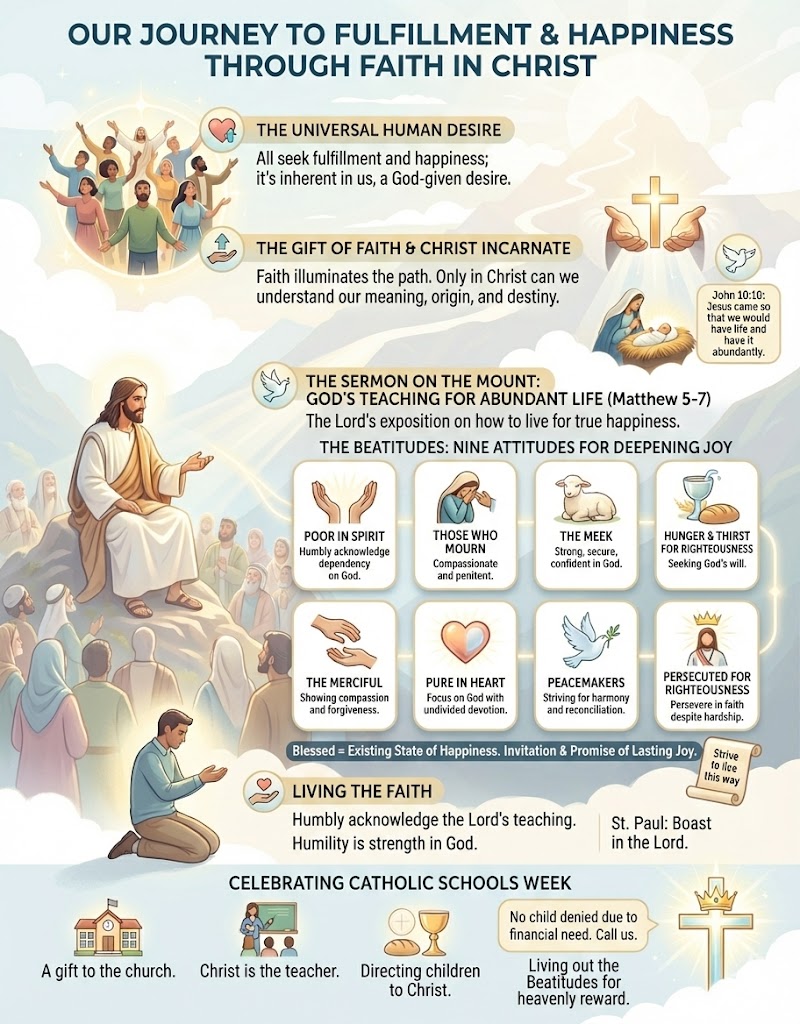
2020 HOMILY – True and lasting happiness can be found by living according to God’s teachings, specifically the Beatitudes, and that a faith-based education, such as that provided by a Catholic school, is essential in helping individuals achieve this happiness. The Sermon on the Mount, covering only five pages in most Bibles, is a crucial passage that teaches how to live a happy life, amidst a culture that constantly tries to sell us false promises of happiness. esus teaches that true happiness comes from living according to the Beatitudes, which describe a state of being that is already blessed, rather than a future reward.
Fr. Charles E. Irvin
4th Sunday of Year A
The Spiritual Life: Winners and Losers

A critic once challenged me by declaring that my homilies were preaching a message of failure to a bunch of losers. He was suggesting that the Good News of Jesus Christ is directed at losers, not at winners. Today’s Gospel account in which we find Jesus giving us the Beatitudes provides us with a good background to take a look at winners and losers.
As in so many things, a lot depends upon your viewpoint, the angle from which you are looking at things. St. Paul puts that issue into sharp perspective in today’s second reading which was taken from his letter written to very cosmopolitan and sophisticated Greeks living in Corinth:
“Consider your own calling, brothers and sisters,” writes St. Paul, “Not many of you were wise by human standards, not many were powerful, not many were of noble birth. Rather, God chose the foolish of the world to shame the wise, and God chose the weak of the world to shame the strong, and God chose the lowly and despised of the world, those who count for nothing, to reduce to nothing those who are something, so that no human being might boast before God. It is due to him that you are in Christ Jesus, who became for us wisdom from God, as well as righteousness, sanctification, and redemption, so that, as it is written, ‘Whoever boasts, should boast in the Lord.'”


Fr. Langeh, CMF

4th Sunday of Year A
Seek the Lord and Be Happy

In the Sermon on the Mount Jesus gives the roadmap for happiness. Beatitude comes from the Latin word “beatitude”, which means happiness. Man naturally desires to be happy. (CCC 1718). The Greek word translated as blessed means, “extremely fortunate, well off, and truly happy.” The Beatitudes respond to a natural desire for happiness which is of divine origin. God has placed it in the human heart to draw man to the One who alone can fulfil it. In the Beatitudes Jesus calls us to abundant happiness that makes us complete and whole; in which we find our true selves and the person God intends us to be. God leads us to transform ourselves, gives us the ability to see what needs to be transformed and to find God’s help in that transformation. We are invited to live the Beatitudes and to focus on God’s desires for our lives. Living the life of the Beatitudes means seeking God. This leads us to a true inward peace that leads to a desire to be outward peacemakers, to bring reconciliation, seek out opportunities for mercy and compassion and pursue, hunger and thirst for justice and righteousness.
Deacon Peter McCulloch
Permission granted for non-profits to use in ministry
The infographic was created using Nano Banana, Google's Revolutionary AI Image Generator. Infographic may not be sold or used for personal financial gain. Please show your appreciation by letting others know about TheWordThisWeek.NET.
4th Sunday of Year A
On Leaving Our Nets Behind
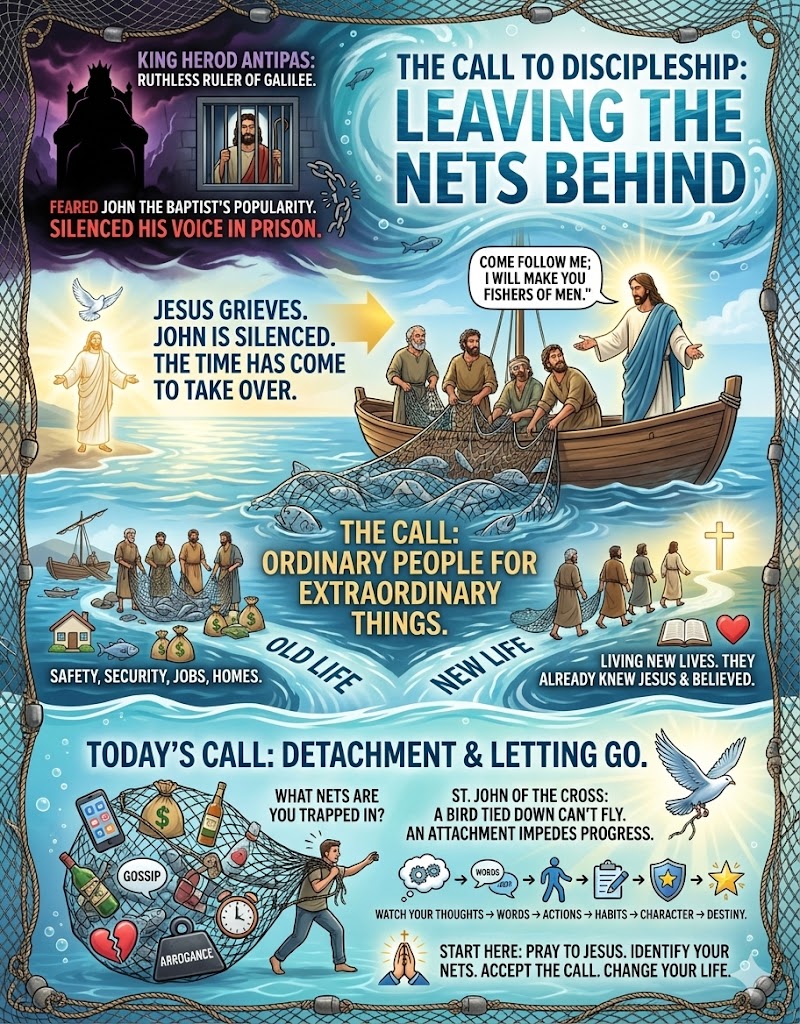
Everyone who wants to follow Jesus has to leave something behind. You can’t live a new life by hanging on to the old one. This letting go is sometimes called Detachment.
Detachment doesn’t mean withdrawing totally from the world, because God loves our world and Jesus wants to heal it (Jn.3:16). But before we can help Jesus make this world a better place, we must first change ourselves. This means we must let some things go (Rom.12:2).
Too many Christians, however, are only lukewarm about their call. They don’t want to be inconvenienced. They don’t want to change. So they drag their nets along after them and sometimes they get tangled up in them.
Joseph Krempa says the problem is that we want the kingdom without changing ourselves. ‘It’s like those who want the meal, but not the cooking; who want the grades but not the study; who want health, but not exercise; who want the salary, but not the work’.
We want all the benefits of God – the peace, the forgiveness, the growth in grace, and the sense of belonging to a spiritual community, but we don’t want to give up the nets, the entanglements that trap us, that hold us back… These are the people, the relationships and the obsessions that separate us from Christ.
Permission granted for non-profits to use in ministry
The infographic was created using Nano Banana, Google's Revolutionary AI Image Generator. Infographic may not be sold or used for personal financial gain. Please show your appreciation by letting others know about TheWordThisWeek.NET.
4th Sunday of Year A
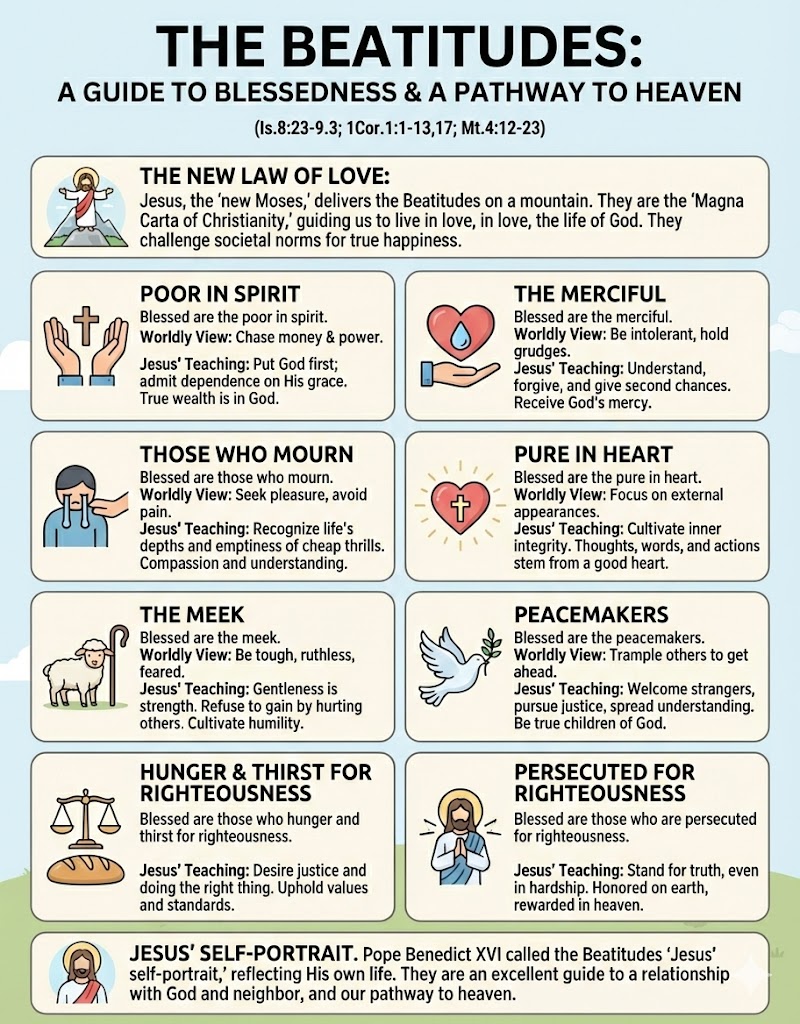
The Beatitudes
Jesus’ Sermon on the Mount has often been described as the heart of the Gospels, and central to this sermon are the Beatitudes.
These famous blessings are at the very heart of Jesus’ teaching.
Pope St John Paul II once called the Beatitudes the Magna Carta of Christianity. What he meant is that these eight blessings are a pivotal guide for how we might live our best lives as disciples of Jesus Christ.
Early in the Old Testament, in the Book of Exodus, Moses climbs Mt Sinai and receives the Ten Commandments from God. These Ten Commandments are ten simple, but profoundly important, rules for how to live a safe and moral life that will both please God and help us all live in community.
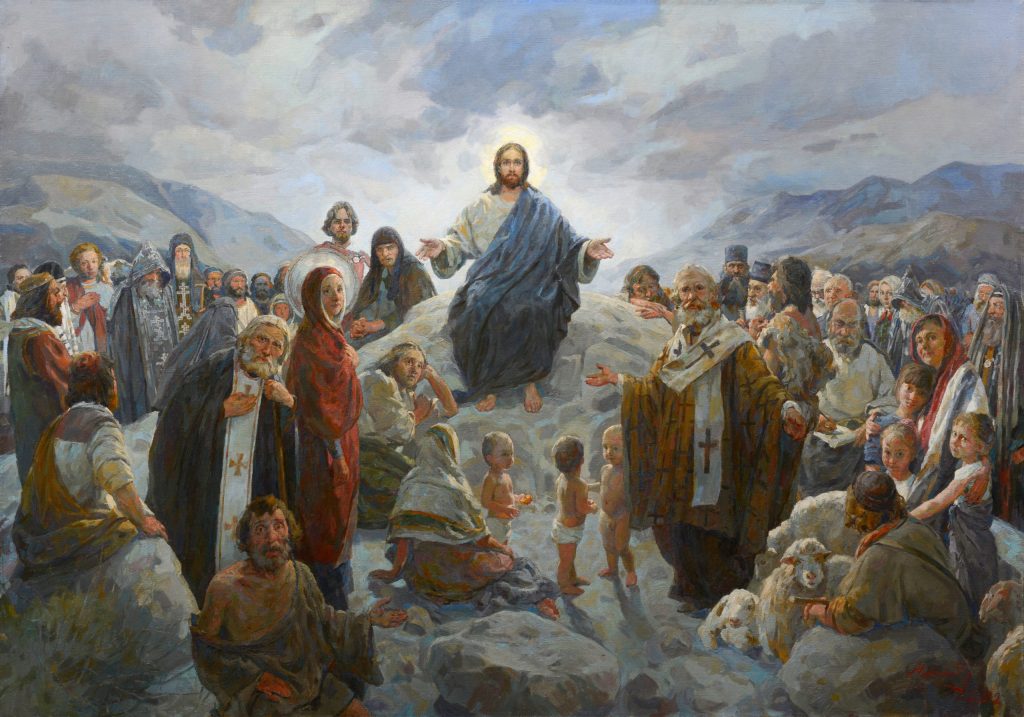
In a similar way, early in the New Testament, Jesus, as ‘the new Moses’, climbs another mountain, this one overlooking the Sea of Galilee, and he introduces a new law which we call the Beatitudes. This new law isn’t meant to replace the Law of Moses. Its purpose is to perfect them and help us understand them better. As Jesus says, ‘I’ve come not to abolish the law or the prophets, but to fulfill them’ (Mt.5:17)
Permission granted for non-profits to use in ministry
The infographic was created using Nano Banana, Google's Revolutionary AI Image Generator. Infographic may not be sold or used for personal financial gain. Please show your appreciation by letting others know about TheWordThisWeek.NET.
4th Sunday of Year A
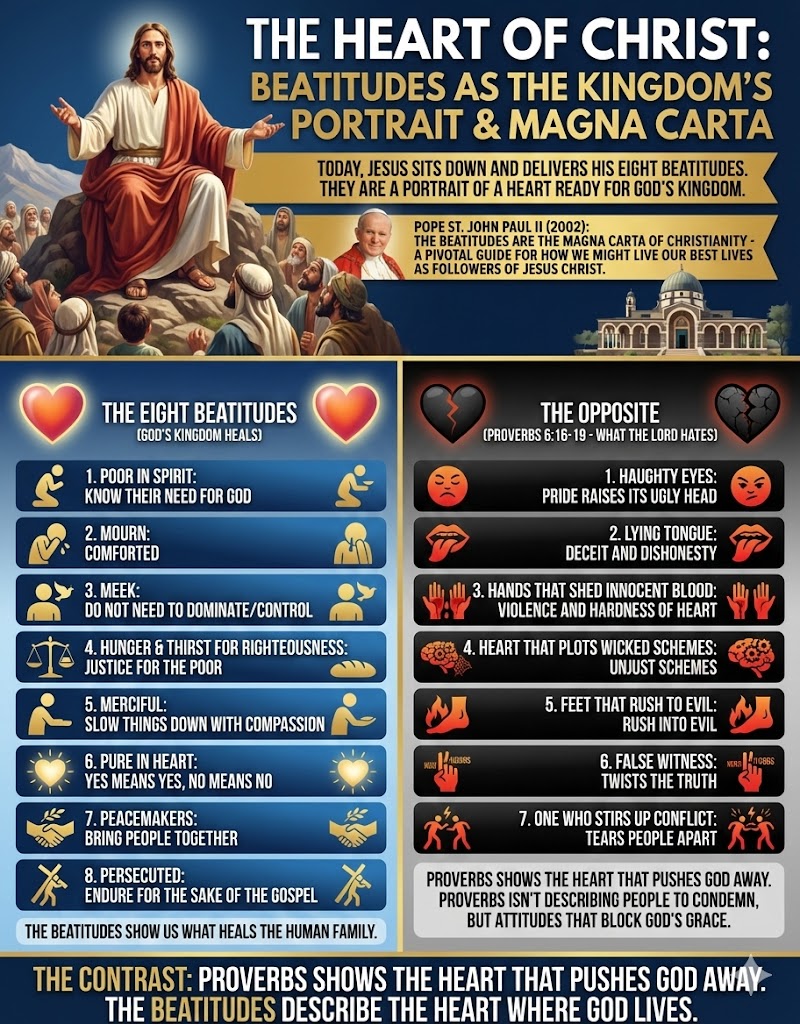
Medicine for the World
One good way to understand these eight blessings is to hear them alongside another passage from Scripture, which describes the very opposite of God’s Kingdom.
The Book of Proverbs (6:16-19) lists seven things that the Lord hates: haughty eyes, a lying tongue, hands that shed innocent blood, a heart that plots wicked schemes, feet that to rush into evil, a false witness, and one who stirs up conflict.
It may seem harsh to speak of ‘what the Lord hates,’ but Proverbs isn’t describing people for us to condemn. Rather, it’s revealing the attitudes and behaviours that block God’s grace, the things that close our hearts and deform our communities.
Proverbs spells out what destroys the human family, while the Beatitudes show us what heals it. Let’s look at the contrasts:
And where conflict tears people apart, Jesus blesses those who endure persecution for the sake of the Gospel, standing firm in truth and love.
- Where pride raises its ugly head, Jesus blesses the poor in spirit, those who know their need for God.
- Where deceit and dishonesty poison relationships, Jesus blesses the pure in heart, whose yes means yes and whose no means no.
- Where violence and hardness of heart can shed innocent blood, Jesus blesses the meek, who do not need to dominate or control.
- Where unjust schemes grind the poor into the dust, Jesus blesses those who hunger and thirst for righteousness.
- Where feet rush to evil, Jesus blesses the merciful, who slow things down with compassion.
- Where false witness twists the truth, Jesus blesses the peacemakers who bring people together.
Fr. Carmen Mele, O.P.
Permission granted for non-profits to use in ministry
The infographic was created using Nano Banana, Google's Revolutionary AI Image Generator. Infographic may not be sold or used for personal financial gain. Please show your appreciation by letting others know about TheWordThisWeek.NET.
4th Sunday of Year A
The Beatitudes
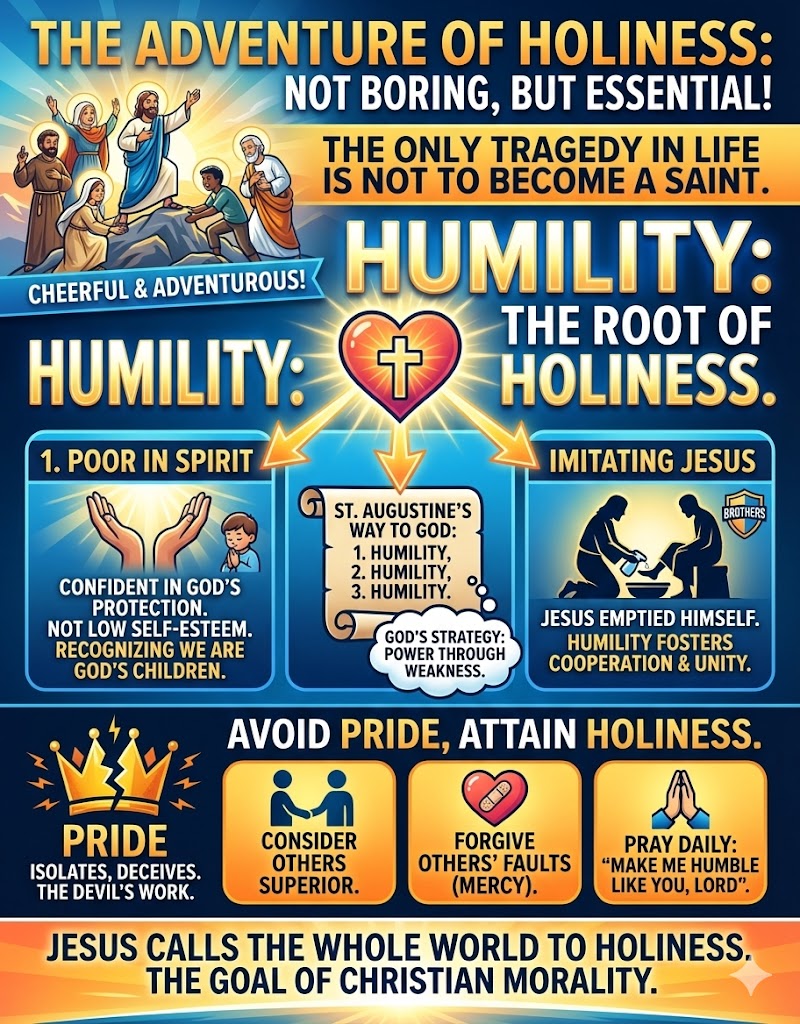
Few people want to be saints. Most think of holiness as boring. They say that they would rather be cheerful and adventurous as if there were no very cheerful and adventurous saints. One thing for sure is that Jesus has taught that one cannot enter the Kingdom of God without being holy. He has called the whole world to holiness. That is why a famous Catholic author once said: “The only tragedy in life is not to become a saint.”
The beatitudes of today’s gospel serve as a description of holiness. They are placed at the beginning of the Sermon on the Mount to indicate the goal of Christian morality. The saints are “poor in spirit.” They “mourn” over their sins and the sins of others. They are also meek, long-suffering, or humble, depending on the translation of our Bible. These first three beatitudes show that holiness is rooted in humility. Contrary to our way of thinking, poverty of spirit is not a lack of self-esteem. Rather, it is recognizing ourselves as sons and daughters of God, the Father, ever confident of his protection. Once a missionary visited a village in the mountains of Honduras. Because it was the day after Christmas, he asked the campesino children about their Christmas presents. Each responded that his present was a gift for the infant Jesus, not what he received from Santa Claus. They told how they would pray more to Jesus or pay more attention to their household chores. This is true “poverty of spirit.”
Msgr. Joseph Pellegrino
4th Sunday of Year A
Humility

Today’s reading begin with a prophet we seldom here proclaimed, Zephaniah. They deal with a subject we usually avoid, humility. And they go to the heart of our Christian life, our relationship with God. The word humility is best understood when we consider its origin, humus. Humus is used in farming. Farmers call humus black gold. What is humus? It is a composition of decayed plant and animal matter. Rather ignoble. But, when humus is mixed with soil it becomes the richest part of the soil. If a farmer tills it, or breaks it open to receive seed, and the Lord provides sufficient rainfall and sunlight, the rich humus soil will yield the most bountiful harvest and the most beautiful flowers.
Like the rich, broken soil of humus, humility is the capacity to be open to receive the seeds of experience, both the painful and the enriching. Humility is the grace to let ourselves be broken like the humus, broken of our pride and our ego, so that we can be used to provide a rich harvest, far greater than we could create ourselves.
All three of today’s readings refer to humility. The prophet Zephaniah calls the faithful Israelites the humble of the earth. He conveys the promise of the Lord that even when God’s anger comes upon the world, a remnant of people will remain who are humble and lowly. They will not be deceitful or perjure themselves. They will be open to God working in them rather than be crammed full of themselves.
Msgr. Charles Pope
Permission granted for non-profits to use in ministry
The infographic was created using Nano Banana, Google's Revolutionary AI Image Generator. Infographic may not be sold or used for personal financial gain. Please show your appreciation by letting others know about TheWordThisWeek.NET.
4th Sunday of Year A
Picture This!
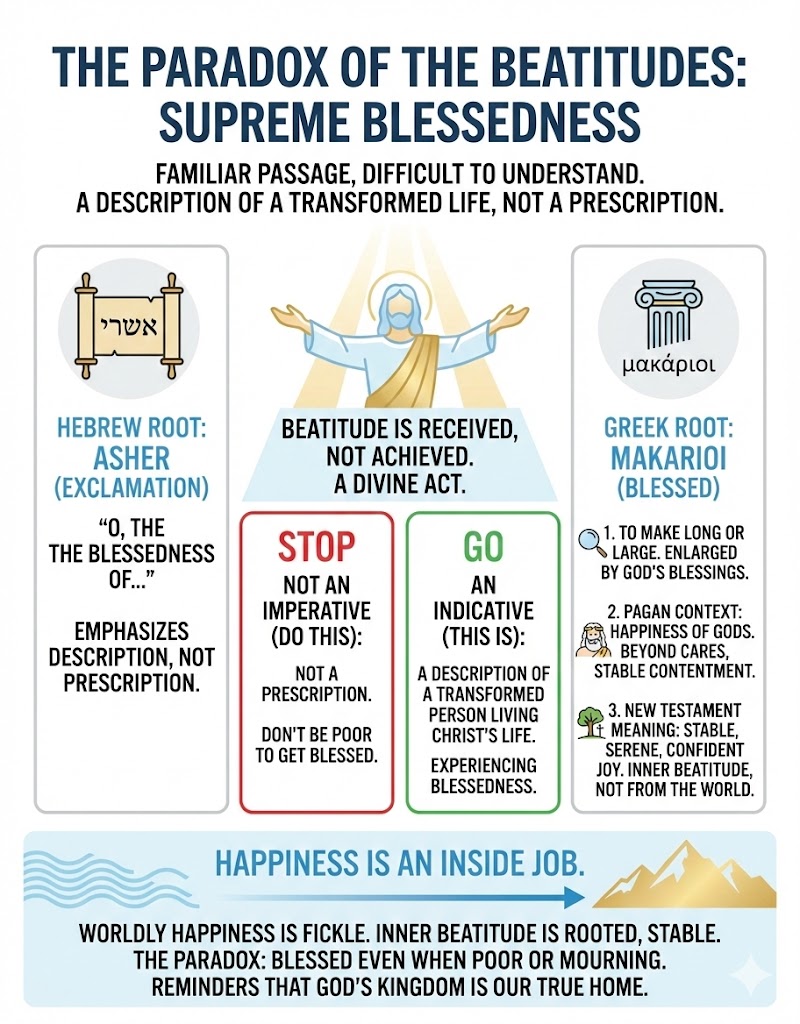
The Gospel passage on the Beatitudes is one of the most familiar. Yet the Beatitudes are difficult to understand because many of them are paradoxical. We do not usually refer to the poor as blessed, but rather the well-off; we do not typically call those who mourn blessed, but rather the joyful.
The word “beatitude” itself means “supreme blessedness.”
Father Kevin Rettig
Permission granted for non-profits to use in ministry
The infographic was created using Nano Banana, Google's Revolutionary AI Image Generator. Infographic may not be sold or used for personal financial gain. Please show your appreciation by letting others know about TheWordThisWeek.NET.

4th Sunday of Year A
Live Out Lord
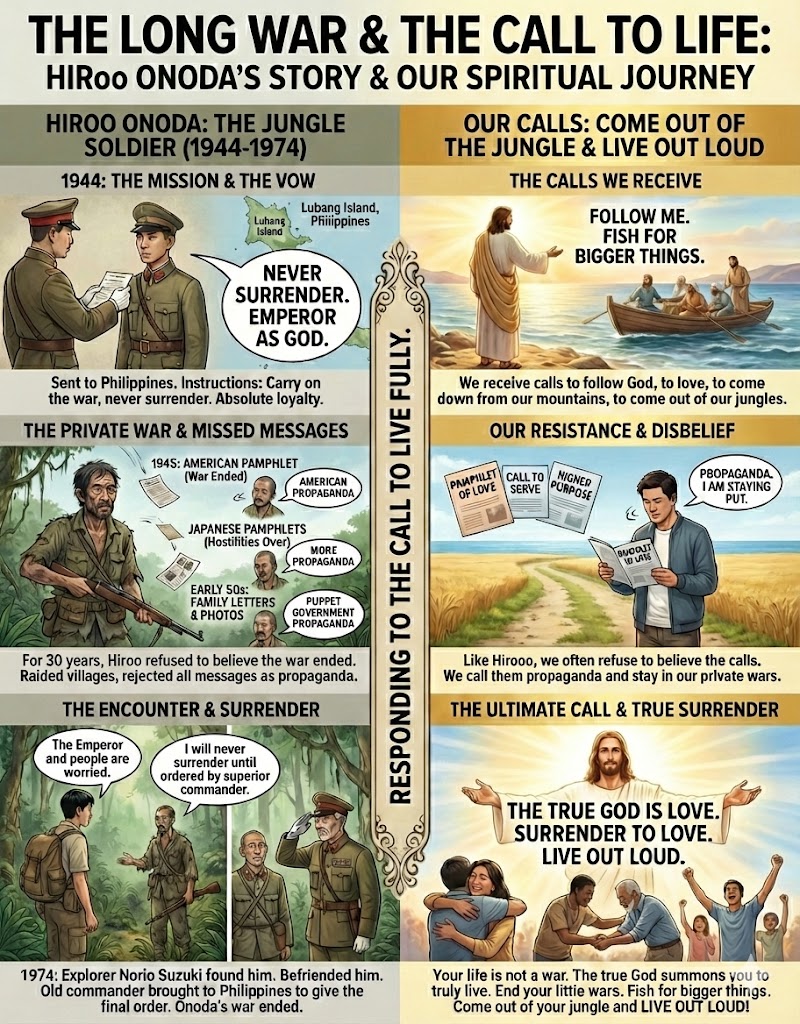
A few years ago a remarkable and very interesting man died in Japan. He was 91 years old and his name was Hiroo Onoda. Hiroo Onoda was a young soldier in World War two sent by the Imperial Japanese army to go to an island in the Philippines on December 26th 1944. Two months later the island was occupied by the Allied forces. Onoda fled to the hills. He had been given instructions never to surrender and he took these instructions very seriously indeed in those days remember.
The Japanese still regarded their emperor as a god to whom absolute loyalty was owed for the next 30 years. Lieutenant Onoda carried on the war and following his instructions meticulously never surrendered. The first time he was told that the war had actually come to an end was near the end of 1945 when a pamphlet was dropped around him. Seeing the war ended August 15th come down from the mountains already Onoda picked up the pamphlet read. It shook his head and said American propaganda he didn’t believe it then the Japanese themselves came up with pamphlets to be airlifted over the place where he was telling him that hostilities had come to an end and ordering him back home. He shook his head and said American propaganda and so he continued hiding out there and inflicting raids on the villages and towns of the island. In the early 50s they tried another tactic.
Permission granted for non-profits to use in ministry
The infographic was created using Nano Banana, Google's Revolutionary AI Image Generator. Infographic may not be sold or used for personal financial gain. Please show your appreciation by letting others know about TheWordThisWeek.NET.

4th Sunday of Year A
Jesus the Teacher
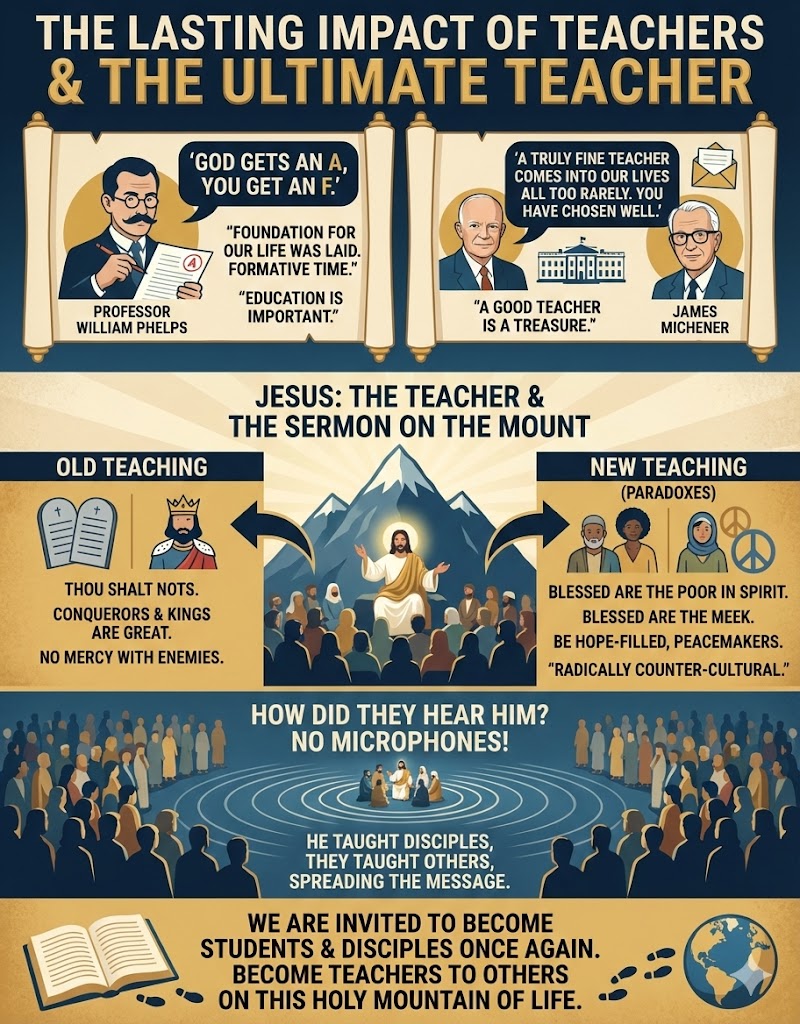
A good teacher is a treasure we hear about Jesus the teacher today and we are given excerpts of his discourses as he taught the crowds in his famous Sermon on the Mount which the Hindu Sage Mahatma Gandhi called the greatest sermon ever preached. This Sermon on the Mount still forms today. Some of the most beautiful words of wisdom on Earth Jesus was giving an entirely new teaching a teaching that was radically counter-cultural.
It was so different from what the people had been used to. They had been used to a Moses going up the mountain and hurling down a list of Thou shalt. Nots. They had been used to being told that conquerors and kings are the great people they had been used to being told to have no mercy with your enemies but to wipe out every man woman and child for you are the ones to conquer the land…
On that Mountaintop 2 000 years ago. He uses our lips our words our lives today to get his message of love to others. Some of us are still in school while for some of us. The memories of our school days are very distant. Still others of us are teachers ourselves no matter which category we fall into no matter our age. No matter who we are we are invited to become. Students disciples once again so that we can be teachers to others on this Holy. Mountain of life.

4th Sunday of Year A
The Sin of Not Noticing
Fr. Ruttig’s homily explores sacrificial love through the Cross. It confronts our tendency to feel that God is distant in our pain and reveals the Cross as God’s defin
Fr. George Smiga
Permission granted for non-profits to use in ministry
The infographic was created using Nano Banana, Google's Revolutionary AI Image Generator. Infographic may not be sold or used for personal financial gain. Please show your appreciation by letting others know about TheWordThisWeek.NET.
4th Sunday of Year A
A Loophole in the Kingdom

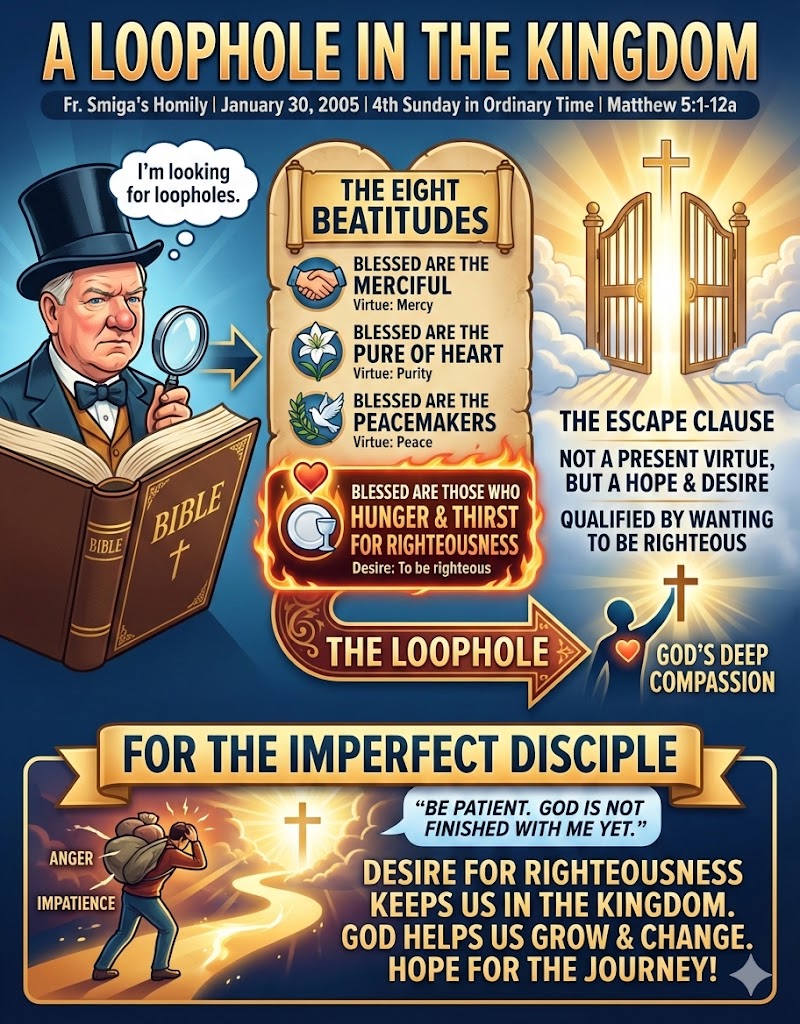
2005 HOMILY – Each one of the beatitudes begins by describing a present quality or condition in us which will lead us to happiness and inclusion into the kingdom of God. Most of the beatitudes point to a virtue, a good habit, which qualifies us to belong to the kingdom: Blessed are the merciful, for they will receive mercy; Blessed are the pure of heart, for they will see God; Blessed are the peacemakers, for they will be called children of God. These qualities of mercy, purity, peace characterize the kingdom and those who belong to it.
But one of the beatitudes is different—the fourth beatitude. The fourth beatitude does not begin with a present virtue or good habit but rather with a hope or desire: “Blessed are those who hunger and thirst for righteousness, for they will be satisfied.” The fourth beatitude says that we are blessed if desire righteousness. What is righteousness? It is what God calls us to be. It is righteousness that mark us for the kingdom. It is, in fact, what the other beatitudes describe. To be a person of mercy, of purity, of peace means that you are righteous. The other beatitudes say we are blessed if we have these qualities, the fourth beatitude says we are blessed if we wish we had these qualities. As such, this beatitude qualifies as a loophole, as an escape clause for us. For it tells us even if we are not completely merciful or pure or peaceful, as long as we hunger and thirst for those virtues, we can still be included in the kingdom of God.