The Deacon, Deacon’s Digest, FREE resource bulletin
The Deacon, Deacon’s Digest, FREE resource bulletin
February 1, 2026
February 1, 2026
4th Sunday of Year A



In His Sermon on the Mount, Jesus begins not with a list of commands, but with a revolutionary charter of blessings.
The Beatitudes are the constitution of the Kingdom, the very heart of the Gospel. They turn the world’s logic upside down: the blessed are not the rich, the powerful, or the self-sufficient, but the poor in spirit, the merciful, the meek, and those who mourn.
This is the soul of diakonia. The Beatitudes are not just a text for the deacon to proclaim; they are his job description. His ministry is to be the living, breathing embodiment of this new law of love.
As St. Lawrence the Deacon showed when he called the poor “the treasures of the Church,” the deacon’s life is a witness to the truth that blessedness and service are the same thing.
The Beatitudes at Mass
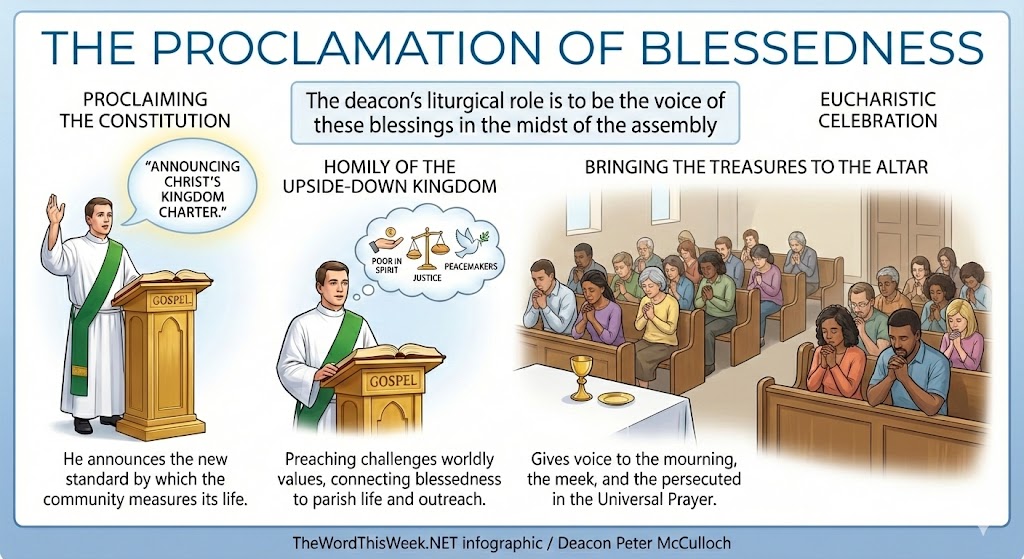
The deacon’s liturgical role is to be the voice of these blessings in the midst of the assembly.
Proclaiming the Constitution: When the deacon proclaims the Gospel of the Beatitudes, he is not just reading a passage. He is announcing the new standard by which the community must measure its life. He is the herald giving voice to the charter of Christ’s kingdom.
The Homily of the Upside-Down Kingdom: The deacon’s preaching on this Gospel must be a direct challenge to the world’s values. He is called to connect the blessedness of the poor in spirit to the parish’s budget, the hunger for justice to the parish’s outreach, and the call to be peacemakers to the parish’s internal life.
Bringing the Treasures to the Altar: In the Universal Prayer, the deacon brings the concerns of the blessed to the altar. He gives voice to the mourning (the grieving and the sick), the meek (the overlooked), and the persecuted (those suffering for their faith or for justice).
The Beatitudes in the Parish
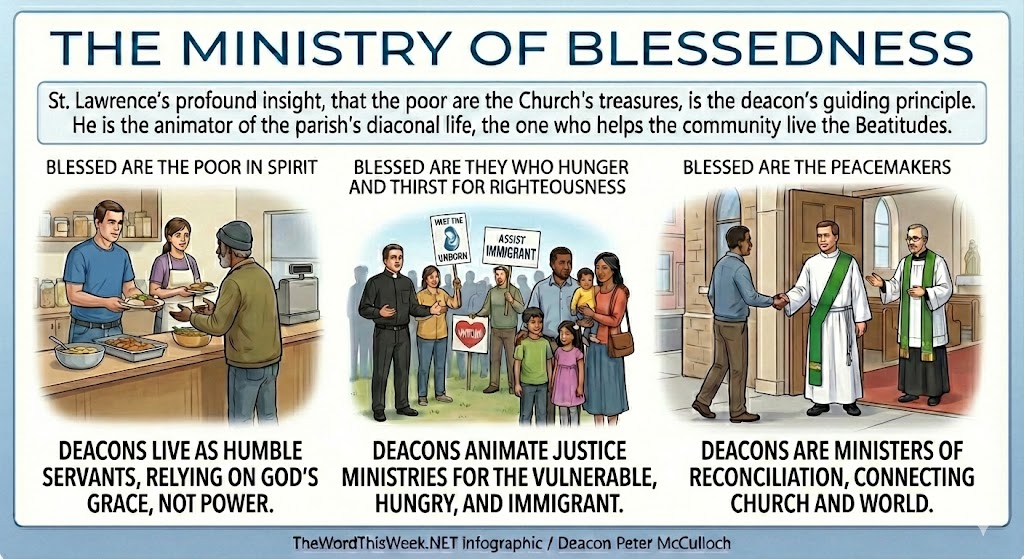
St. Lawrence’s profound insight, that the poor are the Church’s treasures, is the deacon’s guiding principle. He is the animator of the parish’s diaconal life, the one who helps the community live the Beatitudes.
Blessed are the poor in spirit: The deacon, by his very vocation, lives this. He is not a man of power, but of service. His dual life in the world and at the altar teaches him a profound reliance (poverty of spirit) on God’s grace, not his own strength.
Blessed are they who hunger and thirst for righteousness: This is the deacon’s call to justice. He is the one who must ask the parish, “Where are we failing to be just?” He animates the ministries that feed the hungry, advocate for the unborn, and serve the immigrant.
Blessed are the peacemakers: The deacon is often the “man in the middle.” He stands at the door, connecting the sanctuary and the street, the clergy and the laity. He is called to be a minister of reconciliation and unity, a peacemaker in the heart of the parish family.
The Beatitudes at the Margins
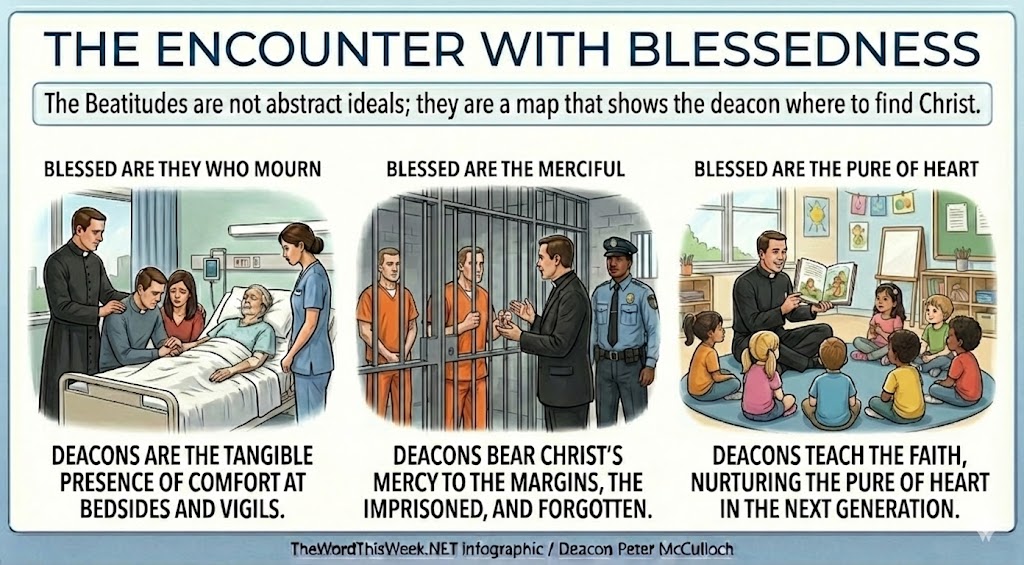
The Beatitudes are not abstract ideals; they are a map that shows the deacon where to find Christ.
Blessed are they who mourn: This is the deacon’s ministry of comfort. His most profound work is often at the funeral vigil, the hospital bedside, or in the home of the grieving. He is ordained to be the Church’s tangible presence, the one who comforts those who mourn.
Blessed are the merciful: The deacon’s ministry to the imprisoned, the addict, the estranged, or the forgotten is the work of mercy. He is the one who goes to the margins, bearing the compassion of Christ.
Blessed are the pure of heart, for they will see God: The deacon’s service is one of humble love, not for status. In this purity of intention, he is given the grace to see God in the faces of those he serves, in the “treasures” that St. Lawrence protected.
The deacon’s life reminds the Church that the world’s measure of greatness (power, wealth and status) is not God’s. The Gospel measures greatness in service, humility and mercy. The deacon’s life is a living witness that blessedness and service are inseparable, because both are born from the heart of Christ.