Homilies
Homilies
February 15, 2026
February 15, 2026
6th Sunday of Year A


DEEP DIVE PODCAST
FEATURED: Deacon Peter McCulloch, Msgr. Pope, Fr. Chua, Deacon Kandra, Fr. Joe Pellegrino, Fr. Rettig, Bishop Barron, Fr. Smiga, Fr. Fleming, and Fr. Ganeri, O.P.

Sunday’s Homily Hooks, Deep Dives, and Antitheses
This episode explores the radical demands of Jesus’ “antitheses” regarding murder, adultery, divorce, and oaths found in Matthew 5:17-37. Collectively, they emphasize that Christ calls his followers beyond the “minimum requirements” of legalistic rule-following toward a profound interior transformation that roots out the hidden sources of sin—specifically anger and lust—residing in the heart.
Bishop Robert Barron
6th Sunday of Year A
Preaching the Radical Word

PODCAST—Like a good healer, Jesus has not come simply to behaviorally modify us; he has come to heal us at the root of our being, eradicating all dysfunction from our most basic core.
6th Sunday of Year A
Choosing the Way of Love
PODCAST—What a privilege we have in this week’s readings to hear from the book of Sirach, composed by an ancient sage who was deeply immersed in the Torah, the law, and the rituals of the Temple. As such, he delivers one of the deepest truths of the spiritual life: God so respects our freedom, that he will allow us to experience life or death, good or evil. He will give us what we choose and, more to it, we will become what we choose. Each day, every moment, choose the path of love, and you will become the kind of person fit to live in heaven.
6th Sunday of Year A
Choosing to Keep the Commandments
PODCAST—Our first reading for this weekend is taken from a book that we don’t consult that frequently in the course of the liturgical year—namely, the book of Sirach. It is presented as a series of sayings of Jeshua ben Sira, a wise Jewish elder. Our reading is taken from the fifteenth chapter of Sirach, and it has to do with the awful fact of our freedom.

6th Sunday of Year A
Be a Saint!
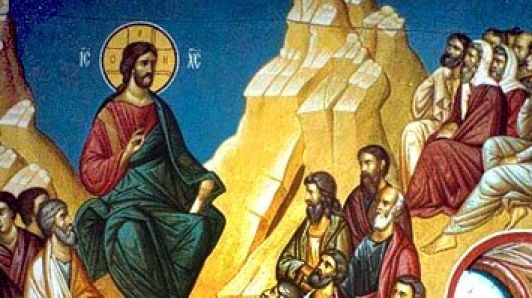
Friends, we have the privilege of continuing to read from the Sermon on the Mount, where Jesus himself lays out his basic teaching. What we find today is Jesus as the new Moses. Like Moses, he goes up on a mountain, and he receives and then gives a new, intensified Law. Jesus wants the corrective power of the Law to go beyond merely the behavioral level and to get down to the level of the heart. We are not called to spiritual mediocrity; we are called to be saints!

6th Sunday of Year A
Coming Soon
Friends, today we come to the third Sunday of Advent, and the great image from Isaiah is that of the blooming desert. Many of us pass through desert times, dry periods of trial and training. But perhaps the Lord has drawn us into the desert to awaken a deeper sense of dependence upon him. We must be patient; and in this season of waiting, we look toward Christmas—the great blooming in the desert.
Fr. Michael Chua
Permission granted for non-profits to use in ministry
The infographic was created using Nano Banana, Google's Revolutionary AI Image Generator. Infographic may not be sold or used for personal financial gain. Please show your appreciation by letting others know about TheWordThisWeek.NET.
6th Sunday of Year A
Law vs. Love
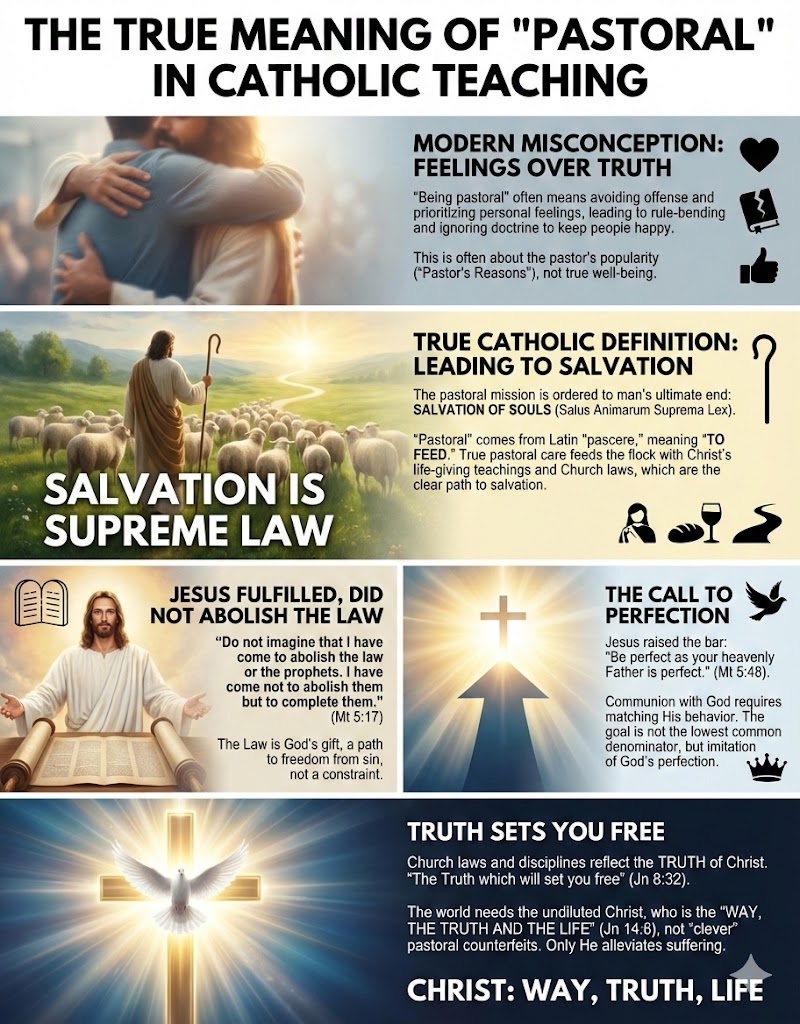
I’ve often heard this argument dragged out of the closet to justify any departure from Church laws or teachings, “We have to be pastoral.” By being “pastoral”, according to this antinomian reasoning, is to have the well-being of people as the paramount consideration. ‘What exactly can be considered the “well-being of people?” you may ask. Well, in today’s age, this has often been distilled into people’s personal feelings. So ultimately in this context, being pastoral means not offending anyone or making them feel rejected or unwelcomed. Being pastoral seems to make that it is alright to break every rule, disobey every instruction, or even ignore every doctrinal truth, as long as this keeps people happy.
But this attempt to pit pastoral practice against doctrine and church laws flies against Catholic teaching and Scripture itself. The division between theory and practice of faith is a false dichotomy, because it would mean a division in the mystery of the eternal Word of the Father, who became flesh. Fr Dominic nails it on the head when he tells me that whenever “pastoral reasons” are cited to justify an action, it is actually “pastor’s reasons.” The goal of bending the rules and ignoring doctrinal truths has little to do with the well-being of the people. Often, it betrays the pastor’s own insecurities of losing popularity with his people….

Permission granted for non-profits to use in ministry
The infographic was created using Nano Banana, Google's Revolutionary AI Image Generator. Infographic may not be sold or used for personal financial gain. Please show your appreciation by letting others know about TheWordThisWeek.NET.
6th Sunday of Year A
Love is Demanding
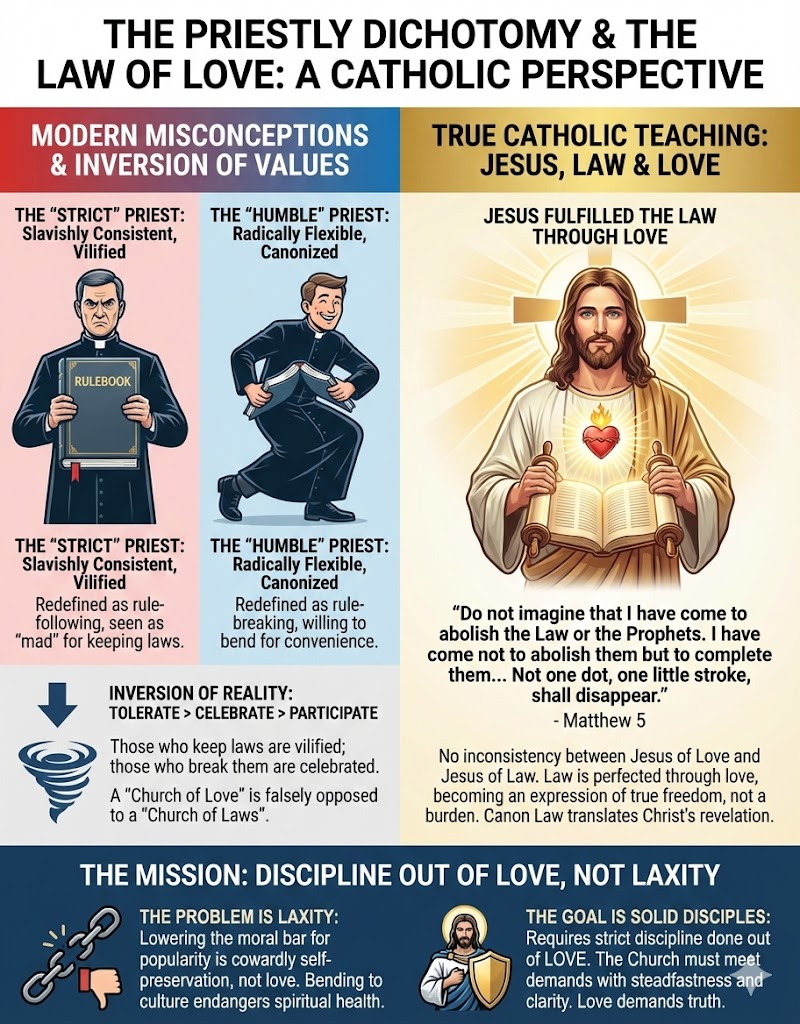
Recently, I was just reflecting over two broad categories which we priests are often lumped into. Some priests are labelled as “strict”, while others are known as “humble.” You may find this dichotomy strange because the opposite of strictness is not humility, they are not antonyms by any measure, but it would appear that these are the only two categories we priests are associated with – it’s either one or the other. As I tried to wrap my head around these concepts, it occurred to me that both strictness and humility have been redefined beyond their traditional and conventional meanings. A strict priest is one who follows the rules and is slavishly consistent with regards to his policies, whereas the humble priest is radically flexible, and is ever willing to bend or break the rules when it is convenient to do so.
More than 1700 years ago St. Anthony the Great, whose feast we celebrated last month, envisioned a day “when men will go mad, and when they see someone who is not mad, they will attack him saying, ‘You are mad, you are not like us.’” That day has arrived. There has been a tectonic shift that has upended how we view reality. It may have started with tiny indiscernible tremors but with hardly any resistance, this has morphed into full blown inversion of values. First you are made to tolerate the abnormal or the immoral, then you are asked to celebrate, and finally, you are forced to participate. Refusal to do so would result in the modern equivalent of excommunication – “cancellation.” In this almost alternate multi-verse-like reality, those who break the laws are canonised while those who keep the laws are vilified.
The Catholic Church, unfortunately, has not been spared. In The First Apology, Justin Martyr taught, “Let those who are not found living as He taught, be understood to be no Christians, even though they profess with the lip the precepts of Christ.” This has been the consistent teaching of the Church for centuries. Yet, today, the “view” of St Justin Martyr would be considered “strict,” “rigid”, overly restrictive and even un-Christian, where cohabitation, sodomy and abortion have become normalised. All of this suggests that the Church has been influenced more by the culture than has the culture by the Church.
Permission granted for non-profits to use in ministry
The infographic was created using Nano Banana, Google's Revolutionary AI Image Generator. Infographic may not be sold or used for personal financial gain. Please show your appreciation by letting others know about TheWordThisWeek.NET.
6th Sunday of Year A
Obedience Brings True Wisdom, Greater Freedom and Happiness
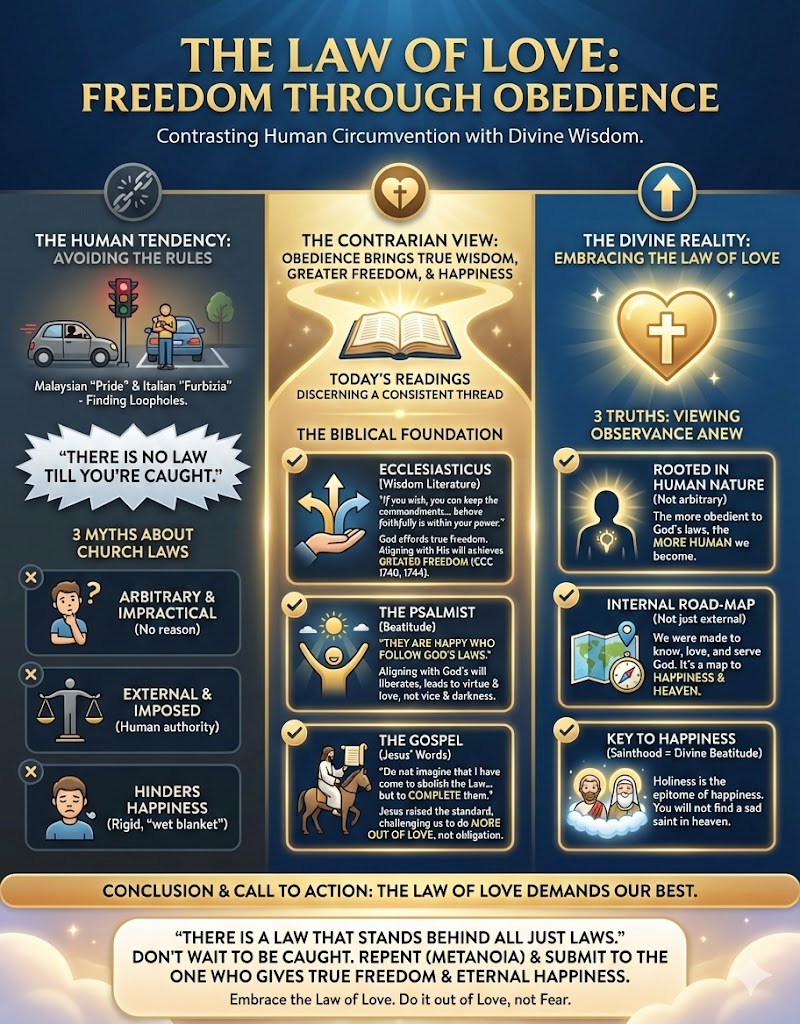
One of the things which Malaysians pride themselves in is being able to get around bureaucracy and inconvenient laws. From evading taxes, beating traffic red lights to double parking along roads, Malaysians are adept at finding loopholes to beat the system. The Italians have a word for it – “furbizia.” I’ve come up with my own phrase that best describes it: “there is no law till you’re caught.”
Unfortunately, many Christians also believe likewise in terms of Church laws. Three myths seem to justify either outright disobedience or mere flexibility in the application of the law.
First, these laws are just arbitrary laws, they have no basis in reason nor are they practical.
Second, these laws are primarily external and imposed by human authority.
Finally, these laws would keep us from doing what would make us happy. People who obey laws are rigid, dowdy and wet blankets.
But today’s readings provide us with a contrarian view. From the first reading to the gospel, we can discern a consistent thread that reminds us that obedience to the Law brings with it true wisdom, greater freedom and happiness.

Dominican Blackfriars
Permission granted for non-profits to use in ministry
The infographic was created using Nano Banana, Google's Revolutionary AI Image Generator. Infographic may not be sold or used for personal financial gain. Please show your appreciation by letting others know about TheWordThisWeek.NET.
6th Sunday of Year A
Meer is in U!
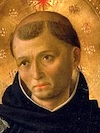
Sixth Sunday of Ordinary Time (A) | Fr Robert Eccles teases out the meaning of the Sermon on the Mount, and he considers the charge that it is impractical or unrealistic.
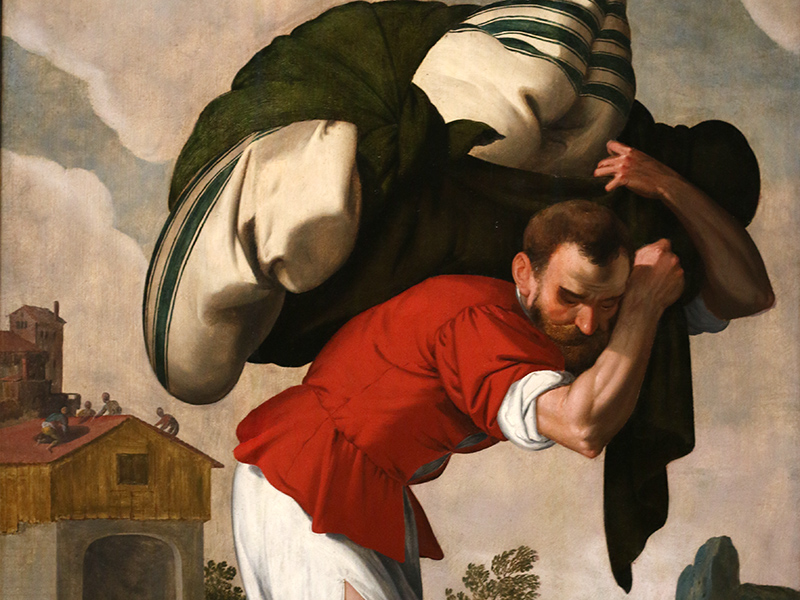
In the Sermon on the Mount, Jesus insists that we can do more than the ordinary. We used to be told that “thou shalt not kill” was quite strict enough. No, because not to kill people is really not enough, it does not give them life. If I have resentment in my heart for Mary Ann, if I think she is a blockhead to get that tattoo, say, I may succeed in being reasonably decent and polite to her, I shall not give her life. If I am at Mass with the family and suddenly realise there’s a debt of love and honour to pay, I never sent flowers or paid the baby sitter or remembered Mum’s birthday, of course I must skip the collection and dash outside and make that phone call. Go and be reconciled and then come back to offer my gift at the altar.
The Lord always says, do a bit more, be bigger than you thought you were. Those people he was talking to had to put up with an occupying army everywhere. A Roman soldier assumed the right to make you hump his heavy pack for a mile. That was a backbreaking imposition. Now suppose you insisted on going the extra mile? – that would take the wind out of his sails!
A squaddie might well bash you in the face. Suppose you stuck out your face to ask for more of the same? The first time he did it brutally, without thinking. But only once because this time he’s got to look at you and do it in cold blood, deliberately, to another human being with a mind of his own; a personality, then. Your non-violence has opened for him a way to act like a decent human being himself. This action says, Christ has won the victory over the way of violence, can’t you see?…
Permission granted for non-profits to use in ministry
The infographic was created using Nano Banana, Google's Revolutionary AI Image Generator. Infographic may not be sold or used for personal financial gain. Please show your appreciation by letting others know about TheWordThisWeek.NET.
6th Sunday of Year A
The Spirit of Wisdom
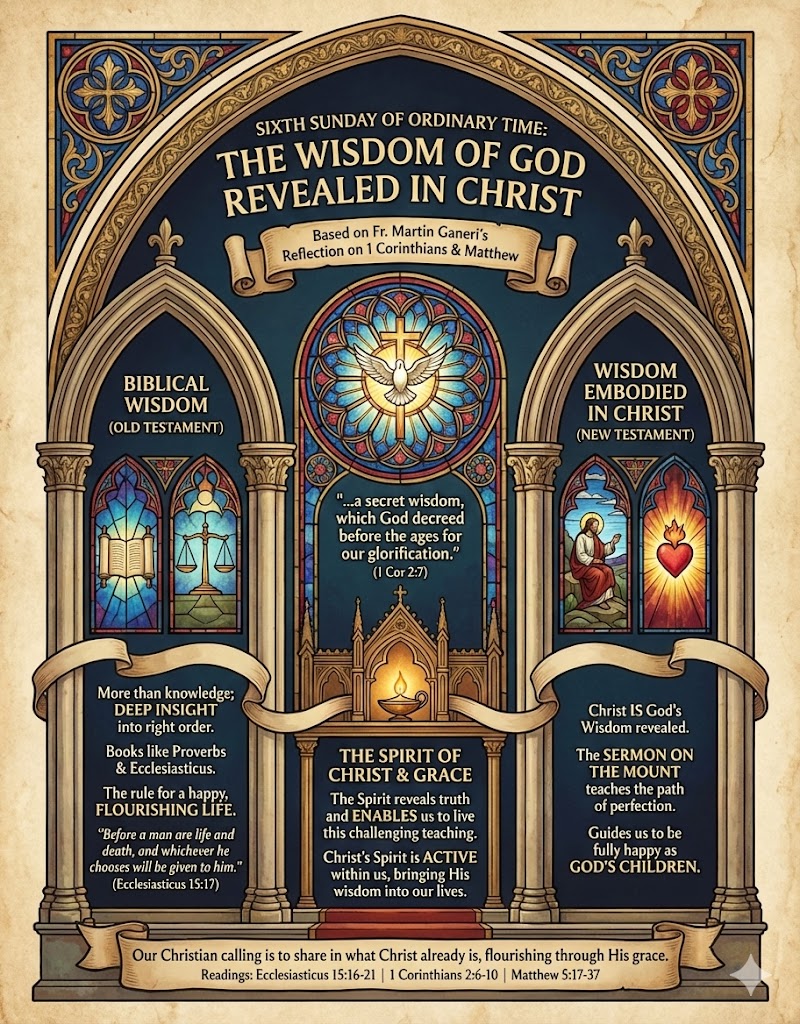
Sixth Sunday of Ordinary Time. Fr Martin Ganeri relates the Wisdom of God to the teachings of Christ.
In the second reading for this Sunday, taken from the first letter to the Corinthians, St Paul speaks of the wisdom of God that has been revealed to us. And he speaks of this wisdom as something that will bring about our glory, a glory that God has predestined for us. What does he mean by this?
When we think about wisdom in our ordinary life we think about a kind of knowledge. Not just a knowledge of facts, not just a knowledge of many things. Someone can be very knowledgeable about many different subjects, but we do not necessarily call that person wise. No, when we say someone is wise, we mean that someone has a deeper insight into something, a knowledge into the way things really are, an important type of knowledge.
And, when St Paul speaks of the wisdom that has been revealed to us and which will bring about our glory, he certainly has this deeper kind of insight in mind. But he also has in mind the way wisdom is spoken about in the Bible.
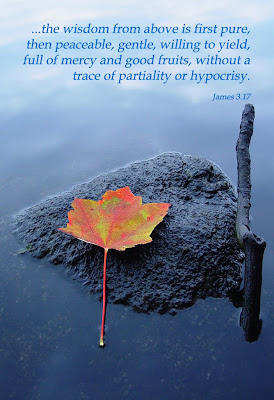
In the Bible there are a number of books of wisdom: the books of Proverbs, Job, Ecclesiastes and also the book of Ecclesiasticus, from which the first reading for this Sunday is taken. In these books wisdom is depicted as a kind of right order that is to be found in the world as created by God, a right order in nature and a right order in human life. Wisdom is the rule for a successful and happy life that God has revealed to human beings, revealed in the natural world, revealed to human minds, as they search out how to live and how to live well as God wants them to do so.
The wisdom taught by the Bible is, then, a kind of deep insight into the way things are, a deep insight that serves as a rule, a guide, for knowing how to live well, to be successful and to flourish as human beings, to be happy and fulfilled, to live as God wants us to live. And God wants us to flourish and to be happy as human beings.

Permission granted for non-profits to use in ministry
The infographic was created using Nano Banana, Google's Revolutionary AI Image Generator. Infographic may not be sold or used for personal financial gain. Please show your appreciation by letting others know about TheWordThisWeek.NET.
6th Sunday of Year A
Nothing is Impossible with God
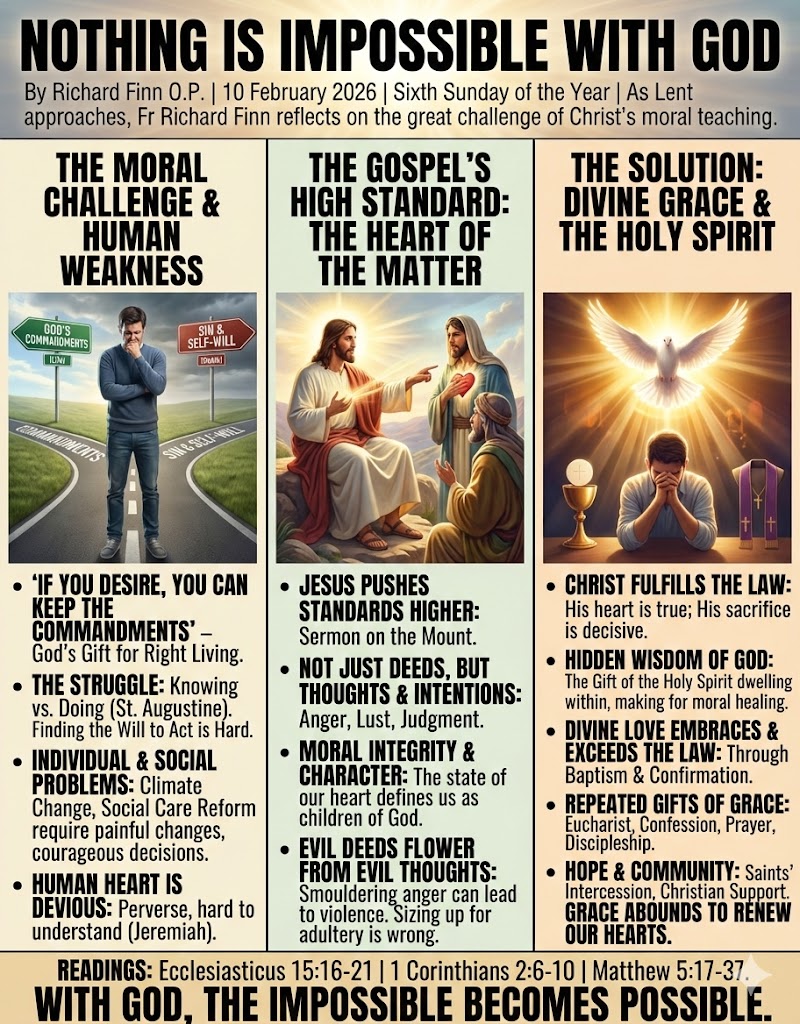
Sixth Sunday of the Year. As Lent approaches, Fr Richard Finn reflects on the great challenge of Christ’s moral teaching.
‘If you desire’, if you wish, ‘you can keep the commandments’. Put like that, it seems so simple. God has gifted Israel with the commandments, to guide and sharpen their understanding of right and wrong, and to make their right living an act of fidelity to God, to make the moral life a continual act of worship.
‘If you wish’ – but do we? As St Augustine famously portrays the matter in his Confessions, it’s one thing to know what we should do, it’s another to bring ourselves to do it. It’s a problem for individuals; it’s also a serious social and political problem, finding the shared conviction and momentum to take courageous decisions for the common good against powerful vested interests. You know the issues – from responses to climate change to the reform of social care. Finding the will to act is all too hard, not least because it requires more than sheer will-power. It often means painful changes, difficult decisions and adjustments, real losses for other gains.
Who could deny the extent of the challenge? And that’s before we get to today’s Gospel, and the Sermon on the Mount. Jesus seemingly pushes the moral standards yet higher. Does He ask too much of weak flesh and blood? It can sound as though God is poised, ready to cast us into hell, for so much as a cross word, one lustful thought, a momentary expletive. To hell with the lot of us! For there’s no shortage of attractive people or sometimes quarrelsome brothers!
Fr. Austin Fleming
Permission granted for non-profits to use in ministry
The infographic was created using Nano Banana, Google's Revolutionary AI Image Generator. Infographic may not be sold or used for personal financial gain. Please show your appreciation by letting others know about TheWordThisWeek.NET.
6th Sunday of Year A
Making Wise Choices
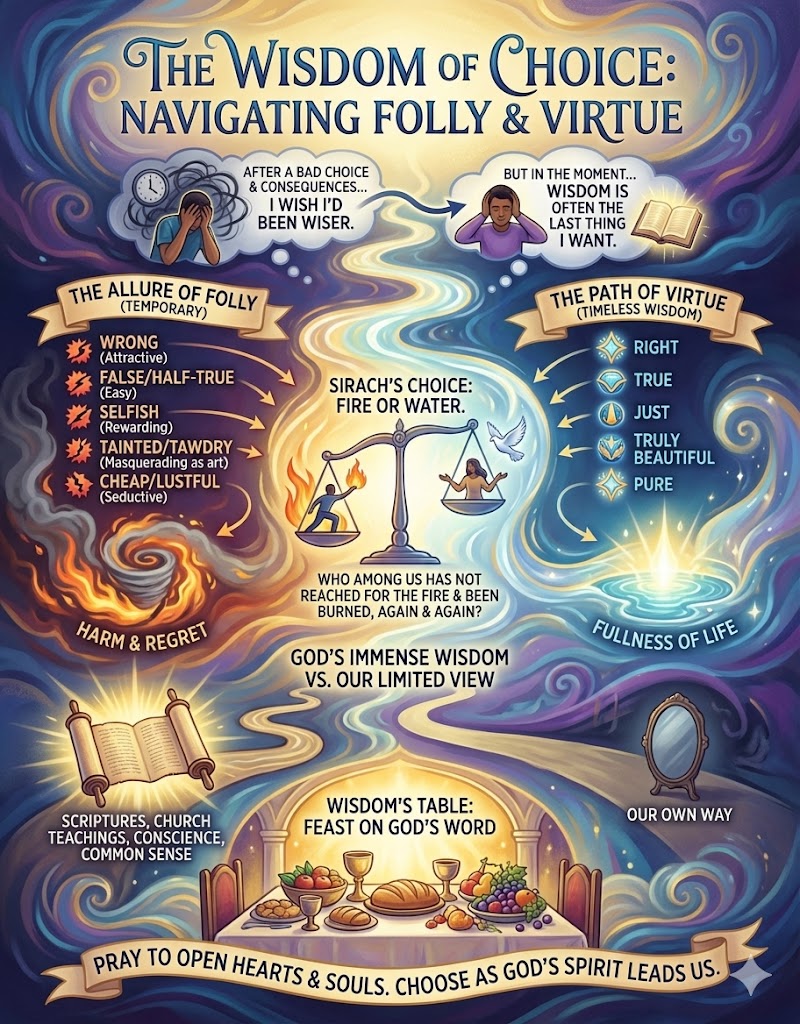
After I realize I’ve made a bad choice and I’m suffering the consequences of it, it’s not unusual for me to wish I had been a little bit wiser.
On the other hand, it seems that while I’m making a choice wisdom is sometimes the last thing I want – or look for – or depend on, especially if I suspect that wisdom will lead me to a choice contrary to the one I want or I’m inclined to make on my own.
Making choices… We live in times when individual, independent choice is exalted – as if choosing, in and of itself, were a virtue. But virtue doesn’t lie in the choice itself.
Monsignor Peter Hahn
Permission granted for non-profits to use in ministry
The infographic was created using Nano Banana, Google's Revolutionary AI Image Generator. Infographic may not be sold or used for personal financial gain. Please show your appreciation by letting others know about TheWordThisWeek.NET.

6th Sunday of Year A
What Am I Supposed to do?
2020 HOMILY – No homily available in the archive delivered by Msg. Hahn.
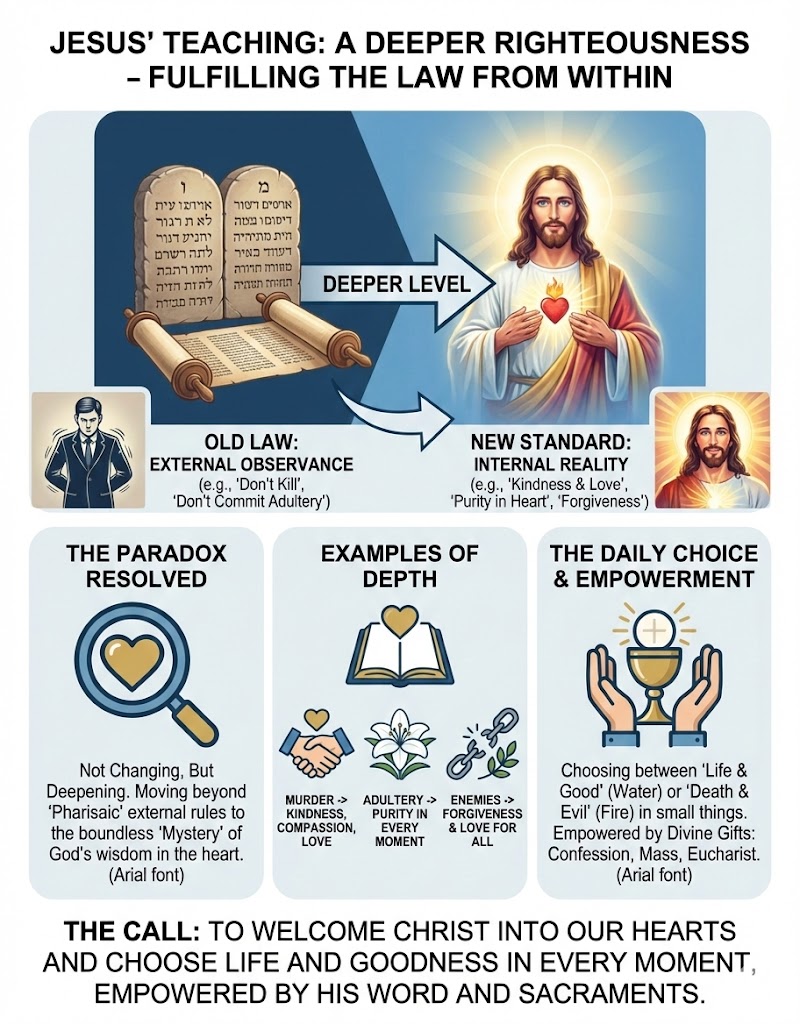
Fr. Logue’s homily addresses the apparent contradiction where Jesus claims He came to fulfill the law, not abolish it, yet introduces teachings with “but I say to you” that seem to alter it. Fr. Logue explains that Christ isn’t changing the law but deepening it, moving it from mere external observance to an internal reality of the heart. While human wisdom understands basic rules like “don’t kill,” divine wisdom requires infinite depth.
Jesus, possessing authority as the Word made flesh, calls followers to a higher standard: not just avoiding murder, but actively showing kindness; not just avoiding adultery, but maintaining internal purity. This challenge is difficult because the world dismisses the significance of small moral choices. However, Fr. Logue warns that these seemingly minor choices between “life and death” eventually harden our hearts. He concludes that we cannot achieve this deeper righteousness alone; we need the divine gifts received through confession and the Eucharist to empower us to choose goodness in every moment.
Fr. Charles E. Irvin
6th Sunday of Year A
When Rules Are Not Enough: Jesus’ Call to Deeper Love

Jesus is looking for something far deeper than legal observances. He wants us to be motivated by love, to live loving lives, to care and to unselfishly give of ourselves to others and to our Father in heaven. This is a way of living that no law can motivate or impose on us. This way of living puts greater demands on us.
Suppose we lived in a society where everyone strictly observed all of its laws. Everyone would behave well, but would such a world be filled with happiness? Jesus wants more from us. Living in strict observance of laws would be good, but would we be living in a world of love? Would it be a loving and caring world, or would it be simply a world in which nobody broke any laws? Jesus wants the best from us, not just our minimum performances.
God gave us a tremendous gift, the gift of freely choosing. This is because love isn’t truly love unless it is freely given – and freely received. After all, a gift isn’t a gift unless and until it is received. God has paid us a tremendous compliment in that He respects our decisions. That is why He never forces our decisions. He offers and then He waits for our response. His love for us is unconditional. His only law is love, a love within us that governs our choices and the actions that flow from our choices.
This is not something new. It is found in God’s Word given to us many centuries before Christ and is expressed in the first reading of today’s Mass, a reading taken from the Old Testament’s Book of Wisdom: If you choose you can keep the commandments; it is loyalty to do his will. There are set before you fire and water; to whichever you choose, stretch forth your hand. Before man are life and death, whichever he chooses shall be given him. Immense is the wisdom of the Lord; he is mighty in power, and all-seeing. The eyes of God see all he has made; he understands man’s every deed.
We all know full well what we do or do or don’t do. And we all know what others do or don’t do. God, however, is more interested in what He finds in our hearts. Do we simply obey rules, or do we choose to live in love and concern for others? That’s a question the answer to which can only be found deep down in your heart – where you really live.

Fr. Langeh, CMF

6th Sunday of Year A
Observance of the Law with Love

Jesus begins the Gospel on a very hard note: “if your virtue goes no deeper than that of the Scribes and Pharisees, you will never get into the kingdom of heaven. The question thus is How can our virtue go deeper than that of the Scribes and the Pharisees? This is found in the observance of the Law. In effect, we all know of the Ten Commandments. However, some look upon the Ten Commandments as ghostly whispers of a dead age; some dislike them, others hate them. Yet it is for the benefit of man that God made the Laws. People have been so eager since its inception to live the ten commandments to the latter.
Ecclesiastes in the first reading makes us understand that halfhearted observance of the law is not Good enough. We have the freedom to choose between life and death, to put our hands in fire or in water. Despite this freedom, God notes all our actions and never permits us to sin. If we want to be happy therefore we must follow God’s commandment. In the Responsorial Psalm from Psalm 118, the psalmist shows the happiness of those who make efforts to keep the law. He says clearly “they are happy who follow God’s law”. Keeping the law to the later meant having a life of virtue or righteousness. This means having love at the basis of the law.
Deacon Peter McCulloch
Permission granted for non-profits to use in ministry
The infographic was created using Nano Banana, Google's Revolutionary AI Image Generator. Infographic may not be sold or used for personal financial gain. Please show your appreciation by letting others know about TheWordThisWeek.NET.
6th Sunday of Year A
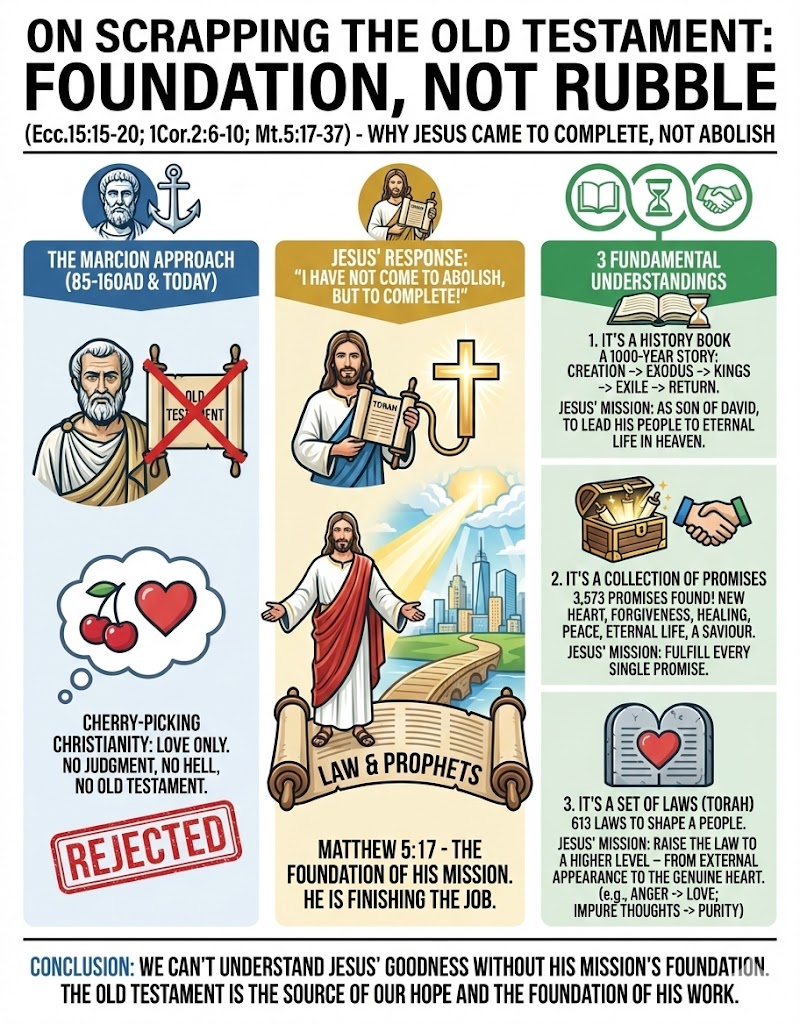
On Scrapping the Old Testament
Matthew’s Gospel presents Jesus as the new Moses delivering the new divine law: The Beatitudes. Jesus didn’t scrap the old law – he raised it to a higher level. He said it’s not enough to be seen to do the right thing; we must be genuine about it. We must use our hearts as well as our heads.
And Jesus gives us some examples. He says it’s not enough to avoid murder. Rather, we must convert our anger and our resentment into love. And it’s not enough to merely avoid adultery. Instead, we must avoid any impure and sinful thoughts. And when we make any promises, we must be genuine about them…
Jesus didn’t come to scrap the Old Testament. He couldn’t, because it’s the very foundation of his work and it’s the source of our hope. The Old Testament, then, is a history book, and Jesus’ mission is to complete this story by leading us all to heaven. It’s also a collection of promises, and Jesus’ mission is to fulfil them all for us. And it’s a set of laws, and Jesus’ mission is to complete the Law by teaching us all to use our hearts as well as our heads.
Here’s the point: we really can’t understand the goodness and love of Jesus Christ if we ignore the very foundation of his mission – the Old Testament.
Permission granted for non-profits to use in ministry
The infographic was created using Nano Banana, Google's Revolutionary AI Image Generator. Infographic may not be sold or used for personal financial gain. Please show your appreciation by letting others know about TheWordThisWeek.NET.
6th Sunday of Year A
A Gift for Valentine’s Day
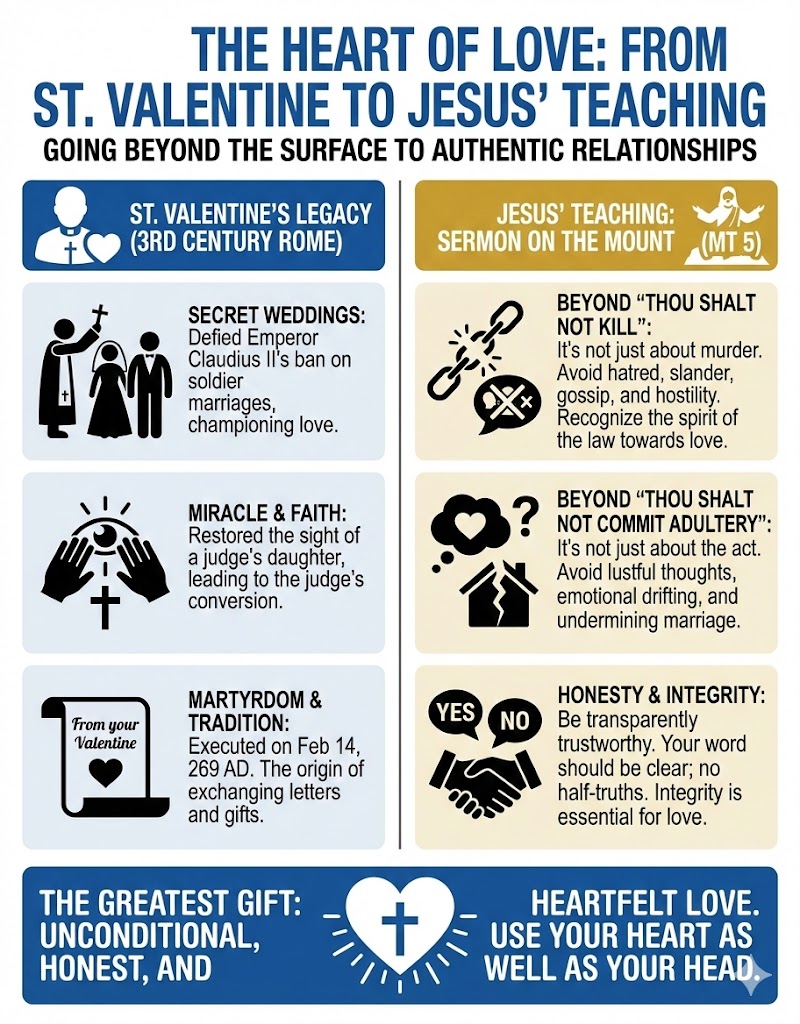
All around the world on 14 February, millions of couples will be celebrating their passion, friendship and love.
Not much is known about St Valentine, but it’s said that he was a Catholic priest who lived in 3rd Century Rome, during the Christian persecution. At one point, Emperor Claudius II insisted that his soldiers’ first love should be Rome itself, so he made it illegal for them to marry.
Valentine responded by conducting secret weddings, but he was caught and gaoled. A judge then offered to release him if he restored his blind daughter’s vision. Valentine placed his hands on her eyes and her sight was restored. The judge was delighted and did release him, and even became a Christian himself.
But the persecution continued, and Claudius had Valentine executed on 14 February, in 269 AD. Legend tells us that just before he died, he wrote to that girl, signing his letter ‘from your Valentine’.
Now on every Valentine’s Day, millions of couples celebrate their friendship and love by exchanging letters, poems and gifts. This wonderful tradition highlights for us just how important love is to us all. Indeed, Martin Luther King once described love as the greatest force in the universe.
Permission granted for non-profits to use in ministry
The infographic was created using Nano Banana, Google's Revolutionary AI Image Generator. Infographic may not be sold or used for personal financial gain. Please show your appreciation by letting others know about TheWordThisWeek.NET.
6th Sunday of Year A
Beyond the Bare Minimum
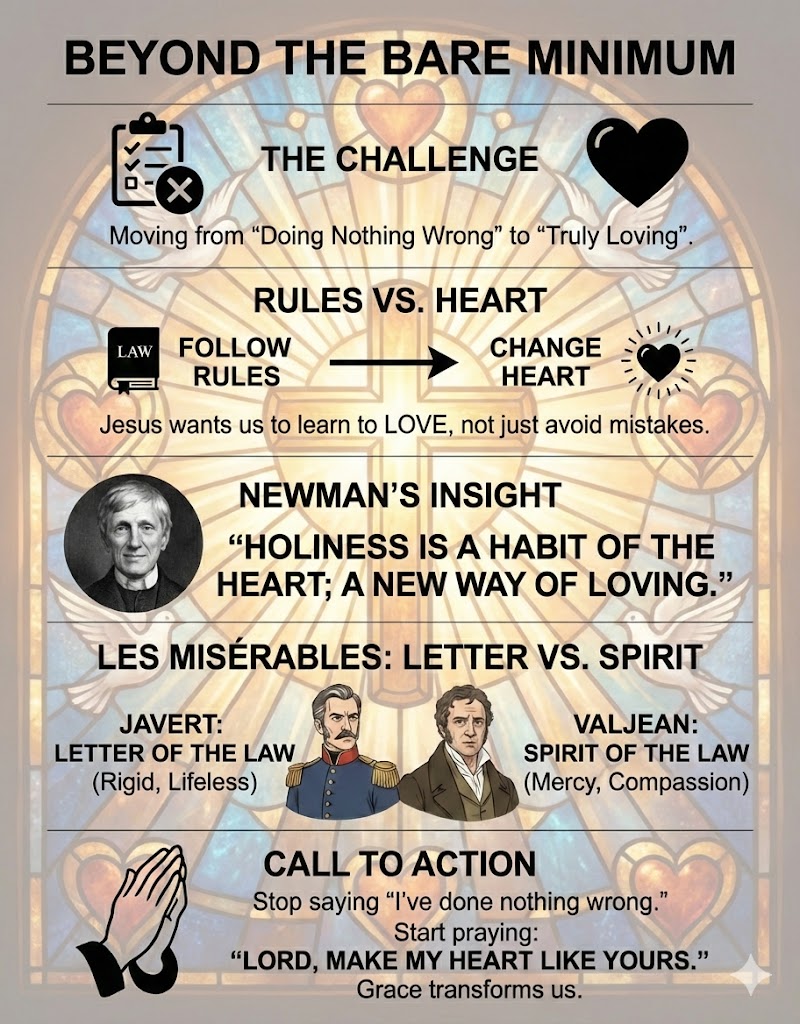
I expect we all know someone who likes to say, ‘Well, I haven’t done anything wrong.’
It’s a familiar attitude, as if the whole point of Christian living were simply to avoid the major sins and to stay out of trouble.
In today’s Gospel, Jesus challenges this thinking. He invites us to go beyond the bare minimum, beyond a faith that is defined by ‘not hurting anyone,’ towards a life that centres on the heart.
A heart that truly loves, and not just hands that stay clean.
‘You have heard it said… but I say to you…’ Jesus says. Not just ‘don’t murder,’ but be reconciled. Not just ‘don’t commit adultery,’ but let your heart be pure. Not just ‘don’t swear false oaths,’ but let your whole life be truthful.
Jesus isn’t interested in whether we have ‘done nothing wrong.’ He wants to know whether we have truly learnt how to love.
Fr. Carmen Mele, O.P.
Permission granted for non-profits to use in ministry
The infographic was created using Nano Banana, Google's Revolutionary AI Image Generator. Infographic may not be sold or used for personal financial gain. Please show your appreciation by letting others know about TheWordThisWeek.NET.
6th Sunday of Year A
The Divine Lawgiver
In today’s gospel Matthew presents Jesus as the divine lawgiver. For Jews this point of view is worse than an outrage. It’s blasphemy. There is only one God, and his law is eternal. However, Matthew does not back out of his position. He quotes Jesus as saying that if one transgresses one iota of the law from him, he will be little in the Kingdom. It is worth taking this gospel to heart so that we can have a place close to him in the Kingdom.
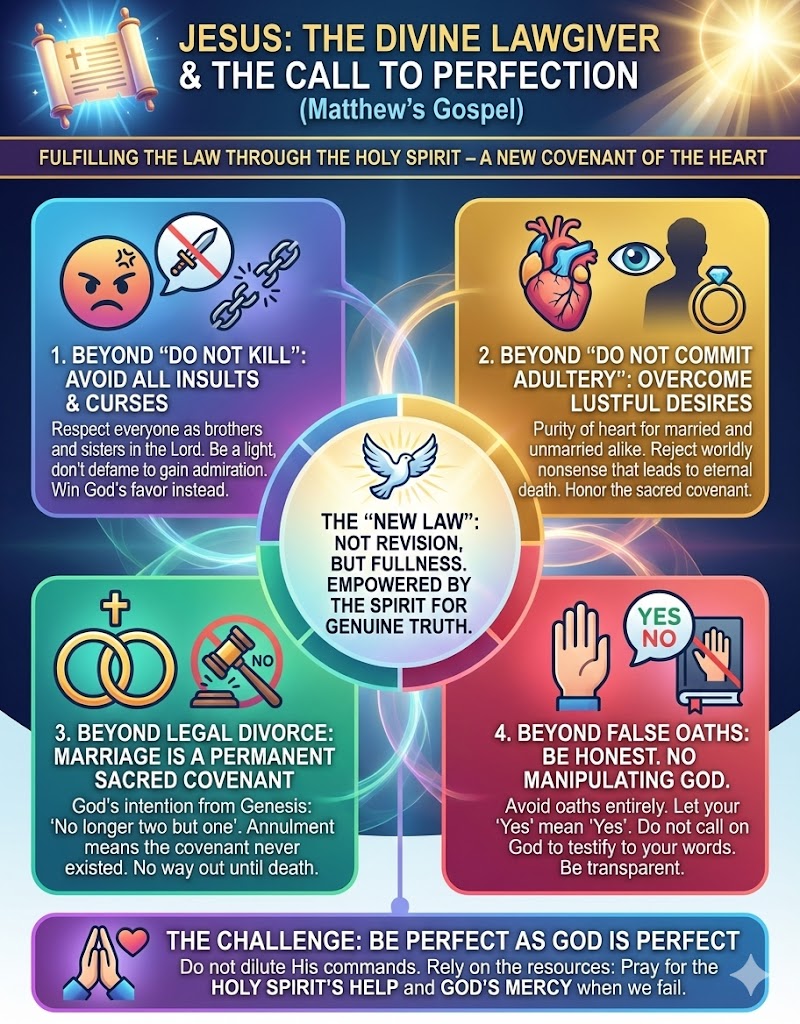
Although he is a legislator, Jesus does not try to revision the law. It will be a “new law” not because of many additions but because of the Holy Spirit who will accompany those who practice it. His purpose is to bring the law to its fullness by eliminating the possibilities of fulfilling it halfway. No more white lies will be allowed. According to Jesus, we are going to tell the truth or we are going to say nothing at all. He presents six intensifications of the law that will distinguish the true heirs of the Kingdom from those whose only concern is to be seen as “good.”
First, according to Jesus it is not enough that we do not kill anyone. To be a son or daughter of God we must avoid all forms of insults and curses against members of the community. Because we are brothers and sisters in the Lord, everyone deserves our respect. So, are we allowed to defame people outside of the faith community? Of course not, because we are still “light of the world” called to attract other people to Christ. Many times we want to make jokes that put people down to gain the admiration of others. Jesus would tell us that it is infinitely more profitable to win God’s favor.
Msgr. Joseph Pellegrino
6th Sunday of Year A
Being Fully Alive

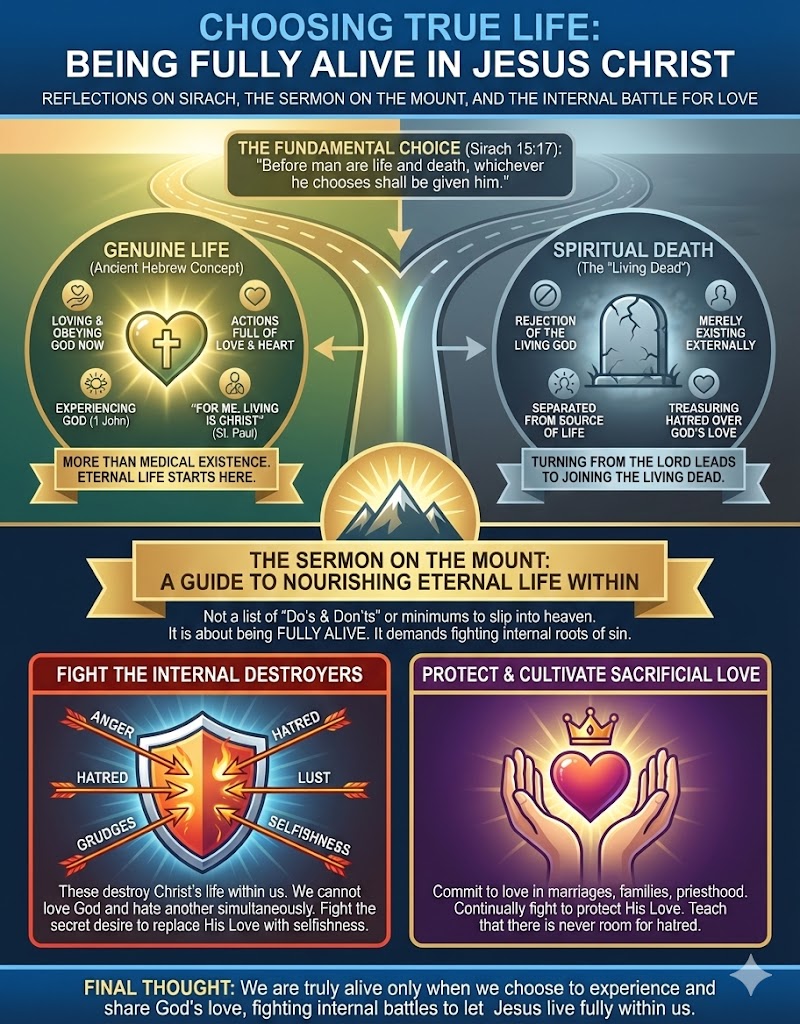
You and I are not genuinely alive because we are not medically dead. We are genuinely alive when our actions are full of love and understanding and intelligence and heart. To be genuinely alive, we must experience God. It is not enough to know about God. We must know Him, experience Him. We can only know Him and experience Him through love. The First Letter of John states, “Whoever does not love, does not know God.” We shall only be admitted into the eternal presence of God if we love Him above all else and if we love the human images of God at least as much as we love ourselves. When we consider all things through the Love of Christ, we are alive in Christ. St. Paul puts it this way, “For me, living is Christ.” Then, as Paul says in Romans 8, nothing in creation can separate us from the Love of Christ, not even physical death. For, as we heard in today’s second reading, ‘The eye has not seen, the ear has not heard, nor has it so much as dawned on man what God has prepared for those who love him.’ Yet God has revealed this wisdom to us through the Spirit. The Spirit scrutinizes all matters, even the deep things of God.”
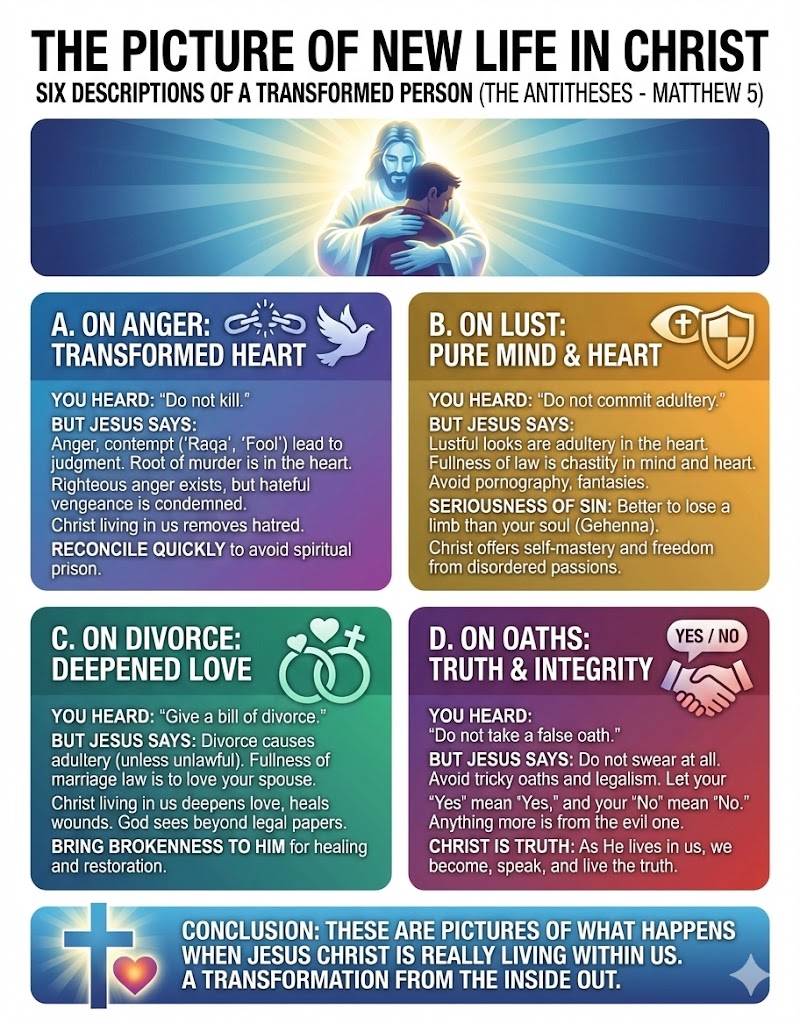
Perhaps all this helps us understand the Gospel for this Sunday. The Sermon on the Mount is not about do’s and don’ts. It is not about lim itations: how little must I do to slip by St. Peter at the gates of heaven. The Sermon on the Mount is about being fully alive in Jesus Christ. It is about nourishing the eternal life within us..
Msgr. Charles Pope
Permission granted for non-profits to use in ministry
The infographic was created using Nano Banana, Google's Revolutionary AI Image Generator. Infographic may not be sold or used for personal financial gain. Please show your appreciation by letting others know about TheWordThisWeek.NET.
6th Sunday of Year A
A Slide Show of Sanctity
The Gospel for Sunday’s Mass is from the Sermon on the Mount (Matthew 5-7), specifically 5:17-37. In a way the Lord is drawing a picture for us of the transformed human person. He is presenting a kind of slide show of what sanctity really is. In understanding this rather lengthy text we do well to reflect on it in three parts.
I. The Power of New Life in Christ
II. The Principle of New Life in Christ
III. The Picture of New Life in Christ
Father Kevin Rettig
Permission granted for non-profits to use in ministry
The infographic was created using Nano Banana, Google's Revolutionary AI Image Generator. Infographic may not be sold or used for personal financial gain. Please show your appreciation by letting others know about TheWordThisWeek.NET.

6th Sunday of Year A
Freeing the Birds
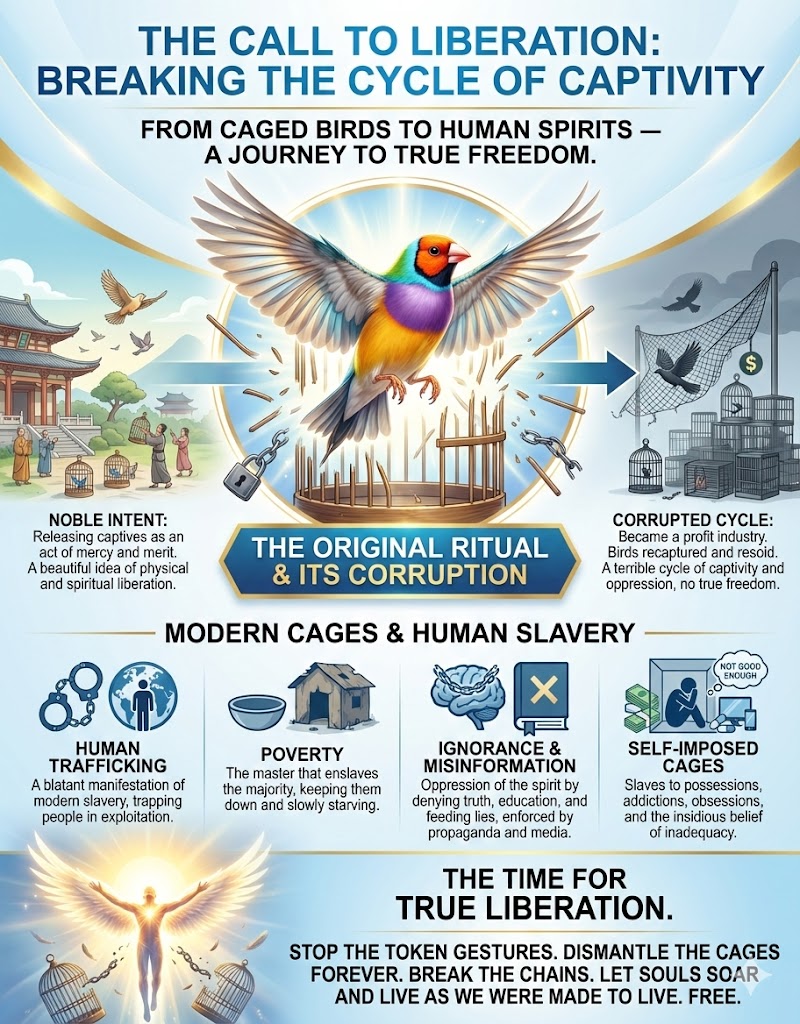
Fr. Kevin uses the example of releasing caged birds as a metaphor for liberation, initially finding the practice noble. However, he realizes it has become corrupted; the birds are trapped in a cycle of capture and release for the sake of profit and a fleeting sense of goodness. This corrupted ritual mirrors how good laws and customs, originally intended to liberate, can become oppressive over time. Jesus came to perfect the old law, offering true liberation.
Fr. Kevin emphasizes that slavery takes many forms in today’s world: human trafficking, poverty, the isolation of migrants, and the oppression of ignorance through the denial of education and the spread of misinformation. He also highlights how people can be enslaved by fundamentalist beliefs and even by their own possessions, addictions, and self-doubt. Fr. Kevin concludes that it is time to break these cycles of captivity, not through token gestures, but by fundamentally dismantling the cages and allowing all people to live free as God intended.
Permission granted for non-profits to use in ministry
The infographic was created using Nano Banana, Google's Revolutionary AI Image Generator. Infographic may not be sold or used for personal financial gain. Please show your appreciation by letting others know about TheWordThisWeek.NET.

6th Sunday of Year A
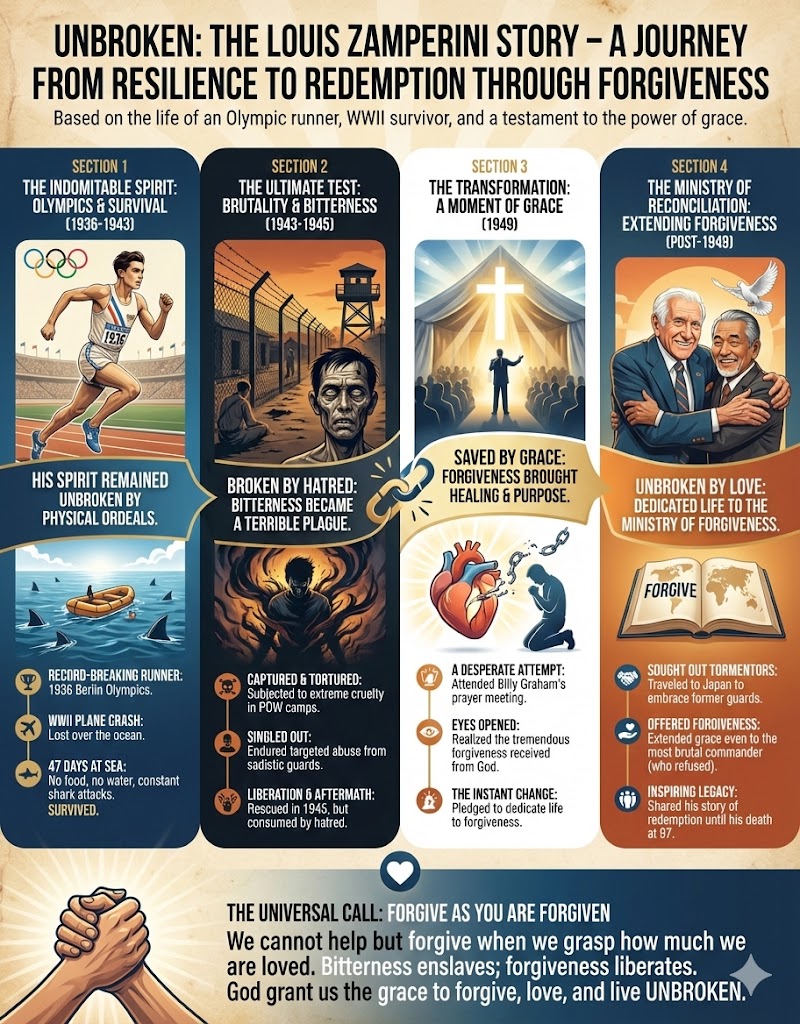
Unbroken
Fr. Kevin’s homily uses the extraordinary life of Louis Zamperini to illustrate the vital necessity of forgiveness. Zamperini, an Olympic runner, survived incredible hardship during WWII, including 47 days lost at sea and brutal torture in Japanese prisoner-of-war camps. Despite these physical ordeals, his spirit remained unbroken.
However, after the war, Zamperini faced a greater trial: he was consumed by hatred and bitterness toward his captors. This internal torment broke him in a way physical torture never could. His life changed profoundly during a prayer meeting where he realized the magnitude of God’s forgiveness for him, understanding that to save his own soul, he must also forgive.
Zamperini subsequently dedicated his life to the ministry of reconciliation, even returning to Japan to embrace his former tormentors. Fr. Kevin concludes that while we may not endure POW camps, we all face the enslaving “torture” of bitterness. To live truly “unbroken,” we must grasp how deeply we are loved by God and extend that same forgiveness to others.

6th Sunday of Year A
The Sin of Not Noticing
Fr. Ruttig’s homily explores sacrificial love through the Cross. It confronts our tendency to feel that God is distant in our pain and reveals the Cross as God’s defin
Fr. George Smiga
Permission granted for non-profits to use in ministry
The infographic was created using Nano Banana, Google's Revolutionary AI Image Generator. Infographic may not be sold or used for personal financial gain. Please show your appreciation by letting others know about TheWordThisWeek.NET.
6th Sunday of Year A
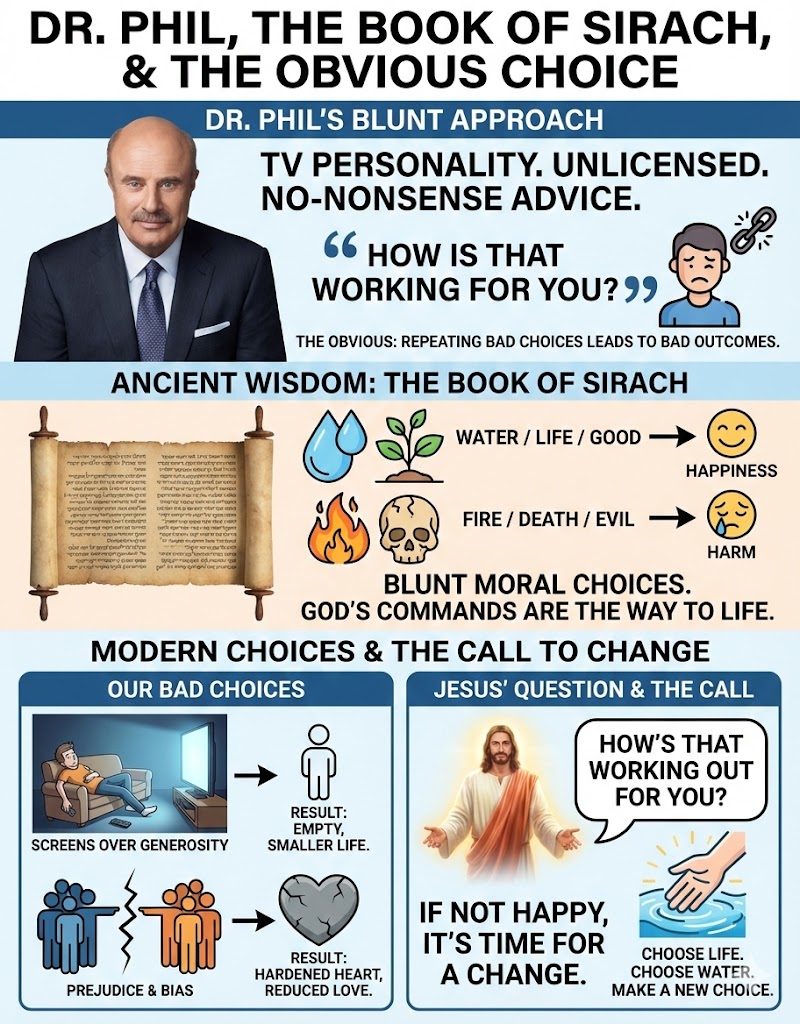
How’s That Working for You?

2020 HOMILY – Dr. Phil is an American TV personality. He does have a degree in psychology, but he is not licensed to practice in any of the fifty states. This does not stop Dr. Phil. He has made a fortune by giving advice to anyone who would listen. I think he is successful, because his approach is blunt and no nonsense. One of his favorite sayings questions a person’s judgment by asking “How is that working for you?” I saw an interview in which a woman confided in him that about twice a month her husband became drunk and would beat her up. Her plan was to become an even better and more docile wife, hoping he would stop drinking. Dr. Phil said, “How’s that working for you?” And, of course, it was not working at all. That is why she was talking to Dr. Phil. Dr. Phil’s approach is to state the obvious. What is obvious to us is that often we make bad choices and make them over and over again.
Today’s First Reading from the Book of Sirach would appreciate Dr. Phil’s method. It lays out our moral choices in a blunt, no nonsense way. It says our choices are good or evil, life or death, water or fire. We can choose any one. But if we choose evil, we should not be shocked to find we are unhappy. If we put our hand into the fire, we should not be surprised that it is burnt. Sirach is telling us that God’s commands are not an arbitrary set of rules to test our obedience. God’s commands are the way to life. If we follow them, we will be happy. If we choose something else, it will harm us….