Catholic Life, Homily Themes
Catholic Life, Homily Themes
February 8, 2026
February 8, 2026
5th Sunday of Year A

⬅️  ➡️
➡️
Videos / Infographics
Topics and themes related to this Sunday’s scripture readings.
5th Sunday of Year A
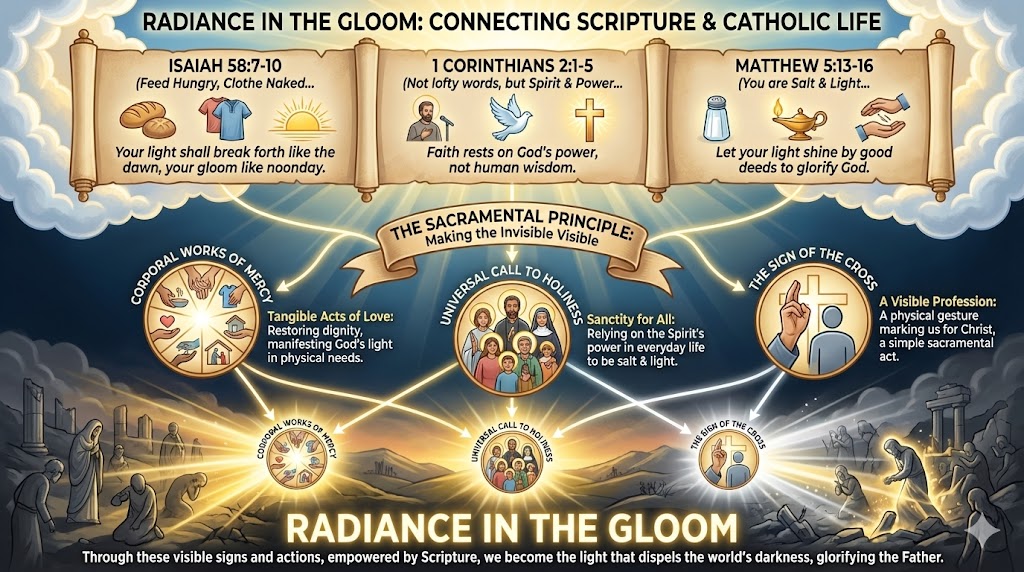
Radiance in the Gloom


LiveNOW from Shalom World (16:38) – The Catholic Church teaches that when we sin, our intellect is darkened; an unnatural desire arises for things that are not good. Our intellect is darkened to the extent that we don’t recognize the light anymore. Peter Van Kampen delivers his second reflection on the topic ‘Fearless’ in the 9 PM Talks series. Listen i
Evangelization
The readings provide a vivid contrast between darkness and light. Isaiah promises that our “gloom shall become like midday,” while the Gospel calls us the “light of the world.” This theme centers on Evangelization. The world is often depicted as a place of “darkness”—full of despair, confusion, and suffering. The Christian’s role is to be a beacon. This isn’t achieved through mere shouting, but through the “radiance” of a life lived in Christ. When we fulfill the demands of charity and the humility of the Cross, we naturally dispel the darkness of those around us. This “shining” is a magnetic force; it attracts people to the source of the light, which is God. It is an invitation to the world to see that a different, more beautiful way of living is possible.
Related Keywords: Light of the world homily, New Evangelization, Catholic witness in darkness, Isaiah 58:10 reflection.
5th Sunday of Year A
The Sacramental Principle


The Visual Nature of Faith
In Matthew’s Gospel, Jesus tells his disciples they are the “light of the world,” insisting that a city on a mountain cannot be hidden. This connects to the Sacramental Principle: the belief that invisible spiritual realities are made manifest through visible signs. Just as light must be seen to be useful, a Christian’s interior state must be evidenced by “good deeds.” Isaiah reinforces this by stating that when we feed the hungry, our “light shall break forth like the dawn.” Faith is not a private abstraction; it is a visible, public reality that points others toward the Father.
Related Keywords: Sacramental living, Christian witness, Matthew 5:14 reflection, Catholic mission.
5th Sunday of Year A
Corporal Works of Mercy


GOPHER CATHOLIC (6:00) – In this episode, Fr. Jake talks about ways to live out the corporal works of mercy in our life.
Social Justice
Isaiah 58 redefines what it means to be a “religious” person. God rejects empty ritualism, demanding instead a “fast” that consists of breaking the chains of injustice and sharing bread with the hungry. This theme connects directly to the Church’s teaching on Social Justice and the Corporal Works of Mercy. The readings suggest that our spiritual “light” is directly proportional to our charity. If we ignore the “homeless poor” or the “naked,” our light becomes dim and our salt loses its flavor. The connection here is “integral”—true holiness requires both a vertical relationship with God and a horizontal relationship with our neighbor. By removing “oppression” and “false accusation” from our midst, we fulfill the Law and the Prophets, proving that our faith is alive through our active, self-giving love.
Related Keywords: Catholic Social Teaching, Corporal Works of Mercy, Isaiah 58 commentary, Faith and Justice.
5th Sunday of Year A
The Sign of the Cross


CATHOLiC FAITH DIARIES (3:57) – The main objective behind this video is to give the real meaning behind our gestures and signs. And to let people know that, to do these signs meaningfully to honor God every time when you are making this sign. Further, there is no rigid way as this is the only correct way, you can make the sign of the cross as also which represents the 5 wounds of Our Lord.
Theology of Grace
In 1 Corinthians, St. Paul arrives in Corinth not with “sublimity of words” or intellectual “wisdom,” but in “weakness and fear.” This theme explores the Theology of Grace, emphasizing that the power of the Gospel does not depend on human charisma or sophisticated rhetoric, but on the “demonstration of Spirit and power.” Paul’s focus on “Jesus Christ, and him crucified” serves as the essential “flavor” of the Christian message. When we rely on our own talents, we risk “losing our taste” as salt. However, when we stand in our poverty and rely on God, the light we shine is clearly His, not our own. This humility ensures that the faith of the community rests on the power of God rather than human persuasion, allowing the light of Christ to shine through our cracks.
Related Keywords: Theology of the Cross, Grace vs Wisdom, Power in Weakness.
5th Sunday of Year A
Universal Call to Holiness
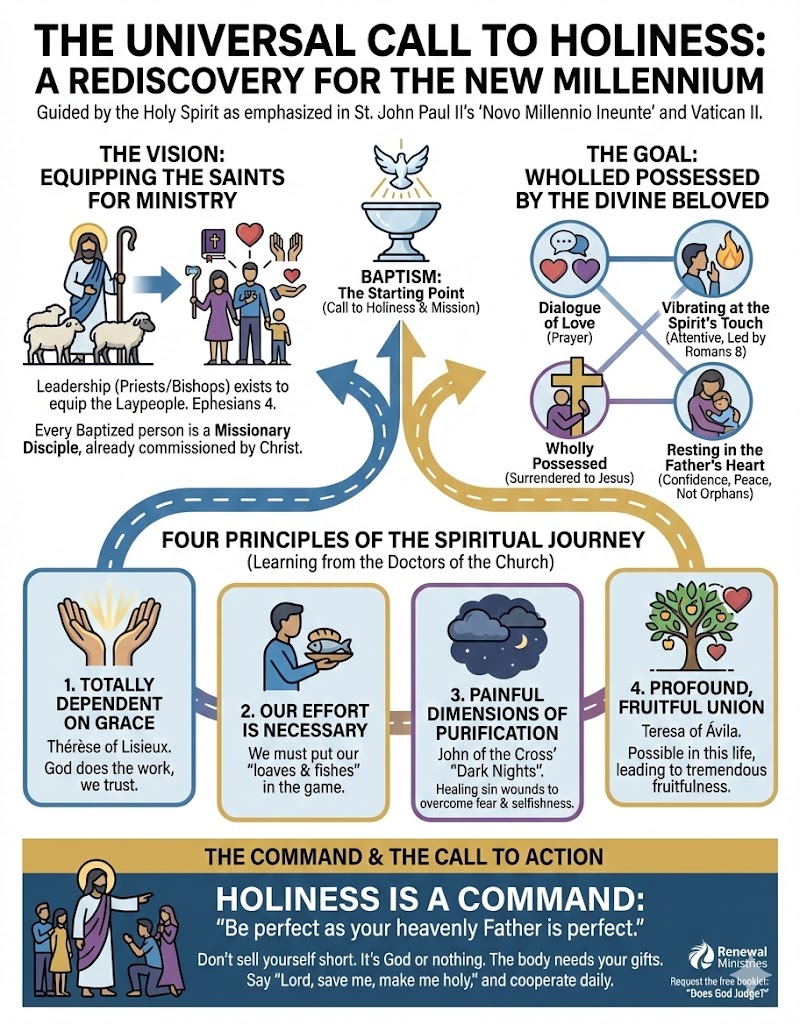
RENEWAL MINISTRIES (28:30) – Ralph Martin speaks at a 2024 priests’ retreat in Uganda about the universal call to holiness and how to progress on the spiritual journey. Renewal Ministries is dedicated to fostering renewal and evangelization in the Catholic Church by helping people know the personal love of God in Jesus and grow in holiness.
Christian Identity and Impact
Jesus uses the metaphor of Salt to describe the Christian’s role in a decaying world. In the ancient world, salt was essential for preserving food from corruption and enhancing its flavor. This theme relates to the Universal Call to Holiness, asserting that Christians are called to be the moral “preservative” of society. By living according to the Gospel, we prevent the “rot” of sin from consuming the world and bring out the “flavor” of God’s goodness in everyday life. However, Jesus warns that if salt loses its taste, it is good for nothing but to be “trampled underfoot.” This highlights the danger of secularization and lukewarmness; if a Christian becomes indistinguishable from the world, they lose their divine purpose. Our distinctiveness is what makes us useful to the Kingdom.
Related Keywords: Salt of the Earth meaning, Universal Call to Holiness, Matthew 5:13 exegesis, Lukewarm Christianity.
Infographics were created using Google Gemini 3 and Nano Banana Pro. Inspiration take from Fr. Tony’s Homilies; Non-profits may freely use this infographic in their publications and/or ministry. Please give credit or a shout out to TheWordThisWeek.NET.