Papal Homilies
February 8, 2026
February 8, 2026
5th Sunday of Year A



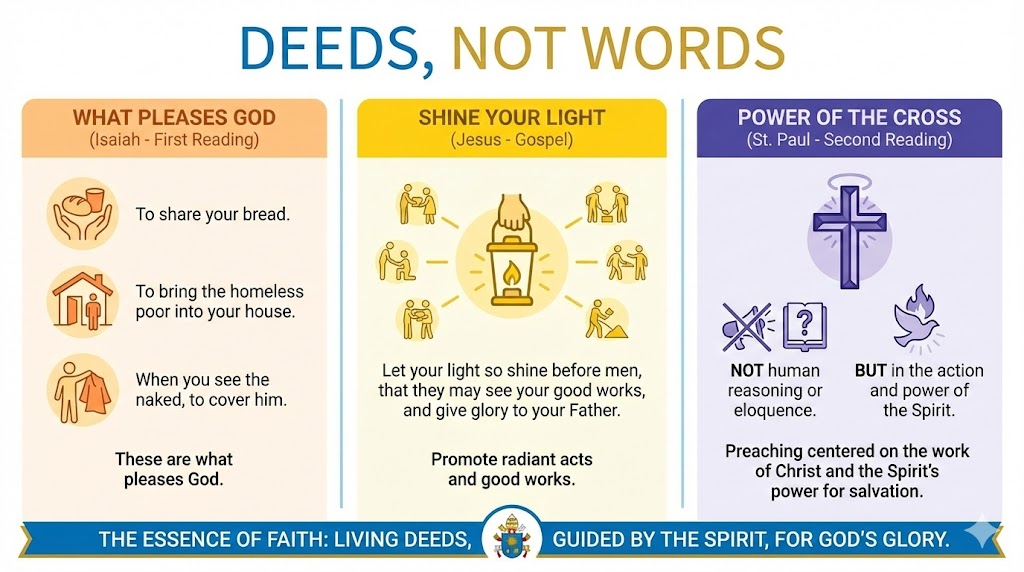
“Deeds, not words,” such could be the message of this fifth Sunday in ordinary time. “To share your bread … to bring the homeless poor into your house, … when you see the naked, to cover him, …” these are what pleases God, says the prophet Isaiah (First Reading). In the Gospel, Jesus says to his disciples: “Let your light so shine before men, that they may see your good works, and give glory to your Father.” Conscious of the essence of the Christian faith, St. Paul centers his preaching, not on human reasoning, but on the work of Christ: his death on a cross for our salvation, not in eloquence or the ability to persuade, but in the action and power of the Spirit (Second Reading).
Doctrinal Message
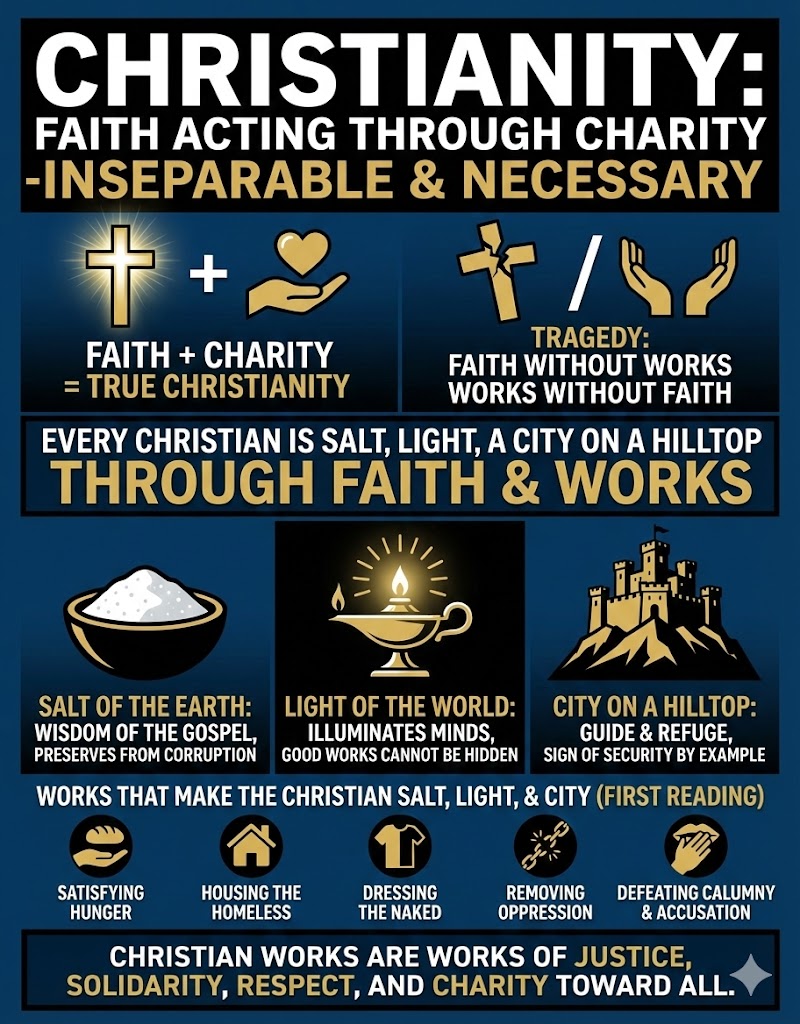

Christianity is faith which acts through charity. Both are necessary and inseparable. Christianity experiences a great tragedy when Christians separate faith and charity: to be a good Christian by faith alone without works, or by works without faith. These are the opposite of true Christianity. Every Christian is salt of the earth, light of the world, a city on a hilltop, thanks to his faith and his works. Salt is the symbol of wisdom, and the Christian has the wisdom of the Gospel. Salt has the capacity to preserve from corruption, and the Christian, as salt, will preserve the milieu in which he lives through the testimony of his works. Light is created to illuminate, and the Christian is light who, with the Word of God, enlightens minds and human situations. One does not light a lamp to cover it. The Christian is this lamp whose good works cannot be hidden, because it would be tantamount to leaving the world in darkness. Like a city on a hilltop guiding the traveler on his journey, so the Christian guides people with his words, with the doctrine of the faith. All find refuge and security in the city. The Christian is refuge and security by his example: a sign of security in the midst of the dangers and uncertainties of life. The first reading gives examples of the works that make the Christian salt, light, and a city on high for men: satisfying the hunger of the needy, housing the homeless, dressing the naked, removing oppression, defeating the temptation to calumniate and accuse. In a word, Christian works are works of justice, solidarity, respect, and charity toward all.
No one loves more than the one who gives his life for another. This is the supreme act of love, the work of Christ that Paul shows the Corinthians. This is the truly effective work, beyond all philosophies or persuasive rhetoric. The Corinthians embraced the faith precisely because of the mysterious action of that work in the interior of their hearts, and by the power of the Spirit which gives efficacy to the redeeming work of Jesus Christ.
© 2004-05 Dicastery for the Clergy
Pastoral Suggestions

1. Role of the Christian in contemporary society. The most important activity of the Christian is to proclaim his faith in Jesus Christ, both in words and in deeds. It is not enough to believe, because faith without works is dead, and a dead faith is like the salt that has lost its saltiness, lacking the power to attract or to convince. Are there not such people in our parishes: persons who go to Mass and then speak badly about others; who believe themselves to be fervent Christians, but do not welcome immigrants; who know the Christian doctrine of the sixth commandment very well, but forget to live the fifth, or do not pay their taxes, or pay less than they should? Neither is work alone sufficient, because works without faith cannot save us. It is not genuinely Christian to work for others, and to dedicate oneself to works of aid, while forgetting to pray or to go to Mass on Sundays. It is not sufficient to give money to the poor, help generously in social works, while also finding it “impossible” to believe in the resurrection of the flesh and in eternal life. We must accept the whole of Christianity as taught by Christ, with no exceptions.
2. Cultivate faith, practice works of charity. Given the situation of so many faithful today, it is necessary that the parishes offer and promote courses and activities to grow in the faith, to strengthen it and to defend it in face of possible dangers, either directly or with the help of other institutions (religious congregations, ecclesial movements, associations of Catholic laymen, etc.). It is advisable that parishes themselves promote “organized charity,” at the parish or diocesan level, in order to be effective in helping the poor. The ways can vary: collection of clothes or food for those suffering loss or for Caritas, a friendly telephone call, a visit to the elderly and the sick, etc.
© 2004-05 Dicastery for the Clergy
Infographic was designed using Nano Banana Pro with Gemini 3.0. It draws inspiration from the commentary from the 2004-05 Dicastery for the Clergy Notes (YEAR A | B | C cf. text above), but is not officially associated with or endorsed by the Holy See. It may be copied for personal use or for use in any non-profit ministry.
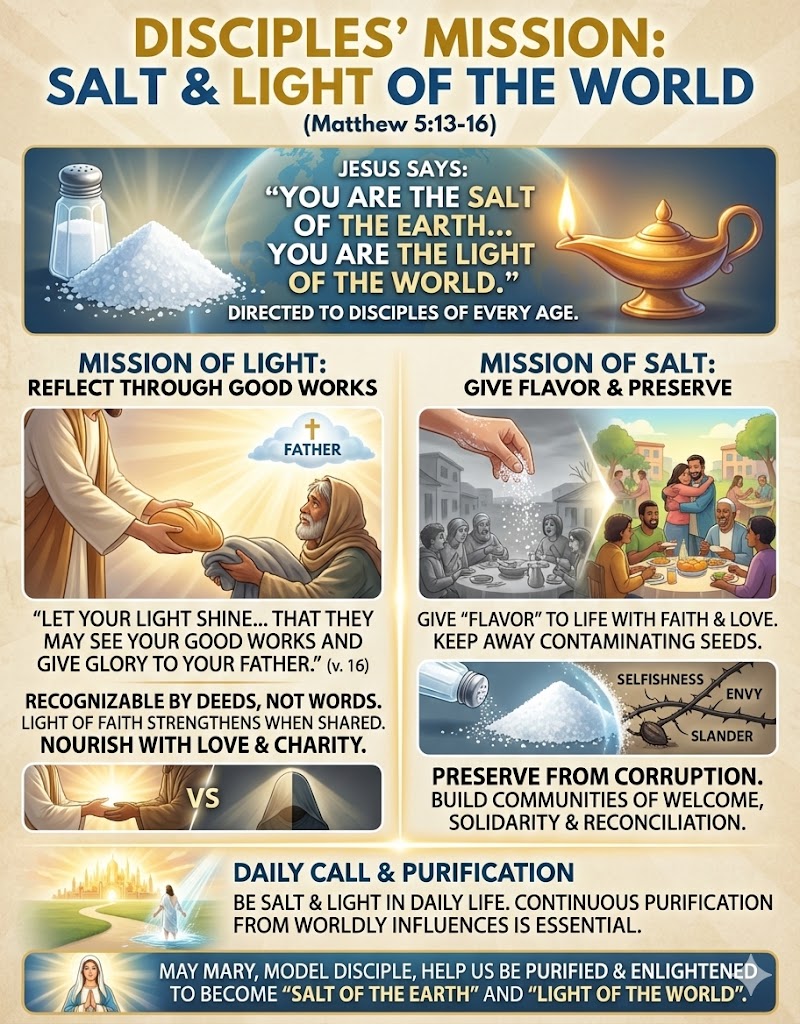
These Sundays the liturgy offers us the so-called Sermon on the Mount, in the Gospel of Matthew. After presenting the Beatitudes last Sunday, today [Matthew] emphasizes Jesus’ words describing his disciples’ mission in the world. (cf. Mt 5:13-16). He uses the metaphors of salt and light, and his words are directed to the disciples of every age, therefore also to us.
Jesus invites us to be a reflection of his light, by witnessing with good works. He says: “Let your light so shine before men, that they may see your good works and give glory to your Father who is in heaven” (v. 16). These words emphasize that we are recognizable as true disciples of the One who is the Light of the World, not in words, but by our works. Indeed, it is above all our behaviour that — good or bad — leaves a mark on others. Therefore, we have a duty and a responsibility towards the gift received: the light of the faith, which is in us through Christ and the action of the Holy Spirit; and we must not withhold it as if it were our property. Instead we are called to make it shine throughout the world, to offer it to others through good works. How much the world needs the light of the Gospel which transforms, heals and guarantees salvation to those who receive it! We must convey this light through our good works.
The light of our faith, in giving of oneself, does not fade but strengthens. However it can weaken if we do not nourish it with love and with charitable works. In this way the image of light complements that of salt. The Gospel passage, in fact, tells us that, as disciples of Christ, we are also “the salt of the earth” (v. 13). Salt is an ingredient which, while it gives flavour, keeps food from turning and spoiling — in Jesus’ time there were no refrigerators! Thus, Christians’ mission in society is that of giving “flavour” to life with the faith and the love that Christ has given us, and at the same time, keeping away the contaminating seeds of selfishness, envy, slander, and so on. These seeds degrade the fabric of our communities, which should instead shine as places of welcome, solidarity and reconciliation. To fulfil this mission, it is essential that we first free ourselves from the corruptive degeneration of worldly influences contrary to Christ and to the Gospel; and this purification never ends, it must be done continuously; it must be done every day!
Each one of us is called to be light and salt, in the environment of our daily life, persevering in the task of regenerating the human reality in the spirit of the Gospel and in the perspective of the Kingdom of God. May there always be the helpful protection of Mary Most Holy, first disciple of Jesus and model for believers who live their vocation and mission each day in history. May our Mother help us to let ourselves always be purified and enlightened by the Lord, so as to become, in our turn, “salt of the earth” and “light of the world”.
In this Sunday’s Gospel the Lord Jesus tells his disciples: “You are the salt of the earth…. You are the light of the world” (Mt 5:13,14). With these richly evocative images he wishes to pass on to them the meaning of their mission and their witness.
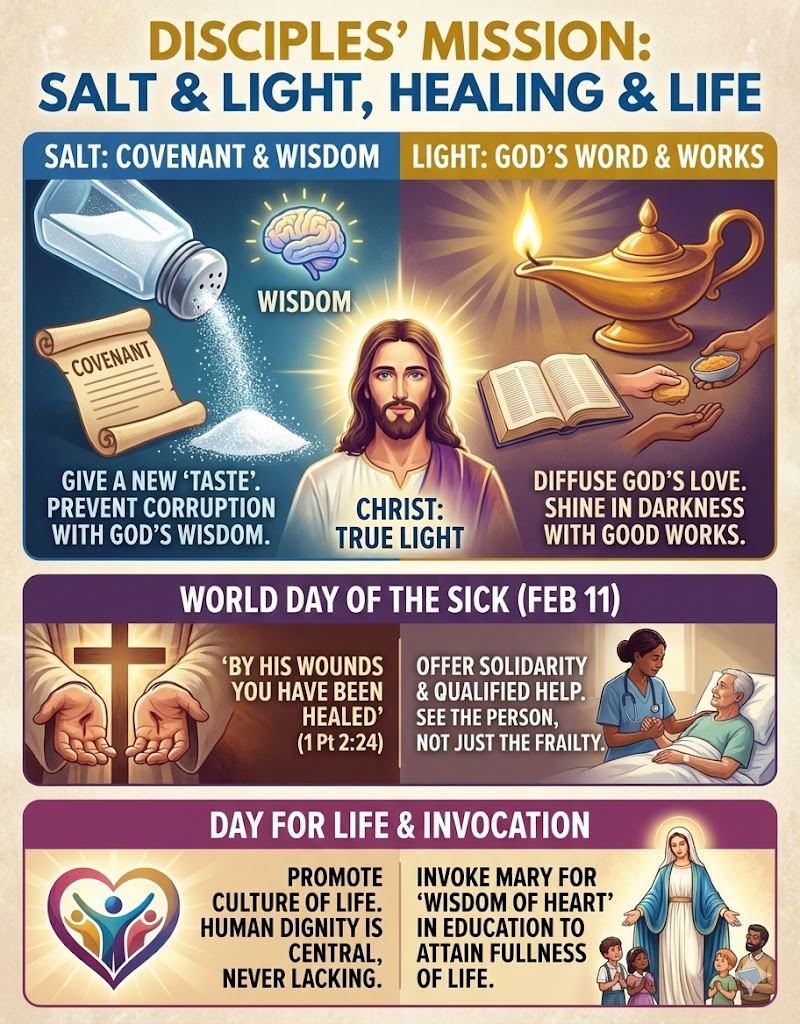
Salt, in the cultures of the Middle East, calls to mind several values such as the Covenant, solidarity, life and wisdom. Light is the first work of God the Creator and is a source of life; the word of God is compared to light, as the Psalmist proclaims: “Your word is a lamp to my feet and a light to my path” (Ps 119[118]:105).
And, again in today’s Liturgy, the Prophet Isaiah says: “If you pour yourself out for the hungry and satisfy the desire of the afflicted, then shall your light rise in the darkness and your gloom be as the noonday” (58:10).
Wisdom sums up in itself the beneficial effects of salt and light: in fact, disciples of the Lord are called to give a new “taste” to the world and to keep it from corruption with the wisdom of God, which shines out in its full splendour on the Face of the Son because he is “the true light that enlightens every man” (Jn 1:9).
United to him, in the darkness of indifference and selfishness, Christians can diffuse the light of God’s love, true wisdom that gives meaning to human life and action.
Next 11 February, the Memorial of Our Lady of Lourdes, we shall celebrate the World Day of the Sick. It is a favourable opportunity on which to reflect, to pray and to increase the sensitivity that the ecclesial communities and civil society show to our sick brothers and sisters.
In the Message for this Day, inspired by a sentence from the First Letter of Peter, “By his wounds you have been healed” (1 Pt 2:24), I invite everyone to contemplate Jesus, the Son of God, who suffered and died but is Risen.
God radically opposes the overbearingness of evil. The Lord takes care of human beings in every situation, he shares in their suffering and opens their hearts to hope. I therefore urge all health-care workers to recognize in the sick person not only a body marked by frailty but first and foremost a person, to whom they should give full solidarity and offer appropriated and qualified help.
In this context I also recall that today in Italy is the “Day for Life”. I hope that everyone will make an effort to increase the culture of life and to make the human being the centre in all circumstances. According to both faith and reason, the dignity of the person cannot be reduced to his or her faculties or visible capacity; thus human dignity is never lacking even when the person is weak, sick or in need of help.
Dear brothers and sisters, let us invoke the motherly intercession of the Virgin Mary so that parents, grandparents, teachers, priests and all who are involved in education may inculcate in the young generations wisdom of heart, to enable them to attain fullness of life.

5th Sunday of Year A
July 28, 2002 | Toronto (17th World Youth Day)
Two Voices Compete
for Your Soul…
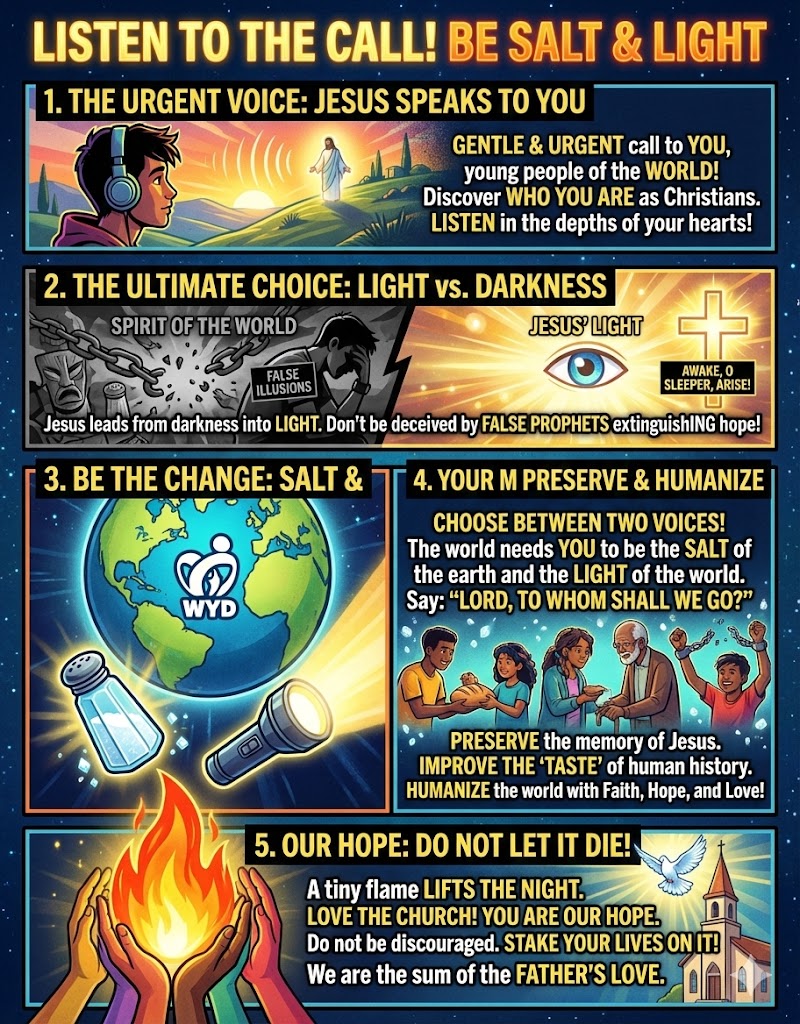
1. On a hillside near the lake of Galilee, Jesus’s disciples listened to his gentle and urgent voice; as gentle as the landscape of Galilee itself, as urgent as a call to choose between life and death, between truth and falsehood. The Lord spoke words of life that would echo for ever in the hearts of his followers.
Today he is speaking the same words to you, the young people of Toronto and Ontario, of the whole of Canada, of the United States, of the Caribbean, of Spanish-speaking America and Portuguese-speaking America, of Europe, Africa, Asia and Oceania. Listen to the voice of Jesus in the depths of your hearts! His words tell you who you are as Christians. They tell you what you must do to remain in his love.
2. But Jesus offers one thing, and the “spirit of the world” offers another. In today’s Reading from the Letter to the Ephesians, Saint Paul tells us that Jesus leads us from darkness into light (cf. Eph 5,8). Perhaps the great Apostle is thinking of the light that blinded him, the persecutor of Christians, on the road to Damascus. When later he recovered his sight, nothing was as before. He had been born anew and nothing would ever take his new-found joy away from him.
You too are called to be transformed. “Awake, O sleeper, arise from the dead, and Christ will give you light” (Eph 5, 14), says Saint Paul.
The “spirit of the world” offers many false illusions and parodies of happiness. There is perhaps no darkness deeper than the darkness that enters young people’s souls when false prophets extinguish in them the light of faith and hope and love. The greatest deception, and the deepest source of unhappiness, is the illusion of finding life by excluding God, of finding freedom by excluding moral truths and personal responsibility.
3. The Lord is calling you to choose between these two voices competing for your souls. That decision is the substance and challenge of World Youth Day. Why have you come together from all parts of the world? To say in your hearts: “Lord, to whom shall we go?” Who has the words of eternal life? “You have the words of eternal life” (Jn 6,68). Jesus – the intimate friend of every young person – has the words of life.
The world you are inheriting is a world which desperately needs a new sense of brotherhood and human solidarity. It is a world which needs to be touched and healed by the beauty and richness of God’s love. It needs witnesses to that love. The world needs salt. It needs you – to be the salt of the earth and the light of the world.
4. Salt is used to preserve and keep. As apostles for the Third Millennium, your task is to preserve and keep alive the awareness of the presence of our Savior Jesus Christ, especially in the celebration of the Eucharist, the memorial of his saving death and glorious resurrection. You must keep alive the memory of the words of life which he spoke, the marvellous works of mercy and goodness which he performed. You must constantly remind the world of the “power of the Gospel to save” (Rom 1, 16)!
Salt seasons and improves the flavour of food. Following Jesus, you have to change and improve the “taste” of human history. With your faith, hope and love, with your intelligence, courage and perseverance, you have to humanize the world we live in, in the way that today’s Reading from Isaiah indicates: “loose the bonds of injustice … share your bread with the hungry … remove the pointing of the finger, the speaking of evil…. Then your light shall rise in the darkness” (Is 58,6-10).
5. Even a tiny flame lifts the heavy lid of night. How much more light will you make, all together, if you bond as one in the communion of the Church! If you love Jesus, love the Church! Do not be discouraged by the sins and failings of some of her members. The harm done by some priests and religious to the young and vulnerable fills us all with a deep sense of sadness and shame. But think of the vast majority of dedicated and generous priests and religious whose only wish is to serve and do good! There are many priests, seminarians and consecrated persons here today; be close to them and support them! And if, in the depths of your hearts, you feel the same call to the priesthood or consecrated life, do not be afraid to follow Christ on the royal road of the Cross! At difficult moments in the Church’s life, the pursuit of holiness becomes even more urgent. And holiness is not a question of age; it is a matter of living in the Holy Spirit, just as Kateri Tekakwitha did here in America and so many other young people have done.
You are young, and the Pope is old, 82 or 83 years of life is not the same as 22 or 23. But the Pope still fully identifies with your hopes and aspirations. Although I have lived through much darkness, under harsh totalitarian regimes, I have seen enough evidence to be unshakably convinced that no difficulty, no fear is so great that it can completely suffocate the hope that springs eternal in the hearts of the young. You are our hope, the young are our hope.
Do not let that hope die! Stake your lives on it! We are not the sum of our weaknesses and failures; we are the sum of the Father’s love for us and our real capacity to become the image of his Son.
6. I finish with a prayer. O Lord Jesus Christ, keep these young people in your love. Let them hear your voice and believe what you say, for you alone have the words of life. Teach them how to profess their faith, bestow their love, and impart their hope to others. Make them convincing witnesses to your Gospel in a world so much in need of your saving grace. Make them the new people of the Beatitudes, that they may be the salt of the earth and the light of the world at the beginning of the Third Christian Millennium! Mary, Mother of the Church, protect and guide these young men and women of the Twenty-first Century. Keep us all close to your maternal heart. Amen.