Papal Homilies
February 1, 2026
February 1, 2026
4th Sunday of Year A



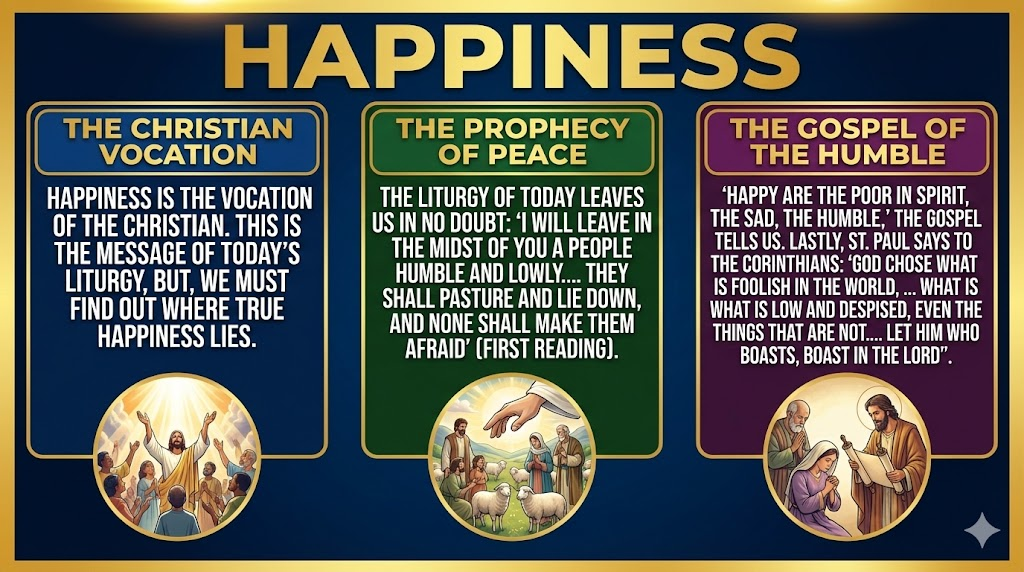
Happiness is the vocation of the Christian. This is the message of today’s liturgy, but, we must find out where true happiness lies. The liturgy of today leaves us in no doubt: “I will leave in the midst of you a people humble and lowly.… They shall pasture and lie down, and none shall make them afraid” (First Reading). “Happy are the poor in spirit, the sad, the humble,” the Gospel tells us. Lastly, St. Paul says to the Corinthians: “God chose what is foolish in the world, … what is weak,… what is low and despised, even the things that are not…. Let him who boasts, boast in the Lord
Doctrinal Message
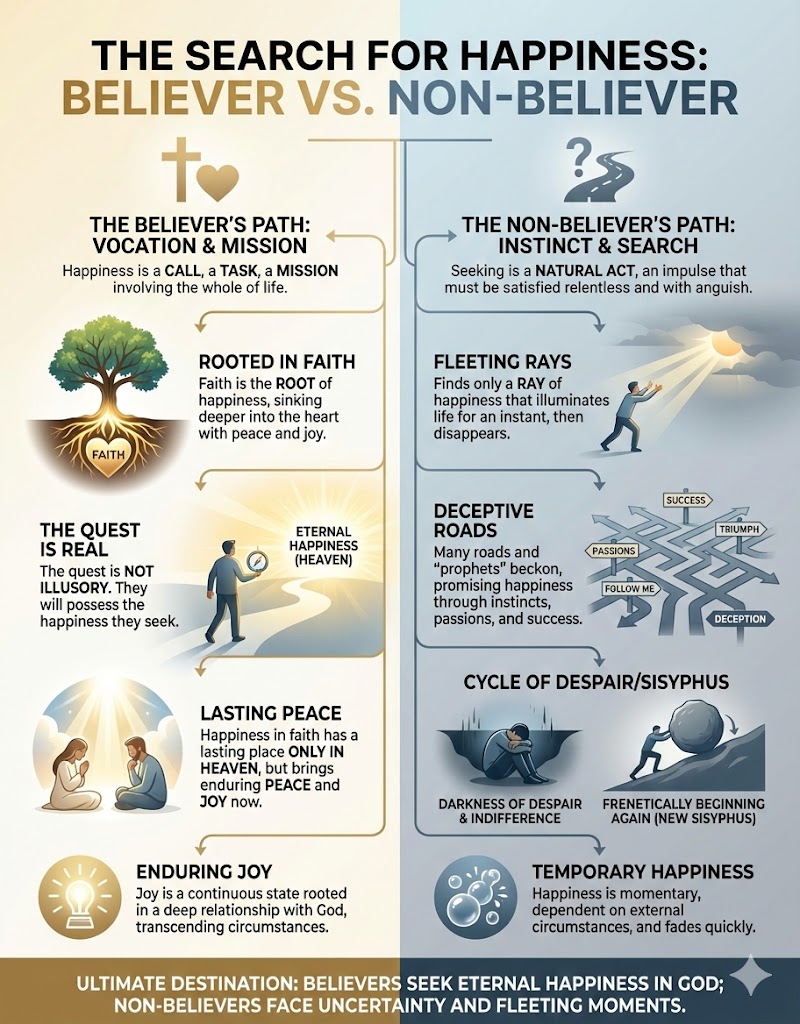
Man looks for happiness. He does it by instinct, it is his end and, speaking in a Christian vein, his vocation and mission. For the non-believer, or for the person of weak faith, to seek is a natural act, an impulse that must be satisfied. Man looks for happiness relentlessly, including with anguish, and when he finds a ray of it, his whole life is illuminated, at least for an instant. Such a person looks for the sun and finds only a ray which he hopes will last forever, but which disappears as fast as it came.
Two attitudes might result from this: to sink into the darkness of despair and indifference, or to begin frenetically again as a new Sisyphus, looking for that happiness barely tasted and so quickly gone. For the believing Christian, happiness is a call, a task, a mission, involving the whole of life in searching for it and possessing it. For the true believer, faith is the root of happiness. The believer searches with peace and joy, and the roots of happiness sink ever deeper into his heart. The believer knows that the quest is not illusory. Eventually he will possess the happiness he seeks. The believer knows that happiness in faith does not have a lasting place on earth, only in heaven. A non-believer does not know where to look for happiness. Many roads are open, and many “prophets” beckon: “Follow me and I will lead you to happiness …” Moreover, within one feels strong instincts and passions … and believes that in satisfying them he will possess happiness. The non-believer also has noble ideals, generous and altruistic thoughts, and sometimes begins to look on such a road. He feels the “I” with irresistible force, and its demands for success and triumph. “This is the true road!” an interior voice whispers. He starts, and after several attempts, realizes that all those roads were deceptions; what to do next?
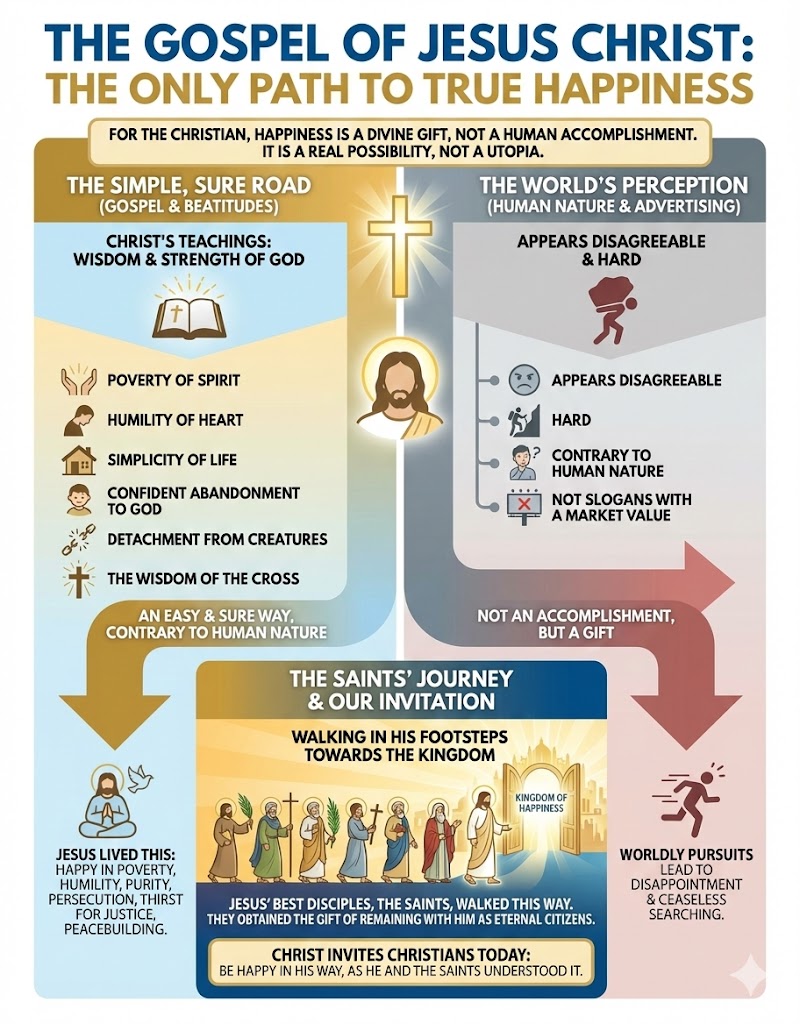
The Gospel of Jesus Christ offers the only path to happiness for a Christian, both now and hereafter. It is a simple, sure road: poverty of spirit, humility of heart, simplicity of life, confident abandonment to God, detachment from creatures, the wisdom of the cross. It is an easy and sure way, but which, unfortunately, appears disagreeable, hard and contrary to human nature. Indeed, the beatitudes are not slogans with a market in the world of advertising. The beatitudes are, essentially, the strength and wisdom of God. Only God can teach us where to find true happiness. Happiness is a gift, not a human accomplishment. It is a real possibility, not an utopia. Jesus received this marvelous gift from his Father. He lived, what he later preached. He was happy in poverty, humility, purity of heart, and persecution, and he thirst for justice, and the building of peace. Jesus’ best disciples, the saints, walk in his footsteps. They have entered the Kingdom of happiness, lived and preached with Jesus, and once there, they asked and obtained the gift of remaining with him, being admitted as citizens to that mysterious Kingdom. Christ invites Christians today to be happy, but in the way he and the saints understood it.
© 2004-05 Dicastery for the Clergy
Pastoral Suggestions
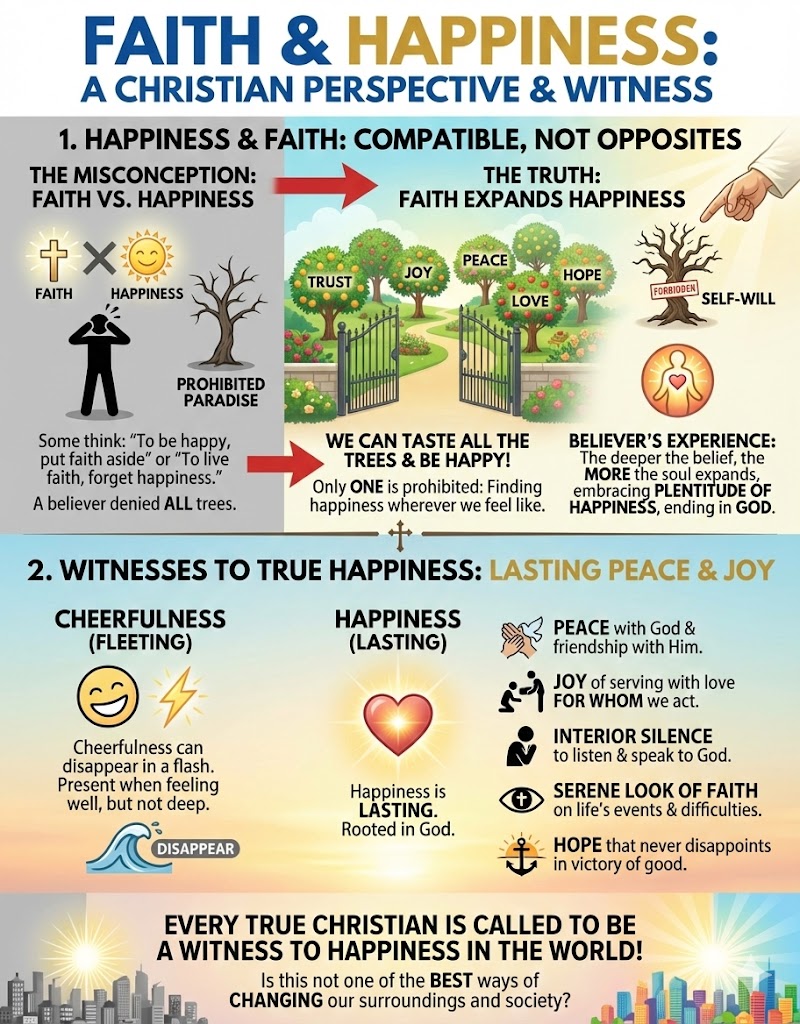
1. Happiness and faith. There could be persons in our parishes who think and live, although they might not realize it, as if faith and happiness are incompatible. For instance, they might reason thus: “If I want to be happy, I must put faith aside” or “If I want to live my faith, I must forget about happiness.” A situation, we might say, where the believer has been prohibited not one but all the trees in paradise. In fact, it is the very opposite. We can taste all the trees in paradise and be happy. Only one is prohibited, and that one is wanting to find happiness wherever we feel like or think is best. The experience of Christian life is quite another: the more deeply one believes, the more the soul expands, and the more capacity there is to embrace the plentitude of happiness, a happiness that ends in God.
2. Witnesses to happiness. There are many cheerful people in the world — I am referring to healthy cheerfulness, not uncontrolled behavior — but few who are happy. Cheerfulness can disappear in a flash, it can be present while we feel well, contented, satisfied, optimistic, smiling. Happiness, instead, is lasting. It is the peace of the one who has God and lives in friendship with him, the joy of serving with love without looking at whom but only for Whom we act, interior silence to listen to God and speak with him, the serene look of faith on the events of life and on the difficulties and sorrows of existence, and the hope that never disappoints of the victory of good over evil. Every true Christian is called to be a witness to happiness in the world. Would this not be one of the best ways of changing our surroundings, and the society in which we live?
© 2004-05 Dicastery for the Clergy
Infographic was designed using Nano Banana Pro with Gemini 3.0. It draws inspiration from the commentary from the 2004-05 Dicastery for the Clergy Notes (YEAR A | B | C cf. text above), but is not officially associated with or endorsed by the Holy See. It may be copied for personal use or for use in any non-profit ministry.

This Sunday’s liturgy leads us to meditate on the Beatitudes (cf. Mt 5:1-12) which open up the great so-called Sermon on the Mount, the “Magna Carta” of the New Testament. Jesus manifests God’s desire to lead men to happiness. This message was already present in the preaching of the prophets: God is close to the poor and the oppressed, and delivers them from those who mistreat them. But in this preaching of his, Jesus follows a particular path: he starts with the word “blessed”, that is, happy. He continues with the indication of the condition to be so; and he concludes by making a promise. The cause of blessedness, that is, of happiness, lies not in the requisite condition — for example, “poor in spirit”, “mourning”, “hungry for righteousness”, “persecuted” — but in the subsequent promise, to be welcomed with faith as a gift of God. One starts from a condition of hardship in order to open oneself to God’s gift and enter the new world, the “Kingdom” announced by Jesus. This is not an automatic mechanism, but a way of life in following the Lord, through which the reality of hardship and affliction is seen in a new perspective and experienced according to the conversion that comes about. One is not blessed if one is not converted, capable of appreciating and living God’s gifts.
I pause on the first Beatitude: “Blessed are the poor in spirit, for theirs is the kingdom of heaven” (v. 3). The poor in spirit is he who has assumed the feelings and attitudes of those poor people who, in their state, do not rebel, but who know how to be humble, meek, open to God’s grace. The happiness of the poor — of the poor in spirit — has a twofold dimension: with regard to riches and with regard to God. With regard to possessions, to material possessions, this poverty in spirit is sobriety: not necessarily sacrifice, but the ability to savour the essence, to share; the ability to renew every day the wonder at the goodness of things, without being weighed down in the obscurity of voracious consumption. The more I have, the more I want; the more I have, the more I want: this is voracious consumption. This kills the soul. Men or women who do this, who have this attitude, ‘the more I have, the more I want’, are not happy and will not attain happiness. With regard to God, it is praising and recognizing that the world is a blessing and that at its origin is the creative love of the Father. But it is also opening to Him, docility to his Lordship: it is He, the Lord, He is the Great One. I am not great because I have so many things! It is He: He who wanted the world for all mankind, and who wanted it so that men and women might be happy.
The poor in spirit is the Christian who does not rely on himself, on material wealth, is not obstinate in his own opinions, but who listens with respect and willingly defers to the decisions of others. If in our communities there were more of the poor in spirit, there would be fewer divisions, disagreements and controversies! Humility, like charity, is an essential virtue for living together in Christian communities. The poor, in this evangelical sense, appear to be those who keep alive the objective of the Kingdom of Heaven, offering a glimpse of it revealed as a seed in the fraternal community which favours sharing over ownership. I would like to emphasize this: to favour sharing over ownership. Always having the heart and hands open (he gestures), not closed (he gestures). When the heart is closed (he gestures), it is a shrunken heart. It doesn’t even know how to love. When the heart is open (he gestures), it is on the path of love.
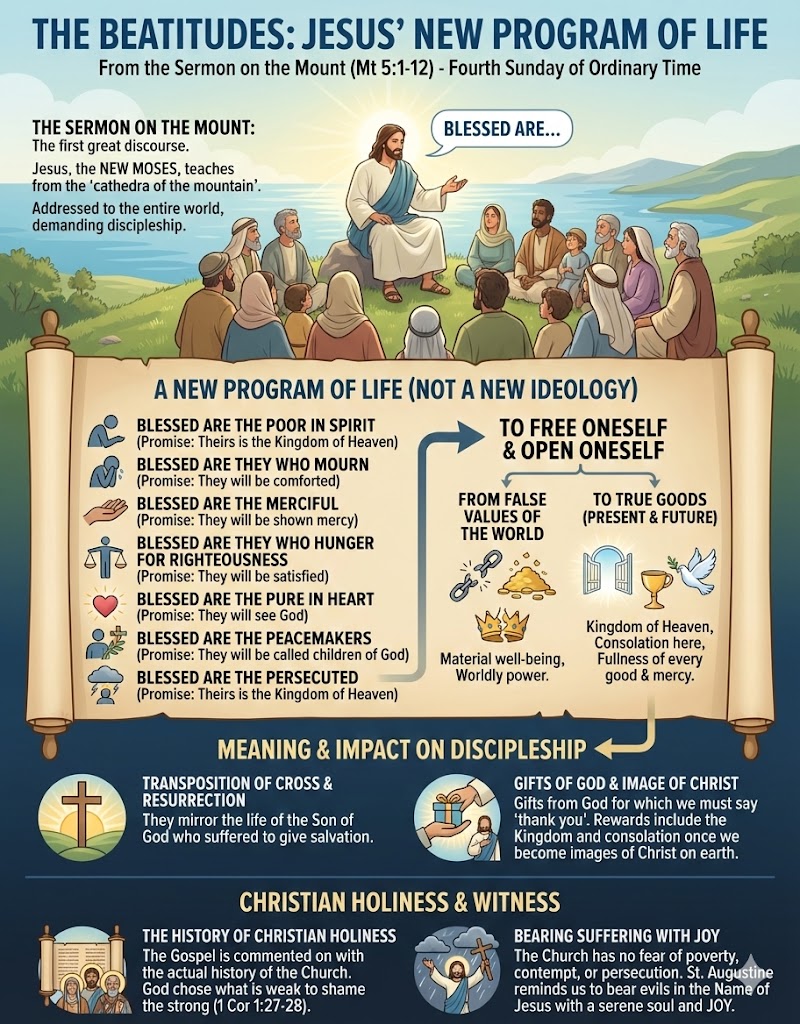
On this Fourth Sunday of Ordinary Time, the Gospel presents the first great discourse that the Lord addresses to the people on the gentle hills encircling the Sea of Galilee. “Seeing the crowds,” St Matthew writes, “he went up on the mountain, and when he sat down his disciples came to him. And he opened his mouth and taught them” (Mt 5:1-2).
Jesus, the new Moses, “takes his seat on the cathedra of the mountain” (Jesus of Nazareth, Doubleday, New York 2007, p. 65) and proclaims “blessed” the poor in spirit, those who mourn, the merciful, those who hunger for righteousness, the pure in heart, the persecuted (cf. Mt 5:3-10). It is not a new ideology, but a teaching that comes from on high and touches the human condition, the condition that the Lord, in becoming flesh, wished to assume in order to save it.
Therefore “the Sermon on the Mount is addressed to the entire world, the entire present and future, and yet it demands discipleship and can be understood and lived out only by following Jesus and accompanying him on his journey” (Jesus of Nazareth, p. 69).
The Beatitudes are a new programme of life, to free oneself from the false values of the world and to open oneself to the true goods, present and future. Indeed, when God comforts, he satisfies the hunger for righteousness, he wipes away the tears of those who mourn, which means that, as well as compensating each one in a practical way, he opens the Kingdom of Heaven. “The Beatitudes are the transposition of the Cross and Resurrection into discipleship” (ibid., p. 74). They mirror the life of the Son of God who let himself even be persecuted and despised until he was condemned to death so that salvation might be given to men and women.
An ancient hermit says: “The Beatitudes are gifts of God and we must say a great ‘thank you’ to him for them and for the rewards that derive from them, namely the Kingdom of God in the century to come and consolation here; the fullness of every good and mercy on God’s part … once we have become images of Christ on earth” (Peter of Damascus, In Filocalia, Vol. 3, Turin 1985, p. 79).
The Gospel of the Beatitudes is commented on with the actual history of the Church, the history of Christian holiness, because, as St Paul writes, “God chose what is weak in the world to shame the strong, God chose what is low and despised in the world, even things that are not, to bring to nothing things that are” (1 Cor 1:27-28).
For this reason the Church has no fear of poverty, contempt or persecution in a society which is often attracted by material well-being and worldly power. St Augustine reminds us that “it serves nothing to suffer these evils, but rather to bear them in the Name of Jesus, not only with a serene soul but also with joy” (cf. De sermone Domini in monte, i, 5,13: ccl 35, 13).
4th Sunday of Year A
28 November 2010 | St Peter’s Square
