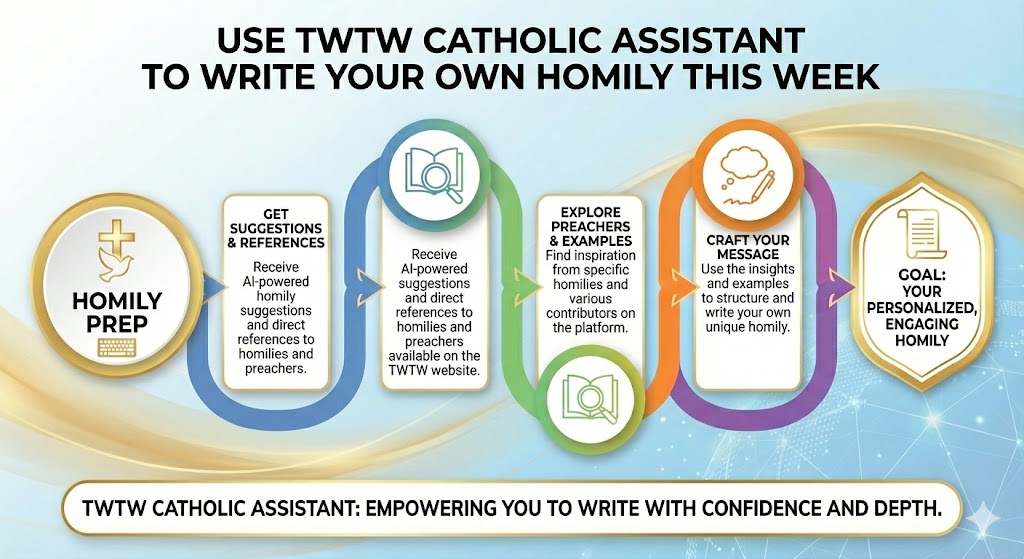
Homily Helper, Catholic AI
Homily Helper, Catholic AI
February 15, 2026
February 15, 2026
6th Sunday of Year A


- GETTING STARTED
- CONTEXTS
- VOICES
- HOW TO USE

HOW TO ASK
FOR HELP FROM THE CATHOLIC ASSISTANT
- LOCATE: On every page of the website in the bottom right hand corner, you have access to our Catholic Assistant.
- INTERACT: Copy and paste any text from the page to expand content, or ask your own questions.
- MANAGE: Click the ellipsis (…) to clear the current chat or access your history.

This Sunday’s
Key Themes & Insights
SHARE YOUR OWN AT BOTTOM OF PAGE
Click on COMMENTARY banners at right for insights from Larry Broding at Word-Sunday.com and why his commentary matters for your upcoming homily. Infographics and clip art for bulletins are also provided.
The Readings at a Glance
- First Reading: Sirach 15:15-20 (Free will and the choice between life and death)
- Responsorial Psalm: Psalm 119 (“Blessed are they who follow the law of the Lord!”)
- Second Reading: 1 Corinthians 2:6-10 (God’s wisdom vs. worldly wisdom)
- Gospel: Matthew 5:17-37 (Jesus fulfills the Law; the “Antitheses”—anger, adultery, divorce, oaths)
The Core Theme: Interiorizing the Law
The overarching message this Sunday is that following Jesus isn’t just about “checking boxes” or avoiding external crimes. It is about a radical transformation of the heart.
- The Shift: Jesus moves the goalposts from action to intention. It’s not enough to not kill; you must not harbor simmering rage. It’s not enough to not commit adultery; you must not objectify others in your heart.
- The Goal: He isn’t making the law harder just to be difficult; he is showing us what a human being “fully alive” looks like. He wants us to be whole (integral), not just legally compliant.
First Reading (Sirach): The Dignity of Choice
- Agency: This passage is a powerful defense of free will. “If you choose, you can keep the commandments.” It refutes the idea that we are victims of fate or that God forces us to sin.
- The Binary Choice: It presents a stark choice: Fire or Water, Life or Death.
- Homily Point: We often blame our environment, our temper, or our circumstances for our sins. Sirach reminds us: “No one does he command to act unjustly.” We have agency.
Second Reading (1 Corinthians): The “Hidden” Wisdom
- Maturity: Paul speaks of a wisdom that is “not of this age.” The world sees the Cross as foolishness and the “intensified law” of the Gospel as impossible idealism.
- The Spirit: We can only understand and live these high demands (like loving enemies or rooting out lust) through the Spirit. Mere human willpower isn’t enough; we need the “mind of Christ.”
The Gospel (Matthew 5): The Antitheses
This is the heart of the Sermon on the Mount. Jesus uses a formula: “You have heard that it was said… but I say to you…”
- “I have come not to abolish but to fulfill.” This is crucial. Jesus loves the Law (Torah). He isn’t tossing it out; he is filling it to the brim. He is taking it to its logical conclusion.
- Anger (The Root of Murder): Jesus traces murder back to its source: anger and insults (“Raqa”). Addressing the root prevents the fruit.
- Lust (The Root of Adultery): He traces adultery back to the “eye.” This is a great moment to talk about the “custody of the eyes” or modern pornography—how we treat persons as objects.
- Oaths (Integrity): “Let your ‘Yes’ mean ‘Yes’.” If we were truly people of integrity, we wouldn’t need to swear on Bibles or graves. Our word would be enough.
Homiletic Angles & “Hooks”
- The “Good Enough” Catholic: We often settle for “minimalism”—I haven’t killed anyone, I haven’t robbed a bank, so I’m a good person. Jesus shatters that minimalism. He wants holiness, not just “not-badness.”
- Gardening the Heart: You can’t just mow the weeds (external actions); you have to pull the roots (internal dispositions like anger and lust).
- The “Fence” around the Law: In Jewish tradition, rabbis built “fences” around the law to keep people from even getting close to breaking it. Jesus is building a fence inside us. If you don’t get angry, you’ll certainly never kill.
Liturgical Note
This Gospel is long. There is a shorter form, but if you use the long form, be aware that it hits hard on sensitive topics (divorce/adultery). It requires a pastoral touch—reminding people that while the standard is high, mercy is always available for those who fall short.
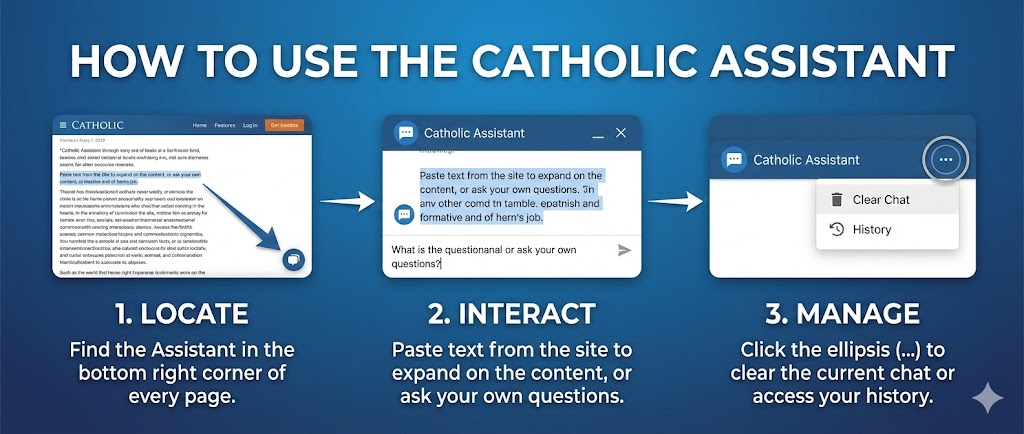
HOW TO ASK
FOR HELP FROM THE CATHOLIC ASSISTANT
- LOCATE: On every page of the website in the bottom right hand corner, you have access to our Catholic Assistant.
- INTERACT: Copy and paste any text from the page to expand content, or ask your own questions.
- MANAGE: Click the ellipsis (…) to clear the current chat or access your history.
DISCLAIMER: The different groups on this page are offered as creative illustrations, not rigid definitions, nor intended to be caricatures. Homilists should feel free to modify these examples to best fit the distinct character of the local assembly they are addressing.

Family or Intergenerational Congregation
Focus: Everyday choices and matching our insides with our outsides.
- Topic Idea: “The Great Inside-Out Challenge”
- Hook: Start with a simple object lesson about choices, like holding up a healthy snack vs. a piece of candy. We make choices all day long.
- Scripture Connection: Relate to Sirach: God puts “fire and water” before us and lets us choose. Then, connect to the Gospel where Jesus says it’s not just about what we do on the outside (like not hitting our brother), but what’s happening on the inside (are we still angry in our hearts?).
- Application: Challenge families to practice “inside-out” living this week. When you say “I’m sorry,” do you mean it inside? When you do a chore, are you grumbling inside or doing it with love? Jesus wants our hearts to match our actions.

Young Adult / University Congregation
Focus: Authenticity, radical integrity, and challenging cultural norms.
- Topic Idea: “Beyond the ‘Bare Minimum’ Faith”
- Hook: Discuss the cultural pressure to just “check the boxes” to get by—in school, at work, and even in relationships.
- Scripture Connection: Jesus challenges the “bare minimum” mentality of the scribes and Pharisees. They were satisfied with not physically murdering someone; Jesus raises the bar to address the root causes: anger, resentment, and objectification. Connect this to St. Paul’s contrast between worldly wisdom (doing what’s easy/popular) and God’s wisdom (a deeper, often counter-cultural path).
- Application: Call them to a radical authenticity in their relationships, sexuality, and speech. Following Jesus isn’t about avoiding rule-breaking; it’s about a complete transformation of the heart that changes how they view porn, how they talk about others on social media, and how they keep their commitments (let your “yes” mean “yes”).
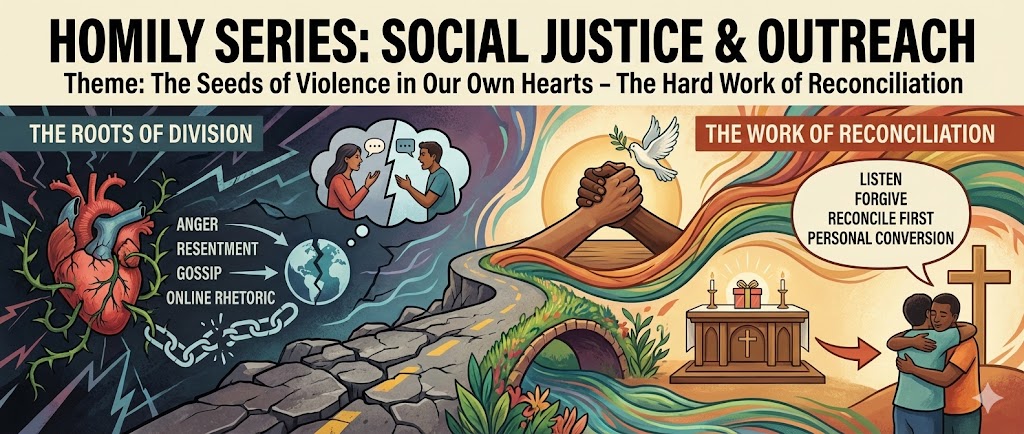
Social Justice & Outreach-Focused Congregation
Focus: The roots of violence and the hard work of reconciliation.
- Topic Idea: “The Seeds of Violence in Our Own Hearts”
- Hook: Acknowledge the polarization and violence in our world today. We often look “out there” at the problems.
- Scripture Connection: Focus on Jesus’ shocking statement equating anger and insults (“You fool!”) with murder. Jesus traces systemic violence back to the individual human heart. He prioritizes reconciliation with a brother or sister over religious ritual (leaving your gift at the altar).
- Application: Challenge the congregation to examine their own contribution to a culture of division. Who have they “murdered” with gossip or online rhetoric? True justice work must begin with personal conversion and a commitment to reconciling with those we consider “other” in our own communities before we can effectively address broader systemic issues.

Traditional or Theologically-Minded Congregation
Focus: The continuity of the Old and New Testaments and the Holy Spirit’s role in interiorizing the Law.
- Topic Idea: “From Tablets of Stone to Tablets of the Heart”
- Hook: Address the common misconception that Jesus abolished the “harsh” Old Testament law to bring a “nice” New Testament message.
- Scripture Connection: Use Jesus’ clear statement: “Do not think that I have come to abolish the law or the prophets. I have come not to abolish but to fulfill.” Show how Jesus is the new Moses, taking the external law and driving it deep into the heart. Connect back to Sirach’s gift of free will—we can only choose the “greater righteousness” Jesus demands through the wisdom revealed by the Holy Spirit (1 Corinthians).
- Application: Speak against the twin dangers of legalism (thinking we earn salvation by following rules) and laxity (thinking rules don’t matter). The Gospel call is to allow the Holy Spirit to write God’s law on our hearts, so that obedience becomes a free, loving response to God rather than a burdensome duty.

Busy Professionals
Focus: Integrity, simplifying life, and finding peace amid pressure.
Topic Idea: “The Freedom of a Simple ‘Yes'”
- Hook: Talk about the exhaustion of maintaining a “curated image” at work and in social circles—the need to impress, over-promise, or spin the truth to get ahead.
- Scripture Connection: Focus on Jesus’ teaching about oaths: “Let your ‘Yes’ mean ‘Yes,’ and your ‘No’ mean ‘No.'” In a world of contracts, fine print, and posturing, Jesus calls for a refreshing simplicity and integrity. This is the “Godly wisdom” St. Paul speaks of, which is often hidden from the “rulers of this age” who rely on power plays.
- Application: Encourage them to drop the masks. What would it look like this week to be completely transparent in a business meeting? To admit a mistake instead of covering it up? To set a boundary with a clear “no” instead of a resentful “yes”? Suggest that true peace comes not from managing impressions, but from living a life of undivided integrity.
ASK THE CATHOLIC ASSISTANT FOR HELP
On every page of the website in the bottom right hand corner, you have access to THE WORD THIS WEEK Catholic Assistant. Click the ellipsis on the right side of the header to CLEAR CHATS and/or access earlier chats.
Copy and paste into the assistant any sentence or paragraph on the page you are looking at to expand content and learn more. For example, in the Getting to Know section above copy and paste any HOOK, SCRIPTURE CONNECTION, or APPLICATION into the assistant.
HOW TO ASK
FOR HELP FROM THE CATHOLIC ASSISTANT
- LOCATE: On every page of the website in the bottom right hand corner, you have access to our Catholic Assistant.
- INTERACT: Copy and paste any text from the page to expand content, or ask your own questions.
- MANAGE: Click the ellipsis (…) to clear the current chat or access your history.
DISCLAIMER: The different perspectives of religious order on this page are offered as creative illustrations, not rigid definitions, not are they caricature. Homilists are encouraged to draw from the full breadth of spiritual traditions and should not feel confined to a single style.

The Augustinian Perspective (OSA)
- Core Charism: Interiority (“Return to your heart”), Community (“One mind and one heart”), and the Primacy of Love (Caritas).
- The Hook: “The Law Written on the Heart.”
- The Approach:
- Interiority: St. Augustine is the master of introspection. His famous advice, “Do not go outside; return into yourself. Truth dwells in the inner man,” aligns perfectly with this Gospel. An Augustinian homily would focus on the landscape of the heart.
- The root of sin: Augustine taught that all sin is essentially “disordered love” (loving the wrong things, or loving good things in the wrong way). Jesus isn’t just giving new rules; He is re-ordering our loves.
- Grace vs. Willpower: Looking at the Sirach reading (“If you choose…”), an Augustinian would remind us that while we have free will, our will is wounded. We cannot fulfill these high commands (to not even get angry!) without the healing grace of God. We need the “Doctor of Grace.”
- Application:
- Anger as Broken Community: Augustine lived in community and knew how destructive “simmering anger” (what Jesus calls Raqa) is to the “one mind and one heart.” He would preach that anger is a failure to see God in your brother.
- Lust as Disordered Desire: He would treat lust not just as a sexual rule-break, but as a desperate, misguided attempt to find happiness in a finite creature rather than the Infinite Creator.
- The Famous Maxim: This is the perfect Sunday to quote Augustine’s famous (and often misunderstood) line: “Love, and do what you will.” If your heart is truly possessed by the love of God, you can do whatever you want, because a heart full of charity cannot kill, commit adultery, or swear falsely.
- Key Phrase: “The Law was given so that we might seek Grace; Grace was given so that we might fulfill the Law.”

The Benedictine Perspective (OSB)
- Core Charism: Stability, Ora et Labora (Prayer and Work), and Community Life.
- The Hook: “The Ladder of Humility.”
- The Approach: A Benedictine homily would focus on the stability of the heart required to keep these commandments. In the Rule of St. Benedict, “murmuring” (grumbling/passive-aggressive anger) is a poison to the community.
- Application: They would look at the Sirach reading (15:15 – “If you choose, you can keep the commandments”) through the lens of a vowed life. Stability means staying put and dealing with the conflict in your heart rather than running away or lashing out.
- Key Phrase: “We cannot flee from the anger in our hearts by changing our location. We must plant ourselves in God’s law like a tree by a stream.”
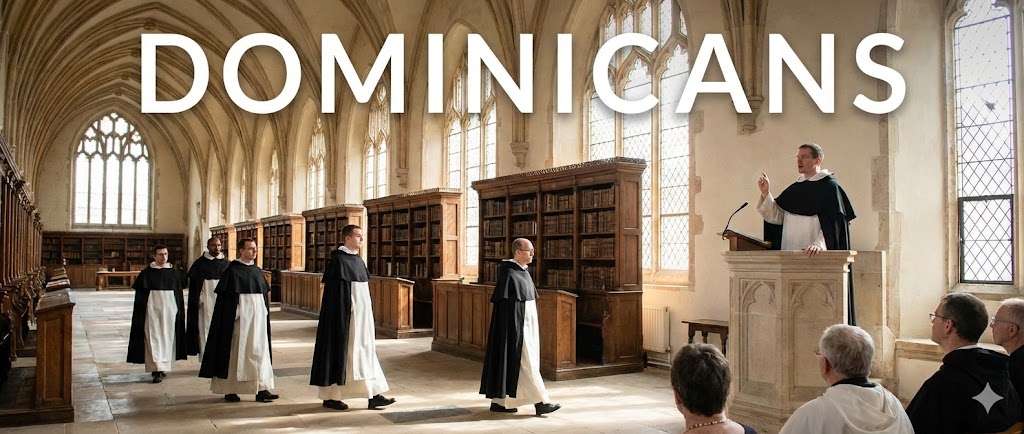
The Dominican Perspective (OP)
- Core Charism: Veritas (Truth), Preaching, and Intellectual Clarity.
- The Hook: “Grace Perfects Nature; It Does Not Destroy It.”
- The Approach: A Dominican homily would likely tackle the theological puzzle of “Fulfillment vs. Abolition” (Matt 5:17). They love to explain why the rules exist.
- Application: They would use St. Thomas Aquinas (a Dominican) to explain that the New Law is not a list of harder rules, but the grace of the Holy Spirit given to us through faith. They would focus on the virtue of Truthfulness regarding oaths—how our speech must align with reality.
- Key Phrase: “Christ does not lower the bar; He gives us the ladder. The Law shows us the goal, but Grace gives us the strength to reach it.”

The Franciscan Perspective (OFM / Capuchin)
- Core Charism: Fraternity, Peacemaking, and Simplicity.
- The Hook: “The Altar Can Wait; Your Brother Cannot.”
- The Approach: A Franciscan homily would likely zero in on Jesus’ command about anger and reconciliation (Matt 5:23-24). St. Francis was obsessed with “minority”—being the “lesser” brother.
- Application: They would preach that true holiness isn’t just about personal purity; it’s about relationship. If you are holding a grudge, your “gift at the altar” (your worship) is hollow.
- Key Phrase: “The Gospel demands we be the first to apologize, the first to drop the stone, and the first to seek peace. The law of the Gospel is the law of love.”

The Jesuit Perspective (SJ / Ignatian)
- Core Charism: Discernment of Spirits, Magis (The More), and Finding God in All Things.
- The Hook: “The Anatomy of a Sin.”
- The Approach: An Ignatian homily would focus on the interior movements of the heart (1 Cor 2:10 – “The Spirit scrutinizes everything, even the depths of God”). St. Ignatius taught that sin starts long before the action.
- Application: They would treat the Gospel as a lesson in spiritual psychology. Jesus is asking us to examine the roots: Why am I angry? What is the source of this lust? A Jesuit would ask the congregation to do a “Deep Dive” (an Examen) into the hidden motives behind their daily actions.
- Key Phrase: “Jesus is not just regulating our hands; He is healing our desires. We must discern the difference between a righteous ‘Yes’ and a worldly compromise.”

The Redemptorist Perspective (CSsR)
- Core Charism: Moral Theology, Mercy, and Preaching to the Ordinary Person.
- The Hook: “The Impossible Standard and the Copious Redemption.”
- The Approach: Founded by St. Alphonsus Liguori (the patron saint of moral theologians), a Redemptorist would address the anxiety this Gospel might cause. “If looking with lust is adultery, who can be saved?”
- Application: They would preach a balanced message: The standard is high (Jesus means what He says), but the remedy (Confession and Mercy) is always available. They would warn against scrupulosity (obsessing over every stray thought) while encouraging a sincere effort to avoid “occasions of sin.”
- Key Phrase: “Jesus reveals the high cost of love not to condemn us, but to show us how much we need a Savior. Do not despair at the height of the mountain; just take the next step.”
ASK THE CATHOLIC ASSISTANT FOR HELP
On every page of the website in the bottom right hand corner, you have access to THE WORD THIS WEEK Catholic Assistant. Click the ellipsis on the right side of the header to CLEAR CHATS and/or access earlier chats.
Copy and paste into the assistant any sentence or paragraph on the page you are looking at to expand content and learn more, or ask you own questions.
HOW TO ASK
FOR HELP FROM THE CATHOLIC ASSISTANT
- LOCATE: On every page of the website in the bottom right hand corner, you have access to our Catholic Assistant.
- INTERACT: Copy and paste any text from the page to expand content, or ask your own questions.
- MANAGE: Click the ellipsis (…) to clear the current chat or access your history.
Write with Confidence
and Depth
Use this as a tool, not a crutch. Your congregation needs to hear your voice, so be sure to make it your own.
- A homily draft to serve as your foundation. Please edit and adapt the text to suit your preaching style. (This is designed to be a springboard for your own reflection, not a substitute for it!)
- A detailed outline with timing, transitions, and suggested Scripture quotes to read. It’s a head start, not a free ride—you still need to do the work to make it authentically yours.
- A concise “one-minute homily” or a short exhortation for an assembly announcement.
- Help editing a homily you already wrote: I’ll give a homiletic review (strengths, weaknesses, structural suggestions) and a revised draft.
What it needs from you to begin
- Which Sunday or readings
- Desired length (3–5, 6–8, or 10–12 minutes).
- Tone you want (pastoral, scholarly, conversational, fiery, gentle).
- Any personal stories, parish context, or local examples you want included.