Homilies
Homilies
March 8, 2026
March 8, 2026
3rd Sunday of Lent (A)




💫 2026 AI Generated
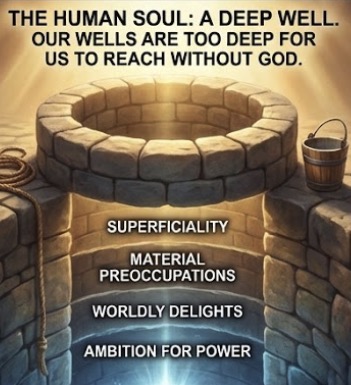
Thirst and the Human Soul
This episode focuses on four homilies from TWTW contributors for the Third Sunday of Lent on Jesus’ conversation with the woman at the well.
- Give Me a Drink – Fr. Michael Chua
- Is the Present Bleak for You? – Fr. Irvin
- The Thirsty Soul – Bishop Barron
- Just A Little Talk With Jesus Makes it Right – Msgr. Charles Pope
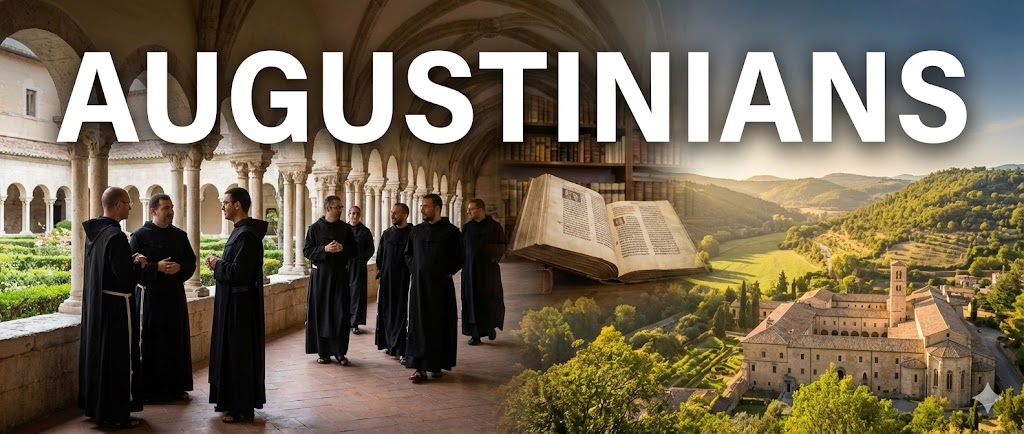
Core Charism: Interiority (searching for God within), community life (“one mind and one heart on the way to God”), and the restless heart that finds repose only in God.
3rd Sunday of Lent (A)
This Sunday’s Hook: “Our hearts are restless until they rest in Thee.”
The Approach: An Augustinian homily centers on Interiority and Longing. Augustine famously described sin as amor curvatus in se (love curved inward). The preacher would describe the woman’s journey as a picture of the human condition: trying to fill an infinite abyss with finite things. The “well” is inside us. We must enter into our own hearts to find the God who is “more intimate to me than I am to myself.”
Application: Look inward. Admit that the things of this world cannot make you happy. Let your restlessness drive you to God rather than to distraction.
Key Phrase: “You were with me, but I was not with you. You called, and broke through my deafness.”

Core Charism: Ora et Labora (Prayer and Work), Stability, Hospitality, Lectio Divina, Listening with the “ear of the heart.”
3rd Sunday of Lent (A)
This Sunday’s Hook: “If today you hear his voice, harden not your hearts.” (Psalm 95)
The Approach: A Benedictine homily would focus on Listening and Stability. The woman at the well was restless, moving from man to man. Jesus offers her a place to stand. The homily might focus on the rhythm of the encounter—it happened in the mundane routine of daily chores (drawing water). God speaks not in the earthquake, but in the daily labor. There is also a strong theme of hospitality: Jesus asks to be received as a guest in her life.
Application: Practice Lectio Divina (divine reading) this week. Slow down. Stop running from well to well. Find God in the stability of your daily routine and the people you live with.
Key Phrase: “Listen with the ear of your heart in the routine of the day.”

Core Charism: Contemplation, The Desert, Prayer as Friendship, The Dark Night, Elijah, St. Teresa of Avila.
3rd Sunday of Lent (A)
This Sunday’s Hook: “The Desert of the Soul.”
The Approach: A Carmelite homily would focus on the Mystical Journey of Prayer. The “desert” of Exodus is not a punishment, but a necessary purification where God strips away distractions so we can hear Him. St. Teresa of Avila often used the image of “watering the garden” of the soul. The homily would distinguish between the “water we draw” (active prayer/meditation) and the “rain from heaven” (infused contemplation) that God gives when we are passive and open.
Application: Do not be afraid of silence or dryness in prayer (the desert). Stay at the well. Wait for Him. Prayer is simply “being alone with the One who we know loves us.”
Key Phrase: “God leads us into the desert to speak to our hearts.”

Core Charism: Veritas (Truth), Preaching, Study, Combatting Error with Clarity, Contemplation passed on to others.
3rd Sunday of Lent (A)
This Sunday’s Hook: “You worship what you do not know; we worship what we understand.”
The Approach: A Dominican homily would focus on the Theology of Grace and Truth. It would likely analyze the doctrinal error of the Samaritans (worshipping on the wrong mountain, rejecting the prophets) versus the fullness of revelation in Christ. The preacher would explain what “Living Water” actually is (Sanctifying Grace) and how it changes the soul from the inside. It is an intellectual and catechetical deep dive into why truth matters—because you cannot truly love what you do not know.
Application: Study your faith this Lent. Don’t be satisfied with a vague or superstitious spirituality (“Samaritan worship”). Seek the Truth, because the Truth is a Person who wants to set you free.
Key Phrase: “Worship must be grounded in Spirit and in Truth.”
Coming Soon!

Core Charism: Poverty, Minority (being “lesser”), Fraternity, and finding God in the grit of humanity and creation.
3rd Sunday of Lent (A)
This Sunday’s Hook: “God is thirsty.”
The Approach: A Franciscan homily would focus intensely on the humanity and vulnerability of Jesus. It is shocking that the Creator of the universe sits down, dusty and tired, and has to beg a creature for a drink. This flips the power dynamic. Franciscans would also likely highlight the solidarity with the poor; the “thirst” of the Israelites is echoed today in those who lack clean water or basic dignity. The “Living Water” is free—it cannot be bought, only received by those humble enough to admit they are empty.
Application: Don’t be afraid to be weak. Don’t be afraid to ask for help. Jesus wasn’t. Also, look for the thirsty Jesus in the poor around you this week.
Key Phrase: “The Humility of God is found in his thirst.”

Core Charism: Ad Maiorem Dei Gloriam (For the Greater Glory of God), Discernment of Spirits, Finding God in All Things, Imaginative Contemplation.
3rd Sunday of Lent (A)
This Sunday’s Hook: “What are you really thirsty for?”
The Approach: An Ignatian homily would use Imaginative Gospel Contemplation. The preacher might invite the congregation to close their eyes, feel the heat of the noon sun, smell the dust, and feel the weight of the jar. The focus would then shift to discernment of desires. The woman is trying to satisfy a deep spiritual ache with “disordered attachments” (the five husbands). Jesus helps her identify the deeper desire beneath the surface.
Application: Conduct a mini “Examen” of your life. What “wells” are you going to that keep running dry (career, status, material goods)? Identify the deeper thirst that only Christ can satisfy.
Key Phrase: “Disordered affections leave us thirsty; God alone satisfies the deep desire.”
Coming Soon!

Core Charism: Preaching “Plentiful Redemption” (Copiosa Redemptio), especially to the abandoned and sinners; Moral Theology (St. Alphonsus Liguori).
3rd Sunday of Lent (A)
This Sunday’s Hook: “While we were still sinners, Christ died for us.” (Romans 5)
The Approach: A Redemptorist homily is often Kerygmatic and Emotional. It would zoom in on the woman’s shame and her status as an outcast. She is the “abandoned” one. Jesus breaks every social rule to reach her. The focus is heavily on Romans 5: God didn’t wait for her to fix her marriage situation before offering her grace. He offered it in the middle of her mess. It emphasizes the abundance of God’s mercy over the severity of human sin.
Application: Go to Confession. Do not let shame keep you away. No matter how many “husbands” (sins/idols) you have had, the Redeemer is waiting for you with open arms.
Key Phrase: “With Him there is Plentiful Redemption.”
Featured Homilies
Looking for fresh ideas to expand your homily for this Sunday? This page has over 120 command prompts you can paste into the Catholic Assistant (located in the bottom right corner) to help you refine your homily.
Bishop Robert Barron

2026 HOMILIES | ARCHIVE: 2023 | 2020 | 2017 | 2014 | 2011 | 2005
3rd Sunday of Lent (A)
The Thirsty Soul

Friends, on this Third Sunday of Lent, we are again getting back to spiritual basics, and the first reading from Exodus and the Gospel from John both focus on the symbol of water. Water in the Bible can be a negative symbol of destruction, but it can also be a positive symbol of life—not just physical life but the divine life of grace. Water for thirsty bodies symbolizes the water of grace for thirsty souls.
3rd Sunday of Lent (A)
Featured Homily

The Crown Jewels of Christ

In 2011, on the Sunday following the death of Elizabeth Taylor, Fr. Don weaved the classic filmography of Hollywood icon Elizabeth Taylor with the profound Gospel narrative of the Samaritan woman at the well. By referencing seven of Taylor’s famous movie titles, the homily reframes this biblical encounter as a transformative confrontation with truth and divine love.
Unlike the fleeting men of her past, however, Christ does not shy away from her complicated history; instead, He offers her eternal stability. The homily culminates in a striking metaphor: just as a devoted husband adorns his bride with precious gems, Christ offers the “living water” of eternal life. Fr. Don beautifully links the luster of this living water to the Sacraments of the Church, presenting them as the ultimate spiritual jewels that restore and adorn the human soul with God’s radiant grace.

3rd Sunday of Lent (A)
Fr. Michael Chua

2026 HOMILIES | ARCHIVE: 2023 | 2020 | 2017 | 2014 | 2011
Give Me a Drink

In his 2023 homily, Fr. Chua uses the physical thirst of both Jesus and the woman as a starting point to discuss a deeper, spiritual thirst that resides in every human soul. Fr. Chua contrasts the temporary satisfaction offered by worldly pursuits—symbolized by Jacob’s well—with the eternal fulfillment found in Christ, the “living water.” Drawing on examples from Pope Benedict XVI, St. Augustine, and even H.G. Wells, he argues that humans have an innate longing for God that cannot be satiated by material possessions, fleeting pleasures, or superficial experiences. He concludes by emphasizing that this “living water” is accessible to all who simply ask, as God’s love and grace are deeper than any human need or spiritual emptiness.
GO DEEPER
PROMPTS TO KEEP YOU WRITING
Copy/paste one of these command prompts into the Catholic Assistant (bottom right corner). This tool can help you brainstorm and provide you with further ideas to keep you writing.
_
- Write a theological reflection on the Samaritan woman. Contrast Jesus' thirst for our salvation with humanity's unquenchable thirst for love. Emphasize that only Christ's living water satisfies this deep longing.
- Expand on the symbolism of Jacob's well representing worldly pleasures like technology and immorality. Explain that like Jacob's passionate nature, our deep human thirst cannot be quenched by earthly waters.
- Write an essay connecting the Samaritan woman's thirst to Pope Benedict’s 2011 World Youth Day address. Describe the modern spiritual desert and our deeper longing for goodness, beauty, and truth.
- Compare the Samaritan woman's search for fulfillment to St. Augustine’s restless heart and H.G. Wells' "God-shaped vacuum." Describe how false philosophies fail, but Christ’s living water perfectly satisfies human weariness.
- Create a reflection on the human soul as a deep well. Explain that beneath material superficiality lies an aquifer of God's love, accessible without a rope—we only need to ask.
- Explore the irony of Jesus asking for a drink at Jacob’s well. Detail how this mundane conversation starter shifts to reveal the Samaritan woman's deep spiritual emptiness and Christ's solution.
- Discuss how society substitutes novelty for true goodness, beauty, and truth. Use the biblical woman at the well to illustrate choosing Christ's endless living water over the world's broken cisterns.
- Analyze Jacob as an intensely "thirsty" character who wrestled angels. Contrast his historical well with the eternal living water Jesus offers the spiritually parched Samaritan woman to cure her emptiness.
- Meditate on the profound mystery that God thirsts for us. Connect Jesus asking for water at the well to His thirst on the cross, emphasizing His desire for our ultimate liberation.
- Trace the Samaritan woman's shift from sarcasm about lacking a bucket to conceding her need for living water. Highlight this as a universal journey from worldly skepticism to spiritual surrender.
3rd Sunday of Lent (A)
Dominican Blackfriars
2026 HOMILIES | ARCHIVE: 2023 | 2020 | 2017 | 2014 | 2011 | 2008 | 2005 | 2002
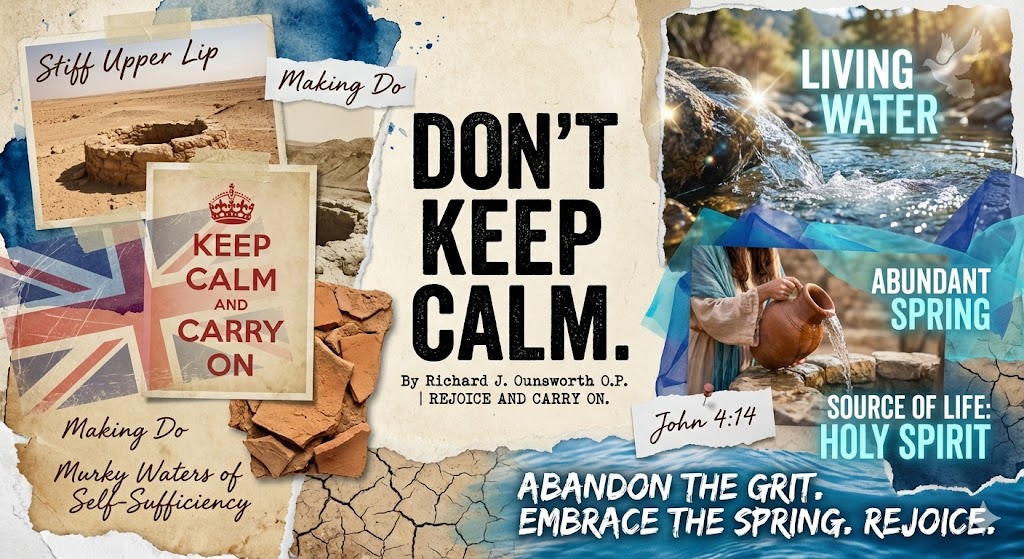
Don’t Keep Calm

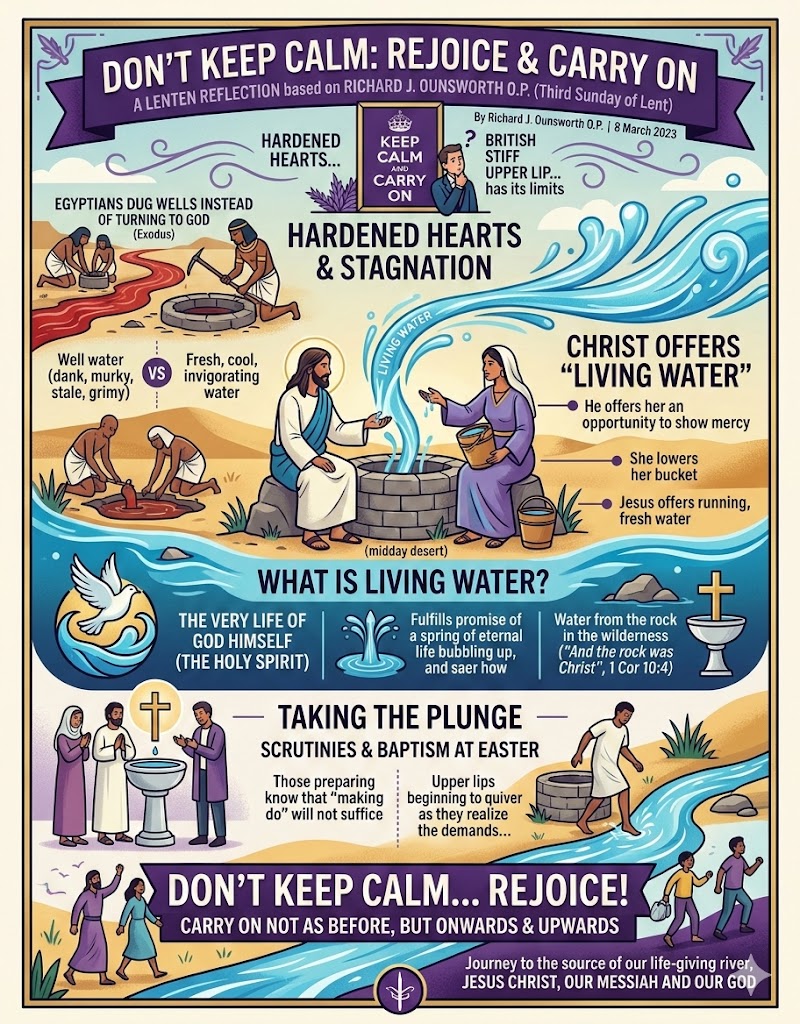
In “Don’t Keep Calm,” Fr. Richard Joseph Ounsworth O.P. challenges the “stiff upper lip” mentality that often hinders spiritual transformation. Drawing a parallel between the Egyptians’ stubbornness during the plagues and the Samaritan woman at the well, he contrasts the stagnant, “murky” waters of self-sufficiency with the “living water” offered by Christ. While Pharaoh’s people chose to dig wells rather than acknowledge divine power, the Samaritan woman recognizes that the time for “making do” is over. Fr. Ounsworth posits that the Holy Spirit—prefigured by the water from the rock in the wilderness—is the true source of life that surpasses human endurance. For those approaching baptismal scrutinies, this message is a call to abandon the stoic “Keep Calm and Carry On” mantra. Instead, believers are invited to “rejoice and carry on,” trading the grit of worldly perseverance for the abundant, bubbling spring of eternal life found only in Jesus Christ.
GO DEEPER
PROMPTS TO KEEP YOU WRITING
Copy/paste one of these command prompts into the Catholic Assistant (bottom right corner). This tool can help you brainstorm and provide you with further ideas to keep you writing.
_
- The Hardened Heart: Write a reflection comparing the Egyptians digging murky wells during the Nile's blood plague to the "Keep Calm and Carry On" mindset, ignoring divine miracles to maintain the status quo.
- Stagnant vs. Living Water: Contrast stale, murky well water with fresh, life-giving spring water. Use this physical imagery to explore how human workarounds fail compared to the pure, invigorating spiritual life God offers.
- An Invitation to Mercy: Describe Jesus meeting a Samaritan woman at midday. Frame his request for a drink from Jacob's well as a deliberate opening gambit allowing her to show mercy to a stranger.
- Prefiguring the Spirit: Connect Christ’s offer of living water to the Samaritan woman with St. Paul’s teaching in 1 Corinthians 10:4, showing how the rock in the wilderness prefigured the Holy Spirit.
- The Echo of Baptism: Explain how Jesus’s conversation at the well foreshadows Christian baptism. Describe how this encounter reveals his promise of an eternal spring of living water bubbling up within new believers.
- Spiritual Intuition: Detail how the Samaritan woman intuitively grasps the superiority of a fresh spring over a stagnant well, sensing an extraordinary divine encounter even before Jesus reveals his true identity.
- Beyond Human Grit: Contrast a "Make Do and Mend" wartime mentality with Christ’s radical demands. Explain why relying on stoic human endurance is insufficient when faced with the promise of living water.
- Taking the Plunge: Write a message for catechumens preparing for Easter scrutinies. Highlight their brave decision to abandon the stagnant waters of ordinary life and dive into the demanding, life-giving Christian waters.
- The Demands of Faith: Explore the anxiety of embracing a new spiritual life. Acknowledge how one's lip might quiver when realizing the profound, life-altering demands required after accepting Christ's abundant, living Spirit.
- Rejoice and Carry On: Transform a stoic cultural meme into a spiritual call to action. Urge believers to "rejoice and carry on," journeying upwards toward Jesus Christ, the ultimate source of life-giving water.
3rd Sunday of Lent (A)
Fr. Austin Fleming
2026 HOMILIES | ARCHIVE: 2023 | 2020 | 2017 | 2014 | 2011 | 2008
167 Hours Between Sundays

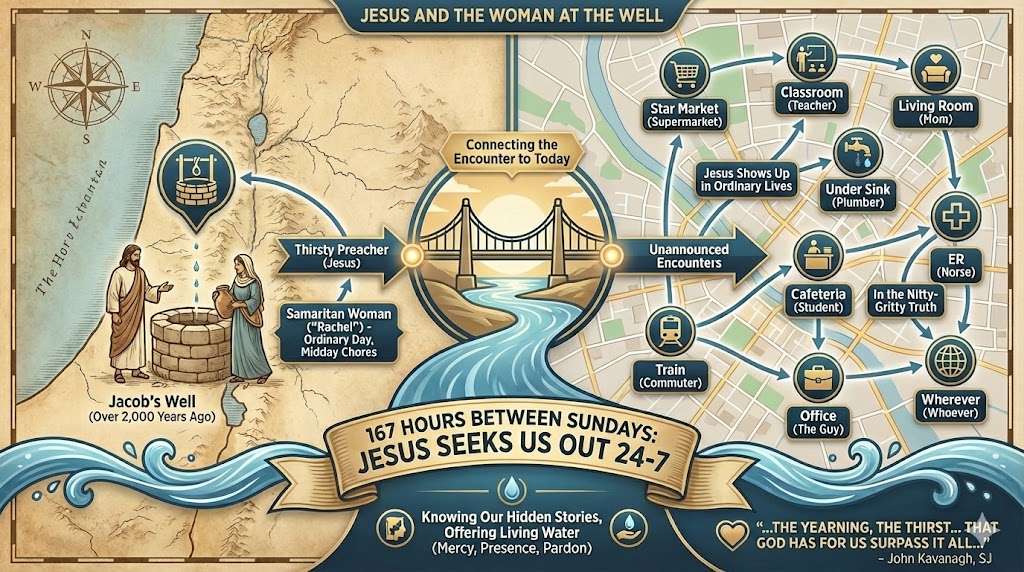
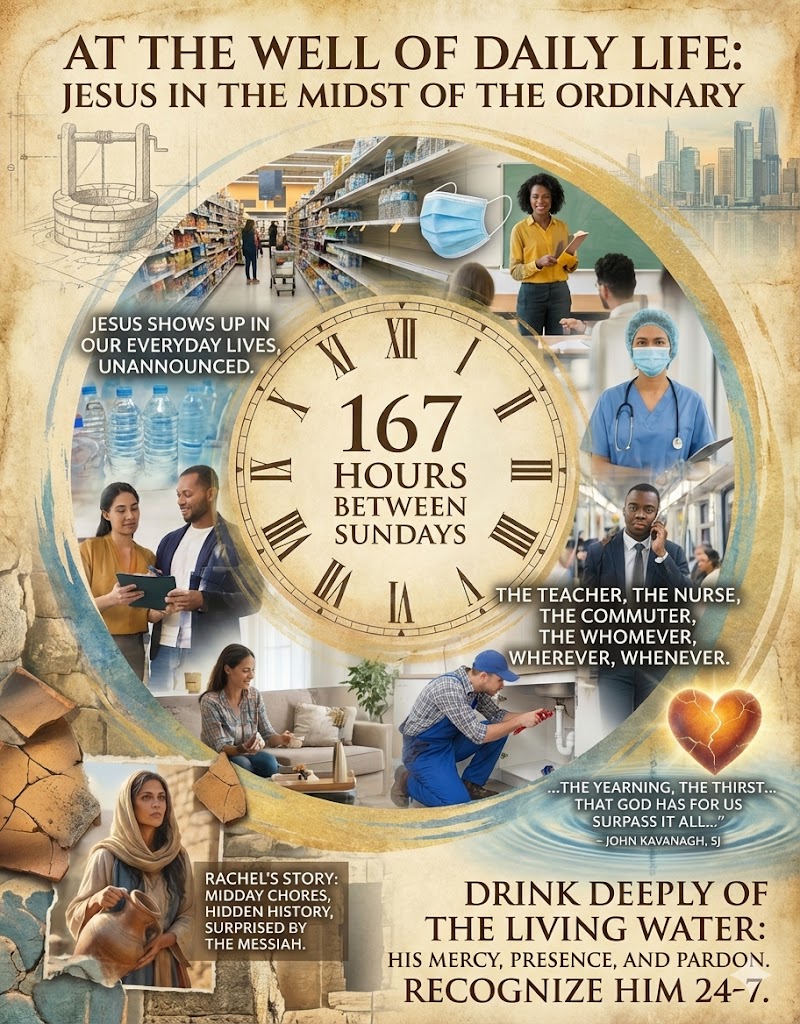
In his 2020 homily, Fr. Fleming reflects on the Gospel encounter between Jesus and the Samaritan woman at the well, whom he names “Rachel.” He emphasizes that this pivotal meeting occurred not in a holy place, but during the routine tasks of an ordinary day. Fleming uses this to illustrate that Jesus actively seeks to meet people within the “nitty-gritty truth” of their everyday circumstances—whether in the workplace, household, or facing contemporary anxieties like the emerging coronavirus pandemic.
Fr. Fleming argues that just as Jesus knew Rachel’s hidden history yet still offered her the “living water” of mercy, He knows our flaws fully and still seeks us out during the 167 hours between Sunday Masses. The homily challenges believers to recognize Jesus interrupting their daily routines, offering his presence, love, and pardon without waiting for them to seek Him first.
GO DEEPER
PROMPTS TO KEEP YOU WRITING
Copy/paste one of these command prompts into the Catholic Assistant (bottom right corner). This tool can help you brainstorm and provide you with further ideas to develop your homily.
_
- The Modern Grocery Encounter: Rewrite the biblical story of the Samaritan woman, renaming her Rachel. Place her encounter with Jesus in a modern grocery store where she seeks water during a viral pandemic panic.
- The Midday Avoidance: Describe "Rachel" going to a well at noon to avoid the judgmental whispers of her town. Explain how Jesus takes her completely by surprise during her ordinary daily household chores.
- The 167 Ordinary Hours: Write a reflection asking how often Jesus approaches us unannounced in our daily routines. Focus on the 167 hours between Sunday services where he seeks to change our hearts.
- Christ in Everyday Roles: Expand on the idea of finding God in ordinary people. List modern equivalents to the biblical well encounter, such as a teacher, plumber, nurse, commuter, or mom in her living room.
- Concealing Personal History: Detail how Jesus confronts a woman named Rachel about her hidden past mistakes and failed search for love. Show how facing her nitty-gritty truth allows her to receive divine mercy.
- God's Infinite Thirst: Draft a spiritual reflection based on John Kavanagh's insight. Emphasize that God’s exhausting journey into our hearts and His yearning for us infinitely surpasses our own thirst for Him.
- Known Yet Loved: Write about how Jesus knows every hidden mistake and failure we try to conceal. Explain that despite this complete knowledge, He still seeks us out to offer pardoning, living water.
- Bumping into the Divine: Create a reflection on recognizing Jesus when he intentionally "bumps into" us at work, school, or home. Challenge the reader to stop hiding and accept His gift of living water.
- Strength in Anxious Times: Write an exhortation about gathering on the Lord's Day to hear the scriptures. Explain how this strengthens believers to recognize Christ's voice in daily life, even amidst a menacing virus.
- Worship in Spirit and Truth: Conclude a reflection by comparing modern believers to Rachel. Emphasize coming to worship because we have met a Savior who knows everything we’ve ever done but forgives and loves us anyway.
3rd Sunday of Lent (A)
Monsignor Peter Hahn

2026 HOMILIES | ARCHIVE: 2023 | 2020 | 2017 | 2014
From Slavery to Eternal Life

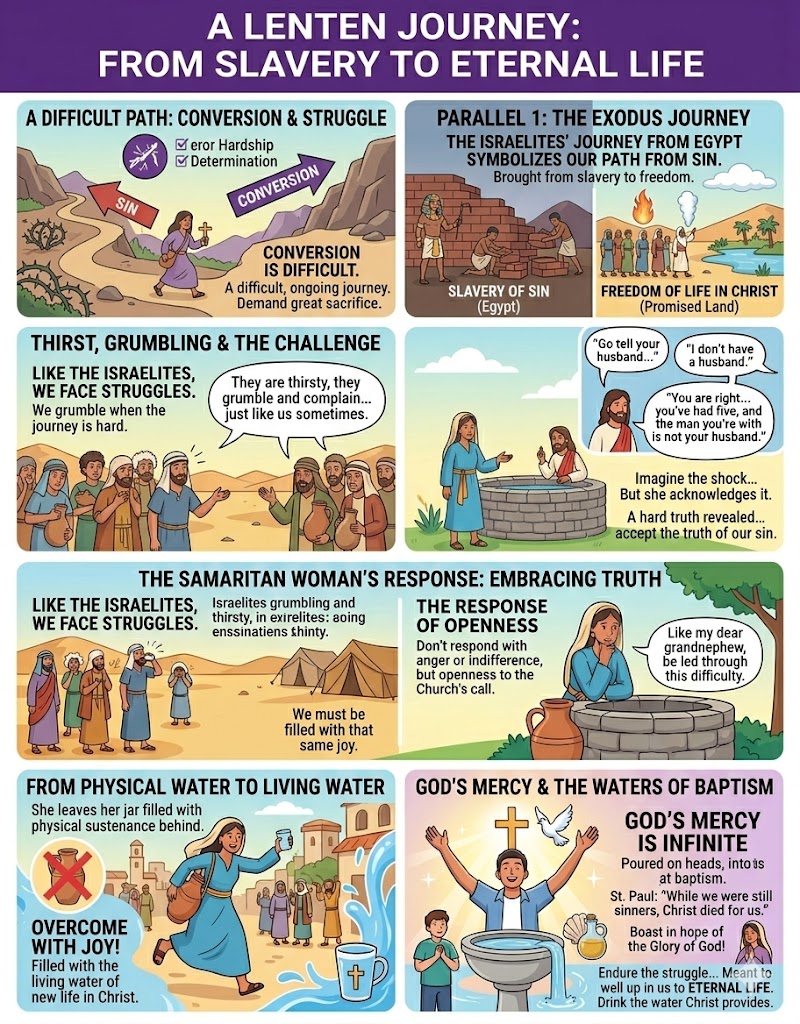
In his 2017 homily, Msgr. Hahn explores the themes of acknowledging sin and the difficult journey of conversion. Opening with a humorous anecdote about his young grandnephew trying to “give up sinning” for Lent, Hahn illustrates the necessity of recognizing one’s own faults. He connects this to the Gospel encounter at the well, where Jesus confronts the Samaritan woman with the uncomfortable truth of her past.
Hahn parallels the spiritual journey of conversion to the Israelites’ difficult Exodus from Egyptian slavery, noting human tendencies to grumble when facing hard truths. However, he holds up the Samaritan woman as the ideal model: she accepts the difficult truth from Jesus and is consequently filled with joy and “living water.” Hahn concludes by urging believers to embrace the struggle of admitting sin to fully receive God’s infinite mercy and the promise of eternal life first poured out in baptism.
GO DEEPER
PROMPTS TO KEEP YOU WRITING
Copy/paste one of these command prompts into the Catholic Assistant (bottom right corner). This tool can help you brainstorm and provide you with further ideas to develop your homily.
_
- Out of the Mouths of Babes: Write a reflection starting with an anecdote about a seven-year-old boy who "gave up sinning for Lent but it's not working." Use this to illustrate the universal need to humbly acknowledge our sins.
- Confronting Hard Truths: Describe Jesus surprising the Samaritan woman by revealing she has had five husbands. Compare her shock to our own discomfort when we are forced to confront the hidden reality of our sins.
- Responding to Conviction: Explore how the Samaritan woman remained open to dialogue after her sins were exposed. Challenge readers to respond with similar openness, rather than anger or indifference, when called to repentance during Lent.
- The Journey to Freedom: Contrast the grumbling Israelites in the Exodus desert with the joyful Samaritan woman. Explain that moving from the slavery of sin to life in Christ requires enduring a difficult, sacrificial journey.
- Leaving the Jar Behind: Detail the Samaritan woman abandoning her water jar. Explain how this symbolizes leaving behind mere physical sustenance to joyfully embrace the living water of new life in Christ and share it.
- Boasting in Hope: Write a theological reflection using St. Paul's teaching that Christ died for us while we were still sinners. Show how acknowledging our faults leads directly to experiencing God's infinite, joy-filled mercy.
- The Poured-Out Spirit: Focus on the perfect love poured into our hearts by the Holy Spirit. Explain how accepting the painful truth of our sinfulness makes room for this divine love to bring ultimate joy.
- The Spring of Baptism: Connect the living water Jesus offers to the sacrament of baptism. Emphasize that enduring the struggle of conversion allows this never-ending spring, first poured on our heads, to well up to eternal life.
- The Lenten Struggle: Draft a Lenten message emphasizing that ongoing conversion is difficult. Use the parallel of a child admitting failure in avoiding sin to show that honest struggle is necessary to receive Christ's living water.
- Joyful Evangelism: Narrate the Samaritan woman’s transformation from a confronted sinner to an excited evangelist. Highlight how she runs into town to proclaim her life-changing experience, challenging modern believers to share that same joyful transformation.
3rd Sunday of Lent (A)
Fr. Charles E. Irvin

Is the Present Bleak for You?

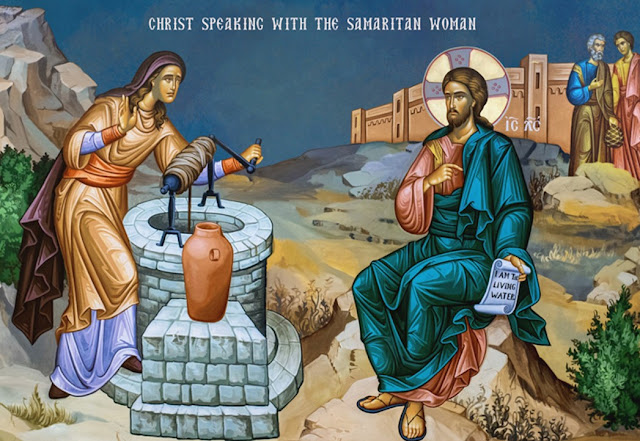
Fr. Irvin’s homily uses Fantine’s lament about lost dreams from Les Misérables to explore the roots of human despair. He draws a parallel to the Exodus Israelites, who, despite liberation, desired a return to Egyptian slavery when faced with present hardships. Irvin identifies two primary drivers of this despair: a nostalgic, revisionist view of the past that ignores its negative aspects, and the false belief that current suffering is permanent. He argues that wallowing in self-pity is a form of modern bondage. Conversely, Irvin asserts that the Catholic faith is inherently future-oriented. He emphasizes that God is a God of power and change, and the Sacraments are moments of grace looking ahead, not backward to the “Egypt” of past bondage. He concludes that through Christ’s resurrection and Holy Communion, believers are offered a journey toward a “Promised Land,” rather than remaining trapped by past regrets or static present circumstances.

GO DEEPER
PROMPTS TO KEEP YOU WRITING
Copy/paste one of these command prompts into the Catholic Assistant (bottom right corner). This tool can help you brainstorm and provide you with further ideas to develop your homily.
_
- The Song of Despair: Write a reflection using Fantine’s lament from Les Misérables to explore how lost innocence and shattered dreams lead to deep human despair, comparing it to personal feelings of hopelessness.
- Returning to Slavery: Compare the Israelites wanting to return to Egyptian slavery with modern struggles like addiction and self-pity. Emphasize how despair tempts us back into familiar but destructive bondage.
- The Rose-Colored Past: Explain the danger of false nostalgia. Detail how people romanticize the past—claiming harder work or perfect family Sundays—while conveniently forgetting historical hardships, traumas, and moral failures.
- The Illusion of Permanence: Address the lie that our current bleak situations, like loneliness or a bad marriage, will never improve. Use the Israelites in the wilderness to illustrate this trap of stagnant thinking.
- Water from the Rock: Write about God's power to transform our future. Emphasize that if God can draw water from a stone, He can change our seemingly hopeless circumstances and move us forward.
- Sacraments of Transformation: Describe how Catholic Sacraments are profound moments of change and grace. Explain that true faith is always oriented toward a hopeful future, not just celebrating the present or past.
- Out the Church Doors: Explain the symbolic purpose of church doors. We receive Holy Communion to be transformed, then walk out into the world to build a better future, never retreating to past spiritual slavery.
- Christ's Answer to Despair: Contrast Fantine’s song about a "living hell" with Christ's descent into hell and resurrection. Show how Jesus overcomes our shattered dreams, offering a new life through Holy Communion.
- Getting Egypt Out of Us: Reflect on the phrase that it took weeks to get the Israelites out of Egypt, but forty years to get Egypt out of them. Apply this to breaking ingrained destructive habits.
- Journey to the Promised Land: Draft a message of hope asserting that with God, we are never stuck. Emphasize that faith is a forward-moving journey toward the potential and promises God envisions for us.
3rd Sunday of Lent (A)
Fr. Joe Jagodensky, SDS
Transition?

Fr. Joe Jagodensky explores the painful disorientation of abrupt job loss. Writing from Wisconsin, Jagodensky rejects the sanitized “expert” term “transition,” preferring to describe his current state as being stuck in a “deep hole” without a ladder. He struggles with the advice to “finish the past” when his career was coldly terminated by corporate standards, unappreciative of his years of service. Jagodensky notes that well-meaning advice to “give yourself time” feels burdensome when excess time leads only to apathy, staring spells, and procrastination. He argues that the word “transition” implies a blending of past and present, whereas his current situation is fixed solely on the trauma of the past. True transition, he asserts, can only begin once a new position is secured. He concludes with a metaphor contrasting the harsh light of his present reality with the sleeping dream of his next step.
GO DEEPER
PROMPTS TO KEEP YOU WRITING
Copy/paste one of these command prompts into the Catholic Assistant (bottom right corner). This tool can help you brainstorm and provide you with further ideas to develop your homily.
_
- The Desert of Job Loss: Rewrite the reflection on corporate firing as a modern wilderness experience. Like the Israelites in Exodus 17 grumbling about thirst, explore the frustrating, motionless "hole" of unexpected unemployment.
- Staring Down the Deep Well: Expand the author's feeling of being stuck in a "hole" without a ladder. Connect this emotional paralysis to the Samaritan woman's deep well in John 4, seeking living water.
- The Mirage of Transition: Relate the hollow corporate word "transition" to the Israelites' bitter wandering in Exodus 17. Describe the struggle of clinging to the past while staring into an empty, uncharted future.
- Leaving the Past Behind: Focus on the forced "finishing" of a career. Relate this abrupt ending to John 4, where the Samaritan woman must abandon her past relationships to embrace a new beginning.
- Thirsting for a Ladder: Rewrite the experience of having too much empty time and staring blankly. Compare this draining stagnation to the agonizing spiritual thirst of the Israelites at Rephidim in Exodus 17.
- The Noon-Day Stare: Expand the author's avoidance of laundry and endless cleaning. Connect this isolating, repetitive routine to the Samaritan woman fetching water at noon in John 4, waiting for divine disruption.
- Dreaming of the Rock: Use the sleeping cat dreaming of the "next step" as a metaphor for hope. Connect this to Moses striking the rock in Exodus 17, unleashing sudden life from barrenness.
- Beyond Corporate Terminology: Contrast meaningless corporate buzzwords like "transition" with the profound truth of "living water" in John 4. Describe how unexpected job loss forces a search for deeper spiritual purpose.
- The Temptation of the Past: Explore the author's frustration with being told to "finish the past." Compare this one-sided focus on a lost job to the Israelites in Exodus 17, desperately wishing for Egypt.
- From Cloudy Sun to Living Water: Expand the opening imagery of cloudy Wisconsin sunsets and laptop glare. Relate this hazy "in-between" stage to John 4, moving from cloudy uncertainty to the clarity of Christ's living wateater.
3rd Sunday of Lent (A)
Deacon Greg Kandra
Looking for fresh ideas? Copy/paste one of these command prompts into the Catholic Assistant (bottom right corner). This tool can help you refine your homily.
_
- The Minister's Return: Rewrite the story of a 72-year-old female Protestant pastor who, after decades away, feels drawn back to her childhood Catholic faith, goes to Confession, and joyfully anticipates receiving the Eucharist.
- Universal Spiritual Thirst: Expand on the metaphor of the Samaritan woman. Explain how humanity universally thirsts for peace, mercy, and wholeness, and how our spiritually parched souls can only be satisfied by Christ.
- Encounters Change Everything: Write a reflection on how encountering Jesus completely transforms a person. Parallel the Samaritan woman finding living water with the healing of the blind, lame, and spiritually dead in the Gospels.
- Foreshadowing Easter: Connect the story of the woman at the well to Mary Magdalene on Easter morning. Detail how both women experienced a life-altering encounter with Christ and immediately ran to tell others.
- The Lenten Desert Journey: Create a Lenten reflection explaining how Ash Wednesday invites us into the desert. Describe how our spiritual thirst during this penitential season prepares us to receive Christ's living water.
- The Restless Heart: Detail a 72-year-old retired minister's email describing her spiritual reexamination. Explain how an unexpected desire for the Catholic faith led her to Ash Wednesday Mass and a profound meeting with a priest.
- The Joy of Confession: Describe a woman's extraordinary joy after receiving the Sacrament of Reconciliation for the first time in decades. Compare her energetic, sleepless excitement to the Samaritan woman's zeal after meeting Jesus.
- The Irony of the Well: Write a theological exploration of Jesus asking for a drink at the well. Highlight the irony that the Savior offers living water to a woman who doesn't realize she is spiritually parched.
- Coming Home: Draft a piece about the desire to "come home" spiritually. Blend the journey of a retired minister returning to Catholicism with the Samaritan woman's immediate transformation and excitement to share the good news.
- Praying for Catechumens: Conclude a reflection by asking for prayers for a returning 72-year-old minister and all catechumens preparing for Easter. Emphasize how their journey to the Church reflects our own ongoing Lenten conversion.
Thirsting for Living Water
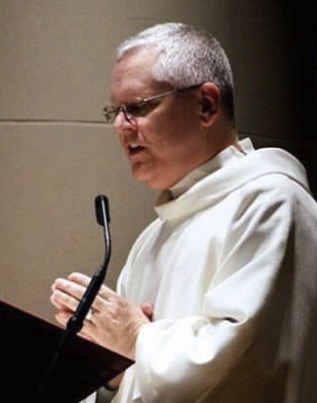
Deacon Greg Kandra’s 2020 homily intertwines a modern conversion story with the Gospel of the Woman at the Well to explore the universal theme of spiritual thirst. He recounts his correspondence with a retired female minister who, after decades away from her Catholic roots, felt drawn back to the Church. Her eventual return to Confession brought her overwhelming joy, mirroring the transformative experience of the Samaritan woman. Kandra argues that we all share this deep thirst for love, mercy, and grace that only Jesus can satisfy. He emphasizes that an encounter with Christ “changes everything,” initiating an ongoing journey of conversion rather than a single event. Seeing parallels between the Samaritan woman and Mary Magdalene sharing the news of the Resurrection, Kandra highlights that this transformative grace cannot be contained, urging prayers for all those currently on their journey home to the Church during Lent.
3rd Sunday of Lent (A)
Fr. Langeh, CMF

Looking for fresh ideas? Copy/paste one of these command prompts into the Catholic Assistant (bottom right corner). This tool can help you refine your homily.
_
- The Gift of Water: Write a reflection on how water is essential for physical life and spiritual health. Explain that cherishing water as God's gift allows us to draw joyfully from salvation's wells.
- Scripture's Flowing Rivers: Expand on the imagery of water framing the Bible. Contrast the Spirit brooding over the waters in Genesis with the crystal-clear river of life flowing from the New Jerusalem in Revelation.
- Moses the Provider: Describe Moses as a dual bearer of water and good news. Detail how he provided physical water from the rock to the complaining Israelites while delivering God's covenant message.
- Tired and Thirsty: Narrate Jesus arriving tired at a well at noontime. Describe his encounter with a Samaritan woman, showing how his simple request for a physical drink introduces his offer of living water.
- Leaving the Jar: Rewrite the story of the Samaritan woman leaving her water jar behind. Emphasize her transformation from a simple water bearer into an apostolic Gospel sharer who evangelizes her entire town.
- The Echo of Thirst: Connect Jesus's noontime thirst at the Samaritan well with his noontime cry of "I thirst" from the cross. Explain how both moments reveal Christ's deep yearning for human souls.
- Answering the Cry: Use Mother Teresa's story to illustrate responding to Christ's thirst. Detail how hearing Jesus say "I thirst" moved her from her comfortable nunnery to serve the streets of Kolkata.
- Love in our Weakness: Draft a theological reflection based on Romans 5. Explain the profound truth that Christ proved God's love by dying for us while we were still helpless, unworthy sinners.
- The Missionary Shift: Explore the overarching theme of moving from a physical water bearer to a spiritual Gospel sharer. Encourage readers to leave their comfort zones to actively bring Christ's message to others.
- Longing for the Divine: Create a concluding prayerful reflection. Focus on the human soul's desperate thirst for God, encouraging believers to seek Him with the intensity of someone needing physical water in a desert.
From Water Bearers to Gospel Sharers
3rd Sunday of Lent (A)
Deacon Peter McCulloch


2026 HOMILIES | ARCHIVE: 2023 | 2020
Our Hungry Hearts
Deacon Peter uses Bruce Springsteen’s “Hungry Heart” to illustrate our universal, deep longing for connection—a divine hunger designed to be satisfied only by God. In the Gospel, Jesus meets the Samaritan woman’s physical thirst with an offer of “living water,” the Holy Spirit, to fill her spiritual emptiness.
Fr. Ronald Rolheiser describes this inner void as “holy longing,” which we often mistakenly try to satiate with fleeting distractions. True peace requires creating space for God. The Samaritan woman exemplifies radical transformation; recognizing the Messiah, she leaves her past behind to become an evangelist. The homily concludes with Joseph Krempa’s warning: during Lent, we must not merely study or admire the “water” of faith. Like the woman at the well, we must actively drink it, moving from intellectual curiosity to a life-sustaining encounter with Christ.

GO DEEPER
PROMPTS TO KEEP YOU WRITING
Copy/paste one of these command prompts into the Catholic Assistant (bottom right corner). This tool can help you brainstorm and provide you with further ideas to develop your homily.
_
- The Universal Hunger: Write a reflection using Bruce Springsteen’s "Hungry Heart" to illustrate our deep longing for belonging. Connect this to God deliberately placing an infinite, purposeful hunger within the human soul.
- The Midday Encounter: Describe an outcast Samaritan woman fetching water at noon. Detail her unexpected encounter with Jesus at Jacob’s well, where he offers her life-giving water for her hidden spiritual struggles.
- The Illusion of Satisfaction: Contrast the fleeting satisfaction of earthly desires, like buying a new car, with our infinite spiritual needs. Explain how only Jesus’ living water permanently quenches this deep soul-thirst.
- The Holy Longing: Explore Ronald Rolheiser’s concept of "holy longing." Explain how our deep-seated desire to love God grows with intentional practice, ultimately leading us to profound peace and divine connection.
- Making Space for Grace: Use the metaphor of trying to attach two fully inflated balloons together. Explain why we must first empty our hearts of worldly attachments to make room for God's love.
- Ending the Aimless Drift: Use lyrics about a river taking a wrong turn to describe aimless worldly drifting. Show how accepting Jesus' living water ends this wandering by fulfilling our profound spiritual emptiness.
- Leaving the Jug Behind: Detail the Samaritan woman’s transformation into St. Photina, "the enlightened one." Describe her pivotal decision to leave her physical water jug behind to travel as an evangelist for Christ.
- The Divine Thirst: Write a Lenten reflection incorporating St. Augustine’s profound insight that Jesus was actually thirsting for the Samaritan woman's faith. Challenge readers to recognize Christ's thirst for their own faith.
- The Danger of Passivity: Draft a strong warning about spiritual passivity. Describe a person who studies, sings, and talks about water but tragically dies of thirst because they refuse to actually drink it.
- The Lenten Call: Connect the story of the Samaritan woman to the current Lenten season. Urge believers to actively drink the refreshing, living water of the Holy Spirit made available in Baptism.er.
3rd Sunday of Lent (A)
Msgr. Charles Pope
Just A Little Talk With Jesus Makes it Right

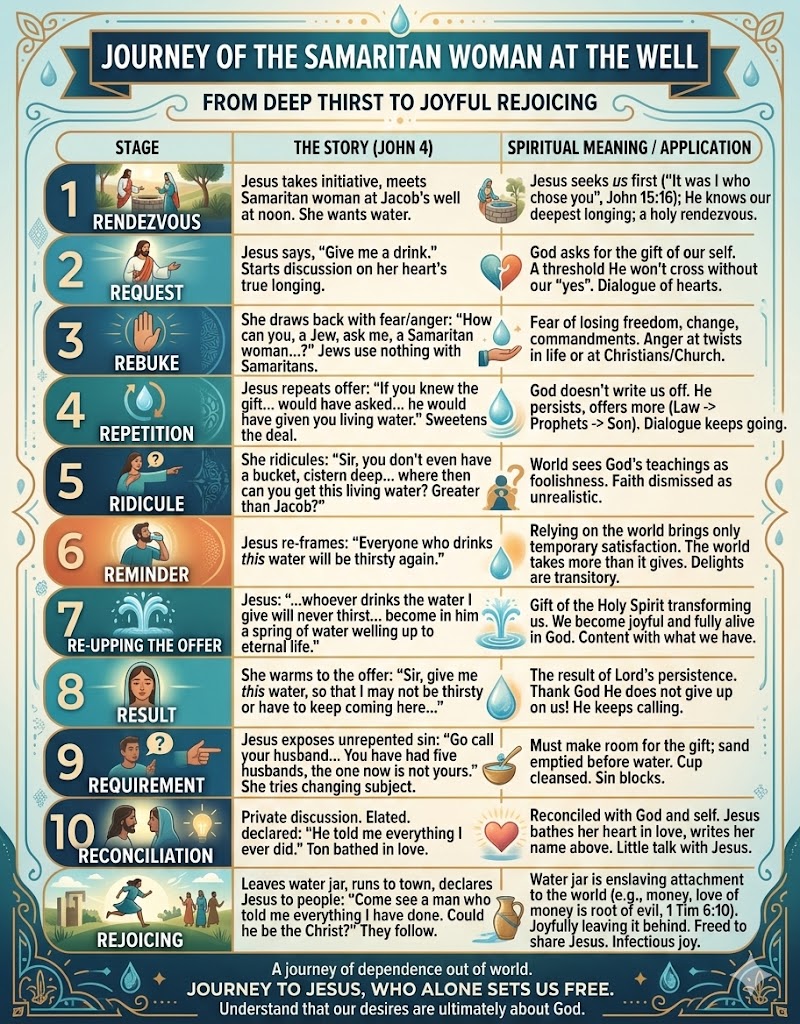
Let’s look at the journey that this woman makes to Jesus. This is the journey of a woman who represents each one of us. This is our journey, out of dependence, out of an enslaving attachment to the world. It is our journey unto Jesus, who alone can set us free. Here is our journey to understand that our desires are ultimately about God.
You can listen to this homily here:
Things start out rough, but in the end she discovers her heart’s truest desire. The journey is made in stages.
Rendezvous, Request, Rebuke, Repetition, Ridicule, Reminder, Re-upping the offer, Result, Requirement , Reconciliation, Rejoicing
GO DEEPER
PROMPTS TO KEEP YOU WRITING
Copy/paste one of these command prompts into the Catholic Assistant (bottom right corner). This tool can help you brainstorm and provide you with further ideas to develop your homily.
_
- The Divine Initiative: Write a reflection on how God initiates encounters with us. Describe Jesus at a well asking a woman for a drink, showing how He desires our self-giving over worldly things.
- Drawing Back in Fear: Explore why we resist God's invitations. Describe a woman at a well reacting with cultural anger to Jesus, mirroring how modern people often distrust God or the Church out of fear.
- God's Patient Persistence: Detail how Jesus responds to hostility by repeating His offer of living water. Explain that despite our rejection and ridicule, God patiently sweetens the deal to maintain a relationship.
- The Foolishness of Faith: Describe a woman mocking Jesus for offering water without a bucket. Use this to illustrate how the modern world often dismisses profound spiritual teachings as fanciful, unrealistic, and foolish.
- The World's Empty Promises: Contrast the temporary satisfaction of worldly delights with eternal joy. Explain that earthly pleasures always leave us thirsty again, while the Holy Spirit provides an ever-growing spring of life.
- Making Room for Grace: Explain that to receive God's gifts, we must confront unrepented sin. Use the metaphor of emptying a sand-filled cup, connecting it to Jesus confronting a woman's five past marriages.
- Healing and Reconciliation: Describe a private, non-accusatory conversation where Jesus helps a woman understand her sinful past. Emphasize how this gentle confrontation leads to profound healing, making her whole and reconciling her.
- Abandoning Worldly Attachments: Focus on a woman leaving her water jar behind to joyfully share Christ with her town. Compare the jar to our modern dependence on money and enslaving worldly attachments.
- Stages of Spiritual Awakening: Outline the gradual journey of conversion. Show how an encounter with Jesus moves from initial fear, skepticism, and deflection, to ultimately recognizing our heart's truest desire for God.
- The Joy of Evangelism: Write about the infectious joy of being freed from worldly burdens. Describe a transformed woman running into town to declare she met the Christ, inspiring others to follow her.
3rd Sunday of Lent (A)
Father Kevin Rettig
2026 HOMILIES | ARCHIVE: 2023 | 2020
Fountain of Youth

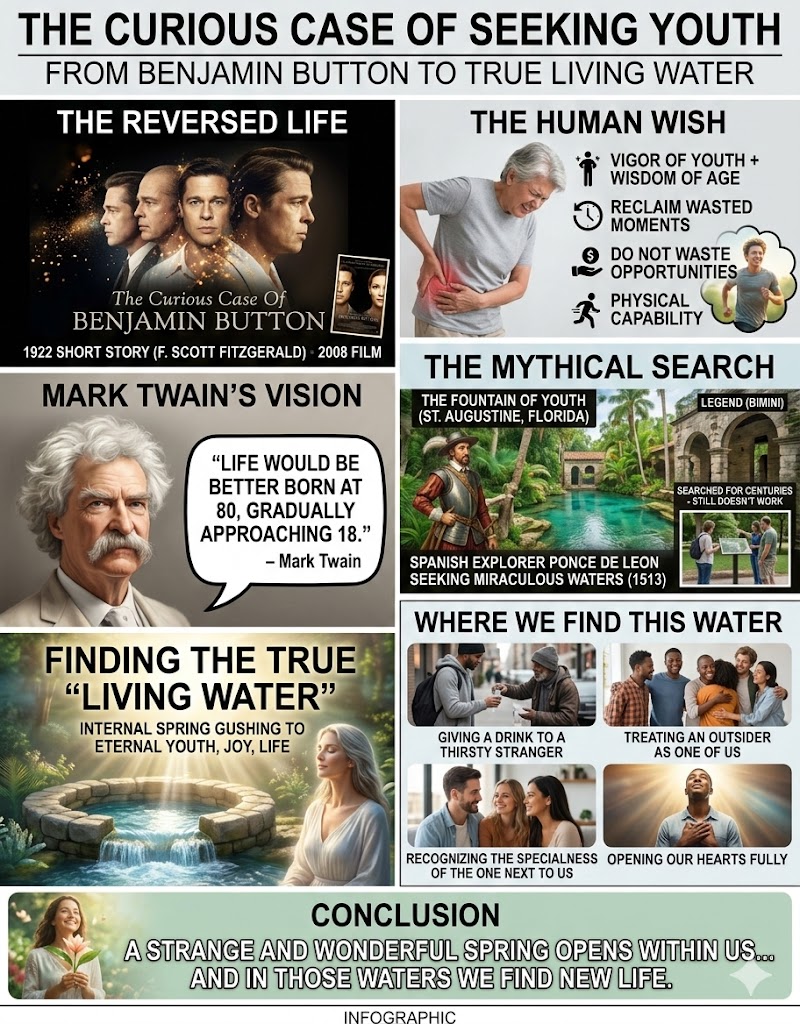
Fr. Kevin Rettig begins by invoking the story of The Curious Case of Benjamin Button and the musings of Mark Twain to illustrate a common human desire: the wish to grow younger rather than older. He describes the physical realities of aging and the longing to reclaim lost vigor while retaining acquired wisdom. This universal quest is mirrored historically in Ponce de León’s search for the Fountain of Youth in St. Augustine, Florida—a site people still visit today in hopes of restoration.
However, Fr. Rettig pivots from this physical search to a spiritual one, drawing a parallel to the Samaritan woman at the well. He suggests that the “Living Water” we truly seek—one that offers eternal life rather than just fleeting youth—is not found in a mythical spring or a distant location. Instead, it is discovered in our daily lives.
GO DEEPER
PROMPTS TO KEEP YOU WRITING
Copy/paste one of these command prompts into the Catholic Assistant (bottom right corner). This tool can help you brainstorm and provide you with further ideas to develop your homily.
_
- The Backward Life: Write a reflection using the concept of someone aging backward. Describe the human desire to combine the physical vigor of youth with the hard-earned wisdom of old age.
- Wasted Moments of Youth: Explore the universal regret of aging. Describe the aches and pains of growing older and the deep wish to re-experience unappreciated moments of youth with newfound perspective.
- Mark Twain's Wish: Draft an essay expanding on the idea that life would be infinitely happier if we were born at eighty and gradually approached eighteen, avoiding the physical decline of aging.
- The Florida Spring: Describe the ongoing human obsession with staying young. Detail how modern tourists still flock to St. Augustine's Fountain of Youth Archeological Park hoping to find restorative, magical waters.
- Ponce de Leon's Quest: Narrate the 1513 Spanish exploration of Florida. Describe the fruitless, desperate search through every river and lagoon for a mythical Fountain of Youth based on native legends.
- The True Fountain: Contrast the futile historical search for a physical fountain of youth with the spiritual quest for "living water." Compare our modern search to the Samaritan woman at the well.
- Eternal Joy: Write a theological reflection explaining that true eternal youth and life cannot be found in a mythical Florida spring, but only through the living water of the Holy Spirit.
- Water for the Stranger: Explain how we find spiritual living water in our daily lives. Describe how giving a drink to a thirsty stranger or welcoming an outsider opens an internal spring.
- The Person Next to Us: Draft a reflection on finding profound spiritual meaning right where we are. Emphasize that recognizing the specialness of the person sitting next to us unlocks new, life-giving waters.
- Opening Our Hearts: Conclude a spiritual message by urging readers to open their hearts as fully as the biblical woman at the well, discovering an internal spring of new, eternal life.
3rd Sunday of Lent (A)
Fr. George Smiga
2026 HOMILIES | ARCHIVE: 2023 | 2020 | 2017 | 2014 | 2011 | 2008 | 2005
Improbable Connections

The story of the Samaritan woman does not guarantee us that we will find Christ in every place. But it tells us that we will find Christ more often, if we look for Christ in every place, if we live our lives with expectation that we about to meet the Lord. If we live with that expectation, it changes the way we approach every situation. We begin to act less out of duty or responsibility and more out of the anticipation of being blessed. Parents begin to help their children with homework, not simply because that is a parent’s responsibility, but because they believe that in such an encounter Christ could teach them something, Christ could touch their hearts. Co-workers begin to listen and be attentive to another not simply to help another but out of the belief that in such an encounter Christ could help them, Christ could show them something about themselves. We begin to address a problem in our family or a misunderstanding in our marriage, not simply because that problem needs to be addressed, but also because we expect that in such an encounter Christ could bless us—Christ could give us reason to be thankful.

GO DEEPER
PROMPTS TO KEEP YOU WRITING
Copy/paste one of these command prompts into the Catholic Assistant (bottom right corner). This tool can help you brainstorm and provide you with further ideas to develop your homily.
_
- The Desert Necktie: Write a parable about a thirsty crash survivor who rejects a necktie salesman, only to find an oasis club requiring a tie. Relate this to improbable avenues of spiritual salvation.
- Unpromising Encounters: Compare a thirsty man needing an improbable necktie to survive with a Samaritan woman finding eternal salvation through an unlikely, bothersome encounter with a Jewish stranger at a well.
- The Bothersome Stranger: Describe a Samaritan woman expecting a frustrating interaction with a Jewish man at a well. Detail how this unpromising nuisance unexpectedly transforms into a life-changing encounter with the Messiah.
- Rushing Past Grace: Write a reflection on how we miss God's presence. Explain how rushing through daily agendas and prejudging others causes us to leave Christ behind in seemingly unpromising situations.
- Anticipating the Divine: Draft a spiritual guide on living with expectation. Explain that if we actively look for Christ in every person and place, ordinary daily situations transform into profound, unexpected blessings.
- Homework and Holiness: Transform the mundane chore of helping children with homework into a spiritual encounter. Explain how parents can anticipate Christ teaching them and touching their hearts through this ordinary responsibility.
- The Office Encounter: Write a reflection on workplace spirituality. Explain how attentively listening to a coworker isn't just a duty, but a profound opportunity for Christ to reveal deep truths about ourselves.
- Resolving Marital Strife: Discuss addressing family problems or marital misunderstandings. Show how approaching these difficult, unpromising situations with the expectation of encountering Christ can lead to unexpected blessings and deep gratitude.
- The Ordinary Day: Create a reflection on finding the Savior in daily life. Emphasize that Christians should never dismiss any person or opportunity, because God frequently touches our hearts through ordinary routines.
- Salvation in the Enemy: Explore the absurdity of finding salvation through an enemy. Compare it to needing a necktie in a desert, showing how God uses the most improbable people to deliver saving grace.
3rd Sunday of Lent (A)