Children, Catholic Home School, Children’s Liturgy of the Word, Catholic Home School
Children, Catholic Home School, Children’s Liturgy of the Word, Catholic Home School
May 3, 2026







LITURGY OF
THE WORD


5th Sunday of Easter (A)
↩️ ↪️ Catholic Women Preach


THE WORD THIS WEEK infographics are created using using GOOGLE’S AI Gemini 2.5 Pro. You are free to use the above infographic in any non-profit ministry. Please give credit to TheWordThisWeek.net and Mary Jo Cole which contributed content.
Jesus Leads and Guides Us – May 3, 2026
Jesus’s Identity and Path to Heaven
Q: What does Jesus mean by calling himself “the way, truth, and life”? A: Jesus identifies himself as the way, truth, and life who guides followers to eternal life in heaven through his teachings, as revealed to his disciples the night before his death.
Q: How does knowing Jesus relate to knowing God the Father? A: Jesus explains that knowing him is the same as knowing the Father because he is one with the Father, requiring faith in this unified relationship.
Jesus’s Promise and Preparation
Q: What specific promise does Jesus make about heaven? A: Jesus promises to prepare a place for each disciple in his Father’s house with many rooms and assures he will return for them.
Disciples’ Role and Works
Q: What works does Jesus expect his followers to accomplish? A: Jesus wants followers to do great things by caring for people, helping the poor, and being kind and loving wherever they are, performing the same works he did.
Q: What greater capability will believers have after Jesus returns to the Father? A: Jesus promises that believers with faith will do the same works he did and even greater things once he goes back to the Father.
Addressing Doubt
Q: How does Jesus respond to Thomas’s doubt about knowing the way? A: Jesus assures Doubting Thomas that following him will place disciples on the right path to heaven, addressing his question about how to know the way.
↩️ ↪️ Jeff Cavins

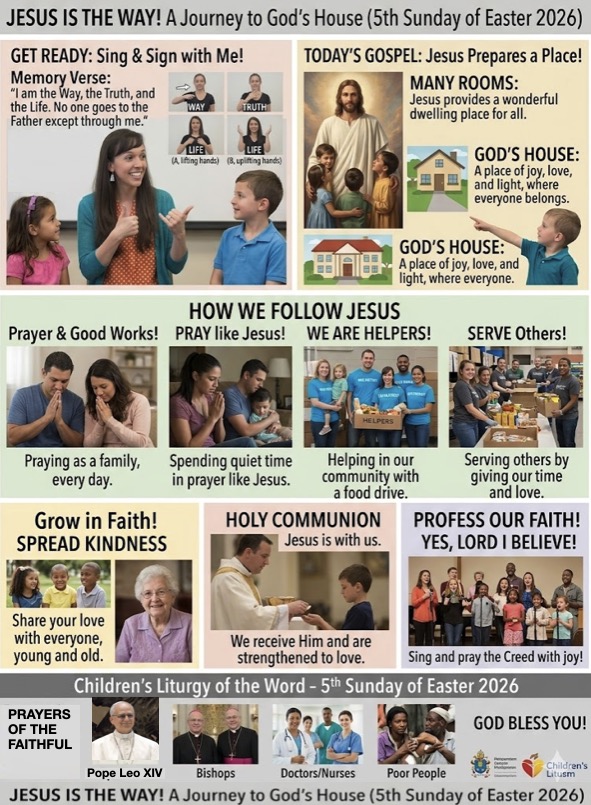
THE WORD THIS WEEK infographics are created using using GOOGLE’S AI Gemini 2.5 Pro. You are free to use the above infographic in any non-profit ministry. Please give credit to TheWordThisWeek.net and Heidi Witte – Kid’s Liturgy.
5-10-2020 / Children’s Liturgy of the Word / 5th Sunday of Easter (MOTHER’S DAY 2020)
IN 2026, Mother’s Day is NEXT WEEK on 6th Sunday of Easter MAY 10. 2026
Jesus’s Identity and Promise
Q: What does Jesus mean by “I am the way, the truth, and the life”? A: Jesus identifies himself as the path to God, the source of all truth, and the giver of life, inviting us to become his disciples and follow him (John 14:6).
Q: What specific promise does Jesus make about heaven? A: Jesus promises to prepare a place for each disciple in his Father’s house in heaven, then come back to take them to be with him forever (John 14:2-3).
Unity with the Father
Q: How does Jesus describe his relationship with God the Father? A: Jesus teaches that knowing him means knowing the Father, seeing him means seeing the Father, because he and the Father are one (John 14:7, 9).
Disciples’ Mission and Power
Q: What extraordinary capability does Jesus promise to believers? A: Jesus assures that those with faith in him will do the same works he does and even greater things as he goes to the Father, calling us to continue his mission of love and service (John 14:12).
Spiritual Nourishment and Practice
Q: What is the purpose of the Eucharist according to the teaching? A: The Eucharist (Holy Communion) is special food Jesus gives to nourish our souls and help us become more like him, requiring preparation with a pure heart and desire to grow closer to Jesus.
Practical Faith During Isolation
Q: How can we serve others when churches are closed? A: We can pray at home by watching Mass videos, setting aside family prayer time, praying for healthcare workers, and serve by sending letters and pictures to nursing home residents who are lonely and isolated.

↩️ ↪️ Bishop James Golka
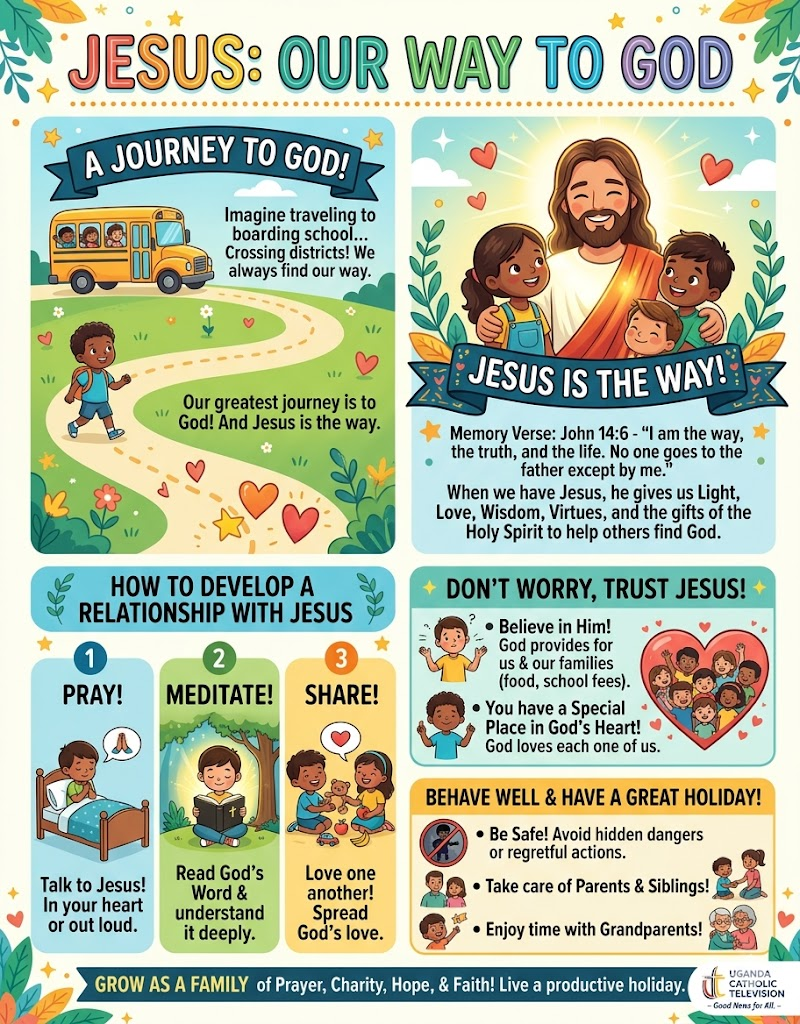
THE WORD THIS WEEK infographics are created using using GOOGLE’S AI Gemini 2.5 Pro. You are free to use the above infographic in any non-profit ministry. Please give credit to TheWordThisWeek.net and Uganda Catholic Television which contributed content.
CHILDREN’S LITURGY PROGRAM 07TH MAY 2023
Relationship with God
Q: What does Jesus promise about preparing a place for believers? A: Jesus assures in John 14:1-2 that in his Father’s house are many rooms, he goes to prepare a place for his disciples, and promises to return and take them to himself so they can be where he is.
Q: What is the only way to reach the Father according to Jesus? A: Jesus declares in John 14:6 “I am the way, the truth, and the life” and states that no one comes to the Father except through him, explaining that knowing him is knowing the Father because the Father dwells in him and does his works.
Practical Faith Development
Q: How can children develop a relationship with Jesus? A: Children are encouraged to pray, meditate on the Word of God, and share love with others to internalize Jesus’ teachings, feel his presence, and spread God’s love.
Trust and Provision
Q: What should children trust instead of worrying about material needs? A: Jesus tells children not to worry about needs like food or school fees but to believe and trust in his love, assuring that because the Father is in him, he will provide for them and all children in the world.
Q: What does God’s provision mean for each individual child? A: Children are reminded that each person has a special place in God’s heart and God has enough love and provision for everyone, so they should trust in God’s provision for themselves, their families, and all children.
Sharing and Abundance
Q: What is the “magic in sharing” that Jesus teaches? A: Jesus encourages children to keep trusting, loving one another, and sharing what they have, promising that when they share food with those in need, God repays them abundantly, providing even more than they can imagine.
↩️ ↪️ Know Before You Go


THE WORD THIS WEEK infographics are created using using GOOGLE’S AI Gemini 2.5 Pro. You are free to use the above infographic in any non-profit ministry. Please give credit to TheWordThisWeek.net and Edmonton Catholic Schools Division.
Little Liturgies: May 3rd, 2026 — 5th Sunday of Easter
Divine Revelation Through Jesus
- Jesus as the way, truth, and life reveals the Father so perfectly that knowing Jesus equals knowing the Father, making every encounter with Jesus an encounter with the Father himself through their complete unity.
- The Holy Spirit dwelling within believers enables them to manifest Jesus himself to others when acting with love, compassion, gentleness, care, justice, and mercy, making human actions vehicles of divine presence.
Empowerment and Promise
- Believers will accomplish greater works than Jesus performed because he returns to the Father, transferring divine power through faith and the Holy Spirit’s indwelling presence.
- Jesus promises to prepare a place in the Father’s house with many dwelling places and return to bring believers to himself for eternal togetherness.
Restoration and Relationship
- The liturgy provides structured moments to examine relationships with God, others, and ourselves, offering pathways to request mercy, healing, and peace when straying from love’s path.
- The Gospel of John emphasizes Jesus as the divine Son whose words and works perfectly reveal the Father through their profound love relationship.
↩️ ↪️ 1-Minute Homily


THE WORD THIS WEEK infographics are created using using GOOGLE’S AI Gemini 2.5 Pro. You are free to use the above infographic in any non-profit ministry.
Hail Mary Queen of May // Little Liturgies from The Mark 10 Mission
Following Jesus
Q: What does Jesus mean by “I am the way, the truth, and the life”? A: Following Jesus as the way to heaven requires three specific actions: loving everyone, doing the right thing, and praying daily, which leads to both heaven and happiness (John 14:6).
Q: What promise does Jesus make about heaven in John 14:1-3? A: Jesus comforts disciples by promising to prepare a place in his Father’s house (heaven) and return to take them to himself, symbolized by the Paschal candle representing “I will be with you always” (Matthew 28:20).
Month of Mary Devotion
Q: What is Mary’s role in helping believers follow Jesus? A: Mary, Mother of Jesus, functions as a helper and guide who, like a kind mother, guides believers to love Jesus more each day and helps them stay close to him.
Q: How should Catholics honor Mary during May, the Month of Mary? A: May devotion includes decorating Mary’s statue or picture with flowers, creating a Marian display at home or school, saying a Hail Mary each day, and singing Marian hymns like “Bring Flowers of the Rarest” which praises Mary as the loveliest rose of the air.
Liturgical Symbols
Q: What do the Paschal candle and white cloth symbolize during Easter season? A: The Paschal candle symbolizes Jesus’ promise of constant presence (Matthew 28:20), while the white cloth on the prayer table signifies the Easter season celebrating Jesus’ resurrection.
Q: What is the purpose of the Hail Mary prayer in Marian devotion? A: The Hail Mary prayer serves dual purposes: asking for Mary’s help in following Jesus and showing love for her as a spiritual mother.
↩️ ↪️ Priests for Life


THE WORD THIS WEEK infographics are created using using GOOGLE’S AI Gemini 2.5 Pro. You are free to use the above infographic in any non-profit ministry.
Children’s Message (5-7-23) – Big Al knows the way
Following Jesus’ Way
Q: What matters more than our location or next steps in life?
A: Doing things like Jesus did—being kind, forgiving, helpful, and loving—matters more than where we are or what we do next, as his way leads to happiness even when life is confusing and uncertain.


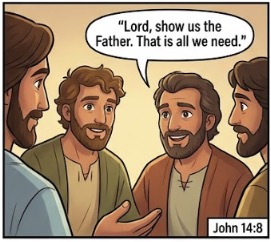

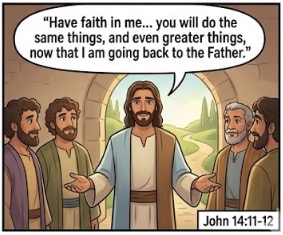
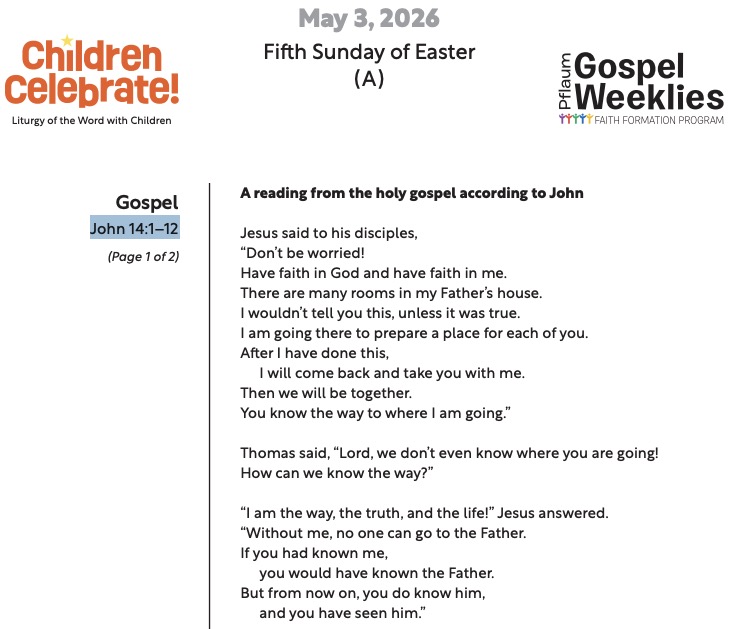

QUESTIONS
The Meaning of Deacon in the Catholic Church
- The video mentioned that the word “deacon” comes from a Greek word (diakonos). Do you remember what that word means? (Answer: Servant, minister, or even table waiter!)
- In the early Church, the Apostles were very busy praying and spreading the good news. Why did they appoint the very first seven deacons? (Answer: To help minister to and serve the people so the Apostles could focus on prayer.)
- Who were the early deacons especially focused on helping? (Answer: The poor and the widows.)
What Deacons Do Today
- Deacons are still very active in the Church today! Can you name two or three things a deacon helps with? (Answer: Helping at Mass, marriages, funerals, baptisms, and reading or preaching the Gospel.)
- The video says deacons have a “special calling.” Who are they specifically called to help through works of charity? (Answer: Those who are in the greatest need in the community.)
Steps of Service
- Before a man can become a priest, what role must he take on first? (Answer: He must become a deacon first.)
- What is the difference between a “permanent” deacon and a “transitory” deacon? (Answer: A permanent deacon might be a married man who stays a deacon forever. A transitory deacon is someone who is a deacon for a short time before becoming a priest.)
Putting It Into Action (Life Application)
- The most important job of a deacon is to be a “servant” to the community. You don’t have to be an ordained deacon to serve others! What is one way you can be a servant to your family or friends this week?
5th Sunday of Easter (A)

The Meaning of Deacon in the Catholic Church
The Religion Teacher
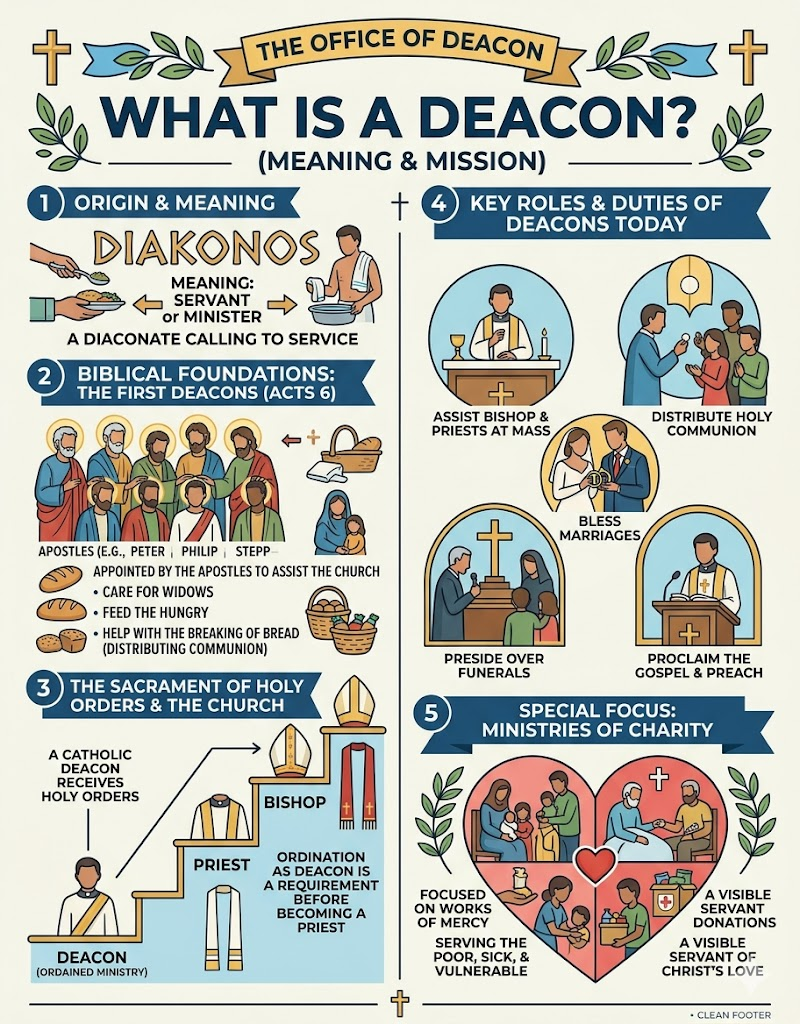
What does the term “deacon” mean and what do deacons do? The word deacon comes from the Greek word “diakonos,” which means “servant” or “minister.” The Apostles appointed the original seven deacons in the Book of Acts (Acts 6) to assist them in serving the Church. Originally, they were appointed to care for the widows of the community, feed the hungry, and help distributing communion in the breaking of the bread.
A deacon receives the Sacrament of Holy Orders in the Catholic Church. In fact, a priest must be ordained as a deacon before becoming a priest. Deacons assist the bishop and priests in the celebration of the Mass, distribution of communion, blessing marriages, presiding over funerals, and the proclamation and preaching about the Gospel. They also serve in a variety of ministries especially focused on charity.
Our Sunday Visitor

THE WORD THIS WEEK infographics are created using using GOOGLE’S AI Gemini 3 Pro. You are free to use the above infographic in any non profit ministry. Please give credit to TheWordThisWeek.NET and Our Sunday Visitor.
QUESTIONS
Opening Up
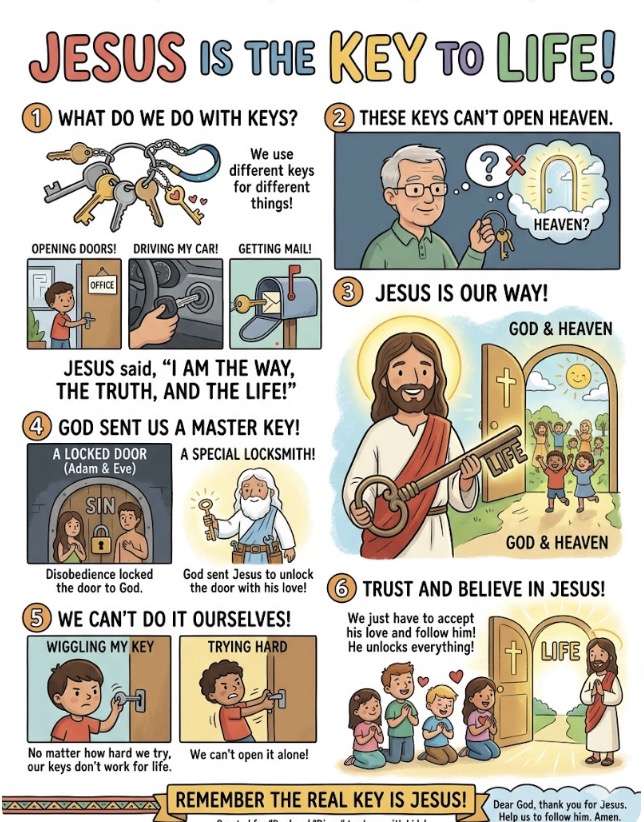
- Think about the keys your family uses. What are some of the most important things those keys open or start?
- If you tried to use your front door key to start your family’s car, what would happen? Why?
- Why can’t the keys we use here on Earth open up the door to Heaven?
Digging into the Story
- A long, long time ago, what happened with Adam and Eve that put a “lock” on the door to being close with God? (Answer: They disobeyed/sinned).
- The story called God a “pretty good locksmith.” Who did God send to be the special key to unlock that door?
- What do you think it means that Jesus is the “Master Key”?
Life Application
- The story says we can’t unlock the door to Heaven just by trying really hard or “wiggling our own key.” If we can’t do it ourselves, what do we need to do? (Answer: Trust, believe, and accept what Jesus did for us).
- Jesus said He is the “way, the truth, and the life.” How does knowing that Jesus has already unlocked the door for you make you feel?
- What is one way you can say “thank you” to God this week for sending Jesus to be our key?
5th Sunday of Easter (A)
Jesus is the Way
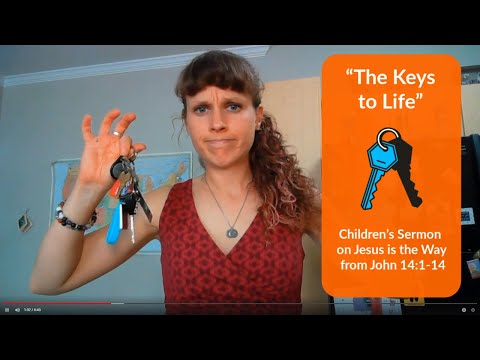
What does it mean that Jesus is “the way”? This message demonstrates to children the importance of Jesus being the most important thing in our lives. The object lesson utilizes a key to describe Christ’s power, emphasizing the key’s ability to let us into places, just as Jesus lets us into fellowship with God and eternal life.

QUESTIONS
Opening Up (Connecting to the physical world)
- Have you ever been lost in a store, a park, or somewhere else? How did it make you feel?
- Besides a paper map, what are some other things we use today to help us find our way when we travel?
Digging into the Story (Understanding the Gospel)
- In the story, Jesus told his disciples he was leaving to prepare a special place for them. How do you think the disciples felt hearing that?
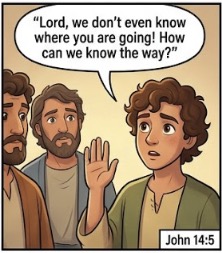
- Why was Thomas worried?
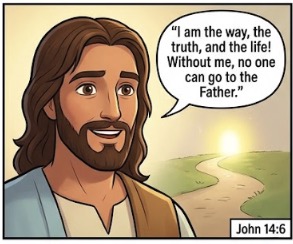
- Jesus didn’t hand Thomas a paper map to find Heaven. What did Jesus say was the way?
Life Application (Connecting the lesson to their lives)
- When we feel stuck or confused this week, how can we check “God’s Map” to figure out the right way to go?
- The story mentions that sometimes we can feel “lost inside” when we have a hard problem or a tough choice to make. Have you ever felt “lost inside” about a decision?
- If the Bible is “God’s Map,” what are some of the “directions” or rules you can think of that God wants us to follow? (e.g., loving others, sharing, telling the truth)

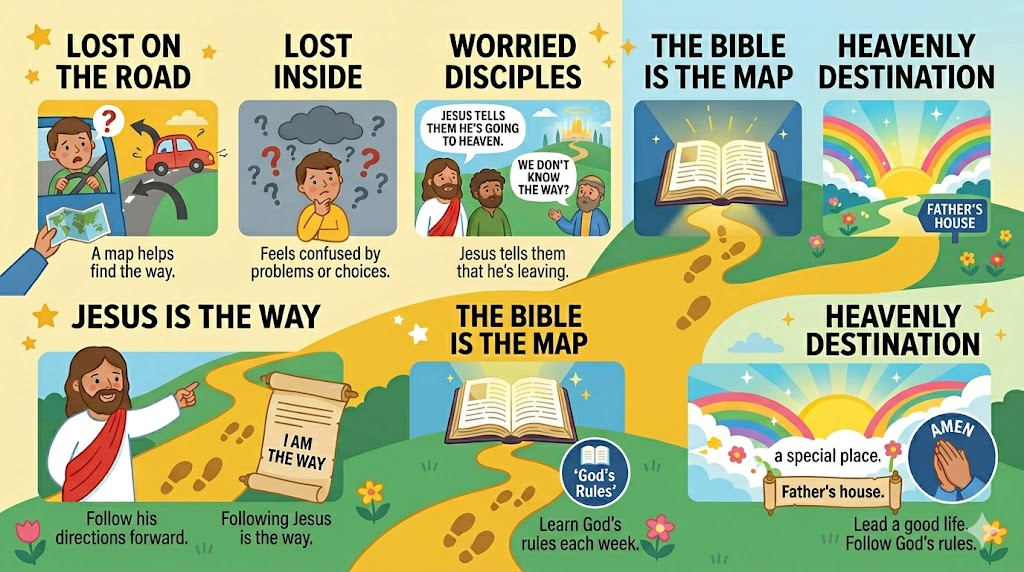
Image added by TWTW; not part of original source material
God’s Map
Not long ago I was driving to another part of the state and made a wrong turn. Before I knew it, I had no idea where I was.
Luckily I keep some maps – like this one – in my car. Maps show us roads and streets – and can help us get from one place to another, especially when we don’t know the way.
Sometimes we can feel lost in life. Even when we know where we are, we can be confused by problems we face or choices we need to make. Not knowing the right thing to do can make us feel lost inside.
In our Gospel reading today, Jesus is telling his disciples that it is time for him to leave and go to heaven. He tells them he is going to prepare a special place for them there.
SOURCE: Sermon Writer – © 1997 – 2026 Richard Niell
QUESTIONS
Talking About Our Feelings
- The story mentions a little girl who scrunches up her face and says, “I mad!” Can you show me what your face looks like when you are mad? What about when you are surprised or happy?
- What are some things that might make you feel sad or fearful?
- Why is it important to talk about how we are feeling instead of keeping it a secret?
Understanding Jesus’s Words
- Sometimes we get upset over little things that don’t really matter. Can you think of an example of a “little thing” that might ruin someone’s mood?
- When Jesus’s friends (the disciples) were feeling worried and upset, what did He tell them to do? (Hint: “Don’t let your heart be troubled…”)
- What do you think a “troubled heart” feels like? How is it different from a peaceful heart?
Trusting God’s Plan
- What is one choice you can make the next time you feel upset to help calm your heart and remember God’s love?
- The story reminds us that God cares for us and has a plan for our lives. How does knowing that God loves you help you when you feel scared or angry?
- If you see a friend or a brother/sister who is having a really tough day and feeling “troubled,” how could you use Jesus’s words to help comfort them?

Image added by TWTW; not part of original source material
Do Not Let Your Hearts be Troubled
I know a little girl who is two years old and when she gets upset she scrunches up her face and says, I mad! We all feel like that at times. It is good to recognize our feelings and think about why we feel as we do. You may realize that you feel happy, sad, angry, or fearful.
It is okay to feel angry if someone hurts you or someone you love. It is okay to feel sad when you have lost something or someone who is dear to you. We understand that when we don’t know what’s going to happen next (what to expect) we may feel fearful.
There are times, however, that we become upset over things that don’t matter. At those times it is helpful to stop and think about something that Jesus said to his disciples,
SOURCE: Sermon Writer – © 1997 – 2026 Richard Niell

5th Sunday of Easter (A)

DOWNLOAD PDF (High Resolution)

DOWNLOAD PDF (High Resolution)
THE WORD THIS WEEK infographics are created using using GOOGLE’S AI Gemini 3 Pro Nano Banana and images from Unsplash. You are free to use the above infographic in any non-profit ministry. Please give credit to TheWordThisWeek.net and the Word-Sunday.
Entrance Song
Core Biblical Foundation
Q: What Scripture anchors “The Best Way” worship song?
A: The song draws directly from John 14:6 where Jesus declares “I am the way, the truth, and the life,” transforming this foundational verse into a youth-focused worship anthem that emphasizes choosing God’s direction over personal preferences.
Musical Design & Target Audience
Q: What makes this song effective for youth ministry settings?
A: The track combines vibrant pop-rock energy with an easy-to-sing chorus and bold lyrics, specifically designed for youth worship nights, VBS (Vacation Bible School), church praise services, and family devotions to engage young believers through movement and memorable repetition.
Central Message & Application
Q: What practical decision does the song encourage listeners to make?
A: The repeated refrain “Not my way, but Your way. Because You have the best way!” teaches young believers to trust God’s direction over their own judgment, framing following Jesus as the best decision that brings love, joy, and freedom.
5th Sunday of Easter (A)

ST. JOSEPH’S CORNER (3:04) —See left sidebar for Questions
Response & Acclaim
Response & Acclaim

Communion
Identity and Purpose in Christ
Q: How does baptism and faith transform our spiritual identity?
A: Before knowing Jesus, we exist as purposeless rocks stuck in sin, lost and not belonging anywhere, but through baptism and faith God chooses us as His children, connecting us to Jesus the cornerstone and bringing us into His family where we gain both belonging and purpose.
Individual Significance in God’s Design
Q: Why is each believer essential to the Body of Christ?
A: Just as removing stone blocks causes the museum to crumble, each person in the Body of Christ has been chosen and formed by God for a specific purpose, making every individual necessary and important regardless of feelings of inadequacy or not belonging.
Living Out Our Calling
Q: What is our function as living stones in God’s family?
A: Each believer is needed in the Body of Christ to share the love of Jesus using their unique gifts and abilities, similar to how each stone block is required to construct the complete museum structure.