Homily Starters, Fr. Tony’s Homily
Homily Starters, Fr. Tony’s Homily
May 3, 2026



5th Sunday of Easter (A)
The Darkest Hour: Do Not be Troubled
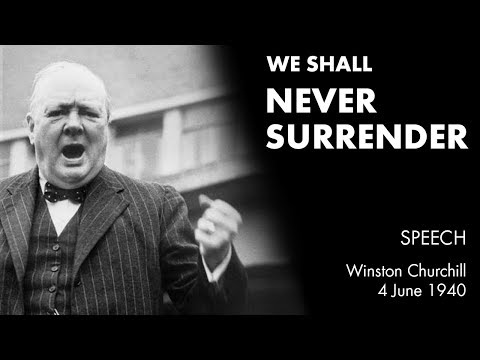
During the Second World War, specifically in the late spring of 1940, the United Kingdom faced an existential crisis. The British Expeditionary Force had suffered a demoralizing defeat at Dunkirk, narrowly escaping total annihilation only through a desperate maritime evacuation. With the Fall of France imminent and the threat of a Nazi invasion looming over the English Channel, the atmosphere in London was one of profound trepidation.
It was in this crucible of history that Prime Minister Winston Churchill delivered some of the most stirring oratory of all time. Addressing the House of Commons, he did not offer false platitudes; instead, he galvanized a weary nation by articulating a commitment to ultimate victory that transcended the immediate terror of the moment.
Churchill’s Clarion Call
Churchill understood that in times of catastrophe, the spirit of a people is their strongest defense. He famously declared:
“Victory at all costs, victory in spite of terror, victory however long and hard the road may be, for without victory there is no survival. We shall not flag or fail. We shall go on to the end. We shall fight in France, we shall fight on the seas, we shall fight in the air. We shall defend our island, whatever the cost may be. We shall never surrender.”
With these words, Churchill aroused the hearts of his people to remain undaunted. He transformed a military retreat into a psychological rallying cry, encouraging the British public not to lose faith, however fierce the fight became. He provided a vision of a future that justified the immense sacrifices of the present.
The Darkest Hour of the Soul
In today’s Gospel, we encounter a different kind of “Darkest Hour,” yet one that carries a similar weight of impending doom. The scene is the Last Supper. In spite of knowing that the worst is about to occur, Jesus does not respond with a call to physical arms, but with a command for spiritual steadfastness. He gives one of his own stirring speeches, beginning with a profound exhortation: “Do not let your hearts be troubled. Have faith in God and faith in me.”

5th Sunday of Easter (A)
The Magnitude of a Single Point of Failure
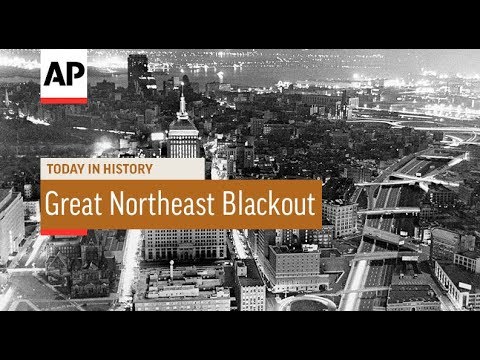
On November 26, 1965, Time Magazine had a story that can give us all food for thought. An electrical fuse about the size of a breadbox failed, resulting in 80,000 square miles along the US-Canadian border being plunged in darkness. All the electrical power for that entire region passed through that single fuse. Without that fuse no power could reach any point in that vast region.
Like that fuse box each of us has a tremendous potential for good or evil, which can affect a multitude. Jesus promises us believers all His power and even more. All we have to do is walk the way he walked and be Jesus to a waiting world!
This historical event, often referred to as the Great Northeast Blackout, serves as a profound metaphor for the individual’s role in the Kingdom of God. To expand on this narrative, we can look at the technical reality of that “breadbox” and the spiritual “voltage” we are called to carry.
On that November evening, a single backup relay at the Sir Adam Beck Station in Ontario was incorrectly set. This small device, no larger than a common household item, was responsible for monitoring the flow of power. When it tripped, it didn’t just stop the local current; it triggered a cascading failure. Within minutes, 30 million people from Ontario to New York City were left in a prehistoric silence.
The “breadbox” was small, but its position was strategic. It was the gatekeeper for a massive network of energy. This illustrates a sobering truth: our lives are rarely lived in isolation. We are “relays” in a spiritual grid. When we fail to love, when we choose bitterness, or when we shrink from our calling, the darkness doesn’t just affect us—it dims the light for everyone connected to us.
The Potential for Spiritual “Voltage”
The flip side of this metaphor is the staggering potential for good. Just as that fuse was the conduit for enough electricity to light up half a continent, Jesus promises that the believer is a conduit for the Holy Spirit.
In John 14:12, Jesus makes a radical claim:
“Very truly I tell you, whoever believes in me will do the works I have been doing, and they will do even greater things than these.”
This is the “power” the anecdote references. It is not a power of worldly status or force, but a power of impact. One person acting with virtuous love, offering radical forgiveness, or practicing quiet compassion can “jumpstart” the faith of an entire community.
Being “Jesus” to a Waiting World
To “be Jesus” is to be a fuse that stays intact under pressure. The world is often a “vast region” waiting in the dark for a sign of hope. We walk the way He walked by:
- Maintaining Connection: A fuse is useless if it isn’t connected to the power source. Our “work” is first to remain in Him through prayer.
- Marrying Prayer with Tangible Action: Power that stays in the wire is just potential; power that reaches the bulb is light. We must move from the “pew” to the “pavement,” serving those who are overlooked.
- Operating with Integrity: In the 1965 blackout, the system failed because of a miscalculation. In our lives, integrity ensures that the power of the Gospel isn’t “short-circuited” by our hypocrisy.
When we realize that we are the “breadboxes” through which Christ chooses to channel His grace, every small act of kindness takes on the weight of a continental miracle. We have the potential to light up the world, one soul at a time.
5th Sunday of Easter (A)
Many Rooms in My Father’s Mansion
When inserting this into your homily choose denominations you want to use and condense, as you see fit.
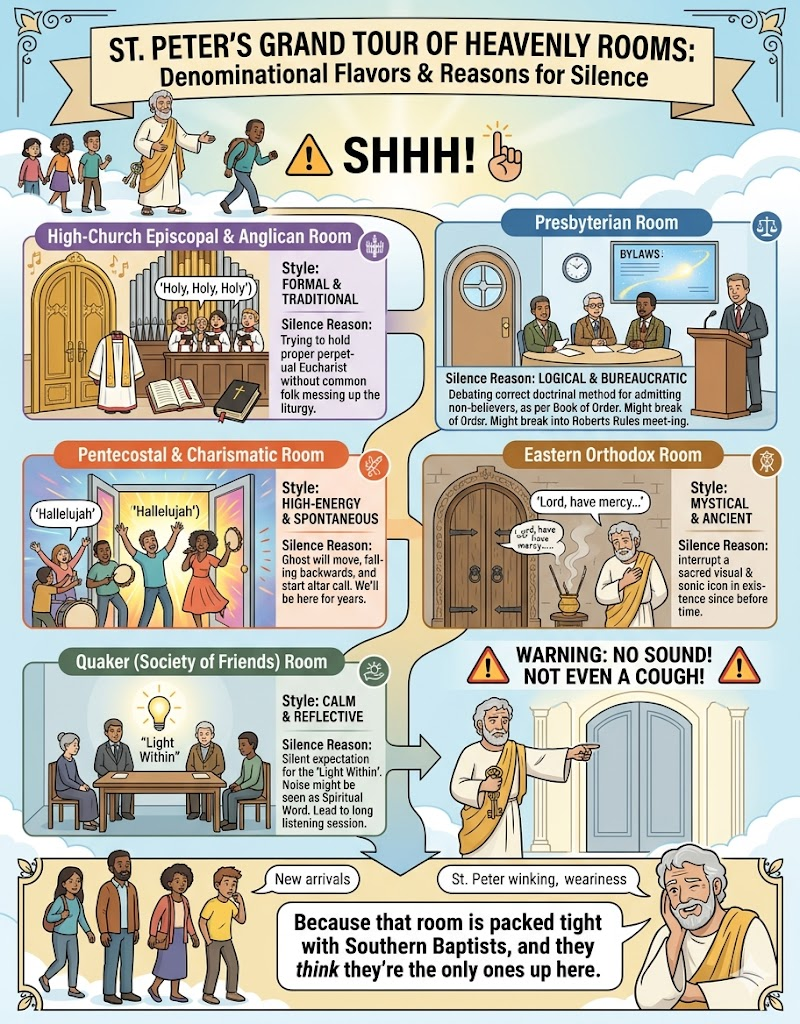
St. Peter was leading a new group of arrivals on their first Grand Tour of the Afterlife. Everyone was chattering with relief and joy, but as they rounded a corner, Peter suddenly stopped and put a cautionary finger to his mouth. “Shhh,” he whispered urgently. “From here on, we cannot make a sound. Total silence. Remember that.”
Puzzled, the new souls tipped-toed after him. They noticed several large, gilded doors along the hallway, each marked with small, discrete brass plaques. Peter was strictly keeping them to the opposite side of the corridor, moving them like a military covert operation.
They inched past a large, opulent door made of ancient, dark wood. Peter shot the group a meaningful glare, demanding absolute silence. Through the massive hinges, they could hear the distant, grand swell of a choir singing Holy, Holy, Holy in multi-part harmony, accompanied by the distinct, complex breathing of a very expensive pipe organ, but the sound was muted, and there was no noise of people moving or speaking. It was a place of formal, synchronized quiet. As they passed out of hearing range, one of the new arrivals whispered, “Who’s in there?” St. Peter replied, “That’s the High-Church Episcopal and Anglican Room. They believe we all should have arrived with perfectly ironed vestments and a Book of Common Prayer, and they are trying very hard to hold a very proper and dignified perpetual Eucharist without any of us common folk messing up the liturgy.”
A few feet further, they saw a door with a small, circular window. Inside, it was brightly lit and looked surprisingly like a very well-funded town council meeting. The occupants were dressed in tidy tweed jackets, sat in perfectly aligned rows of cushioned chairs, and everyone was looking with quiet intensity at a set of bylaws projected onto a celestial screen. A man was speaking with meticulous reason and order from a wooden podium, making a carefully structured point with three logical subsets. “The Presbyterian Room,” Peter explained with a quiet smile. “Total silence is necessary because they are currently debating the correct doctrinal and constitutional method for admitting non-believers, as per the established Book of Order. If they hear us, they’ll break into a twelve-hour, well-documented meeting with Robert’s Rules of Order and try to file a grievance against us for unauthorized noise. Their flavor is reasonable, decent, and above all, properly procedural.”
Around the next corner, a vibrant, warm light spilled from under a large door, and the air seemed to vibrate. Peter didn’t just motion for silence; he practically had to give them the universal “cut” sign. From within, they could hear a muffled, irrepressible rumble—a low hum of spontaneous vocalizations, shouts of ‘Hallelujah’ and ‘Praise Him!’, a building crescendo of a fast-paced praise band, and the distinct sound of a tambourine that just would not quit. They quickly scurried past, as a burst of glossolalia faintly pushed through the frame. St. Peter dabbed a bead of sweat from his brow. “The Pentecostal and Charismatic Room. Total silence because if they hear so much as a squeak of a shoe, the Holy Ghost will move, and someone will catch the Spirit and fall backwards, and there will be an altar call on the spot for everyone in this group, and we’ll be here for years. They are a high-energy, experiential-flavor crowd.”
He led them down a long, quiet wing where the architecture was grand and aged. They passed a large, ancient oak door with a profound, solemn hush around it. Through the thick wood, they could only hear the faint, repetitive, and deep tones of a low chant, ‘Lord, have mercy… Lord, have mercy…’, and the air was subtly perfumed with the scent of an aromatic, centuries-old incense. St. Peter put his hand on his heart and bowed slightly as they passed. “The Eastern Orthodox Room,” he whispered with reverence. “This is their Perpetual Divine Liturgy. They believe that their worship is heaven, and any noise we make, especially something as profane as a car key jingle, will interrupt a sacred visual and sonic icon that has been in existence since before time. Silence is required to respect the mystery and ancient tradition of their flavor.”
Further still, they saw a room that looked perfectly designed for deep, focused work. A long, beautiful wooden table ran down the middle, and about twelve people, of different ages and backgrounds, were sat in profound, reflective stillness, with no leader, no music, and no apparent activity. The only sound was the almost non-existent breathing of the individuals. “The Quaker (Society of Friends) Room,” Peter noted. “We must not make a sound. They are in silent expectation for the ‘Light Within’ to speak. If we make a noise, we risk being interpreted as the Spiritual Word that someone was supposed to share with the group, and that will lead to a very long, quiet, and meaningful time of communal listening that we simply cannot afford on this tour. Their flavor is deep, reflective silence and simple peace.”
Finally, Peter stopped the group a comfortable distance away from a last, imposing door that was shut tight. This time, he didn’t just ask for silence; he put an arm out, effectively blocking their path, and took a deep breath, preparing to deliver a serious warning. “This is the most critical stop,” he whispered, his eyes wide with gravity. “Absolutely NO sound. None. Not even a cough. Trust me, it’s not for them; it’s for us.”
They held their breath and slowly, silently crept past. Just as they cleared the door and stepped around a safety barrier, the same new arrival from before couldn’t stand it. “OK, Peter,” he asked, exasperated. “Why was that room so dangerous? It was dead quiet. Was it full of people who are still on spiritual probation or something?”
St. Peter sighed and a look of both weariness and amusement crossed his face. He leaned in and whispered, “Because that room is packed tight with Southern Baptists, and they think they’re the only ones up here.”